On this page
Yoga Vasistha · Story 2
Lila and Padma: Worlds Within the Pavilion
Lila asks that death never carry her husband beyond their palace. When the boon is tested, she finds a youthful king governing another realm inside the very space where Padma’s body lies under flowers. Her search leads through three forms of space, a forgotten village life, a second Queen Lila, and worlds whose histories unfold at radically different speeds.
The Discipline Hidden Inside a Marriage
Vasistha had been speaking in Dasharatha’s court for days, and the prince he spoke to had the look of a man who has seen through the kingdom he will inherit. The sage’s answer to that despair had been argument, patient and repeated: this visible world is no production at all; it has no foundation except in the Spirit it is a particle of; it is as empty as empty air, a city pictured in imagination. Then he changed his method. “Now listen to the story of the Temple,” he said. “It is a pleasure to hear, and it will press this truth deep into your mind.” Rama leaned forward. “Tell me all of it, then, if it will help me understand.”
There was once a prince named Padma, the lotus of his race, and like a lotus he opened in every direction at once: wisdom, prosperity, good children. He kept inside the bounds of duty and destroyed whoever crossed them, he was the refuge of the learned and the patron of learning, and he had one wife. In a world where a king’s household was measured in queens, that single marriage was a choice, and the court knew it. His consort was Lila, playful as her name promised, the goddess of prosperity walking on the ground. She was gentle and sweet-spoken, an exact picture of her lord in every respect except one: she was afraid to see him angry. Their days were a long game played in gardens and arbors, on swings and in boats, among hills and hermitages and the shrines of pilgrimage. They capped jokes and riddles, told stories, played chess and dice, sat over stanzas so difficult that the learned gave them up, played hide and find, danced the fierce tandava and the soft lasya, and kept the lute and the drum going into the night.
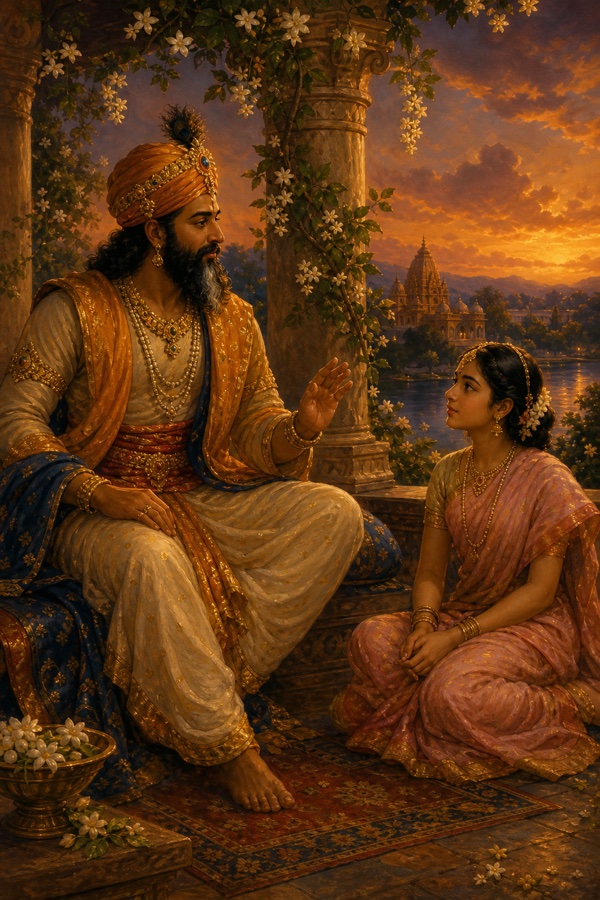
It was in the middle of that happiness that the thought came, and it came with a wistful heart. “He is young, he rules the earth, everything is going his way, and he is dearer to me than my own life,” she said to herself. “How is he going to escape old age and death?” She did what a queen can do with a question. She sent for the most knowing, the most austere and the most learned Brahmins in the realm, received them with the honors due to men who speak with the gods, and when they were seated and fed she asked them plainly how a man becomes immortal here on earth.
The answer was gentle and it was final. “Holy men can get almost anything by austerity, prayer and the rites. But nobody has ever become immortal down here, and nobody will.” Lila took the limit and worked inside it. If she died first, she reasoned, she would be at rest. If he died first, there was one thing she could still arrange: his soul must not leave this house. “Then his spirit will stay close, in the holy vault of the inner apartment,” she thought, “and I will have the comfort of moving in his presence every day.”
For that she would need a goddess, and the one she chose was Sarasvati, the goddess of Intelligence. She told her lord nothing. The practice ran in cycles of three nights: she fasted, and at the end of the third night she broke the fast with feasts and honors to the gods, to Brahmins, priests and holy people; every day there were ablutions, alms, austerities and meditation; and at the stated hours she was at Padma’s side as always, serving a husband who had no idea what his wife was doing for him.
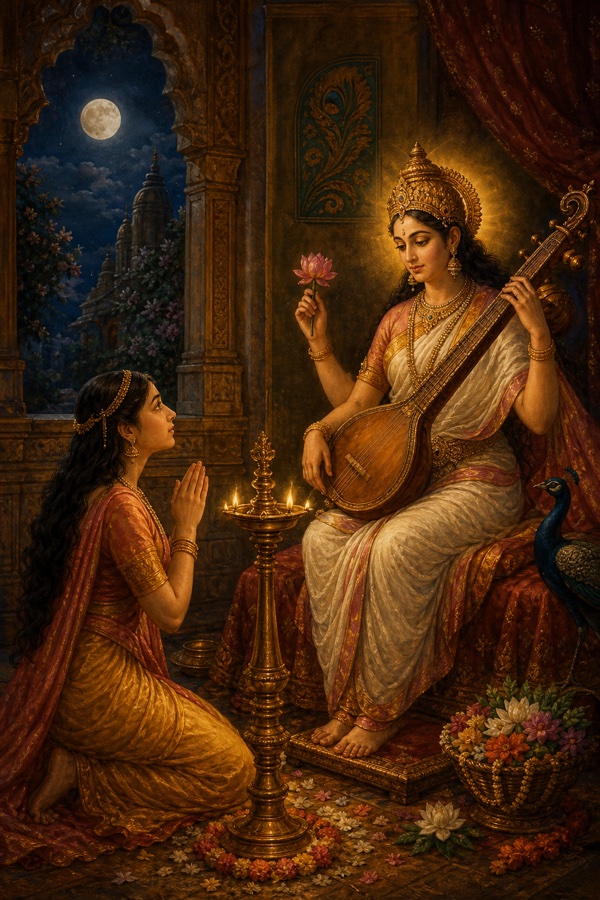
She completed a hundred of these three-night observances, and at the end of the hundredth Sarasvati came to her. “I am pleased with you, Lila. You have never stopped worshiping me, and you have never stopped serving your husband. Ask me for what you want.”
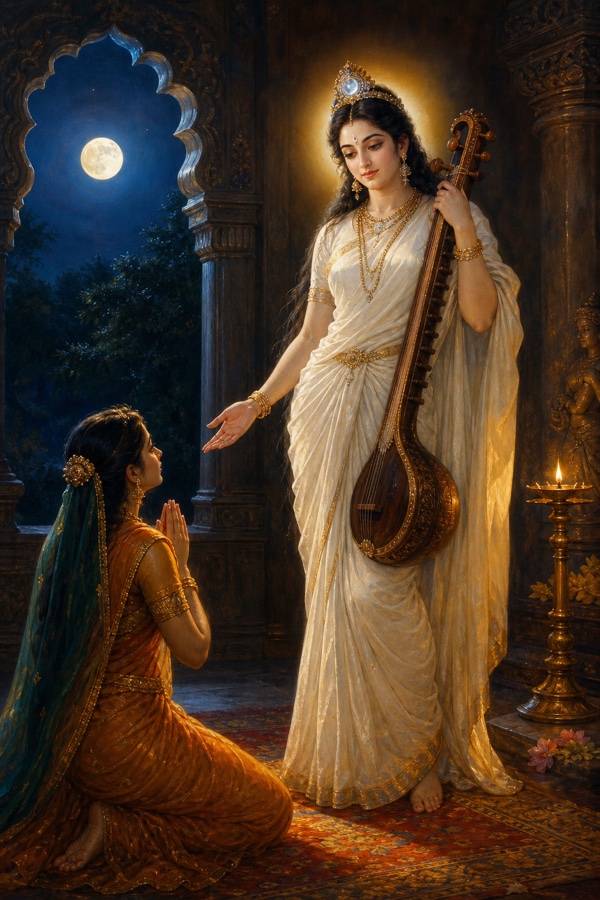
Lila praised her first, the moon-bright goddess who ends the pain of birth and death, and then she asked. “Have pity on me, and give me the two things I am begging for. The first: when my husband dies, let his soul never leave this shrine in the inner apartment. The second: whenever I call you, hear me, and come, so that I can see you and have your blessing.” “You have them,” said the goddess, and she was gone into the air she had come from, as a wave sinks back into the sea that raised it. Lila was as delighted as a doe that hears music.
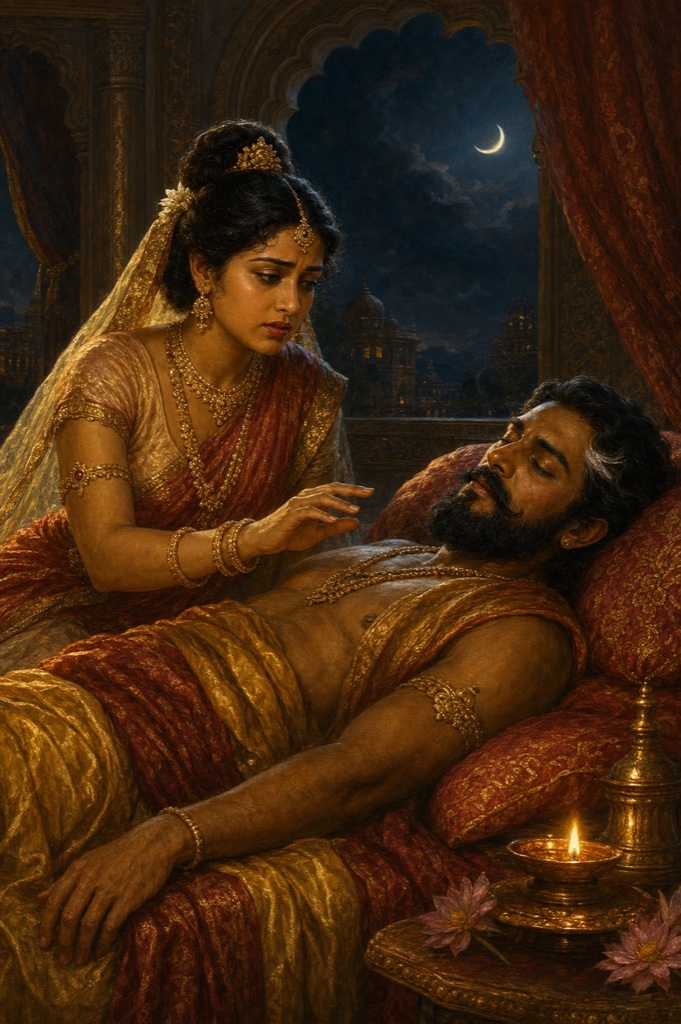
The wheel of time rolled on, fortnights for its half-circles, months for spokes, years for its orbit, and fleeting moments for the axle that kept it turning. Then the prince’s senses began to draw back from the world into the man inside the body, and in a short time he looked as dry as a withered leaf that has lost its gloss. He went inward, and did not come back. The body of the warlike prince was laid over the sepulchre inside the palace.
At the sight of it Lila began to fade like a lotus taken from its water. Her lips went pale with the hot, poisoned breath of sorrow; her eyes went dark, as a house goes dark when its lamp is put out; she grew thinner by the moment. She moved, and then stood mute as a statue, and then moved again. She was about to die of it, as the ruddy goose dies when its mate is taken.
Sarasvati, who had promised to hear her whenever she called, saw the size of the grief and took pity on it, the first shower of rain taking pity on the fish in a drying pond.
Three Spaces and a Ten-Year-Old King
A voice spoke in the room where nobody else was awake. “Move your husband’s body into the shrine over there, Lila, and cover it with those flowers, and you will have him back. As long as the flowers over it stay fresh, the body will not rot or fade, and he will come back to life before long. His living soul is as pure as air, and it will never leave this burial place in your inner apartment.”
Lila was cheered, the way a lotus bed lifts when the rains return. She placed the corpse in the shrine, hid it under flowers, and settled in to wait for it to rise, as a poor man nurses the hope of finding treasure. At midnight of that same day, when every member of the family had fallen asleep, she went back to the shrine and called on the goddess with all the sorrow in her. The voice answered. “Why are you calling me, Lila, and why is your face so sad? The world is full of errors, and they shine like false water in a mirage.” “Tell me where my husband is right now, Sarasvati, and what he is doing. Take me to him. I cannot carry my life without him.”
“His spirit is roaming the sky,” the goddess said, “and there are three skies. One is the firmament, the sky of the visible world. The second is the sky of the mind, where wishing and making happen. The third is the sky of the Intellect, and it holds the other two inside it. Your husband’s soul is in the sheath of the Intellect, and what does not exist here can be found there, if you look for it there. When you walk from one place to another there is a moment when you stand at a middle point that is neither; in the same way you will arrive in an instant at the middle region of the intellectual world. If you can stay there, with every wish of the mind set down, you will certainly come to know the spiritual Being who holds everything in himself. It is only by knowing that this world does not exist that you can know that he does, and you can do it now, by my grace, and by no other means.” With that the goddess went back to her heavenly seat, and Lila sat down gladly into steady meditation.
In a moment she quit the prison of her body, and her soul broke out of the inner bound of the mind to fly in the air like a bird freed from its cage. She rose into the airy region of the Intellect, and there, by its light, she saw her husband seated amid a group of princes and rulers of the earth. He was on a throne. The hall rang with “Long live the king” and “Victory to the king.” Sages sat at the eastern door, princes at the southern, young ladies at the western, and the horses and elephants stood at the northern. A guard was reporting war in the Deccan: the Karnatic had attacked the eastern frontier, Surat was subduing the northern tribes, Malwa was besieging Tonkan. Envoys stood waiting from Lanka and from the western sea. A kingdom at full stretch, in the middle of a working day.
The ardent Lila walked into that court unseen by any, as one void mixes with another void and air is lost in air. And what she saw was her own world. The same places, the same dealings, the same ministers as before; the same rulers of the earth and the very same Pandits; the identical courtiers and the selfsame servants. Then, on a sudden, wildfire spread on every side in broad midday light, the sun and the moon stood in the sky at once, and clouds roared with the whistling of winds. She saw trees, hills, rivers and cities full of people. And she saw her royal consort as a boy of ten years old, the frame of his old age shaken off, sitting in the midst of the hall with all his former retinue, and with all the inhabitants of his village.
Were these people living beings, or the ghosts of the souls they had been? She could not tell. When the trance lifted she was in the inner apartment, it was still midnight, and the inmates were bound fast in sleep. She raised her sleeping companions one by one and told them she wanted to visit the royal hall, to sit beside her lord’s throne and settle her doubt by seeing the courtiers all alive. The court was summoned and lit; she took the golden seat beside the throne, and the courtiers, roused in the small hours and puzzled, took the places she had just seen them in. Nothing was missing. “You are a great comfort to me,” she said, “and now I will go and comfort my own heart,” and gave the sign for the assembly to break.
Back in the inner apartment she sat by the body under its heap of flowers and spoke to herself. “What magic is this? These people of mine are arranged outside me exactly as I saw them seated inside me. A mirror shows the hills inside itself exactly as they stand outside it, and the mirror of the intellect does the same with the whole creation. I must ask the goddess of wisdom which of the two is the illusion and which is the sober, certain reality.” She worshiped and called, and the goddess was there at once, in the form of a young girl. Lila made her sit on the raised seat and sat on the ground before her.
“Clear this doubt for me,” she said, “for your wisdom framed this beautiful system of the universe and you know the truth of it. I saw the pattern of this world in the intellect, which is clearer than the sky and so wide that it holds millions and millions of miles in a small corner of itself. So the images of worlds are to be seen both inside the intellect and outside it, and I cannot tell the real ones from the unreal.” “Then tell me, Lila, what you call the real world, and what you mean by unreal.” “The real is what I find myself in now: sitting here, looking at you seated in this place. The unreal is the state I saw my husband in a while ago, out in that ethereal region, because empty space has no limit of time or place in it.”
“A real creation cannot produce an unreal figure,” the goddess said, “and a cause cannot produce an effect unlike itself.” Lila had an answer ready. “But we see it all the time. Earth and an earthen pot are the same substance, and one melts in water while the other carries water in it.” “Yes, when something is made with the help of other means, the effect differs a little from its first cause. Fire and the potter’s wheel stand between the clay and the pot. Now tell me: what caused your husband to be born on this earth?” Lila knew that answer; every Brahmin gave it. A man’s merit and his desires. “The same things caused his birth in the other world. And once the soul has left here, how can the earth follow him there, and what other means could there be?”
Lila tried once more. “I think it was his memory, growing on its own, that produced him again. It is certain that remembering sets objects in front of us.” “Memory is made of air, and what it produces is as thin as itself.” “Yes. I can see that remembering is an airy thing, and that the husband and everything else it set up inside me are empty shadows in the mind.” “So was the husband you saw in your reverie, and everything that appeared to you there. And so, Lila, is everything I see in this world.”
That sentence reached the room they were sitting in, and Lila asked the question it forced. “Then tell me, so that I can stop believing the world is real, how an unreal world produced the false appearance of my formless husband in front of me, when nothing unsubstantial can cast a shadow.” “This illusive world looked real to you before you remembered it. You will know that all of it is unreal from what I am about to tell you.” She began. There is a house of the world set in the Intellect, with Meru for its pillar and the fourteen regions for its rooms, and its creatures move through it like ants.
In a corner of that house there is a secluded vale, sheltered by hills on every side, and in it a Brahmin lives with his wife and children. He is free from disease, from the care of gain and from fear of any ruler. He keeps his fire, feeds his guests, and lives by his cows and his lands.
The House That Contained Padma’s Reign
“That Brahmin,” Sarasvati said, “is the equal of the sage Vasistha in age and dress, in learning and wealth, in everything he does, in everything except his profession.” The sage telling this to Rama was a priest to kings; the man in the vale was a householder, and his name was also Vasistha. His wife was Arundhati, and she matched her namesake, the sage’s own wife, in her virtues and gifts and in all things except her soul and her body.
One day the Brahmin was sitting under the sarala trees on the table land of his hill when the ruler of the country passed below, going to a hunt with his family and his troops. White fly-whisks, banners, umbrellas, elephants with howdahs on their backs, wild animals bolting ahead of the line. The Brahmin watched it all go by and said to himself, “How beautiful royalty is, with all that splendor and wealth. How could I become king of all ten directions and have a retinue like that, horses and elephants and foot soldiers, flags and whisks and blazing umbrellas? When will a breeze bring the scent of kunda flowers and lotus pollen into my bedchamber, to lull me and my wives to sleep?” From that day he gave himself, with care and without a break, to the rigid austerities of his religion, for the rest of his life.
The infirmities of age overtook him. His wife, fading with fear, worshiped Sarasvati for the boon of immortality, which is hard to have, and then, with the plainness of a woman who knows the odds, for the lesser thing. “Let my husband’s spirit never leave this burial place after he dies,” she said. “And I gave her what she asked,” the goddess said. The Brahmin died, and his spirit stayed in the empty space of that house; there, by his desire and his merit, it became a mighty man, the victorious monarch of the three realms. His body dissolved into its elements. His widow pined; her heart split in two like the dried pod of the simal tree; she died, and in her subtle form met his ghost. Their property still stands in the rocky village. “It is only eight days,” said Sarasvati, “since the souls of this loving pair were reunited in the hollow vault of their house.”
Then she said the thing the story had been built to say. “The Brahmin I told you became a king on earth is your husband, and his wife Arundhati is you.” Lila heard it as an insult to sense. “How can what you say be so far from the truth? You make us the same as that Brahmin couple, who are in their own house, while we are sitting here in our palace. And how could the small room where my husband’s body is lying hold those wide lands and hills and the ten directions of the sky that I saw in my trance?” Sarasvati’s answer went back to the thing the Brahmin’s soul had done. It had seen a kingdom inside a house, and his departed spirit saw it still. Lila had forgotten her former life the way the events of the day are forgotten inside a dream. The hills she saw in the house were the mind’s images, and they seemed real only because the intellect that held them was real; every atom of the intelligent soul holds worlds within worlds.
Lila counted on her fingers. “How can the Brahmin couple be us, when they died only eight days ago and we have been reigning here for years and years?” “In reality there is no limit of space or duration, no distance of place, no length of time. Here is the reason. The moment anyone feels the insensibility that follows his death, he forgets what he was and thinks himself another being. In an instant he takes an empty form in the womb of empty space, and inside that container he thinks, ‘This is my body.’ He remembers his birth, his parents, his age and his home, in their exact order. He enters a new body soon after his death, becomes a baby, finds a new father and mother, and begins to grow. When he wakes from that trance, like a fruit out of the cell of its flower, he finds that a single moment had seemed to him an age. King Harishchandra once lived twelve years in one night, and one day is as long as a year to anyone parted from what they love.”
She told Lila what that passage is made of. The dense sphere of the soul throws up figure after figure, and they seem to rise in it as things rise somewhere in the world, yet they neither rise nor stay in the soul itself, which is as transparent as empty air; they appear to the intellect as a vision appears in a dream, so that the reality of this world and the unreality of the other are alike to someone dreaming. Waves are made of water, and the waves themselves are as false as the horns of a hare, since the wind raised them. When the visible world drops out of sight at death, the soul turns over its memory of creation in the inner world of the mind: its birth, its parents, its age and its home, its learning and its pursuits in their exact order, its friends and its servants, the successes and failures of its attempts. “Who believes a man with a full stomach when he says he is starving, or a man who swears he witnessed what he never saw, or someone who says an empty room is full of people? Yet this visible world rests in the invisible spirit of God, as pungency rests in a peppercorn and painted pictures rest on a column. Where are the open, clear eyes to see it?”
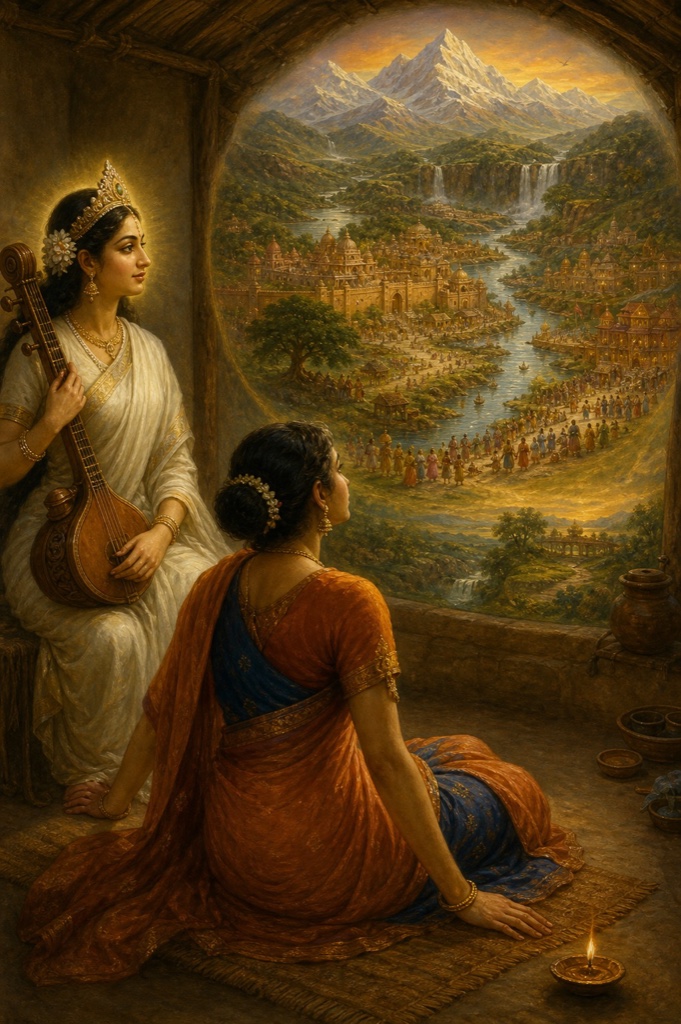
A kalpa and a moment, she went on, are impressions of slow thought and fast thought, and liberation is complete forgetfulness of the world. Lila wanted the chain to have a first link. If every birth is the memory of a former one, what caused the Brahmin couple, who remembered nothing before? Sarasvati took her back to the first-born. Brahma himself had no memory of a prior birth when he arose, and the Brahmin and his wife came into being the same way, with no past behind them.
Lila could follow it. She could not rest in it. “Please take me to the house where the Brahmin couple lived together, and show me that place in the mountains.”
“If you want to see that,” the goddess said, “you have to be spotless. Give up the sense of ‘mine’ and take up the clear sight that sees the Intellect inside the soul. Then you will find yourself in empty air, up in the sky, and we will see them and everything they own, with nothing in the way. Otherwise this body is a wall across spiritual sight.” “Then tell me why we cannot see the other world with these eyes, or go there in these bodies.” “Because you take the true future for false and the untrue present for true. Those worlds have no form, and they look to your eyes as if they had, the way you take gold for a ring.” Without yoga, she said, no one reaches God; the error that persists is what the fatalists call niyati and the mayavadis call maya. Lila turned the question on her guest. “I can go there with the purer part of myself, the sentient soul. But how will you go, who are pure intellect?” The goddess’s body, she answered, was made of will; and Lila’s own body, by leaning toward spirit, would become ativahika, as it is in sleep and in meditation. Lila asked what happens to the spiritual body once constant practice has made it compact: does it last, or does it perish like every other finite thing? “Anything that exists is perishable,” the goddess said, “but how can a thing die which is nothing, and imperishable by its nature? When the mistake of the snake in the rope is removed, the snake vanishes by itself, and all imagery ends when there is no image at all, as the sculptor’s art must end for want of stone.” And how, Lila asked, had they fallen into the error of seeing two where there is one? “Want of reason led you into it, and when reason takes its place it brings the light of knowledge into the soul in a moment. From this day you are awake to your welfare and your liberation, and the seed of the great desire is sown in your heart. Withdraw your mind from the seer, the seen and the seeing of this world, settle it in the complete negation of all existence, and sit in unalterable stillness. Once the seed of inappetency has taken root, the sprouts of your likes and dislikes will die of themselves, and in time you will have a soul as luminous as a star in a clear sky, freed forever from the chain of causes and their consequences.”
The goddess went on to the abandonment of desires. Things seen in a dream prove false on waking, once we know them for the fumes of fancy, and in the same way the belief in the reality of the body comes apart when our desires dissolve; as the body wakes after dreaming and desiring, so the spiritual body wakes when we stop thinking of our bodily states. The desire of the living liberated is hardly a desire at all, since it is the pure wish for the welfare of everyone. The sleep in which will and wish lie dormant is deep sleep, sushupti; the dormancy of desire in the waking state is stupor, moha; and sleep wholly without desire is turya, the fourth state of yoga, which in waking is called samadhi, union with the Supreme. “When the mind becomes a pure essence and its desires weaken, it becomes spiritual, ativahika, and then it glows and flows as snow melts to water under heat. Until the moon of your knowledge shines out full, you will have to leave this body here to see the other world; this body of flesh can have no tangible connection with one that has no flesh. It is people’s habitual reliance on their gross bodies that binds their souls and brings them back to earth. No one believes he has a spiritual body even on his deathbed, yet this body neither dies nor lives at any time, for life and death are resemblances, as false as the appearance and disappearance of puppets in a show.” Lila said this knowledge was a healing balm on the pain the phenomenal world had caused her, and asked the name and nature of the practice that serves the spirit. “Whatever a man attempts, he hardly ever completes it without painful practice to the utmost of his power. The wise say practice consists in conferring about the same thing again and again, in understanding it thoroughly, and in devoting oneself solely to one’s object. The strong tendency of the soul toward the spirit of God, which comes from knowing the nothingness of visible things and from the subsidence of the passions, is the effect of yoga. Mere knowledge that the world does not exist, without the subduing of the passions, is knowledge without practice, and does its owner no good. The habit of mind that is conscious of the nonexistence of the visible world is the practice of yoga, and it leads to the final extinction, nirvana.” As the sage spoke, the day went to its evening service and led the assembled train to their ablutions, and they met again with their greetings when the sun had scattered the dark.
That same night, with the inmates asleep in the inner apartment, the two of them entered the charnel house, shut on every side by latches on its doors and windows and perfumed by heaps of flowers, and sat beside the corpse. Then they stood motionless on the spot, like sculptures carved on marble columns. They shook off every thought and care and closed like lotus blossoms at the end of the day; they were absorbed in the thought of the absolute absence of everything, and lost even the memory of the phantom of the world. Then they rose one span above the ground. Then they mounted the sky as two forms of intellect and came to a region millions of leagues in length, and seeing no other figure in it, grew more attached to each other than before. Hand in hand they went higher and higher, viewing the heavens as they went. They dived into a vast ocean of emptiness, deep and translucent, soft with an ethereal mildness and a cool breeze, and its purity gave them a delight greater than the company of the virtuous. They wandered under the beams of the full moon and halted under the clear vault of the clouds that cover the tops of Meru, as if under the dome of a huge whitewashed building; they roved by the regions of the Siddhas and Gandharvas, breathing the fragrance of mandara garlands, passed the lunar sphere with its scent of nectar, bathed in the lakes of showering clouds with the blushing lotuses of lightning flashing inside them, and alighted like fluttering bees on the tops of high mountains, which looked like filaments of the lotus-shaped earth below. They saw what they had never seen: a depth of emptiness that the myriads of worlds revolving in it did not fill. Huge mountainous bodies like Meru moved about in space and gave off a ruddy glare, like a flame from their bowels; there were tablelands with pearly peaks of snow, mountains of gold and of emerald, tracts of blue sapphire with parijata creepers blooming like banners. The Siddhas flew past, their minds outstripping the winds; half-burnt Siddhas fled from their burning chariots, having come too near the sun. Kushmandas, Rakshasas and Pisachas sat in aerial circles at the borders; Dakinis heaved their heads like surges in the cloudy ocean of the sky; Yoginis with the faces of dogs, ravens, asses and camels crossed the wide heavens to no purpose. They saw the path of the planets resounding with the music of the spheres, the sons of the gods gazing at the heavenly Ganga studded with stars, the gods wielding their thunderbolts and discuses, and Narada and Tumburu singing in their aerial abodes. The Matris danced naked in their giddy circles in one place, and circles of holy men sat in calm meditation in another; there were the cities of Brahma and Rudra full of their people, and the city of illusion, Maya, with its ever-growing population; the sun rising in one part and the darkness of night veiling another; Kartikeya’s peacocks dancing among the clouds; gigantic Bhairavas dancing with their mountainous bodies; the castles of the Gandharvas rising and falling with the celestial nymphs inside them; a furious battle between the gods and the demons in the clouds; the moon eclipsed by the shadow of the earth, and the sun by the shadow of the moon. And they saw all the beings of the three worlds flying in the air like a swarm of gnats in the hollow of a fig tree. Then the two of them stopped, intent on revisiting the earth.
They came down in their forms of intelligence and saw the world lying like a lotus held in the breast of the first male, Brahma: its eight sides the petals of the flower, the hills its pistils, the rivers the tubes of its filaments with drops of snow for dust, the days and nights rolling over it like swarms of black bees and butterflies, and all its living creatures like gnats fluttering about it. The earth-lotus floats on the waters of the ocean, which shake it at times and cause the earthquake; the serpent Vasuki serves for its understalk, and demons girdle it like thorns. Jambudwipa sits in one petal, a thousand yojanas square, with the great Sumeru at its center reaching to the sky and nine varshas ruled by nine brother kings, Bharata-varsha in the midst. The briny ocean, twice the size of the continent, girds it as a bracelet encircles a wrist; beyond lies the round Shaka continent and the milky ocean, then Kushadwipa and the sea of curds, then Krauncha and the sea of butter, then Shalmali and the foul sea of wine, then Plaksha and the sea of sugar, then Pushkara and an ocean of sweet water, each ring double the one before. From there they saw the descent to the infernal regions, where the south polar circle lies with its hideous cave below, hemmed in by the dreadful vacuum; the Lokaloka, the south polar mountain, bright with sunshine on one side and dark on the other, with the everlasting snows clapped like a cap of hair on its head; a great forest untrodden by any living foot; the great northern ocean around the pole; the flaming light of the aurora, which threatened to melt the snowy mountain to water; the fierce north winds, threatening to blow the mountains away like dust or grass; and far beyond them the empty space of vacuum stretching wide on every side, encompassing the worlds as a golden circlet encompasses a wrist.
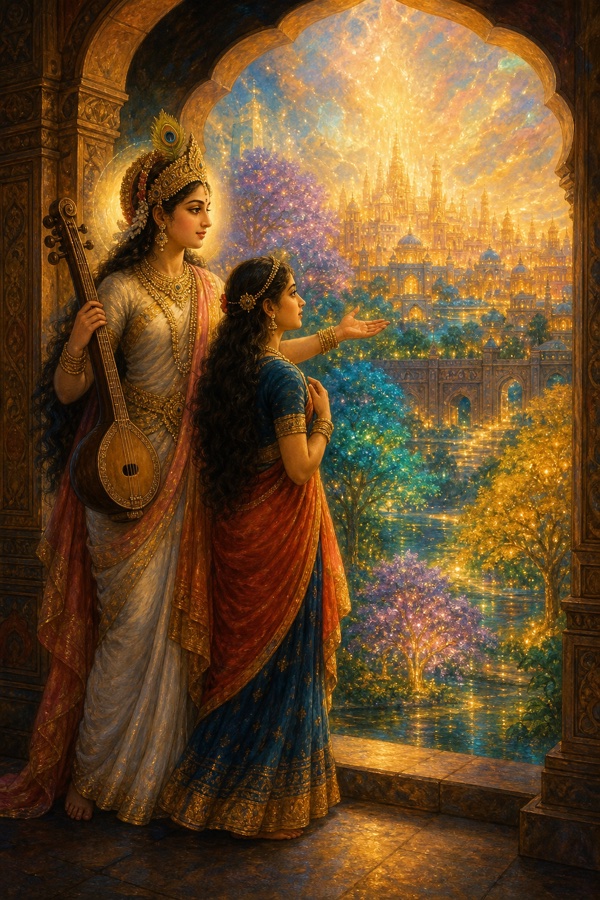
Then Lila returned on a sudden to her own land and found herself in her closet again, beside the flowers, with the goddess, and with the night not yet over. The house where eight days of grief had passed was the next place to go.
A Son Meets His Former Mother
They entered the Brahmin’s house unseen, and the first thing they found in it was his tomb. The servants and the women were in tears; there was no joy anywhere in the rooms. Lila wished that the inmates should see the two of them in the ordinary forms of human beings, and the household looked up and saw Lakshmi and Gauri standing together in their doorway, radiant.
The whole family cried out at once, with Jyeshtha Sarma, the eldest boy of the dead Brahmin, loudest among them: “We bow to the goddesses of the forest!” They threw handfuls of flowers at the visitors’ feet, where they lay like dewdrops on lotus leaves in a lake. “Victory to the goddesses who have come to take away our sorrow,” Jyeshtha Sarma said. “It is in the nature of good people to rescue others from their distress.” The goddesses asked him gently what had made them all so sad, and one by one the family told them. “A Brahmin and his wife lived here, and this house was a refuge for guests and a pillar of the Brahmin order. They were our parents. They have just left this house, and they have left us behind with all their friends and their animals, and gone to heaven, and we are helpless here.” The whole valley had taken the loss: the mountains howled in their caverns and wept in their streams, the streets were empty, and some of the villagers were fasting to die. “Take this grief from us. A visit from the great is never for nothing.”
Lila reached out and gently touched the head of her son with her hand, as a lotus bed leans to touch its offshoot by the stalk. At the touch the boy was relieved of all his sorrow and misfortune, the way the summer heat of a mountain is allayed by the first showers of the rains, and everyone else in the house felt what a pauper feels when his poverty is lifted.
Rama stopped the story. “Clear this up for me. Why did Lila not appear in her own shape to her eldest son, Jyeshtha Sarma?” “You are forgetting, Rama, when you think Lila had a material body, or could take one whenever she liked. She was in her form of pure intellect, the lingadeha, and it was with her spiritual hand that she touched the boy’s inner spirit, and not his body.” Whoever believes himself to be made of his earthly body is confined in it, the sage went on; whoever knows his spirituality is as free as air. Everyone is what he thinks himself to be by habit. Lila, who saw only Brahma, had no room left in her for a son or a friend or a consort. The touch was for his edification in intellectual knowledge.
The two vanished. “The goddesses of the forest have been very good to us,” the family said, and went back to the work of the house. Standing above it in the air, Sarasvati and the aerial Lila talked like two people dreaming the same dream. “Tell me why my son could see me,” Lila said, “when nobody could, where my husband’s spirit is reigning over his realm.” “Because your yoga was not finished then, and your wish could not be granted; and you had not yet lost your sense of duality, which stands in the way of perfection. You had not practiced forgetting that you were Lila, and you had not learned that it is God’s will that is always done. Since then your desire has become pure. You wished your son to see you, and he saw you. If you go back to your husband now and do the same, you will succeed.”
Lila looked inward and saw, within her own mind, the Brahmin and his death, his kingship, the city and the palace, and his death again. “Put me beside him,” she said. “Tell me which husband you want to go to, Lila,” the goddess said. “You have had hundreds of them in your past lives and you will have hundreds more, and right now there are three of them on this earth. The nearest is the Brahmin, who is ashes here. The next is the prince lying in state under the flowers in the inner apartment. The third is a reigning prince on this earth at this moment, tossed about on the waves of error in the great ocean of the world. His intelligence has gone stupid, and he has become a tortoise in that ocean. Managing his many disordered affairs of state has dulled him; he is fast asleep in the middle of his business, chained to the thoughts that he is a lord, that he is mighty and accomplished, that he is happy and will enjoy his estates forever. So tell me which husband you want to be carried to, like the scent of one forest carried by the breeze to another.”
“So it is,” Lila said. “I remember now that this birth of mine is of the rajasika kind, neither too pure nor too dark. Since I came down from Brahma I have had a hundred and eight births in different shapes, and after all those states I find I still exist.” She began to count them. She had been the bride of a Vidyadhara in another world, roaming as freely as a bee over flowers; for her wantonness she had been born in this mortal world as the mate of the king of the birds, an eagle; then a woodman’s mate with a skirt of leaves; then the guluncha plant in a holy hermitage; then, after a wildfire took the woods, a hermit’s child, who was initiated into the rites for removing the curse of womanhood and became a male, the handsome prince of Surashtra, reigning for a hundred years. For misrule in that government she became a weasel covered with leprosy in the lowlands of Tali. She was a bullock at Surat, goaded by thoughtless cowherd boys in their sport for eight full years. She was a bird that broke a fowler’s net; a bee asleep in the cups of lotus flowers; an antelope, until a huntsman’s dart found her; a fish; a Chandala huntsman by the Charmanvati; a stork; an Apsara as bright as melted gold; a tortoise on the banks of a river; a goose; the companion of a poor gnat on a salmali leaf, and as contemptible a thing as the gnat; a crane; a girl who scorned the Vidyadhara boys on the Gandhamadana and Mandara hills; and a lovesick girl pining on a bed strewn with camphor, wasting like the waning moon. “I have passed through many births in the wombs of higher and lower animals,” she said, “and found them all full of pain.”
Rama asked how the two goddesses had broken out of their bodies to cross such spaces, and Vasistha told him where the world was: inside the minds of the goddesses, the hilly tract and the deserted house and the prince’s city all pictured there, mere vision and void. The two of them walked out of the house. Unseen by the villagers they went through the mountain hamlet, past the waterfalls and the cattle, a hungry beggar woman, mendicant boys smeared with curd and cow dung, flies on the milk while children cried for food. Then they alighted in the village itself, and Lila became a seer of the three times, and her past life came back to her whole. “By your grace, and by the sight of this place, I remember everything I did and thought in my past life. I grew old here, and withered here, until I was as thin as a skeleton. I was a Brahmin’s wife here, and the dry kusa grass I had to handle scratched my body. I milked the cows and churned the curd; I was the mother of many sons and a kind hostess to my guests. I cooked the food every day with one glass bracelet and one conch bracelet on my wrists, and I fed my father, my mother, my brother, my daughters and my sons-in-law. I worked day and night, and ‘hurry, hurry’ were the words I kept saying to myself. I was so busy that I never once wondered, even in a dream, what I was and what this world was, though I was the wife of a Brahmin. I picked the worms out of the ears of the milk cow, and painted the doorway with rice paste. And with my ears shaking like dry leaves and a stick to lean on, I lived here in dread of old age.” She walked the goddess through it. “This is the bank of the pond where the calves were tied, and this is my pet calf Karnika, who has stopped browsing the leaves since I went. This is my watering woman, so tired and dirty now, crying these eight days for me. This is my eldest son Jyeshtha Sarma, crying in the house. These windows and this portico, still smeared with the dry powder of Holi. These gourds, which I planted with my own hands, spreading over the oven.” And then she came to it. “My husband lived here. His life flew into the sky in its airy form and then became lord of the earth to the surrounding seas. I remember how he nursed that wish for royalty. I see his eight days of kingship, which seemed before to have lasted so long, eighty years of it. I see my lord’s soul living in the empty space of this house, invisible to everyone, like a current of air in the sky; his soul is held in this empty space in the form of a thumb, and in its bosom it holds the whole extent of his realm, thousands of leagues around.”
“Now I want to see my lord’s earthly city again,” she said. “Let us turn that way. No place is far for the resolute.” She bowed to the goddess, entered the shrine, and flew into the air with her like a bird. They passed above the clouds and the winds and beyond the orbits of the sun and the moon, beyond the pole star and the circuits of the Sadhyas and the Siddhas, up to the heavens of Brahma and the Tushita divinities, to Goloka, to Shivaloka, and to the sphere of the Pitris, the departed souls of the dead; and when the ethereal sphere was behind them they saw nothing there except the sun, the moon and the stars shining far below, and a deep darkness filling the whole vacuity, as compact as the cavity of a rock. “What became of the light of the sun and the other luminaries,” Lila asked, “and where does this darkness come from, so dense that a fist could close on it?” “You have come to a spot so remote from the spheres of heaven that their light can never reach it. As a man in a deep pit sees nothing of a firefly flitting over its mouth, so the light of the sun is invisible to anyone behind the great belt of heaven.” “How far we have come, that the sun shows no bigger than an atom below us. Tell me, mother, what lies beyond this region.” “Behind it is the great pole of the universe, scattered with innumerable nebular stars like particles of dust.” As they talked they glided to that pole, as a bee saunters over a solitary hut on the height of a mountain, and saw the system of the universe laid naked to their sight, as a bold navigator beholds a world exposed beyond the wide waters: water ten times greater than the earth, wrapping it like the shell of a walnut; a latent heat ten times as great as the water; the circumambient air, as much greater again; and then the all-encompassing vacuum, with no beginning, middle or end, productive of nothing, like a barren woman of offspring, an extended expanse seated in the Supreme spirit, so immense that a stone flung from its top with full force, or the phoenix flying across it at full speed, could not reach from one end to the other in a whole kalpa.
In a moment they passed beyond the regions of earth, air, fire, water and vacuum and the tracks of the ten planetary spheres, and reached the boundless space from which the universe appeared as an egg. Under its vault they saw millions of luminous particles floating like innumerable bubbles on the waters of the ocean of the Intellect, some going downward and others rising, some turning round and others seeming to stay fixed, and these motions appeared to them only by their own situations. Here there were no ups and downs, no going forward or backward, none of the directions that people take from the position of their bodies; there is but one indefinite space in nature, as there is but one consciousness in all beings. Rama asked why, then, we speak of upward and downward if there are no such things in space. “There is one space enveloping all things,” Vasistha said, “and the worlds in the womb of vacuity are like worms moving on the surface of water. When a number of ants sit on an earthen ball, all the sides under their feet are reckoned below, and those over their backs above. Such is this ball of the earth in one of these worlds, covered with cities and mountains and their inhabitants as a walnut is covered by its coat; as elephants look like pygmies in the Vindhya mountains, these worlds look like particles in the vast expanse of space. Some are hollow within and others as dark as the darkness at the end of a kalpa; some whirl about with a jarring noise that no one hears; some are growing in form like sprouts in the cells of newly sown seeds; some are melting away like icicles under heat; others keep falling without ever reaching ground, until they dwindle and melt into the divine Intellect. Nothing is stable in nature. There are other Brahmas and other patriarchs, many Vishnus and many Indras one after the other; different kings of men, and sometimes no ruler at all. The world is filled with creatures beyond the conception of yogis, and the great vacuum beyond it is so extensive that Vishnu and the other gods could not measure it in the whole of their lives. Every one of these ethereal globes is encircled by a belt like a golden bracelet, and has an attractive power like the earth’s to draw other objects to it. I have told you all I know of the grandeur of the universe, and of anything beyond this I have no knowledge and no power to describe.” The two travelers turned back toward the earth, toward the city of the third husband, who was asleep in his affairs and in the middle of a war.
The Battle Seen from the Sky
Having seen so many worlds on their aerial journey, the two women came down from there and quickly entered the inner apartment of the king. They saw his dead body lying in state among heaps of flowers, and the spiritual body of Lila sitting beside the corpse. It was the dead of night; the people of the house had fallen asleep one by one, and the room was perfumed with the incense of resin, camphor, sandalwood and saffron. Seeing the house of her later husband and wishing to enter it, Lila alighted in the body of her will on the spot of his burial. Breaking out of the confines of her body and her skull, which the yoga books call the earthly and worldly envelopes, she passed through the fictitious spacious palace of her lord and went again with the goddess into the bright and spacious pavilion of the world. She saw her husband’s imaginary world lying like a dirty, mossy pool, as a lioness beholds a mountain cave covered in darkness and cloud, and the two goddesses entered that vacuous world with their airy bodies, as weak ants make their passage through the hard crust of the wood-apple. They passed through regions of cloudy hills and skies and reached the surface of the earth, came to Jambudwipa, set amid the ninefold petals of the other continents, and went on to the land of Bharata and the territories of Lila’s husband.
At that very time they saw a certain prince, the ruler of Sindhu, strengthened by other chiefs, making an attack on this part of the earth which was the beauty of the world. The air was crowded with people of the three worlds who had gathered to watch the conflict, aerial beings in groups like clouds: Siddhas, Charanas, Gandharvas, Vidyadharas, Suras and apsaras in large bodies; the goblins, Bhutas and Pisachas, and Rakshasa cannibals too; and the Vidyadhara women were flinging handfuls of flowers on the combatants like showers of rain. The Vetalas, Yakshas and Kushmandas, who were watching the affray with pleasure, took shelter behind the hills to avoid the flying darts and weapons, and the spectators were worked up by the war whoops of the fighters. Lila, standing by with a fan in her hand, was frightened at the dreadful conflict about to begin, and smiled to scorn at the boasts the two sides flung at each other.
Virtuous people who could not endure the horrid sight betook themselves to prayers, with the chief priests, to avert the calamity. The messengers of Indra were ready with their decorated elephants to bear the souls of mighty heroes to grace the seats of heaven. The Charanas and Gandharvas were singing the praises of the advancing heroes, and the heavenly nymphs who like heroism were glancing at the best of the combatants.
Rama asked: “Tell me what sort of warrior is called a hero, who becomes a jewel in heaven, and who is called an insurgent.”
Vasistha answered: “He who engages in a lawful war and fights for his king, whether he dies or wins the field, is called a hero and goes to heaven. Whoever kills men otherwise in war, in an unjust cause, and dies afterward, is called an insurgent and goes to hell at last. Whoever dies in war with a willing mind for the protection of cows, Brahmins and friends, and whoever guards his guest and the refugee at his door with all diligence, truly becomes an ornament of heaven after his death. The king who stands steadfast in protecting his subjects and his own country is called the just, and those who die in his cause are called the brave. Those who die fighting on the side of riotous subjects or rebellious princes are doomed to fire. A just war serves to establish order, and the shastras call the lawful warrior a hero and no one else.” It was in expectation of seeing such heroes that the daughters of the gods stood in the air, wishing to become the brides of such warriors; the sky was decorated as if by an illumination on high, with rows of the beautiful heavenly chariots of the gods and the Siddhas, and celestial maidens sang in sweet notes with mandara flowers in their locks.
Lila, standing in the air with the goddess of wisdom, saw the apsaras dancing there at the eagerness of the fighters below. She saw the forces gathering in her own territory, which her lord had once governed. The meeting of the two armies made the ground look like a billowy sea, like two clouds meeting in the sky. The array of armored warriors flashed like the fire of heaven, and after it their commingled blows came like the rattling of thunder, deafening the ears and dazzling the eyes. Darts and javelins, spears and lances began to fall on both sides like showers of raindrops, hailstones and meteors, and showers of arrows fell with a force that would pierce the pinions of Garuda, striking the glare of sunbeams out of the armor they hit. Yet before all that there was a moment when the combatants stood face to face with their arms lifted, staring at each other with fixed looks, as if they were figures in a painting. The armies drawn up in long regiments answered one another with repeated shouts, and the drums on both sides were held back by their leaders’ warnings against striking the first blow. The gap of two bow-lengths that lay between the hostile forces like a bridge looked like the rift the winds cut in the midst of the ocean at the universal deluge. The leaders were drowned in thought for fear of bloodshed; the cowardly soldiers groaned in their hearts like croaking frogs; there were numbers of bravoes eager to give up their precious lives in a trice, and the bowmen stood with their bowstrings drawn to the ear. The faces of the brave burned with rage, and the faces of the cowards were turned toward sheltered retreats for flight. The silence that followed, in expectation of the first blow, was like the calm of a stormy sea and the deep sleep of a city at the dead of night. The drum and the conch were silent, and a thick cloud of dust covered the face of the earth and the sky.
Then the silence broke. The glittering fringes of the flags put the stars to blush, the goads lifted in the hands of the elephant drivers made a forest of tapering trees in the sky, and the arrows flew like flocks of birds. Here a phalanx in a circular form attacked a host of wicked demons, and there a squadron in the form of Garuda, with its right and left wings, attacked a body of elephants. A multitude of big mallets rose in the hands of the fighters; the glare of black steel shaded the sunbeams like a cloud, and the hissing darts in the air sounded like a breeze in the dry leaves of trees. Now the brunt of battle began, like the dashing of clouds on clouds at the end of a kalpa, and the war raged like the sea ruffled by a hurricane. Big elephants fell in the field like coal-black rocks hurled down by gusts of wind. It seemed that the infernal spirits had been let loose from their caves to rage on the battlefield in their horrid and dismal figures. The daylight was obscured by the black cloud of swords.
Rama said: “Tell me this warfare in short and promptly; my ears are delighted with narratives of this kind.”
Vasistha went on. To have a better view of the battle below, the two women ascended in their imaginary aerial chariots to a more retired spot in the higher regions of the sky. At that interval the mingled fight of the forces began face to face, with a commingled shout of the two armies like the dashing of waves against one another in a raging sea. And at that instant Viduratha, the lord of the realm, who had been Padma, the husband of Lila, saw a daring warrior of the hostile force attack one of his soldiers, and struck him impatiently on the breast with the blow of a ponderous mallet. Then the battle raged with the impetuosity of the rolling waves of the stormy sea, and the arms on both sides flamed with living fire and flashes of lightning. The edges of waving swords glittered in the sky, and a cracking and clashing noise filled the air. Winged arrows flew, overshadowing the beams of the sun and emitting a booming that hushed the clamor of summer clouds. Armor clashed against armor with a clanking noise and shot forth sparks of fire. Iron shafts like sheets of hail pierced the heads of the soldiers; lifeblood spouted from throats parted from their bodies; mangled limbs and heads and broken swords filled the whole space. The lofty elephants, pierced by the spears of the Kunta lancers, poured out torrents of red-hot blood, while the tusked tribe gored whole bodies of men with their shrill cries. The heads of the slain soldiers swam in rivers of blood over the plain. Here the hungry vultures were pouncing from above, there the sky was covered by a cloud of dust, and the weaponless fighters held each other down by the hair.
Now the generals and ministers of the two powers, and the aerial spectators of the war, were talking among themselves like this. “Look, the ground here has become a lake of blood, with the heads of the slaughtered hosts floating on it like lotuses; and there the air has become the starry heaven, glittering with broken weapons that fly like birds in the sky.” “What are these, flying like straws in the firmament?” said one. “Those are no straws,” said another; “that is the flight of arrows, and it has filled the air.” “As long as the dust of the earth is moistened with the blood of the brave,” cried a third, “so long are the heroes entitled to glory, and have their homes in heaven for myriads of years.” “It is by my lance,” said the lancer, “that I have severed the head of my adversary with the rings in his ears, like the head of Rahu approaching the disk of the sun.” “There comes a combatant in the form of Yama, appearing from the region of the dead and spreading a horrid devastation all around; come, let us go from here as we came.” Wives who had become apsaras after death were now eager to claim their husbands, who had been restored to their youth by falling in the field of battle; and the wife of a slain soldier, seeing a heavenly goddess take possession of her husband’s fair gold-like breast, was looking about in search of another. Generals wailing loudly with their uplifted arms over their fallen armies cried out to fight the foremost in war, to carry the wounded to the rear, and to spare the bodies of their own soldiers lying low on the ground. The sky had become a lake of lotuses with the lotus-like heads of warriors flung aloft in it, the flying weapons floating like their stalks and the broken swords like thorns all around. The brave warrior, soon after his death, takes on a celestial form framed by his own merit, as a sleeping man reaches a state he imagined to himself in his waking. The fighting of one man among the motionless onlookers was like the magic play of a magician who acts his parts amid the bewitched beholders, while the indifferent spectators viewed the warfare as a dream. “Hear me, friend, you who are tired of the sight; it is time for us to leave this place, before our bodies are pierced by these sharp arrows flashing like fire, and before the day runs out its fourth watch.”
Then the waves of horse troops mounting to the sky made the battlefield look like a raging sea. The moving umbrellas floated as its foam and froth; the feathered silvery arrows glided like pearly fishes in it; the whirling discs were its eddies, the gigantic warriors its whales and alligators, and the soldiers clad in black iron armor its dark blue deeps. In a little while the same field was turned to a forest of arrows, with wounded soldiers standing fixed on the ground as trees, arrows flying as locusts and horses moving like antelopes in it. And then it was like the last doom of death: the outstretched bows were rainbows and the falling arrows showers of rain, the flying sabers were forked lightning and their falling fragments sparkling hailstones, and here and there burned the fires that performed the funerals of the slain.
The heaps of arrows rising in spires above the ground drove the cowards and the wounded far from the field. The hills of the dead bodies of men, horses and elephants, heaving in promiscuous heaps and looking like clouds fallen upon the earth, invited the Yakshas and Rakshasas and the carnivorous Pisachas to come and sport in the wide ocean of blood. Now the men of rank and virtue on both sides fell on one another, and the holy and the household people were not spared from the combat. Horse met horse and elephant opposed elephant; footmen fought with footmen as the reeds crush the reeds; chariots running against chariots broke one another to pieces. Those overpowered by unequal arms fled from the field as men flee from a conflagration, and then equal met equal: those armed with discuses met the wielders of discs, bowmen were set against bowmen, swordsmen challenged swordsmen, maces were opposed to maces, lancers to lance-bearers, battle axes to poleaxes, trappers with their snares to the throwers of nooses, tridents to tridents. So the armies of the two kings, each composed of eight ranks, fell furiously on each other. And from above Lila saw who was fighting on the side of her lord, who had been Padma and was now named Viduratha: from the east the warriors of Kosala and Kashi, of Magadha and Utkala; from the southeast the Chedis and Vatsas, the Angas and Bangas; from the south the Kalingas, Vidarbhas, Andhras and Cholas, and the people of the three peaks of Chitrakuta, which were the seats of the guardian Rakshasas of Lanka; from the southwest Surashtra, Sauvira, Abhira and the Dravidas, Cutch and Mewar, the Yavanas and the Bahlikas; from the north the Madras, the Malavas and the Shurasenas, the Trigartas and the Shakas, the Gandharas and the men of Takshashila; from the northeast the people of the Brahmaputra, the Pahlavas, the people of Kashmir, the Daradas and the Kiratas. And in the west lay the countries of the enemy: the Haihayas, the Hunas and the Tajikas, the hill country where Venupati was king, and beyond it the kingdom of women, ruled by a queen. Thus Lila saw in one view the residences of the gods, the forests and the earth in all their beauty, the summit of Kailasa and the delightful groves at its foot, and the level lands traversed by the aerial chariots of the Vidyadharas.
So the ravaging war was making a rapid end of men, horses and elephants, and the bravoes who came foremost in the combat fell in equal numbers on both sides, like poor moths into the fire. The Daradas were gored by the tusks of the enemy’s elephants and borne away in floods of their own blood like broken branches of trees. The lifted swords of the Tongas destroyed the Gurjara force by hundreds and, like razors, bared the heads of hundreds of Gurjara women. The flight of the crowbars untimely obscured the orb of the sun and frightened the Abhira cowherd warriors with the dread of an eclipse. The Shaka warriors, pouring like a blue torrent from the azure sky, looked in their black garb like the mist of night approaching their white-robed Persian foes. The soldiers of Shibi were pierced with the spears the Kuntas hurled; they fell as dead bodies in the field, and their spirits flew to heaven in the form of Vidyadharas. The Sarasvatas fought one another on both sides until evening, and neither party was the loser or the gainer, as in a learned discussion between pandits. And the puny, short-statured men of the Deccan, driven back by the Rakshasas of Lanka, redoubled their attack on them as a smothered fire is rekindled by fuel. “What more shall I relate about this war, Rama, which baffles even the serpent Vasuki’s attempt to describe it in full with his hundred tongues and mouths?”
As the war was waging fiercely with mingled shouts on both sides, the sun shrouded his burnished armor under the mist of darkness and was about to set. Severed heads like loose lotuses floated and whirled in the whirlpools of blood below, and the sea of heaven was filled with flying weapons moving like marine animals above. The day declined after it had run its course of eight watches, and assumed the graceful countenance of a hero returning in glory after he has fought his battle; and the army, like the day, declined in splendor, battered in its cavalry and shattered in its elephants. Then the commanders of the armies, in concert with the ministers of war, sent envoys to the hostile parties for a truce. Both sides agreed, seeing how badly the engagement had broken them, and the soldiers with one voice gave their assent. They hoisted their soaring banners of truce on the pinnacles of the highest chariots, and a crier on each side mounted over one to proclaim it to the armies below. They unfurled the white flags on every side, which like so many moons in the gloom of night proclaimed peace on earth. The drums sent their loud peals around, and the clouds above echoed them back. The flights of arrows and weapons that had been raging like fire in the air now began to fall in torrents, like the currents of the lake Manasarovar, to the ground below. The two armies went their own ways from the field, as the arms of the sea run into the land in different directions.
In an instant the field became as dreadful as the dismal womb of death, as deep and dark as the hollow pit of the sea after Agastya drank its waters. It was full of the dead bodies of men and beasts, flowing in floods of purpling blood and resonant with the sounds of insects. The cries of the wounded who wished to live pierced the ears; the dead and the wounded weltered side by side, and the living thought the dead still alive like themselves. Big elephants lying dead in piles looked like fragments of cloud, and the heaps of broken chariots like a forest dispersed by the storm. The winds rustled in the mouths of the quivers like the hissing of arrow-snakes, and the Pisachas rolled on beds of dead bodies as on bedding of straw. Greedy dogs and jackals tore the entrails of the dead like long ropes. The weeping, tottering wives of the fallen soldiers fell on their bodies weltering in blood, embraced them fast by their necks, and made an end of themselves with the same weapons. The dying remembered their sons and their parents, their dear ones and their adored deities, and called them by their names. The brave who died cursed their fates, and those who fell fighting with elephants blamed the unkind gods they had adored in vain. The battlefield had the look of an eighth sea of blood: the war chariots its rocks and their wheels its whirlpools, the flags its foam and the white fans its bubbles. Even the devouring dogs and the ravenous ravens beheld the last gasp of the dying with pity, while the feeders on carrion howled and fought over their common carcass until many of them became dead bodies themselves. That ocean of blood became a pleasure garden to the god of death, delighting in his bed of bloodshed and his grove of weapons set all around.
Now the blood-red sun went down in the west like a hero red with blood, and hid the luster that the brightness of the weapons of war had dimmed. The sky, which had worn the blood-red flush of the field all day, darkened under the veil of evening. Thick darkness overspread heaven and earth like the waters of the great deluge, and a body of Vetalas appeared, dancing in a ring and clapping their hands. The busy buzz of creation fell silent in the dead darkness of night, and the hearts of men were closed in sleep as in death, like the petals of the lotus at night. The birds lay with their folded wings and fallen crests in their nests, as the dead bodies lay in the field covered with their wounds and their weapons. Then the fair moonbeams shone above and the white lotuses opened below; the hearts of men were gladdened, and the victors felt joyous in themselves. There was an ethereal lake above, spangled with stars like white lotuses, and here was the earthly lake below, set with lotuses that looked like the stars of heaven. The bodies thought lost in darkness were recovered in light, as the gems hidden under the water are found scattered about in moonlight.
And in that moonlight the battlefield filled with Vetalas howling their hideous cry, while vultures, crows and owls tore the carcasses and sported with the skeletons. The funeral piles blazed as brightly as the stars on high, and the fire consumed the dead bodies together with their bones and raiment, and then went out by itself, as if sated with plenty. A mingled cry rose of dogs and crows, of Yakshas and Vetalas, with the clapping of their hands. The Dakinis were eager to steal the flesh and fat from the piles, the Pisachas delighted in sucking the blood of the dead, and the Rakshasas that rushed in bore the carcasses away on their shoulders. Bodies of ferocious Kumbhandas and big Damaras came too, uttering their barbarous cries of chum chum and hovering like clouds over the fumes of fat and flesh. The Vetala younglings slept in the bellies and chests of the elephants; the giddy Vetalas fought one another with the lighted faggots of the piles, and the winds wafted the stench of the putrid carcasses on every side. A Vetala fell into a dark pit of blood hidden among the heaps of dead bodies, and the Pisacha ogres and the leaders of the Yogini sprites laughed at him for his false step. Vetala urchins were busy putting the scattered heads back on the headless bodies, and bodies of Yaksha, Rakshasa and Pisacha ogres flashed like firebrands in the sky. At last a thick cloud of darkness covered the face of the sky, and the view of the hills and valleys, gardens and groves was hidden under an impenetrable gloom. The infernal spirits got loose from their dismal abodes and ranged and ravaged over the field, like a hurricane under the vault of heaven. And on one side of that dark field, wet with the dew of the night and white as moonlight, lay the camp in which Lila’s lord was sleeping; the eyes of both women, standing in the sky, turned that way.
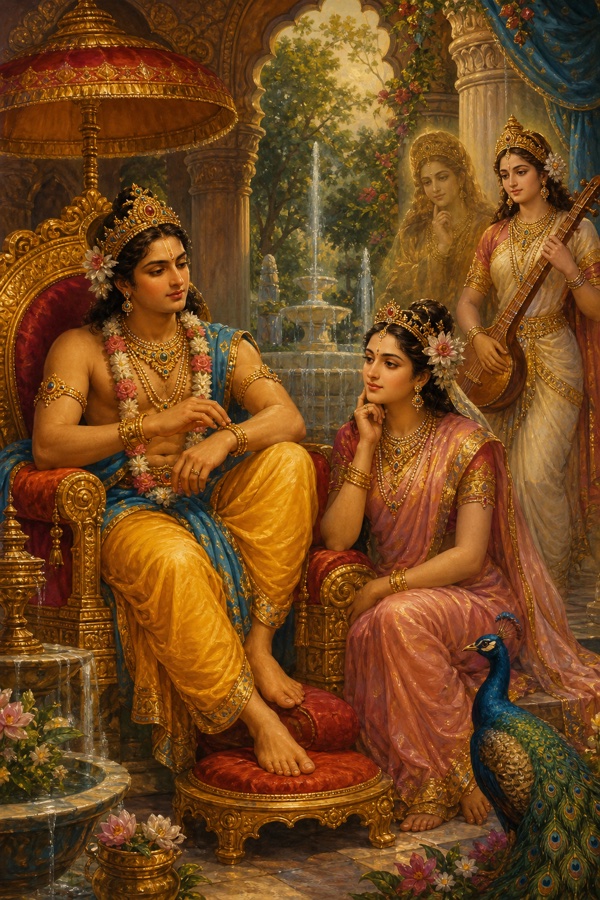
To Viduratha’s Tent
So the nocturnal fiends infested the gloomy field, and the myrmidons of Yama roamed about it as marauders roam in the daytime. The naked, fleeting ghosts were reveling on their provision of carrion in their nightly abode, under a canopy of darkness so thick that a hand could have closed on it.
It was in the still hour of that gloomy night, when the whole host of heaven seemed fast bound in sleep, that a sadness stole in upon the mind of Lila’s magnanimous husband, the belligerent prince Viduratha. He thought about what was to be done the next morning, in council with his counselors, and then went to his bed, which was as white as moonlight and as cold as frost. His lotus eyes closed in sleep for a while in his royal camp, which was as white as the moonbeams and covered by the cold dews of night.
Then the two women issued from their vacuous abode and entered the tent through a crevice, as the air penetrates into the heart of an unblown bud.
What passed inside that tent, Vasistha told next: Viduratha: Memory, Death, and Padma’s Awakening.