On this page
Yoga Vasistha · Story 3
Karkati: From Hunger to Self-Inquiry and Mangala Devi
A hunger the size of a continent drives Karkati, a Rakshasi of the northern Himalaya, to trade her mountainous body for the thinness of a needle and the reach of a disease. The bargain works exactly as she asked, and that is the trap: a needle cannot eat. Her second austerity on the same summit turns the question she is asking, and she comes down into the Kirata country with a mantra, a restored body, and an old appetite, where on a moonless night a king named Vikrama and his minister must answer her riddles or become her meal.
A Hunger as Large as Jambudvipa
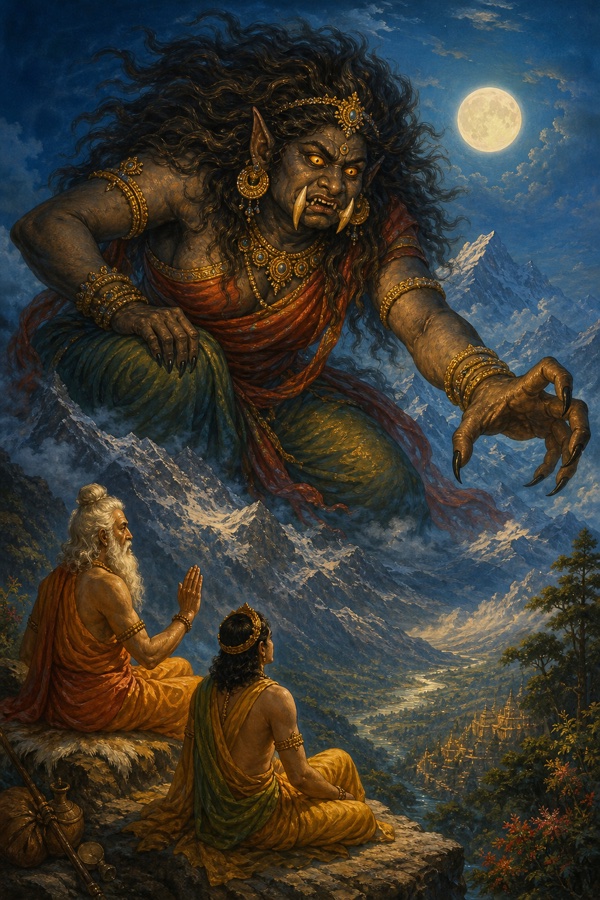
Vasistha had been telling Rama how the mind rises out of Brahman and how a whole world can stand inside it the way a reflection stands in a mirror, and he could see the prince struggling to hold a thing so abstract. So he reached for a story. “Listen, Rama,” he said, “to an old account that bears on this. A Rakshasi once put a difficult proposition to two men, and what came of it is worth your attention.” North of the Himalaya, he said, there lived a Rakshasi named Karkati, the crooked crab, dark as ink and solid as rock, with limbs that could split hard timber. People also called her Visuchi, the colic pain, because that pain never left her, and it had bent her great frame the way the Vindhya range was bent when the sage Agastya told it to bow and never rise. Her eyeballs blazed like two fires. She stood halfway to the sky, wrapped in a blue garment that hung on her like the shade of night on the air, with a white mantle on her head like a torn piece of cloud and her hair standing straight up above it like a black cloud on a crest. Her hooked nails glittered like sapphires, her legs were as long as tamala trees, and her laugh came out like a burst of frost. She wore a string of dried bones where another woman would wear flowers, with the leftovers of corpses hung on every part of her, skulls at her ears for earrings, and she liked to play among the Vetalas, the ghouls who roam the night, stretching her arms up over her head as if to pluck the sun out of its orbit.
A body that size needs feeding, and nothing fed it. Inside her, hunger burned the way the submarine fire burns at the bottom of the sea, where all the water in the ocean cannot put it out. Her tongue hung out of her mouth like a flame that is always reaching. One night, with the pain gnawing at her, she made a plan. “If I could only get once to Jambudvipa,” she said to herself, meaning the great continent where human beings live in their crowded kingdoms, “I would swallow every man in it in a single sweep, and keep on feasting there forever, the way the sea fire feeds on the waters. Clouds cool the burning sand with rain. I will cool this fire the same way. That is settled. It is the only plan that will keep me alive.”
Then she thought it through, and the plan hit a wall. “The men down there are well guarded,” she admitted. “They have their mantras and their medicines, their austerities, their devotions, their charities. Those things fence a person off from every evil in the world. Nobody can destroy a devotee who has made himself indestructible.” The obvious answer was to become one herself. “I will perform the most rigorous austerity there is,” she decided, “with a heart and mind that do not flinch. What is otherwise out of reach is won by sheer intensity of pain.” She did not for a moment question what the austerity was for. It was for the destruction of every creature that breathed.
She went to a mountain no one could climb and climbed it, scrambling up the rock on hands and feet, and stood on the summit like a thundercloud with lightning flickering in her eyes. She bathed there. Then she sat down to her devotion, her eyeballs fixed on a single point like the two orbs of the sun and moon stopped in the sky. Days went by, then months. She watched the seasons turn and the years pile up. She gave her huge black body to the heat and the cold exactly as the hill beneath her did, and she never moved, a dark cloud settled on a peak, her jet hair standing up as if it meant to touch the sky. The wind beat her until nothing was left on her bones except ragged skin, and tossed that hair back and forth, and the only movement in her was the blink of her eyelids, which threw a whitish glare across the black of her face.
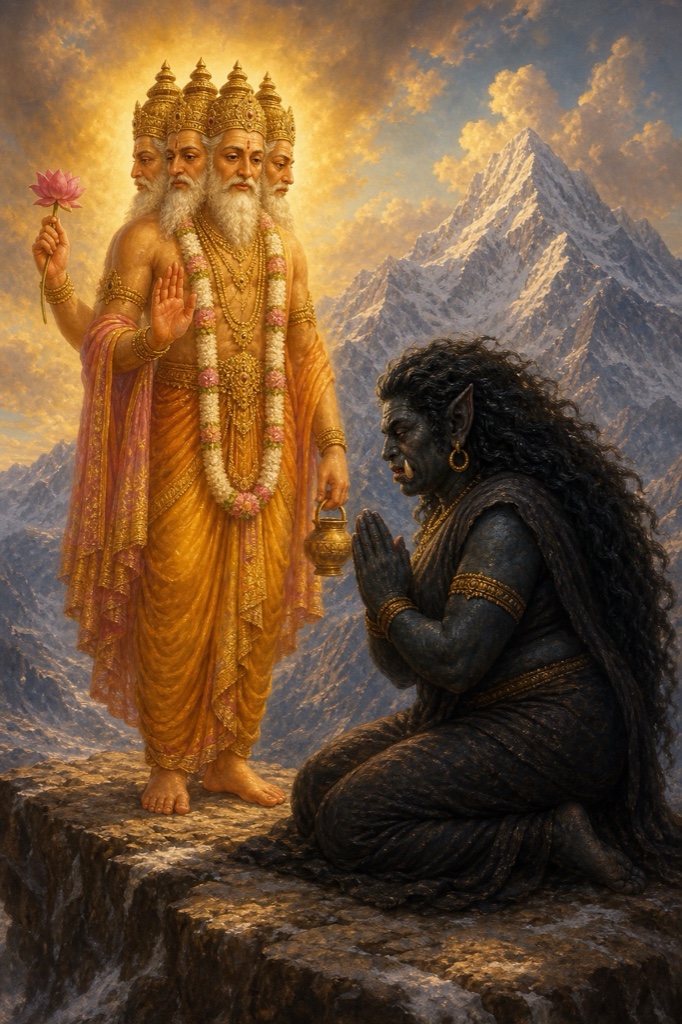
A thousand years of this went by before Brahma came. The creator, the lotus-born god from whom this whole world order issues, appeared in the sky above her to put an end to the fever of her austerity and give it its reward. She did not stand. She saluted him inwardly, in her mind, and stayed exactly as she was, because now she had to choose, and the choosing had to serve her appetite. It did not take her long. She wanted her soft, pliant body changed into an iron needle, rigid and inflexible, so that she could torment every living being without anything being able to pierce her back. “I will become as thin as the smallest pin,” she thought, “so that I can slip unseen into the hearts of animals, the way the smell of a flower slips into the nostrils. That is how I will drink the heart-blood of creatures, to my heart’s content. That is how this hunger will finally be fed, and the pleasure of it will be the greatest joy my soul has known.” Brahma, who sees thoughts before they are spoken, saw this one, and saw how foreign it was to anything a yogi should want, and he spoke to her anyway in a voice like clouds rolling. “Daughter Karkati of the Rakshasa race, sitting like a cloud on this unclimbable summit, know that your devotion has pleased me. Rise now, and receive the boon you want from me.” She answered him with the formality the moment called for. “Lord of what has been and what will be, if you are willing to grant my request, then please give me this: turn this body of mine, which is not iron, into the form of an iron needle.” And Brahma said, “So be it. You will be a pin, and you will be called the colic pain, because you will give pain to every body you enter.”
He did not stop there. A boon from Brahma comes with its terms, and he set them out one by one. “You will be the cruel cause of sharp pain and spasm in every living being,” he said, “and especially in the intemperate, the hard-driving fools, the loose libertines. Those are the victims marked out for you. You will also torment the people who live in unhealthy districts and the people who practice what they should not, entering their hearts on your infectious breath, breaking their sleep, upsetting the liver and the rest of the gut. You will take the form of wind in the bowels, and under the different names of the colic diseases you will raise bile and flatulence, and you will attack the intemperate wherever you find them, among the wise and the unwise alike.”
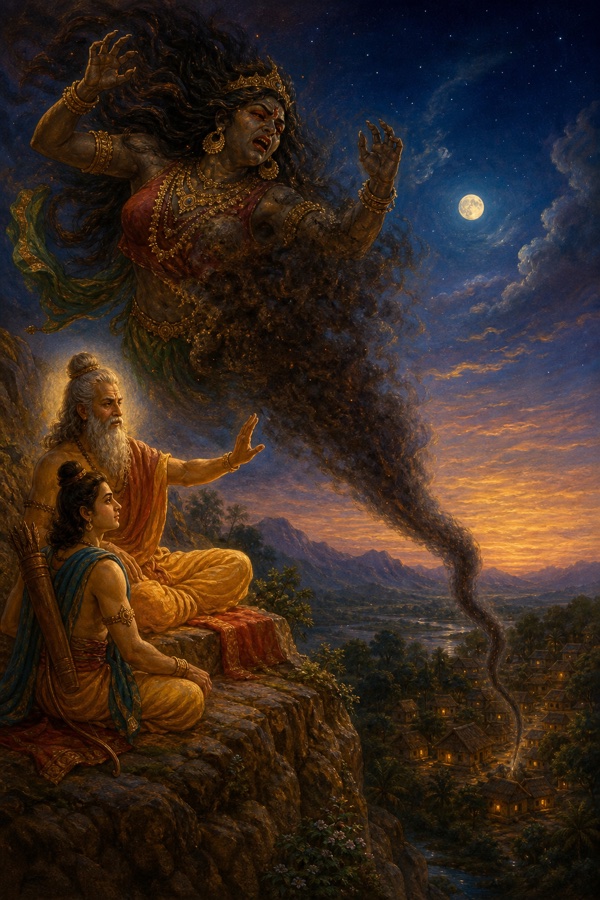
Then he turned to the other side of the ledger, because a god who releases a disease on the world also provides its cure. “When the wise are attacked by you,” he said, “they will be healed by repeating this mantra, which I will set out here for their good.” And he gave it: a formula that names her and her home, that says Karkati the Rakshasi lives in the north of the snowy mountain and her name is Visuchika, and that it is to repel her power that the speaker repeats it, and then calls on the seed syllables, hram, hrim, shrim, ram, and on the powers of Vishnu, the Vaishnavi powers, to remove, destroy, uproot and drive this colic pain far beyond the Himalaya and away to the orb of the moon, and closes with the words that seal every offering, Om, svaha, so be it. The lines were to be worn on the left arm as an amulet. “Then rub the painful place with the palm of that hand,” Brahma went on, “and picture the colic Karkati crushed under the mallet of this amulet and driven back over the hills, wailing as she goes. Let the patient picture the medicinal moon seated in his heart, and believe himself freed from death and disease, and his faith will save his life and end his pain. The careful adept who purifies himself first by sipping water and then repeats this formula will be rid of the colic altogether in a short time.”
With that the lord of the three worlds vanished into the air, after handing the amulet to the Siddhas who attend him, the perfected beings who carry what he decrees down into the world. He went back to his bright seat in heaven, where Indra, king of the gods, came forward to greet him with hymns, as if nothing on the summit had happened. Down on the mountain the Rakshasi sat with what she had won. She had spent a thousand years of discipline to make an appetite more efficient, and the body she had given to the wind for all that time was already beginning to go.
The Two Needles
The Rakshasi who had stood as tall as a mountain peak, black as a monsoon cloud, began to fade. Day by day she grew leaner. The cloud shrank to the size of a tree branch, the branch to the size of a man, the man to a cubit, the length of a forearm. Then she was a span, the width of an open hand, then the length of a finger, then something like a grain of corn, and at last she was a needle, the thin kind that is fit only to sew silk, as fine as the filament inside a lotus. Her own wish had done it. A wish of that kind can grind a hill down to a grain of sand.
So the unmetallic Suchi, the needle, became a slender black needle of iron, and the strange thing was that every limb and organ she had owned was still there inside it, folded into that sliver, and the sliver carried her through the air wherever she wanted to go. She looked at herself and saw an iron pin with no substance to it, no length or breadth worth the name. Her mind, with its power of thought, was as bright as a golden needle pointing at its point. Her eyeballs, which had been like black clouds driven by wind, were now two sparks peering out through the needle’s pores at a glory beyond them. She had kept a vow of silence, the mauna vrata, all through the thinning of her body, and she was pleased with her face for having grown as thin as the barb of a feather. Then she saw a light coming to her out of the air from a long way off, and felt her inward spirit go light as air itself, and the hairs of her body stood up like a baby’s at its bath. The great channel that yogis call the sushumna rose through her toward the opening at the crown of the head, the brahmarandhra, the way the filaments of a lotus rise toward the sun. With her senses and their powers subdued, she was like something that had no organic frame at all, one with the living soul inside her, invisible to anyone looking, as thin as the last hope a man keeps when everything else is gone, a wick with the flame out and only the heat left.
And here Vasistha paused over the pity of it. She had never grasped, at the start, that a slender pin was the wrong shape for an insatiable appetite. What she had wanted was food. The contemptible form of the pin was never the object; her heart desired one thing, and she woke up inside another thing, which was of no use to the first. That is how it goes with the short-witted, who lack the sense to judge beforehand what their future good will be. A strenuous effort to get one thing often lands on a different result, and even a success on one side turns out a failure on the other, the way a mirror shows a man his face and is fogged by his breath in the same moment. Still, the Rakshasi soon settled into her needleship. She had given up her giant body for it, and she judged the exchange worse than being destroyed outright, and she accepted it anyway, the way a glutton pushes away one dish and takes another, the way the giddy will embrace even death if they are fond enough of what lies past it.
Then the needle learned to do what she had asked for. It took the rarefied form of air and moved about as the colic wind, following living creatures everywhere in search of blood. Its body was burning heat, its life was the breath of the animals it rode, its seat was the sensitive heart, and it moved as fast as a particle of sunlight or moonlight. It was as deadly as the edge of a sword and as quick as a smell on the air, and it got into bodies the way the smallest trace of an odor does. Her whole bent was to do harm, like an evil spirit, which is what people now called her, and her one aim was to kill what she pleased. After a while her body divided into two halves. One half was as fine as a thread of silk and the other as soft as a thread of cotton, and in these two forms Suchi ranged over all ten directions of the world and pierced her way into the hearts of living things with every pain she could bring. For this, great or small, Karkati had thrown away a mountain. A person of small understanding will turn a slight business into an arduous task, and here was the proof: a thousand years of austerity to do the mean work of a needle.
Her aerial form, swollen with that heinous ambition, melted into the air like vapor, like an autumn cloud, and went to work. She slipped into the body of some sensualist, or someone weak, or someone too fat, and there the inward colic flatulence became Visuchika, cholera. Sometimes she entered a lean man, sometimes the healthy and even the wise, and what began as a colic pain ended as true cholera. She loved best to sit in the hearts of the ignorant, and from there she was thrown out again by the good deeds and prayers, the mantras and medicines of the wise. For years she wandered this way, her divided body sometimes flying up into the air and sometimes creeping low along the ground. She lay hidden in the dust, under the clenched fingers of a hand, in a sunbeam, in the air, in the threads of cloth. She hid in the intestines, the entrails, the privates, in the bodies of pale, ash-colored people, in the pores and lines of the skin, in dry grass and the dried beds of rivers. She kept her seat among the destitute, in naked, uncovered bodies, in anyone who breathed hard, in places thick with flies and places with no ventilation, in every kind of greenery except the mango and the bel tree. She lurked where bones and joints lay scattered, where violent gusts of wind blew, in filth, on cold icy ground, in polluted cloth and the places that cloth had polluted. She sat in holes and hollows and withered trees, wherever crows and flies and peacocks gathered, in numb fingers and toes, in the cloud country, in caverns shaped like rotting bodies, in melting and driving snow, in marshes full of anthills and stands of the malura tree. She showed herself in the mirage on desert sand, in wildernesses of beasts and snakes, in lands crawling with venomous reptiles and with leeches and worms. She haunted stagnant pools scummed with dead leaves and the leaves the Pishachas had chewed, and the hovels at the crossroads where travelers stop out of the cold. She went everywhere a leech sucks a man’s blood and vile people tear it off with their nails and keep it in their fists to feed on. She passed through every place a painter puts into a drawing of a city, until the long journey wore her out.
Then she stopped, like a tired bullock whose body has heated up from hauling bales of cotton and loads of pots through town after town, and lay down somewhere hidden the way a needle lies down when the sewing is done, dropping from the bridle of its thread in the sewer’s hand. The needle in the hand never pricks the finger that holds it; a servant, however sharp, does not turn on the master. The iron needle grew old in its stitching and one day was simply lost, the way a rotten plank goes down under its ballast of stones. It drifted where it drifted, driven here and there like chaff on the wind, which is the course of nature with all things. Someone picked it up and fed it the fag end of a thread, and that is how the colic is caught too, by the human parasites who gorge on food supplied by another man’s sap. The colic, like the needle, is forever feeding on other people’s pith with its mouth open, and forever finds the thread-like heartstring of somebody fed into its hole. The strong bodies of the greedy are nourished by the sap of the weak and innocent; the colic preys on the thin bodies of the poor; the sharp needle lives on the thin thread of the needy, who cannot afford new clothes. And though the heart of Suchi, like the eye of the needle, was made to receive the thread-like sap of a patient’s heart, her power to pierce it was like the sewing needle’s, as sure as a sunbeam going into the hardest substance.
That was when, all at once, Suchi saw the flaw in what she had chosen. She had taken a puny body that could hold nothing more than a scrap of thread, and she began to repent of her stupidity. It changed nothing. She kept on with all her strength in her accustomed course, pricking and piercing the bodies of others, because for all her regret she could not escape the cruelty of her nature. A tailor cuts and sews the cloth as he likes, Vasistha said, but the weaver of destiny weaves the long loom of lengthening desire inside every body and hides the reason for it under a garment of her own making. The colic Suchi went on exactly like the sewing needle, piercing the hearts of people with her head hidden, the way robbers do their work with their faces covered. Like the needle with the thread trailing behind it, she raised her head to find and eye the loophole she would go through, the way burglars mark the spot in the wall where they will break in. She entered the weak and the strong alike, as a needle stitches silk and linen and coarse fiber without preference, as the wicked spare neither the just nor the unjust. Pressed under the fingers, the colic let go of its gripe the way a needle gives under the thread when it sews, and like the stiff heartless needle, which cannot tell a soft cloth from a dry one, the colic pierced the hardiest breast without getting any sweetness out of it. The needle is like a rich widow, Vasistha said: both stern and full of regret, both veiled and speechless, and the needle’s one eye, like hers, is empty in a joyless heart. The needle hurts nobody of itself, and yet it is dragged along by its thread, which is the thread of its own fate. Slipped from the master’s finger, it sleeps in peace after its trudging among its fellows in the dirt and dregs, because everyone counts himself blessed in the company of his equals when he is out of work. And once in a while a blacksmith finds a lost needle, heats it in his hearth, and it flies up out of the fire on the breath of the bellows and vanishes into the air.
The vital airs inside a body carry the breath of life into the heart, where it becomes the living spirit by the force of acts done in earlier lives, and when those airs go bad they produce the colic pains that go by so many names, flatulence, bile and the rest. When the vyana air is corrupted it brings on diseases through every member and a watery fluid under the skin; when the breath of the lungs carries it, it is the vayu-shula, the colic of the lungs, with its disfigurement of the body and the madness people call hysteric colic. Sometimes it comes from the hands of shepherds and the smell of sheep’s wool in a blanket. Sometimes it takes hold of a child’s fingers and makes the child tear its bedclothes. When it comes in by the foot it sits sucking blood, and for all its voracity it is satisfied with very little. It lies with its mouth downward in the gland of the bowels and takes whatever shape it likes. It is the nature of the malicious to show the perversion of their hearts by hurting others, the way base people start a brawl for the fun of it and not for any gain, and the miser counts a single cowrie a victory; so deep is the greed in human nature. For a drop of blood, as much as the point of a pin could lift, the colic Suchi had bent herself to the destruction of men. “What a master stroke of mine,” the needle said to herself, “that from stitching rags of cloth I have risen to piercing the hearts of men. So be it. I am happy in my success.” A needle that lies idle rusts, and only loses its rust in sewing, by pushing through the patient, passive shreds. The unseen airy darts of fate kill the way the cruel Visuchi kills, and both take their rests between massacres. The needle rests when the sewing is done; the wicked are not satisfied even when the slaughter is over. She dove into dirt and rose into the air, flew with the wind and lay down wherever she fell. She slept in dust, hid at home and inside things and under clothes and leaves, lived in hands and in the holes of ears, in lotuses and heaps of wool, and was lost in the cracks of houses, in splits in the wood, under the ground.
As the sage reached that point, Valmiki tells us, the sun went down in the west and the day withdrew to its evening worship. The assembly in Dasharatha’s court broke up with the usual salutations so that each man could perform his evening bath, and it met again the next morning, with the first rays of the sun, in the royal palace. Vasistha took up the thread exactly where he had left it. After the carnivorous Karkati had feasted for a long age on the flesh and blood of mankind, he said, she found that her voracity knew no bounds and that nothing would ever satisfy it. In her needle form a single drop of blood was all she could take, and that one drop filled her. And she began to grieve, of all things, for the loss of the bottomless thirst and appetite she had owned before.
She said to herself, “What a pity, that I came to be a worthless needle, with a body so weak and slender that I cannot take anything for food. How stupid I was, to throw away my giant form, and trade my dark cloud of a figure for something like the dry leaf of a forest tree. Wretch that I am, I gave up my fine food of flesh with the fat on it. Now I am doomed to dive in dirt and drop on the ground, to be walked over and trampled under people’s feet, soiled and dirtied in filth. I am a miserable, helpless, hopeless thing with no support and no standing. I fall from one woe into the next and one danger follows another. I have no mistress and no maidservant, no father, no mother, no son, no brother, no one to serve me or befriend me. I have no body and no home, no refuge, no fixed place anywhere. I am blown about like a fallen leaf by the wind. Every accident finds me and every calamity is aimed at me. I wish for my own extinction, and extinction does not wish to come near me. What have I done, giving away my own big body out of the foolishness of my heart, except what a madman does when he parts with a precious jewel for a scrap of glass? One calamity is enough to turn a brain; what will become of me when they follow each other without end? I am hung up with the cloth to choke in the smoke and dropped in the street to be trodden on. I am thrown out with the rubbish and lost under the grass. I serve at another’s will and go where my guide takes me. I am stark naked while I sew for others, and I will always be at someone else’s disposal. I drudge and trudge all day for a paltry gain, and stitching is the only work I will ever have. How unlucky I am, that even my bad luck is this luckless. I can see the demon of despair rising in front of me on this day of my penitence, threatening to finish this body, which I have already made over to him. What better fate can be waiting for me, after I lost so big and bulky a body by my own stupidity, than to be wiped out into nothing, which would be preferable to being a thing good for nothing? What man would ever pick me up, lean as a threadworm, out of the heap of ashes by the roadside where I lie buried? No sharp-sighted man takes a wretched forlorn thing into his reckoning; nobody who lives on a high hill stoops to notice the grass on the ground below. I cannot hope to raise myself while I lie in this sea of ignorance; what blind man ever saw the glorious sunlight who steers by the flash of fireflies? I do not know how long I will have to labor under this, now that I find myself already drowned in an ocean of misery.”
“When will I be given back the form of the daughter of Anjanagiri?” she went on, and the name was the black mountain whose bulk she had once resembled. “When will I stand again like a pillar over the ruins of the upper and the lower worlds? When will I have arms that reach to the clouds and eyes that flash like lightning, a garment as white as snow, hair that touches the sky? My big belly like a huge cloud, my long breasts hanging down like pillows, swinging with the motion of my body as I danced, like a peacock’s feathers? The ash-white light of my laughter used to throw the sun into shade, and my old tall stature threatened to swallow the terrible god of death himself. My hollow sockets, deep as the holes of mortars, flashed with living fire like the rays of the sun, and my great legs moved like two monumental pillars when I walked. When will I have that pot of a belly again, and my soft black nails like the dark wet clouds of autumn? When will the smiles come back that won me the favor of the great Rakshasas, and when will I dance my giddy circles to the drum in the forests? When will that belly be filled with potfuls of fattening liquor and heaps of the flesh and bones of the dead? When will I get drunk on the blood of human gore, and go merry and giddy, until I fall fast asleep? It was I who destroyed my own brilliant body by a bad choice of austerities and took this petty needlish form, like someone who takes the sulphate of gold in place of the metal. Where is that huge body that filled every direction and shone like the gable of Anjanagiri, and what is this puny pinny thing shaped like a spider’s leg, as thin as a blade of grass? The ignorant throw a golden jewel on the ground as if it were glass, and that is what I did with my shining body, for this bit of blackest needle. Great Vindhya, with your hollow snow-covered caves, why do your native lions not kill your dull elephants? I am the one as silly as an elephant. My arms, which used to break the peaks off mountains, why do you fail to pluck the butter of the moon with your moony nails? My breast, as fair as the flank of the snowy mountain even without my glass ornaments, why do you not show your hairs, that were as large as leeches fed on lion’s flesh? My eyes, which drove the dark out of the darkest night and lit dry fuel with your glare, why have you stopped lighting the air? My shoulder blades, are you broken and leveled with the earth, or crushed and crumbled and worn out with age? My moon-bright face, why do you not shine on me with those beams, like the everlasting light of the moon’s orb, now ended forever? My hands, where has your strength fled today? Do you not see how I have been changed into an ignoble needle that the touch of a fly’s foot can move? My navel, that was as deep as a well, with hairs around it like rows of beautiful plants, and my great haunches like the base of the Vindhya hills. Where is that towering stature that reached the sky, and what is this newly earned contemptible needle? Where is that mouth, hollow as the vault of the sky, and what is this hole in a needle? Where is my heap of meat, and what is this drop of watery food? How lean I have grown. And who is to blame for an act I did myself?” With that she fell silent and motionless, and in the silence she made up her mind to go back to austerity, this time to win her lost body back.
Many Thousand Years and a Changed Question
She went back to the Himalaya. On the way she gave up her craving for human blood, and she sat down again to the punishments she knew. In her mind she watched her needle form going into her own heart with every breath, and as she held that picture her vital breath lifted her and carried her up to the top of the hill, where she came down the way a vulture drops out of the sky. There was no living thing anywhere near her. She sat among burning fires with her body the color of an ash-smeared stone, a green sprout in a dry grassless place, and she soon withered into a blade of dead hay in a sandy desert. Then she stood up, on the tip of one foot, and stayed there, barely touching the ground, never glancing to either side, her face turned up and her eyes lifted to the sky. The sharp point of the black iron needle held her upright by pricking into the ground, and she fed on nothing except the air she drew in through her uplifted mouth. The forest had no food in it, so she looked up as if for some prey coming from far off, while her lower half trembled in the wind and tempted the unwary closer.
A pencil of light came through the eye of the needle and stood behind her like a guard. People grow fond of the small creatures that attach themselves to them, and the needle grew attached to that ray, which never left her. She had a second companion in her devotion, her own shadow, which because of the blackness of her person always kept behind her back. The shadow, the ray and the iron needle held fast to each other and became three close friends, the way good people stay together and help each other. The trees and plants of the mountain forest felt for her when they saw her like this; who can watch a devotee at her austerities and not feel something? The breeze fed her uplifted mouth with the fragrance of fruit. The gods and demigods of the woods kept filling it with the pollen of flowers blown and unblown. But she would not swallow the powdered meat that Indra, who had been watching, had thrown into her mouth to break her devotion; her fixity of purpose would not let her taste it. A person, however mean, is sure of success if the mind is firm. The god of winds, who can tear mountains up by the roots, was astonished to find the needle refusing even the pollen that was offered to her.
A resolute devotee is not shaken from her purpose. Throw her in the mud, drown her, scatter her on the wind, toss her into the fire, pelt her with hail, strike her with lightning, batter her with rain and threaten her with thunder, and the resolute mind is not changed in a thousand years; the feet of the firm do not move from their place any more than those of the drowsy or the dead drunk. The hermit who holds to her purpose loses the use of her outer organs in time, and gains by the exercise of her reason the light of true knowledge in her soul. That is what happened to Suchi. She gained the light of knowledge and became a seer of what had been and what was to come. The dross of her sins was washed off her, and her Visuchi, her impurity, turned into Suchi, purity. She came to know, in her own understanding, the one thing truly worth knowing, and with her sins taken away by her devotion she felt the true bliss of the soul. And then she simply went on, for many thousand years, until seven times seven worlds took fright at her austerity, afraid she would win their happy seats by the merit of it. The great mountain caught fire from the heat of her devotion, and the flame spread out to all the worlds like the blaze of a portentous meteor.
That brought it to Indra. The king of the gods asked the sage Narada, who wanders between the worlds and knows what is happening in all of them, who was behind it. “Who is it,” Indra said, “that is drawing the fruit of all the worlds to herself by this austere devotion?” Narada said, “It is Suchi. By her devotion kept up for thousands of years she has reached her highest state of enlightenment, and it is that light that is setting all the worlds on fire. It is Suchi’s devotion, lord of the gods, that makes the Nagas sigh and the hills tremble. It makes the celestials fall from their places and the sea overflow onto the land. It dries up everything and throws the bright orb of the sun itself into shade.” Indra had heard of her and wanted to know more. “I know that Suchi got her fiendish practice of blood-sucking by means of devotion,” he said, “but who is this apish Karkati who is so greedy for flesh and bones?” Narada told him. “It is Karkati, the malevolent fiend, who became Jiva Suchi, the colic pain of the living, and took the shape of an iron needle as her prop and fulcrum. Then she let go of that prop and went into the human body as her landing place, and flew up to the heart on the vehicle of the vital breath, and now she rides the currents of the air. This colic of life gets into the bodies of vicious people, passes down the canals of their entrails and through the pores of their flesh and fat and blood, and nests like a bird in the interior. She goes into the intestines with the breath and settles there as flatulent colic; seated at the end of the nyagrodha artery she becomes the plethoric colic, with its fullness of blood and inflammation. She enters by other parts and organs and takes different names according to where she sits, and feeds on their flesh and marrow. Fastened to the knots of garlands and stuck to the leafy wreaths on the breasts and cheeks of fond girls, she sleeps enraptured with them on the bosoms of their husbands. She flies to the bodies of birds in forest retreats that know nothing of the world’s grief, flutters on the flowers of the kalpa trees in paradise, rolls on beds of lotuses in the lakes. She crosses the high hills of the gods as a swarm of bees and sips the honey perfumed with mandara pollen. As a vulture she eats the entrails of dead warriors through the gashes that swords have cut in them. She goes up and down the clear glassy roads of the sky and pierces every pore and artery and inlet of the human body, the way the wind gets into every nook and corner. As the one vital air runs in every living heart as the pulse, so Suchi vibrates in every body as if it were her own house. As the powers of the mind are lodged in every person like burning lamps, so she lives and blazes as the mistress of every body. She sparks as the vital spark in the particles of the blood and flows as fluidity in liquids, and she rolls in the bowels of living things the way whirlpools turn in the sea. She rests on the milk-white mass of the flesh as Vishnu reclines on his serpent bed, and tastes the blood of every heart as the goddess drinks from her goblet of wine. She sucks the circulating hot red blood of hearts as the wind draws the living sap out of the hearts of plants and trees.”
“Now this living Suchi has decided to become a devotee,” Narada went on, “and she stays as motionless as a stone, and as fixed in her mind. The iron-hearted needle, thinned to invisible air, had been traveling in every direction on the swift wings of the winds as if they were her horses, feeding on the flesh and drinking the blood of every living thing, giving and taking, dancing and singing the whole way. Though the bodiless Suchi had become as airy and invisible as empty space, there was nothing her mind could not accomplish, faster than the winds. But though she ran mad with her meat and reeled with her drink, fate kept her curbed, like an elephant in chains that cannot run where it likes. The living body is a stream racing along with its billows, and the painful, destructive diseases it labors under lie hidden under the surface like greedy sharks. This frail body, like the formless Suchi, found itself unable through its own infirmity to gorge on its fleshy food and began to lament its fate, the way old sick rich people lament their lost hunger and appetite. People rely in vain on mantras and medicines, austerities and charities and the worship of idols for relief, while their bodies are as subject to disease as the sea to its surges. The unseen force of motion is lost in the solid body as lamplight is lost in darkness, and so the living Suchi came to be lost in the iron needle, where she took her rest. Everyone aspires to a state that fits his own bent, and the Rakshasi’s bent had led her to choose needleship. A traveler who has gone far and wide comes home at last to rest, and so the great living Suchi returned to the form of the thin iron Suchi for her repose; but like ignorant people who prefer the grosser pleasures of the body to the finer delights of the soul, she still panted for the gross enjoyments that were now lost to her. She had traveled everywhere, in her poor needle’s form, to satisfy her thirst, and she had gotten more of the mental pleasure of experience out of it than any satisfaction of the body’s appetite. When the container exists, it can be filled; a person who has a body can seek and get every pleasant thing to delight it. Remembering the enjoyments of her former body, which had been so pleased to fill its belly, she grew sorrowful, and she resolved on austerity to get that body back, and she chose the proper place for it. The living soul of Suchi thought of entering the heart of a young vulture that was flying by, and rose to it, and rested in the air inside the bird by the help of her vital breath. The vulture, filled with the malevolent spirit of the colic Suchi, began carrying out what Suchi had in mind. It flew with the insatiate Suchi inside it to the spot she wanted on the mountain, driven there like a cloud by the wind, and that is the place where Suchi was to be released from her needleship. The bird settled on a patch of the lonely forest in an attitude of asceticism, as if freed from every desire in the world. It stood on one leg, balanced on the tip of its toe, like the image of some deity that someone had consecrated on the top of the mountain in the form of Garuda. And there, standing on one leg on a speck of dust, she stayed like the mountain peacock that stands on one leg with its head lifted to the sky. When the bird saw the living Suchi come out of its body and stand on the mountain like a statue, it fled and was gone. Suchi came out of the vulture the way the spirit leaves a body and the intellect rises toward the higher regions, the way particles of fragrance ride on the wind to meet the breath of the nostrils. The vulture flew home like a porter who has set down his load, and found on its return that it was cured of its gluttonous diseases. Now the iron Suchi sits in her devotion in the form of the living Suchi, as graceful as a person doing his proper duty at night, and since a formless spirit can do nothing without some formal support, the living Suchi holds herself up on the tip of her toe for her devotion. The living Suchi has sheathed the iron needle in her heart the way a Pishachi, a she-demon, wraps herself around a shinshapa tree, the way the winds fold up the particles of scent they carry away. From that time, Indra, she has given herself to her long devotion and passed many years in that lonely wilderness in that one steady posture. It is for you, Indra, who are skilled in stratagems, to think of some plan to turn her from her object, or her devotion will destroy the people you have preserved so long.”
Indra heard Narada out and sent Maruta, the god of winds, to search for her in every quarter of the globe. Maruta went in his spiritual form of pure intelligence through the sky, over the world-encircling mountains of Lokaloka, over Pushkara, Gomeda, Krauncha, Shvetadvipa, Kusha and Shaka, the island continents that ring the earth, with their seas, until he set his course for Jambudvipa and came to the summit of the snowy mountain. On the highest top of it he found a great desert, as wide as the expanse of the sky, with no living creature in it and no remains of one. Nothing green grew there, so close to the sun, and the dust that covered it was like the dust of which the whole earth is made. A wide ocean of mirage spread across it to excite thirst, like the clear water of a river, with all the colors of the rainbow in it to tempt the longings of men. It stretched almost to infinity, beyond the measuring of the regents of the quarters of heaven, and every gust of wind only pulled a canopy of dust across it. It was like a wanton woman smeared with red powder of sunbeams and sandal paste of moonlight, listening for the whistling of the breeze as if it were the hissing of men. The god of winds had crossed the seven continents and their seas, and he was tired; he rested his enormous body, which fills infinite space on every side, on the top of that mountain like a butterfly resting on a twig after a long flight. And there he saw Suchi, standing erect like a crest on the summit, in the middle of all that desert. She stood on one leg, fixed in her meditation, roasted by the sun straight overhead, dried by her endless fasting to a skeleton, her belly shrunk to the skin. Now and then she drew the hot air in through her open mouth and let it out again, because her heart could not hold the repeated inflow. She was withered by the sun and beaten by the hot desert wind, and she had not moved from her place, because every night the cold bath of moonbeams relieved her. She was content with the particles of dust that covered her head and had no wish to exchange her state for a better fortune. She had given her forest over to other living things and lived apart from all of them in the form of a crest of hair, her breath drawn up into the cranium and showing out of it like a tuft of hair or a bush clapped on her head. The god of air was astonished. He bowed to her, and the longer he looked the more terror struck him, and he was so overawed by the blaze of her person that he did not dare ask her anything, not even the simple question of why she was undertaking these austerities. All he could say was, “Holy Suchi, what a wonder this sight of your devotion is!” Then, filled with veneration for her holiness, he left for the heaven he had come from. He passed the region of the clouds and reached the sphere of still air, left the realm of the Siddhas behind him and came to the path of the sun, the ecliptic, and rising higher in his airy chariot entered the city of Indra, where the lord of the gods embraced him for the merit of having seen her.
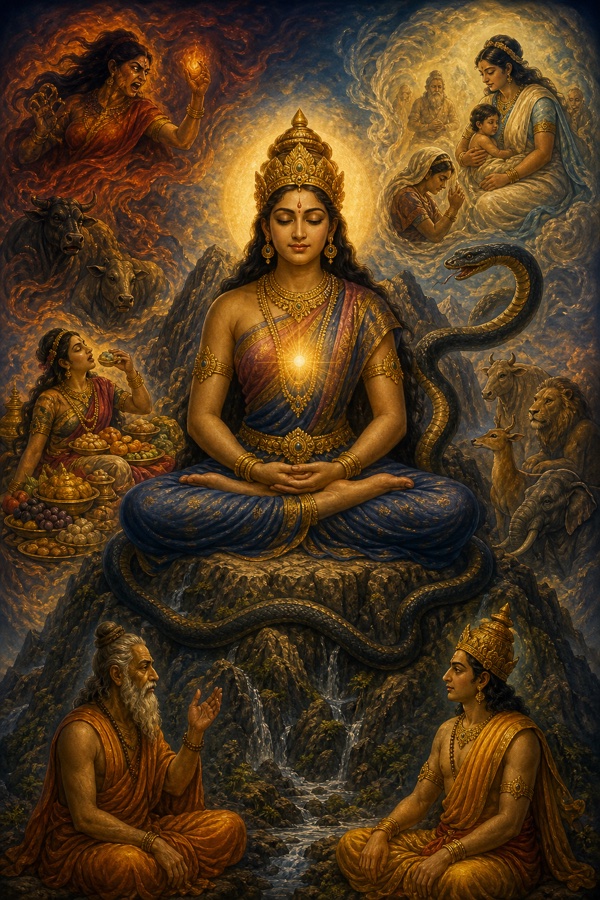
Asked what he had seen, he told it all before the gods assembled in Indra’s council. “There is the king of mountains, the high Himalaya, in the middle of Jambudvipa,” Pavana said, giving the mountain its full honor, “who has for his son-in-law the lord Shiva, who wears the crescent moon on his brow. To the north of it is a great peak with a plain on top of it, and there the holy Suchi keeps her hermitage and performs her terrible devotion. What more can I tell you than this: she has given up even air, her one food, and made a coiled mess of her entrails. She has narrowed the opening of her mouth to a needle-hole and stopped even that with a particle of dust, so that not even a cold dewdrop can get in as food. The heat of her devotion has made the snowy mountain forget its cold and take on a fiery form that cannot be approached. So let us all rise and go at once to the great father of creatures for redress, or know that this fervent devotion of hers will end to our disadvantage.” At those words Indra and the gods with him went to Brahma and prayed to him for their safety, and Brahma answered, “I am going this moment to the summit of the snowy Himalaya, to give Suchi the boon she wants.” On that assurance the gods went back to their heavenly homes. All this while Suchi was becoming perfect in her holiness and beginning to glow with the heat of her devotion on the mountain of the immortals. She could see plainly how the time of her austerity was turning, because she fixed her open eyes on the sun and counted the days by the rays of sunlight that came in through the opening of her mouth, the eye of the needle. Flexible as a bit of thread, she had gained by her upright posture the firmness of Mount Meru, the axis of the world. By the ray that passed through the needle’s eye she saw that the shadow attending her was the only witness of her upright devotion, and at midday that shadow hid under her feet for fear of the heat, as people in difficulty find their best friends leaving their company in hard times. The three persons of Suchi, the iron, the ascetic and the shadow, made a triangle together like the meeting of three rivers that lays out the sacred city of Benares, like the confluence at a Triveni where three rivers of three colors, blue, black and white, wash away the sins of men. And here Vasistha turned to Rama. A person comes to know the unknown cause of everything only by suchana, he said, by reasoning in his own mind, by his own consciousness of what is true and what is false. The cogitation of one’s own mind is the best guide in all things, Rama. There is no better teacher for anyone than that.
After a thousand years of this long and painful devotion the great father of creation appeared to her under his pavilion of the sky and told her to accept the boon he had come to offer. Suchi, absorbed in her devotion, her vital principle lying dormant inside her, had no outer organs of sense with which to speak a prayer, and all she could do was think over the choice she was to make. “I am now a perfect being,” she said to herself, “and I am delivered from my doubts. What blessing is there that I need to ask for, for myself or anyone else, beyond this state of beatitude, which I already have in my peace and quiet and in the bliss of contentment and self-surrender? I have the knowledge of all that is to be known, and I am free of the web of errors. My reason is developed. What more does a perfect rational being require? Let me stay seated as I am, in my present state. I am in the light of truth, and far away from the darkness of untruth. What else is there for me to ask for or accept? I spent a long age in my unreason, carried away like a child by the demon of earthly desire, the way a child wants everything it sees without knowing whether it is good or bad for it. That desire is under the control of my reasoning now. What are all the objects of my desire worth to my soul?” The lord of creatures stood looking at Suchi sitting there with her mind fixed in silent meditation, resigned to her destiny, withdrawn from every outer sensation and from the use of every bodily organ.
Then Brahma, out of the kindness of his heart, spoke to the unmoved woman again. “Receive the blessing you wanted,” he said, “and live to enjoy yourself a while longer on earth. Then, having had the joys of life, you will reach the blissful state from which there is no coming back here, and that is the fixed decree for every living being on earth. May your desire be crowned with success by the merit of this devotion of yours. Take back your former bulk, and remain a Rakshasi in this mountain forest. Regain the cloudlike shape you are deprived of now, and revive like a sprout from your needle-thin root, to become a great tree growing from a small root and a little seed. You will get an inward supply of sap from that needle of a tendon, as a plant draws its sap from the seeded grain, and the flow of that juice will make you grow as a shoot grows from the seed. Your knowledge of the truth has nothing to fear from the difficulties of the world; the righteousness of your soul will carry you through them like a great cloud heavy with pure water, high in the sky, whatever gusts of wind blast against it. By your constant practice of yoga meditation you have grown used to a deathlike samadhi for your intellectual delight, and have become assimilated to the numbness of that meditation, to the state of a stock or a stone. But your meditation has to be compatible with your worldly affairs. The body, like the breeze, is nourished best by constant motion. So, my daughter, you are acting against nature by withholding the action your nature requires. And there can be no objection to your killing animal life, within proper bounds. Act within the bounds of justice, then, and refrain from every act of injustice in the world, and hold fast to reason, if you want to live liberated in this life.” With that the god disappeared upward to his heavenly sphere, and Suchi said after him, “So be it. I have nothing to oppose to this.”
She thought it over and found no reason to be dissatisfied with the decree of the lotus-born Brahma, and at once she found herself in possession of her former body. She came first to the measure of a span, then a cubit, then a full fathom, and shooting up fast she grew to the size of a tree and at last to the shape of a cloud, every member added to her in an instant, the way the arbor of human desire puts out all its branches at once. From the fibrous form of Suchi, which had no shape or feature, no body, no blood, no bones, no flesh, no strength, all the parts and limbs sprang up together, the way the imagined garden of our desire springs up suddenly with all its green leaves and fruit and flowers out of nowhere. Suchi the needle was the fiend Karkati again; her thinness turned to bulk the way a flimsy cloud swells into a giant in the rainy season. Back in her native air and element she felt some joy in herself, and she threw off her fiendish nature by the knowledge she had gained, as a snake throws off its old slough. There she sat in the lotus posture and reflected on the course ahead of her, relying on the purity of her new life and faith, as fixed as a mountain peak. After six months of unbroken meditation she got the knowledge she was looking for, the way the roar of the clouds rouses the peacock to the sense of coming rain.
When she came back to her senses, the body came back with her. She felt the pain of thirst and hunger, because the body never gives up its appetites as long as it lasts in the same state. And she grieved, because she could not find any food she was willing to take; killing a living creature for food now seemed to her unlawful and repugnant. “Food that respectable people forbid and that is got by unjust means has to be refused,” she thought, “even at the cost of one’s precious life. If my body perishes for want of lawful food, I break no law in that. The guilt would lie in taking unlawful food to keep myself alive. Whatever is not got by the customary rules of society is not worth taking, and if I die for want of proper food, or live on improper fare, it comes to the same thing whether I live or die. Before, I was only the mind, with the body added onto it as a base appendage. The body vanishes on the knowledge of the self; so its care and its neglect are the same to me.” As she said these words silently to herself she heard a voice in the air. It came from the god of winds, who was pleased that she had renounced her fiendish nature. “Rise, Karkati,” it said, “and go to the ignorant and enlighten them with the knowledge you have gained, because it is the nature of the good and great to deliver the ignorant from their error. And whoever will not receive this knowledge when you offer it, make him the object of your scorn, and take him as the right meat and the proper food for you.” She answered, “Kind god, you have done me a great favor,” and she got up and came slowly down from the heights of the craggy mountain, past the peaks and into the valley at its foot, and from there toward the homes of the Kirata people, the hill tribes who live on the lower skirts of the Himalaya.
Two Figures in a Dark Country
The Kirata settlements were full of provisions of every kind: people and their cattle, fodder and grass, vegetable food and animal food, roots and plants of all sorts, things to eat and things to drink, the flesh of deer and fowl and even of reptiles and insects. The night-fiend walked her way toward the houses at the foot of the Himalaya under the cover of a deep darkness, in her shape of the black mountain Anjanagiri, and nobody saw her pass. It was a night black as ink and thick as pitch you could touch, and it hid the whole Kirata country under its shade. There was no moon. A veil of dark cloud covered the sky, the woods were made darker by their tamala trees, and masses of black cloud flew about in the air. Thick furze and bushes around the hill villages blocked the paths with their impenetrable gloom, and the flitting lights of fireflies gave the homesteads the look of a wedding night. The darkness lay so heavy over the yards of the houses that it shut out the light of the lamps burning inside, which only found its way out through the chinks of the walls. Karkati saw a band of Pishachis dancing around her for company, and went still as a block of wood at the sight of the giddy Vetalas moving about with human skeletons in their hands. She saw antelopes asleep beside her and the ground matted with fallen snow, while the breeze shook drops of dew and frost gently from the leaves. She heard frogs croaking in the bogs and night ravens calling from the hollows of trees, and the mingled noise of men and women enjoying themselves inside the houses. She saw marsh lights burning in the swamps with the glow of portentous meteors, and found the banks and borders of the streams thick with thorns and thistles, washed by the water gliding below. She looked up and saw the clusters of stars in the firmament, and watched the forest around her shake its fruit and flowers in the breeze. She heard the cries of owls and crows taking turns, without pause, from the hollows of trees, and listened to the shouts of robbers on the outskirts and the wailing of villagers far off. The foresters were silent in their woods and the townspeople were fast asleep in their towns; the winds howled in the forest and the birds rested in their nests. Fierce lions lay in their dens and the deer lay in their caves. The sky was full of hoarfrost and the woodlands were still. Lightning flashing out of the inky clouds looked like rays reflected off the breast of a crystal mountain. The clouds were as thick as solid clay and the darkness so stiff you would need a sword to cut it. A dark cloud, driven by the storm, fled across the sky like the black Anjana mountain itself and let down a flood of pitchy rain like a waterfall off a mountain’s breast. The night was as dark as the pit of a coal mine and as jet black as the wing of the black bee, and the whole landscape, lulled to sleep, looked like the world lying drowned in ignorance.
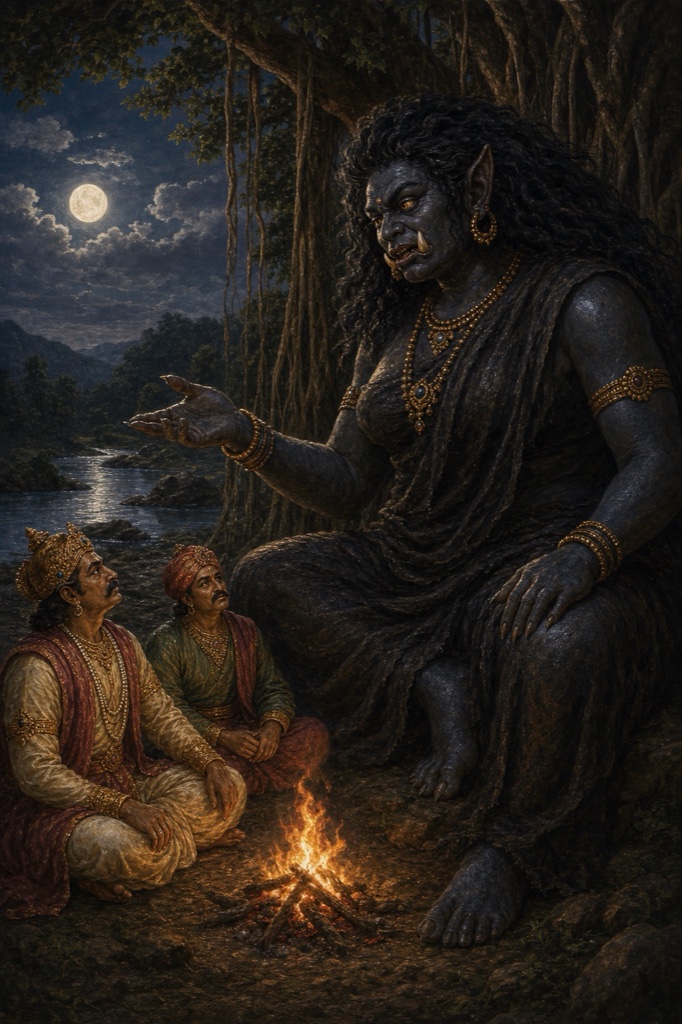
In this dreadful dead of night, in the district the Kiratas inhabit, she saw a prince and his minister walking together through the forest. The prince was named Vikrama, which means valor, and he was as brave as his name and his conduct suggested. He had come out undaunted from inside the city after the citizens had fallen asleep. Karkati watched the two of them roving the forest with the weapons of their courage and fortitude, hunting the Vetalas that infested the neighborhood.
Her first thought was gladness: here at last was her proper food. But she wanted to know, before she did anything, whether these were ignorant men or men who knew their own souls, or whether weariness under the burden of their bodies had simply exposed them to the dangers of the dark. “The lives of the unlearned,” she said to herself, “are for their own perdition in this world and the next. It is better to end them than to leave them alive to their peril in both. The life of the untutored, without spiritual knowledge, is death already, and physical death is preferable, because it saves the dying soul from piling up more sin. It is the primeval law laid down by our first father, the lotus-born Brahma, that ignorant souls, souls without knowledge of themselves, become the food of the hideous. So there is no harm in my feeding on these two, who have offered themselves for my food. It is silliness to let a ready prize or a proffered gift slip out of your hand. But if they turn out to be men of parts, good and great souls, then nothing in my own nature could bring me to end their valuable lives. So I must make a trial of them, and see whether they have such parts, so that I can decline to make my meal of them; I feel an aversion to harming the intelligent. Anyone who hopes for true glory and real happiness through a long life on earth must always honor the learned with rewards that match their gifts and their wishes. I would rather let my body perish of hunger than destroy the intelligent to keep it going, because the soul gets more satisfaction from the counsel of the wise than bare life without knowledge can ever give it. The learned have to be supported even at the cost of one’s own life, because the company of the wise is medicine to the soul, even when death takes the body away. When a man-eating Rakshasi like me is so well disposed toward preserving the wise, what reasonable man would fail to make a breastplate of them for himself? Of all the embodied beings that move on the face of the earth, it is only the man of deep understanding who sheds his kindly influence all around him like cooling moonbeams. To be despised by the wise is death, and to be honored by the learned is true life, because only the company of the wise makes a life bear its fruit of heavenly bliss and final beatitude. I will put a few questions to them for their examination, and find out whether they are men of parts or only gilded on the surface with wise-looking faces, like copper plated by a trick of chemistry. If on examination they prove wiser than their examiner, one should take their instruction. Otherwise there is no harm in finishing them, as they best deserve.”
Then the Rakshasi, that offshoot of the great garden of the Rakshasa race, let out a loud, tremendous yell like the deep roaring of a cloud, and after the roar she muttered in a clattering voice like the rattle of a thunderclap after the rumbling. “Ho, ho,” she said. “What are you, who dare to wander in this dread and dreary desert, dark as the great delusion of Maya, as gloomy without sun or moon as the gloom of ignorance itself? What are you crawling here for, like insects bred in stones? What great-minded men are you, to have come here like weak-minded strays who have lost their way? You have become an easy prey to me, and you will meet your fate at my hands in a moment.” The prince answered her out of the dark. “What are you, and where are you standing? If you have a body, show yourself to us. Who is going to be terrified by a bodiless thing buzzing like a bee? The business of the brave is to pounce at once like a lion on its prey; the dog barks from a distance. So leave off your bragging and show us your strength now. Tell me what you want from us, and whether you are trying to frighten us with this empty boasting, or whether you are saying these things out of your own fear of us. Match your body to your speech, and face us without delay, because the dilatory gain nothing except the loss of their time.”
She heard the prince out and thought it was well said, and she showed herself to them at once, with a shout and a grinning laugh. The prince heard her voice fill the air and echo through the woods, and he saw her huge hideous person by the light of her own open mouth and ivory teeth as she laughed. Her body was like a great cliff hurled down by the thunderbolt of the last doomsday, when high mountains are split and thrown into the sea to lie there as hidden rocks. The flashes of her eyeballs blazed in the sky like a pair of bangles or conch shells. The blackness of her put the deep dark waters of the universal deluge into shade, the waters that hide the flame of the submarine fire under them, and her voice was as hoarse as the growling of clouds on the high heads of hills. She stood like a monumental pillar between heaven and earth, and the grinding of her teeth struck the night-rovers with the terror of being ground to death under them. Her figure, with its erect hairs, its muscular limbs, its dingy eyes and the coal black of its skin, carried the same dread of disaster as the goblins of the night, the Yakshas, the Rakshasas and the Pishachas. The air in her lungs snored like the horrible snorting of a horse’s nostrils; the tip of her nose was as big as a mallet, and its sides as flat as a pair of bellows or a winnowing fan. She stood in her jet-black body like a rock of dark agate, and that, together with her loud laugh, made her look like the all-subduing night of dissolution, Kalaratri, the night in which the worlds end. Her bulk, like a thick cloudy night, came toward them like an autumn cloud moving through the forest of the sky. It was like a demon rising from under the ground to swallow them, the way an eclipse swallows the orbs of the sun and moon. Her ebony breasts hung down like two pendant clouds of dark sapphire, or like two mortars or two water pots, with her necklaces hanging on them. Her two arms hung from her bulky body like a couple of stout branches off a sturdy oak, or like two logs of burnt wood against her coal of a body. The two men looked at her and did not move, as steadfast as people standing on the firm ground of certainty, whom no doubt can carry off.
It was the minister who spoke. “What is causing this rage and fury in your great soul? It is only the mean and base who are violent even over trifles. Put aside this great ado about nothing; it does not become you. The wise go about their business coolly and crown it with success. Know that the soft, slow breath of our moderation has blown swarms of flies like you away into the air, the way a slight breath of wind scatters dry leaves and straws. Setting aside all haughtiness and heat of spirit, the wise man conducts his business with a calm, cool mind, helped by reason and practical wisdom. A man has to manage his affairs slowly, whether it proves effective or not, because the overruling destiny disposes of every event, and human ardor has no power to prevent it. Now let us know what you want, and what your object is with us, because no one who has ever asked us for anything has been refused, or sent away disappointed.”
Hearing this, the Rakshasi thought it over. “What serene composure these lion-like men have,” she said to herself, “and what courtesy toward others. I do not think they are men of the ordinary kind, and the wonder of it is that their inward soul is written on their faces and in their eyes, and in the tone and tenor of their speech. In the wise the words, the face and the eyes all express the inward thoughts, and they go together like the salt and the water of the sea. My intention is already known to them, as theirs is to me. I cannot destroy them when they are indestructible themselves by their moral excellence. I understand that they have spiritual knowledge too, without which there can be no good understanding, because it is the knowledge that the spirit cannot be destroyed that takes away the fear of death, and these men have no fear of death. So I will ask them about the things I am in doubt about, because people who fail to ask the wise what they do not know stay dunces all their lives.” She opened her mouth to put her questions, holding back the roaring voice and the loud laughter for a while. “Tell me who you are, you brave and valiant men, and where you have come from, because the very sight of you has raised my regard for you, the way the good-hearted become friends at first sight.” The minister said, “This is the king of the Kiratas, and I am his counselor. We have come out tonight on our nightly round, to apprehend malicious beings like you. It is the duty of princes to punish the wicked, by day and by night, because those who trespass the bounds of their duty must be made fuel for the fire of destruction.”
“You have a good minister,” the Rakshasi said, “and a bad one unbecomes a prince. All good princes have wise counselors, and the counselors make the prince good. The wise minister is the prince’s guide to justice, and it is he who raises both the prince and his people. Justice is the first of the four cardinal virtues and the one virtue of a ruler, which is why a king is called the embodiment of dharma. But kings must have spiritual knowledge too, because it is the highest of human knowledge. A king who has that knowledge becomes the best of kings, and the minister who knows the soul can give the best counsel for the guidance of other souls. It is fellow feeling for others that makes a ruler, and whoever does not know this rule is fit to be neither a ruler nor his minister. If you know this polity, good, and you will prosper. If not, you wrong yourselves and your subjects, and in that case you must be made my prey. There is only one way out of my clutches for you two boys, and that is to solve my intricate questions, by your best wits and judgment. So now, both of you, give me the solutions I require. If you fail to give proper answers, as you have agreed to do, you will fall into my hands, like anyone who fails to keep his word.”
Seventy Questions
“Now attend to her questions, Rama,” Vasistha said, “the way the prince did when he told her to go on.” The Rakshasi began. “What is that atomic minim which is one and yet many, as vast as the ocean, and which holds innumerable worlds inside it like the bubbles of the sea? What is the thing that is a void and yet no void, something and yet nothing? What is it that makes myself and yourself, and where do I and you abide and subside? What is it that moves without moving and stands without stopping? What is intelligent and yet as dull as a stone? What is it that paints its variety on the emptiness of the understanding? What has the nature of fire without its burning, and what unfiery substance produces the fire and its flame?”
“Who is he who is none of the ever-changing lights of sun and moon and stars, and is the never-changing enlightener of the sun, the moon and the stars? Who, having no eyes, gives the eye its sight? Who gives eyesight to the eyeless plants and the blind minerals, so that the sunflower turns to follow the sun? Who made the heavens, and who is the author of the natures of things? Who is the source of this jeweled world, and whose treasure are all the gems in it? What is that monad which shines in darkness, that point which is and is not, that iota no one can perceive, that jot which becomes an enormous mountain? To whom is the twinkling of an eye as long as a kalpa, a whole age of the world, and a whole age no more than a moment? Who is he whose omnipresence is the same as his absence, and whose omniscience is the same as his total ignorance? Who is called spirit and is no air in himself, and is said to be the sound or the word and is neither? He is called the All, and is none of all that exists; he is known as the Ego, and he is no ego.”
“What is it that is won by the greatest effort over a great many births, and once won, is hard to keep? Who, living in easy circumstances, has not lost his soul in them? Who, being only an atom in creation, does not count the great mountain Meru a particle? What is it that is no more than an atom and fills a space of many leagues, and what is the atomic particle that cannot be measured in many miles? At whose glance and nod do all beings act their parts like players, and what is that unit which holds many a mountain chain in its bosom? Who is bigger than Mount Meru in his very minuteness, and who, being smaller than the point of a hair, is yet higher than the highest rock? Whose light brought the lamp of light out of the bosom of darkness, and what minute particle holds the minutiae of ideas without end? What has no flavor in it and gives savor to everything, and whose presence, withdrawn from substances, reduces them to infinitesimal atoms?”
“Who is it that by his self-pervasion connects the particles that make up the world, and what imperceptible power rejoins the scattered particles after their separation and dissolution, to make the world again? Who, being formless, has a thousand hands and eyes, and a twinkling of whose eye holds many cycles of time together? In what microscopic mite does the world live as a tree lives in its seed, and by what power do the unproductive seeds of atoms become productive of worlds? Whose glance causes the production of the world, as from its seed, and who creates the world without any motive and without any material? What being enjoys the pleasure of seeing without any organ of sight, and is the viewer of himself, making himself the object of his own view? Who, having no object of vision before him, sees nothing outside him, and looks on himself as an infinity void of all visible things? Who shows the subjective sight of the soul by itself as an objective view, and represents the world as the figure of a bracelet in his own metal?”
“Who has nothing existing beside himself, and in whom all things exist, like the waves in the waters, and whose will makes them appear as different things? Time and space are both infinite and indivisible, like the essence of God in which they live; why then do we try to separate them, like water from its wetness? What is the inward cause in us that makes the believer in the soul see the unreal world as real, and why does the fallacy go on at all times? The knowledge of the worlds, present, past or to come, is all a great error; and yet what is that immutable being which holds in it the seed of this phenomenal wilderness? What being shows these phenomena without changing itself, sometimes in the shape of the seed of the world before it develops in creation, and sometimes in the form of a full-grown forest of created beings? Tell me, prince, on what solid base the great Meru stands like the tender filament of a lotus, and what gigantic form holds thousands of Merus and Mandaras in its capacious womb. Tell me what that immeasurable Intellect is which has spread these myriads of intelligences through all these worlds; what it is that supplies you with your strength for ruling and protecting your people, and for conducting yourself through life; and what it is in whose sight you either lose yourself, or think that you exist. Tell me all these things, for the satisfaction of my heart.”
“Let your answer melt the doubt that lies over the face of my heart like snow. If it fails to wipe this dirt of doubt entirely off the surface of my heart, I will never count it the saying of a wise man. And if you fail to lighten my heart of its doubts and set it at ease, then know for certain that you will be made fuel for the fire of my bowels at this very moment. I will fill this big belly of mine with all the people of your realm. But if you answer rightly, you will reign in peace. Otherwise you will meet your end like the ignorant, who are glutted with the enjoyments of life.” With that the night-fiend gave the loud shout of a roaring cloud, out of sheer pleasure, and sat silent with her fearful features, like an autumn cloud, gigantic in shape and empty of rain.
The giant daughter of the Rakshasas had put her occult questions in the deep gloom of night in that thick forest, and it was the good and great counselor who began to answer. “Hear me,” he said, “while I unravel your riddles, as easily as a lion foils the fury of giant elephants. All your questions concern the Supreme Spirit, and they are framed in your enigmatic language to try the force of our penetration into their hidden meanings. The soul, which is the same as the intellect, and finer than a particle of air, is the atomic principle you ask about. It is a nameless minim that the six organs of sense cannot perceive and the mind cannot grasp. Underlying that atomic intellect is the minute seed which holds this universe, and whether it is a substantial reality or an unsubstantial one, nobody can say. It is called a reality from our notion that it is the soul of all by itself, and that from that soul every other existence has come into being. It is a void in its outward emptiness, and no void as regards its intellect, which is real. It is said to be nothing because it cannot be perceived, and it is a subtle something because it cannot perish. And it is no nothing, because it is spread through all things: everything is a reflection of the minute Intellect, and its unity shines out in the plurality, all of which is as unreal as the bracelet’s form is unreal next to the gold it is made of.”
“This minute thing is the transcendent vacuum, imperceptible because of its minuteness; it sits in all things and goes unperceived by the mind and the outer senses. Its universal pervasion cannot make it void and null, because not everything that exists is that Intellect, which alone is known as the thinking principle that makes us speak and see and act. No reasoning can establish the nonexistence of the real Being merely because nobody has seen it. The universal soul is known in its hidden form the way unseen camphor is known by its smell. The unlimited soul lives in every limited body, and the atomic intellect pervades the vast universe, the way the mind fills every body in its pure subtle state, unknown to the senses. It is one and all, the unity as well as the plurality, by being the soul of each and of all, singly and together, supporting and containing each and all by itself and within itself. All these worlds are little billows in the vast ocean of the divine Intellect, whose intelligence, like a liquid body, shows itself in the form of eddies in the water. This minute intellect, which the senses and the mind cannot perceive, is said to have the form of emptiness; and because our consciousness does perceive it, it is no nothing, though it is of the nature of a void in itself.”
“You asked what makes myself and yourself. I am That, and so are you, by our conviction of the unity of the spirit. And I am not That, and you are not He, when we believe we are made of our bodies alone. When our I-ness and you-ness are got rid of by knowledge of the truth, we stop being the I and the you, and all other persons lose their separate properties in the one Unity.”
“This particle of the intellect is immovable, though it moves over thousands of miles, and in our consciousness we find many a mile composed inside this particle. The mind is firmly seated in the empty intellect and never stirs from it, though it goes to every place where it is never located. What has its seat in the body can never go out of it, as a baby hanging on its mother’s breast does not look anywhere else for its rest. A man free to range over large tracts at will never leaves his own home, where he has the liberty and the power to do whatever he likes. And wherever the mind roves, the climate of that place never touches it, the way a jar carried to a distant country with its mouth shut lets none of the light and air of that region in. That is what stays in a place while it does not stay there.”
“The intellect’s thinking and its not-thinking are both perceived in our minds, so it is said to be both intellection and the dullness of intellect; and when our thinking is absorbed into the solid substance of the divine Intellect, our intellect is said to turn solid as a stone. That is your intelligent thing dull as a stone. The worlds that the intellect of the Supreme has spread through infinite space are the most wonderful of things, because they are its uncreated creations. The divine soul is of the essence of fire and never leaves its fiery form; it lives in every body without burning it, and it is the enlightener and purifier of every substance. That is your fire without burning. The blazing intelligence of the divine soul, purer than the ether, produces elemental fire by its presence; that is your unfiery substance producing fire. The intellect, which is the light of the soul and the enlightener of the luminous sun and moon and stars, is indestructible and never fades, though the light of the luminaries goes out on the last day of universal doom. There is an inextinguishable light, called the ineffably transcendent, which the eye cannot see and the mind can perceive as its inward illumination, presenting all things to its view. From that comes the intellectual light, which surpasses the light of the senses and the mind and shows it wonderful pictures of things that the visual light cannot show; it is luminous by itself and reveals what lies hidden in the dark. And the eyeless plants are sensible of an inward light inside them, which makes them grow and gives them the capacity to bear their fruit and flowers. That is your sight in the sightless.”
“As for time, space, action and the existence of the world: all these are perceptions of the senses, and they have no master or maker, no father or supporter, except the Supreme Soul in whom they exist as modifications of himself, and they are nothing of themselves. That is your maker of the heavens. The atomic spirit is the casket of the bright gem of the world, without ever changing its minuteness; the divine spirit is its measure and its measurer, and beside that there is no separate world at all. It is that Spirit which shows itself in everything in all these worlds, and it shines as the brightest gem when all the worlds are compressed inside it at the universal dissolution. From the unintelligibility of his nature he is said to be a speck of obscurity, and from the brightness of his intellect he is called a ray of light. He is known to exist by our consciousness of him, and said not to exist because he is removed from our sight. He is said to be far away because our eyes cannot see him, and near us because he is of the nature of our own intellect. He is represented as a mountain because he is the totality of our consciousness, though he is finer than any perceptible particle. That is your minute yet vast. It is his consciousness that shows itself in the form of the universe; the mountains are not real existences, and they stand, like Meru, in his atomic substratum. That is how an atom holds a hill.”
“A twinkling is what appears as a short instant, and a kalpa is the long duration of an age, each what it is. But sometimes a twinkling-instant represents a kalpa, when it is loaded with the acts and thoughts of an age, the way an extensive country of many leagues is pictured in miniature inside a grain of the brain. The course of a long kalpa is sometimes held in the womb of a single instant, the way the whole period of the building of a great city is present in the small space of the mind’s memory, as in the bosom of a mirror. As little moments and whole kalpas, high mountains and extensive yojanas can all live in a single grain of the intellect, so do all dualities and pluralities unite and meet in the unity of God. That ‘I did this and that before’ is an impression derived from the thought of our actual acts, and the truth of it becomes as untrue as our doings in a dream. It is calamity that stretches the course of time, and prosperity that shortens it; the space of a single night seemed a period of twelve long years to King Harishchandra in his misery. Whatever appears as certain truth to the mind stamps the same impression on the soul, the way the sense of a piece of gold jewelry becomes more impressive to the soul than the idea of its gold. There is no such thing as a moment or an age, as near or far, to the soul; it is the conception in the minute intellect, the working of the mind, that creates their length and brevity, their nearness and remoteness. Contraries like light and darkness, nearness and distance, a moment and an age, are only varied impressions on the unvarying percipient mind, and there is no real difference between them.”
“Everything that the senses can perceive is called evident or apparent, and what lies beyond them is called imperceptible. But sensation is not self-evident; only the vision of the intellect is, which is the real essence. So all that is apparent is untrue. As long as there is the knowledge of the jewel, there is knowledge of the gold too, and the real gold is lost under the apparent form. It is by turning the attention back from the visible form of the jewel to the real essence of the gold that one is led to the sight of the pure light of the one Brahman. Brahman is viewed as Sat, reality, when he is considered as pervading all things, and is said to be Asat, unreal, because he is not an object of sight; so the Intellect is said to be a reality from its faculty of thinking, and otherwise it is dull matter. That is your reality that appears unreal, and your intellect that appears as the absence of intellect. The intellect is the wonderful property of the divine Spirit, in which it is present as its object; but how can a man have a view of it whose mind is fixed on the sight of the world, which is a shadow of the Intellect and shakes like a tree in the wind? As a mirage is the reflection of the dense light of the sun, so the world is a shadow of the solid light of the divine intellect. That which is rarer than the sun’s rays and never decays is as uniform as it was before creation and disjoined from it; so its existence is the same as its nonexistence. As a heap of sunbeams shows the look of a gold mine in the sky, so the golden appearance of the world keeps the deluded from looking toward what the intellect could know. Like a city seen in a dream, the sight of this world is neither a reality nor altogether unreal, because it is a reflection of the intellect, as the dream is a reflection of the images in memory. It is a continued medley of error. Knowing it as such, a man should consider everything by the light of reason, and go on to the knowledge of truth by cultivating his intellect.”
“There is no more difference between a house and empty space than that the one is an object of vision and the other of consciousness. All nature teeming with life is said to live in God, who is the light and life of all forever, and yet all these living beings have no room in the empty sphere of the divine Intellect; they live and shine like the sun’s rays, proceeding imperceptibly from that luminous orb. The rays seem to differ from the original light and from each other, in different beings, by a curious design of Providence, and yet it is the same light in all, like the forms of trees grown from the same kind of seed. As the tree inside the seed is of one kind with its parent seed, so the innumerable worlds inside the empty seed of Brahman are as void and vacant as Brahman himself. As the undeveloped tree in the seed is not in being until its parts develop, so the world in the womb of Brahman was discernible only to the divine Intellect, in the form of the ideal world that was to come. There is only one God, one and uncreated, calm and quiet, without beginning, middle or end, without a body and its parts. He has no duality and is one in many. He is of the form of pure light, and shines forever with an everlasting and undiminished luster.”
The Rakshasi had listened without moving. “Well said, counselor,” she said. “Your words are sanctifying, and full of spiritual doctrine. Now let the prince with his eyes like lotus leaves answer the rest.” The prince began with the thing itself, before any of the questions. “He whose belief consists in giving up all reliance on this world,” he said, “and whose attainment depends on forsaking every desire of the heart; he whose expansion and contraction cause the creation and extinction of the world, who is the object of the doctrines of Vedanta, and whom no words or speech of humankind can express; who stands between the two extremes of doubt, whether he is or is not, and in the middle of both, that he is and is not; the pleasure of whose mind displays the world with all its moving and unmoving things to view; he whose pervasion of everything does not destroy his unity, who being the soul of all is still only one: it is he alone who is truly said to be the eternal Brahman.”
“This minute particle is wrongly conceived as spirit, as air, because the naked eye cannot see it. In truth it is neither air nor any other thing except the one pure Intellect. That is your air that is no air. This minim is said to be sound, or the word, and it is an error to say so, because it is far beyond the reach of sound or the sense of words. That is your sound that is no sound. That particle is all and yet nothing; it is neither I nor you nor he. It is the almighty soul, and its power is the cause of everything. The soul is what is attained with great pains, through the labor of yoga, and when attained it adds nothing to our stock, since we already possess our souls; yet its attainment comes with the gain of the supreme soul, than which there is no better gain. That is your gain that is no gain. Ignorance of the soul stretches out the bonds of our worldliness and our repeated transmigrations, with their evils growing like the rankest weeds in spring, until spiritual knowledge roots them out. And those who live in easy circumstances lose their souls by viewing themselves as solid bodies only, which rise quickly to view like the dense mirage under the light of the sun. It is the particle of self-consciousness that holds Meru and the three worlds inside it like bits of straw; they are as if disgorged from it, to present their delusive appearances to us.”
“Whatever is imprinted on the intellect, the same appears expressed outside it; the fond embrace of passionate lovers in dream and in imagination is enough to show that truth. As the intellect rose of itself with its all-powerful Will at the first creation of the world, so it exercises the same volition in every later formation too, like sprigs rising from the joints of reeds and grass. The hobby that has gotten into the heart shows itself on the outside too, as in the whims of children. The iota of the intellect, as minute as an atom and as subtle as air, fills the whole universe on every side. Though only a particle, it is not contained in hundreds of leagues; being all-pervasive, it is infinite; having no beginning, it is measureless; having no form of its own, it is formless. As a cunning dandy deludes young girls with his becks and calls and winks and glances, so the holy look of the divine intellect serves as the prelude to the circling dance of worlds, with all their hills and contents, forever. It is that atom of the intellect which envelops all things within its consciousness and represents their forms outside it too, as a painted canvas makes the hills and trees drawn on it seem to stand out in relief. The divine spirit, though as minute as the hundredth part of the point of a hair, is yet larger than the hills it hides inside itself, and as vast as infinity, unlimited by any measure of space or time. The comparison my minister made, of the vast emptiness of the divine understanding with a particle of air, is not an exact simile; it is like comparing a mountain with a mustard seed, which is absurd. The minuteness attributed to it is as false as the attribution of different colors to the peacock’s plumage, or of jewelry to gold; no attribute applies to the spirit.”
“It is that bright lamp which has brought forth light out of its own thought, without any loss of its essential effulgence. That is your lamp that gave light in darkness. If the sun and the other luminous bodies were dull and dark in the beginning, then what was the nature of the primeval light, and where did it live? The pure essence of the mind, situated in the soul, saw the light displayed on the outside of it by its own internal particle of intellect; the light existed inside the intellectual atom before creation and before the darkness, and afterward it was set forth by itself outside, when it shone in the midst of the darkness. There is no difference between the light of the sun, the moon and fire and the darkness out of which those lights were produced; the difference is only that of the two colors black and white, the way a cloud and the snow differ only in the blackness of the one and the whiteness of the other. Light and darkness differ in color only and not in substance, because neither has any real substance. Both are insensible things, and they disappear or join together before the light of the intellect, the way the yogi in his meditation sees no physical light or darkness in the blaze of his own mind; they go together like light and shade, the shadow following the light. The sun of the intellect shines by day and by night without setting or sleeping; it shines in the breast of a hard stone, never clouded, never rising or setting. The light of this blazing soul has lighted the sun, which spreads its light through the three worlds and has filled the capacious womb of the earth with a variety of provisions, as men lay up big baskets of food in a storehouse. It enlightens darkness without destroying itself, and the darkness that receives it becomes as enlightened as the light. As the shining sun brings the lotus buds into the light, so the light of the divine Spirit enlightens our intellects in the gloom of ignorance that wraps them. And as the sun shows itself by making day and night with its rise and fall, so the intellect shows itself by its development and its silence, by turns. All our notions and ideas are held in the particle of the intellect, as a healthy seed holds in its breast the leaves and fruit and flowers of the future tree, and these, and all the powers of the mind, develop in their proper times, as fruits and flowers come in spring and in their seasons.”
“The particle of the divine spirit is altogether tasteless, vapid and void of qualities, and yet it is always delectable, as the giver of flavor to all things. That is your tasteless thing always tasted with zest. All savors live in water, as a mirror receives a shadow; but the savor, like the shadow, is no substance; it is the essence of the spirit that gives it flavor. All the bodies in the world are forsaken by the atomic spirit of the Supreme, through their unconsciousness of him, and they depend on him through the consciousness of the divine particle shining in their souls. That is who forsakes and supports. It is he who, unable to wrap himself up, wraps the world in himself, by spreading the vesture of his atomic intellect over all existence. The supreme Spirit, which has the form of infinite space, cannot hide itself in anything within its own sphere; that would be like an elephant hiding in the grass. And yet this all-knowing spirit encompasses the world, knowing it to be a trifle, the way a child holds a grain of rice in his hand; and that is an act of maya, of delusion. The spirit of God exists even after the dissolution of the world, by resting in its own intellect, as plants outlive the spring by the sap they drew from it. It is the essence of the Intellect that gives rise to the world, as a garden goes on flourishing on the nourishment of the spring; know that the world is a transformation of the intellect, and all its productions are plants in the great garden of the world, fed by the vernal juice of the intellect. It is the sap supplied by the intellectual particle that makes all things grow up with myriads of arms and eyes, the way the atom of a seed produces plants with a thousand branches and fruits. That is your formless thing that takes a thousand forms.”
“Myriads of kalpas add up to an infinitesimal part of a twinkling of the atomic intellect, as a dream lasting a moment presents a man all the periods of his life from youth to old age. This infinitesimal of a twinkling is too long for thousands of kalpas; the whole duration of existence is as short as a flash of his eye. It is the idea alone that makes a twinkling appear a kalpa, or many, just as the idea of satiety in starvation is a mere delusion to the deluded soul. It is craving that makes the famished man feed on his thoughts of food, as it is despair of his life that shows a man his death in his dream. All the worlds live in the intellectual soul, within the atom of its intellect, and the outward worlds are only reflections of the inner prototype. Whatever object appears to be situated anywhere is only a representation of its model in some place or other, like figures in relief on the side of a pillar; the changes in the outer phenomena are no results of the inner, which is serene emptiness and subject to no change. Every existence present in the intellect at this moment is the same as it has existed and will ever exist inwardly, like trees in their seeds. The atom of the intellect holds the moments and ages of time like grains in the husk, and it holds them as its contents in the seed within the infinite soul of God. The soul stays quite aloof, as if retired from the world, though the world subsists on it and depends on it; the divine soul is unconcerned with its creation and its sustaining at all times. That is your cause of the world without any motive. The essence of the world springs from the atom of the pure Intellect, which stays apart from both action and passion. Nothing is created or dissolved in the world by anybody at any time; all the apparent changes are caused by the delusion of our vision. Seen in its spiritual light, this world with all its contents is as void as the vault of the empty sky, and the word world, applied to the phenomena, is an insignificant term that signifies a nothing.”
“It is the particle of intellect, led by the delusion of maya, that views the scenes situated in the divine soul in the outward appearance of the phenomenal world. That is your thing with eyes that sees outside itself what is held in the soul. The words external and internal, applied to the world, are meaningless; there is no inside or outside to the divine soul, and the words are contrived to explain its different views by the intellect, for the instruction of pupils. The viewer who looks into the invisible being within himself comes to see the soul; he who looks outside with open eyes comes to see the unreal as real. So whoever looks into the soul as the true reality can never see the false phenomena as real, as others do. It is the inner sight of the intellect that looks into the inward soul, which is without any desire; the outer eyes are mere organs for looking at the false appearance of outward objects. There can be no object of sight unless there is a looker too, as there can be no child without a parent; and this duality of mutual dependence comes from want of knowledge of their unity. The viewer himself becomes the view, since there can be no view without its viewer; nobody prepares food unless there is somebody to eat it. It lies in the power of the intellect to create the views of its vision, as it lies in the capacity of gold to produce every form of jewelry. The inanimate view never has had, nor can have, the ability to produce its viewer, any more than a gold bracelet has the power to bring gold into being. The intellect, having the faculty of thinking, forms the thoughts of its thinkables within itself, and though these are unreal, its intellectual vision wrongly sees them as real entities, to its own deception, the way jewelry seems to appear in gold. The viewer, the divine intellect, transformed into the view, the visible world, is no more perceptible in it than the gold is in the jewelry made from it. So the viewer, having become the view, still views himself as the viewer, as gold turned into a jewel is still looked on as gold. Since one unity alone appears in all nature, it is useless to talk of the duality of viewer and view. The viewer who feasts his eyes on the outer visible world cannot have the sight of the inner soul with the inner eyes of his intellect; but when the viewer shuts out the outer view, all its realities appear unreal. When the viewer perceives the unreality of the visible by the light of his understanding, he comes to see the true reality, as by drawing the mind back from the figure of the jewel one comes to see only the nature of its gold. The visible being present, there must be viewers too, to whose view it appears; it is the absence of both, the viewer and the view, and the knowledge of their unreality, that produces the belief in unity, the way taking away the umbrella drives away its shade. The man who considers all things in the contriteness of his conscious soul comes at last to perceive something in himself that is serenely clear, which no words can express.”
“The minute particle of the intellect shows us the sight of the soul as clearly as a lamp shows everything in the dark. That is your thing that shows the soul as clearly as something visible. The intelligent soul is absolved of its perceptions of measure, measurer and measurable, of the forms and properties of things, as molten gold is absolved of its form as an ornament. As there is nothing that is not composed of the elements, earth, water and the rest, so there is nothing in nature apart from the nature of the atomic intellect; the thinking soul penetrates all things in the form of their notions, and because all thoughts concentrate in the intellect, nothing is apart from it. Our desires are the parents of the objects we wish for, and so they are the same as the prospects we see; there is no difference between our desires and the things desired, any more than between the sea and its waves. The Supreme Soul exists alone, unbounded by time and space; being the universal soul it is the soul of all, and being omniscient it is no dull matter at all. That is your undivided duality and plurality. The Being, being intelligence alone, is not perceptible to sight; there is unity and no duality in it, and all forms unite into one in the great self of the Supreme. If there is a duality, it is the one and its unity; the unity and duality of the universal soul are both as true as light and its shade joined together. Where there is no duality or any number above it, unity has no application either; where there is no unit, there cannot be a two or more over it, which are only repetitions of the unit, except an indeterminate whole. Anything so situated is in itself what it is; it cannot be more or less than itself; it is identical with itself, like water and its wetness. The multiplicity of forms it exhibits blends into a harmonious whole without any conflict; the multifarious creation is held in Brahman like a tree with all its parts in the embryo of the seed. Its dualism is as inseparable from it as the bracelet from its gold, and though the multiformity of nature is evident to the comprehending understanding, it is not true of the true entity of God. Like the wetness of water, the fluctuation of air, the emptiness of the sky, this multiformity is an inseparable property of the Godhead. Disquisition about unity and duality is the cause of misery to the restless spirit, and it is the end of that distinction that consummates the highest knowledge. The measure, the measurement and the measurer of all things, the viewer, the view and the vision of the visible world, all depend on the atom of the intellect, which holds them all. The atom of the divine intellect spreads out and draws in, like its own limbs, these mountainous orbs of the world, by an inflation of its spirit, as if by a breath of air. What a wonder, and the great wonder of wonders, that this atom of the intellect should hold in its embryo all three regions of the worlds, above and below one another. It is an incredible delusion, and it must stay an inexplicable riddle, how the monstrous universe is held in the minute atom of the Intellect.”
“As a pot holds the seed, with a huge tree inside its cell, so the divine soul holds the atom of the intellect, which holds the chains of worlds stretched out inside it. The all-seeing eye sees all the worlds at once, lying in the bosom of the intellect, the way a microscopic sight discovers the parts of the future tree hidden in the seed. The expansion of the world in the atom of the Intellect is like the enlargement of the hidden parts of the seed into leaves and branches, fruits and flowers. As the multiformity of the future tree is held in the uniform substance inside the seed, so the multiplicity of worlds is situated in the unity of the atomic Intellect, and anyone who will only look into it sees it there. It is neither a unity nor a duality, neither the seed nor its sprout, neither thin nor thick, neither born nor unborn, but ever the same as it is. He is neither an entity nor a nonentity, neither graceful nor ungraceful; and though it holds the three worlds with the ether and the air, it is nothing and no substance at all. There is no world and no not-world beside the intellect, which is all of itself, and is said to be such and such in any place or time as it appears so and so to us there and then. It rises as if unrisen, and expands in its own knowledge; it is the same as the supreme soul, and as the totality of all selves it spreads through the whole emptiness like air. As a tree springs from the ground according to its seed, so the world appears to sight in the form in which it is held in the seed of the intellect. The plant does not quickly quit its seed, or it would dry up and die for want of sap; so the man who sticks to the soul and seed of his being is free from disease and death. Mount Meru is like the filament of a flower in respect to the vastness of that atom; all visible things have their place in that invisible atom. Meru is a filament of the atomic flower of the divine soul, and myriads of Merus are like the cloudy spots rising in the sphere of the intellect. It is that one great atom that fills the world, after making it out of itself and giving it a visible, extended, material form in its own hollow sphere. That is who created and extended the world. As long as the knowledge of duality is not driven out of the mind, so long does the mind find the charming form of the world, as it finds its dream on waking. The knowledge of unity liberates the soul from its stay in the world and its return to it, and the soul then sees the world as a mass of the divine essence.” He stopped. The Rakshasi sat very still, turning the words over.
A Promise, a Mantra, and a Difficult Compact
The apish Karkati of the forest had heard the prince out, and she weighed the sense of his words inside herself, and her levity and her malice fell away. The fever was over, and she found a coolness and quiet in her heart, like the peacock when the rains set in, like a bed of lotuses when the moonbeams rise. The prince’s words had delighted her the way the cries of cranes flying across the sky gladden the passing clouds. “How brightly the pure light of your understanding shines,” she said. “It glows as serenely by its own inward effulgence as if the sun of intelligence were lighting it. Hearing the grains of your reasoning, my heart is as glad as the earth when the cool beams of the moist moonlight fall on it. Reasonable men like you are honored and venerated in the world, and I am as delighted in your company as a lake of lotuses is in its full-blown buds under the moon. The company of the virtuous scatters its blessings the way a flower garden spreads its fragrance all around, the way the brightness of sunbeams brings the lotus buds into bloom. The company of the good and great drives off all our woes, as a lamp in the hand drives off the darkness around it. I have had the good fortune to find you two great lights in this forest. You are both entitled to my reverence here. Now be so good as to tell me what good intent brought you out tonight.”
“The people of this province are always afflicted in their hearts by a certain evil,” the prince answered, and he did not soften the word. “It is the obdurate disease of Vishuchi, the colic pain, that troubles the people of this part of the country, and that is why I have come out with my guards on my nightly rounds, to find her. No medicine takes this colic out of the hearts of men, so I have come out in search of the mantra that was revealed to her for its cure. It is my business and my professed duty to hunt down wicked beings of your kind that infest my ignorant subjects in this way. That is all I have to tell you, and all I have to do, in this place. So promise me in your own words that you will never injure any living being in the future.” She said, “Well. I tell you in truth, my lord, that from this day I will never kill anybody.” The prince looked at the size of her. “If that is so,” he said, “then tell me, you who live on animal flesh, how you are going to support that body by abstaining from animal food.” And she told him. “It is now six months since I rose from my trance of meditation, and in those months I fostered my desire for food, and today I renounce it wholly. I will go back up to the mountaintop and give myself to steadfast meditation, and sit there content, as long as I like, in the posture of an unmoving statue. I will restrain myself by unshaken meditation until my death, and then I will leave this body in its own time, gladly. That is my resolution. I tell you now that until the end of this life and this body of mine I will never again take the life of any living thing, and you can rely on my word.”
Then she told them who she was. “There is the mountain called Himalaya, standing at the center of the northern region, stretching in one sweep from the eastern sea to the western. There I lived at first, in a cave of its golden peak, in the shape of an iron statue, and also as a fragment of cloud, and I bore the name of Karkati the Rakshasi. There, by the austerity of my devotion, I won the sight of Brahma, and I told him I wanted to kill mankind in the shape of a destructive needle. I got the boon accordingly, and I passed a great many years afflicting living beings and feeding on their entrails in the form of the colic pain. Then Brahma forbade me to kill the learned, and taught me the great mantra, which I was bound to observe. He gave me the power to pierce the hearts of men with some other diseases too, the ones that infest all mankind. I spread myself far and wide in my malice and sucked the heart-blood of men, which dried up their veins and arteries and wasted their bodies, and the ones I left alive, after I had eaten their flesh and blood, fathered a race as lean and veinless as they had become themselves. You will succeed in getting the mantra for driving out the Visuchika pain, because there is nothing the wise and the strong cannot attain. Receive from me now the mantra that Brahma uttered for removing the colic pain from the cells of the arteries that Visuchika has vitiated. Come with me, and let us go to the river nearby, and there I will initiate you both with the mantra once you have prepared yourselves to receive it by your ablution and purification.”
So the Rakshasi went to the riverside that same night, with the prince and his minister, the three of them joined together as friends. The two men, sure now of her good faith by every proof, affirmative and negative, bathed in the river and stood on its bank, and she gave them, with tenderness, the effective mantra that Brahma had revealed to her for the removal of the Visuchika pain, which had never once failed. Then the night-fiend turned to go, leaving her new friends behind her, and the prince stopped her with his words. “You have become our teacher,” he said, “by teaching us this mantra, and we invite you, with affection, to take your meal with us tonight at our house. It would not be right for you to break off a friendship that has grown, as friendship does between good people, at our very first meeting. Give that ill-favored shape of yours a somewhat more graceful figure, and walk along with us to our home, and stay there as long as it pleases you.”
The Rakshasi answered him honestly. “You can easily provide a woman of your own kind with the food that is proper for her,” she said. “But what entertainment can you give me that would satisfy me, when I am a cannibal by nature? Only the food of a giant, of a Rakshasa, can satisfy me, and no little morsel such as petty mortals eat. That is the innate nature of our kind, and it cannot be done away with as long as we carry these bodies of ours.” The prince had thought about this, and his answer came from the office he held. “Decked in necklaces of gold,” he said, “you will be free to stay with the ladies of my house for as many days as you like. And I will arrange for your food. The robbers and felons that I seize in my territories will be handed over to you, by the hundreds and the thousands, at all times. You can put off your comely form, take on your hideous Rakshasi shape, and kill and eat hundreds of those lawless men. Take them to the top of the snowy mountain and devour them there at your pleasure, since great people always like to take their meals in private. When you have refreshed yourself with that food and a short nap, you can go back to your meditation, and when you are tired of your devotion you can come back here and take the next offenders for your slaughter. The killing of culprits is not only justifiable by law; it amounts to an act of mercy, because it rids them of their punishment in the next world. You must come back to me whenever you are tired of your devotion, because a friendship once formed, even with the wicked, is not easily undone.” She said, “You have spoken well, prince, and we will do as you say. Who would slight the words of the wise when they are spoken to him in the way of friendship?”
With that the Rakshasi put on a graceful form, with necklaces and bracelets, silk robes and laces, and said, “Well, raja, let us go together,” and followed in the footsteps of the prince and his counselor, who walked ahead and led the way. They came to the royal house and passed the rest of that night in their meal and in talk together, and when morning came the Rakshasi went inside and stayed with the women, while the prince and his minister went about their business.
Over the next six days the prince collected all the offenders he had seized in his territory, and more brought in from other parts, until they came to three thousand heads, and he gave them over to her. She took back her fiercely dark form, the black fiend of the night, and gathered thousands of men into her outstretched grasp the way a fragment of cloud holds the drops of rain in its wide bosom. She took leave of the prince and went to the top of the mountain with her prey, the way a poor man carries off gold he has happened on in some hidden place.
There she refreshed herself with her food and her rest for three days and nights, and then, with her understanding firm again, she gave herself to her devotion. Once in a while she rose from it, after four or five years, sometimes seven, and came down to the homes of men and to the court of the prince. She would spend some time there in their confidential conversation, and go back to her retired seat in the mountain with her prey of offenders.
So she lived on in that mountain, freed from cares even in her lifetime, a liberated being. Rulers came after Vikrama, one after another, and she stayed.
Kandara Devi and Mangala Devi
The Rakshasi kept to her devotion and stayed on friendly terms with the rulers of the Kirata country, one after another, who kept her supplied with her rations. By the power of her perfection in yoga she warded off every portent, every dread and danger from demons, and the diseases of the people, so that the woman who had once been the colic of a whole country became its protection.
Through the long years of her meditation she would come out of her cell at certain intervals and call at the headquarters for her capture, the collection of living creatures kept there as her victims. The princes of the place keep the practice up to this day, Vasistha said; they conduct the animals to be sacrificed to her departed ghost on the hill, because no one can neglect to repay the good services of a benefactor.
At last she went out in her meditation, and from then on she stopped appearing in the homes of men and lending her help against their diseases and dangers and difficulties. The people dedicated a high temple to her memory and placed a statue of her in it, under the title of Kandara, the goddess of the valley, who is also Mangala Devi, the auspicious goddess. Since then it has been the custom of the chiefs of the tribe to consecrate a newly made statue in honor of Kandara Devi whenever the old one has grown disfigured and dilapidated, and any prince of the place who is vile enough to neglect the consecration of her statue brings great calamities down on his people through his own perverseness.
By worshiping her a man gets the fruit of all his desires, and by neglecting her he exposes himself to every kind of evil, as the pleasure or displeasure of the goddess falls on her votaries. The dying and the ailing still worship her with offerings, for the cure of their illness and the securing of her blessing, and she distributes her rewards among those who worship her in her statue or her picture. She is the giver of every blessing to young babies and to weak calves and cows, while she kills the hardy and the proud who deserve their death. She is the goddess of intelligence, and favors the intelligent, and she presides forever over the realm of the Kirata people. “So I have told you the unblamable legend of Karkati, the Rakshasi of the Himalaya,” Vasistha said to Rama, “from its beginning to its end.” Rama had a question. “How could someone born in a cave of the Himalaya become a black Rakshasi,” he asked, “and why was she called Karkati? I want these two things clearly explained to me.”
“The Rakshasas are of many races, from the beginning,” Vasistha said. “Some of them are dark, some fair, many have a yellowish look and some a greenish shade. As for Karkati, you should know there was a Rakshasa by the name of Karkata, so called from his exact resemblance to a crab. And the reason I told you Karkati’s story was only for her questions, which I remembered and thought would serve well to explain the God who takes every form.” Then he went on with what the questions had opened, how the one is the source of the many, how a thought and the mind that thinks it are one substance in two forms, like the seed and the fruit; and when Rama objected that “everything comes from Brahman” could not sit beside “nothing is distinct from Brahman,” the sage answered that such words are used for teaching, and that usage, not truth, separates what we see from Brahman, since there is no more duality in Brahman than there is between a city and the dream of it. The world, he said, is like a city seen in a vision. And he had an instance of the mind spinning a world out of itself that he could set before Rama’s own eyes.