On this page
Yoga Vasistha · Story 21
Dama, Vyala, and Kata: How Habit Creates the Ego
Shambara creates three commanders without former lives, personal memories, fear, or any wish to survive. The gods cannot overcome them by force. Brahma proposes a longer campaign: make action recur until the warriors begin to call the body “I” and its victories “mine.” Their acquired identity leads from military power into fear, defeat, and an immense sequence of births.
Three Commanders Enter the War
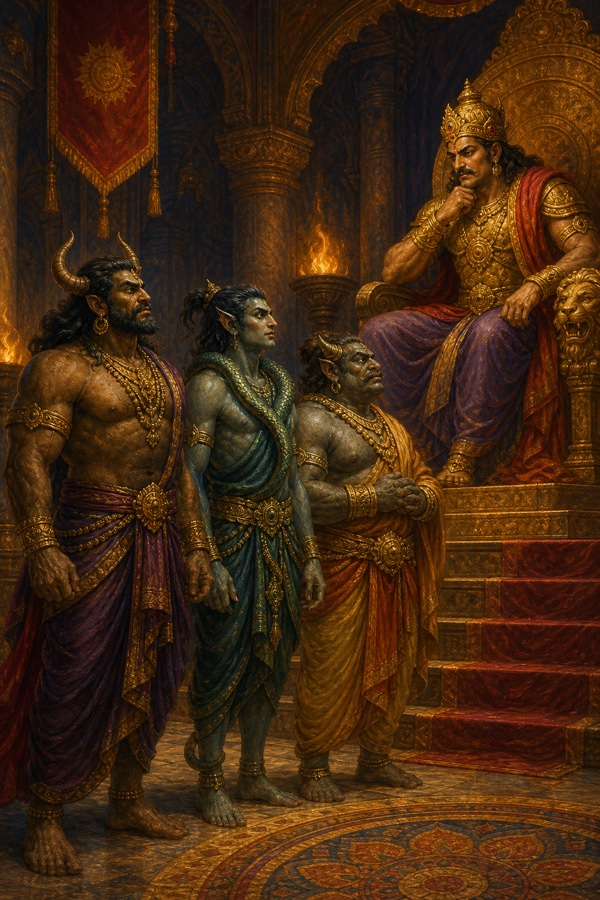
Vasistha had already told Rama how the demon king Shambara created Dama, Vyala, and Kata through maya, his power to project coherent forms. They possessed bodies, names, strength, and a military purpose from the instant they appeared. They possessed no former lives. No remembered injury made them cautious, no earlier triumph made them proud, and no private history gave them something to defend.
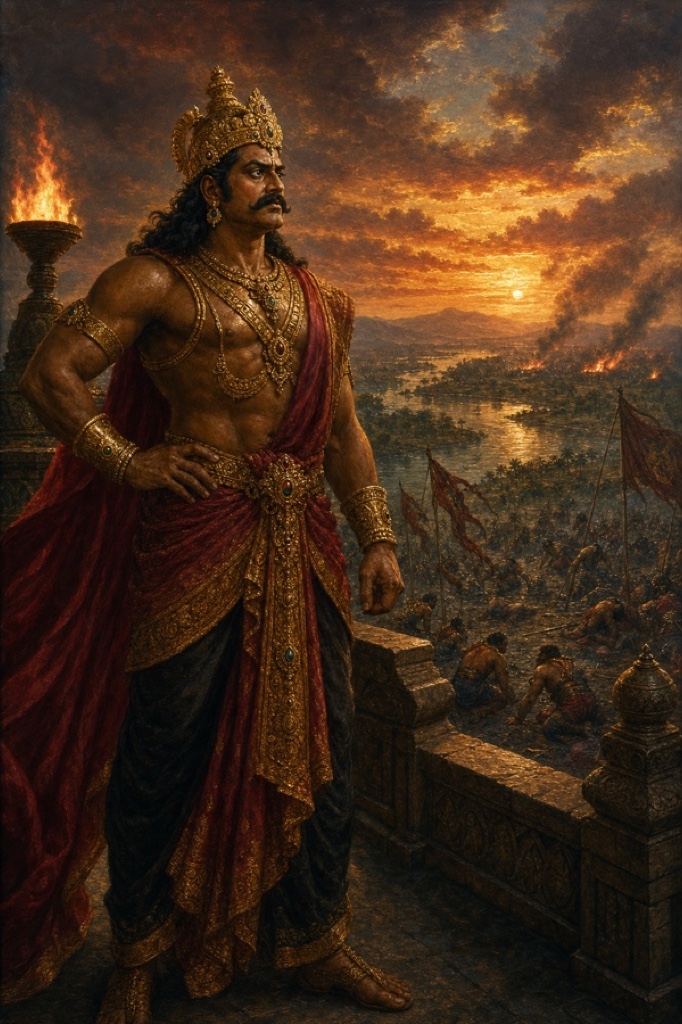
Their names described their assigned functions. Dama subdued an enemy. Vyala coiled around and seized an adversary like a serpent. Kata protected the demon army from hostile weapons. They were three distinct commanders serving the same king.
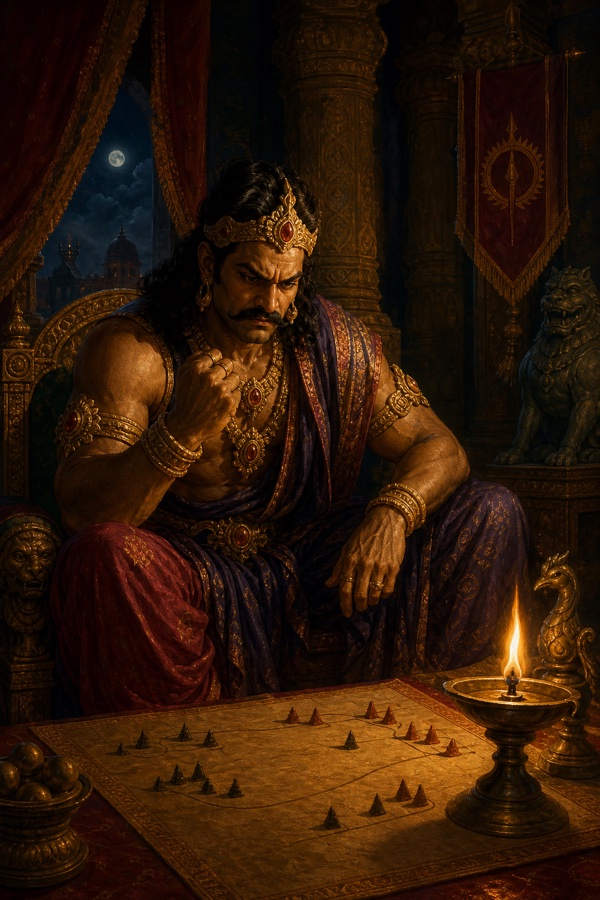
Their lack of vasana gave them their initial advantage. A vasana is a conditioning trace left by repeated experience, desire, fear, and identification. Dama, Vyala, and Kata had accumulated none. They also lacked self-knowledge. Their apparent detachment came from an unwritten past, while a liberated person’s freedom rests on understanding. Shambara’s intention moved them toward the work for which he had made them.
He placed the three over his army and sent it upward from Patala, the subterranean realm in traditional cosmography. Demons emerged through thickets near the sea and through mountain caves. The gods descended from Meru’s groves and caverns. Their armies filled the region between earth and sky.
The battle expanded beyond ordinary weapons. Blades, spears, clubs, arrows, uprooted trees, and fragments of mountains crossed the field. Some missiles spread fire or darkness. Others induced sleep, answered sleep with awakening, assumed serpentine forms, or met those serpents with Garuda-like counterweapons. Shukracharya’s Sanjivani knowledge restored fallen demons to life. Severed limbs and broken armor lay among the traces of successive assaults.
The field became a contest between entire environments. Dust rose and was pressed down by streams of blood. Fire spread until a counterforce covered it. Darkness concealed one force, and a weapon of illumination exposed it. Mountains were used as missiles, then broken into falling stone. The scale matters because the three commanders met every change without pausing to ask what the next blow might do to them. They had no remembered body whose earlier pain could warn the present one.
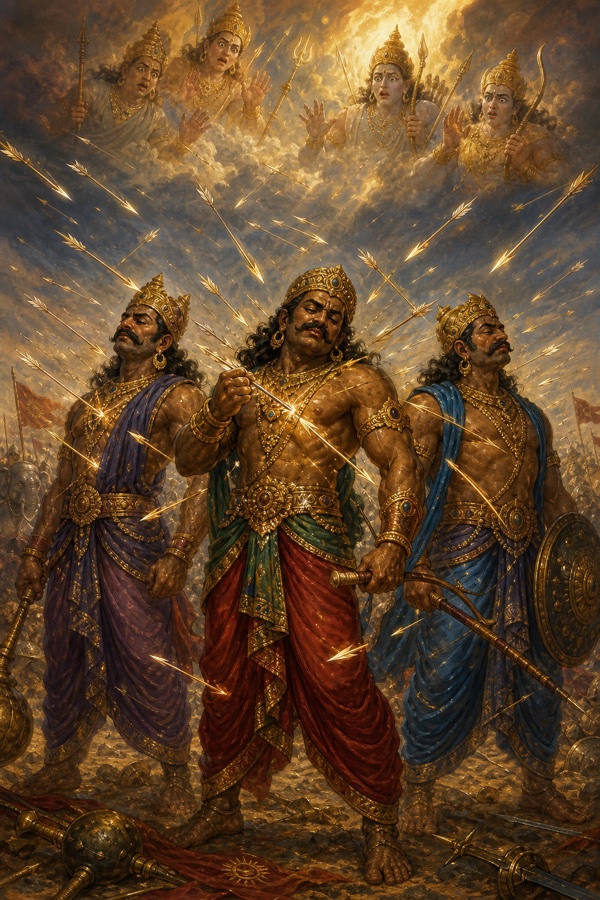
Dama enclosed the gods’ forces and roared. Vyala dragged at them and broke their dwellings. Kata cut through their ranks. Airavata, Indra’s elephant, withdrew, and the wounded divine army lost its formation. The commanders pursued the fleeing gods until concealment in dense retreats kept the fugitives beyond their reach. Satisfied with the result, the three returned to Shambara in Patala.
Their conduct had been immediate. An enemy appeared, and they attacked. They made no inward calculation about injury, reputation, or death. A threat to the body had yet to become “my danger.” That absence made familiar methods of intimidation useless.
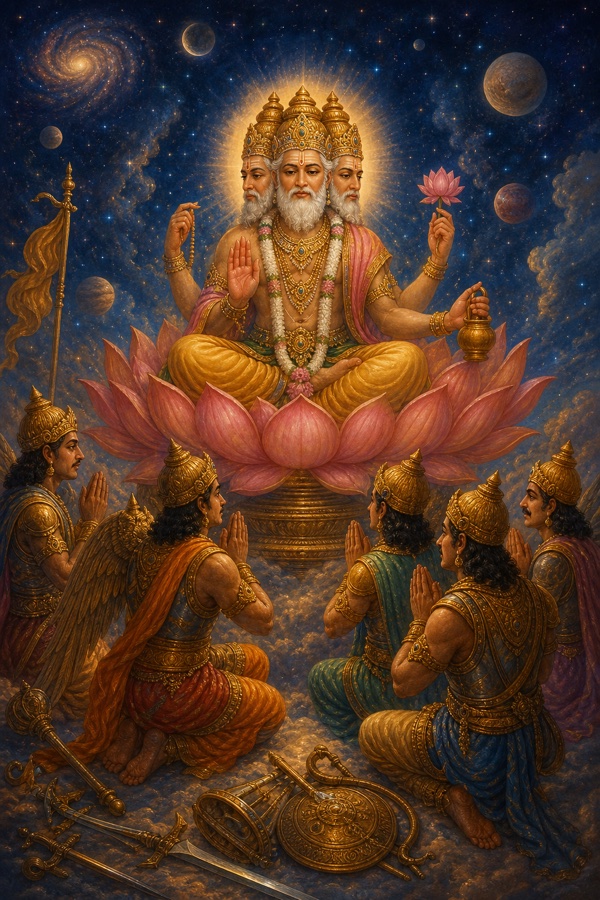
The gods understood the practical problem. They had faced fighters who could suffer danger without anticipating personal loss. After a short rest, they approached Brahma and described Shambara’s new creation.
Brahma Designs a War of Repetition
Brahma told the gods that Shambara’s destined death lay far ahead. Shri Hari would kill him after one lakh years. Until that time, the immediate contest had to be directed toward the three commanders.
His strategy depended on duration and repeated engagement. The gods should return to battle, draw Dama, Vyala, and Kata into combat, and then appear to retreat. They should renew the challenge, negotiate, conceal themselves, offer signs of surrender, reappear, and attack again. Ordinary arms and maya weapons could serve the same design. Every encounter would give the commanders another occasion to act, remember an outcome, and anticipate the next one.
Brahma compared the process to a reflection settling into view when an object repeatedly appears before a mirror. The three currently had no personal center that claimed an action. Continued warfare could deposit the sense “I am acting.” That claim would soon produce its counterpart: “this victory, this body, this life, and these possessions are mine.”
The proposal did not depend on praise or flattery. The gods were instructed to prolong behavior until behavior left a trace. Pursuit could become the memory “I pursued them.” Success could become “I won.” Exposure to danger could become “I must preserve myself.” Each fresh encounter would make those conclusions easier to repeat.
Brahma also explained why their present condition was unstable. Dama, Vyala, and Kata were profoundly ignorant products of Shambara’s maya. They had no accumulated personal conditioning, yet they had no discrimination capable of recognizing conditioning as it formed. An enlightened person can see bodily action without fastening identity to it. These commanders had no such knowledge. Their empty history remained available for new impressions.
Their state therefore differed from liberation at its cause. Freedom through knowledge understands consciousness as prior to every changing body and action. The commanders simply lacked a personal archive. Nothing within them had yet linked one event to the next as the fortune of a continuing individual. Repeated warfare could supply precisely that link. Memory would preserve an outcome, expectation would give the next outcome value, and value would organize desire and fear around a supposed owner.
Once attachment arose, their great strength would cease to guarantee victory. A bird caught in a net still has wings, yet desire and fear place its movement under another power. A strong being who has organized life around “I” and “mine” becomes vulnerable through everything it wants to keep.
The gods returned to their realms and prepared. Then the drums sounded again. The demon forces rose from Patala, and a long sequence of engagements began.
The gods followed Brahma’s instructions. They challenged the commanders in speech, opened negotiations, concealed their own people, withdrew as if overpowered, asked for protection as if helpless, struck, and vanished. The field repeatedly changed under competing acts of maya. Earth, water, flame, wind, and open space seemed to assume military form. Figures appeared to drown, burn, rise through the air, or fall into depths. Mountains, rivers, serpents, birds, weapons, spirits, and newly fashioned bodies emerged and disappeared inside the combat.
The engagements extended across three immense periods. One war or phase continued for thirty years. Another lasted five years, eight months, and ten days. A third lasted twelve years. The durations make the gradual nature of the change visible. Recurrent action built a history, and that history slowly acquired an owner.
Across those periods, apparent retreat was essential. If the gods had vanished permanently, the commanders’ activity would have ended before a durable personal pattern formed. By returning, yielding, bargaining, hiding, and striking again, the gods gave each commander a succession of unfinished contests. Yesterday’s victory could be remembered, today’s resistance could threaten it, and tomorrow’s encounter could be anticipated. Continuity of action became continuity of the imagined actor.
When Action Acquired an Owner
At first, Dama, Vyala, and Kata had responded only to the task before them. After decades of engagement, memory began to connect one battle with another. They expected adversaries to return. They prepared for outcomes. The accumulated sequence formed the conviction “I am.”
From that conviction came wishes for continued life, health, strength, wealth, food, women, and pleasure. Each began to want the body kept whole from head to foot. Victory acquired personal value. Honor and worship became desirable. The same awareness that called an achievement “mine” could now call an injury “my loss.”
The change did not erase their power. It altered what their power had to protect. Every advance now exposed a valued body. Every defeat threatened an acquired name. Thought moved ahead of the weapon, measuring the possible damage and the possibility of death.
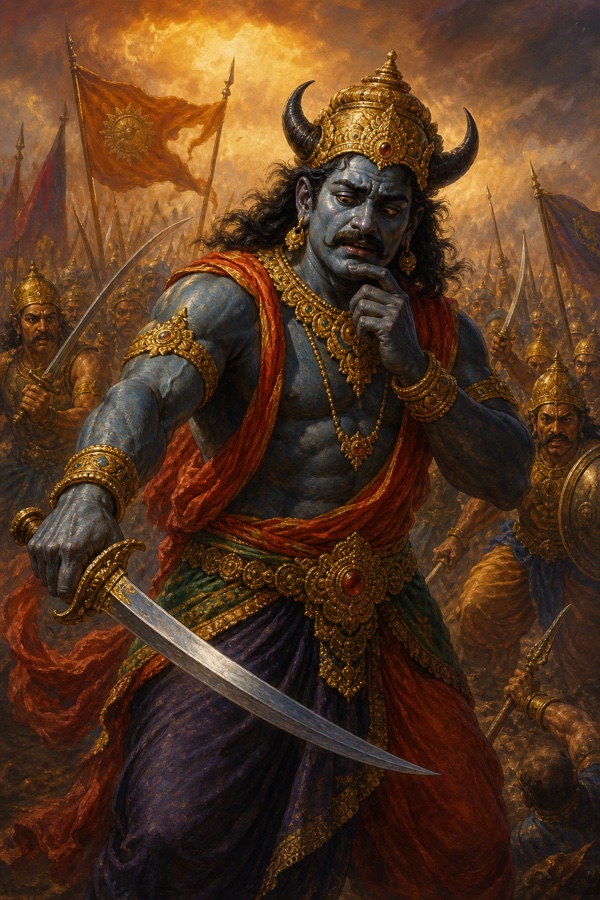
Their former steadiness weakened. Courage became obscured by concern for survival. Movements that had once followed the immediate demand of combat grew hesitant. When the gods pressed them, fear entered the interval between danger and response.
At last the three commanders fled. The demon army had relied on their apparently unbreakable advance. Seeing its protectors retreat, the larger force lost order. Warriors scattered across mountains, forests, rivers, villages, cities, coasts, and distant regions. Weapons, armor, and garments were abandoned along the routes of escape. Shambara’s surviving army collapsed with the confidence that had sustained it.
The rout spread across a vast geography. Some fugitives fell toward Lokaloka, the boundary mountain of the inhabited world. Others scattered through Andhra, Dravida, Kashmir, the Persian region, and lands associated with Jambu. Some became trapped in water, vines, nets, or caves. The commanders’ private fear had become a public consequence. Once the center of the formation chose survival, the whole force inherited disorder.
Dama, Vyala, and Kata feared the king who had created them. They could not return to Patala carrying news of the ruin. Instead, they descended to the seventh Patala, where attendants of Yama administered the regions associated with death and punishment.
The attendants granted the refugees protection and gave them three wives. A different life then extended the grammar of possession learned in war. “My body” widened into “my wife,” “my daughter,” and “my authority.” The commanders lived there for ten thousand years. Attachment deepened through domestic relationship and status, long after the battlefield that had first taught them to claim an outcome.
Safety did not reverse what battle had formed. It supplied fresh objects for the same habit. A protected household could be guarded, a relationship could be claimed, and authority could become proof of importance. The repeated sentence “this is mine” continued to confirm the speaker who said it. Their refuge gradually became another enclosure built from identification.
Yama eventually came to that region on business concerning the great hells. He arrived without the royal signs by which an office might be recognized, including the umbrella and chowrie. The three saw no visible insignia, mistook the ruler of death for an ordinary servant, and withheld the honor due to him.
One frown from Yama ended their protected existence. Dama, Vyala, and Kata, together with wives, loved ones, and relations, were sent into the burning regions of Raurava and related hells. The identities they had spent millennia protecting could provide no refuge there.
The Long Descent into Small Lives
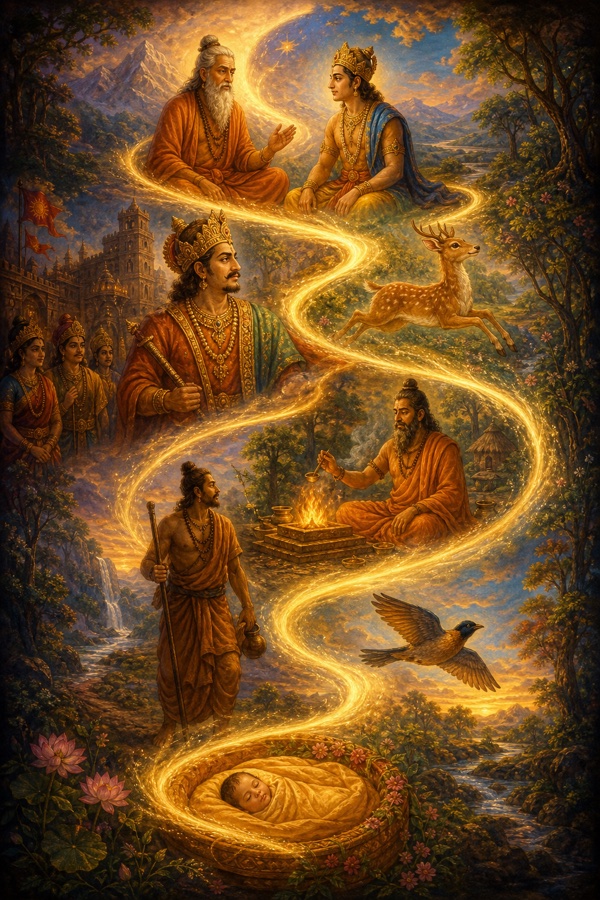
Actions joined to violence, attachment, and fear continued to shape experience after the punishment. The three became royal servants or Kiratas, then crows, vultures, and parrots. They were born as pigs in Trigarta, as clouds upon mountains, and as insects in Magadha. Other embodiments followed within the same long current.
Each form supplied a new local world of food, danger, movement, and survival. The private history that began in war no longer needed a warrior’s body. Its conditioning could organize life around the limits of a bird, animal, cloud, or insect. The former commanders repeatedly treated the present embodiment as the whole of what they were.
Vasistha connects each transition with the dispositions strengthened before it. Violence, confinement, appetite, dependence, and fear leave tendencies suited to later circumstances. The list is therefore a causal history expressed through bodies. A royal servant’s obedience, a scavenging bird’s hunger, a pig’s search for food, a cloud’s brief formation, and an insect’s narrow field of movement each provide another setting in which the conditioned sense of life continues.
Eventually all three became fish in a small forest pond in Kashmir. Summer heat and forest fire reduced and warmed the water. The mud dried. They remained in the foul shallows, longing for scraps of aquatic weed, unable either to live well or to die. The scale of their concern had narrowed from armies and celestial regions to the next fragment of food in a failing pool.
Rama interrupted the account. Shambara had produced the three through maya, and Vasistha had called them unreal. How, Rama asked, could projected figures undergo suffering that appeared fully real?
Vasistha answered by applying the same question to everyone in the teaching hall. Dama, Vyala, Kata, gods, demons, Rama, and Vasistha all appear within experience, speak, move, and enter relationships. On the practical level, their worlds have sequence and consequence. Under inquiry, no experienced body has a separate substance outside consciousness.
He used the appearance of water in a mirage to clarify the distinction. The water is perceived, while independent water-substance never arises there. In a similar way, consciousness presents a form according to the way it knows itself. Identification gives that form an experienced history, even though the form possesses no independent foundation apart from consciousness.
Vasistha calls the enduring reality chidakasha, the limitless expanse of consciousness. It remains peaceful and unchanged while names, bodies, worlds, sleep, waking, pleasure, and pain appear within it. The reality of awareness lends coherence to what awareness experiences. A projected beginning therefore gives no exemption from suffering once identification organizes the projection around fear and possession.
Vasistha asked Rama to examine the common ground shared by Dama, gods, demons, and every other appearing person. Practical experience continues to matter within its order. Knowledge removes the claim that any passing form exists by itself.
The explanation holds two levels together. Within conduct, a wound calls for care, an action bears consequences, and a listener can learn from a teacher. In the inquiry into ultimate substance, body and event arise as presentations within consciousness. The fish suffer within the practical order while their passing forms remain inseparable from the awareness in which they are known.
Rama then asked when the misery of the three would end. Yama’s attendants had once asked the same question. Yama had told them that release would come after the three separated from one another and heard the account of their own maya-created individuality. The hearing would remind them of the vasana-free consciousness beneath the identity they had acquired.
The fish lives continued. During one summer, buffaloes and pigs trampled the shallow pond, and the three fish bodies ended. The next birth placed them as sarus cranes in a lotus lake. They lived there for a long time among lotuses, aquatic vines, cool eddies, and rain-bearing clouds. Their minds gradually became clearer. Then the shared course divided, carrying each toward a separate place of hearing.
Three Hearings in Adhishthana
In Kashmir stood a city named Adhishthana, surrounded by mountains and trees. A small height called Pradyumna Peak rose near its center. On the northeastern side of a tall house upon that height, a nest occupied a crack in a high wall. Vyala was born there as a sparrow. Its chirping resembled the empty recitation of someone who had touched a little scripture without grasping its meaning.
King Shri-Yashaskara ruled Adhishthana with a prosperity compared to Indra’s. Within the royal palace stood a great wooden pillar. A small hole opened in the back of it, and Dama lived there as a softly sounding mosquito.
The city also contained a pleasure house called Ratnavali Vihara. Minister Narasimha lived there. Through revealed teaching, reasoning, instruction from his teacher, and direct experience, he had gained a clear understanding of bondage and liberation. Kata became the minister’s play-bird, a myna kept in a silver cage.
The three former commanders now occupied tiny lives within the same city, each in a different setting. Vyala had a nest in a wall crack at Pradyumna Peak. Dama inhabited a wooden pillar in the king’s palace. Kata lived in Narasimha’s silver cage at Ratnavali Vihara. They never assembled for a common audience.
Narasimha recited the account of Dama, Vyala, and Kata in verse. Kata heard the complete history from the cage: creation without inherited vasana, repeated war, the growth of “I” and “mine,” fear, defeat, punishment, and the procession of lives.
Hearing supplied a view of the identity from outside its habitual claim. Kata recognized that the limited life-form imagined through Shambara’s maya had been acquired and sustained through conditioning. Memory of the unbounded Self arose. The myna attained nirvana and ceased to wander through further births.
Narasimha’s qualifications explain why this recital carries philosophical weight. He knows bondage and liberation through shruti, the body of revealed teaching; through reasoning; through a teacher’s instruction; and through his own direct experience. His verse gives Kata an intelligible account of cause and result. The listener can recognize both the acquired personality and the consciousness that had never been confined to it.
Vyala heard the same account from people living around Pradyumna Peak. No minister convened a second formal recital. Words passing among the residents reached the sparrow in its wall-side nest. Through hearing and recognition, Vyala attained nirvana.
Dama’s occasion was quieter still. People near the palace happened to discuss the Brahma-teaching together with the history of the former birth. Their conversation reached the mosquito within the wooden pillar. Dama recognized the same origin and came to peace.
The three private hearings fulfilled Yama’s prediction. Kata received an ordered recitation from a learned minister. Vyala caught the history in the speech of local people. Dama encountered it incidentally through discussion near the palace. Many lives of consequence had prepared them to recognize how repeated action had formed the ego-sense they had accepted as natural. Once that process became visible, the claim of a separate, enduring owner lost its support.
What Vasistha Asks Rama to Practice
After the three releases, Vasistha widened the teaching. Maya can carry an immature, apparently unconditioned being from a powerful station into progressively narrower embodiments. Initial fearlessness does not establish realization. Stability requires knowledge of the Self and a mind prepared to receive it.
Vasistha then distinguished three uses of ahamkara, the sense expressed by “I.” The bodily form declares, “These hands, feet, and this body are all that I am.” This is the binding ego exemplified by the commanders. It converts every bodily condition into a total statement about the self. From it grow the claims attached to health, food, wealth, relationship, status, victory, and survival.
A second orientation regards the observing Self as extremely subtle and distinct from every limiting object. It helps the seeker loosen exclusive identification with name, limbs, possessions, and circumstance. A third, more comprehensive orientation affirms identity with the whole universe and the imperishable Self, with no independent thing standing outside consciousness. These two formulations serve as disciplines during inquiry. When realization matures, the seeker releases the need to maintain even these provisional ideas.
The practical direction follows the causal structure of the story. Repeated activity built the commanders’ bodily ego. Deliberate effort can also refine the mind. Vasistha recommends sustained inquiry, study of trustworthy scripture, service to a teacher, and the company of wise people. He identifies such company by its effect: greed, confusion, and anger diminish day by day in the presence of those whose conduct accords with the teaching.
The criterion is deliberately observable. Prestige, verbal display, and claims of holiness provide no adequate test. A relationship with a wise person should reduce the impulses that cloud judgment and strengthen conduct aligned with inquiry. Practice then becomes an environment in which discernment is repeatedly exercised, much as the long war had been an environment in which possession and fear were repeatedly exercised.
Vasistha recalled Nandi, the gods oppressed by Bali, Samvarta at King Marutta’s sacrifice, Vishvamitra, Upamanyu, the sage Shveta, and Savitri as examples of firm effort bearing its appropriate result. He asked Rama to direct that capacity toward self-knowledge, since the central confusion about birth, death, pleasure, and pain is rooted in mistaken identity.
The sequence of practice remains gradual. The seeker first loosens the bodily “I” through discernment. Listening, inquiry, service to the teacher, and the seven stages of spiritual development steady the mind. The useful orientations toward the observing Self and the all-pervading Self then complete their work. The final teaching rests in the unbounded Self and culminates in videha-kaivalya, liberation when embodied life has ended.
Dama, Vyala, and Kata show repetition operating in two directions. Unexamined action made identity, possession, and fear increasingly persuasive. Sustained inquiry made recognition possible in lives reduced to a mosquito, a sparrow, and a caged myna. Vasistha asked Rama to carry that discernment into ordinary action, so that work could proceed without building another chain of possession.