On this page
Yoga Vasistha · Story 16
Dasura and the Kadamba Tree: The City of Imagination
Grief drives Dasura to search the earth for a place pure enough for austerity, and he finds none until he climbs into the high top of a vast kadamba tree. Years later a forest goddess brings him her twelve-year-old son, and Dasura uses the impossible city of King Khottha, the Air-born, to show the boy how the will builds bodies, worlds, selves, and sorrow.
A Mountain in Magadha
Vasistha had been telling Rama that a man caught up in business and bent on wealth and pleasure never learns the truth until he puts his worldliness down; that the one who sees through the world’s errors drops his egoism as a snake sheds its skin, and is never born again, like a roasted grain that will not sprout however long it lies in the field. Then he reached for a story. “The turning of this world is like the hallucination in Dasura’s mind. Hear how. On the surface of this land lies the great and wealthy province of Magadha, full of flowering trees of every kind. There is a forest there of wide kadamba groves where birds of every color come, and fields heavy with grain, and groves along the borders, and the banks of its streams are crowded with lotus and water lily in bloom. The arbors ring with the songs of country girls, and at night the frost beads the flower stalks on the plains until they look like Kama’s arrows. At the foot of a mountain there, among karnikara blossom and rows of plantain and kadamba, is a hidden spot grown over with moss and shrubs, dusted red with the pollen the wind carries, loud with water birds and cranes. On the sacred hill above it stands a kadamba crowded with birds, and on a branch of that kadamba sat a sage of great austerity, a man of high soul and no passions. His name was Dasura.” Rama asked the question anyone would. “How did that hermit come to live in that forest, and why did he take his seat so high up in a tree?”
“His father,” Vasistha said, “was the famous sage Sharaloma, who lived on that same mountain and went so deep in meditation that people compared him to Brahma himself. Dasura was his only son, as Kacha was the only child of Brihaspati, the teacher of the gods, and he had lived in the forest at his father’s side from boyhood. His mother was already gone. Sharaloma passed many years in that life, and then he left his mortal frame for his heavenly home, as a bird leaves its nest for the open air.”
Dasura was left alone in that lonely forest. He wept bitterly, he wailed for his father as a heron shrieks when it has lost its mate, and with both parents gone the grief ate at him until he faded like a lotus in winter. His eyes were red and raw. The god of that wood, the unseen spirit who lives in it, saw the young man’s state, pitied him, and spoke to him out of the air.
“Son of a sage, and a sage yourself: why do you weep like the ignorant? Why are you so broken, when you know how unstable the things of this world are? That is the condition of this frail world, that nothing here stands still; the course of nature is that all things are born, live a while, and perish into nothing. Whatever you see here, from great Brahma down to the meanest thing, is doomed to perish, beyond any doubt. So do not wail at your father’s death. Know that everything is destined to rise and to set, like the sun.”
The voice came from nowhere, and it carried. Dasura wiped his eyes and fell silent, as a peacock that has been screaming goes quiet at the sound of the rain cloud. He rose, performed his father’s funeral rites with all his heart, and set his mind on steady devotion. He kept his austerities by the Brahmins’ law and worked through the ceremonial rites of the Shrauta ritual for one vow after another. None of it settled him. He did not know Brahman, the thing that is to be known, and so his mind found no rest in its ceremonies, and no purity anywhere on the surface of the stainless earth. Because he did not see the world as full of the divine spirit, with every place in it holy, the ground itself looked polluted to him, and he could find nowhere to sit down. So he made a vow of his own: he would take his seat on the branch of a tree, which the earth’s pollution did not touch. “From now on I will do my austerities in these branching arbors,” he said, “and rest like the birds and the spirits of the wood, on the branches and the leaves of trees.”
Fire at the Treetop
So he sat up high, and he kindled a blazing fire beneath him, and he was about to feed it with living flesh, paring slivers from his own shoulder blade, blood and all, when the god of fire took thought. Fire is the mouth through which the gods take their food; the flesh of a Brahmin dropped into it would scorch the face of every god at the feast. So Agni came, in his full blaze, and stood before the young man as the sun stands before Brihaspati, the lord of speech, and spoke gently. “Take the boon you want from me, young Brahmin, as the owner of a storehouse takes his treasure out of the chest it is kept in.”
Dasura’s hand stopped where it was. He saluted the god with a hymn of praise, honored him with offerings of flowers, and said what he wanted. “Agni, I can find no holy place on an earth so full of iniquity and sinful beings. I ask you to make the tops of trees the only places where I live.”
“So be it,” the god said from his flaming mouth, and he was gone, as daylight leaves the face of a lotus. The sage’s son had what he had asked for, and his face shone like the full moon; the smile broke across it as a white lotus opens its petals when the moonlight touches them.
The tree he had chosen was a kadamba, and it was no ordinary tree. It stood in that forest reaching to the region of the clouds, high enough to be a halting stage for the tired horses of the noon sun. Its boughs spread a canopy under the vault of heaven on every side, and it looked out at the sky with its thousand opened blossoms for eyes. The wind shook fragrant dust from its hanging tufts, which were studded with bees, and its leaves brushed the face of the sky like open palms. Peacocks sat along its top like rainbows in green foliage; white herons on their nesting boughs looked like siddhas at rest in heaven; birds lived in its hollows as all the races of beings live in the person of Vishnu. Elephants lay beneath its branches with stars shining above them, so that the woodland looked like a sky with dark clouds below and the stars burning overhead. Birds on the boughs, birds about their nests, fowl feeding on the ground: the forest was a city with its people above, below and all around, and its bowers were the inner rooms of houses, with blossoms waving over them for flags. With its head in the sky it defied Indra’s parijata; thronged with bees, it rivaled thousand-eyed Indra for eyes; dusted with its own pollen, it looked like Shiva anointed with ash. Dasura climbed it, mounted the high and airy top, and looked out on all sides like Vishnu surveying the worlds. From that branch that reached into the sky he kept his devotions, with no fear and no desire. And from his leafy couch he saw the whole country below him as a fairy queen: a distant river glittering as her gold necklace, the hills rising as her breasts under a mantle of cloud, the green of the trees her dress, the flower clusters garlands on her head, the lakes her water pots, the lotus fragrance her breath, the waterfalls the anklets ringing at her feet, the sun and the moon her two earrings, the clouds her garment and the trees at the borders its fringe. Ten directions of heaven, and every one of them full of her.
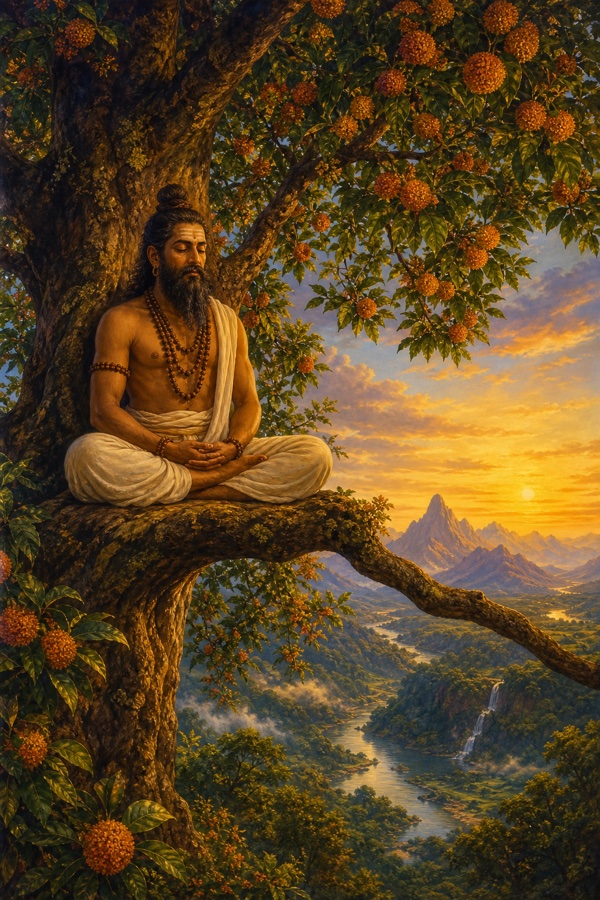
From then on he lived in that hermitage in the air and was known as Kadamba Dasura, a giant of austerity. He sat on the leaves of the creepers that grew along the branch, looked up to heaven, folded himself into padmasana, and called his mind back into himself. He knew nothing yet of the worship of the spirit, he was out of reach of the ceremonial ritual he had been trained in, and he still wanted what the rituals promised. So he performed the sacrifices in his mind. For ten full years he sat on that airy seat and carried out, in spirit and in thought, the rite of the sacred fire and the great sacrifices, the gomedha of the bull, the ashvamedha of the horse and the naramedha of the man, satisfying the gods and paying the priests their fees, every piece of it imagined and every piece of it exact.
In the course of that time his mind was purified and widened, and the knowledge of his own soul’s blessedness came to him. It is said that ceremony leads on to the knowledge that gives bliss; so it was here, with ceremonies no one but he had ever seen. His ignorance went, his heart was washed of the dirt of worldly desire, and when he opened his eyes a sylvan goddess was standing beside his leafy, mossy seat.
The Forest Goddess and Her Son
She was a body of light in a robe of flowers, with a beautiful face and large bright eyes that turned toward him and then fell. Her body breathed the fragrance of the blue lotus, and her figure went straight to his inmost heart. He spoke to her as she stood there with her eyes lowered. “What are you, tender lady, who look like a creeper loaded with flowers, and would put Kama to shame with that form and those lotus-petal eyes? Why do you stand there like the goddess who befriends every flowering vine?”
“May you prosper and have everything you wish,” she said, in a voice that was sweet and sure of itself. “Whatever is worth wanting in this world, however hard to get, the great obtain by the right effort. I am a goddess of this forest, Brahmin, this forest so full of creepers and so lovely with its kadamba trees. I came here to watch the festival of the sylvan goddesses, which is held in this forest every year on the thirteenth day of the month of Chaitra. I saw my companions enjoying their festival of love, and among them I felt the sorrow of having no child. I find you accomplished in every qualification, and so I have come to you with my suit: give me a son. Please, sir, beget a son in me. Otherwise I will put my body in the fire and be rid of the grief of childlessness.”
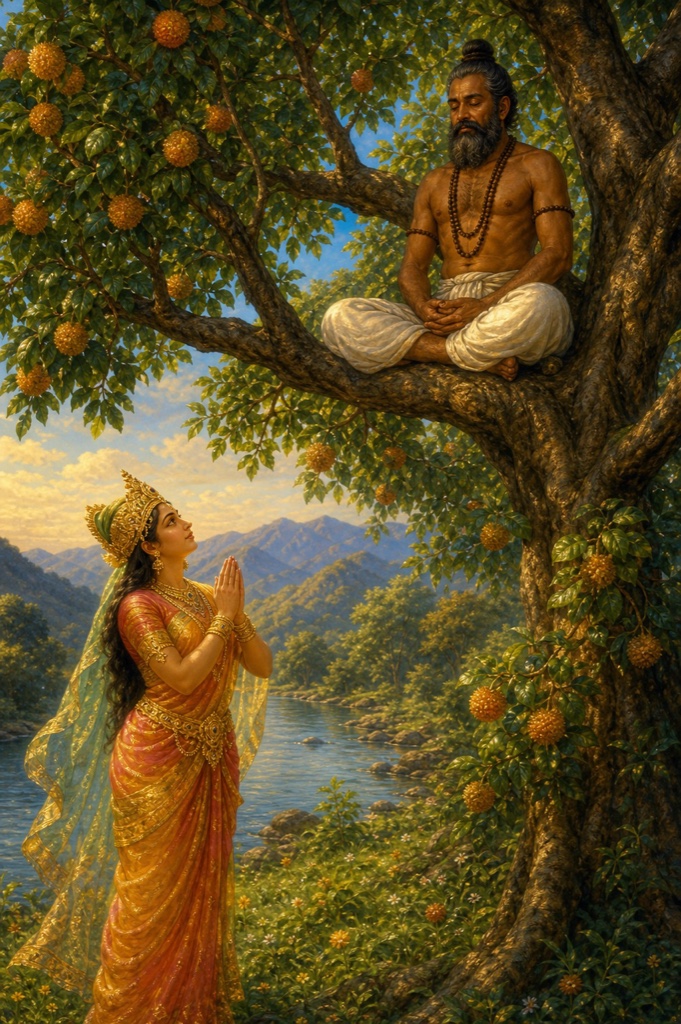
The hermit smiled at her. He took a flower in his own hand and gave it to her, and spoke kindly. “Go, young woman, and give yourself to the worship of Shiva for a whole month. Then, like a tender creeper, you will bear a boy as beautiful as a bud, by this time of year. But that son of yours, whom you asked of me at the price of your own life, will take up austerities like mine and become a seer like me.”
She went away glad in her face, and he promised to do what his blessing required of him. The lotus-eyed goddess returned to her home, and the hermit went on through his months and his seasons and his years in meditation.
After a long time she came back, and with her came a boy, now in the twelfth year of his age. She bowed and sat down before Dasura with her moon-faced son, and spoke to him in words as sweet as a bee’s murmur to a stately mango tree.
“Sir, this is the son of us both, the boy who was to be. I have trained him in all the branches of learning. He is untaught in one thing only, the best knowledge, the knowledge that frees the soul from coming back to this world of troubles. Now teach him that yourself. Who is there who would want to keep his own boy in ignorance?”
Dasura told the young mother to leave the child there and go her own way. When she had gone, the boy stayed at his father’s side as his pupil, obedient, waiting on him as Aruna waits on the sun. He hardened himself to austerity and took his best knowledge from his father’s lectures, and he lived a long time with him in that place, under the name of the sage’s son. Dasura taught him through narratives and tales, through examples and things he could see with his own eyes, through the histories and the evidence of the Veda and the Vedanta. The boy listened without anxiety and built his right notions of things from their antecedents: what he perceived, what he could infer, what he could compare, and what the shastras testified. His father put true knowledge into him by right reasoning and plain, correct words, caring nothing for elegance, as the cloud tells the peacock that rain is coming by its hoarse rumble and nothing more.
It was in those years that Vasistha passed that way. He was traveling in his invisible body to bathe in the heavenly stream, the Mandakini, by the road of the seven sages, and he came to the place where Dasura lived on his high kadamba. Out of the hollow of the tree in the forest came a voice, as charming as a bee humming around a lotus bud. “Listen, my intelligent son,” it said, “to a story I will tell you as a simile of worldly things. It is pleasant to hear.”
King Khottha’s Impossible City
“There is a very powerful king, famous in all three worlds for his prosperity. His name is Khottha, the Air-born, and he can grasp the whole world in one hand. Every lord of the earth bows his head under his rule, and they wear the badge of their submission to him as proudly as a poor man wears a bright gem on his head. He exults in his valor and in the possession of every kind of rarity, and there is no one in the three worlds who can bring him under subjection.”
“His acts and exploits are past counting, and they are strung with pain and pleasure one after the other, as endless as the waves of the sea. No one has ever checked the prowess of that mighty bravo by fire or by sword, just as no one has ever closed his fist on the wind. Even the gods Indra, Upendra and Hara have fallen short of following his steps in his ambitions and the splendid inventions of his imagination. He has three forms, sattvika, rajasika and tamasika, and in that triple shape he encompasses the world and gets every kind of action done. He was born in the vast emptiness with a triple body, as a bird is flesh and bone and feather, and he lives in the void as air lives there, and sound.”
“In that unlimited space of the universe he has built a city. It has fourteen provinces, laid out in three divisions: the earth, the regions above it, and the regions below. It is beautified with forests and groves, pleasure lawns and hills, and bounded on every side by seven lakes of pearly water. Two lamps light it, one hot and one cool, and they wheel above it and below it on their day and night rounds, like righteous people and night prowlers going about their business.”
“The king has peopled this great city of his with many self-moving bodies, which go round in their spheres quite ignorant of themselves, of where they came from, where they are going and what will become of them. Some he has posted in the high spheres and some in the low; others go their middle way; some are destined to live long and some to die within a day. These bodies are roofed with black hair like thatched huts, and they are fitted with nine holes for doors and windows, through which the air goes in and out without a pause to keep them alive. Each is lit by five lights of sensation and perception. Each stands on three posts, the two legs and the backbone, with a frame of white bones for beams and rafters, plastered over with flesh as a mud wall is plastered with wet clay, and the two arms hang across the doorway as its latches.”
“Over each of these houses the great king has set a sentinel, the yaksha called egoism. In the dark that guard is as fierce as Bhairava; by daylight he is as timid as a coward; he brags in the darkness of ignorance and runs from the daylight of reason. The masters of these walking houses play their pranks in them as a bird frolics in its own nest. And the three-formed prince himself is never steady anywhere. He lives in many bodies, plays his games in them with his guard of egoism, and leaves one body for another as he pleases, as a bird hops from branch to branch.”
“He is always changing his will. He lives in one city and builds another for his future home. Like a man ridden by a ghost he starts up from one place and runs to the next, building and breaking and rebuilding his castles in the air as the whim takes him. Sometimes he decides to destroy his old frame and move to another, and he does it, at will. He rises again like a wave of the sea after it has sunk to rest, and takes a different course, slowly, in his renewed life. Sometimes he remembers what he did in a former life and laments his ignorance and his miseries and does not know what to do. He is cast down by sorrow and lifted by success, like a river that runs low in the hot season and floods its banks in the rains. His hobbies drive him as the winds drive the waters of the sea: he puffs and swells, falls and rises, runs fast, and stops dead in a calm.”
The boy was listening in the dark. It was night over the forest of Jambudvipa, and his father sat reclining on the sacred kadamba as he spoke. When the story stopped, the boy asked: “Tell me, sir, who is this Air-born prince with the supernatural form you have just told me about? I do not fully understand it. I want it explained plainly. You said that this prince builds himself a new home while he is still living in his present body, and moves into it once he has left the old one. That seems impossible to me, like joining one tense to another, the present to the future.”
The Ruler Made of Will
“Hear the meaning of the parable, my son,” Dasura said, “and it will show you the nature of this turning world in its true light. I told you at the start that a non-entity sprang in the beginning out of the entity of God, and that this non-entity, stretched out afterward as illusion, gave rise to this illusory world we call the cosmos. The empty spirit of the Supreme gives rise to his formless will, and that will is what we call the Air-born: the mind. It is born of itself, formless, from the formless Spirit, and it dissolves back into the same, as a wave rises from the sea and falls into it. It is the will that produces everything; nothing is produced except by the will. The will is one with its object, which is made of it and lives in it, and it lives and dies along with its object. Know the gods Brahma, Vishnu, Indra, Shiva and the Rudras as offspring of that willful mind, as branches are offshoots of the main tree and the summits are projections of the principal mountain.”
“This mind builds the city of the three worlds in the void of Brahman, an air-drawn castle, because it has intelligence from the Omniscient, in its form as Virinchi. The city has fourteen worlds with all their peoples, chains of hills and forests, gardens and groves. It has the two lights of the sun and the moon to burn as two fires by day and by night, and many mountains for human sport. Pearly rivers wind through it, their waves shining like chains of pearls under sunbeam and moonlight, and the seven oceans lie in it like so many lakes of clear water, lit from beneath by their submarine fires like lotus beds and mines of gems under a blue sky. Gods, men and savages trade here in the commodities of virtue and vice, and the trade leads up to heaven or down to hell.”
“The self-willed king, the mind, has hired many persons to play their parts before him for his pleasure. Some he has placed high above the stage, to act as gods; others he has set in the lower pits of this earth and the regions beneath it, to act their miserable parts as men and Nagas. Their bodies are made of clay, framed on white bones, plastered with flesh under the skin, and they breathe like bellows. Some have long parts to play and some make their exit in a short time; some wear caps of black hair and others of white and gray. Each is pierced with nine crevices, two ear holes, two eye sockets, two nostrils and the opening of the mouth among them, which spend their time breathing cold air in and hot air out. The ears, the nostrils and the palate are the windows of the house, the hands and feet its gateways, and the five inner organs its lamps.”
“Then the mind creates, of its own will, the delusion of egoism, which takes possession of the whole body like a yaksha demon and flies before the light of knowledge. With that delusive demon for company the mind takes great pleasure in amusing itself with unrealities, until reason shows it how empty they are. Egoism lives in the body like a rat in a barn or a snake in a hole in the ground, and it drops off like a dewdrop from a blade of reed when the sunlight of reason comes up. It rises and falls in the house of the body like the flame of a lamp, and it is as loud with its desires as the sea with its waves.”
“Now to your question. The mind builds a new house for its future home out of the endless desires it has in its present one, desires it expects to see fulfilled and enjoyed in the state to come. But the moment it stops feeding its desires, it stops existing, and loses itself in that Supreme bliss which has no end. It is born and reborn by its repeated desires, as a child goes on seeing the ghost by its constant fear of it. It is egoism, the belief in one’s own real existence, that spreads this miserable world out before a man; take away the knowledge of self-existence and the sight of every object goes with it, as thick darkness hides all things. A man brings the world’s miseries on himself by his own effort in this way, and then he wails at his fate, like the foolish monkey in the fable who pulled the wedge out of the half-split log and was crushed by it. The mind waits in eager expectation for the enjoyment of what it wants, like the stag that stood with its mouth open under a honeycomb, waiting for a drop to fall. It chases its objects, drops them in disgust, longs for joy, and sulks at its failure like a fretful child. So work hard now, my boy, to pull your mind free of every outward object and fix it on the inward object of this meditation.”
“The willful mind takes on, at its own will, its good, its bad and its sober forms, which are called sattva, rajas and tamas. In its vitiated form it delights in worldliness, and by degrading itself with its greedy appetites it brings itself down to the state of worms and insects in its future births. In its good form it is inclined to virtuous deeds and the getting of knowledge, and by these it advances to its aloneness and its self-enjoyment, which is full liberation, the state of the highest Brahman. In its moderate form it keeps the rules and laws of society and conducts itself in the world among friends and the members of its family. When it has given up all three forms, and egoism and desire with them, it reaches the state of the absolute Supreme Being.”
“So shun the sight of the visible, hold your fleeting mind down with your sober intellect, and cut down your desires for every good, inward and outward. Because you may practice your austerities for a thousand years and crush your body by throwing yourself from a precipice onto the rocks; you may burn yourself alive on a pyre or plunge into the fire under the sea, fall into a deep dark pit or well, or run onto the edge of a drawn sword; you may have Brahma himself or even Shiva for your teacher, or the kindest and most tender-hearted ascetic for your religious guide; you may be in heaven or on earth or in the regions of Patala below us: there is no way to liberation for you except keeping your desires under subjection. Use your manhood to master your violent, irresistible desires and passions, and you will have the pure, transcendent joy of peace and holiness. All things are tied together in the bandage of cupidity; break that band, and the things desired vanish into nothing. The real is unreal and the unreal is real, as the mind makes them appear; all reality and unreality lie in our conception of them and nowhere else. As the mind conceives a thing to be, so it perceives it to be in fact; so have no conception of anything, if you want to know the truth of it. Act as the world goes, without liking or disliking anything, and when desire is at an end the intellect rises to the inscrutable, beyond the knowledge of the mind. The mind that sprang from the Supreme Soul in the form of goodness and then leaned toward the unrealities of the world has estranged itself from the Supreme and exposed itself to every misery. We are born to the doom of death; let us not die to be reborn into the miseries of life and death again. First learn the truth and come to the true knowledge of your soul; then put down all your desire and dislike of the world. When your inner feelings have gone as still as the dead, you will be able to know that transcendental state which is full of perfect bliss.”
The boy had one question left in him. “What is this desire, father? How is it produced, how does it grow, and how is it destroyed in the end?”
“The desire, the will, sits in the mind, in the mental part of the one eternal, universal, spiritual substance of God. It takes the form of a monad out of a formless unit, and then by slow expansion it spreads over the whole mind and fills it, as a thin cloud soon covers the sky. The mind, resting in the divine Intellect, thinks of thinkable things as if they were distinct from itself, and its longing after them is what we call desire; it springs from the mind as a shoot from its seed. Desire is produced by desiring something, and it grows of itself in size and in quantity, for our trouble only, and for no good or happiness at all. It is the piling up of our desires that makes the world, as the piling up of waters makes the ocean. You have no trouble without your desire, and free of it you are free of the miseries of the world. It is by mere chance that we come upon the objects of our desire, and by an equally unavoidable chance that we lose them; they show themselves like secondary suns in the sky and fly off like a mirage. As a man with jaundice from eating a certain fruit sees everything as yellow as gold, so desire in a man’s heart paints the unreal as real before him. Know this truth: you are an unreality yourself, and must become an unreality afterward. He who has learned to disbelieve his own existence and everyone else’s, and knows how empty his joy and grief are, is troubled at the gain or loss of nothing. Knowing yourself as nothing, why think about your birth and your pleasures here? You are deluded for nothing by the emptiness of your desires. Do not entertain them; do not think about anything, which is nothing; live that way and you will be wise and happy.”
“Try to give up your desire and you will slip past every difficulty. Stop thinking of a thing, and your desire for it disappears of itself. Even crushing a flower takes some effort; it takes no effort at all to destroy your desire, which vanishes for want of its thought. You have to open your palm to take hold of a flower; you have nothing to do to destroy your frail, false desire. Whoever wants to destroy his desire can do it in a trice, by forgetting the thought of the thing he desired. Hold your thoughts back from other objects and fix them in the Supreme Spirit, and you will be able to do what is impossible for other men. Kill your desire by desiring nothing; turn your mind from all things by fixing it in the Supreme, which you can easily do by yourself. Once our desires are quieted every worldly care comes to a standstill and every trouble is locked up. Our wishes are our minds, our hearts, our lives, our understandings and all our desiring faculties; those are different names for the same thing, with no difference in what they mean. There is no other business in our lives than to desire, and to be doing, and when it is done to desire again; root that restless craving out of the mind and it is free of every anxiety. The world below is as empty as the hollow sky above, and both are empty nothings, except that our minds make something or other of them to suit their fancy. Desire is a curable disease as long as it is a passing sickness of the mind; it becomes incurable once it has struck deep root. The knowledge that the world is unreal cures the disease quickly; certainty about the world makes it as incurable as the blackness of coal. What fool would try to wash a coal white? A man’s mind, though, is like a grain of rice inside its husk, and the husk comes off quickly on the threshing floor. The light of reason removes the false idea of the world as a lamp clears the dark from a room on sight, as clear vision takes away the second moon. The world is not yours, and you are not the world’s; there is no one here and nothing here that is kin to you, and you are kin to none. Never think otherwise, and never take the false for the true. Never let the idea grow in you that you are master of great possessions and pleasant things; know that you, and every pleasant thing, exist for the delight of the Supreme Maker and Master of all.”
One Night in the Kadamba
Vasistha had heard the whole of it from the air. Now he came down out of the sky onto the top of the kadamba, with its green leaves and its fruit and flowers, and settled there slowly and silently in his spiritual body, as a light cloud settles on the summit of a mountain. Dasura sat there like a giant, his senses subdued, shining with the luster of his devotion as a fire shines with its flame; the light from his body had strewn his seat with purple gold and lit the spot as sunbeams light the world. When he saw his visitor he spread a leafy seat for him and honored him by the rules of ceremonial law, and then Vasistha joined the luminous Dasura in the discourse he had been giving, which was meant for the boy’s instruction and for the rescue of mankind from the miseries of life.
With Dasura’s leave Vasistha looked down into the hollow of the tree and out over the herds of deer grazing fearlessly around it. The bower hung with creepers, its flowers shedding light and breathing fragrance to the wind. Chauri deer flapped their long moon-bright tails against the arbor as white wisps of cloud sweep the sky. The tree stood fringed with pearl dewdrops and dressed in the flowered garb of its blossoms, dusted with pollen as if with sandal paste, its bark red as rose, a bridegroom with the twining creepers for his brides. The thickets around looked like hermits’ leaf huts, and the blossoms over them like a city flying its festival flags. Deer rubbing their flanks against the trunks brought flowers down in showers. Peacocks powdered with pollen flew onto the neighboring hill like evening clouds. The tired bees drank the dew on the flower tops, ate their meal of pollen, and slept with their mates in the cups of the flowers, humming their love tunes to one another. For a moment the sage listened to the murmur from the village beyond the forest, and then to the busy buzz of blue bees and flies far off. Then the two sages looked down at the moonlight spread like fine linen over the blades of grass below, at the antelopes asleep in their leafy beds under the boughs as if they were the forest’s own children, at the fearless birds chirping on the branches and the others asleep in their nests, at the ground alive with creatures feasting on fallen ripe fruit, at the long lines of black bees lying mute on the earth like strings of beads. The forest was heavy with fragrance, the sky hung with a cloud of flowers, the ground stained amber with kadamba pollen and covered with kadamba fruit. There was no part of that tree that was of no use to some living thing. While they looked at all this, the night went by as quickly as a night of festivity. The hermit’s son kept talking with Vasistha on one subject after another and took much from his teaching, and the night passed as fast as a wedding night.
Then it began to dawn. The flowers blushed and opened their petals, and the host of stars left their arena in the sky. Vasistha took his leave, and the hermit and his son walked with him some distance from their kadamba before he rose on his airy road to the heavenly stream. He bathed there, came down under the vault of heaven, and entered the celestial region of the sages in the midway sky. “I have told you this story of Dasura, Rama,” he said in Dasharatha’s court, “so that you learn from him how unreal the apparent world is: a shadow of the ideal one in the Divine mind. Know the Spirit as Dasura knows it, and match him in the greatness of your soul. Forsake the unreal and pursue the real for your lasting delight. Rub the dirt of desire off your mind and see the image of truth in it as in a mirror, and you will reach the highest knowledge and be honored in every world as a perfect being. Knowing the world as nothing, you must stop taking delight in it; what reasonable being delights in an unreality? The world is no substance, and you are no creature of its unsubstantiality; it is a clear reflection of the divine mind, spread over all infinity. It is neither an agent nor the act of any agent; it is the reflection of the noumenal, with no agency of its own. The soul has no organs of action, and with all its activity it stays motionless. The world is the product of chance, like the crow landing on the palm as the fruit falls, and no one but a boy relies on it. A hundred years of human life is a very small piece of unlimited duration; it is astonishing that anyone should be so concerned with so small a piece of his existence. Can you be sorry when the froth on milk or water dissolves? Then why lament the loss of what perishes? Reliance on the world is the soul’s fetter to it. The soul is the source of all actions and yet does none of them, as unconnected with them as a lamp is from its light; doing everything, it does nothing, like the sun that runs the day’s business from its place without stirring. There is some hidden cause guiding the course of the world besides soul and body, as there is an unknown cause for the Aruna river’s course though stones block it. When you know this for certain, Rama, by your own proficiency, put no more reliance on material things, which are as false as a flame in the air or a vision in a dream. Look on this ideal world, born of your own brain, as you look on a creature of your conception, a dream, an apparition, the second moon that bad eyesight puts in the sky. Shun your desires and the thought of your own agency even while you act. It is a general law that the nearness of the cause produces the act without the will of the actor, as the presence of a lamp lights a room without the lamp willing it; a tree blossoms under heavy clouds and never from its own choosing; the sun’s appearance in the sky sends all beings to their day’s work without his ordering it; a bright gem casts its light without any will of its own; and so the mere existence of God causes the existence of all worlds. The soul is beyond the senses and is neither the doer nor the receiver of any act, and yet, shut in the sensible body, it is thought to be both. Believe yourself to be in the body and do your acts without thinking yourself their author, and you are saved from the guilt of all of them. The man who does not set his mind on his actions becomes indifferent to the world, and the one who is certain he is no agent of his actions is freed from it. Whether a man is fond of his enjoyments or forsakes them in disgust, it is all the same, if he thinks himself no actor of them. Fellow feeling for all living beings is the best state of mind, and a soul so disposed is not subject to transmigration. Make this your lesson for life, Rama: with all your activities, go on thinking yourself no actor at all. Stay quiet and steady as you are, resign all things to themselves, and never think that it is you who does or undoes anything. The belief that you are a destructible body and no spiritual being is a bed of thorns; shun it, and when the cloud of corporeality has cleared, the light of the spirit appears, like moonlight when the clouds break, and by that light a man steers across the ocean of this world. Remain, Rama, in that best and blessed state in which the wisest and holiest of men have found their rest: the constant habit of thinking yourself nothing and doing nothing, or that you are all things and do everything, as the Supreme soul knows itself; that you are a person with a personality of your own, and yet no body at all, a spiritual and transcendent being.”