On this page
Yoga Vasistha · Story 25
The Wish-Fulfilling Gem and the Piece of Glass
Kumbha tells Shikhidhvaja of a gifted seeker who is prepared for the cintamani yet cannot believe it has appeared so soon. He lets the real gem vanish, embraces a piece of glass, and abandons his life under a false certainty that turns austerity into another bond.
Why Kumbha Tells the Story
King Shikhidhvaja had left his palace, kingdom, and familiar life to practice austerity in the forest. His wife, Chudala, had already realized the Self. The king had once discounted her teaching because it came from his wife. Chudala therefore assumed the form of a young Brahmin teacher named Kumbha and approached him again.
In that guise, she examined the difference between visible renunciation and freedom from the inner claimant who says, “I possess,” “I have left,” and “I will obtain the result.” Kumbha offered two related parables. The first concerned a seeker, a genuine cintamani, and a piece of glass. The second concerned an elephant whose broken chains did not secure its freedom.
Kumbha told the king that the stories closely resembled his own condition. A person of ordinary intelligence could understand their point through sustained reflection; a subtle reader might grasp it quickly. Shikhidhvaja agreed to listen. He had yet to learn that the seeker in the first parable represented him.
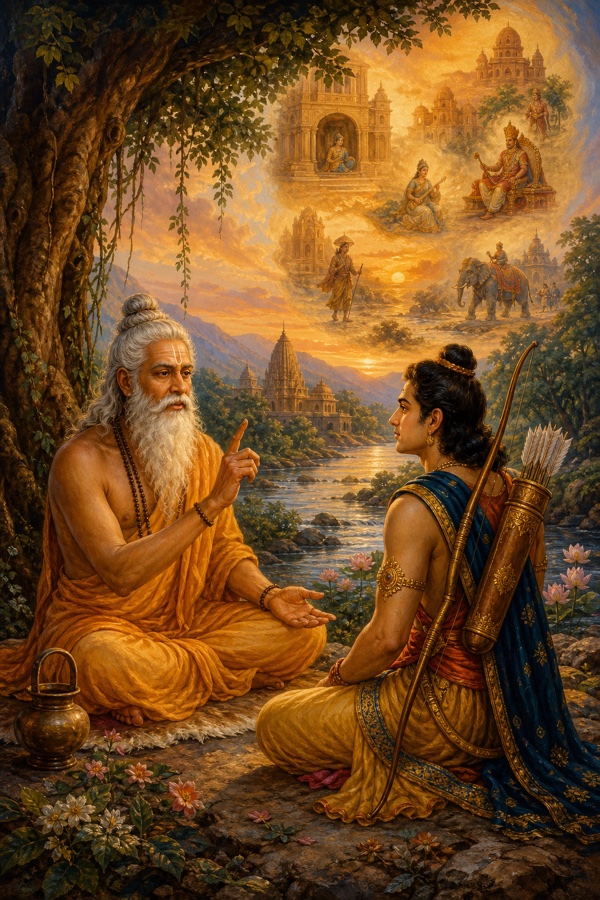
A Seeker Ready for the Gem
The man Kumbha described was wealthy in property, grain, capacity, and reputation. He was also generous, disposed toward dispassion, and prepared to give away what he possessed. Such abundance joined with detachment was uncommon.
His education was equally broad. He had mastered the sixty-four arts, knew weapons, understood the demands of practical conduct, and could complete whatever task he resolved to undertake. These qualities made him effective in the world. Knowledge of the supreme state had yet to become settled experience.
The sixty-four arts form a traditional catalog of cultivated skills. The exact count signals the breadth of the seeker’s preparation across learning and practical accomplishment. He had intelligence, competence, and discipline. His failure occurred at the point where discernment had to recognize its own result.
A powerful desire arose in him to obtain the cintamani, the fabled wish-fulfilling gem. He undertook the prescribed means with intensity: austerity, recitation, praise of the deities, and other disciplines associated with its attainment. His effort was concentrated and capable. After only a short time, the genuine gem appeared before him, close enough to be taken by hand.
The speed of its arrival created the crisis.
The Gem He Could Not Accept
The seeker looked at the object he had labored to find, and doubt began to rearrange the evidence. A gem of such rarity, he thought, should require a lifetime of effort. He could not be fortunate enough or sufficiently accomplished to receive it so soon. The brilliance might be a trick of sight. The object might disappear if an unworthy hand touched it.
He considered reaching for the gem and stopped himself. He left what stood before him untested and assembled reasons for his own inadequacy. His image of a proper attainment carried more authority than the result his practice had produced.
The cintamani remained within reach while he moved among alternatives. He made no effort to take it. At last the neglected gem disappeared.
The seeker resumed his disciplines. His capacity for effort remained intact, and he returned to austerity, recitation, and the search. Unseen siddhas, accomplished beings who observed him, decided to amuse themselves. They placed a bright, unbroken piece of glass before him.
This time he hesitated no longer. The glass shone, and he declared it to be the cintamani. The real gem had prompted a long inquiry into worthiness and probability. The powerless object received immediate certainty.
Convinced that the false gem would supply every future need, the seeker judged his former possessions useless. He left wealth, home, country, and relations and went to a solitary forest carrying the glass.
In the forest, the glass fulfilled nothing. It had no power to answer desire or protect its owner. The man who had begun with wealth, learning, generosity, dispassion, and practical skill entered severe suffering because he could not distinguish what he possessed from what he imagined it to be.
Kumbha drew attention to the inward scale of the result. Ignorance can generate misery amid outward privilege. Clear knowledge can keep adversity from taking the same form within. The decisive factor in this story is the intelligence through which the gem and the glass are received.
The Elephant Between Story and Meaning
Kumbha did not interpret the cintamani immediately. He first told a second parable. A powerful elephant in the forest of Vindhya was bound in iron chains and struck by a mahout. After three days of suffering, the elephant used its two great tusks to break the chains. The mahout attempted to attack from a palm tree, fell, and lay defenseless before the animal.
The elephant spared him out of compassion and went free. The mahout recovered, followed, and prepared another trap. He dug a round pit near the elephant’s resting place and concealed its opening with tender creepers. Days later, the elephant stepped onto the covering, fell into the pit, and was bound again.
Only after both stories had been heard did Shikhidhvaja ask Kumbha to explain their relation to his life. The sequence matters. The first parable concerns misrecognition of the goal. The second concerns a bondage that survives the breaking of visible restraints.
Shikhidhvaja as the Seeker
Kumbha identified the seeker directly with the king. Shikhidhvaja knew scripture and possessed real dispassion. He had left his wife, wealth, relations, kingdom, and country. These acts were substantial. A subtler ignorance survived within the pride of having renounced them.
The genuine cintamani represented uncontrived total renunciation, called sarvatyaga. In this condition, sorrow ends and the mind releases its claim upon possession, action, and result. The seeker in the parable distrusted an attainment that came with unexpected directness. Shikhidhvaja responded similarly to the simplicity of complete relinquishment. He assumed that a great result must require a longer, harsher, and more visibly exceptional path.
Kumbha measured this freedom against the widest scale he could name. Once self-knowledge is clear, even the celebrated powers of the world and the station of Hiranyagarbha, the cosmic Creator, lose their force as objects of personal acquisition. The gem represents release from that entire economy of attainment.
Thought returned to the categories of leaving and retaining, discipline and reward, seeker and attainment. With each calculation, the mind recovered an object around which it could organize identity. The statement “I have renounced everything” became another possession.
Kumbha identified the piece of glass with painful austerity treated as the final goal. Shikhidhvaja’s departure from palace life had begun in dispassion. Forest exposure, cold, heat, and bodily hardship followed. Attachment then gathered around the expected fruit of austerity. Difficulty acquired the gleam of proof.
The defect lay in the surviving claim upon practice and result. In Shikhidhvaja’s life, hardship had become the object through which ego preserved the identities of renouncer, practitioner, and future recipient of liberation.
The Examination Kumbha Leaves to the King
The parable holds two failures of judgment beside one another. The seeker met the genuine gem with disbelief because reality did not match his theory of how attainment should look. He accepted glass because its brightness matched the object he had imagined. Both decisions were governed by prior mental construction.
Kumbha asked Shikhidhvaja to use his own clear intelligence. Which was the faultless cintamani: total relinquishment of the mind’s claim, or an austerity whose value depended on pain and an expected reward? The teacher left the king responsible for examining his experience and following the insight to its full consequence.
The question reaches beyond visible possessions. A house, a kingdom, or a deerskin can be placed outside one’s reach. The identity of the person who has performed that act can remain carefully guarded. In Kumbha’s application, the last attachment is the one that turns renunciation itself into evidence of personal achievement.