On this page
Yoga Vasistha · Story 24
Bhasa and Vilasa: Friendship, Inquiry, and Liberation
Raised together in Atri’s Sahya hermitage, Bhasa and Vilasa lose their elders, separate, and spend years in practice without reaching pure knowledge. Their reunion in old age begins an honest inquiry into whether anyone caught in conditioned life can truly be called well in the deepest sense.
Atri’s Hermitage on Mount Sahya
Vasistha told Rama to let the mind examine itself through discrimination and loosen its insistence on “I” and “mine.” As long as the mind’s constructions retain unquestioned authority, the sorrow gathered from the world continues. He then began the history of Bhasa and Vilasa.
Their youth unfolded on Mount Sahya, a dwelling shared by the three worlds: divine beings above, human communities on its lower ground, and nagas within the earth. Clear cascades crossed slopes bright with minerals and jeweled rock. Wind entered bamboo and produced resonant tones. Siddhas occupied caves, serpents wound around sandalwood trees, and lions moved among the peaks.
Elsewhere on the slopes, clouds gathered among the heights and deer moved through flowering growth. Bees circled blossoms, birds filled the groves, and lotus ponds held the light between ridges. Kiratas inhabited the mountain country, while vidyadharas and celestial women belonged to its sacred geography. The description establishes Sahya as a meeting ground for human discipline, natural abundance, and multiple orders of life.
On a northern ridge stood the extensive hermitage of the sage Atri. Fruit-laden trees bent over clear water. Lotuses opened in the ponds, and flowering groves surrounded the places of study and tapas. Its beauty recalled Brahmaloka, heaven, and Shiva’s city, and arriving siddhas found their fatigue relieved there.
Two learned ascetics named Shukra and Brihaspati lived there, carrying the learning associated with the celebrated celestial sages who bore those names. A son was born in each household. One boy was Bhasa and the other Vilasa.
One Mind in Two Lives
The boys grew within the hermitage like new shoots extending from creepers planted by their fathers. Affection joined them with unusual ease. They moved through study, bathing, inward discipline, and daily life as companions for whom the other’s presence required no arrangement.
Vasistha uses two quiet comparisons. Oil is present within sesame even when the eye cannot separate it from the seed. Fragrance belongs to a flower without appearing beside it as another object. Bhasa and Vilasa lived with that intimacy. Their dispositions were so closely attuned that one mind seemed to have divided itself and taken two bodies.
Childhood passed. Youth arrived, and the two were compared with the newly risen sun and moon. Their friendship remained settled within the order of the ashram.
Old age eventually overtook their fathers, Shukra and Brihaspati. Both elders died, and grief descended upon the two households.
Bhasa and Vilasa performed the prescribed funeral and after-death rites. They remembered the elders’ qualities and lamented them. Vasistha observes that learning does not erase the accepted duties owed at such a moment. The two young men completed the rites even while sorrow emptied their faces of color and weakened their bodies.
Their faces faded like lotuses removed from water. Vitality ebbed, familiar work lost its attraction, and memory repeatedly returned to the qualities of the dead. Grief and discipline remained together as they completed the duties of mourning while feeling the full force of bereavement.
Separation and the Passing Years
Grief altered their relation to the world they knew. House, field, property, and familiar objects lost their attraction. Their bodies grew lean under the pressure of loss, like forest trees dried from root to crown by summer heat and wildfire.
They separated and passed their time in different parts of the forest, like deer divided from their herd. Each followed the movement of grief and dispassion into solitude.
Days became months, and months became years. Both continued tapas in their separate places. Age changed their bodies. Pure knowledge did not arise merely because time had passed or hardship had accumulated.
This interval is essential to the story. Dispassion after bereavement had loosened worldly attachment. Solitude had given each friend room for practice. Their old age revealed that withdrawal and duration had not completed the inquiry into the mind that claimed the body, discipline, and result.
Much later, through the unfolding of prarabdha, the portion of prior karma ripening in this life, the two elderly ascetics met again.
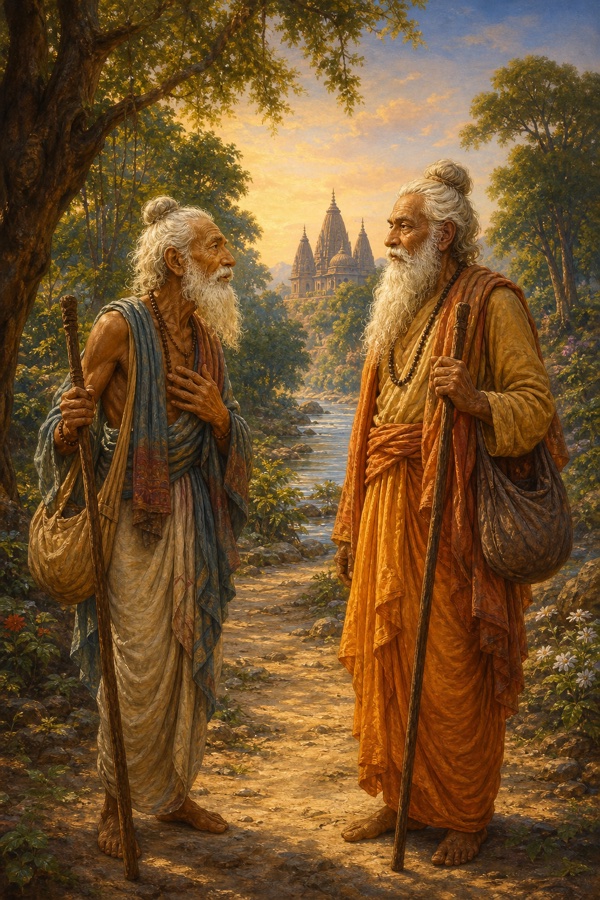
Questions at the Reunion
Vilasa recognized Bhasa and welcomed him with the affection of their youth. He called his friend the fruit of the tree of his own life and an ocean of nectar abiding in his heart. Then he asked where Bhasa had lived through the intervening years.
His questions moved rapidly beyond ordinary news. Had Bhasa’s austerity succeeded? Had his intelligence grown cool after the heat of worldly distress? Had he known the Self that was to be known? Had his learning borne fruit? Was he truly well?
Bhasa answered first with gratitude. Seeing Vilasa had made the day auspicious. Then he examined the word “well.”
“Friend, how can we call ourselves well while we continue to turn within sorrowful samsara? Welfare remains incomplete while the reality to be known has not been known, while desire and mental construction continue, and while the mind still treats its conditioned movement as the Self.”
For Bhasa, the success of austerity could not be measured by elapsed years. Knowledge had to cut through hope and craving, and equanimity had to become steady. He compared conditioned existence with a recurring malignant illness and knowledge with the medicine capable of reaching its cause.
True welfare, he continued, would become possible when the reality worth knowing had been known directly, the stream of desire and conceptual construction had subsided, and samsara had been crossed through understanding. Hope had to be cut by the sharp instrument of detachment and inquiry. Stable equanimity would then replace the mind’s alternating possession of success and loss.
The answer carries no accusation against either friend’s years of effort. It measures that effort by the clarity it has produced. Age, discipline, and sorrow become material for inquiry only when the assumptions tying them to an owner are examined.
The Body-Tree and the Restless Mind
Bhasa described embodied life as a tree exposed to time. The moisture of youth dries. Flowers of enjoyment and leaves of passing days fall. Craving continues to rise like a banner above a temple even while the structure below it ages.
The body also appeared as a mountain or deep well. Serpents of enjoyment occupied its recesses, thorns of hope caught the traveler, and waters of thirst gathered in its depths. These images did not condemn the body. They exposed the mental claims attached to bodily experience.
The mind behaved like an intoxicated elephant. It uprooted the post of discrimination and ran after the female elephant of craving. It was also an ocean or river filled with waves and whirlpools of action, worry, desire, anger, and fear. The force of these movements made the observing intelligence resemble a bird caught in a net woven from “I did this,” “I am doing this,” and “I will do this.”
Judgments of friend and enemy, identification with the body, and the notions “I” and “mine” dried the inner lotus. A drop of bodily pride could open into the whole painful field of samsara because every change in the body was then appropriated as a change in the Self.
Bhasa’s answer reached a precise conclusion. When bodily identification remains, bodily sorrow is claimed as one’s essential condition. When the identification is understood, experience can continue without being assigned to an imagined permanent owner.
Conversation Followed by Practice
The friends continued questioning one another about the instability of conditioned life and the absence of genuine welfare without self-knowledge. Their reunion gave inquiry a trustworthy human setting. Each could speak to someone who knew the history behind the austerity and the grief.
Time passed after the exchange. Through continued practice, discriminating contemplation, and dispassion, Bhasa and Vilasa attained pure knowledge in due course. They then attained liberation.
Vasistha expands the lesson. What seems as vast as an ocean to an undiscerning mind becomes as passable as water in a hoofprint to Garuda when discrimination is clear. Body and Self have no intrinsic bond. Ignorance superimposes their relation, as the mind may imagine a connection between water and a rock or between a reflection and the surface where it appears.
Pure consciousness does not independently undergo bodily pleasure and pain. The inert body does not know them on its own. Experience arises through the identification that joins the two in thought. Inward ego, possessiveness, and attachment sustain aging, fear, and bondage as personal claims.
This analysis leaves room for rightful action. A person may care for the body and fulfill present responsibilities while inwardly free of possession and doership. Severe withdrawal can preserve bondage when attachment survives within it. Participation in appropriate action leaves no stain when the inward claim has released its hold.
The distinction completes the friends’ arc. Their first withdrawal followed grief and dispassion. Their later freedom followed knowledge of the relation between body, mind, and Self, after conversation had been tested through further practice.