On this page
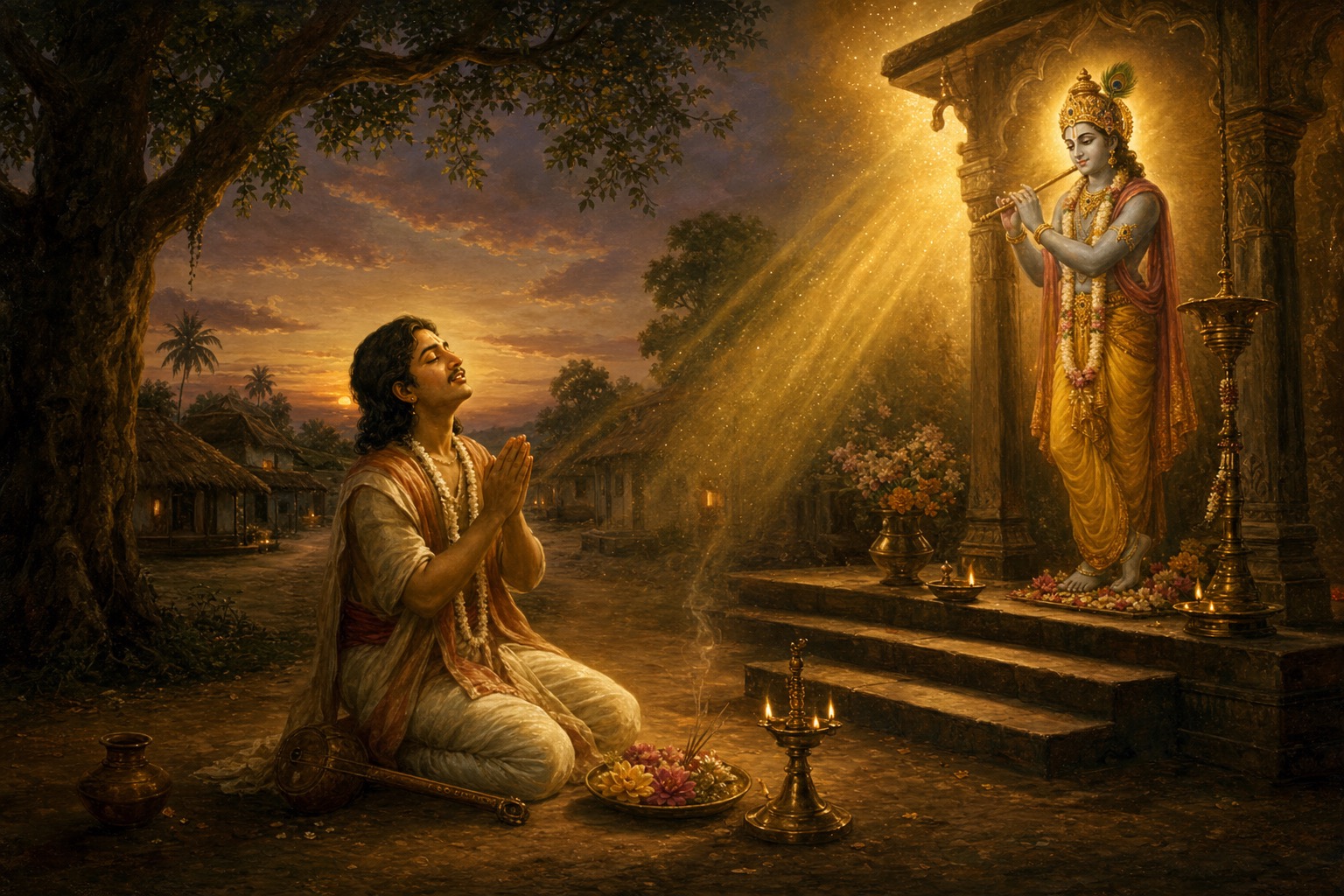
Maitreya had heard a great deal. The making of the world, the long succession of lineages, the order of the manvantaras, the lives of the great kings, Parashara had recounted all of it to him at length. Now a fresh curiosity stirred in him. Folding his hands, he said, “Great sage, I wish now to hear from you the true account of that great dissolution in which, at the close of a kalpa, this whole world is gathered back into itself.”
Parashara said, “Listen, Maitreya. Understand the measure of time first, and the matter of dissolution will come easily. A single month of men is one day and night of the ancestors, and a single year of men is one day and night of the gods. When two thousand such chaturyugas have passed, one full day and night of Brahma is complete. The four ages together, Satya, Treta, Dvapara, and Kali, span twelve thousand divine years. In every manvantara, apart from the first Satya age and the final Kali age, all the remaining chaturyugas stay alike. As Brahma fashions the world in the first Satya age, so in the final Kali age he draws it to its close.”
Hearing this, Maitreya asked, “Lord, describe to me in full the nature of that Kali age, in which dharma, standing on all four of its feet, is very nearly lost.”
The Face of the Kali Age
Parashara said, “Listen, Maitreya. In the Kali age the inclination of men no longer follows the dharma of varna and ashrama. The threefold discipline of Rig, Sama, and Yajus goes unperformed. Marriages are not made by the rites that render them lawful. The bond of student and teacher does not hold. No fire-offering to the gods is carried out. Whoever is strongest in a family sets himself up as everyone’s master, and all the varnas melt into one another. Any rite done in any fashion passes for penance, and whatever falls from a man’s mouth is taken for scripture.”
“A trifling sum of money will swell people with the pride of wealth, and women will grow vain over nothing more than their hair. When gold and gems and jewels grow scarce, women will adorn themselves with their braided hair alone. A wife will leave a husband who slips into poverty; the man who holds wealth will be reckoned the husband of women. Whoever pays the most will be the master, and noble birth will no longer be the ground of authority. All one’s substance will go into the building of houses, the mind will dwell only on scraping money together, and a fortune will be spent away on a man’s own indulgence.”
“Kings will not guard their subjects; under the pretext of taxes they will simply seize the people’s wealth. Whoever owns elephants, horses, and chariots will be called a king, and the man without strength will become a servant. The vaishyas will forsake farming and trade for the crafts, and shudras will take on the dress of renunciants, live by the trade of imposture, and win people’s respect. In dread of drought the people will keep their eyes forever fixed on the sky; short of grain, they will live like ascetics on roots and bulbs and fruit alone, and in their misery some will even take their own lives.”
“In that time men will eat without so much as bathing; they will give up the worship of the fire, the gods, and the guest. A man’s mother-in-law and father-in-law will be his elders and teachers, and his heart-stealing wife and her brothers will be counted his true friends. People will say, ‘Whose father is whose, and whose mother is whose? Each is born and dies according to his own karma.’ Women will bear children at five or six or seven or eight years of age, men will become fathers at eight or nine or ten, hair will turn gray at twelve, and no one will live past twenty.”
How to Recognize the Decline of Dharma
“Maitreya, whenever a heavy loss of dharma shows itself, the wise should understand that the Kali age is on the rise. Whenever imposture appears to swell, when the good men who walk the true path are nowhere to be found, when the works begun by the righteous begin to fail, and when people give up the worship of the Supreme Lord through yajnas, know then that the strength of Kali has grown. When love for the word of the Veda fades and affection for imposture takes hold, the discerning man recognizes the swelling of Kali. In the grip of imposture people will say, ‘What is there in this purity that comes from gods, brahmins, the Veda, and water?’”
“The rains will carry little water, the fields will yield a scant crop, the fruit will be without substance. Clothing will mostly be made of hemp, the trees will mostly be the shami, and nearly all the varnas will come to resemble the shudra. The grain will bear very small kernels, goat’s milk will be almost all that can be had, and usheera, a fragrant root, will be the only unguent left. With the path of the Veda lost and unrighteousness on the rise, the lifespan of the people will shrink.”
“And yet, Maitreya, this terrible age carries one great virtue. The vast store of merit that in the Satya age is won only through immense austerity, a man attains in the Kali age with the slightest effort.” Saying this, Parashara paused a moment, then went on, “On this very matter the great sage Vyasa once spoke; hear that too.”
Vyasa’s Three Dips
“Once a question began to move among the sages: in which age does even a little merit yield a great fruit, and who can perform it with ease? To settle the doubt, all those foremost sages came to my son, the illustrious Vyasa. When they arrived, they found him at his bath, standing half-sunk in the Ganga. The sages settled on the bank beneath the trees and waited for him.”
“Just then Vyasa plunged beneath the water, rose again, and declared, ‘The Kali age is best, the shudra is best.’ He dipped once more and said, ‘Shudra, you alone are blessed.’ Rising a third time he said, ‘Women alone are holy, they alone are blessed; who is more blessed than they?’ The sages listened in astonishment.”
“When Vyasa had finished his bath and his daily rites and taken his seat, the sages asked him humbly, ‘Lord, at your bath you praised the Kali age, the shudra, and woman again and again. What is the secret of it? If it may be told, tell us.’ Vyasa smiled and said, ‘Listen. I will tell you why I cried out, “blessed, blessed.”‘”
Why the Kali Age, the Shudra, and Woman Are Blessed
“‘The fruit that in the Satya age is won by ten years of austerity, celibacy, and japa, the steady repetition of a holy name, comes in Treta in a single year, in Dvapara in a single month, and in the Kali age in no more than one day and night. That is why I called Kali the best. What is gained in the Satya age by meditation, in Treta by yajna, and in Dvapara by worship of the gods, in the Kali age is gained by nothing more than chanting the name of Sri Krishna. The accomplishment of great dharma with so little labor: for this I am wholly content with the Kali age.’”
“‘Now hear why the shudra is blessed. The twice-born must first study the Veda under a vow of celibacy, and then, with wealth earned by his own lawful calling, perform yajnas in the prescribed form. In all of this he is forever bound; he cannot even eat and drink as he wishes, and he wins the worlds of merit only through great hardship. The shudra, whose sole right is the offering of cooked food, gains a good destiny merely by serving the twice-born; no rule governs what he may eat or drink, and for this I called him holy.’”
“‘And woman? A man must give the wealth he earns through dharma to a worthy recipient and perform yajnas in the prescribed form, and the earning and the keeping of that wealth are hardship enough. A woman, serving her husband in body, mind, and speech and becoming the one who works for his good, reaches with ease the very blessed worlds a man attains only through the harshest labor. That is why a third time I said that women are holy.’ Hearing this secret, the sages found that the answer to their own question had come to them of its own accord, and they went home content, singing Vyasa’s praise.”
At the last Parashara said, “Maitreya, in this most wicked Kali age there is this one great virtue: by the mere singing of the name of Sri Krishna a man attains the supreme state. Now I will tell you what you had asked about the winding-up of the world, that is, the elemental dissolution (prakrita) and the intermediate dissolution (avantara).”
Source: Vishnu Purana (Gita Press, Gorakhpur)