On this page
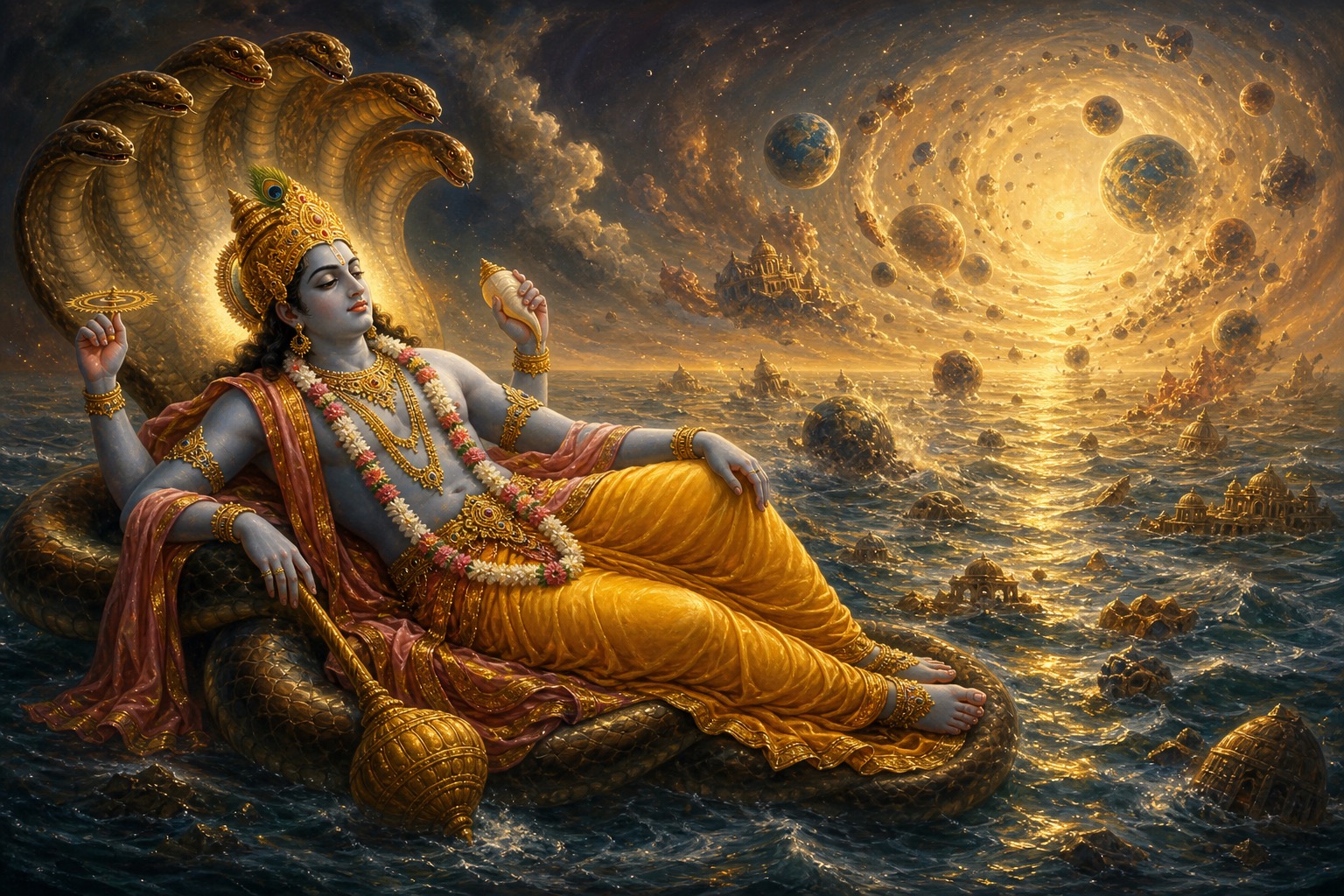
Parashara said, “Now listen, Maitreya. The world is folded back into itself in more than one way, in many forms at once. There is a perpetual dissolution (nitya pralaya) running this very moment, in which creatures are born and die every single day. Beyond it stand three great dissolutions: the occasional (naimittika), the elemental (prakrita), and the absolute (atyantika). But before any of these, learn the measure of time, for every dissolution happens in the lap of time.”
“A human nimesha, the span it takes to utter a single short syllable, is the smallest unit of measure. Fifteen such nimeshas make one kashtha, thirty kashthas make one kala, and fifteen kalas make one nadika, which is timed with a copper water-vessel. Two nadikas make one muhurta, thirty muhurtas make one day and night, thirty days and nights make one month, and twelve months make one year. This single human year is one day and night in the world of the gods; three hundred and sixty such years make one year of the gods, and twelve thousand divine years make one chaturyuga, a cycle of the four ages. One thousand chaturyugas make a single day of Brahma, and within that one day fourteen Manus rise and pass away. This is one kalpa.”
The occasional dissolution
“At the end of a kalpa, Maitreya, the night of Brahma arrives, and with it comes the occasional dissolution. Listen closely, for its shape is terrifying. When a thousand chaturyugas have passed and the earth has grown thin and spent, a merciless drought settles in for a hundred years, and every creature of little strength perishes from hunger. Then Lord Vishnu, wearing the form of Rudra, enters the seven rays of the sun and drinks up all the water of the oceans, the rivers, and the lower worlds. Swollen with that water, the seven rays become seven suns, and blazing above, below, and on every side, they burn the entire triple world to ash. Some accounts speak of twelve suns, yet the Vishnu Purana here names only seven.”
“Then Rudra, in the form of the fire of time (kalagni), breaks out from the mouth of Shesha, the cosmic serpent, and burns the lower worlds beneath. That immense fire consumes the surface of the earth, the middle region (Bhuvarloka), and heaven (Svarloka) as well, and stirs the flames into a vast churning whirlpool; the three worlds glow like a cauldron set over coals. Scorched by the heat, the dwellers of Maharloka withdraw upward to Janaloka. Then the Lord in the form of Rudra breathes clouds from his mouth. Huge as royal elephants, some deep blue, some white, some the color of smoke, those clouds cover the sky with terrible thunder and drown that dreadful fire under sheets of rain. Even after the fire is out, the clouds keep pouring for more than a hundred years and sink the whole world beneath water. The flood rises as far as the seat of the seven rishis (the Saptarshis), and the three worlds become one boundless ocean.”
“Upon that measureless water, Lord Narayana takes the form of Brahma and sleeps on the couch of Shesha. As long as that Self of all remains awake, the workings of the world go on; when he lies upon his couch of maya and sleeps, the world too melts away into him. This night of Brahma, exactly like his day, lasts a thousand chaturyugas. When the night ends, he wakes again, takes the form of Brahma, and fashions creation precisely as it stood before. This, occurring at the close of a kalpa, is what is called the occasional or intermediate dissolution (naimittika, also named avantara).”
The elemental dissolution
“Now hear the elemental dissolution, Maitreya. When drought and the rest combine to destroy every world and every lower region, then all the evolutes, from the great principle (mahat) down to earth, begin to dwindle away in order. First, water absorbs smell, the quality of earth, into itself; once smell is taken from it, earth melts and only water is left. Then fire draws off taste, the quality of water; with taste destroyed, water too dries up and turns to fire. Then air absorbs form, the quality of fire, and the fire goes out. Then space (akasha) swallows touch, the quality of air, and the air falls still. At that point only space remains, holding its single quality of sound, round and hollow in form, wrapping everything within it.”
“After this, the origin of the elements (bhutadi), which is the dark, tamasic ego, swallows sound, the quality of space; and the great principle (mahat) absorbs that bhutadi into itself. At the last, primal nature (mula prakriti) gathers up even the great principle. The balanced state of the three qualities, sattva, rajas, and tamas, is what is called the pradhana, or prakriti, and it is the ultimate cause of the whole universe. Within this nature, in its manifest and unmanifest forms, there dwells a pure, imperishable, eternal, and all-pervading spirit (purusha), and he too is a portion of the Supreme Self. In the end, prakriti and purusha both dissolve into that Supreme Self. He is the ground of all and the one sovereign; in the Vedas and the Vedantas he is sung under the name of Vishnu. This account of dissolution appears in the Shrimad Bhagavata as well, though the manner of the Vishnu Purana is complete in itself.”
The three afflictions and the absolute dissolution
“Maitreya, there are three afflictions: the bodily-and-mental (adhyatmika), the divine (adhidaivika), and the creaturely (adhibhautika). When a person comes to know these three, and knowledge and dispassion (vairagya) are born within him, then he reaches the absolute dissolution (atyantika), which is moksha, liberation. The adhyatmika affliction is of two kinds, bodily and mental. Headache, fever, colic, and the many diseases are the bodily afflictions; desire, anger, fear, malice, greed, delusion, and grief are the mental ones. The pain that comes from cold, heat, wind, and rain is adhidaivika, and the suffering caused by beasts, snakes, thieves, and the like is adhibhautika.”
“Beyond these, the sorrows of the womb, of birth, of old age, and of death come in their thousands. In a womb full of waste, the living being lies wrapped in the fetal membrane, the bones of its back and neck bent double, tormented by the sour and bitter food its mother eats, remembering its own hundreds of former lives. At the moment of birth, the birth-wind turns its face downward, and it struggles out in great anguish. Then, in the delusion of childhood, it forgets, ‘Where have I come from? Who am I? Where will I go?’ In old age the limbs go slack, the teeth loosen and fall, and at the hour of death the nooses of Yama’s servants and the dread of the body of torment rise up over its head.”
“The very things a person holds dear become the seeds of his sorrow. Whatever happiness seems to come from wife, sons, wealth, and home, far greater is the grief that flows back from them. And so, for those whose inner being is scorched by the heat of this sun that is the world, the reaching of God is the one cool shade. This is the absolute cessation (atyantika nivritti), and its means are two, action and knowledge, karma and jnana.”
Bhagavan and Vasudeva
“Knowledge is of two kinds, Maitreya. The knowledge of the sound-Brahman (shabda-brahman) born of the shastra is like a lamp, and the realization of the supreme Brahman (para-brahman) born of discernment (viveka) is like the sun. That which is unmanifest, unaging, unthinkable, unborn, and imperishable, which the wise call the supreme abode (paramadhama), is the most subtle and highest state. That very form of the Supreme Self is what the word ‘Bhagavat’ denotes. In this word the syllable bha carries two senses, the nourisher and the support of all; and the syllable ga carries the senses of the giver of the fruits of action, the dissolver, and the creator. Complete lordship, dharma, fame, splendor (shri), knowledge, and dispassion, these six together are named ‘bhaga’, and because he holds them all, the supreme Brahman is called ‘Bhagavan’.”
“As for the meaning of ‘Vasudeva’, long ago Keshidhvaja explained it to King Khandikya in this way: he who dwells within all beings, and within whom all beings in turn abide, is the maker and the guardian of the world, and is called Lord ‘Vasudeva’. That Self of all lies beyond every covering, stands apart from prakriti and its evolutes, and is the storehouse of every auspicious quality. To see or know him as flawless, wholly pure, and of one uniform nature bears the name of knowledge, and whatever runs contrary to it is ignorance.” Having said this, Parashara added, “In this way, Maitreya, I have now told you of the absolute dissolution as well.”
Source: Vishnu Purana (Gita Press, Gorakhpur)