On this page
The Estranged Prince on Mount Krauncha
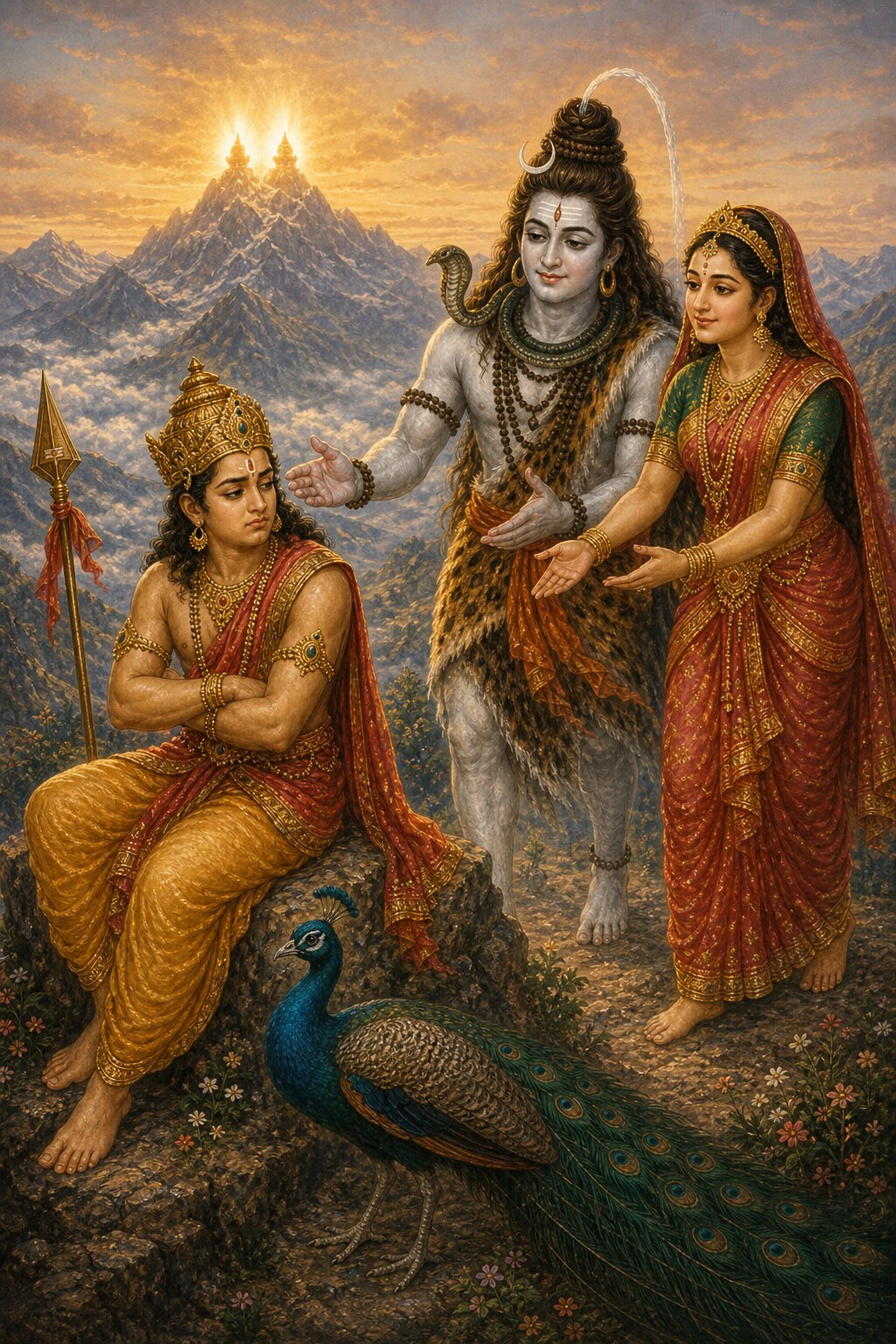
On Kailasa that day, the hour of homecoming had come. The mighty prince Kartikeya, slayer of Tarakasura, had circled the whole earth and returned, and the sage Narada was waiting with the news, telling him everything that had happened while he was gone, chief of it that Ganesha had already been married. The words did their work. His heart turned so bitter that he bowed to his parents, and though they forbade him, he left Kailasa and went away to Mount Krauncha.
Parvati could not bear the separation from her son. Do not grieve, Shiva told her, our son will certainly come back to us. She would not be comforted, and in the end the two of them went to the mountain themselves, grieving like any father and mother in the world. Both Parvati and Shiva reached the mountain and pleaded with him at length, yet the prince would not return; instead he moved twelve kos farther off. Then the parents did the one thing that only parents can do. Since the estranged son would not come near them, they took on a luminous form and settled themselves right there. Aching with love for their child, they still go to look upon their son on the festival days: on the new-moon night Lord Shankara himself, and on the full-moon night Parvati without fail.
From that day the linga of Lord Shiva known as Mallikarjuna grew famous across the three worlds. Mallika stands for Parvati, and the word Arjuna names Shiva; in that single linga the lights of both are enshrined. Whoever takes its darshan is freed from every sin and attains all that the heart desires. His sorrow lifts, happiness of the highest kind comes to him, and he is spared the long distress of being carried again in a mother’s womb; wealth and grain and fame and health follow him, and the wishes he has held closest. This is the second jyotirlinga, the one that grants every kind of joy by the mere sight of it.
The Mahakala of Avanti
Now hear the story of the third jyotirlinga, in which Time itself becomes the sentinel of the devout. There is a lovely city named Avanti, a giver of liberation to embodied souls and exceedingly dear to Shiva. In it lived a great brahmana named Vedapriya, and his life was this: the study of the Vedas, the daily fire-offering kept alive on his own hearth, and the fashioning of a clay shivalinga for worship each day. Nothing in it was extraordinary except that he never once missed a day. Through this discipline he won the blessed end that comes easily only to saints. He had four radiant sons, Devapriya, Priyamedha, Sukrit, and Suvrat, no lesser than their father and mother in virtue, and all four bound to the worship of Shiva as he had been. By the power of what those four earned, happiness rose on the earth the way the moon swells through the bright half of the month. Because of them Avanti had filled with the splendor of sacred knowledge.
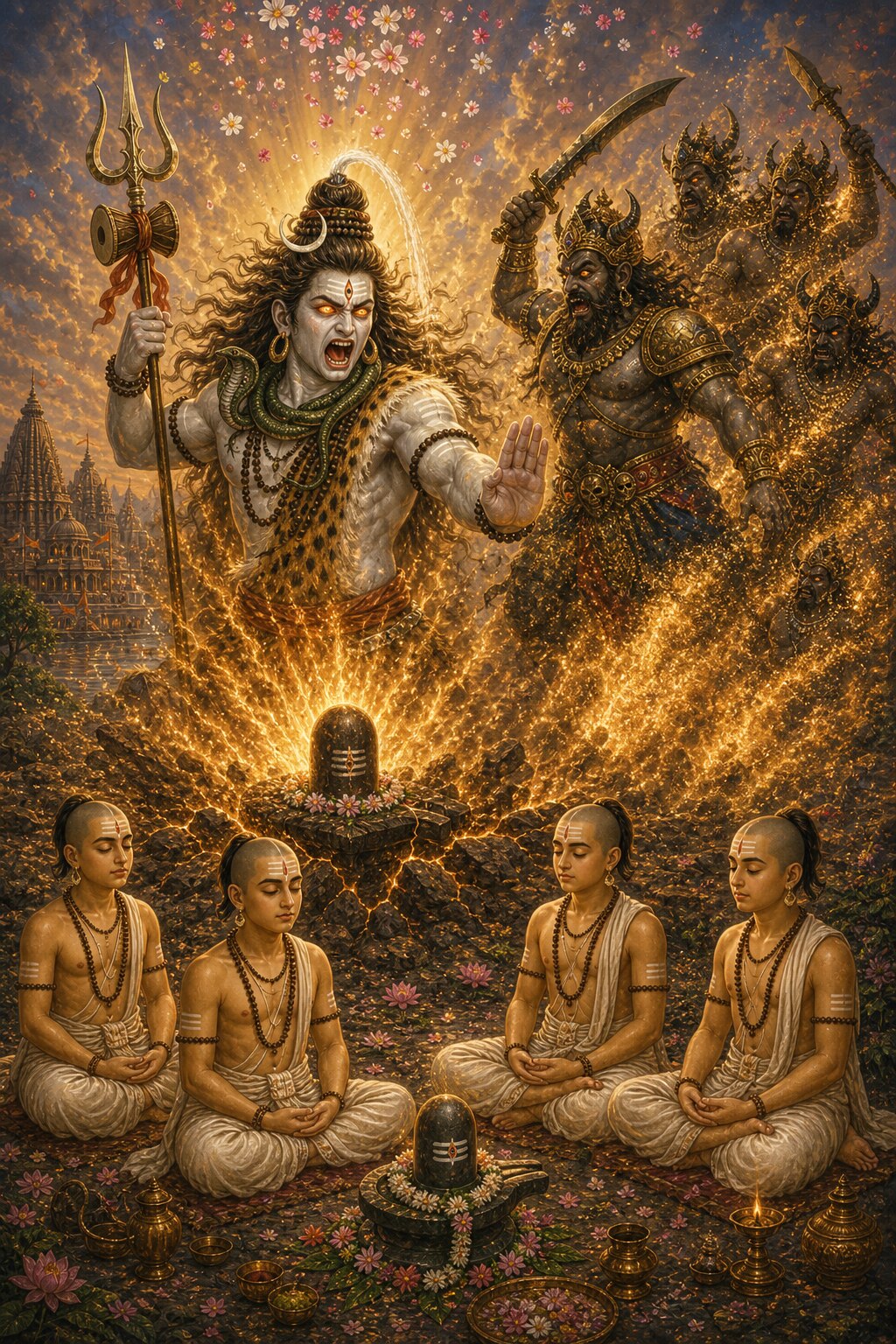
At that same time, on Mount Ratnamala, an asura named Dushana, a hater of dharma, having won from Brahma a boon that made the whole universe look small to him, launched an assault upon the Vedas, upon dharma, and upon the righteous. He drove the gods out of their own places and stamped out every rite still burning on the earth, until dharma had been pushed off into some far corner of the world, and at last he took his army and marched even on the brahmanas of Avanti. At his command four terrible demons appeared in the four directions like the fire of universal dissolution, carrying his terms with them: give up the rites of Shiva and the rituals of the Veda and live, keep to them and do not. The brahmanas of the city grew frightened, yet those Shiva-trusting sons of Vedapriya were not afraid in the least. We have no army to frighten these creatures, they said, and no weapons to drive them off; whatever dishonor falls on us falls on the one who upholds us, and what is there that can touch Shiva? They steadied everyone, telling them to place their faith in Shankara who loves his devotees, and then, worshiping the shivalinga themselves, they sat down in meditation.
Just then Dushana stormed in with his army and gave the order that all of them be killed, be bound in chains. The sons did not so much as hear the words; they were fixed on the path of meditation toward Shambhu. But the instant that king formed the wish to slay them, at the very place of the worshiped clay shivalinga a pit split open with a tremendous roar, and out of it, at once, appeared Lord Shiva in a fearsome form, who became renowned by the name Mahakala, destroyer of the wicked, refuge of the good. He thundered that he had appeared as Mahakala for evildoers exactly like these, and he commanded the demons to flee far from these brahmanas. Then, by a single roar, Dushana and his army were burned to ash. Part of the army was slain, part fled, and like darkness before the sun the remainder vanished. Kettledrums sounded, and flowers rained down from the sky.
When it was over Shiva consoled the brahmanas, and they bowed and praised him with hymn after hymn. Well pleased, Mahakala Maheshwara said, Ask for a boon. The brahmanas folded their hands and answered, Mahakala! Mahadeva! Grant us liberation from the ocean of the world, stay here always to protect ordinary people, and rescue all who come for your darshan. Two of the three things they asked for were for other people. Shiva gave them the blessed state, and to guard his devotees he settled into that most beautiful pit, the chasm his own arrival had opened. For one kos in every direction the ground became the seat of Shiva in the form of the linga, and upon the earth he was called Mahakaleshwara. Avanti had asked him to stay, and he stayed. By his darshan sorrow does not touch a person even in dreams; the heart’s wish is granted, and liberation too in the world beyond.
The Chintamani, the Cowherd Woman’s Son, and Shrikara
In Ujjayini there was a great king named Chandrasena, versed in the truths of the shastras, master of his senses, a devotee of Shiva. Manibhadra, foremost among Shiva’s attendants, was his friend, and pleased with the king he gave him a great jewel called the Chintamani, radiant as the Kaustubha gem and as the sun, one whose mere sight, mention, or contemplation assured a person’s good fortune. Bell-metal, copper, tin, plain stone: whatever its surface touched turned to gold. When Chandrasena wore that jewel at his throat and sat upon his throne, his splendor among men was like that of the sun and of Narayana among the gods. A man who owns a thing like that does not stay unremarked for long, and word of it went out of Ujjayini in every direction.
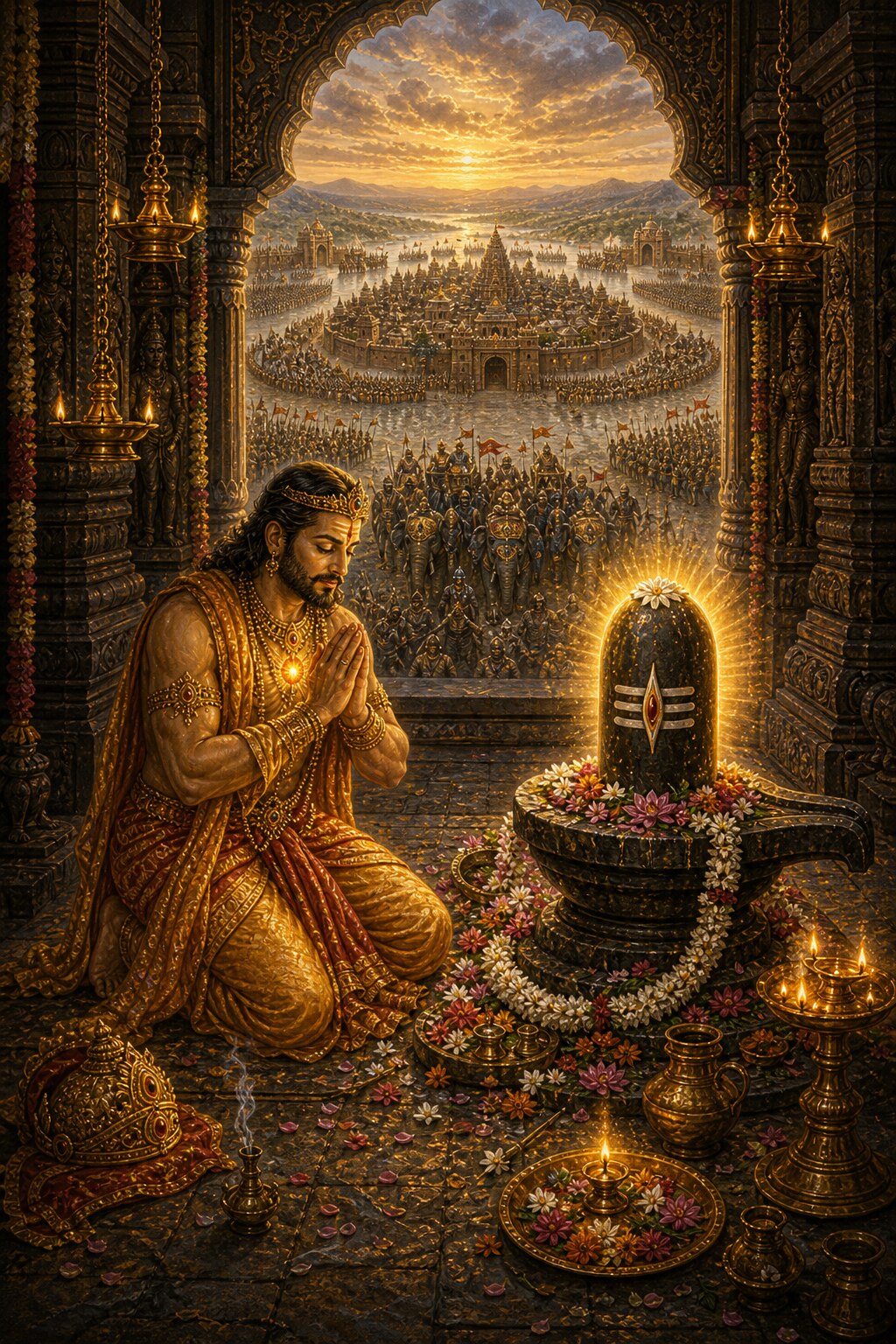
When they heard of this, kings from many lands grew covetous of the jewel. They came asking for it first, and they used every means they had, until Chandrasena, steady in his devotion, had refused them all. Refused and slighted, their greed turned to anger. They joined together and, taking their fourfold armies of elephants, chariots, horse, and foot, laid siege to the four gates of Ujjayini. Popular tales often tie this siege to a king named Ripudamana, yet the Shiva Purana names no besieger; in its eyes they are simply kings greedy for the jewel. Seeing his city surrounded, Chandrasena did not raise a weapon. He took refuge in Mahakaleshwara and, with a mind free of doubt, fasting, gave himself day and night to single-hearted worship.
Shiva heard him, and was pleased, and set a means in motion to save the king. It began where no besieging army would think to look. In those very days a widowed cowherd woman lived in the city, and she had a single son. Carrying her five-year-old boy, she went to the temple of Mahakala, watched King Chandrasena’s worship of Mahakala with reverence, and returned to her camp. The boy too had watched that worship, and he had missed none of it. Home again, curiosity moved him to attempt the worship of Shiva himself. He brought a lovely stone and set it in a solitary spot a little distance from the camp, took it for a shivalinga, and, gathering the make-believe of a child’s play, fragrant paste, ornaments, cloth, incense, a lamp, and unbroken rice, he worshiped it with devotion. He offered a divine food-offering shaped in his own mind, worshiped again and again with leaves and flowers, danced, and bowed his head at its feet over and over. He had no mantra. He had a pebble, and the whole of his attention.
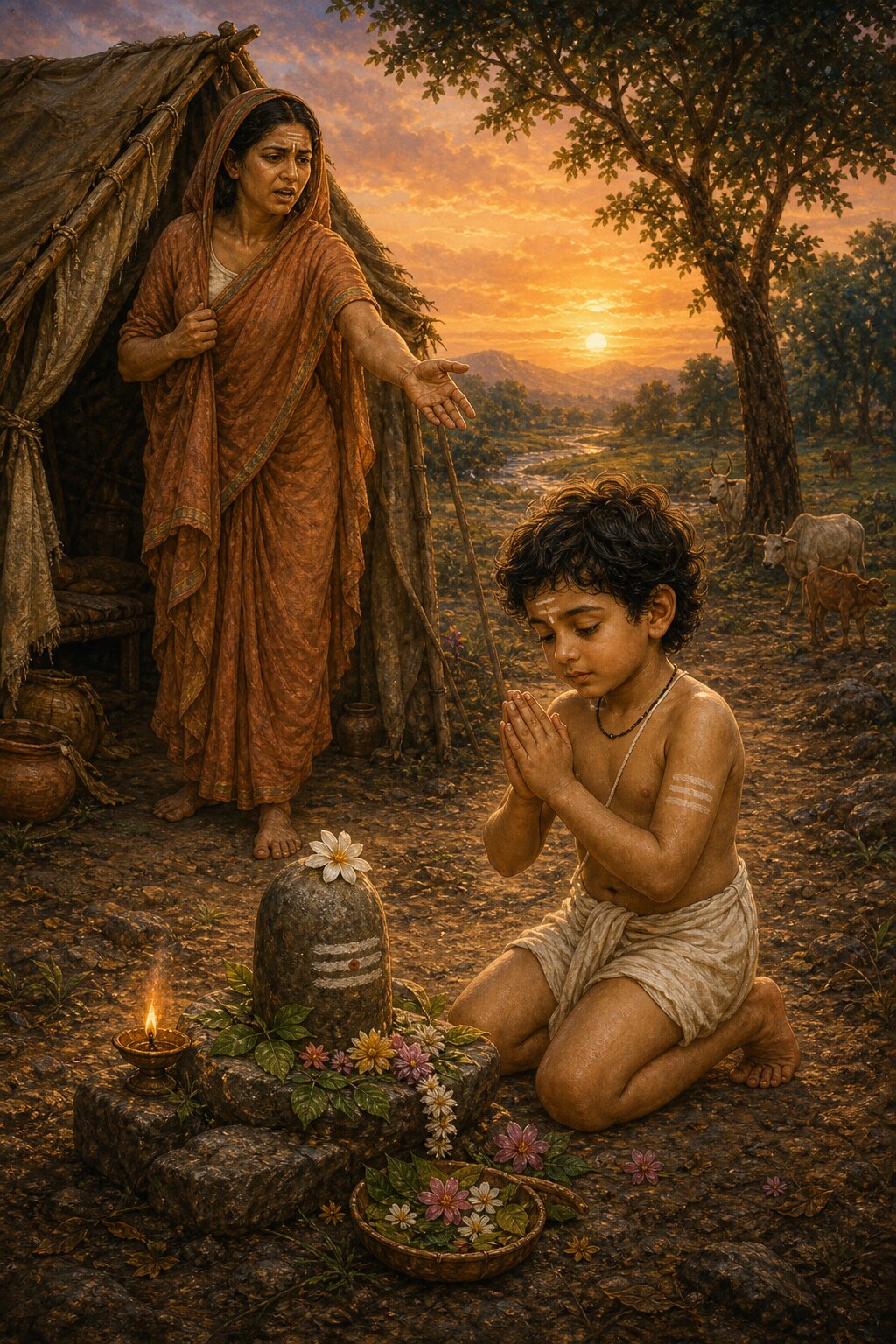
The cowherd woman lovingly called her son to his meal, but his heart was set on the worship. He did not come though she called again and again, so the mother went herself, and seeing him seated in meditation with his eyes closed, she took his hand and began to pull. When he would not rise, in anger she beat him hard. Even then the boy did not come, so she picked up the shivalinga and flung it away and destroyed all the offerings. She was a widow with one child and a meal going cold, and her patience gave out where any tired woman’s would. The child cried out in grief, and the mother, scolding him harshly, went off home. Seeing his worship ruined, the boy fell down in a faint, crying Deva! Deva! Mahadeva!, and a stream of tears kept flowing. After two ghadis he came to his senses and opened his eyes.
And what that child saw when his eyes opened is astonishing even to hear. By Shiva’s grace his very camp had become a splendid temple of Mahakala: gleaming pillars of gems, a floor inlaid with crystal, water-pots of burnished gold, a vast golden gateway hung with festoons, terraces of sapphire and diamond. At its center stood the jewel-studded linga of the merciful Shankara, and upon it were arranged the very offerings the boy had made with his own hands, the leaves, the flowers, the rice, every one of them accepted and set in its place. Immersed in supreme bliss he sang praise, bowed his head again and again, and when he stepped outside after sunset the camp glowed like the palace of Indra, studded within, on every side, with gems, jewels, and gold, with pieces of gold lying scattered where the cooking things had been. In the hour of dusk he saw his mother sleeping on a beautiful bed, endowed with divine marks, every limb bright with jeweled ornaments, like a celestial woman in the flesh.
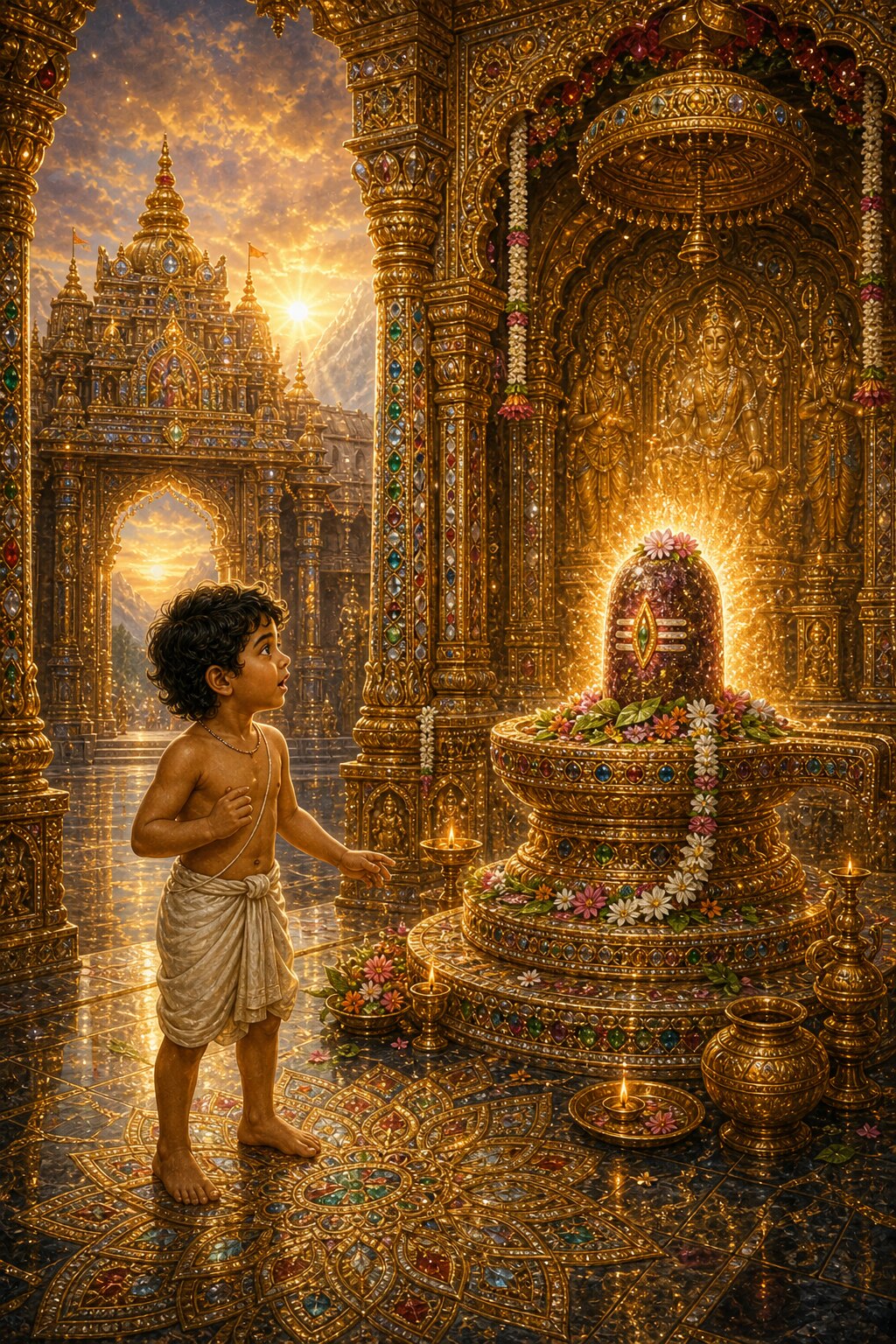
Overwhelmed with joy, the boy woke his mother in a rush. The cowherd woman looked and saw that everything had become wondrous, and the sight took her the way it had taken him; the hand that had thrown the stone away was shaking now. In her delight she pressed her son to her breast, and hearing from his own lips the tale of the grace of Girijapati, she sent word to the king. Chandrasena, having completed his vow, arrived that very night, and with his ministers and priests he beheld it all and sank into supreme bliss. Here was the answer to a month of fasting, and it had reached him through a five-year-old he had never met. Shedding tears of love and chanting the name of Shiva, he clasped the boy to his heart. That night there was a great festival, the townsfolk kept singing the glory of Maheshwara, and the whole night passed like a single moment.
When dawn came, the besieging kings heard this marvel from their spies and, astonished, began to say that in a city whose very children are such devotees of Shiva, the king Chandrasena must surely be a great devotee, and victory over him would be hard. The lord of Ujjayini, the city of Mahakala, is not a man who comes to grief. If they opposed him, Shiva’s wrath would destroy them all, so reconciliation was the wise course; only then would Maheshwara show grace. Those rulers laid down their arms, and the enmity went out of their hearts and left their minds clean of it. With Chandrasena’s leave they entered the city, worshiped Mahakala, and, praising the good fortune of the cowherd woman, came to her house, where Chandrasena stepped forward and honored them all and seated them as guests. Beholding the temple that had appeared of itself, they turned their minds to the contemplation of Shiva, gave the cowherd child many gifts, and made that very boy the king of the cowherds of all the surrounding lands.
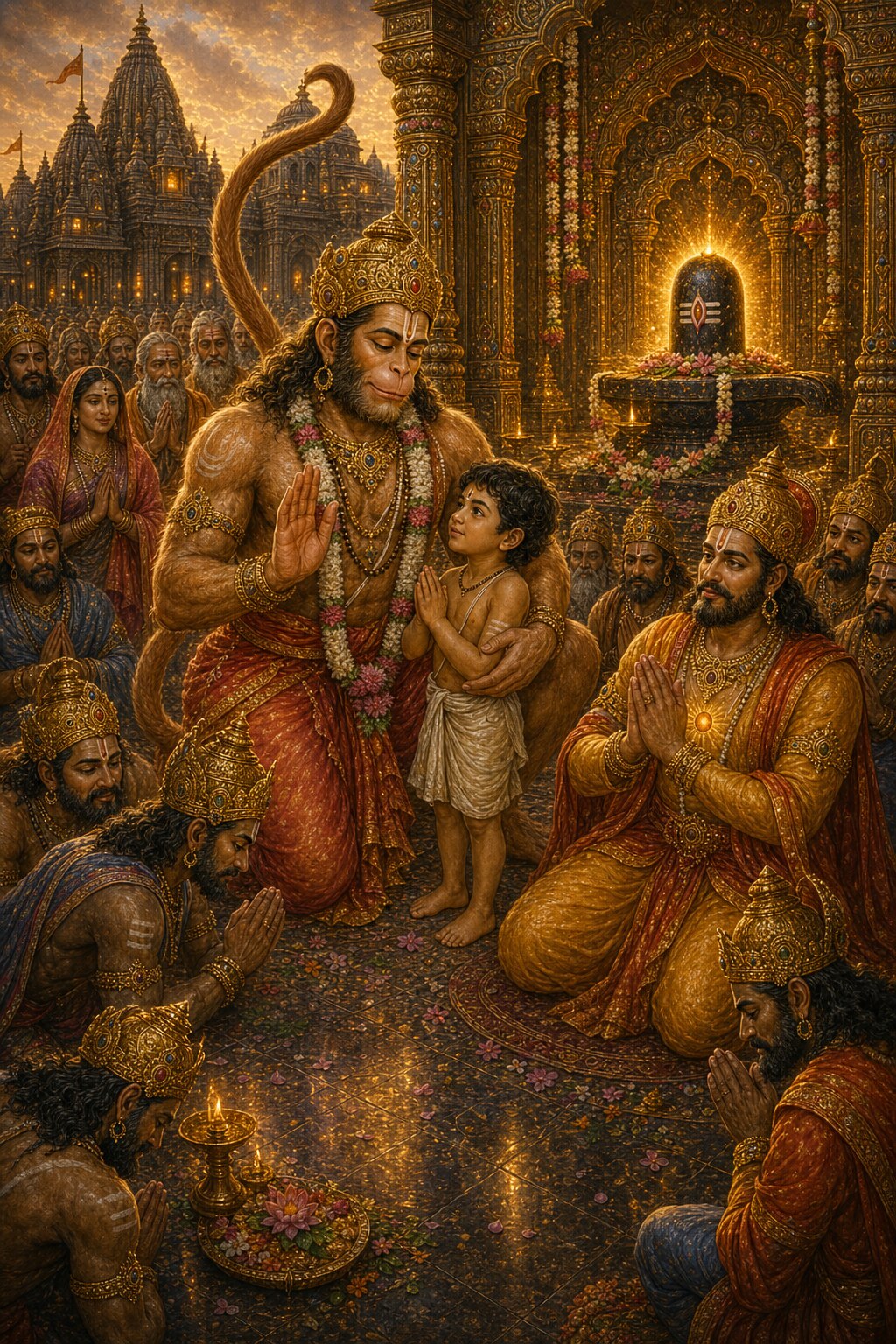
At this very moment the monkey-king Hanuman, worshiped by all the gods, appeared there. The kings did not know what to make of it. Every one of them rose and bowed his head. Hanuman sat among them, drew the cowherd boy to his heart, and said: Kings! Hear my words, all of you, and every embodied being besides, for in them lies the good of all. For those who wear bodies there is no refuge except Shiva. See what fortune is: this boy merely watched the worship, took inspiration from it, and, worshiping Shiva even without any mantra, attained him. No mantra, no priest, no rite in its proper order, and the lord of Avanti came out of a pebble for him. This child, who will lift the fame of the cowherd line, is a supreme devotee of Shankara; he will enjoy every pleasure in this world and in the end will win liberation. In his eighth generation will be born the greatly renowned Nanda, in whose home Lord Narayana himself will appear in the form of a son and become famous by the name Shrikrishna. And from this day this cowherd prince will be known throughout the world by the name Shrikara.
Having said this, Hanuman, the son of Anjana and the very form of Shiva, looked upon the kings and Chandrasena with a gracious gaze, taught Shrikara the rite of Shiva-worship that is most dear to Shiva, and vanished before the eyes of all, while every one of them was still watching the king and the boy. The kings, honored, returned as they had come, and Ujjayini kept its jewel and its gates. Shrikara took up his worship in the company of brahmanas learned in dharma, and both King Chandrasena and Shrikara, serving Mahakala, attained the highest state through his worship and came at last to the great region of Shiva. The shivalinga named Mahakala is the refuge of the good, Shankara who loves his devotees is the utter destroyer of the wicked, and this most holy account is said to grant every kind of joy, to increase devotion to Shiva, and to lead to heaven.
Source: Shiva Purana (Gita Press, Sankshipta Shivapurananka), Kotirudra Samhita