The Saundarya Lahari
Part 2 · The Description of Her Beauty · Shlokas 42-100
In the first part the Goddess was an idea: Shakti, the Sri Chakra, the climb through the chakras. Now she takes on a face. The poet begins at the crown and comes down limb by limb to the feet, resting a moment on every shloka before he moves again. It was made for sinking into. Read it slowly.
First, one thing
The Ananda Lahari was a map: who the Goddess is, what Shakti is, the chakras, the Sri Chakra. All of that is behind us now. Here the poet does something very simple and very human. He looks at the Mother, and he tries to catch in words what he sees, and the trying is most of what happens in these verses.
The description follows a particular order, keshadi-padanta, from the hair on the head down to the feet. The crown, the hair, the brow, the eyebrows, the eyes, the nose, the lips, the smile, the voice, the throat, the arms, and down, and down, all the way to the lotus feet. Each shloka rests on a single limb and asks nothing more of itself.
This is the most poetic stretch of the Saundarya Lahari. Each shloka is a small picture, and pictures open only for those who slow down in front of them.
The journey starts at the very top, above the head. The first picture already brings the whole sky down into it: in the Goddess’s golden crown, twelve suns are set as rubies, a sliver of moon rides above them, and against that golden glow the moon scatters its light like a rainbow. Then the hair, thick and glossy and smooth, dark as a grove of blue lotuses just split open, and may it shake the darkness off us. A lovely conceit rides along with it: her tresses carry a fragrance of their own, and even the flowers of heaven come and settle in this hair out of longing for that fragrance. Hair that lends perfume to flowers, the reverse of the usual arrangement, and sweet for that reason. Then the line of the parting, and may it spread our well-being: the beauty of her face brims over so fully that the parting looks like a channel cut to carry the overflow, and the red sindoor set in the black hair looks as though the darkness had taken a single ray of the sun captive and were holding it there.
42-44 · The crown · The hair · The parting
Now the whole face. Ringed by dark curling locks like young bees, faintly smiling, lovely with the filaments that are the glow of her teeth, and fragrant, this face outdoes the lotus, and here is a fine touch: bees hover over a lotus, and over this lotus Shiva’s own eyes turn into bees and grow drunk. The forehead too curves like a slice of moon, and the poet works a sweet geometry with the pair of them: take the half-moon of the crown and the half-moon of the forehead, join them the wrong way around, and they make one full harvest moon, the seam stitched shut with a coat of nectar. Then the eyebrows, and in them the bow of Kamadeva shows itself: the two arched brows are its curve, the bee-black eyes its string, and the nose between them the grip, where the hand closes and hides the middle of the bow from sight. And this bow is the one that ends the fear of this world.
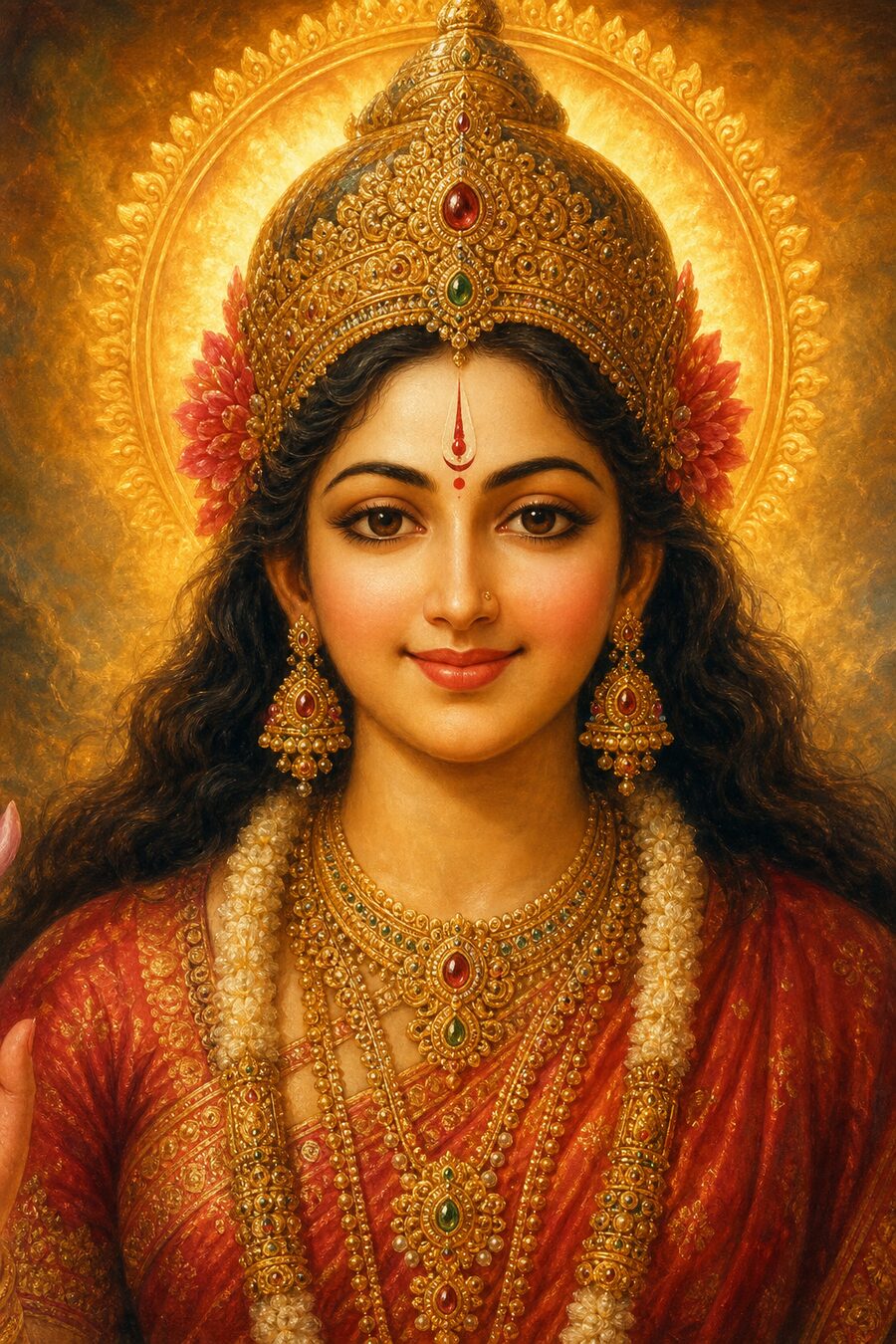
45-47 · The face · The forehead · The eyebrows
Now the eyes, and the poet makes them the source of time itself. The right eye, formed of the sun, gives birth to the day; the left, formed of the moon, makes the night with all three of its watches; and the third, like a half-opened golden lotus, holds the twilight that walks between them. Here seeing and creating are one act. And shloka 49 is a clever play on words: Vishala, Kalyani, Ayodhya, Avanti, each of these is at once a quality of the Goddess’s gaze and the name of a famous city, so the poet says that the quality which gives those cities their names belongs, in truth, to the Goddess’s gaze. Then those same sidelong glances, so long that they reach the ears, become two young bees drinking the honey of the poets’ verses, and the third eye, watching them go, flushes a little red with envy.
48-50 · The three eyes · The reach of the eyes
Here comes the loveliest shloka in the Saundarya Lahari. A single eye, and so many different moods inside it, every one of them decided by whom it falls upon: soaked with love when it turns to Shiva, scornful toward everyone else, faintly resentful of her co-wife Ganga, full of wonder at the stories of Shiva’s own deeds, frightened of the snakes he wears, smiling at her friends, and last of all, softest of all, “compassion, upon me.” The poet builds the whole list only to arrive at this one phrase: the Mother’s gaze, on the devotee, simple mercy. And then the bow of shloka 47 returns here fully drawn: the eyes so long, stretched all the way to the ears, that they look like the arrows of Kamadeva, and this arrow is aimed at the calm mind of the very Shiva who is the image of renunciation. The three-colored eyes then become the three gunas, rajas, sattva, and tamas, out of which Brahma, Vishnu, and Rudra will be made again, and the poet calls her kohl “lila-anjana,” the play-collyrium, because for the Goddess creating the universe is a game as easy as lining her eyes.
51-53 · A different look for each · The bow of the eye · The three gunas
The three colors of the eyes, red, white, and black, show the poet a confluence of three sacred rivers, and he says the three have gathered there to purify us: the red Shona, the white Ganga, the dark Yamuna, a Triveni standing right there on the Goddess’s face, with no need to travel to any holy river at all. And then a startling conceit: if the opening of the eye creates the world and the closing of it dissolves the world, then the Mother never blinks, and she does not blink, so that the world may go on living, a Mother gazing unbroken who never looks away for even an instant. The eyes are like fish, an old comparison the poet turns over on its head: it is the fish who hide in the water out of fear, because the Goddess’s eyes reach all the way to her ears, and eyes that long carry tales. Shri, the goddess of beauty, keeps her own hours by those eyes: at dawn she leaves the blue water-lily, its petals shut tight like the panels of a door, and at nightfall she pries the panels apart and slips inside again.
54-56 · Three holy rivers · The eyelids · The fish
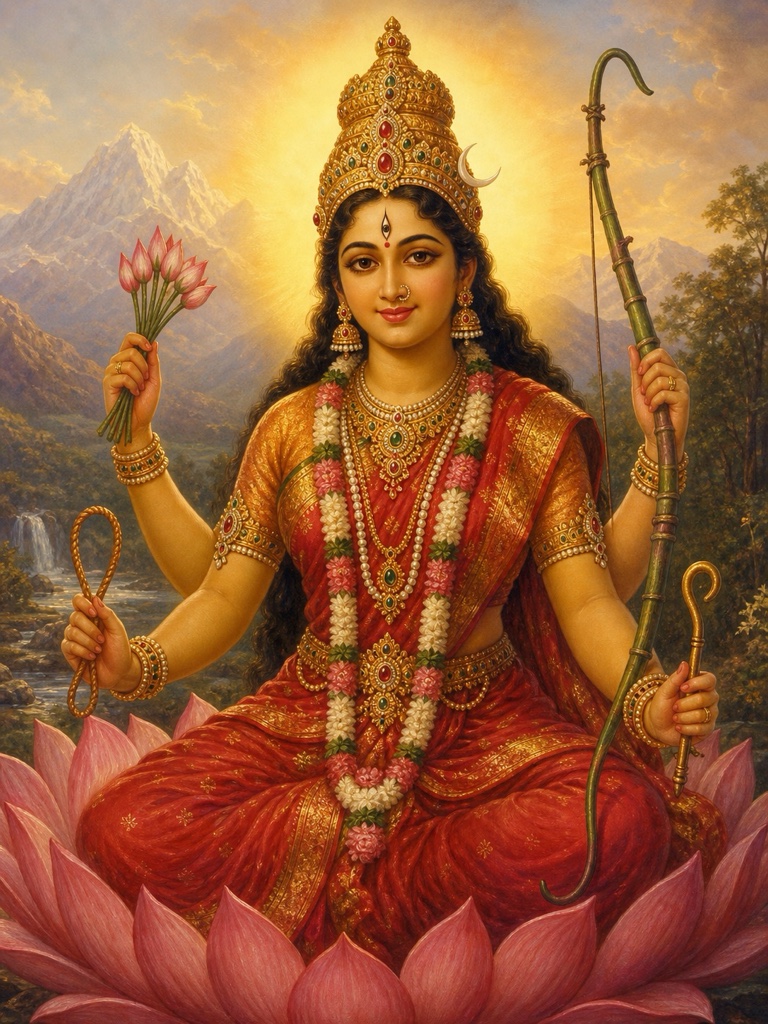
Now comes the tenderest shloka in the whole eye sequence. The poet asks for so little: one glance, long, colored like a half-opened blue lotus, and let it fall even on him, standing far off and wretched, and let it wash him. And he brings a lovely argument with the request. He is made blessed by it and you lose nothing at all: the moon drops its light on the forest and on the palace without weighing which is which, and grace does not shrink by being shared. Then that curve between eye and ear, where the Kamadeva bow of shloka 47 shows itself again from a new angle. Then the face itself becomes a chariot: her two earrings flash and stand reflected in her glowing cheeks, and the poet counts four wheels, and on this chariot the great warrior Mara rides out against the lord of the ganas, who has come to the field on the chariot of the earth with the sun and the moon for its wheels. And then the earrings once more: when the Goddess drinks Saraswati’s words with the cupped hollows of her ears and, lost in delight, nods her head in a “wonderful,” her earrings ring out and seem to be answering those words themselves, so vivid, so flavorful a picture of listening.
57-60 · One glance · The curve of eye and ear · The chariot of the face · The earrings
Now the nose, and a sweet conceit: this nose is as straight as the flagstaff of the Himalaya clan’s banner, and may it bear us a fitting fruit; inside it are so many pearls that one pearl flows out with the Goddess’s cool breath and settles as the pearl of her nose-ring, an ornament born of a breath. Then the red lower lip: to what can it be compared? Let the coral creeper put out a fruit and try. The bimba fruit itself turned red only by catching the reflection of the Goddess’s lip, so how could it climb into the scale against the true redness without blushing for the attempt? The poet admits his defeat at finding a comparison, and that admission becomes his most beautiful comparison. And the smile: the chakora birds drank the moonlight of the Goddess’s smile until they were so filled that their beaks went numb, and now, night after night, they sip the real moon’s light thinking it sour gruel, the Goddess’s smile having proved sweeter than the moon itself.
61-63 · The nose · The lower lip · The smile
Now the voice, and the poet composes a delicate scene around it. The Goddess’s tongue is red like a hibiscus flower and recites the virtues of Shiva without ever tiring of the telling, and Saraswati, seated on its tip, white as crystal, takes on that redness and turns ruby-red herself, so that even the Goddess of speech is dyed in the Goddess’s color. And the tambula, the betel: Kartikeya, Indra, and Vishnu come back from the war with the daityas beaten, their helmets off and their armor still on them, and these three, who by tradition turn away from the leavings of Shiva’s offerings, long to receive the betel-quid that has come down from the Goddess’s mouth with its flecks of camphor white as the moon, for even the Goddess’s leavings are so holy that the great gods want them like a sacred gift. Then that same “wonderful”: Saraswati was singing Shiva’s glory on the vina, the Goddess nodded her head and said only “wonderful,” and the sweetness of that one word made the vina sound so dull that Saraswati quietly slipped her vina back into its case.
64-66 · The tongue · The betel · The voice and the vina
Now the chin, and the poet cannot find a single comparison anywhere for it, yet even in defeat he leaves three tender images: her father Himalaya touches it with his fingertips, out of affection; her husband Shiva lifts it up again and again, restless to drink from her lip; and for Shiva it is the handle of the mirror in which he looks at the Goddess’s face. Three touches of three relationships, on one chin. Then the throat, the stalk of the face-lotus, on which the thrill of Shiva’s constant embrace has raised the thorns of gooseflesh, and the necklace below it, white by nature and darkened with the paste of black aloe, looks like a lotus stalk blooming up out of the mud, so that even the smudge on an ornament becomes beauty here. And the three natural lines on the throat become witnesses to two things at once: to the threads of the auspicious marriage-cord of her wedded state, and to the boundary lines of the three gramas of music, as if the throat of one so skilled in gati and gamaka and song were itself the instrument.
67-69 · The chin · The throat · The three lines
Now the arms. Brahma praises the Goddess’s four arms, tender as lotus stalks, and he uses all four of his mouths to do it, and the poet supplies a mischievous reason for the enthusiasm: Shiva has already cut off one of Brahma’s heads, so, afraid for the four he has left, he is begging a hand of “no fear” for each of them at once. The hands are more beautiful than the lotus, and that same trouble with comparison returns: how are we to tell of them, the poet asks, when the light off her nails alone laughs at the flush of a new lotus? The lotus might match them in some small part, but only when the red lac from Lakshmi’s playing feet is laid upon its petals first, for the Goddess’s beauty is the original, and everything else asks her for its color. Then a lovely child-scene: the pair of breasts that both Kartikeya and Ganesha drank from belongs to the Mother-form, and Ganesha, in the middle of drinking his mother’s milk, remembers the two swellings on his own elephant head and gropes for them in a hurry, “are mine all right?”, and everyone in the room laughs.
70-72 · The four arms · The hands · The pair of breasts
The poet frames a delightful argument: why did Ganesha and Kartikeya stay unmarried their whole lives long? Because they drank the Mother’s nectar-milk, and whoever has tasted that supreme rasa never wants any other rasa again, the Mother’s milk holding a fulfillment that lets no other thirst even arise. Then the necklace: the string of white pearls taken from the skull of the elephant-demon Gajasura, catching a glimpse of the Goddess’s red lips, turns pink from within, as if it were the fame of Shiva mixed red with his valor. And the breast-milk: it is really a milk-ocean of knowledge flowing up from the heart, which is why, when in her compassion the Goddess gave that milk to a Dravidian child to drink, the child, having tasted it, became the most charming poet even among poets long seasoned in the art. The Mother’s first food is the first sip of knowledge itself.
73-75 · The breasts · The necklace · The breast-milk
Now the lines around the waist, and the poet turns them into a whole story. Shiva had burned Kamadeva with his third eye, the body licked over by the rows of flame in Hara’s anger; the burned Kamadeva fell into the deep pool of the Goddess’s navel, and out of that pool a thin creeper of smoke rose up, and people take the smoke for the line of down on her belly. The whole story of a burned love, held in one line on a body. That same thin line becomes, in the next conceit, a slender wave of the Yamuna, as if the strip of sky caught between her two pitcher-like breasts had been pressed thin by their nearness and were slipping down into the cave of the navel to escape. And the navel by itself becomes five things: a steady whirlpool in the Ganga, a flower-bed, the fire-pit in which Kamadeva’s brilliance was burned, the pleasure-house of Rati, and deepest of all, the mouth of the cave through which the meditator’s inner sight goes down.
76-78 · The line of down · The belly · The navel
Looking at the waist, the poet grows genuinely anxious, and one shloka becomes a prayer: “may it be well,” this waist that is naturally thin, bent under the weight of the breasts, barely holding on like a tree on a collapsing riverbank. But the very next shloka brings its balm from the same body. Those breasts, two golden pots bursting the bodice fastened over their suddenly damp slopes and chafing at the shoulders, are precisely the danger; and the three lines on the belly (the trivali) are really three cords with which Kamadeva has tied the waist so it will not break. The worry and the answer are found in that same body. And then the hips, and a sweet play on words: “nitamba” also means the slope of a mountain, so Himalaya cut away the heaviness and breadth of his own slopes and gave them to his daughter as dowry, a father handing his daughter his very own identity, his own weight; and that broad, heavy weight now covers the whole earth, and makes the earth itself seem light.
79-81 · The waist · The three folds · The hips
Coming down past the thighs, which have already beaten both the trunks of the great elephants and the golden stems of the plantain, the poet stops at the knees and admires their roundness, and the roundness carries a tender thought inside it: these knees have grown hard from bowing, again and again, which is to say the Goddess bows to her husband so often that her knees have firmed from the practice, and with that one word the praise turns into a devotion of her own, and even the celestial elephant’s two brow-globes are outmatched. Then the calves: Kamadeva has five arrows and no more, and conquering Shiva is a large piece of work, so he made the Goddess’s two calves into two quivers of twenty arrows, and the sharp tips of those arrows are the ten nails of the Goddess’s feet, honed on the whetstone of the gods’ bowing crowns. And then the feet, and here the poet’s tone changes, and the description turns without warning into a prayer: those very feet that the Upanishads carry on their heads like a crest, whose wash-water is the river running in Shiva’s matted locks, and whose red lac has the glow of the ruby on the crown of Hari, Mother, set them on my head too, out of pity.
82-84 · The knees · The calves · The prayer to the feet
Now the poet bows to the feet, and in each shloka a new tenderness: even Shiva grows jealous of these feet, because the ashoka tree blooms at the kick of a woman’s foot and the Goddess’s feet want to touch that ashoka, and Shiva wishes the touch would come to him instead, so the poet fixes even upon a god that small jealousy of a lover. Then a domestic scene of sulking and coaxing: in a lover’s teasing the Goddess lets slip someone else’s name, Shiva bows his head in embarrassment, and the Goddess, laughing, taps her foot on his forehead; and the cry of the burned Kamadeva, the thorn he has carried inside himself since the burning pulled out at last, is heard as the jingle of the Goddess’s anklet. And then the comparison with the lotus, which the poet defeats point by point: the lotus dies of cold, and her feet were raised in the snows of the Himalaya; the lotus shuts at night, and her feet stay open all night long; Lakshmi lives inside the lotus, but the feet themselves give her away to whoever comes asking.
85-87 · The feet · On Shiva’s forehead · The lotus feet
Now two lovely complaints, made with great love. One: the poetic tradition has long compared the soft sole of the Goddess’s foot, that seat of all fame and no misfortune, to the hard shell of a tortoise. Two: at the saptapadi during the wedding, how did Shiva take so soft a foot in his two hands and set it down on a hard stone, and do it with a heart full of pity at that? This meeting of the soft and the hard leaves the poet uneasy. Then beyond the wish-granting kalpavriksha tree: the celestial trees hand out their fruit with fingertips of new leaf, and only to the dwellers of heaven, while the Goddess’s feet give to the destitute, and “ahnaya,” at once, without making anyone wait. And at the end, the tenderest turn of the whole journey to the feet: the poet’s soul, whose own feet have wandered until now through the five senses, wants only this, to sink into the flower of the Goddess’s feet and become a bee there, at rest in the honey, belonging only there. The journey that began at the hair finds a new home here.
88-90 · The softness of the feet · The toenails · The lotus feet
This stage of the journey to the feet passes in glimpses, some light, some deep. The royal swans of the palace want to learn the Goddess’s walk and follow her about, stumbling as they go, and the jingle of her anklet seems to be teaching them that walk without a word spoken, so that even the bird with the most beautiful gait on earth is taking its lessons from the Mother. Then the famous image of the Sri Vidya: the Goddess’s couch, whose four legs are Brahma, Vishnu, Rudra, and Ishvara, and whose spread is Sadashiva, so that all five great gods together come to no more than a single bed for the Goddess, and the white Sadashiva, catching the Goddess’s red glow in his own clear body, turns pink himself, the color of Shakti laid over consciousness. And then the summing-up shloka: the poet leaves off going limb by limb and gathers them all at once, curling in the hair, straight and simple in the gentle smile, soft as a shirisha flower in the mind, hard as stone at the slope of the breasts, very slender at the waist and full above it, and says this whole form is really the compassion of Shiva, who took on a body to save the world, the Mother beautiful because she is compassion.
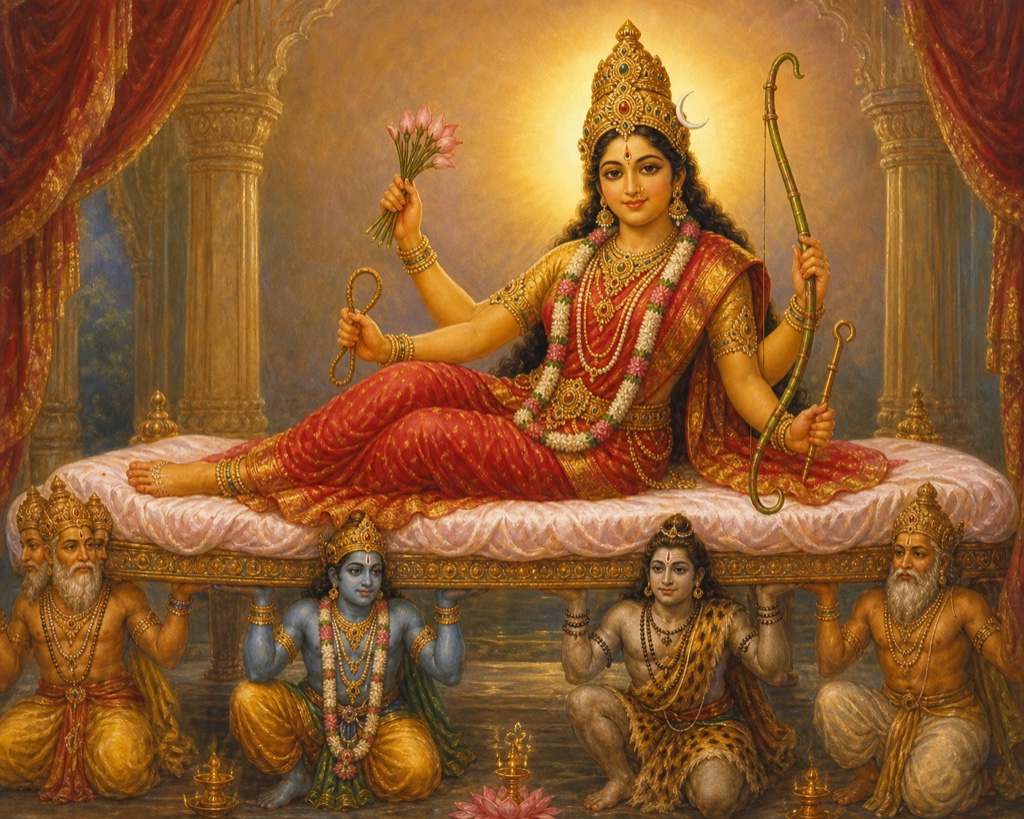
91-93 · The feet and the swans · The couch of Sadashiva · The compassion of the Goddess
Now the description rises from the body toward the cosmos and the supreme reality. The waning and waxing of the moon stops being an astronomical event for the poet: the moon is really the Goddess’s emerald casket of cosmetics, its dark stain the musk packed inside it, its digits the camphor, and each day the Goddess takes her adornments out of it and it empties and wanes, and Brahma packs it full again, the whole sky at work in the Goddess’s service. Then the siddhis: the Goddess is Shiva’s innermost private chamber, into which those of restless mind have no direct entry at all, and yet gods like Indra, merely by standing near the Goddess’s door, became the eight siddhis, anima and the rest, so that the threshold alone bears fruit for the one who waits at it. And her singleness of devotion: many poets win Saraswati’s grace, anyone at all can become the “husband” of Lakshmi with a little wealth, while the Goddess is the foremost among faithful wives, and apart from Mahadeva her touch is beyond the reach of even the kuravaka tree.
94-96 · The moon · The siddhis at her feet · The one true wife
Now the poem reaches its largest statement. There are three goddesses, Saraswati, Lakshmi, and Parvati, the companions of the three gods, and the Goddess of the Saundarya Lahari stands apart from all three of them. She is the Turiya, the fourth, who lies beyond the three and is the source of the three, whose greatness has no limit and no easy way into it, the Mahamaya who keeps the universe turning, the queen of the supreme Brahman; the way waking, dream, and deep sleep are three states and Turiya is the fourth, the ground-consciousness lying beneath them all. Then the poet makes his most personal prayer, and it asks for no great attainment, only this much: when, Mother, tell me when, may he drink the water that has washed the Goddess’s feet, the water that turns even a person born mute into a poet? Remember that Dravidian child. And even after writing a whole book the poet calls himself only a “student.” And what does the Goddess’s devotee gain? Learning, prosperity, beauty, these of course, but the real thing waits at the end, “chiram jivann eva,” in this very life: while still living he is freed from his bonds and tastes the rasa of supreme bliss. This is jivanmukti, liberation while alive.
97-99 · The Turiya · The water of the feet · The devotee’s reward
And then the close, on such a humble note. The poet says: this whole hymn that I have written, what is it really? Waving a lamp-flame in front of the sun to worship it, when the sun is itself the source of all light. Offering the moon an arghya made of the drops that had fallen from the moon. Satisfying the ocean with a handful of its own water. Mother, you are the Goddess of speech yourself, and the very words I praised you with were given to me by you; I have given you nothing, I have only handed back to you what was already yours. The whole journey of a hundred shlokas comes to rest on a single feeling: everything we have is a gift from her, and devotion is simply handing it back with gratitude.
100 · The close
Appendix · 3 additional shlokas
The three shlokas below stand outside the original hundred, a later appendix found attached in many editions. Read them in the same spirit: one more glimpse of the Goddess’s face, and one final surrender.
The first glimpse returns to the face: the Goddess’s feet are so radiant that the sun itself was brought down to be a jeweled mirror for them, its piercing rays going still and soft in fear before her face, and in that sun-mirror the Goddess’s face stands reflected, never closing, like a lotus that has no fear of the moon, blooming without dread, waiting on no one else’s light. Then a deep thought, offered very tenderly: the Goddess’s true, pure devotees slowly take on the Goddess’s own marks, the full breast, the lovely chest, the gentle smile, Kandarpa himself in the sidelong glance, so much so that even Shiva, looking at them, is caught for a moment by the thought, “this is Uma herself,” devotion in the end erasing the difference between the devotee and God. And the very last shloka, whose every epithet begins with “ni,” a chain of sound as if a single name were being called again and again, and after singing the Goddess’s glory across a hundred shlokas the poet at the last sets down only that one humble wish: Mother, accept this hymn of mine too. The whole Saundarya Lahari was a prayer, and it comes to rest on one final, humble prayer. Iti, and so it ends.
101-103 · The feet and the sun · What the devotee becomes · The final surrender
The road ahead
The Saundarya Lahari is complete: two parts, a hundred shlokas, and one appendix. That first line of shloka 1, “Shiva cannot so much as stir without Shakti,” sounds a little deeper a hundred shlokas later.
In this same collection, the Devi Mahatmya shows another form of the same Goddess, where that same Shakti destroys the demons. This wave of beauty and that roar of the battlefield are both forms of one and the same power.
The thought of shloka 100 lingers a long while: even our finest praise is made from the speech she gave us. Of whatever good comes through our hands, how much is our own and how much is borrowed, given to us, this is the question that flows on behind the whole hymn.