The Saundarya Lahari · Waves of Beauty
Part 1 · The Ananda Lahari · Shlokas 1-41
The very first shloka sets down a daring claim: without Shakti, Shiva cannot so much as tremble. The other forty shlokas keep unfolding the layers of that single claim, through the chakras, through threads of lightning, through a dance out of which the world is born.
First, one thing
Ananda Lahari means the waves of bliss. This opening part sees the Devi as pure Shakti, and it looks at her that way before it gives her any form, any face, any single limb for the eye to rest on. She is the energy that keeps creation in motion. She is what lies coiled and sleeping at the base of the spine, waiting. And she is the force standing behind every god, the one on whose account the gods are able to act at all.
This part runs somewhat esoteric: kundalini, the chakras, the Sri Chakra, mantras. Under every esoteric sign sits a plain feeling, and that feeling is what surfaces here, again and again, however coded the sign standing over it looks. This is an inner map, a chart of the ground within you, and every landmark it names is standing in your own body.
How to read this
In order, and slowly. Each shloka is a small jewel, cut to be turned over and over in the light. The main pillars: shloka 1 (Shiva and Shakti), 8 through 10 (the Sri Chakra and kundalini), 21 and 35 (the Devi is everything). Every shloka is a resting place in its own right.
1-2
The root claim of the whole Saundarya Lahari is set down in the very first line, and it is a daring one. Shiva, who is pure consciousness, can create only when he is joined with Shakti; without her this god cannot even stir, cannot lift a hand, cannot tremble. Knowing is one power, and that is Shiva; yet a man may know a thing perfectly well and go on sitting exactly where he is until an impulse rises from somewhere within and moves the limbs, and that impulse is Shakti. So how could anyone find the strength even to bow to the Devi, or to open his mouth and praise her, the Devi whom Hari, Hara, and Brahma themselves worship, the three who between them build the world and keep it and unmake it, unless some merit had already ripened in him? In the next shloka the same claim moves on with a light playfulness. Brahma gathers a single fine speck of dust from the Devi’s lotus feet and out of that one speck fashions all the worlds. Vishnu takes the same speck onto his thousand heads and carries it only with great effort, the weight of it telling on every one of them. Shiva grinds it down and smears it over his body like ash. The three who are held to be the very highest all rest on one grain of that root Shakti.
3-4
Now that single source becomes the answer to every lack, and the shloka goes down the list of lacks one at a time. For those lost in ignorance, for the darkness sitting inside them, the Devi is a city on a sun-bright island, a whole island of light standing exactly where the dark had been. For the dull of mind, she is honey dripping from the flower of consciousness. For the poor, a string of chintamani gems, the stones that give whatever is asked of them. And for those going under in the ocean of births, she is the very tusk on which Vishnu, in his boar form, once hooked the earth and lifted it clear of the water. Whatever state the seeker is in, the Devi arrives in the shape that state needs. Then a tender distinction: every other god raises one hand to promise freedom from fear and another to promise a boon, while the Devi, the refuge of the worlds, makes no such sign at all, because her feet are already skilled at saving from fear and at giving more than was asked. Why would one who is fearlessness itself need to shape a gesture that promises freedom from fear?
5-6
Beauty and allure are a power too, and they also have a source. Vishnu worshiped the Devi, and afterward took on the form of Mohini and unsettled even Shiva with it; and Kama too, once he had bowed to the Devi, won a form so lovely that the minds of even the great sages sway when it goes by. The power to attract that shows in Vishnu or in Kama is borrowed, drawn from this one source. And look at the inventory this Kama goes to war with: a bow made of flowers, its string a row of live bees, five arrows and not one more, the spring for his general, and for a war-chariot nothing sturdier than the soft Malaya breeze. He has no body at all. Yet let the grace of a single sidelong glance from the Devi, the daughter of the snow mountain, fall on him, and he conquers the whole world alone, with that armory. The real strength is in the grace arriving from behind him. The size of his weapons counts for nothing.
7-8
Now, for the first time, the poet gives the Devi a form, and the form holds two moods at once. A girdle chimes softly at her waist as she moves; she leans a little under the weight of a bosom full as the brow of a young elephant; the waist itself is slender; her face is the full moon of autumn; and her hands hold a bow, an arrow, a noose, and a goad. Tenderness on one side, four weapons on the other, and each weapon carries an inner meaning: the bow and arrow are the mind and the senses, the noose is the cord that binds together, the goad is what holds back. The Devi is beautiful, and the Devi is the one who keeps everything in order. And the shloka ends by asking for exactly one thing: may she stand here, in front of us. Then, past the form, her divine dwelling. In the middle of an ocean of nectar, ringed by a grove of wish-granting trees, there is an island of jewels; on the island a park of nipa trees and a house of chintamani stone; inside the house a couch shaped like Shiva; and on the bed of Parama Shiva rests the Devi who is a wave of consciousness and bliss, worshiped by only a few blessed ones. This is the map of an inner place, and every layer of it is a feeling: the ocean of nectar is the boundless, the wish-granting trees are every desire already fulfilled, the jewel-island is preciousness, and at the center of it all the wave of consciousness and bliss.
9-10
Now the whole journey of kundalini, told in two shlokas: one breath rising, one settling back down. The Devi is the energy asleep at the base of the spine; when she wakes she pierces the path straight up through all the chakras, earth in the Muladhara, water in the Manipura, fire in the Svadhishthana, air at the heart, ether above that, and mind between the brows, and in the thousand-petaled Sahasrara above them all she sports in secret with her lord. This is the rise from the grossest level to the very subtlest, the summit of yoga, said in the language of bhakti. Then she returns. From that union in the Sahasrara she pours a stream of nectar down through her two feet, waters the whole world with it, and then, taking the form of a serpent coiled three and a half times, folds herself back and sleeps again in the deep hollow of the Muladhara where she began. The nectar poured from above is what keeps watering all the life below.
11-12
Now the Sri Chakra, the most sacred yantra of Sri Vidya, and the beauty of the Devi that nothing can match. Shiva’s four triangles and Shakti’s five, nine root triangles in all, and set around them lotuses of eight petals and of sixteen, three rings, and three lines: the whole figure opens out into forty-four corners. The feeling beneath the numbers is this: the upward-pointing triangles are Shiva, consciousness; the downward-pointing ones are Shakti, energy; and they are interwoven so tightly that they can never be pulled apart, the very claim of shloka 1 made visible. Then that beauty, which even a crown-jewel of poets like Brahma somehow keeps laboring to match and keeps falling short of, and which the women of heaven grow so eager to see that in their hearts they come to long for union with Shiva, the state that even hard tapas can barely reach. The mere wish to see her becomes, without their ever intending it, a step toward liberation.
13-14
Now that same glance of grace, the sidelong look that is the root of every attraction, put as a piece of playful exaggeration. Take an old man, well past his years, dull to look at, blank at any joke or banter; let one sidelong glance of the Devi fall on him, only the one, and hundreds of young women come running after him, their braids loosening as they run, their garments slipping, their girdles snapping. Attraction belongs to no one on its own. The real magic is in that sidelong glance. And the Devi’s feet stand above even that. Each chakra has its own rays, fifty-six at the Muladhara, fifty-two at the Manipura, sixty-two at the Svadhishthana, fifty-four at the Anahata, seventy-two at the Vishuddhi, sixty-four at the Ajna; and above every one of those rays, counted and stacked, are the Devi’s two lotus feet. Every inner energy there is points toward one thing, and that one thing stands above them all. The chakras are the stairs; the Devi’s feet are the place the stairs arrive at.
15-17
Now a single current runs through three shlokas, the deep bond between the Devi and speech, and here the poet is plainly speaking from inside his own experience. Bright as autumn moonlight, crowned with a knot of matted hair with the moon set into it, holding in her four hands the boon gesture, the fearlessness gesture, a crystal rosary, and a book: this is the Sharada form, the form of learning and of speech. Whoever will not bow to her even once with a true heart, how could speech with the sweetness of honey, milk, and grapes ever come to him? Then the Devi’s color is aruna, the red of the first light of dawn; the saints who worship her in this form find the lotus-grove of their poet’s heart breaking into bloom, and with speech like Saraswati’s own deep, love-laden wave they win over the hearts of the good. And whoever meditates on the Devi together with the eight goddesses, Vashini and the rest, who glow like moonstone and give birth to speech, becomes the author of great poems, his words carrying the sweetness of the lotus that is the face of the goddess of speech. For one who settles the Devi within, beauty comes and sits down on his tongue of its own accord.
18-20
The different fruits of meditating on the Devi’s aruna form open out further now, and one feeling underlies all three: meditation fixed on a single inner image changes the seeker from within. Whoever meditates on that glow of the Devi’s body, the glow that dyes the whole sky and the whole earth with the redness of a sun just risen, wins even celestial women to his will, Urvashi among them, whose eyes are shy as a startled forest deer’s. Whoever takes her face as the point, below it the two breasts, and below that the half of Shiva, and meditates on this art of Manmatha, can set even the three worlds spinning; what that meditation points to stays quiet here, and the shloka leaves it quiet, since the effect of one correct, concentrated inner image is boundless. And whoever settles the Devi in the heart like an image carved in moonstone, she who scatters rays of nectar-juice from her limbs, calms the pride of serpents the way Garuda does, and cools those burning with fever with a single nectar-filled look. The effect of meditation does not stay shut inside the one who meditates; once this cooling image has settled in someone, his presence alone begins to quiet the fever of others.
21-22
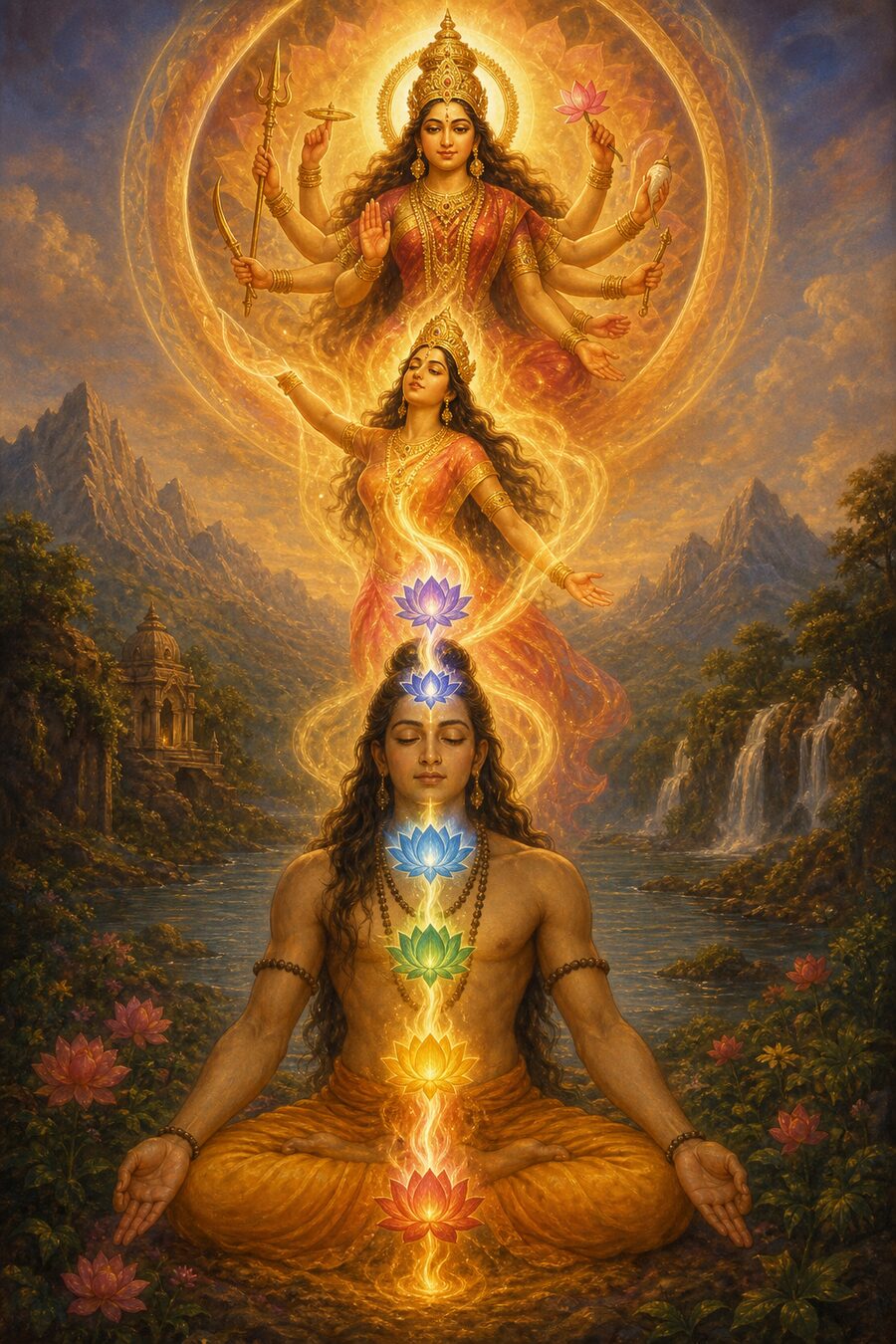
Now the true summit of the Ananda Lahari, and right after it the tenderest shloka of all. That subtle art of the Devi, thin as a line of lightning, made of sun and moon and fire, seated in the Sahasrara above all six chakra-lotuses: only those great souls can see it whose minds have been washed clean of stain and of maya, and what they sink into on seeing it is a wave of the highest bliss. The name of the whole text rises from right here. And then that eager grace. The devotee sets out to offer the praise, “Bhavani, cast your compassion-filled gaze on me, your servant,” and manages only the first two words of it, bhavani tvam, and in that very instant the Devi has already granted him the state of union with her, the state whose feet are worshiped with waving lamps by the crowns of Vishnu, Brahma, and Indra. The heart of it sits in a play on words: bhavani, heard as a verb, can also be read as “may I become.” The devotee means to say you, the Devi hears may I become you, and she makes him one with herself on the spot. The supplicant has not even finished his sentence, and the gift is already in his hands.
23-24
Now that same deep claim, that Shiva and Shakti can never be pulled apart, first in a lighthearted turn and then on the scale of all creation. As Ardhanarishvara the Devi had already taken the left half of Shiva’s body for her own, yet her heart was apparently still not filled, and so, the poet suspects, she quietly took the other half as well. That would explain why this whole form of hers glows aruna, why it has three eyes, why it leans a little under the breasts, why it wears the crown with the crooked moon riding in it: every one of these is a mark of Shiva’s, showing now on her. Each holds the other entirely within. And then that same thread runs the length of all creation: Brahma builds the world, Vishnu sustains it, Rudra destroys it, Ishvara folds everything back and hides even his own body away, and Sadashiva grants his grace to all; yet these five acts they can perform only when the Devi’s brow stirs for a moment, which is to say only when her command comes. Even the very highest gods wait on a single signal from the Devi’s brow.
25-26
Now the heart of single-pointed devotion, and then the picture of Shiva left alone in the great dissolution. The worship of all three gods, born of the three gunas, happens on its own if only the Devi’s two feet are worshiped, because those three stand forever right beside the jeweled footstool of her feet, hands folded, crowns bowed; water the root, and the whole tree is watered, with no need to scatter your care across the branches. And at the time of the great dissolution Brahma meets his death, Vishnu passes into rest, Yama is destroyed, Kubera is wiped away, Indra’s whole company, who never sleep, close their eyes at last, and through all of it the Devi’s husband Shiva goes on sporting alone. Shiva remains because he is pure consciousness; yet the shloka addresses the Devi as Sati and Shiva as your husband, and the real center of the sentence is the one on whose account Shiva is Shiva at all, Shakti.
27-29
Now the whole definition of worship changes, and then the three great gods step down into a household scene. Let my every conversation become your japa, every motion of my hands your sacred gesture, my walking your circumambulation, my eating and my drinking an oblation poured for you, my lying down an act of prostration; in the mood of handing myself over, let my every comfort become a form of your worship. There is only one condition, that mood of self-offering; where it is present, every moment of the day becomes worship on its own, and the wall between the temple and the rest of life comes down. And those same three gods: Shiva arrives at the Devi’s palace without warning, the Devi rises to receive him, and her companions call out to her as she goes, “Move Brahma’s crown from your path, your foot will catch in Vishnu’s hard crown, push Indra’s crown aside,” because all three already lie bowed at the Devi’s feet, and their crowns are now obstacles strewn across her floor, to be stepped around on the way to the door.
30-31
A paradox has already gone by in shloka 28: the gods drank nectar and still perished in the dissolution; Shiva drank the halahala poison and stayed immortal through it, because the Devi is a wife whose husband lives and the ornament in her ears is the standing mark of that living union. Shiva’s immortality rests in his bond with the Devi. The nectar and the poison had nothing to do with it. Now the highest form of meditation, and Sri Vidya’s own lineage. Whoever meditates always on the Devi, ringed by the rays of the siddhis, anima and the rest, that rise from her own body, and holds the thought “you alone are I,” for him even the wealth of Shiva is worth a blade of grass, and where is the wonder in that, when the fire of the great dissolution itself turns into an arati for such a man, its flames waving in front of him like lamps at worship? Once I and the Devi have become one, no ground is left anywhere for fear to stand on. And Shiva first kept the whole world entangled with sixty-four tantras, each tantra good for a single siddhi and no more; then, at the Devi’s insistence, he brought down to this earth that one tantra, your own tantra, which by itself fulfills all four aims of life, one complete path set among the scattered ones, the Devi’s gift.
32-33
Now the Devi’s name and her form are no longer two separate things. Shiva, Shakti, Kama, Kshiti; then Ravi, Chandra, Smara, Hamsa, Shakra; and then Para, Mara, Hari, the seed-letters that stand for all of these, joined at the ends with three hrim syllables (the seed-syllable called hrillekha), become the limbs of the Devi’s name-mantra. This is the coded language of the fifteen-syllable mantra, and the details are veiled on purpose, because the mantra passes from a guru and passes no other way; this much is clear in the open, that the Devi’s name is itself a composition, woven out of the root elements of the universe, and the name and the one the name points to are not apart. And some seekers place three seeds, Smara, Yoni, Lakshmi, at the beginning of the Devi’s mantra, take up rosaries strung with chintamani beads, and pour hundreds of oblations of fragrant ghee into the fire of Shiva, becoming connoisseurs of a boundless, supreme bliss. This is a special color of Sri Vidya; the purest form of bliss is found right here, with no dry austerity anywhere in it, and the name Ananda Lahari comes true again.
34-35
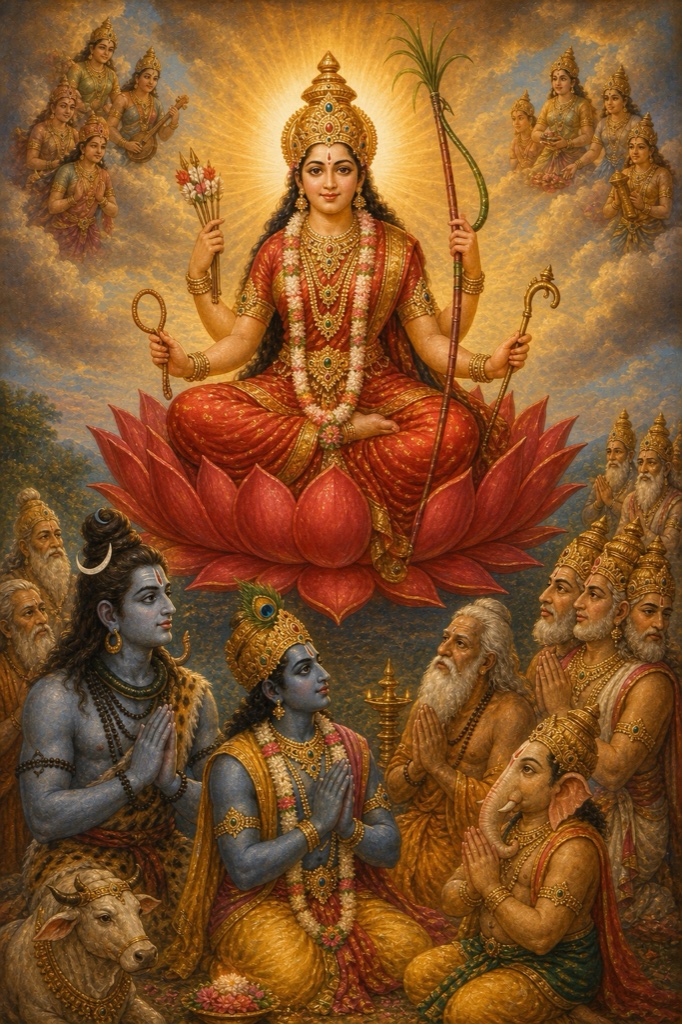
Now the two greatest claims of the Ananda Lahari, the ones that state the bond of Shiva and Shakti most plainly. The Devi is Shiva’s body, with the moon and the sun for its two breasts; and Shiva is the Devi’s soul, that spotless Shiva of the nine-fold Self. So which is the support and which is the supported? The question falls apart in the asking, since each is the other’s body and each is the other’s soul, both one rasa, both standing in the highest bliss; the very attempt to separate Shiva and Shakti comes to nothing. And then the greatest claim of all: the Devi is the mind, she is space, air, fire, water, earth; once she has turned into all these forms, nothing else remains at all. She turns herself into the form of the universe and goes on holding her own form of consciousness and bliss within it. This whole world is the transformed shape of that one blissful consciousness. Nothing inert lies beneath it. Whatever comes into sight, that is she.
36-38
Now the climb turns back toward the upper chakras, Shiva and Shakti together in each one, and in each one a light. At the Ajna chakra, between the brows, the poet bows to that supreme Shambhu who shines with the light of ten million suns and moons and whose side is merged with the Para Shakti; whoever worships him with bhakti comes to dwell in that world which the light of sun and moon and fire never reaches, and which blazes anyway, lit from inside by its own flame. Then the Vishuddhi chakra, the chakra of the throat, where Shiva and Shakti are both clear as crystal, and the Devi is called equal in nature to Shiva, with no higher and no lower between the two of them; the blended radiance of the pair comes down like moonlight, and the world drinks it in the way the chakora bird drinks the moon, its inner darkness washing off as it drinks. And a pair of swans, connoisseurs of the honey of the lotus of unfolding consciousness, floating on the mind-lake of the great; from the talk of these two, learning ripens eighteenfold in the one who carries them, and once this pair has settled in someone’s mind, he sorts the good out of the flawed the way a swan sorts milk from water. The inner union of Shiva and Shakti hands him the gift of discernment.
39-41
Now the climb comes back down to the two lower chakras, and the Ananda Lahari settles into its coolest image of all, a balm set beside the fire. At the Svadhishthana chakra, Rudra in the form of the fire of dissolution sits forever upon the flame, and with him the great goddess Samaya; when Rudra’s anger-filled gaze is burning the worlds down, the Devi’s gaze, wet with mercy, comes over him like a cooling treatment laid on a burn, and wherever there is an energy that scorches there is a power that cools standing right beside it. Then at the Manipura chakra the Devi appears as a dark raincloud, and her power is the lightning in it, the flash that darkness cannot stand against, and the rainbow is her jewelry; and this cloud rains on the three worlds scorched by the sun of destruction, a soothing rain arriving exactly where the world is being singed. Last, the Muladhara chakra at the very base of the spine, where the Devi Samaya dances the gentle lasya and Navatma Shiva dances the fierce tandava of the nine rasas; two dances side by side, the pair of them full of compassion and dancing with the making of the world in view, and out of this joined dance of theirs the whole world is born, with its mother and its father. The claim with which the Ananda Lahari began comes to rest here in its tenderest form: two dancers, and this entire world born of their dance. Now, in Part 2, the form of that Mother, from crown to feet, is about to open.
The next page
The part that follows directly: Part 2 · The Portrait of Her Beauty. In this part the Devi was pure Shakti, moving through the chakras and the lines of lightning with no face to show for it. There she takes on a face, a form, from crown to feet, the beauty of each limb one by one. The Ananda Lahari is an inner map; the Portrait of Her Beauty is the darshan of that same Devi in a form the eye can hold.
Let the sense of shloka 27 stay with you: with the right feeling every act becomes worship, conversation becomes japa, walking becomes circumambulation. Take one small act of your day, any one of them, and do it in that same mood of self-offering. The difference arrives in your own experience, and it needs no arguing for.