Practice the gesture
Let the meeting of the hands mark a small pause in your day. Feel their contact and give your attention to the moment you are in.
 Enlarge image
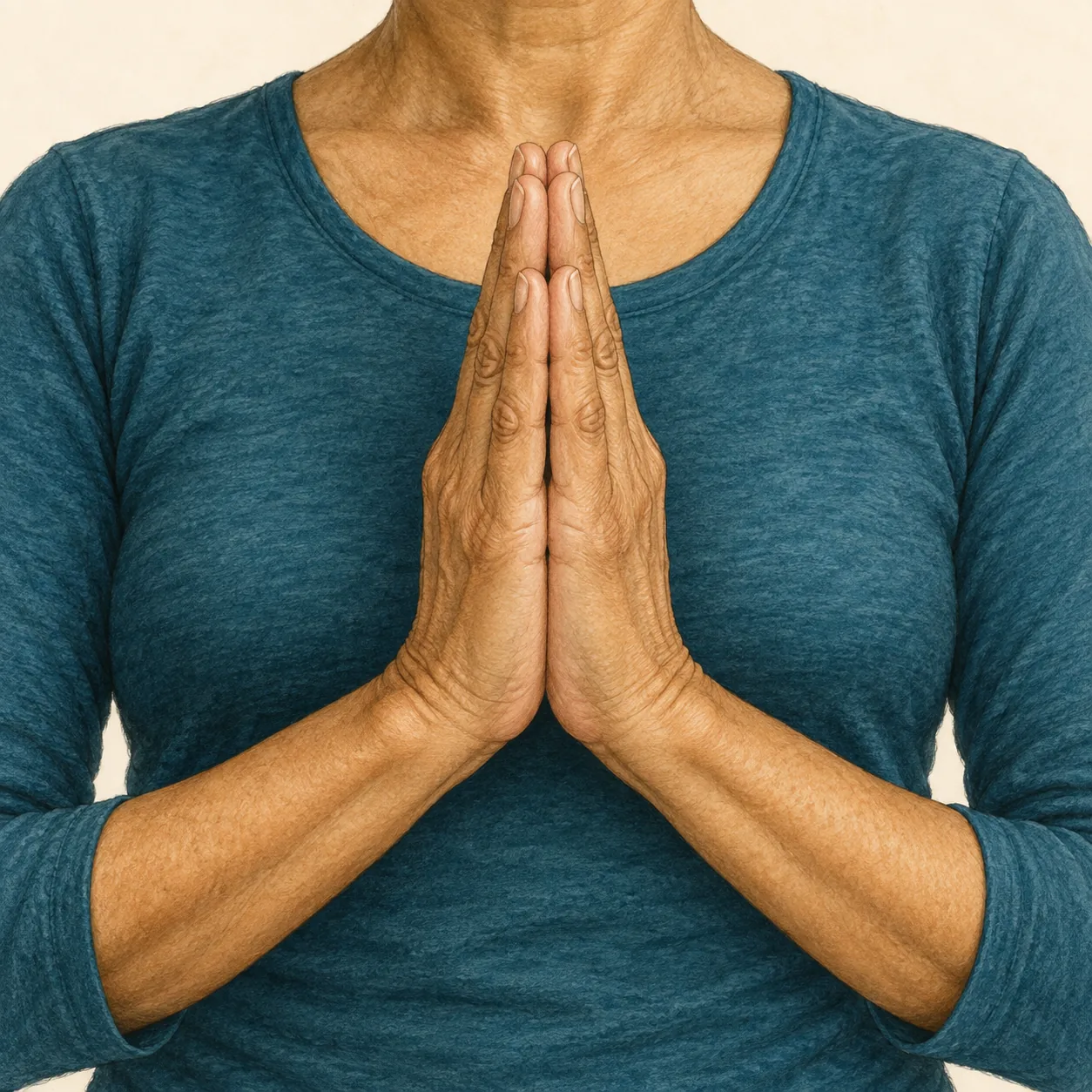
Anjali: palms meet lightly, fingers upward.
Settle in
Sit comfortably on a chair or in a seated position you already use. Let the shoulders settle.
Start with your hands resting on your thighs and your face relaxed.
Place your hands
- Bring both hands in front of your chest, palms facing each other.
- Let the palms and fingers meet lightly, with the fingers pointing upward.
- Keep the hands near the center of your chest and allow the elbows to relax downward.
- Soften the pressure between the palms until the gesture feels easy to maintain.
Breath and attention
Let the breath come and go naturally. If you wish, notice an incoming breath and the outgoing breath that follows, without trying to meet a count.
What to notice
- Where do you feel the contact between the two hands?
- Can the shoulders and jaw stay relaxed while the hands meet?
Finish gently
Separate the palms, lower both hands to your thighs, and let the fingers rest.
Make it easier
Hold the hands a little lower or leave some space between the palms. Comfortable contact is enough.
Take care
Avoid forcing sore fingers straight or pressing the palms flat. Release the gesture if pain, numbness, or increasing strain appears.
Sources and meaning
The teaching sources use joined hands in the prayer position. Joseph LePage identifies this as Anjali and relates it to reverence and devotion. This seated introduction adapts that hand position for a quiet pause. You may bring a sense of greeting, gratitude, or attentive presence to it.
- Art of Living: Sun Salutation · Step 1: Pranamasana (Prayer pose)
- Sivananda International: The Sun Salutation · Step 1: prayer position in front of the chest
- Joseph LePage: The Universe of Mudras, Part I · Opening discussion: Anjali, hands together in front of the heart
- British Museum: figure with joined hands in Anjali · Object 1919,0717.80