Practice the gesture
Explore a small change from the open Chin shape: the same light circle, with the other fingers folded. Notice the difference without tightening the hand.
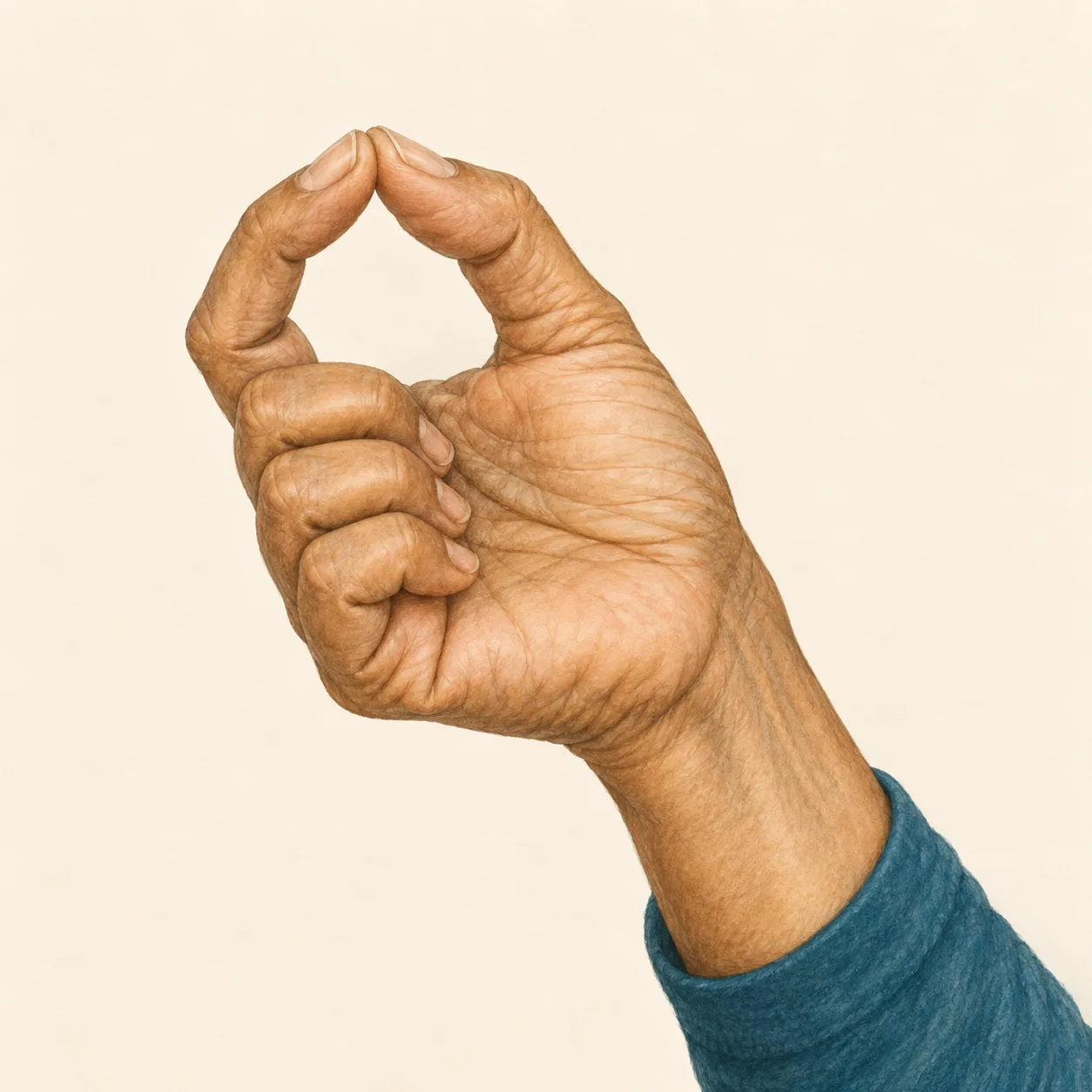 Enlarge image
Chinmaya: a close-up of finger placement, with the other three fingers gently curled.
Settle in
Sit comfortably and support the hands on your thighs, allowing the elbows to relax.
Place your hands
- Bring the tip of each index finger gently to the tip of its thumb.
- Keep that circle and slowly curl the middle, ring, and little fingers toward the palm.
- Let the curled fingers rest softly, with no grip.
- Settle the hands on your thighs. Let the angle of the palms suit your wrists and release any lift in the shoulders.
Breath and attention
Keep breathing naturally. If you catch yourself holding the breath while arranging the fingers, soften the hands and begin again comfortably.
What to notice
- Does curling the three fingers make the thumb-index circle tighten?
- Can the folded hand remain soft?
Finish gently
Uncurl the three fingers, separate thumb and index finger, and let the hands rest open.
Make it easier
Fold the fingers only as far as feels easy; they do not have to press against the palm.
Take care
Avoid forcing the fingers inward. Open the hand if pain or cramping develops.
Sources and meaning
ICYER and the AIIMS/DST teaching booklet agree on this finger arrangement. The practice follows ICYER’s placement on the thighs; the other booklet also describes a placement near the chest. Both teach Chinmaya within a fuller breathing lesson. The practice above introduces a comfortable hand position while ordinary breathing continues.
- Ananda Balayogi Bhavanani, ICYER: Basic Practice of Some Pranayamas · Mudras for pranayama, items 1 to 6, PDF pp. 2 to 3
- AIIMS / DST: Structured Yoga Module for Diabetes (2024) · Section 9.1(a-d), printed p. 49