Practice the gesture
Give your attention a small, clear point of contact. When the mind wanders, the meeting of finger and thumb offers a simple place to return.
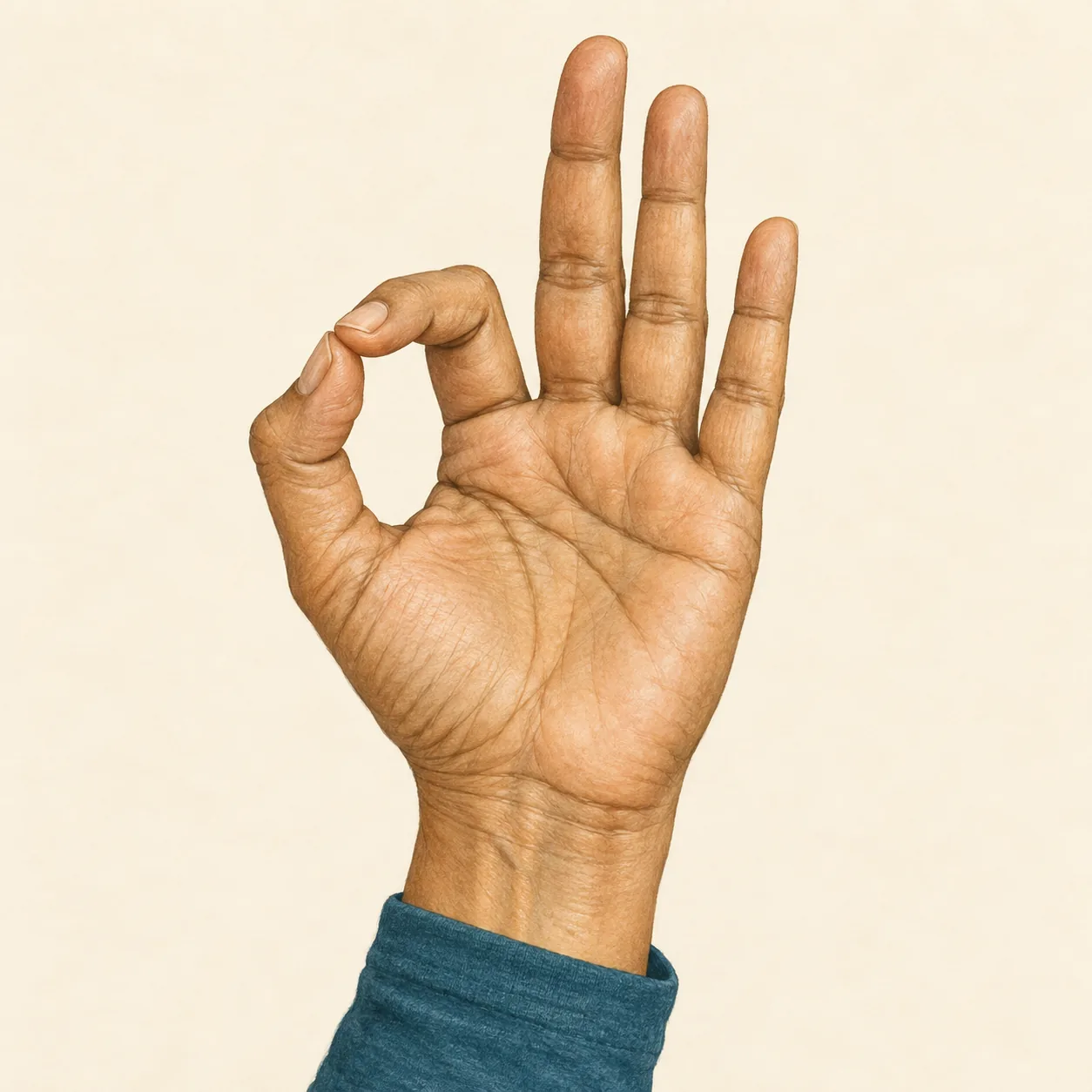 Enlarge image
Chin: a close-up of finger placement. Follow the instructions for resting the hand comfortably.
Settle in
Sit comfortably upright and rest both hands on your thighs, with the elbows at ease.
Place your hands
- On the right hand, bring the tip of the index finger gently to the tip of the thumb, making a circle.
- Let the middle, ring, and little fingers remain open without stretching them stiffly.
- Make the same shape with the left hand.
- Turn the palms upward and let the backs of the hands rest on your thighs.
Breath and attention
Breathe naturally while noticing the light contact between finger and thumb. When attention wanders, return to that contact.
What to notice
- Can the circle stay light, with no pinch in it?
- Are the other three fingers and the wrists comfortable too?
Finish gently
Separate thumb and index finger, open the hands, and let them rest on the thighs.
Make it easier
Try one hand at a time. If bringing the fingertips together is uncomfortable, let that hand rest open.
Take care
Do not pull on the finger joints to complete the circle. Release if the position causes pain or tingling.
Sources and meaning
The practice begins with the palms-up form called Chin mudra in the cited sources. The Australian School of Meditation and Yoga calls the same finger shape with palms down Jnana mudra. You can gently turn the hands over to explore that variation if it is comfortable. Names vary across schools. ASMY interprets the meeting of finger and thumb as a symbol of the individual soul’s relationship with the Supreme.
- Ananda Balayogi Bhavanani, ICYER: Basic Practice of Some Pranayamas · Mudras for pranayama, items 1 to 6, PDF pp. 2 to 3
- AIIMS / DST: Structured Yoga Module for Diabetes (2024) · Section 9.1(a-d), printed p. 49
- Australian School of Meditation and Yoga: Chin and Jnana Mudra · Hand shape, palm orientation, and the school’s symbolic interpretation