On this page
Baka’s tribute, and Kunti’s offer
Kunti asked the Brahmin to explain his grief. “If I can, I will remove its cause.” He acknowledged the generosity of her words, but told her that no human being could solve the problem. “A Rakshasa named Baka lives near this town. He eats human flesh and rules this country. His strength protects the town and the surrounding land, so we have nothing to fear from an enemy’s schemes or from any other creature. His power keeps other enemies away, but we must feed the being whose strength gives us that protection. He has fixed the payment: a cartload of cooked rice, two buffaloes, and the human being who takes them to him. Each household supplies the tribute in turn. Many years pass before a particular family’s turn comes again. Anyone who tries to evade it is killed and eaten with his wife and children. The king of this country lives in the city of Vetrakiya. He has little understanding of government and takes no careful measures to make the land permanently safe. We deserve this suffering for remaining under such a weak, worthless ruler. Brahmins are free to travel, like birds ranging from country to country; we are bound to no one and need not settle forever within a single king’s territory. People say to secure a good king first, then a wife, then wealth. With those three, a man can protect his relatives and children. I went about it in the opposite order, and now I am in terrible danger. Our turn has arrived. We must send that food and a person with it. I have no money to buy someone to go. I cannot give up any member of my family, and I can see no escape. I will take all of them to the Rakshasa today so he can devour us together.”
Kunti offered a way forward. “Do not grieve. You have only one son, and he is very young. You have one daughter, young and helpless. I do not want either of them, your wife, or you to go. I have five sons. Let one of them carry the Rakshasa’s tribute on your behalf.” The Brahmin immediately refused. “I will never allow a Brahmin or a guest to die so that I can live. Even people of low birth and wicked conduct would reject such a proposal. It is said that a person should sacrifice himself and his children for a Brahmin’s benefit. I consider that teaching right and wish to follow it. If the choice is between a Brahmin’s death and my own, I choose my own. Killing a Brahmin is the gravest sin, with no expiation. Giving myself up unwillingly is better than unwillingly sacrificing a Brahmin. And by going, I would not be guilty of suicide, because someone else would take my life. If I knowingly agreed to a Brahmin’s death, the act would be cruel and sinful, with consequences I could never escape.” He believed the family sheltering in his home to be Brahmins, and his obligations to guests made the offer unacceptable to him.
“The learned condemn abandoning someone who has entered one’s home or sought one’s protection,” he continued. “They also condemn killing someone who seeks death at one’s hands. Both are cruel and sinful. Those who understand what conduct is permitted in adversity say that even then one should never perform a cruel, blameworthy act. I would accept dying with my wife today, but I will never agree to a Brahmin’s death.” The Brahmin had understood her offer as the exchange of one life for another. Kunti answered by telling him why she believed her son would come back alive. “I also believe firmly that Brahmins must be protected. Even if I had a hundred sons, each would be as dear to me as the five I have. This Rakshasa, however, will be unable to kill my son. He has great strength and energy and is skilled in mantras. He will deliver the food faithfully and, I am certain, save his own life. I have already seen mighty Rakshasas of enormous size fight him and die by his hand. Tell no one this. If people hear of it, those who want such powers will keep troubling my sons with their curiosity. The wise say that someone who teaches knowledge without his teacher’s permission loses the ability to benefit from it himself.” To the Brahmin and his wife, her assurance was like nectar. They gladly agreed. They had her assurance that the son she would send could protect himself, together with her request that the matter remain private. Kunti then brought their host to Bhima and asked her son to undertake the task. Bhima accepted. “I will do it.”
The gist: Baka demanded a cartload of rice, two buffaloes, and a human victim from each household in turn. The Brahmin refused to save himself at a guest’s expense. Kunti assured him that her son could survive, asked him to keep the matter secret, and obtained Bhima’s agreement to go.
Kunti’s confidence, and the death of Baka
The other Pandavas returned with the alms they had collected after Bhima had accepted the task. Yudhishthira needed only a look at his brother’s face to suspect what he had undertaken. Sitting privately beside Kunti, he asked whether Bhima was acting on her orders or on his own. “At my command, he will do this great deed for the Brahmin and free the town,” she answered. Yudhishthira was alarmed. “What a reckless thing to do! The task is so difficult that it amounts almost to suicide. The learned never praise abandoning one’s child. Why would you sacrifice your son for someone else’s? It goes against ordinary human conduct and the teachings of the Vedas. We sleep safely because of Bhima’s arms. We count on him to regain the kingdom Duryodhana took from us. The thought of his strength keeps Duryodhana and Shakuni awake all night. He saved us from the house of lac and other dangers; he killed Purochana. Relying on his power, we think of Dhritarashtra’s sons as already slain and the wealth of the earth as already ours. What has made you decide to give him up? Have you lost your judgment? Have our misfortunes clouded your understanding?” Kunti assured him that she had made a considered decision. “Do not be anxious for Bhima. This Brahmin has honored us, eased our suffering, and sheltered us where Dhritarashtra’s sons cannot find us. I want to repay him. A worthy person returns more kindness than he receives. I saw what Bhima did when we escaped the burning house, and I saw him kill Hidimba. His arms have the strength of 10,000 elephants. That is how he carried all of you from Varanavata, though each of you is as heavy as an elephant. No one on earth equals him; he could even overcome Indra. Soon after his birth, he fell from my lap onto the rock of a mountain. The stone broke beneath his weight. I have known his strength since then.”
“That is why I have sent him against the Brahmin’s enemy,” she continued. “I acted deliberately, seeking a virtuous deed, with no foolishness, ignorance, or desire for gain. Two purposes will be fulfilled: repayment of our host’s kindness and the acquisition of great merit. A Kshatriya who helps a Brahmin in any undertaking wins blessed regions hereafter. A Kshatriya who saves another Kshatriya’s life wins great fame in this world and the next. One who helps a Vaishya gains affection throughout the earth. A person of the ruling order must also protect a Shudra who seeks refuge. By doing so, he is born in a prosperous royal family in his next life and earns the respect of other kings. Vyasa, whose wisdom comes from severe austerities, taught me this long ago.” Yudhishthira accepted her reasoning. “What you have deliberately done out of compassion for our distressed host is excellent. Bhima will return alive after killing the cannibal, for you are always compassionate toward Brahmins. But make our host promise to do nothing that would reveal us to the people of the town.” Yudhishthira now accepted both purposes Kunti had named: repaying the shelter they had received and fulfilling the duty to help. He also repeated the need for secrecy. Freeing the town would leave the family with a public deed to explain while they were still living in disguise.
After the night passed, Bhima took the tribute to Baka’s forest. On reaching it, he called loudly for the Rakshasa and began eating the food himself. Baka came out in anger. His body was huge, his eyes, beard, and hair red. His tread pressed into the earth. His mouth stretched from ear to ear, the ears stood straight like arrows, and three lines furrowed his forehead. Seeing his own meal being eaten, he bit his lower lip and approached with eyes widened in rage. “Who is this fool who wants to go to Yama’s realm?” he demanded. “Who eats my food in front of me?” Bhima smiled contemptuously, turned his face away, and went on eating. Baka roared and rushed him with both arms raised. Bhima gave him a single glance and continued his meal. The food had been brought as Baka’s tribute, with its bearer intended to be eaten as well. Now that bearer was finishing the meal while Baka tried to kill him. The Rakshasa struck him heavily on the back with both hands. Bhima did not even look up. Enraged, Baka uprooted a tree and came at him again. By then Bhima had leisurely finished all the food. He washed and stood up cheerfully to fight. When Baka hurled the tree, Bhima caught it in his left hand, still smiling.
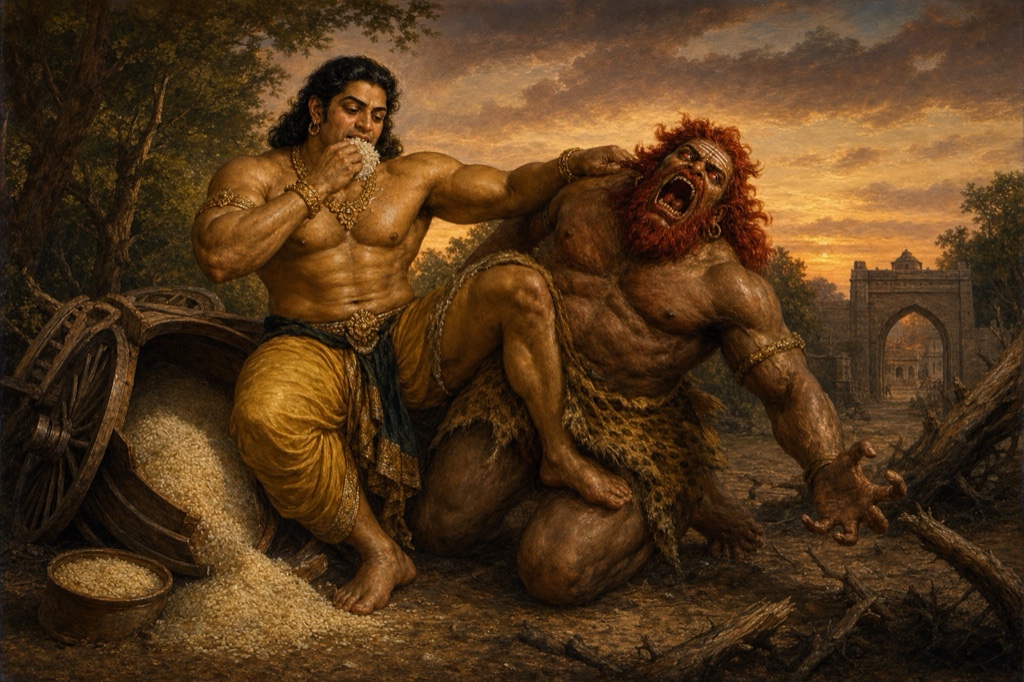
Baka tore up more trees and threw them. Bhima answered with just as many, until their battle stripped the surrounding ground of trees. Announcing that he was Baka, the Rakshasa sprang at Bhima and locked him in his arms. Bhima clasped him in return and began dragging him with great force. Each pulled against the other. The earth shook under their efforts, and standing trees broke. Baka became exhausted. Bhima pressed him to the ground with his knees and struck him hard. Then, planting one knee in the middle of his opponent’s back, he seized the neck with his right hand and the clothing at the waist with his left. He bent the body double across his knee. Baka roared and vomited blood as his body broke. His dying cries brought his relatives and their attendants out of the forest, terrified and scarcely able to think. Bhima reassured them, then demanded a promise. “Never kill human beings again. If you do, you will die as Baka has died.” They agreed. From that day, the people of the town found the Rakshasas of the region peaceful toward them. Bhima dragged the dead cannibal to one of the town gates and left without being observed. Baka’s relatives, frightened by the sight of what Bhima had done, fled in different directions.
Back at the Brahmin’s house, Bhima gave Yudhishthira a full account. The following morning, people leaving the town found the blood-covered body. The sight of the terrible cannibal, huge as a mountain cliff and now lying broken on the ground, made their hair stand on end. They returned to Ekachakra with the news. Thousands came out to see for themselves, accompanied by their wives, with young people and old among them. Astonished by a feat beyond ordinary human strength, they prayed to their gods. Then they worked out whose turn it had been to take the tribute the day before and went to question that household. Their repeated questions left the Brahmin with the task of explaining the town’s deliverance while protecting his guests. “A noble Brahmin skilled in mantras saw my family and me weeping when our turn to supply the food came,” he told them. “He asked the reason. Once he understood the town’s suffering, he reassured me and said with a smile that he would take the food himself. He told me not to fear for him. Then he carried it toward Baka’s forest. He must be the one who performed this deed for the good of us all.” The Brahmins and Kshatriyas wondered at the account, while the Vaishyas and Shudras rejoiced. Together they established a festival whose principal ceremony was the honoring of Brahmins, remembering the deliverer who had freed them from fear of Baka.
The gist: Kunti trusted Bhima’s proven strength and believed that repaying their host was a duty. Bhima killed Baka and bound his relatives to spare human beings. Ekachakra celebrated its deliverance while the Brahmin kept the Pandavas’ identities concealed.
The traveler’s account
The people of Ekachakra returned to their homes, and the Pandavas continued living there as before. Janamejaya asked what the brothers did after killing Baka. Vaishampayana told him that they remained in their host’s house, studying the Vedas. Within a few days, a Brahmin devoted to strict vows arrived to stay there. Their host welcomed him with the proper ceremonies and gave him lodging. Kunti and the brothers asked their new companion to recount his experiences. He spoke about countries, sacred places and rivers, kings, remarkable provinces, and cities. Then he told them of the extraordinary ceremony at which Yajnasena’s daughter would choose a husband. He also mentioned the births of Dhrishtadyumna and Shikhandi, and the appearance of Krishna, the princess also known as Draupadi, at Drupada’s great sacrifice. She had been born without a woman’s womb. The Pandavas wanted the details. “How did Dhrishtadyumna emerge from the fire, and Krishna from the center of the sacrificial platform?” they asked. “How did Drupada’s son learn all the weapons from Drona? And how, through whose actions, and for what reason did Drona’s friendship with Drupada break apart?” Their questions joined the strange births to another matter: why Drona would teach Drupada’s son after the two men had become enemies. Their guest began with the fathers, taking the story back to the hermitage where Drona and Drupada had first known one another.
“Where the Ganga enters the plains,” he said, “there lived a great sage named Bharadwaja, a man of severe austerity, strict vows, and profound wisdom. One day he came to the river to bathe and saw the Apsara Ghritachi standing on the bank after her own bath. A gust of wind lifted away her clothing. Although he had practiced continence since his youth, desire arose in him, and his semen was released. He caught it in a vessel, a drona. From what was preserved there, a son was born and named Drona, the vessel-born. Drona studied all the Vedas and their branches. Bharadwaja’s friend Prishata, the king of Panchala, had a son named Drupada at about the same time. The young prince came to Bharadwaja’s hermitage every day to play and study with Drona. After Prishata died, Drupada succeeded to his throne. Drona then heard that Rama of the Bhrigu line, the warrior sage, was giving away all his wealth before withdrawing into the forest. He went to him and asked for a share. ‘I am Drona, and I have come to obtain your wealth.’ Rama replied that everything had already been given away. ‘Only my body and my weapons remain. Ask for either of those.’ Drona chose the weapons, together with the knowledge of how to use them and withdraw them. Rama agreed. Receiving that armory made Drona feel that he had achieved his purpose. Above all, the Brahma weapon gave him exceptional power, placing him beyond other men.”
“Drona next approached Drupada,” the traveler continued. “‘Recognize me as your friend,’ he said. Drupada answered with distinctions of rank. ‘A man of low birth cannot be the friend of someone of pure lineage. A man who is no chariot warrior cannot befriend a chariot warrior. In the same way, a man who is no king cannot be a king’s friend. Why do you seek to renew our former friendship?’ The answer deeply humiliated Drona. He resolved to find a way to humiliate the king in turn and went to Hastinapura, the Kuru capital named for an elephant. Bhishma brought his grandsons to him as pupils and presented him with wealth of many kinds. Drona gathered the princes and asked for a future payment. ‘Once you have mastered your weapons, you must give me something I cherish in my heart as the fee for teaching you.’ Arjuna and the others agreed. When the Pandavas had become skilled in arms and accurate in their aim, Drona named what he wanted. ‘Drupada, Prishata’s son, is king of Chhatravati. Take his kingdom from him and give it to me.’ The Pandavas defeated Drupada in battle and brought him, captured with his ministers, to their teacher.”
“Drona addressed the defeated king. ‘I ask for your friendship once again. Since only a king can deserve a king’s friendship, I have decided to divide your kingdom between us. You will rule south of the Bhagirathi, and I will rule north of it.’ Drupada accepted. ‘May all be well with you, noble son of Bharadwaja. Let it be as you wish, and let our friendship last forever.’ Having declared that bond, Drona and Drupada returned to their respective homes. Yet the humiliation never left Drupada’s mind for even a moment. Grief wore him down.” The traveler’s account had reached the injury that continued to trouble the king after the agreement over his kingdom.
The gist: Asked about Draupadi’s and Dhrishtadyumna’s births, the visiting Brahmin recounted Drona’s birth, acquisition of weapons, and broken friendship with Drupada. The division of the kingdom had restored an outward agreement between them, while Drupada remained consumed by humiliation.
Two children from Drupada’s sacrifice
The traveling Brahmin continued his story. “Drupada wandered among hermitages, looking for exceptional Brahmins who understood sacrificial rites. Grief consumed him. He kept saying that none of his children possessed the accomplishments he wanted, and spoke bitterly of the children and relatives he already had. His thoughts returned constantly to revenge against Drona. However carefully he considered the problem, he could see no way for his warrior strength to overcome Drona’s discipline, training, and skill. Traveling along the Yamuna and the Ganga, he came to a sacred hermitage where every Brahmin had completed his studies, observed firm vows, and lived virtuously. Among them were two brothers of Kashyapa’s line, Yaja and Upayaja. Both practiced self-command and studied the ancient teachings. Drupada recognized that they could help him and began attending to them with determination. Finding the younger, Upayaja, superior in his accomplishments, he approached him privately, honored his feet, spoke gently, and offered whatever he might desire. ‘Perform the sacrifice that will give me a son who can kill Drona,’ the king asked. ‘I promise you 10,000 cows, or anything else you wish.’ Upayaja refused. Drupada continued serving him, unwilling to accept the refusal as final.”
“A year passed before Upayaja offered another course. ‘Once, while walking through a deep forest, my elder brother picked up a fallen fruit without considering whether the ground beneath it was pure,’ he said. ‘I was following him and saw it. He has no scruple about accepting an impure thing. Someone who overlooks purity on one occasion is unlikely to attend to it carefully on others. While he lived with his teacher and studied the sacred rules, he used to eat what remained of other people’s meals. He always praises food and rejects none of it. From these signs, I believe he desires worldly acquisitions. Go to him. He will perform the rite for you.’ The account lowered Drupada’s opinion of Yaja, but the king went to him nevertheless. He paid the sage the honor due to him and offered 80,000 cows for his services. ‘My enmity with Drona burns in my heart. Relieve it. He knows the Vedas and the Brahma weapon. That power enabled him to defeat me when our friendship broke down. Bharadwaja’s son is now the chief teacher of the Kurus, with no Kshatriya on earth superior to him. His bow is a full 6 cubits long, and his arrows can kill any creature. Wearing a Brahmin’s garb, he destroys warrior power across the earth, like a second Jamadagnya, the son of Jamadagni, sent to exterminate the Kshatriyas. No man can resist his weapons. He combines spiritual power with military strength and consumes his opponents like fire fed with clarified butter. Your spiritual power alone is greater than his combined forces. I possess only warrior strength and am therefore inferior to him. I seek your help, since your knowledge of Brahma surpasses his. Perform the sacrifice that will give me an invincible son capable of killing Drona. I am ready to give you 10,000 cows.’”
“Yaja agreed and began recalling the ceremonies required. Recognizing the gravity of the undertaking, he asked Upayaja, who desired no reward, to assist him. He promised a sacrifice directed toward Drona’s destruction. Upayaja told Drupada everything that would be needed and assured him that a child would be born with the strength, energy, and prowess he wanted. The king began gathering what the sacrifice required. His wish remained the same one he had brought to Upayaja a year earlier: a son whose power could overcome Drona. Now Yaja had accepted the task, and Upayaja was specifying the means of carrying it out. When all was ready, Yaja poured clarified butter into the sacrificial fire and called for Drupada’s queen. ‘Come, daughter-in-law of Prishata. A son and daughter have arrived for you.’ She asked him to wait. ‘My mouth still contains saffron and other fragrant substances. Perfumes are on my body. I am not yet fit to receive the sanctified offering. Wait a little.’ Yaja answered that the sacrifice was already ready to achieve its purpose. ‘Whether you come now or delay, I have prepared the offering and Upayaja’s invocations have consecrated it. Why should the result be held back?’ He poured the offering into the fire.”
“A boy rose from the flames, radiant as fire and resembling a celestial being. A crown was on his head, fine armor covered his body, and he carried a sword, bow, and arrows. He roared repeatedly. Immediately after his birth, he mounted an excellent chariot and drove about in it. The Panchalas cried out in delight, praising what they saw. The earth seemed scarcely able to bear the weight of their joy. An unseen voice sounded in the sky: ‘This prince has been born to destroy Drona. He will dispel the fears of the Panchalas, spread their fame, and end the king’s sorrow.’ Then a daughter arose from the center of the sacrificial platform. The girl was called Panchali, the princess of Panchala. She was extraordinarily beautiful and blessed with good fortune. Her large, dark eyes were like lotus petals; her complexion was dark, and her blue hair curled. Her nails were gracefully rounded and shone like polished copper, her eyebrows were beautiful, and her breasts were full. She looked like a celestial daughter born among human beings. The fragrance of blue lotuses came from her body and could be perceived a full 2 miles away. No woman on earth equaled her beauty; a god, a Danava, or a Yaksha might desire her as a wife. A bodiless voice announced her future: ‘This dark girl will be foremost among women and the cause of the destruction of many Kshatriyas. In time she will fulfill the purpose of the gods. With her, many dangers will come upon the Kauravas.’ The Panchalas roared in joy again, and the earth seemed unable to bear the jubilant gathering.”
“Seeing the boy and girl, the queen approached Yaja and asked that they recognize no mother except her. Desiring the king’s welfare, he granted the request. The Brahmins named the boy Dhrishtadyumna because of his extraordinary boldness and his birth like Dyumna with natural armor and weapons. Because the girl’s complexion was dark, they named her Krishna. In this way the pair were born from Drupada’s great sacrifice. Drona later took the Panchala prince into his own home and taught him the use of every weapon, repaying the half-kingdom he had taken from Drupada. He regarded destiny as inevitable. Knowing that, Bharadwaja’s son chose the act that would perpetuate the renown of his own great deeds.”
The gist: Drupada obtained Yaja’s and Upayaja’s help in a sacrifice intended to produce Drona’s killer. Dhrishtadyumna emerged from the fire and Krishna, Draupadi, from the platform. Voices announced their futures. Drona later trained the very prince born to bring about his death.
Toward Panchala, and Vyasa’s promise
The traveler’s words disturbed the Pandavas as though they had been struck by arrows. Kunti saw her sons distracted and without peace, and spoke to Yudhishthira about leaving Ekachakra. “We have spent many nights in this Brahmin’s home,” she said. “Life here has been pleasant, supported by the alms of honorable and generous people. We have seen the surrounding woods and gardens repeatedly. Seeing them again will no longer give us the same pleasure, and alms are becoming harder to obtain. If you agree, let us go to Panchala. We have not seen that country, and I think we will enjoy it. We hear that alms are readily available there and that King Yajnasena is devoted to Brahmins. Remaining too long in one place seems unwise. Let us go, if that is your wish.” Yudhishthira accepted her judgment. “Obeying you is our duty, and your advice must be for our good. I only do not know whether my younger brothers want to go.” Kunti put the proposal to Bhima, Arjuna, Nakula, and Sahadeva. All agreed. They bowed to their host and set out with their mother for Drupada’s city.
Vaishampayana then recounted a visit Vyasa had made while the brothers were still living in disguise in the Brahmin’s house. When Satyavati’s son arrived, the Pandavas rose and went forward to meet him. They saluted him, performed the proper acts of honor, and stood silently with their hands joined. Pleased by their welcome, he invited them to sit. “Are you living according to virtue and the scriptures?” he asked. “Do you honor the Brahmins? I hope you are diligent in showing reverence to those who deserve it.” After speaking about many matters of duty and interest, he told them a story. “A renowned sage once had a daughter who lived in his hermitage. She was beautiful, with a slender waist, fine eyebrows, and lovely lips, and possessed every accomplishment. Yet her earlier actions had brought her an unfortunate destiny. Though virtuous and beautiful, she could find no husband. In sorrow, she undertook severe austerities to obtain one. Her penance pleased Shiva, whom Vyasa called Shankara. The god appeared favorably disposed toward her and invited her to ask for a boon. ‘I am Shankara, ready to grant what you desire,’ he told her. She repeatedly asked him for a husband endowed with every good quality.”
“The god answered, ‘You will have five husbands from among the princes of the Bharata line.’ The maiden objected. ‘Through your grace, I want only one husband.’ Shiva explained his answer. ‘You asked for a husband five times. Therefore, in another life, you will have five.’” The repeated request would bear its result in her next life. Vyasa then identified the woman whose birth the brothers had heard about and applied the promise directly to the five men listening to him. “That maiden of celestial beauty has now been born in Drupada’s family. Krishna of Prishata’s line is destined to be the wife of all of you. Go to the capital of Panchala and live there. You will certainly find happiness in obtaining her as your wife.” Having spoken, their grandfather took his leave and returned to the place from which he had come.
The gist: Kunti proposed leaving Ekachakra for Panchala, and all five brothers agreed. During their stay, Vyasa had told them that the woman now born as Krishna had asked Shiva for a husband five times in an earlier life. She was destined to marry all five Pandavas.
Source: the Mahabharata of Krishna-Dwaipayana Vyasa, Adi Parva. This chapter follows K. M. Ganguli, sections CXL-CLXXXIV (140-184); the Gita Press Hindi edition numbers these chapters differently. Names, order, and events were checked against Ganguli’s complete translation. Dialogue and commentary are adapted, not a verbatim translation. About the sources.
Based on: The Mahabharata, Vyasa (Gita Press, Gorakhpur)