On this page
The succession, and an invitation to Varanavata
Vaishampayana first gave Janamejaya the outline of the calamity that followed. Shakuni, the son of Suvala, conspired with Duryodhana, Duhshasana, and Karna. With Dhritarashtra’s approval, they decided to burn Kunti and her five sons to death. Vidura, who could read hidden intentions from outward signs, recognized the plan in the conspirators’ faces. Devoted to the Pandavas’ welfare, he arranged their escape. He had a boat prepared that could withstand wind and waves, then warned Kunti. “Dhritarashtra has been born to destroy the honor and descendants of the Kuru line. His intentions are wicked, and he is about to abandon the enduring law of virtue. I have placed a strong boat on the river. Take your children aboard and escape the net death has spread around you.” Distressed by his words, Kunti crossed the Ganga with her sons. Following Vidura’s advice, they left the boat and safely entered the deep forest, carrying the wealth their enemies had given them at Varanavata. An innocent Nishada woman who had come to the house of lac on some business burned to death there with her children. Purochana, the wicked man employed to construct the house, also died in the fire. Dhritarashtra’s sons and their counselors had failed in their purpose, but the people of Varanavata knew nothing of the escape. Believing the Pandavas dead, they grieved and sent messengers to Dhritarashtra with an accusation: “Your great purpose is accomplished. You have finally burned the Pandavas to death. Enjoy the kingdom with your children now that you have what you wanted.” Dhritarashtra and his sons made a display of mourning. Together with their relatives, including Bhishma and Vidura, they performed the final honors for the Pandavas. Janamejaya interrupted the outline with a request. “I want to hear the whole account of the burning of the house and their escape. Acting on wicked Kanika’s advice, the Kurus committed a cruel deed. Tell me everything that happened. I am eager to know.”
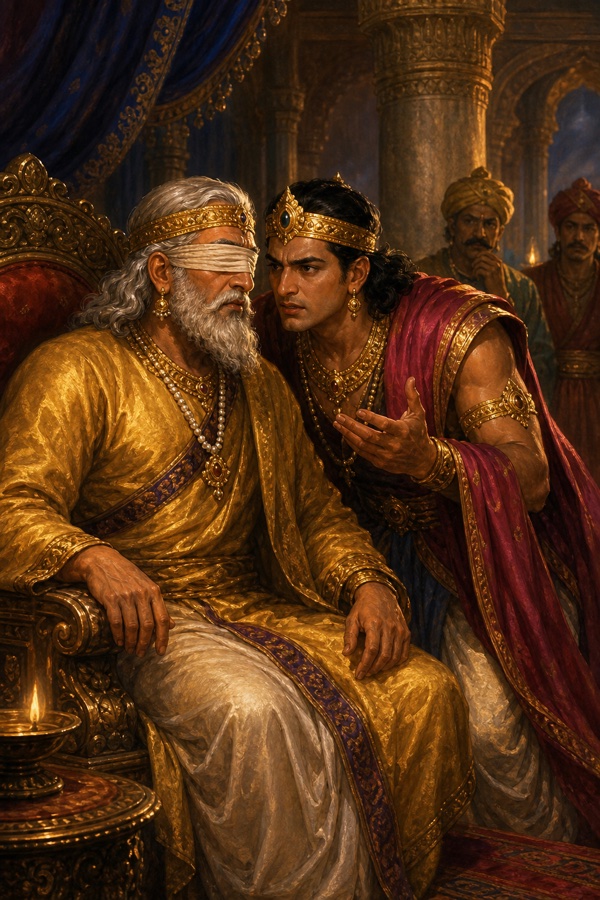
At Janamejaya’s request, Vaishampayana returned to the events leading up to the journey. The escape he had just outlined lay ahead of the princes; in Hastinapura, their growing strength and the question of succession were still occupying the court and the city. Bhima’s unmatched strength and Arjuna’s mastery of weapons had made Duryodhana miserable. Karna, the son of the Sun, and Shakuni had repeatedly tried to bring about the Pandavas’ deaths. The brothers defeated those attempts one after another. On Vidura’s advice, they kept silent about them afterward. Meanwhile, the citizens were discussing the qualities of Pandu’s sons in courtyards and other public gathering places. They saw Yudhishthira as a man fit to rule. “Dhritarashtra has the sight that knowledge gives,” they said, “but because he was born blind, he did not receive the kingdom before. How can he be made king now? Bhishma, Shantanu’s son, has already renounced sovereignty. A man so devoted to his vows and to truth will never accept it now. Let us install the eldest Pandava with the proper ceremonies. He is young, capable in battle, learned in the Vedas, truthful, and kind. He will honor Bhishma and Dhritarashtra and maintain them, along with Dhritarashtra’s children, in every comfort.” Duryodhana heard people repeating these views as they dispersed. Their preference for Yudhishthira tormented him. Finding his father alone, he bowed and reported what he considered ominous talk. “They want Pandu’s son as their king, passing over both you and Bhishma. Bhishma will agree, since he will never rule himself. The citizens are trying to inflict a grave injury on us. Pandu’s accomplishments won him the ancestral kingdom. You were fully qualified, yet your blindness prevented you from receiving it. If Pandu’s son now inherits, his own son will inherit after him, then his grandson, and the kingdom will remain in that line. Our children and I will be excluded from the succession and disregarded by everyone. Find a way to prevent us from living in perpetual misery, dependent on others for our food. Had you received the sovereignty in the first place, I would certainly have succeeded you, however much the people opposed it.”
Dhritarashtra listened and remembered Kanika’s words. Sorrow unsettled him, and his resolve wavered. Duryodhana consulted again with Karna, Shakuni, and Duhshasana, then proposed a course to his father. “Find some clever way to send the Pandavas to Varanavata. We will have no need to fear them then.” Dhritarashtra considered the suggestion. “Pandu was devoted to virtue and dutiful toward all his relatives, especially toward me. He cared little for worldly pleasures. He gave me everything, even the kingdom. His son is just as virtuous and possesses every accomplishment. Yudhishthira is famous everywhere, beloved by the people, and supported by allies. How can we force him out of his ancestral kingdom? Pandu supported the ministers and soldiers, their sons, and their grandsons. Remembering those benefits, might the citizens kill us, along with our friends and relatives, for what we do to Yudhishthira?” Dhritarashtra had named the families who owed their livelihood to Pandu and the support they might give his son. Duryodhana acknowledged that debt, then proposed using the treasury and the ministers to win those people over. “Consider the danger approaching you. If we win people over with money and honors, those demonstrations of our power will secure their support. The treasury and the ministers are already under our control. Send the Pandavas to Varanavata by some gentle means. Once sovereignty has been conferred on me, Kunti and her children may return.”
“That same thought is already in my mind,” Dhritarashtra admitted. “I have never spoken it because it is sinful. Bhishma, Drona, Vidura, and Kripa will never approve the Pandavas’ exile. To those wise and virtuous men, we and the Pandavas have equal claims on their regard. They will make no distinction between us. If we behave this way, will we not deserve death at the hands of those elders, the Kurus, and the whole world?” Duryodhana calculated where each elder would stand. “Bhishma has no greater affection for either side, so he will remain neutral. Drona’s son Ashwatthaman is with me, and his father will follow his son. Kripa, Sharadwat’s son, will stand with Drona and Ashwatthaman. He will never abandon Drona or his own sister’s son. Vidura secretly supports the enemy, but he depends on us for his livelihood. Even if he takes the Pandavas’ side, what harm can he do alone? Send them to Varanavata without fear. Arrange for them to leave today. Father, extinguish the grief that consumes me like fire, keeps me awake, and pierces my heart like a weapon.” Duryodhana had answered his father’s objections one by one: the citizens could be won with wealth, the elders would be neutral or bound by family loyalties, and Vidura could do little alone. He ended by asking his father to relieve his own consuming distress.
Duryodhana and his brothers began gradually securing public support through grants of money and honors. At Dhritarashtra’s direction, several skillful counselors spoke in court about the attractions of Varanavata. The festival of Pashupati, Shiva, had begun there, they said. Crowds were gathering, and its beautifully adorned procession delighted everyone who saw it. They praised it as the finest such spectacle ever witnessed. Listening to their descriptions, the Pandavas grew interested in visiting. Once Dhritarashtra recognized their curiosity, he addressed them. “My men often describe Varanavata as the most delightful town in the world. If you wish to see the festival, go there with your friends and attendants. Enjoy yourselves like the gods. Give pearls and jewels to the Brahmins and musicians gathered there. Stay as long as you please, enjoy its pleasures, and then return to Hastinapura.” Yudhishthira understood the king’s motives fully. Considering himself weak and without friends, he nevertheless accepted the command. He spoke slowly and humbly to Bhishma, Vidura, Drona, Bahlika of the Kuru line, Somadatta, Kripa, Ashwatthaman, Bhurishravas, the other counselors, Brahmins, ascetics, priests, citizens, and Gandhari. “At Dhritarashtra’s command, we are going with our friends and attendants to the beautiful, populous town of Varanavata. Give us your blessings gladly, so that we may prosper and remain untouched by wrongdoing.” The Kuru leaders blessed them with cheerful words. “May all the elements favor you on your journey, sons of Pandu. May no harm, however slight, come to you.” The Pandavas performed rites intended to secure their share of the kingdom, completed their preparations, and set out for Varanavata.
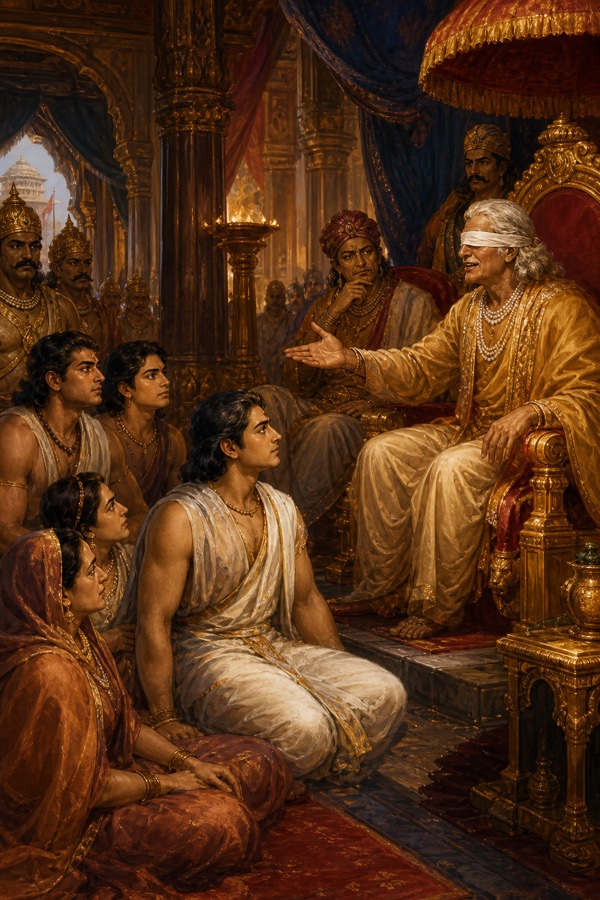
The gist: After hearing an outline of the fire and escape, Janamejaya asked for the full story. Vaishampayana described Duryodhana’s fear that the succession would remain with Pandu’s descendants. With Dhritarashtra’s agreement, the festival at Varanavata became the occasion for sending the Pandavas away.
Purochana’s orders, and Vidura’s warning
Duryodhana was delighted when Dhritarashtra sent the Pandavas to Varanavata. In private, he summoned his counselor Purochana, took his right hand, and entrusted him with the plan. “This earth, with all its wealth, is mine,” he said. “It is equally yours. Protect it. I have no counselor I trust more with a secret. Keep this one and destroy my enemies by a clever device. The Pandavas are going to Varanavata for the festival at Dhritarashtra’s command. Take a chariot drawn by fast mules and reach the town today. Build a four-sided palace near the arsenal. Furnish it richly, use fine materials, and keep a close watch on it. In its construction, use hemp, resin, and every other combustible substance you can obtain. Mix a little earth with clarified butter, oil, fat, and a great quantity of lac, and plaster the walls with it. Place hemp, oil, clarified butter, lac, and wood around the house so carefully that the Pandavas, or anyone else examining it, cannot detect them or recognize the danger. Receive the brothers with the greatest respect, then settle them there with Kunti and their friends. Provide excellent seats, conveyances, and beds, giving Dhritarashtra no reason to complain about their treatment. No one in Varanavata must learn anything before our purpose is fulfilled. Once you are certain they are sleeping inside, confident and unafraid, start the fire at the outer door. They will burn to death, and the people will believe their house caught fire by accident.” Purochana accepted the command. His mule-drawn chariot carried him to Varanavata, where he lost no time in carrying out the instructions. The plan depended on the materials remaining undetected even under close examination. The walls themselves would help the fire spread, while the fine furnishings and respectful service were intended to keep the guests at ease. Purochana had orders to wait for that confidence before lighting the outer door.
The Pandavas meanwhile prepared their own chariots, harnessing fine horses as swift as the wind. Before mounting, they sorrowfully touched the feet of Bhishma, Dhritarashtra, Drona, Kripa, Vidura, and the other Kuru elders. They bowed to the older men, embraced their equals, and accepted the farewells of the children. They took leave of the respected women of their household, walking around them in reverence, then said goodbye to the citizens. Vidura, other leading Kurus, and many townspeople followed them some distance in distress. People from the town and countryside spoke out. “Dhritarashtra treats them unjustly. He gives no thought to virtue. Yudhishthira, Bhima, and Arjuna would never commit the wrong of rebellion. If those three remain quiet, what would Madri’s sons do? They inherited their father’s kingdom, and Dhritarashtra cannot bear them. How can Bhishma permit this injustice and allow them to be sent to that wretched place? Vichitravirya, Shantanu’s son, and the royal sage Pandu cared for us like fathers. Now Pandu has gone to heaven, and Dhritarashtra cannot tolerate his children. We reject this exile. Let us leave our houses and this fine city, and go wherever Yudhishthira goes.” The people were offering to abandon their homes and follow the family they believed had been wronged. Yudhishthira was grieving too, but he still acknowledged Dhritarashtra as the elder whose command he must obey. After thinking for a moment, Yudhishthira answered. “The king is a father to us, worthy of reverence, our guide and our elder. Our duty is to obey his commands without suspicion. You are our friends. Walk around us, give us the happiness of your blessings, and return home. When the time comes for you to act for us, do whatever will help and please us.” The citizens circled the brothers respectfully, blessed them, and turned back toward their homes.
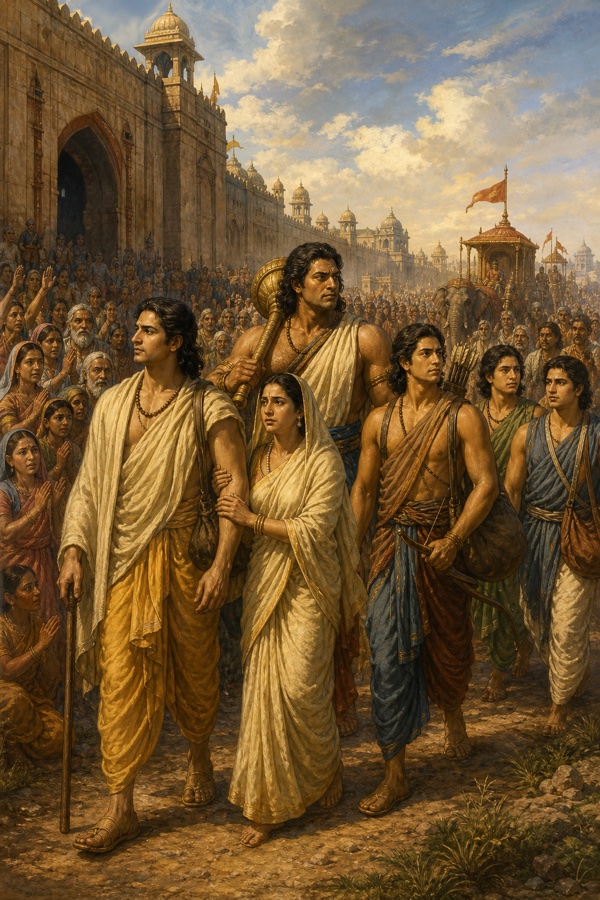
Once the citizens had stopped following, Vidura spoke to Yudhishthira in a language the others could not understand. Both men knew this Mlechchha tongue, and it allowed Vidura to warn him without making the meaning public. “A man who recognizes the schemes his enemies devise through political skill should use that knowledge to keep himself safe,” he said. “There are sharp weapons that can cut a body even though they are not made of steel. The man who recognizes them and knows how to ward them off cannot be harmed by his enemies. Neither what consumes straw and wood nor what dries the dew burns those who live in a hole in the deep forest. A man lives if he knows this and protects himself. The blind cannot see their path or know their direction. Those without firmness never prosper. Remember this and stay on your guard. If you must accept a weapon made of something other than steel from your enemies, make your dwelling like a jackal’s, with several ways out, and escape the fire. Wandering teaches a person the routes; the stars reveal direction. A man who controls his five senses cannot be overcome by his enemies.” The fire, the refuge underground, and the means of finding a way beyond it were all carried in his guarded words. Yudhishthira answered simply, “I understand.” Vidura had walked with the brothers far enough to deliver his warning. He circled them in reverence, took his leave, and returned home.
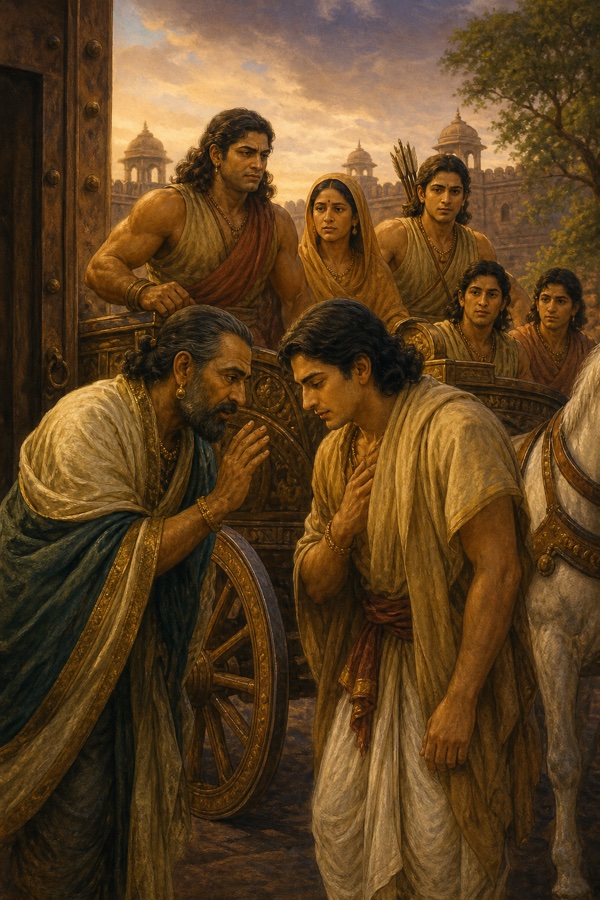
After the citizens, Bhishma, and Vidura had all stopped accompanying them, Kunti approached Yudhishthira. “Vidura spoke to you among the others so obscurely that it seemed he had said nothing,” she said. “Your answer was equally obscure. I could not understand either of you. If there is no reason I should not know, tell me everything that passed between you.” Yudhishthira explained. “Vidura told me that the house prepared for us at Varanavata has been built from combustible materials. He said that the route of escape would also become known to me, and that those who govern their senses can acquire sovereignty over the whole earth. My answer was that I understood.” The Pandavas had set out on the eighth day of Phalguna, with Rohini in the ascendant. They reached Varanavata and saw the town and its people.
The gist: Duryodhana instructed Purochana to hide combustible materials inside a comfortable palace and burn it when the Pandavas trusted their surroundings. Vidura warned Yudhishthira through guarded language, pointing toward underground refuge, multiple exits, knowledge of routes, and self-command.
The Blessed Home, and a passage beneath it
News of the Pandavas’ arrival brought the people of Varanavata out to welcome them. Thousands of vehicles carried citizens from the town, with the auspicious articles prescribed for a formal reception. They called out blessings and cries of victory as they gathered around Kunti’s sons. Among them Yudhishthira shone like Indra, the thunderbolt in his hand, surrounded by the gods. The brothers returned the citizens’ greetings and entered the populous town, which was richly decorated. Their first visits were to Brahmins engaged in their religious duties. They then called at the homes of the town officials, the Sutas, the Vaishyas, and the Shudras. Having received the people’s hospitality, they followed Purochana to the residence prepared for them. He supplied fine food and drink, beds, and carpets. The Pandavas lived there in costly clothing, honored by both their host and the people of Varanavata. They spent their first 10 nights in that residence. Only then did Purochana speak of the other building he had prepared and invite them to move into it. He called it the Blessed Home, though the purpose built into it was deadly. At his urging, the well-dressed brothers entered it, their arrival compared to the Guhyakas entering Shiva’s palace on Mount Kailasa.
Yudhishthira inspected the building and recognized what its walls contained. The smell of fat mixed with clarified butter and preparations of lac gave it away. “Bhima, this house is made of combustible materials,” he said. “There is no doubt about it. Our enemies have employed trusted, skillful builders. Hemp, resin, brushwood, straw, and bamboo have been soaked in clarified butter and carefully worked into the structure. Purochana is staying here under Duryodhana’s orders, waiting to burn me when he sees that I trust him. Vidura knew the danger and warned me. Our youngest uncle, who always seeks our good out of affection, knew what Duryodhana’s men were doing in secret.” Bhima proposed returning to the first residence. Yudhishthira had another course in mind. “I think we should stay here, showing no suspicion while keeping our senses alert and finding a reliable means of escape. If Purochana reads our understanding in our faces, he may act immediately and burn us without warning. He has little concern for sin or disgrace. He is here to carry out Duryodhana’s instructions. If we die in this fire, will our grandfather Bhishma be angry? Why would he provoke the Kauravas against him by displaying his anger? Perhaps he and the other Kuru elders will consider indignation at such a crime their duty and become enraged.” Yudhishthira weighed that uncertain response alongside the danger already built into their lodging.
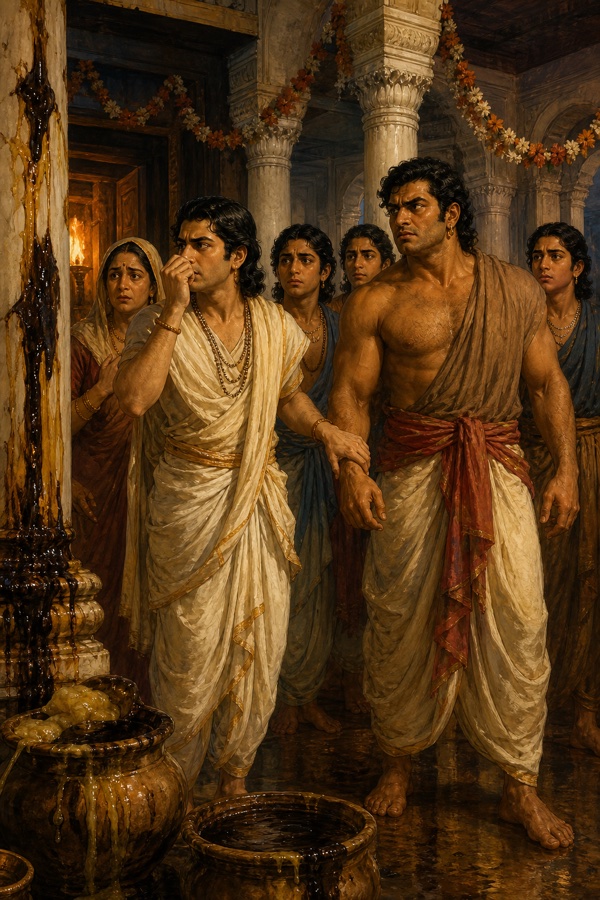
“If we run away because we fear the fire, Duryodhana will use spies to arrange our deaths,” he continued. “He wants the sovereignty. We lack position and power; he has both. We have neither friends nor allies to rely on here; he has them. We lack wealth, and he controls a full treasury. With those resources, he can certainly find a way to destroy us. Let us deceive Purochana and Duryodhana while we live here. We can disguise ourselves at times and range through the country hunting. If we need to flee, we will know the roads and paths. Today itself, we should have an underground passage secretly dug from our chamber. Keep everything concealed, and the fire will be unable to consume us. We must work actively for our safety without allowing Purochana or the townspeople to discover what we are doing.” A friend of Vidura’s then came to them privately. He was skilled in tunneling. “Vidura sent me to serve you,” he said. “He trusts me and ordered me to come here and secure your welfare. Tell me what you need. Purochana will set fire to the door of your house on the fourteenth night of this dark fortnight. Dhritarashtra’s son intends to burn you and your mother to death. Vidura spoke to you in the Mlechchha language, and you answered in the same language. I give you those details as proof of who has sent me.”
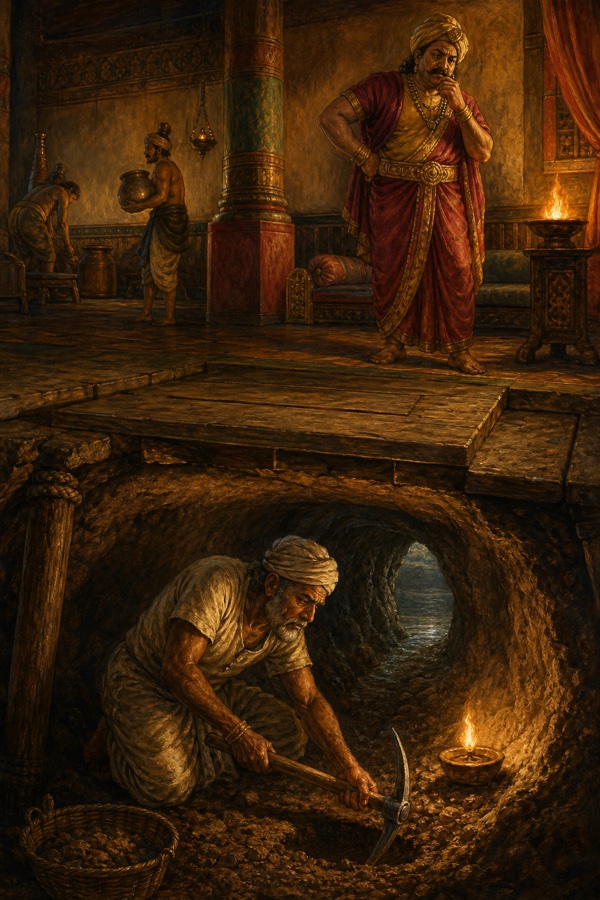
The reference to the private exchange satisfied Yudhishthira. “I recognize you as Vidura’s trusted and devoted friend,” he said. “Nothing escapes his knowledge. Belong to us as you belong to him; make no distinction between us. Protect us as he does. I know that Purochana prepared this inflammable house at Dhritarashtra’s son’s command. That wicked man has wealth and allies, and he pursues us without respite. Help us escape the fire. If we burn here, Duryodhana will have his dearest wish. There stands his well-stocked arsenal. This large house has been built against its high ramparts, with no other way out. Vidura knew the wicked design from the beginning and warned us. The danger he foresaw is now close. Save us without letting Purochana discover it.” The miner agreed and began his work carefully. He dug a large subterranean passage whose entrance lay in the center of the house. It was level with the floor and covered with planks, concealed from the man who kept constant watch at the door. At night, the Pandavas slept in their chambers with their weapons ready. By day they hunted from forest to forest, learning the ground beyond their residence. They maintained an appearance of trust and contentment for Purochana while inwardly feeling neither. Their preparations joined the hidden passage to a knowledge of the countryside outside. The tunnel provided a way past the watched entrance; their daily hunting took them along the routes they might need once they were free of the house. Their precautions remained unknown to the people of Varanavata. Only Vidura’s friend, the miner, knew the plan they were carrying out.
The gist: Yudhishthira detected the combustible materials but chose to conceal that knowledge. Vidura’s miner dug a hidden passage, while the Pandavas kept their weapons ready and used their hunting trips to learn the surrounding routes.
The fire, and the crossing of the Ganga
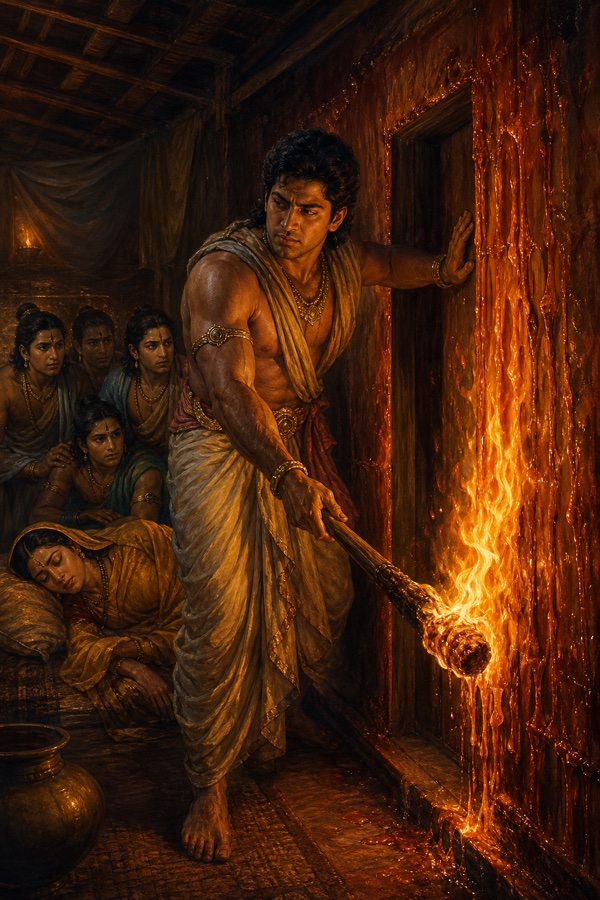
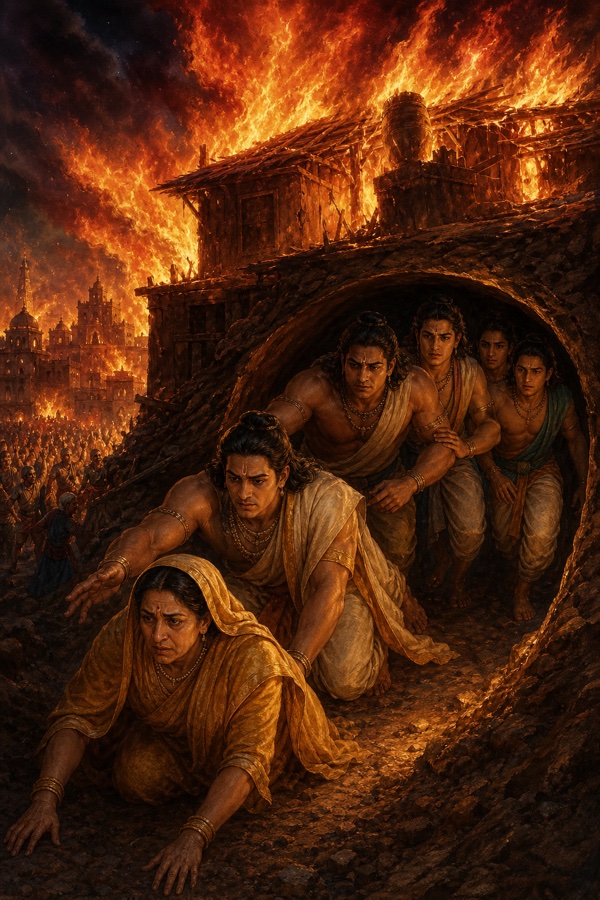
A full year passed with the Pandavas appearing cheerful and unsuspecting. Purochana was delighted. Yudhishthira saw that satisfaction and told Bhima, Arjuna, Nakula, and Sahadeva that their moment had arrived. “He has been thoroughly deceived. I think it is time to escape. Let us set fire to the arsenal, burn Purochana, and leave his body here. Then the six of us can get away unseen.” One night, on an occasion of almsgiving, Kunti fed a large gathering of Brahmins. Many women attended as well. They ate and drank as they wished, then took Kunti’s leave and returned home. A Nishada woman, wandering in search of food, came to the feast with all five of her sons. The wine they drank left the mother and children helplessly intoxicated. Unconscious and scarcely seeming alive, they lay down to sleep inside the mansion. After the household had gone to bed, a violent wind rose in the night. Bhima lit a fire at the place where Purochana was sleeping. He then set the door of the house of lac alight and started fires at several other points around the building. Once the brothers were satisfied that it was burning in many places, they took their mother into the underground passage without delay. The growing heat and roar woke the townspeople. From outside, the flames gave the townspeople no sign of the underground escape. They gathered around the house in grief, believing that the scheme against the princes had succeeded. The words that followed expressed what they thought had happened inside. “Purochana built this house on Duryodhana’s orders to destroy his master’s relatives,” they said. “He has set it on fire. Shame on Dhritarashtra’s partial heart! He has burned Pandu’s innocent heirs as though they were his enemies. The wicked man who burned these trusting princes has himself been burned by fate.” They remained around the house throughout the night, mourning the people they believed were trapped inside.
The Pandavas emerged from the tunnel with Kunti and fled without being seen. Fear and sleepiness slowed them. Bhima lifted his whole family onto his body: his mother on his shoulder, the twins at his sides, and Yudhishthira and Arjuna on his two arms. Carrying all five, he drove through the darkness with the speed of the wind, breaking trees against his chest and pressing the earth beneath his feet. Vidura, meanwhile, had sent a man of trustworthy character into those woods. His spies had kept him informed of Duryodhana’s design, and his messenger went to the place he had been instructed to search. He found the brothers and their mother measuring the depth of the river. On the sacred bank of the Ganga, he showed them a boat equipped with machinery and flags, built by trusted craftsmen to withstand wind and waves. Its speed was compared to a storm or a thought. Before asking them to trust him, the messenger repeated the words that identified his sender. “Yudhishthira, listen to what Vidura told you. Neither what consumes straw and wood nor what dries the dew burns those who live in a hole in the forest. The man who knows this and protects himself escapes death. These words prove that Vidura sent me and that I am his trusted agent. He also said that you will certainly defeat Karna, Duryodhana and his brothers, and Shakuni in battle. This boat is ready on the water. It will travel smoothly and carry you away from this region.” The private warning they had received on leaving Hastinapura now served to identify the man offering them a way across the river.
Seeing them troubled and sad, the messenger helped Kunti and her sons aboard and accompanied them. He carried a further message from Vidura. “He has embraced you in his thoughts and smelled your heads with affection. He says that, as you begin this auspicious journey on your own, you must never become careless.” He took all six across the Ganga. Once they were safely on the opposite bank, he called out “Jaya,” victory, for their success and returned to the place from which he had come. The Pandavas sent a message back to Vidura through him and hurried on in secrecy. Back at Varanavata, daylight brought a large crowd to the burned house in search of Pandu’s sons. When the fire was extinguished, people could see the lac in the building materials and the remains of Purochana. They condemned Duryodhana for planning the princes’ destruction and Dhritarashtra for allowing it. “He must have known. Otherwise he would have stopped his son. Bhishma, Drona, Vidura, Kripa, and the other Kurus have all failed in their duty. Let us tell Dhritarashtra that his wish has been fulfilled and the Pandavas have been burned to death.” As they put out the embers and looked for traces of the family, they found the burned bodies of the innocent Nishada woman and her five sons. Vidura’s miner worked among those clearing the ashes. He used the ashes to cover the tunnel entrance so thoroughly that no one who came there noticed it.
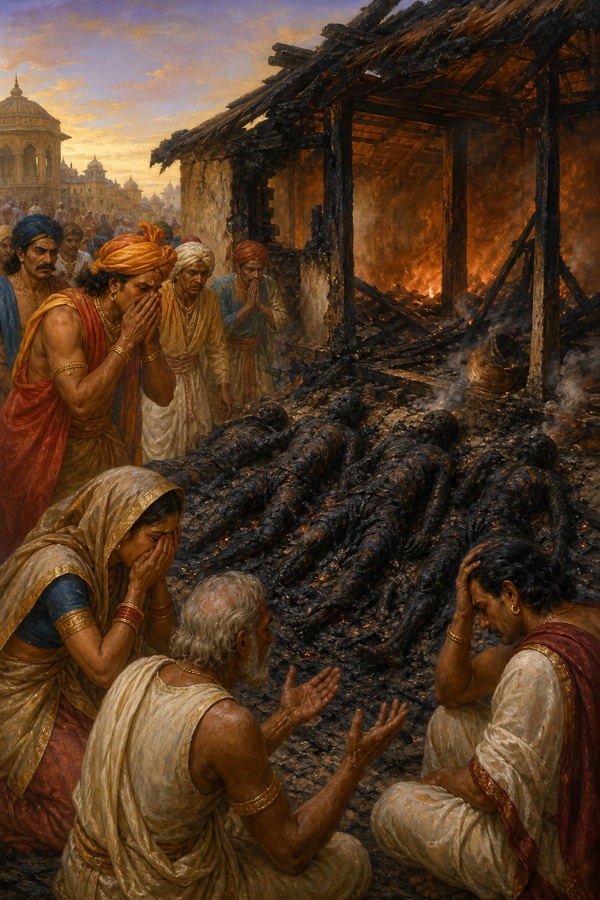
The citizens sent word that the Pandavas and Purochana had died in the fire. On hearing the report, Dhritarashtra wept. “My renowned brother Pandu has truly died today,” he said, “now that his heroic sons and their mother have been burned. Go quickly to Varanavata and arrange the funeral rites for the princes and the daughter of Kuntiraj. Perform the proper observances over their bones. Complete every great and beneficial act prescribed for such a time. Let the relatives and friends of the dead go there, and spend whatever is needed on all the rites we should undertake for Kunti and the Pandavas.” Surrounded by his family, Ambika’s son offered water to the dead. Their names sounded through the lamentation: Yudhishthira, Bhima, Arjuna, the twins, and Kunti. The citizens wept as well. The report from Varanavata had brought the family funeral observances and public mourning to Hastinapura. Vidura knew the escape had succeeded, so he shed fewer tears than those who believed the report. While these honors were being paid, the six survivors were already beyond the Ganga. The strength of the boatmen, the current, and a favorable wind had carried them across quickly. They left the boat and headed south, finding their direction in the darkness by the stars. After much hardship they reached a dense forest, exhausted and thirsty, with sleep repeatedly closing their eyes. Yudhishthira appealed to Bhima. “What could be more painful than this? We are deep in the woods. We cannot tell one direction from another or travel much farther. We do not even know whether Purochana burned to death. How are we to escape these dangers without being seen? Carry us as you did before. You alone have the strength and speed we need.” Bhima lifted his mother and brothers again and carried them swiftly onward.
The gist: Bhima burned the house, and the Pandavas escaped with Kunti through the tunnel. Purochana and the innocent Nishada mother and her five sons died in the flames. Vidura’s boat carried the survivors across the Ganga while the town and the Kuru family mourned them as dead.
Bhima keeps watch beneath the banyan
As Bhima carried his family onward, the forest shook against him. Trunks and branches struck his chest; the movement of his thighs drove a wind like the fierce winds of Jyaishtha and Ashadha, the months at the turn from the hot season toward the rains. He made his own path through trees and creepers, breaking even large trees laden with flowers and fruit. His passage resembled that of a furious 60-year-old bull elephant in rut, with the fluid of its season streaming from three places on its body. He moved with the speed of Garuda or the wind, so violently that the brothers he carried seemed close to fainting. They repeatedly swam across difficult streams and changed their appearance along the way out of fear of Dhritarashtra’s sons. On rough riverbanks, Bhima bore his delicate mother on his shoulder. Toward evening, still carrying his brothers and Kunti, he reached a dreadful stretch of forest. Roots, fruit, and water were scarce. Birds and animals filled it with frightening cries that grew fiercer as the twilight deepened. Darkness hid their surroundings. Unseasonable winds brought down trees, large and small, and creepers with dry leaves and fruit. Exhaustion, thirst, and sleep overwhelmed the princes. Unable to go farther, they sat down without food or water. Kunti kept repeating her distress: “I am the mother of the five Pandavas, and here I am among them, burning with thirst.” Her words stirred Bhima’s affection and compassion. He resolved to carry them farther in search of relief.
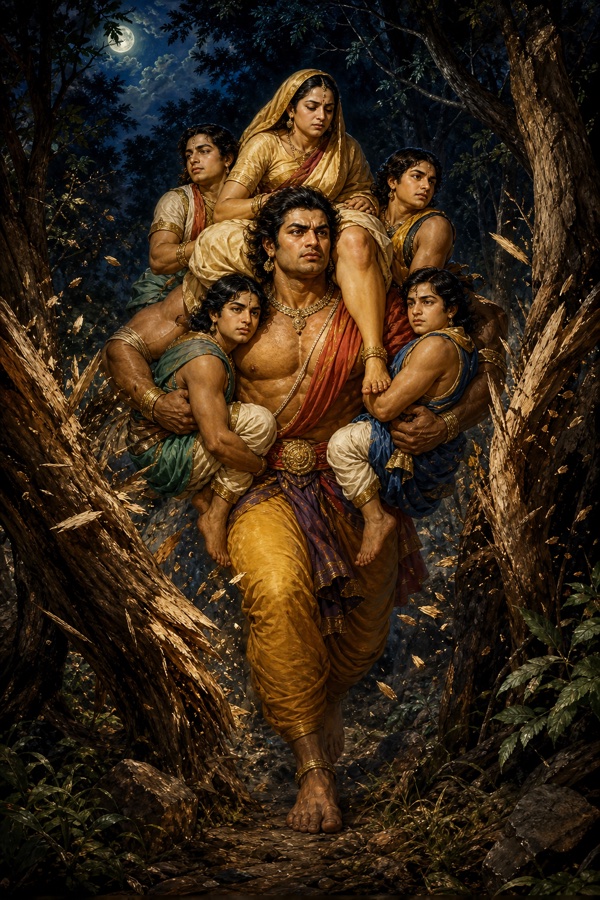
Moving through that vast, uninhabited forest, he found a beautiful banyan whose branches spread widely. He set his mother and brothers beneath it. “Rest here while I look for water,” he told them. “I can hear the calls of water birds. There must be a large pool nearby.” Yudhishthira gave him permission to go. Bhima followed the sound and soon reached a lake, where he bathed and quenched his own thirst. For the others, he soaked his upper garment in the lake. The cloth held the water he would carry to his waiting mother and brothers. He hurried over the 4 miles separating the lake from the banyan. When he reached Kunti, the sight before him brought grief and long, hissing sighs. His mother and brothers had fallen asleep on the bare ground. Bhima began to weep. “How wretched I am to see my brothers sleeping here. What could be more painful? At Varanavata, even the softest, most expensive beds failed to bring them sleep. Now they sleep on the earth. And Kunti, the sister of Vasudeva, the daughter of Kuntiraj, the daughter-in-law of Vichitravirya, the wife of renowned Pandu, the mother of us five brothers, lies here too. Every auspicious mark adorns her. She has the radiance of the filaments within a lotus, a delicacy suited to the finest bed. How can I bear to see her sleeping where she should never have had to sleep?”
The grief carried him through each member of his family. “She bore sons through Dharma, Indra, and Vayu. She has always slept within palaces. Now exhaustion has laid her on the ground. What sight could hurt more than these mighty brothers sleeping on the earth? Yudhishthira deserves sovereignty over all three worlds, yet he lies here tired out like any ordinary man. Arjuna, dark as a blue cloud, has no equal among men, and he too is on the ground. Nakula and Sahadeva have the beauty of the Ashvins, the heavenly twins, and they sleep here like ordinary mortals.” For Bhima, the sight of his brothers sleeping on the ground brought the conduct of their relatives into sharper view. His lament turned to the protection a family could give its members and the harm it could do them. “A man with no jealous, wicked kinsmen can live happily, like a tree standing alone in a village. Covered in leaves and fruit, with no other of its kind nearby, it becomes sacred to the people, honored and revered. A man with many relatives can also live free of sorrow when those relatives are brave and virtuous. Strong themselves, increasing in prosperity and bringing happiness to friends and family, they support one another like tall trees growing together in a forest. But Dhritarashtra and his sons have forced us into exile. Only good fortune brought us out of the fire alive. Now we rest beneath this tree. After so much suffering, where can we go?”
His lament became an address to the cousins who were far away. “Shortsighted sons of Dhritarashtra, enjoy your temporary success. The gods favor you for now. You are still alive because Yudhishthira has given me no command to kill you. Otherwise, Duryodhana, I would send you today to Yama’s realm, together with your children, friends, brothers, Karna, and Shakuni. What can I do while the just king, the eldest of Pandu’s sons, has yet to grow angry with you?” Bhima squeezed his hands and sighed deeply in anguish. His anger flared again, like a fire thought extinguished suddenly catching. He looked once more at his sleeping brothers. They lay on the ground with the trust of ordinary people who had surrendered themselves to rest. Bhima turned his attention to keeping them safe. “I think there is a town not far from this forest. They are all asleep, so I will stay awake. When they rise refreshed, this water will quench their thirst.” He sat beneath the banyan with the water he had brought, keeping watch over his mother and brothers as they slept.
The gist: Bhima carried his exhausted family through the forest and fetched water from a lake. Finding them asleep on bare earth, he grieved for their condition and raged against the cousins responsible. Bound by his elder brother’s authority, he remained beside the sleepers and kept watch.
Source: the Mahabharata of Krishna-Dwaipayana Vyasa, Adi Parva. This chapter follows K. M. Ganguli, sections CXL-CLXXXIV (140-184); the Gita Press Hindi edition numbers these chapters differently. Names, order, and events were checked against Ganguli’s complete translation. Dialogue and commentary are adapted, not a verbatim translation. About the sources.
Based on: The Mahabharata, Vyasa (Gita Press, Gorakhpur)