On this page
Hidimbi chooses Bhima
Not far from the sleeping family, another watcher occupied a sala tree. His name was Hidimba, a powerful Rakshasa who fed on human flesh. Hunger had sharpened his desire for it. His long legs and swollen belly supported a huge, cloud-dark body; his shoulders were as broad as a tree trunk. Red hair and a red beard framed a frightening face, with red eyes, pointed ears, and long, sharp teeth. Looking around from the tree, he saw the sons of Pandu asleep in the woods. He shook his dry, tangled hair, scratched it with his fingers pointing upward, and repeatedly looked at the sleepers, yawning in anticipation. The scent of human beings pleased him. He called to his sister, Hidimbi. “It has been a long time since such welcome food came near me. My mouth waters at the taste I expect. Today these eight teeth of mine, sharp enough to pierce anything, will finally bite into delicious flesh. I will tear open their throats and veins and drink plenty of their blood, hot, fresh, and foaming. Go and find out who is sleeping in the woods. I like the smell of them. Kill them all and bring them here. They are within my territory, so you have nothing to fear. Hurry and do as I say. Then we can tear the flesh from their bodies and eat as much as we please. Once we are full, we will dance together to different rhythms.”
Hidimbi went to obey him. At the place where the family rested, she found the brothers asleep with their mother and Bhima sitting awake. His beauty had no equal among men. Strong as a sala tree, he caught her attention so completely that she immediately fell in love. His complexion was like heated gold, his arms powerful, his shoulders broad as a lion’s. Three lines marked his neck like the lines of a conch shell, and his eyes had the shape of lotus petals. Hidimbi’s thoughts turned away from the task her brother had given her. “This man deserves to be my husband. I will not obey my brother’s cruel order. A woman’s love for a husband is stronger than her affection for a brother. If I kill him, my brother’s pleasure and mine will last only a moment. If I let him live, I can enjoy life with him for a long time.” She possessed the Rakshasas’ power to change shape at will. Taking a beautiful human form and adorning herself with celestial ornaments, she approached him slowly, smiling, with a modest gait. She had come to take his life for food, and now wanted him to accept her as his wife.
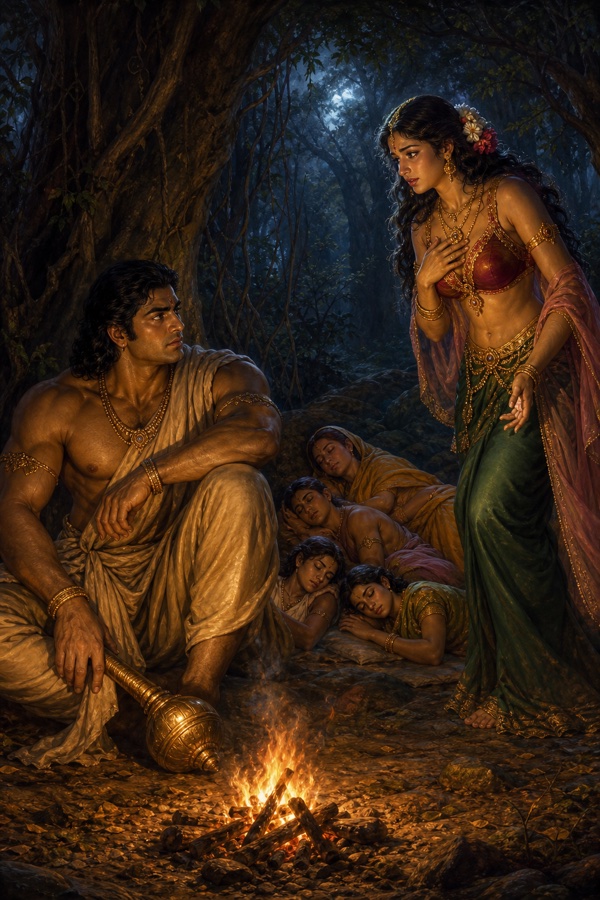
“Who are you, and where have you come from?” she asked Bhima. “Who are these people of such heavenly beauty sleeping here? And who is this extraordinarily beautiful woman, resting as confidently in the forest as though she were in her own room? Do you not know that a Rakshasa lives here? His name is Hidimba, and he is cruel. He is my brother. He sent me to kill all of you for his meal. But when I saw you, radiant as a god, I knew I wanted no other husband. You understand what is right. Knowing my situation, act as you should toward me. Kama, the power of desire, has pierced both my heart and my body. I want you. Accept me. I will save you from the Rakshasa who eats human flesh. Become my husband, and we can live on mountains ordinary people cannot reach. I can travel through the air wherever I please. You could find great happiness with me in those places.” She offered the man keeping watch a life beyond the reach of ordinary mortals, and her own protection from the danger approaching him. Bhima’s answer remained with the sleepers beside him.
“What man with self-command could abandon his mother and his elder and younger brothers while they sleep?” he asked. “How could a man like me go to satisfy his desire and leave them as food for a Rakshasa?” Her first proposal had offered Bhima a way to leave the forest with her. His answer made clear that he would stay beside his mother and brothers. Hidimbi now offered to extend her protection to every member of the family. “Wake them all. I will do whatever you wish for every one of you. I will certainly rescue you from my cannibal brother.” Bhima refused to disturb their rest. “I will not wake my mother and brothers, sleeping comfortably here, because I fear your wicked brother. Rakshasas cannot withstand the strength of my arms. Nor can human beings, Gandharvas, or Yakshas endure my power. Stay if you like, or go. You can even send your brother, the eater of human flesh. I am not concerned.” His family remained asleep while Hidimbi stood before the man she had chosen, who would neither leave them behind nor accept that flight was necessary.
The gist: Sent to kill the Pandavas for her brother’s meal, Hidimbi fell in love with Bhima and offered to save him. He refused to abandon his sleeping family. When she offered to save them all, he refused to wake them out of fear of Hidimba.
Hidimba’s last fight
Hidimba grew impatient when his sister failed to return. He climbed down from the sala tree and hurried toward the Pandavas, his red eyes, bristling hair, wide mouth, and sharp teeth giving his cloud-dark body a terrifying appearance. Hidimbi saw him coming and became frightened. She begged Bhima to follow her advice. “The cannibal is approaching in anger. I have the powers of a Rakshasa and can go wherever I choose. Climb onto my hips. Wake your brothers and your mother. I will carry all of you through the sky.” Bhima told her there was nothing to fear while he was present. “No Rakshasa can harm any of them. I will kill him before your eyes. He is no match for me; even all the Rakshasas together could not withstand my arms. Look at these arms, like elephants’ trunks, these thighs like iron maces, this broad chest as hard as adamant. Today you will see strength like Indra’s. Do not look down on me because I am human.” Hidimbi answered that she held him in no contempt; she had, however, seen the power Rakshasas could exert against people. Her brother heard Bhima’s words as he approached. He also saw Hidimbi in her human shape, with flowers in her hair and a face like the full moon. Her eyebrows, nose, eyes, and curls were beautiful, her nails and complexion delicate. Fine transparent clothing and many ornaments adorned her. He recognized her desire for the man beside her and became furious.
“Who is foolish enough to obstruct me when I am hungry?” he demanded. “Hidimbi, have you forgotten to fear my anger? Shame on you. You want this man and are trying to injure me. You would sacrifice the honor of all your Rakshasa ancestors. I will kill you together with the people you would use against me.” Grinding his teeth, he rushed at her. Bhima stopped him. With a derisive smile, he challenged the attacker to face him first. “Why wake these people who are sleeping so comfortably? Come here and strike me. You have no right to kill a woman who has been wronged. She came at your command. When she saw me, she desired me; Kama, who moves within every living being, prompted her. She has done you no injury. If there is an offense, it belongs to the power of desire. You will kill no woman while I am here. Fight me alone, and I will send you to Yama’s realm today. My strength will crush your head as a great elephant crushes what lies beneath its feet. When you fall, let herons, hawks, and jackals tear at your limbs. I will free this forest from the Rakshasa who has ruled it by eating people. Huge as a mountain though you are, your sister will see you dragged again and again like an elephant seized by a lion. Once I have killed you, people will travel here safely.” Hidimba dismissed the threats. “Do it first. Then boast. You think yourself strong; today you can measure that strength against mine. Until then, I will leave your brothers asleep. I will kill you first and drink your blood. They will die next, and this sister who has injured me will be last.”
He charged with both arms extended. Bhima caught them with almost playful ease, seized the struggling Rakshasa, and dragged him a full 32 cubits away, a distance measured in forearm lengths, like a lion carrying off a small animal. Feeling Bhima’s strength, Hidimba grew angrier. He clasped his opponent and roared. Bhima pulled him farther away to keep those cries from waking his brothers. Locked together, the two dragged and strained against one another like enraged bull elephants, breaking trees and tearing creepers around them. The noise woke Kunti and the sleeping Pandavas. They found Hidimbi seated in front of them, her extraordinary beauty astonishing them. Kunti addressed her gently and reassuringly. “Who are you, and whose family do you belong to? Where have you come from, and what brings you here? Are you the guardian of this forest, or an Apsara? Tell me about yourself and why you are staying here.” Hidimbi explained that the forest belonged to her brother, Hidimba, who had sent her to kill them all. “When I arrived, I saw your powerful son. The desire that enters every living being overcame me, and in my thoughts I chose him as my husband. I tried to carry you all away, but he would not agree. When my brother saw how long I was taking, he came to kill your children. Your strong and intelligent son, my husband, has dragged him away. Look at them now, the man and the Rakshasa. Both are immensely powerful. They are crushing one another and filling the surroundings with their shouts.”
Yudhishthira, Arjuna, Nakula, and Sahadeva rose at once. They saw Bhima and Hidimba pulling one another violently, each struggling to overcome the other. Dust rose beneath their feet like smoke from a forest fire. Their massive bodies, covered in it, resembled cliffs wrapped in mist. The brothers had awakened to a fight already in progress, with Bhima and the Rakshasa some distance from the place where the family had slept. Arjuna saw Bhima under pressure and spoke quietly, with a smile. “Do not be afraid. We were asleep and knew nothing of this terrible fight or the effort it was costing you. I am here to help. Let me kill the Rakshasa while Nakula and Sahadeva protect our mother.” Bhima told him to watch as though he were an uninvolved spectator. “Have no fear for the result. He is within the reach of my arms now and will never escape alive.” Arjuna urged him to finish. “Why keep him alive so long? We must leave this place. The east is reddening, and dawn is close. His strength will increase as day breaks. Rakshasas use their powers of illusion at both twilights. Stop playing with him. Put all the strength of your arms into it and kill him quickly.” Bhima blazed with anger at those words. He summoned a force compared to that of his father, Vayu, at the dissolution of the universe. He lifted Hidimba’s cloud-dark body into the air and whirled it 100 times. “Your intelligence has been wasted,” he told him, “and so has the strength you gained from eating unholy flesh. You deserve an unholy death. I will destroy you today and make this forest safe, as though I had cleared it of thorns. You will never again kill people for food.”
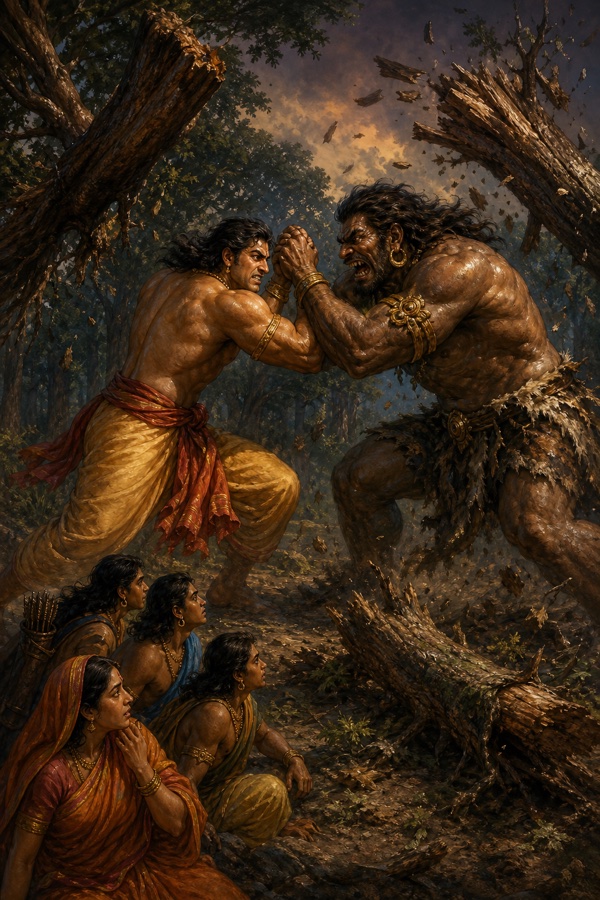
Arjuna spoke once more. “If defeating him is difficult, let me help you. Otherwise, kill him yourself without delay. Or let me do it alone. You are tired and have almost finished the task. You deserve to rest.” The offer intensified Bhima’s anger. With all his strength he dashed Hidimba against the ground and killed him like an animal. The Rakshasa’s dying roar filled the forest, deep as the sound of a wet drum. Bhima held the body in his hands, bent it double, and broke it through the middle. His brothers were delighted by the victory and immediately congratulated him. Arjuna paid his elder brother honor, then urged departure. “I think there is a town near this forest. May all be well with you. Let us leave quickly so that Duryodhana cannot trace us.” They agreed and went on with their mother. Hidimbi followed them.
The gist: Bhima protected Hidimbi from her brother and dragged Hidimba away from the sleeping family to fight him. With dawn approaching, Arjuna urged a quick end. Bhima killed the Rakshasa, and the Pandavas resumed their journey with Hidimbi following.
Hidimbi, Bhima, and Ghatotkacha
Bhima saw Hidimbi following them and turned on her in anger. “Rakshasas take revenge through deceptions no one can penetrate,” he said. “Go where your brother has gone.” Yudhishthira intervened before the threat could become an act. “However angry you are, do not kill a woman. Preserving virtue is a higher duty than preserving life. You have already killed Hidimba, who came to kill us. What can this woman do to us, even if she is angry?” Hidimbi bowed to Kunti and Yudhishthira, then joined her hands in appeal. “You know the suffering that desire brings to women,” she told Kunti. “Because of Bhima, I am enduring that suffering. I have borne it until now in the hope that the time would come for him to relieve it. I have left behind my friends, my relatives, and the customs of my people, and chosen your son as my husband. If he or you rejects me, I cannot continue to live. Think of me as foolish, or as your obedient servant, but have compassion. Unite me with this son of yours. Let me take him wherever I choose, and trust me to bring him back. Whenever you think of me, I will come immediately and carry all of you wherever you command. I will rescue you from danger and take you across rough, inaccessible country. When you need to travel quickly, I will bear you on my back. Please make Bhima accept me.” Her request included a continuing obligation to the family he had refused to leave: she promised that he would return and that all of them could call on her help.
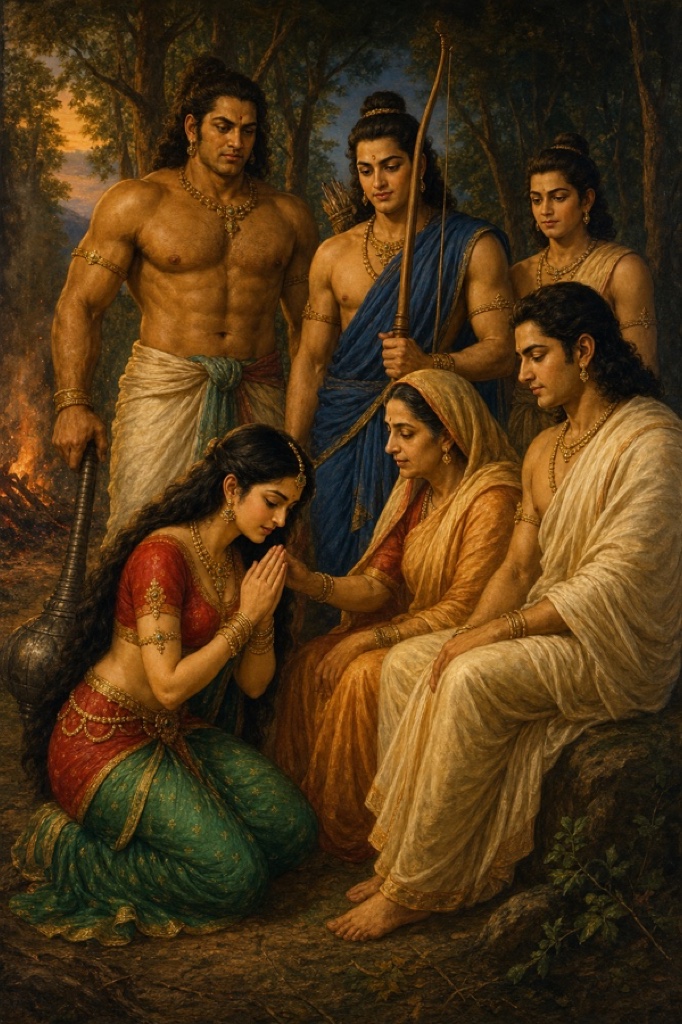
Hidimbi also offered an argument about duty in adversity. “In a time of distress, life should be protected by every available means. Someone carrying out that duty should not hesitate over the means. Whoever preserves virtue during a crisis is foremost among the virtuous, because adversity is the greatest danger to virtue and to those who practice it. Virtue protects life, and so it is called the giver of life. The means that preserve virtue and the performance of duty cannot be condemned.” Yudhishthira accepted what she said, then made the arrangement precise. “You must act as you have promised. After Bhima has bathed, said his prayers, and performed the customary rites, he may attend to you until sunset. Spend the day with him wherever you please, but bring him back here every evening.” Bhima agreed to his elder brother’s terms and added his own promise. “I will remain with you until you have a son.” Hidimbi accepted. She lifted Bhima onto her body and carried him through the sky. The union would leave him free to return to his mother and brothers each night, with a clear end to the period he had promised her.
Taking her most beautiful form, wearing fine ornaments, and sometimes singing sweetly, Hidimbi sought to make Bhima happy. She carried him to mountain summits of beautiful scenery and places sacred to the gods, where spotted animals moved in herds and birds filled the air with song. They visited inaccessible forests and mountainsides covered with flowering trees, lakes bright with lotuses and lilies, river islands and pebbled banks. They went along woodland streams with lovely shores and swift mountain waters, through woods of flowering trees and creepers, Himalayan bowers, and caves. There were clear pools smiling with lotuses, seashores bright with gold and pearls, beautiful towns, and fine gardens. They moved through sacred groves, along hillsides, into the regions of the Guhyakas and ascetics, and onto the banks of Manasarovara, where the fruits and flowers of every season flourished. With the speed of thought, Hidimbi traveled through all these places with Bhima. In time she conceived his child and gave birth to a powerful son.

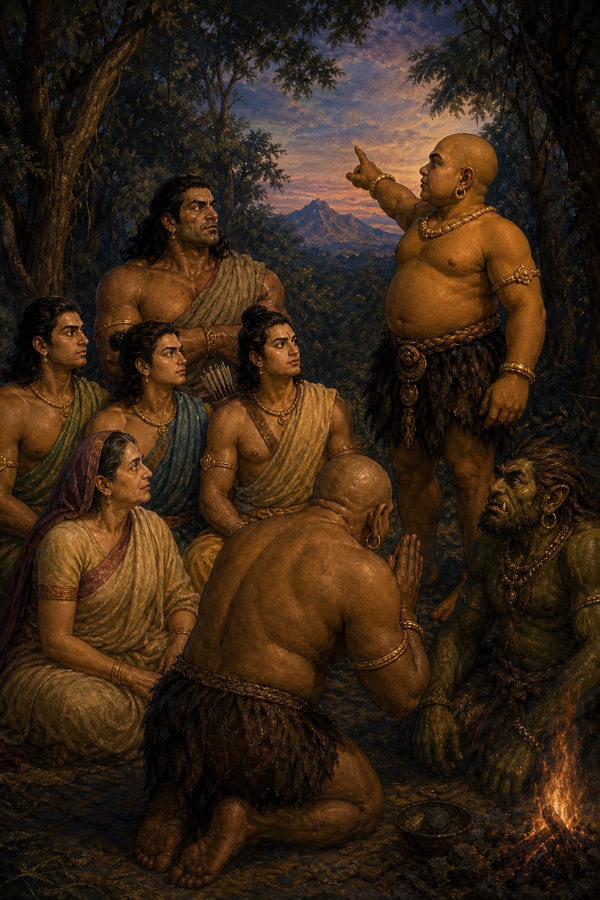
The boy had frightening eyes, a large mouth, and ears that stood straight like arrows. His lips were copper-brown, his teeth sharp, and his roar loud. Long arms, a long nose, a broad chest, and greatly developed calves marked a body of immense strength and speed. Although his father was human, nothing in his face looked human. His strength and prowess surpassed those of the Pisachas, their related peoples, and all the Rakshasas. He grew from infancy to youth in the very hour of his birth and soon became highly skilled with every weapon, a formidable archer. Rakshasa women gave birth on the day they conceived; they also possessed the power to alter their forms whenever they wished. Soon after his birth, the young warrior bowed to his mother and touched both his parents’ feet. His head was bald, and Hidimbi remarked that it resembled a ghata, a water pot. His parents named him Ghatotkacha, the pot-headed one. He became devoted to the Pandavas and dear to them, almost one of their own company. His bond extended from his parents to the brothers whose safety Bhima had guarded through the forest.
Hidimbi now knew that the agreed time with her husband had ended. She saluted the Pandavas, arranged to meet them again, and went where she wished. Ghatotkacha also took his leave. He promised his father that he would return whenever he was needed, bowed to the family, and traveled north. His birth had a place in Indra’s purpose as well. Lending a portion of himself, Indra had brought this mighty chariot warrior into being as an opponent for Karna. The narration here looks ahead to the encounter for which Ghatotkacha would be needed. Its explanation reaches beyond the family’s present journey to a weapon Indra had given that formidable fighter: a dart certain to kill whomever it struck. Because of that weapon, Ghatotkacha had been created to stand against him.
The gist: Yudhishthira allowed Bhima to spend the days with Hidimbi, provided he returned each night. Bhima promised to remain until she had a son. Ghatotkacha grew into a warrior immediately after birth and, on leaving, promised to return whenever his father needed him.
Shelter at Ekachakra, and a father’s grief
The Pandavas continued from forest to forest with Kunti, hunting deer and other animals for food. Their travels took them through the lands of the Matsyas, Trigartas, Panchalas, and Kichakas, with beautiful woods and lakes along the way. Matted hair, bark clothing, and animal skins gave the brothers the appearance of ascetics. Sometimes they hurried with their mother on their backs; sometimes they traveled in disguise or covered the ground at great speed. They also studied the Rigveda, the other Vedas, the Vedangas, the supporting disciplines of Vedic study, and the sciences of conduct and government. During their wanderings they met their grandfather, Krishna-Dwaipayana Vyasa. The brothers and their mother bowed and stood before him with joined hands. “I knew beforehand of the exile Dhritarashtra’s son brought upon you through deceit,” he told them. “I have come to help you. Do not grieve. What has happened will lead to your happiness. You and Dhritarashtra’s children are equal in my sight. Yet people feel particular affection for the unfortunate and the young, and that is why my affection for you is greater now. A pleasant town lies a short distance ahead. You will be safe there. Stay in disguise until I return.”
Vyasa led them into Ekachakra and reassured Kunti. “Live here, daughter. Yudhishthira, who holds firmly to truth, will conquer the earth through justice and rule over other kings. Through Bhima’s and Arjuna’s strength, he will win sovereignty over the land bounded by the seas. Your sons and Madri’s sons, all mighty chariot warriors, will live happily in their dominions. They will perform great sacrifices, including the Rajasuya and the horse sacrifice, with generous gifts to Brahmins. They will regain their ancestral kingdom and keep their friends and relatives in comfort, wealth, and happiness.” He settled them in a Brahmin’s home and told Yudhishthira to wait for him. “I will return. Adapt yourselves to the country and the circumstances, and you will prosper.” They accepted his instruction with joined hands, and he departed. Janamejaya asked what the brothers did after reaching Ekachakra. Vaishampayana described their life in the Brahmin’s household. They supported themselves by gathering alms, seeing the neighboring woods, countryside, rivers, and lakes in the course of their rounds. Their qualities won the affection of the townspeople. Each evening they placed what they had collected before Kunti, who divided it among them. Bhima received half the food. Kunti and the other four brothers shared the remaining half. For a time, this was how the family lived. The princes whom Vyasa had described as future rulers were now sharing a Brahmin’s house and bringing home their daily alms. They remained in disguise as he had instructed, waiting for his return.
One day Bhima stayed at home with Kunti while his brothers went out for alms. From the inner rooms came a cry of grief so painful that Kunti could not ignore it. Their host and his family were weeping. She spoke to Bhima with compassion. “We are living happily here, honored by this Brahmin. Our suffering has eased, and Dhritarashtra’s son does not know where we are. I keep thinking about how we can repay the man whose home shelters us. A worthy person never lets a kindness go to waste. He returns more than he receives. Some trouble has certainly come upon our host. If we can help, we can repay what he has done for us.” Bhima asked her to discover the cause of the grief. “Once I know what it is, I will relieve it, however difficult that proves.” Another lament from the Brahmin and his wife reached them. Kunti hurried into their rooms as a cow runs toward her tethered calf. The father sat with his wife, son, and daughter, his face full of sorrow. She heard the words he was speaking to them.
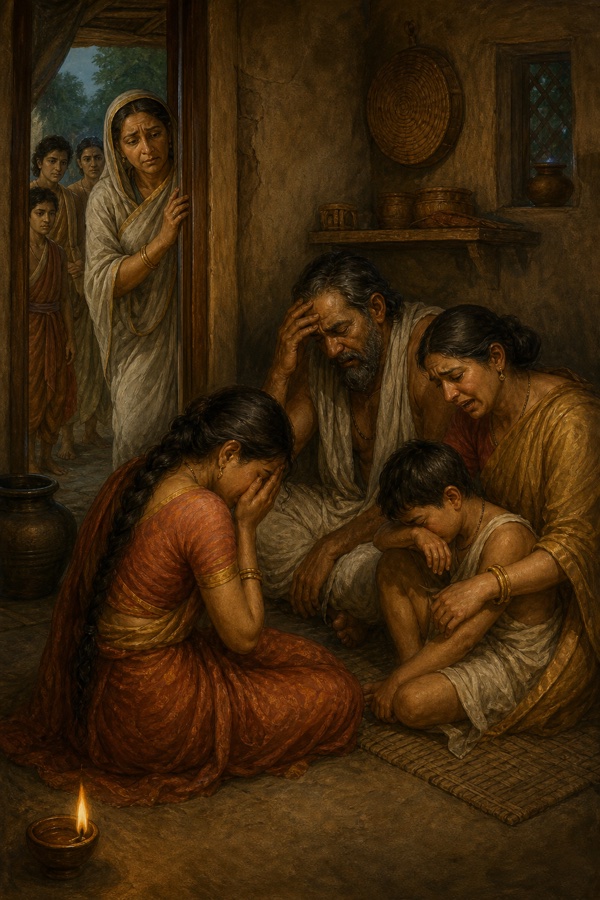
“Shame on this earthly life,” he said, “hollow as a reed, fruitless, founded on sorrow, without freedom. Life brings grief and disease. There is one soul, yet it must pursue virtue, wealth, and pleasure, and these purposes often conflict when we try to pursue them together. That conflict produces misery. Some call liberation the highest goal, but I cannot believe it can be attained. Acquiring wealth is torment. The effort hurts, possession binds us to what we have, and losing it brings still more pain. I can see no way out of this danger, no way to take my wife to a safer place.” He turned to her. “I tried to persuade you to move somewhere we could be happy. Again and again you refused. ‘I was born here and grew old here,’ you said. ‘This is my ancestral home.’ Your parents went to heaven long ago. All your relatives have died. Why did you still want to stay? Affection for your family kept you from listening. Now the time has come to see someone dear to us die. Perhaps it is time for my own death, because while I live I cannot cruelly abandon one of my family.”
He spoke of what each of them meant to him. “You have shared my good works, denied yourself, and loved me with a mother’s care. The gods gave you to me as a true friend. My parents made you my partner in the household. You come from a good family, have a good character, and are the mother of our children, devoted and innocent. I chose you and married you with the proper rites. How can I abandon such a faithful wife to save myself? How can I sacrifice this son, still a child, without even the first signs of manhood? How can I give up the daughter I brought into the world? The Creator entrusted her to me to give in marriage. Through her sons, my ancestors and I hope to attain the blessed regions open to those who have daughters’ sons. Some say a father loves his son more; others say he loves his daughter more. I love these two equally. How can I abandon this innocent girl, on whom rest my hopes for my lineage and happiness hereafter? If I sacrifice myself and pass to the other world, I will find little peace knowing that all of you cannot survive without me. Giving up any one of you would be cruel and blameworthy. Giving myself means leaving you to perish. I do not know how to escape this misery. What am I to do with those I love? Better that we all die together. I cannot endure life any longer.”
The gist: Vyasa settled the Pandavas in Ekachakra and promised that their fortunes would recover. Hearing their host’s family weep, Kunti sought a way to repay his kindness. The father could find no escape from a danger that forced him to consider the loss of his wife, son, daughter, or himself.
The wife and daughter plead to go
The Brahmin’s wife answered his grief. “You should not mourn like a man without understanding. This is no time for weeping. You are learned and know that everyone must die. Why grieve over the inevitable? A wife, son, and daughter are sought for one’s own sake. Use your understanding to overcome your sorrow. I will go. A woman’s highest and enduring duty is to secure her husband’s good, even by giving her life. My act will bring you happiness, win me honor here, and give me lasting joy hereafter. I am telling you what I believe to be the highest virtue, through which you can obtain both goodness and happiness. The purpose for which you wanted a wife has already been fulfilled through me. I have borne a daughter and a son, and so discharged my debt to you. You can support and cherish the children. I cannot do it as you can. You are my life, wealth, and protector. Without you, how will these young children live? How will I?” Her plea rested on the survival of the household after the loss of one of its members. She saw her husband as the person capable of preserving those who remained.
“Widowed, without anyone to protect me, and responsible for two children, how could I keep us alive honorably?” she continued. “If arrogant, dishonorable men, unworthy of an alliance with you, demand our daughter, how will I protect her? Men pursue a woman who has lost her husband as birds gather eagerly around meat thrown on the ground. Harassed by wicked men, I may falter and lose the path approved by honest people. How could I keep this innocent daughter of your house on the path her ancestors followed? In poverty, with no protector, how could I give our son the learning and accomplishments that would make him virtuous like you? Unworthy men would overpower me and demand your daughter, as Shudras might seek to hear the Vedas. If I refused to give them a girl who carries your blood and qualities, they might take her by force, like crows carrying off the clarified butter set aside for sacrifice. If I saw our son become unlike you and our daughter subjected to an unworthy man, even dishonorable people would despise me, and I would die. Without either parent, the children would perish like fish when their water dries up. If you die, all three of us will die. Let me be the one sacrificed.”
“Those who understand duty say that, for a woman who has borne children, dying before her husband brings the highest merit. I am ready to give up our son and daughter, my relatives, and my own life for you. A woman’s constant service to her husband exceeds sacrifices, austerities, vows, and every kind of charity. What I propose therefore serves the highest duty, your welfare, and the welfare of your family. The wise say that children, relatives, a wife, and other beloved possessions are maintained as a means of saving oneself from danger. Preserve wealth against adversity, protect a wife through wealth, and protect yourself through both wife and wealth. A wife, son, fortune, and home are acquired as safeguards against accidents, whether anticipated or unforeseen. The learned say that all one’s relatives together cannot balance one’s own life. Preserve yourself by giving me up. Allow me to go, and care for my children. The moral teachings also prohibit killing women, and Rakshasas know those teachings. He will certainly kill a man. Whether he will kill a woman is uncertain. Send me to him. I have enjoyed much happiness, obtained what pleased me, and acquired religious merit. I have received beloved children from you. Death does not grieve me. I have borne children and grown old, and I want your good. After giving me up, you may marry another wife and continue to acquire merit through your household duties. That brings no sin. For a man, having several wives is meritorious; for a woman, taking a second husband after the first is deeply sinful. Remember that sacrificing yourself would be wrong. Save yourself, your family line, and these children by letting me go today.” Hearing her, the Brahmin embraced her. Husband and wife wept silently together.
Their daughter, distressed by everything she had heard, spoke next. “Why do you weep as though there were no one to care for you? Listen to me. One day you will be bound by duty to part with me. Part with me now, and save everyone else by giving up only me. People want children because children will save them in this world and the next. Use me as a raft to cross this stream of trouble. The learned call a child putra because the child rescues the parents. Our ancestors hope for sons born to me, but without waiting for those sons, I can save them myself by preserving my father’s life. My little brother will certainly die if you die now. If both you and he are gone, the funeral rice offered to the ancestors will cease, and they will suffer. Mother will not survive the loss of her husband and son. Left without all of you, I will sink into grief and eventually perish. If you, Mother, and my young brother are saved, our lineage and the offerings to the ancestors will continue. A son is one’s own self; a wife is a friend; a daughter is a source of trouble. Remove that source of trouble and preserve yourself, placing me on the path of virtue. As a girl without you, I would be helpless, miserable, and forced to wander. I have resolved to undertake this hard task, rescue my father’s family, and share the merit of the act. If you leave me and go to the Rakshasa yourself, I will suffer greatly. Be kind to me. For our sake, for virtue, and for our family, save yourself by letting me go, as you must one day let me go. Why delay what is inevitable? What could be worse than begging strangers for food like dogs after you have gone to heaven? If you and our relatives escape, I will be happy among the gods. We have heard that the gods will be pleased if, after giving your daughter in this way, you make offerings to them.”
Her words increased her parents’ sorrow, and the three wept together. The little boy watched them. His eyes widened with delight as he approached each in turn, smiling and lisping sweetly. “Do not cry, Father. Do not cry, Mother. Sister, you must not cry either.” He picked up a blade of grass and announced, “I will use this to kill the Rakshasa who eats people!” Despite their anguish, joy appeared on their faces at the child’s words. Kunti saw an opportunity to speak. She approached the family with words that would revive them as nectar restores the dead.
A key to reading this: The wife’s and daughter’s claims about duty, gender, and social standing belong to their pleas under extreme pressure. The father had already declared his equal love for both children.
The gist: The wife offered her life so that her husband could raise their children. The daughter asked to go herself, hoping to preserve both the living family and its ancestral offerings. The little boy’s promise to fight with a blade of grass briefly brought joy back to their faces, and Kunti stepped forward.
Source: the Mahabharata of Krishna-Dwaipayana Vyasa, Adi Parva. This chapter follows K. M. Ganguli, sections CXL-CLXXXIV (140-184); the Gita Press Hindi edition numbers these chapters differently. Names, order, and events were checked against Ganguli’s complete translation. Dialogue and commentary are adapted, not a verbatim translation. About the sources.
Based on: The Mahabharata, Vyasa (Gita Press, Gorakhpur)