On this page
Krishna returns to Dwarka, and the lights of the Raivataka festival
Krishna had gone home at last. With Yudhishthira’s leave he had driven out of Hastinapura with his sister Subhadra beside him on the chariot and Satyaki for company, and in the waterless desert on the road he had met the ascetic Utanka, who came close to cursing him over the war, was shown the form Arjuna had seen on the battlefield, and went away with a boon: water in that desert whenever he thought of Krishna. King Janamejaya wanted to know what Govinda did after that, and Vaishampayana took up the road again. The tall, fast horses carried Krishna and Satyaki on past lake after lake, over rivers, through forests and hill country, until the lovely city of Dwaravati lay in front of them.
He had arrived in the middle of a festival. The Vrishnis were keeping the feast of Raivataka, the hill beside their city, and the whole mountain had been dressed for it. Garlands of gold and bright ropes of flowers hung on it, its great trees looked like the wishing trees of Indra’s garden, and lamps burned on golden poles in such numbers that by the caves and the springs it seemed to be broad day at midnight. Flags stood out on every side, sewn with little bells that never stopped ringing. Men and women sang at the top of their voices, thousands of them, until the swell of it seemed to touch the sky. Shops and stalls lined the slopes, heaped with cloth and garlands and good things to eat, with wine of many kinds to go with the food, and vinas, flutes and mridanga drums were playing wherever a person turned. Through all of it gifts went out without a pause to the poor, the blind and the helpless, and that giving made the festival holy as well as loud.
When Krishna reached it, the mountain might have been Indra’s own seat. His kinsmen received him with every honor, and he went into a beautiful house there while Satyaki, well pleased, went off to his own. The chiefs of the Bhojas, the Vrishnis and the Andhakas, the clans of that city, all came forward to meet him as the gods come out to meet their king, and he returned each greeting and asked each man how he did. Then, with a glad heart, he went and bowed to his father and his mother. Old Vasudeva and Devaki took him in their arms and could not make enough of him. He washed his feet, and the tiredness of the road went out of him, and he sat down with the Vrishnis seated all around him. His father had questions about the great battle. Krishna, sitting there among his own people, began to answer them.
A key to reading this (the place, Dwarka and Raivataka): Dwarka, also called Dwaravati and the city of the Anartas, is the home of Krishna’s people, the Bhoja, Vrishni and Andhaka clans, and it stands near the western sea. Raivataka is the hill where they hold their festival. Krishna had not seen his father and mother for a long time; Yudhishthira had said as much when he gave him leave to go.
“I have heard men talk of that battle again and again, my son, and it is a wonder every time,” Vasudeva said. “You saw it with your own eyes. So tell it to me properly. On one side the sons of Pandu; on the other Bhishma and Karna and Kripa and Drona and Shalya and all the rest, Kshatriyas past counting, trained to arms, come from every country, no two alike in face or dress. How did it go between them?”
The gist: Krishna comes home to Dwarka after a long absence and finds the Raivataka festival at its height. His father Vasudeva, who knows the war only by report, asks to be told how it was fought.
A brief reckoning of eighteen days: the war from Krishna’s mouth
He told it in front of his mother as well, the whole roll of how the Kaurava heroes had gone down. “What those Kshatriyas did out there was extraordinary,” Krishna said, “and there was so much of it that hundreds of years would not be enough to count it through. I can give you only the chief things, and briefly. Listen.
“Bhishma of the Kurus took command first. He had eleven akshauhinis of the Kaurava princes under him and stood over them as Indra stands over the armies of the gods. Our seven had Shikhandi for their leader, with Arjuna guarding him. Under those two the Kurus and the Pandavas fought for ten days, and it was the kind of fighting that lifts the hair on a man’s body. Then, in a great engagement, Shikhandi, with Arjuna and the Gandiva bow to help him, brought down Ganga’s son with arrows past numbering, though he fought bravely to the end. Bhishma lay on a bed of arrows and waited there like an ascetic keeping a vow, all the while the sun was on its southern road. When it turned north he let his breath go.
A key to reading this (numbers, a modern equivalent): One akshauhini, by the reckoning the epic gives in its opening book, is 21,870 chariots, the same number of elephants, 65,610 horsemen and 109,350 foot soldiers, which comes to 218,700 if every chariot and every elephant is counted as one. The Kauravas began the war with eleven of these and the Pandavas with seven, and Krishna’s account counts them down: nine left to Drona, five to Karna and three to Shalya, against three and then one on the Pandava side.
“Then the command went to Drona, who knew weapons better than any man living and stood highest of all under Duryodhana, as Shukra once stood beside the lord of the Daityas. He was a Brahmin who never tired of speaking of his own skill in battle. He had what was left of the Kaurava force behind him, nine akshauhinis by then, with Kripa and Karna and others to guard him. On our side Dhrishtadyumna led, a man of great mind who knew many mighty weapons, and Bhima guarded him as Mitra guards Varuna. Dhrishtadyumna had always wanted to measure himself against Drona, and he had not forgotten the wrongs Drona did to his father Drupada, the king of the Panchalas. With the Pandava army at his back he did great things. Between Drona and that son of Prishata the kings who had gathered from so many countries were all but wiped out. That fury lasted five days. At the end of them Drona, worn out, went down before Dhrishtadyumna.
“After him Karna led Duryodhana’s army, and five akshauhinis were all there was for him to lead. The sons of Pandu were down to three, and after the killing of heroes without number those three came to battle with Arjuna guarding them. Karna, the charioteer’s son as men called him, was a fierce fighter. He met Arjuna, and on the second day he came to his end as an insect does that flies into a blazing fire. With Karna gone the heart went out of the Kauravas, and their strength with it. They were three akshauhinis now, and they gathered around Shalya, the ruler of the Madras. Ours had lost chariot fighters and elephants and horsemen until a single akshauhini was left, a sorrowful remnant, and it closed up behind Yudhishthira. In the battle that followed the king did the hardest things of all, and before half the day was out he had killed the ruler of the Madras.
“When Shalya had fallen, Sahadeva killed Shakuni, the man who had brought the whole quarrel about. And when Shakuni had fallen, Dhritarashtra’s royal son, with his army cut to pieces around him and his spirit gone, fled from the field with his mace in his hand. Bhima went after him in a rage and found him lying hidden under the waters of the Dvaipayana lake. The Pandavas came up with what remained of their army and stood all around the lake, glad to have him, and they threw words at him where he lay, and the words went down through the water like arrows and struck. He rose out of the lake with the mace in his hand and walked toward them, wanting the fight. It was a great one, and in front of many kings Bhima put out his full strength and killed him.
“After that came the night. What was left of the Pandava army was asleep in its camp, and Drona’s son, who could not bear his father’s killing, slaughtered it there in the dark. Their sons are dead and their troops are dead. The five sons of Pandu are alive, and I, and Satyaki. On the other side the unslain are three: Drona’s son, Kripa, and Kritavarma the Bhoja prince. Yuyutsu, a son of Dhritarashtra, lives too, because he had come over to the Pandavas. And now that the Kaurava king is dead with every follower and ally he had, Vidura and Sanjaya have gone to Yudhishthira. That was the battle, father. It lasted eighteen days, and the many kings of the earth who died in it have gone up to heaven.” The Vrishnis heard that terrible account through, and grief and pain settled on every one of them.
The gist: Krishna gives his father the war in outline: ten days under Bhishma, five under Drona, two under Karna, half a day under Shalya; then Shakuni’s death, Duryodhana taunted up out of the lake and killed by Bhima, and Ashvatthama’s slaughter of the sleeping camp. Seven men are left alive on the Pandava side and three on the Kaurava.
The grief that Krishna hid, and the lament of Subhadra
One thing he had left out, and it was plain to everyone that he had left it out. Krishna had gone through the whole war of the Bharatas for his father and had stepped over the death of Abhimanyu, the son of his sister Subhadra and Arjuna, old Vasudeva’s grandson. He had done it on purpose. He did not want his father to hear the thing that would hurt him most, or to watch the old man go under at the news of how his daughter’s boy had died.
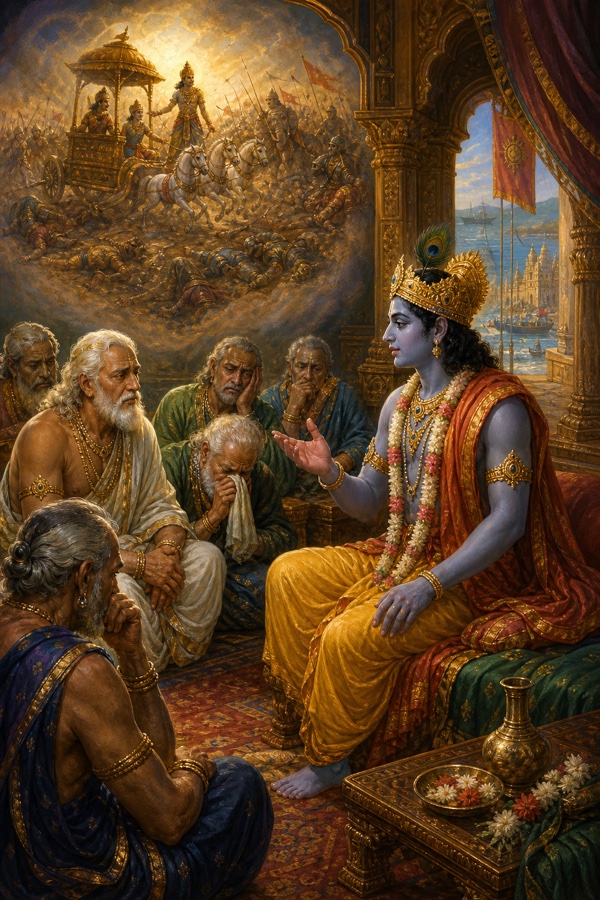
Subhadra noticed that her son’s death had not been spoken of. “Tell how my son died, Krishna,” she said to her brother, and with the words she fell to the ground in a faint. Vasudeva saw his daughter go down, and grief took his own senses from him, and he fell too. When he came back to himself the sorrow for his grandson was on him, and he turned to his son. “The whole earth knows you for a man who speaks the truth. Then why have you not told me today that my daughter’s son is dead? Tell me all of it. He was your sister’s son and he had your eyes. How did his enemies kill him in battle? My heart has not broken into a hundred pieces at this, so it must be true that a man does not die until his hour comes.
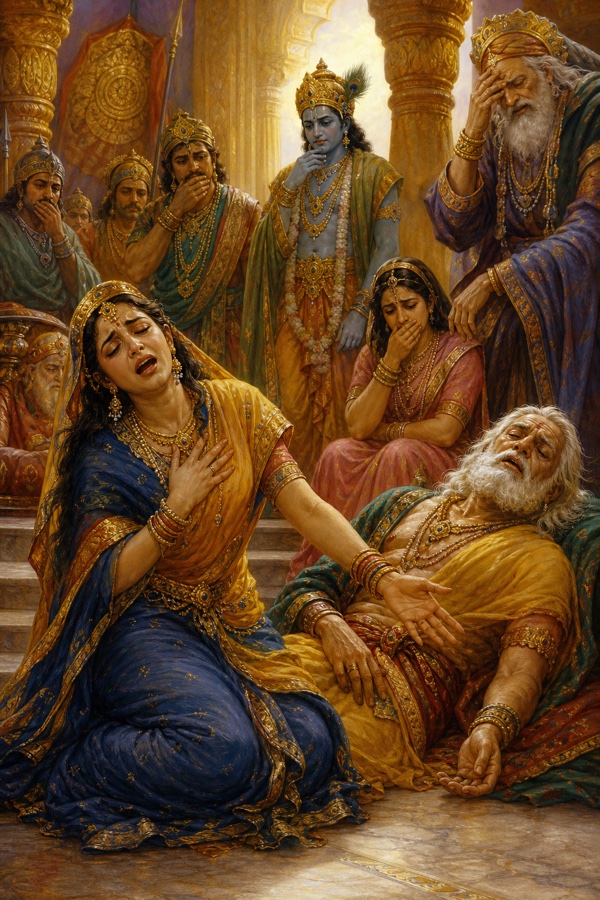
“What did he say when he fell? Did he call out to his mother? What did that boy with the quick eyes, my darling, say for me? I hope he was not killed running, with his back to them. I hope his face did not lose its light while he fought. He had such fire in him, Krishna. He used to stand in front of me and boast of what he could do in a battle, the way a boy will. I hope that child is not lying out on that field because Drona and Karna and Kripa and the rest of them killed him by deceit. Tell me. He was always calling out Bhishma to fight, my daughter’s son, and Karna, the strongest of them all.”
His father went on like that, and Krishna, who was suffering more than he was, answered him. “His face never lost its light. He fought at the very front, and fierce as that battle was he never turned his back on it. He killed kings by the hundred and by the thousand. Drona and Karna wore him down, and in the end he fell to the son of Duhshasana. If they had come at him one at a time, one after another without a break, the wielder of the thunderbolt himself could not have killed him. Arjuna was not there. The Samshaptakas, the sworn men, had called his father out to fight them apart and had drawn him away from the main army, and then the Kaurava heroes, in a rage, with Drona at their head, closed around Abhimanyu. He killed a very great number of them, father, before your daughter’s son went down to the son of Duhshasana. He has gone to heaven; there is no doubt of it. Kill this grief. Men whose minds are clear do not go under when calamity comes. He held back Drona and Karna and the others, men who are Indra’s equals in strength. Why would such a one not go to heaven? Put the grief down, and do not let anger take hold of you. He has reached the pure end that waits for those who die on the edge of a weapon.
“After he fell, my sister here saw Kunti, and she cried out like an osprey. She went to Draupadi and asked her in her grief, ‘Lady, where are all our sons? I want to see them.’ The Kuru women put their arms around her and sat down about her and wept with her. Then she saw Uttara, her son’s wife, and said to her, ‘Where has your husband gone, dear girl? When he comes back, tell me that same moment. He used to come out of his room the instant he heard my voice, daughter of Virata. Why does he not come out today? Abhimanyu! Your uncles are all alive and well, those great chariot fighters. They used to bless you when they saw you come out ready for battle. Tell me what happened in the fighting today, as you always did. Why do you not answer me? I am crying so hard, and you do not answer.’
“Kunti heard this daughter of the Vrishnis lamenting. She was deep in grief herself, and she spoke to her slowly. ‘Subhadra, he had Krishna to guard him, and Satyaki, and his own father, and your young son has been killed all the same. That is the work of Time. He was mortal, daughter of the Yadus. Do not grieve. No one could stand against him in battle, and he has surely reached the highest end there is. You were born into a great house of Kshatriyas. Do not grieve. Look at Uttara. She is carrying a child. Do not give way to sorrow; this girl will soon bear that hero a son.’
“That was how Kunti comforted her. And then Kunti, who knows what is right in every case, put her own grief aside and saw to Abhimanyu’s funeral rites. Yudhishthira agreed to it, and Bhima, and the twins, those two who fight like Yama. She gave a great deal to the Brahmins, and many cows. When she was a little easier she said to Virata’s daughter, ‘You have done nothing to be blamed for, and you must not go on grieving. For your husband’s sake, guard the child you carry.’ She said that and no more. It was with her leave that I brought Subhadra here. That is how your daughter’s son met his death, father. Let the burning go out of your grief, and do not set your heart on sorrow.”
The gist: Krishna leaves Abhimanyu out of his account to spare his father. Subhadra asks for her son’s death by name and faints, and Krishna has to tell it: the boy fought at the front, was ringed by many while Arjuna was drawn off, and fell to Duhshasana’s son. Kunti steadied Subhadra by pointing to Uttara, who is with child.
Vyasa’s prophecy and the buried wealth of Marutta
Vasudeva, descendant of Shura, heard his son out, put his grief down, and made the offerings for the dead. Krishna performed the rites too, for the nephew his father had loved so much. He fed six million Brahmins with food that lacked nothing, and the gold, the cattle, the beds and the garments given away that day lay in heaps that were a wonder to look at. Balarama, Satyaki and Satyaka each performed Abhimanyu’s rites as well. None of it brought them comfort. It was the same with the sons of Pandu in Hastinapura: without Abhimanyu they had no peace of mind.
Uttara was in a worse state. For many days after her husband’s death the daughter of Virata took no food at all, and the whole family sank deeper into grief as they watched her, because every one of them was afraid of the same thing: that the child inside her would die. Vyasa knew how matters stood. The great sage sees such things with the eye of the spirit, and he came to the palace and spoke to Kunti and to Uttara herself. “Give up this grief. A son full of power will be born to you, lady, through the might of Krishna and at my word, and he will rule the earth when the Pandavas are gone from it.”
Then he looked at Arjuna and spoke to him so that Yudhishthira could hear, and what he said gladdened them. “Your grandson will be a prince with a great soul. He will rule the whole earth, out to the edge of the sea, and rule it justly. So put this grief away, and have no doubt of what I tell you; it will happen. What the Vrishni hero said once before will come true. Do not think otherwise. As for Abhimanyu, he has gone to the worlds of the gods, and he won them by what he did. You are not to mourn for him, and neither are the other Kurus.” Arjuna heard his grandfather say it, and the grief went off him, and he was even cheerful. And Janamejaya’s father, Vaishampayana told the king, began to grow in that womb as the moon grows through its bright fortnight.
Vyasa had one thing more to say, and he said it to Yudhishthira: the king should perform the horse sacrifice. Then he vanished where he stood. Yudhishthira had heard him, and he set his mind on the journey that would bring in the wealth to pay for it.
Janamejaya asked, “When Yudhishthira had heard what Vyasa said about the horse sacrifice, what did he do? Tell me how the king got hold of the wealth that Marutta had buried in the earth.”
A sub-tale: Marutta, the son of Avikshit, was a king of an earlier age who held a sacrifice in the Himalayas and gave the Brahmins so much gold that they could not carry it all and left the rest on the mountain. Vyasa had told Yudhishthira of it when the king despaired of paying for a horse sacrifice out of a treasury the war had emptied. The hoard lay in ground sacred to Shiva, and fierce Kinnaras guarded it.
Vaishampayana told him. Having heard the island-born sage out, Yudhishthira sent for his brothers, for Arjuna and Bhima and the twin sons of Madri, and put it to them. “You have heard what Vyasa said, out of friendship for the Kurus and a wish to see us do well. You have heard what Bhishma said as well, and what Govinda said. I mean to do as they told us, because these are men who speak of Brahman, and their words bring great benefit when they are obeyed. The earth has been stripped of her wealth. That is why Vyasa told us of Marutta’s treasure lying buried. If you judge it to be enough for what we need, how are we to bring it back here? Bhima, what do you think?”
Bhima joined his hands. “I approve of what you say about fetching the wealth Vyasa pointed us to. If we can get what the son of Avikshit left there, this sacrifice we intend becomes an easy thing. That is my view. So let us bow our heads to Shiva, the lord of the mountain, give him the worship that is his due, and then bring the wealth away. Blessings on you. If we please that god of gods, and his companions and his followers with him, in word and thought and deed, the wealth will be ours beyond any doubt. The Kinnaras who guard it are fierce to look at, and they will give way to us once the great god of the bull banner is pleased.”
Yudhishthira was delighted with the answer, and Arjuna and the others said, “So be it.” The Pandavas ordered the army to march on the day called Dhruva, under the constellation of the same name. They had Brahmins pronounce blessings over them, and they worshiped Maheshvara first, as the rite requires, with sweet cakes, with rice boiled in milk and with cakes of meat, and set out with light hearts. They took leave of King Dhritarashtra, who was sunk in grief for his dead sons, and of his queen Gandhari, and of Kunti, and they left Yuyutsu, Dhritarashtra’s surviving son, to hold the capital.
The gist: At Hastinapura Uttara starves herself in grief until Vyasa comes, promises her a son who will rule the earth after the Pandavas, and tells Yudhishthira to hold the horse sacrifice. The treasury is empty, so on Bhima’s advice the brothers worship Shiva and march for the mountains where Marutta’s gold lies buried.
The worship of Shiva and the digging of the hoard
They went out in good spirits, men and animals alike, and the clatter of their wheels filled the earth. Bards and Sutas and Magadhas sang their praises on the road. With their own army around them the brothers looked like so many suns dressed in their own rays, and Yudhishthira, under the white umbrella held above his head, shone like the full moon on its night. The host crossed lakes and rivers, forests and pleasure gardens, and came at last to the mountains. Where the wealth lay buried the ground was level and of good omen, and there the king pitched his camp, setting in front the Brahmins and his own priest Dhaumya, who also bore the name Agnivesya and had the Vedas and all their branches by heart. The camp was laid out around the king and his ministers on six roads, three running one way and three across them, so that it fell into nine squares, and a separate camp was made for the elephants in rut.
Yudhishthira asked the Brahmins to fix a lucky day and star for the work, and soon. That very day was a good one, they told him, and they would keep it on water alone, and the king and his brothers should fast as well. So the sons of Pandu ate nothing and lay that night on beds of kusha grass. In the cloudless morning the king had the offerings made to the three-eyed Mahadeva. Dhaumya fed the fire with clarified butter and offered the god flowers, sweet cakes, rice boiled in milk, and meat. Then he made the offerings due to the ghostly beings who walk in Mahadeva’s train, and to Kubera, chief of the Yakshas, and to Manibhadra and the other Yakshas. The king gave the Brahmins cows by the thousand, and with the incense and the smell of flowers that ground sacred to the god of gods became very pleasant to be in.
With Rudra and all his attendants worshiped, the king put Vyasa in front and walked to the spot where the treasure lay. There he worshiped Kubera, the lord of treasures, once more, and Shankha and Nidhi, chief among gems, and the Yakshas who are lords of gems, and he had the Brahmins speak their blessings. Then he gave the order to dig. Up out of the earth came vessels in many pleasing shapes: ewers, cauldrons, water jars, the dishes called vardhamanakas, and bowls of fine make past counting. What was dug out was packed for safety into paired wooden chests roped together, the kind that are slung on camels and bullocks, and part of it went onto men’s shoulders, on stout wooden yokes with a basket hung from each end like the pans of a scale.
A key to reading this (numbers, a modern equivalent): The baggage train is given by count. There were sixty thousand camels, a hundred and twenty thousand horses, a hundred thousand elephants, as many chariots, as many carts and as many she-elephants; of mules and men the number was untold. Each camel carried sixteen thousand coins, each chariot eight thousand and each elephant twenty-four thousand, and the horses, mules and men were loaded in proportion. On those figures the camels alone carried 960 million coins and the elephants 2,400 million.
When the animals and wagons were loaded, Yudhishthira worshiped Shiva once more, took his leave of Vyasa, put Dhaumya at the head of the column, and started for Hastinapura. He kept the marches short, a single goyuta each day, which is some four miles. The great host came on slowly under the weight of what it carried, back toward the capital, and every Kuru heart was glad of what it was bringing.
The gist: The Pandavas camp above the hoard, fast for a night, and make offerings to Shiva, to his attendants, and to Kubera and the Yakshas. Then the ground is opened and Marutta’s gold comes up in vessels of every shape. It takes camels, horses, elephants and chariots by the tens of thousands to carry it home, four miles a day.
The birth of Parikshit: the dead infant, and Kunti’s cry
Krishna, meanwhile, had come back to Hastinapura. When he left the city for Dwarka, Yudhishthira had asked him to return, and he knew that the time fixed for the horse sacrifice was near, so he came, and he brought the Vrishnis with him. Balarama led the party. With Krishna were Pradyumna, the son Rukmini bore him, and Satyaki, Charudeshna, Samba, Gada, Kritavarma, the brave Sarana, Nishatha and Unmukha, and Subhadra came with her brother. He had come also to see Draupadi and Uttara and Kunti, and to comfort those high Kshatriya women, who had lost so many of the men who protected them. King Dhritarashtra and Vidura received the visitors with every honor, and Krishna, made much of by Vidura and Yuyutsu, stayed on in the Kuru capital.
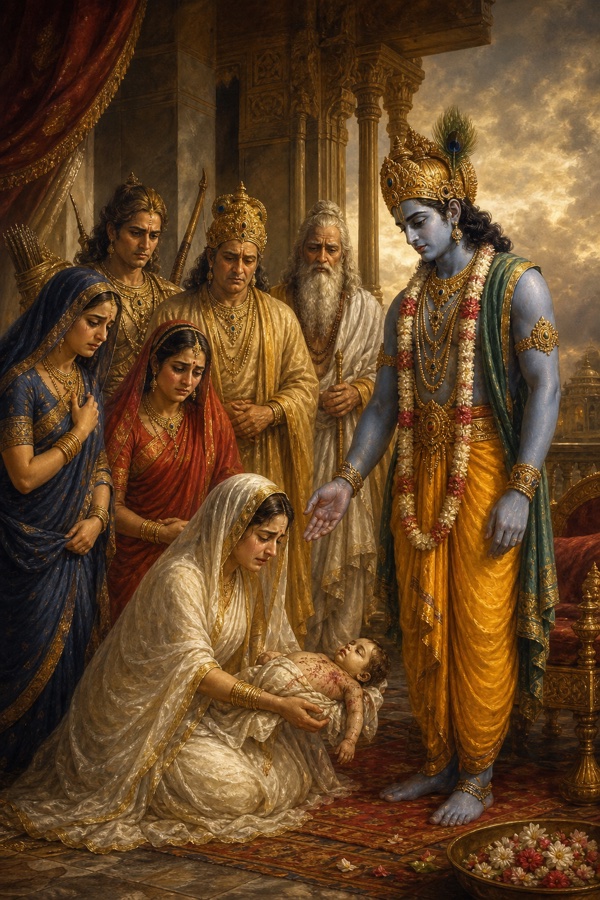
It was while the Vrishni heroes were staying in the city, Vaishampayana told Janamejaya, that the king’s own father was born. Parikshit came out of the womb already struck by the Brahma weapon of Ashvatthama, and he lay still. He did not move. There was no life in him. The citizens had heard that a prince was born and had sent up a shout like a lion’s roar that carried to the far edge of every quarter, and then the word came that the child was dead, and the shout stopped.
Krishna went in at once. He was shaken in mind and body, and with Satyaki beside him he hurried into the inner apartments of the palace, and there he saw his father’s sister Kunti coming toward him, weeping aloud and calling his name over and over. Behind her came Draupadi and Subhadra and the wives of the Pandavas’ kinsmen, all crying pitifully. Kunti reached him and spoke in a voice choked with tears. “Krishna, Devaki is counted a fortunate mother because she bore you. You are our refuge and you are our glory. This house of Pandu has no protector except you. This child of your sister’s son has come out of the womb killed by Ashvatthama. Bring him back to life, Keshava.
“You vowed it. When Ashvatthama breathed the Brahma weapon into a blade of grass, you said, ‘If that child comes out of the womb dead, I will revive him.’ He has been born dead, my son. Look at him. It is for you to save Uttara and Subhadra and Draupadi and me, and Yudhishthira and Bhima and Arjuna and Nakula and Sahadeva. The lives of the Pandavas are tied to this child, and so is mine. The funeral cake of Pandu depends on him, and my father-in-law’s, and Abhimanyu’s too, that nephew you loved, who was so like you. Do today what will save them all. I am begging you.
“Uttara keeps repeating something Abhimanyu said to her, and it must have pleased her very much when he said it. He told this daughter of Virata, ‘Your son will go to my mother’s family. He will live with the Vrishnis and the Andhakas, and from them he will learn the science of arms, and wonderful weapons of many kinds, and the whole science of policy and right conduct.’ That is what Subhadra’s son said to her, out of love. We bow our heads to you and ask you to make those words of Abhimanyu’s true. The time has come; do what will save us.” Having said it, Kunti threw up her arms and fell to the ground, and the women with her fell too. Their eyes were clouded with tears, and they cried out again and again, “The son of Krishna’s nephew has been born dead!” Krishna took hold of his aunt and raised her gently from the floor and spoke to comfort her.
A key to reading this (lineage): Parikshit is the son of Abhimanyu and Uttara, so Arjuna and Subhadra are his grandparents and Krishna is his father’s uncle. Subhadra says in the next scene that the blade of grass Ashvatthama charged with the Brahma weapon was raised to destroy Bhima and came down on the unborn child, on the day Drona’s son meant to kill the Pandavas’ children even in the womb. With Abhimanyu dead this infant is the heir of the house. He is also the father of Janamejaya, the king who sits listening as Vaishampayana tells it.
The gist: While the Pandavas are away fetching the gold, Uttara’s son is born lifeless, struck in the womb by Ashvatthama’s Brahma weapon. Kunti holds Krishna to the vow he made when the weapon was loosed: that if the child came out dead he would revive it.
The lament of Subhadra and Uttara, and Krishna’s “So be it”
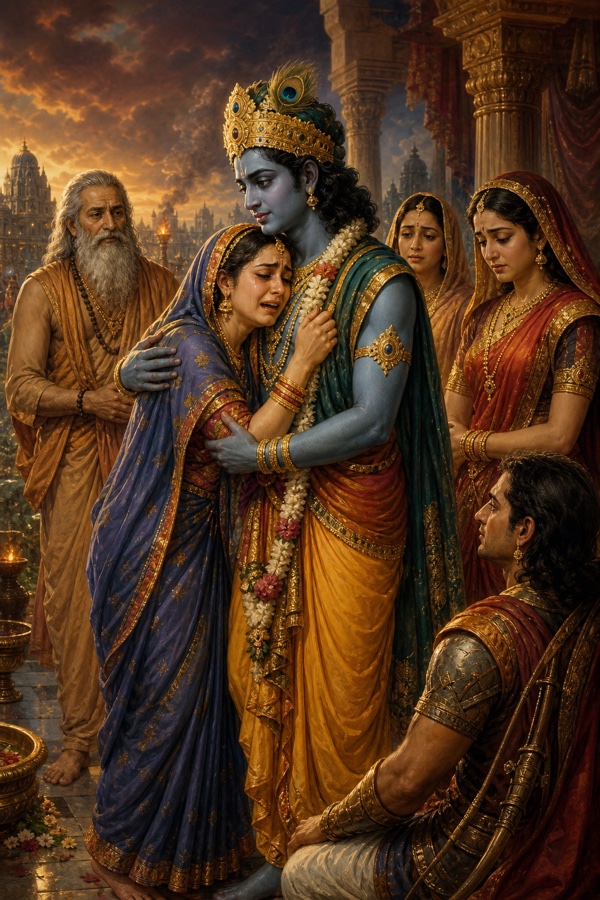
Kunti was sitting up again when Subhadra saw her brother and broke into loud weeping. “Look at him, Krishna. Look at Arjuna’s grandson. The Kurus have been thinned to almost nothing, and the child born to them is weak and dead. Drona’s son lifted that blade of grass to destroy Bhima, and it fell on Uttara and on Arjuna and on me. It is still in me. It went through my heart and no one has drawn it out, because I look at this child and his father, my son, is not beside him.
“What will Yudhishthira say, the just king? What will Bhima and Arjuna and Madri’s two sons say? They will hear that Abhimanyu’s son was born and was dead, and they will think Ashvatthama has cheated them. I bow my head to you, Krishna. Kunti and Draupadi are standing here; look at them. When the son of Drona tried to destroy the children in the wombs of the Pandavas’ women, you spoke to him in anger. You said, ‘Wretch of a Brahmin, vilest of men, I will defeat your wish. I will revive the son of Arjuna’s son.’ I heard you say it, and I know what you can do, and so I ask you. Let Abhimanyu’s son live. If you gave your word and do not keep it, then know that I will give up my life. If this child does not live while you are alive and standing near, what other use will you ever be to me? Revive him, this child with his father’s eyes, as a rain cloud revives a dead crop in the field. If you wished it you could bring the three worlds back from death; how much more easily this one dear child of your sister’s son. Have pity on Uttara, or on me. Think that I am your sister, or think only that I am a mother who has lost her son and has thrown herself on your protection.”
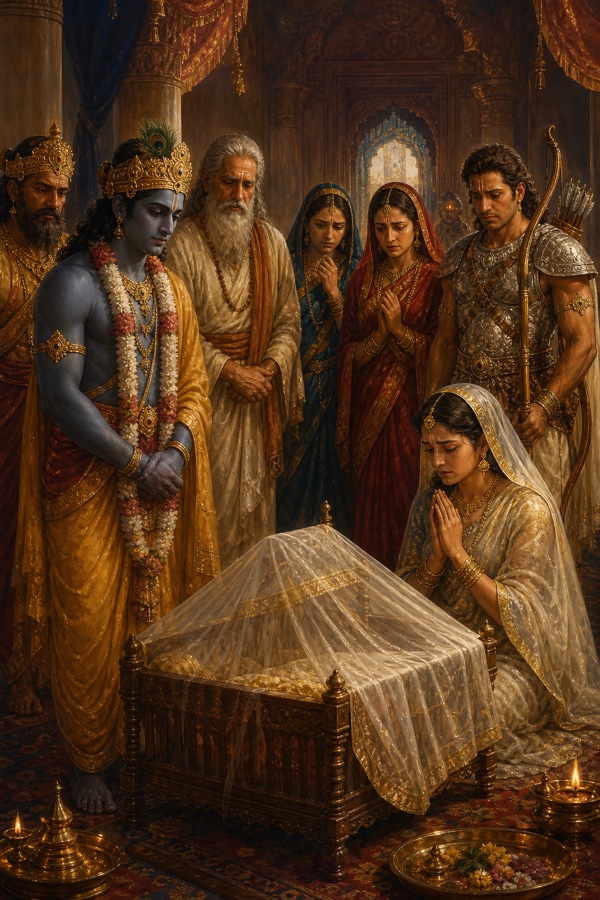
Krishna was sick with grief himself, and he gave them their answer in three words: “So be it!” He said it loudly, loud enough that all who lived in those inner rooms heard it and took heart, and the people gathered there felt what a man streaming with sweat feels when cold water is poured over him.
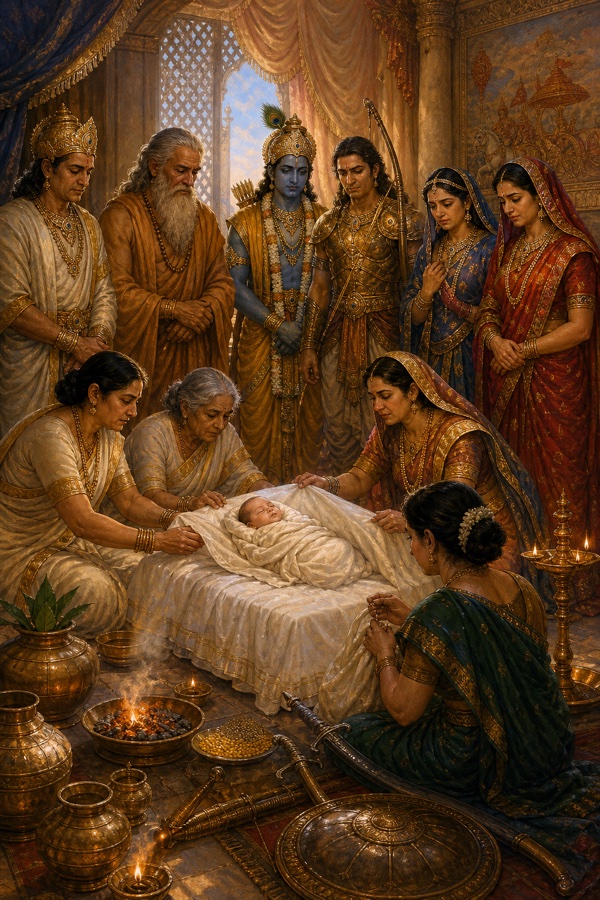
Then he went quickly into the lying-in room, the room, Vaishampayana said, where Janamejaya’s father was born. It had been made ready as such a room should be. White flowers hung in garlands. Full water jars stood on every side, and there was charcoal of tinduka wood soaked in ghee, and mustard seed, and bright weapons set out in order, and fires burning all around. Pleasant old women had been called in to wait on the mother, and skilled physicians stood about the room. Krishna saw, too, that everything known to destroy Rakshasas had been placed where it should be by people who understood the matter. He looked the room over and was glad, and said, “Excellent, excellent!”
When he said that, and with so cheerful a face, Draupadi ran in to the daughter of Virata. “Here he comes to you, dear girl, your father-in-law himself, the slayer of Madhu, the ancient sage whom no one has ever beaten.” Uttara checked her tears and covered herself as was proper, and waited for Krishna as the gods wait on him. When she saw him come in, the helpless girl could hold nothing back. “Look at us, lotus-eyed one, both of us robbed of our child. Abhimanyu and I have been killed alike. I bow my head to you, Krishna. Revive my child, whom the weapon of Drona’s son has burned. If Yudhishthira had said it that day, or Bhima, or you, if any of you had said, ‘Let the blade of grass kill the mother, who knows nothing,’ then I would have died and this would never have happened. What did Drona’s son gain by so cruel a thing, killing a child in the womb with the Brahma weapon? That child’s mother bows her head to you now. If he does not live, Govinda, I will give up my life. I had hoped to come to you with my child on my lap and bow to you. That hope is gone. I swore once, Keshava, that if Abhimanyu fell in battle I would follow him at once. I did not keep it. I was cruel, and I loved my life. If I go to him now, what will Arjuna’s son say to me?”
The gist: Subhadra reminds Krishna of what he said to Ashvatthama and tells him she will give up her life if he does not keep his word. He answers “So be it!” and goes into the lying-in room, where Uttara begs him for the child’s life and makes the same threat.
Krishna’s word of truth, and the revival of the infant
Uttara wanted her child back, and when she had said all that she fell to the floor like a woman out of her mind. The princess lay there with her son gone and her body uncovered, and at the sight Kunti and all the Bharata women began to wail. The palace of the Pandavas turned into a house of mourning. Then she came to herself, and she lifted the child onto her lap and spoke to him. “Your father knew every duty there is. Do you not see the wrong you are doing, then, when the chief of the Vrishnis stands here and you do not greet him? Go to your father, my son, and give him this message from me: it is hard for a creature to die before its time. I have lost you, my husband, and now I have lost my child as well, and I am still alive, when I ought to be dead, with nothing good and nothing of worth left to me. With King Yudhishthira’s leave I will swallow strong poison, or throw myself into a blazing fire. This heart of mine is hard to destroy. My husband is gone and my child is gone, and it will not break into a thousand pieces.
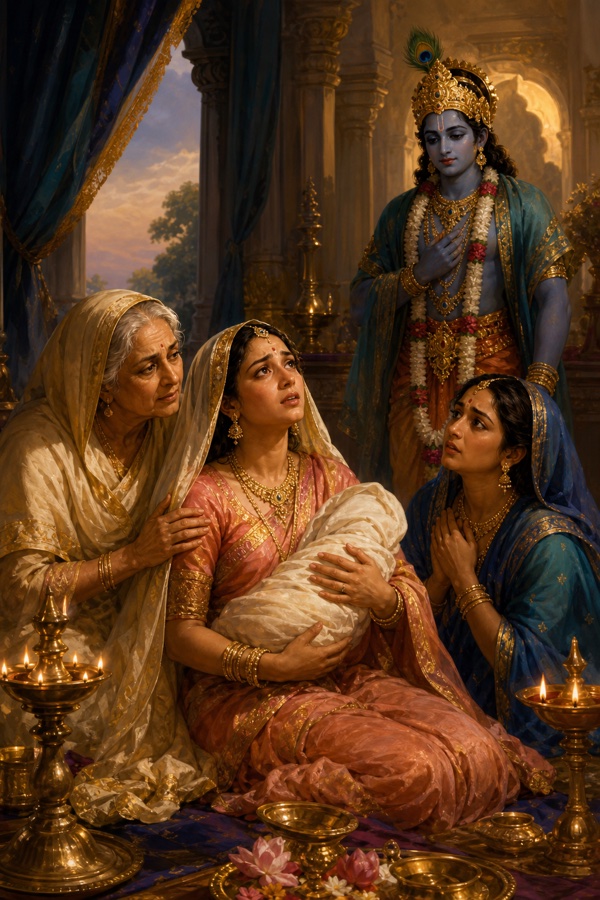
“Get up, my son, and look at your great-grandmother. She is bathed in tears and drowning in sorrow. Look at Draupadi, the princess of Panchala. Look at Subhadra of the Satvatas, who has no one left. Look at me, like a deer with a hunter’s arrow in her. Get up, child, and look at the face of the lord of the worlds here, with his great wisdom and his lotus eyes. He is so like your father, who had that quick glance.”
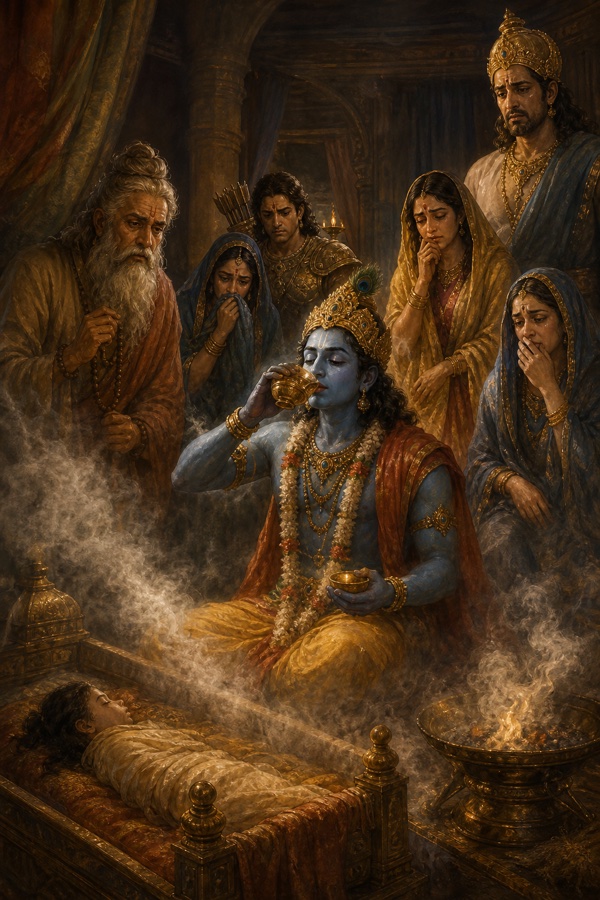
The women lifted her from where she had fallen and made her sit up. Sitting, the daughter of the Matsya king gathered what steadiness she had, joined her hands, and touched her head to the ground before Krishna. He had heard every word of that lament. He touched water, as a man does before a grave act, and withdrew the Brahma weapon. He promised the child his life, and then, pure in himself, he spoke so that the whole universe could hear.
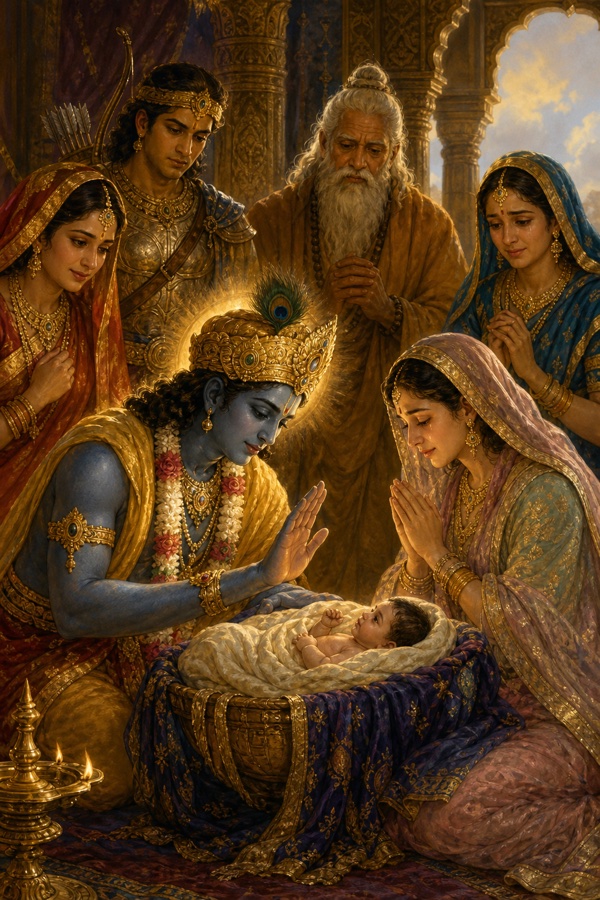
“I do not speak untruth, Uttara, and what I say will prove true. With every creature for witness I will revive this child. I have never told a lie, even in jest. I have never turned back from battle. By the merit of those things let this child live. As righteousness is dear to me, and as Brahmins above all are dear to me, let Abhimanyu’s son, who was born dead, live. No quarrel has ever come between me and my friend Arjuna. By that truth let this dead child live. As truth and righteousness have their home in me always, let this dead child of Abhimanyu’s live. As Kamsa and Keshi were killed by me righteously, by that truth let this child live today!”
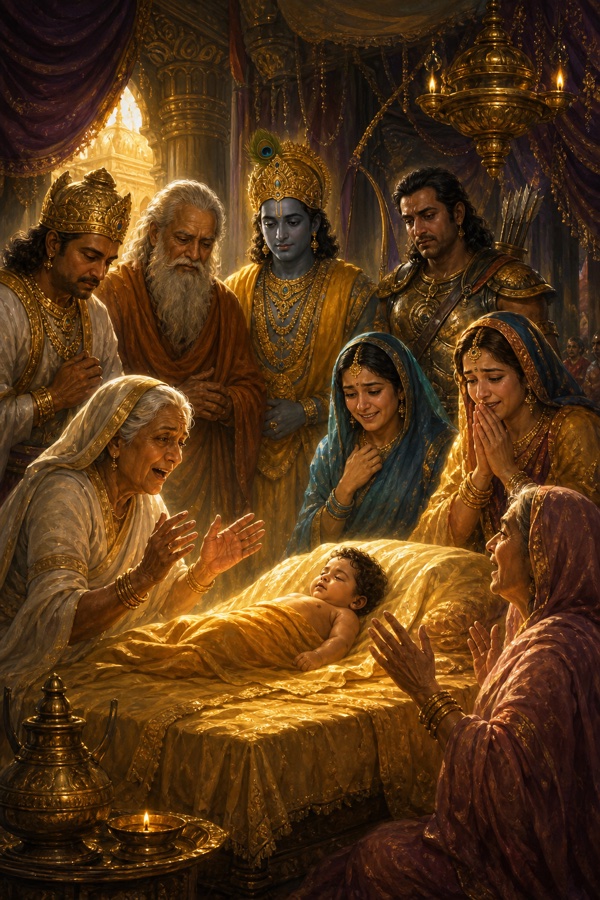
He finished speaking, and the child stirred. Life came into it, and little by little it began to move.
When Krishna drew the Brahma weapon off, Vaishampayana told the king, the child who would be Janamejaya’s father lit that room with his own energy. Every Rakshasa that had come into it was driven out, and many of them were destroyed. A voice spoke in the sky: “Excellent, Keshava, excellent!” The weapon, still blazing, went back to the Grandsire of the worlds. The child had his breath again, and he moved as a child of his strength would move. At Krishna’s word the Brahmins pronounced blessings, and the women praised him, Kunti and Draupadi and Subhadra and Uttara and the wives of the other men of that house, as glad as shipwrecked people who have found a boat and reached the shore.
When the proper time came Uttara rose from her bed, happy, with her child in her arms, and bowed to Krishna with reverence. He was full of joy, and he gave the child many precious gems, and the other Vrishni chiefs did the same. Then Krishna, who holds to truth, gave the child his name. “This child of Abhimanyu’s has been born at a time when his house had almost died out. Let his name be Parikshit.” And the boy began to grow, and everyone who saw him was the happier for it.
A key to reading this (the truth-act, satyakriya): Krishna uses no weapon and no rite beyond touching water. He makes five declarations about his own life: that he has never spoken an untruth, even in jest, and never turned back from battle; that righteousness and Brahmins are dear to him; that he and Arjuna have never quarreled; that truth and righteousness live in him always; that he killed Kamsa and Keshi righteously. On the strength of each he asks that the child live, and the child lives because the statements are true. Arjuna will be held to the same measure in Manipura, where his wife Ulupi tells him that the way he brought Bhishma down was unrighteous.
The child was a month old when the Pandavas came home with their great load of wealth. The Vrishni chiefs heard they were near and went out to meet them. The citizens hung Hastinapura with flowers in masses and with pennons and standards of every kind, and dressed their own houses as well. Vidura, wanting everything done that could be done for the sons of Pandu, ordered worship in all the temples of the gods. The hum of thousands of voices in the city was like the roar of the sea heard from a distance, and bards and praise-singers stood with beautiful women in its quieter corners. The officers of the government had it cried aloud that this was to be a day of rejoicing for the whole kingdom, in honor of the journey that had brought home so great a mass of gems and treasure.
The gist: Uttara bows to Krishna with the dead child in her lap. He touches water, withdraws the Brahma weapon, and stakes the child’s life on the truths of his own. The infant stirs and lives, and Krishna names him Parikshit, because he was born when his house had almost died out. A month later the Pandavas return with the gold.
The welcome of the Pandavas, Vyasa’s leave, and the loosing of the horse
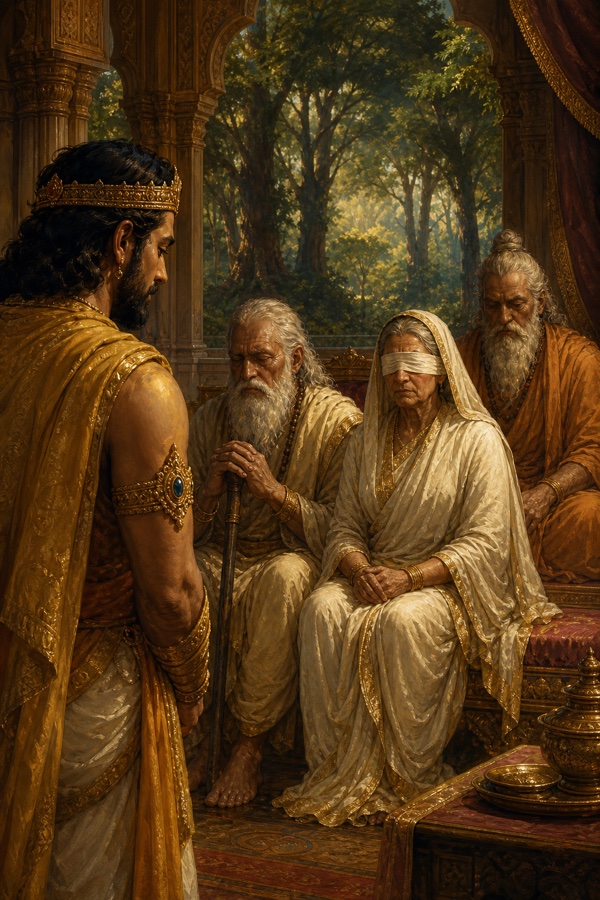
Krishna went out with his ministers to meet them, and the Pandavas and the Vrishnis entered the city as one company, with the treasure carried in front and the noise of voices and chariot wheels filling earth and sky. Custom took the brothers first to King Dhritarashtra, and each gave his name and touched the old man’s feet. They paid their respects to Gandhari and to Kunti; they honored their uncle Vidura and greeted Yuyutsu, the son Dhritarashtra had by his Vaishya wife. Then they were told the news of the birth, that strange and wonderful and happy thing, and what Krishna had done, and they gave Krishna, Devaki’s son, the worship he deserved.
Some days later Vyasa, the son of Satyavati, came to Hastinapura. The Kurus received the great sage as custom required, and the princes of the Vrishnis and Andhakas joined them in honoring him. They talked of many things. Then Yudhishthira said to him, “Holy one, this treasure was brought here through your kindness, and I want to give it to the great rite called the horse sacrifice. I ask your leave for that. We are all in your hands, and in Krishna’s.”
“You have my leave,” said Vyasa. “Do what comes next. Worship the gods with the horse sacrifice, and give with an open hand. That sacrifice washes away every sin, and when you have worshiped the gods with it you will be clean of all of yours; do not doubt it.” So the Kuru king set his heart on making everything ready. He told Vyasa all he intended, and then he went to Krishna. “Devaki is called the most fortunate of mothers because of you. Do what I am going to ask. Every good thing we enjoy, we have through your power. It was your strength and your mind that subdued the whole earth. So let it be you who undergoes the initiation. You are our highest teacher and our master. If you perform this sacrifice I will be clean of every sin. You are sacrifice. You are the indestructible, you are all that is, you are righteousness, you are Prajapati, you are where every creature is going. I am certain of it.”
“It suits you to say that,” Krishna answered. “You are the one every creature turns to; of that I am certain. Among all the heroes of the Kurus you shine today, and it is your righteousness that does it. You have put the rest of them in the shade. You are our king and you are our elder. Worship the gods in this sacrifice yourself, with my full consent. Put us to whatever work you like. I give you my word that I will do everything you ask of me. And when you sacrifice, Bhima and Arjuna and Madri’s two sons sacrifice with you.”
Yudhishthira bowed to Vyasa. “Then have me initiated when the right hour comes. This sacrifice of mine rests entirely on you.” Vyasa told him that he himself, with Paila and Yajnavalkya, would see every rite performed at its proper time, and that the initiation would fall on the day of the full moon in the month of Chaitra. Sutas and Brahmins who knew the science of horses should choose an animal fit for the purpose. “Let it be loosed as the scriptures direct, and let it wander over the whole earth with her belt of seas, showing your glory wherever it goes.” When everything was ready he told the king that the implements of the sacrifice were to be made of gold, and that the horse should be let go that very day, properly guarded.
A sub-tale: In the horse sacrifice a chosen horse is set free to wander wherever it likes over the earth, and a guard follows it. A king into whose country it strays may honor it or seize it, and one who seizes it has to be fought. Yudhishthira’s horse goes out under a particular order: Arjuna is to avoid battle where he can, to defeat those who force one on him without killing them, and to invite every one of them to the sacrifice. When the horse comes home it is sacrificed with the other animals, and its limbs are offered in the fire.
Yudhishthira asked him to say who should guard the horse while it roamed at will. Vyasa named him. “The one born next after Bhima, the best of all bowmen, the one they call Jishnu, who is patient and can break any resistance. He will guard it. He destroyed the Nivatakavachas, and he is able to conquer the whole earth. Every heavenly weapon is his, and his bow and his quivers came from the gods. That long-armed prince, dark of skin, with eyes like lotus petals, Abhimanyu’s father: he will follow the horse. Bhima has strength past measuring, and he can guard the kingdom with Nakula to help him. And Sahadeva, who is wise and well thought of, will look after the kinsmen invited to your capital.”
Yudhishthira did each thing as he was told. He sent for Arjuna. “Come, Arjuna. You are to guard the horse; you can do it and nobody else can. Kings will come out against you. Avoid fighting them if there is any way to avoid it, as far as it lies in your power. Invite every one of them to this sacrifice of mine. Go, and try to make friends of them.” Then he gave Bhima and Nakula the guarding of the city, and with King Dhritarashtra’s leave he set Sahadeva to wait on the guests.
The gist: Vyasa gives leave for the horse sacrifice. Yudhishthira asks Krishna to be the one initiated; Krishna tells him that he is king and elder and must perform it himself. Vyasa sets the initiation for the full moon of Chaitra and names Arjuna to follow the horse, and Yudhishthira orders Arjuna to avoid battle where he can and to invite the kings.
The start of Arjuna’s journey: Trigarta and Pragjyotisha
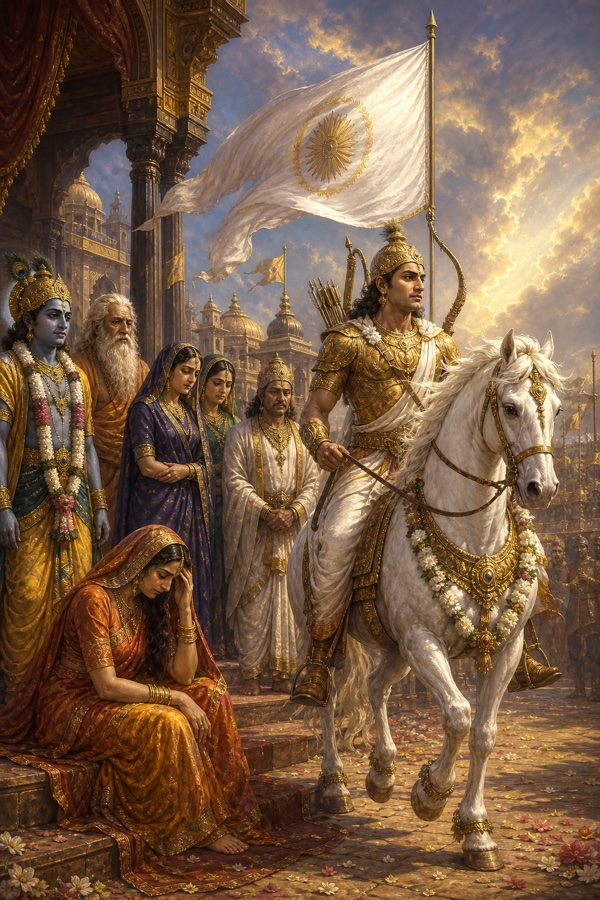
The hour of initiation came, and the priests initiated the king for the horse sacrifice. Vyasa himself turned the horse loose as the scriptures lay down. Yudhishthira wore a garland of gold at his neck, a black deerskin for his upper garment and a cloth of red silk, and carried a staff, and he shone on the sacrificial ground like a second Prajapati. Arjuna, whom men knew by the white horses of his chariot, made ready at the king’s order to follow a horse the color of a black deer. He bound the guard of iguana skin on his hand and drew the Gandiva again and again, and he was cheerful.
All Hastinapura came out to see him go, down to the children. The crowd was packed so close that the press of bodies seemed to give off fire. “There goes Kunti’s son, and there is the horse, how it shines!” Others, farther back, could see nothing of him except the bow, and knew it for the Gandiva. “Blessings on you! Go safely and come back.” A disciple of Yajnavalkya went with him to perform the auspicious rites on his behalf, and many Brahmins learned in the Vedas followed him too, and many Kshatriyas, at Yudhishthira’s command.
The horse went where it liked over an earth the Pandavas had already conquered once with their weapons. From the north it turned toward the east, and it ground its way through the kingdoms of many kings with Arjuna following slowly behind. Kshatriyas past counting came out against him because they had lost kinsmen at Kurukshetra. Kiratas came, and Yavanas, all fine bowmen, and many tribes of Mlecchas who had been beaten before, and Aryan kings with eager troops. He fought them country by country. Vaishampayana said he would tell the king only the chief of those battles, the ones fought with the greatest fury.
The first was with the Trigartas. The Pandavas had an old feud with that people: it was Trigartas who had sworn the Samshaptaka oath at Kurukshetra and kept Arjuna fighting apart for days. Now their sons and grandsons, chariot fighters all, learned that the sacrificial horse had come into their country. They put on armor and surrounded the horse to take it. Arjuna tried to turn them from it with soothing words, and they answered with arrows. He was smiling when he spoke to them again. “Stop this, you lawless men. Life is a gift.” Yudhishthira had charged him earnestly, when he set out, to spare the Kshatriyas whose kinsmen had died at Kurukshetra, and he remembered it. The Trigartas paid no attention.
So Arjuna beat their king. He sent arrows past counting at Suryavarma, the ruler of the Trigartas, and laughed at him. Suryavarma put hundreds of straight arrows into Arjuna, and Arjuna’s own arrows cut the rest down in the air. Then Ketuvarma, the king’s younger brother, came at him to fight for his brother’s sake, and Arjuna killed him with sharp arrows. When Ketuvarma fell, the chariot fighter Dhritavarma drove straight in and poured arrows on him. He was young, and his hands were so quick that Arjuna could not see the moment when the boy drew an arrow or the moment when he set it to the string. He saw only the arrows, coming in sheets through the air. He was delighted, and for a little while he fought his enemy gently, admiring him, with no wish to take his life.
Dhritavarma shot a blazing arrow while Arjuna was being gentle with him, and it went deep into Arjuna’s hand. He stood dazed. His grip loosened, and the Gandiva slipped out of his fingers and lay on the ground like the bow of Indra that hangs in the sky after rain. Dhritavarma laughed out loud. That roused Arjuna. He wiped the blood from his hand, picked the bow up, and sent a downpour of arrows, looking like Yama at the end of an age. The Trigartas rushed from their places to ring him and get Dhritavarma out, and finding himself surrounded made him angrier still. With shafts of hard iron, like the arrows of Indra, he quickly killed eighteen of their best men. Then they ran, and he shot after them, laughing. With the heart gone out of them they came back to him and said, “We are your slaves. We yield. Command us, son of Pritha, and we will do everything you order.” Arjuna answered, “Then save your lives, kings, and accept my rule.”
From there the horse made its way to Pragjyotisha. Its king was Vajradatta, the son of Bhagadatta, and when he found the sacrificial horse inside his borders he came out of his city, seized it, and started back toward his capital. Arjuna strung the Gandiva and rushed at him, and under the arrows from that bow Bhagadatta’s son let the horse go and fled. He went back into his city only to arm. He came out again in mail, riding the prince of his elephants, with a white umbrella held over his head and a yak tail fanning him, and out of childishness and folly he challenged Arjuna to fight. The animal looked like a mountain, with rut running from its temples, and he drove it at Arjuna with the iron hook.
Arjuna stood on the ground and took on the rider above him. Vajradatta sent a flight of broad-headed arrows with the heat of fire in them, and Arjuna’s shafts met them in the air and cut them in two and in three. Then Arjuna answered with straight-flying arrows winged with gold, and they struck Vajradatta with such force that he fell from the elephant to the ground. He kept his senses, climbed back up in the middle of the fight, and coolly shot again, while Arjuna’s arrows pierced the great animal until it streamed blood like a mountain running with red ocher. The battle went on like that for three days, as when Indra fought Vritra.
On the fourth day Vajradatta laughed loudly and called across to him. “Wait, Arjuna, wait! You will not get away from me alive. When I have killed you I will pour the water for my father as the rite requires. My father Bhagadatta was old, and he was your own father’s friend, and you were able to kill him because of the weight of his years. Now fight me. I am only a boy!” He drove the elephant forward in a fury. Arjuna trusted the Gandiva and stood where he was. He thought of how this king was blocking the work he had been sent to do, and of the old enmity of that house toward his own, and his anger rose. He stopped the charge with a shower of arrows, and the beast stood checked, stuck all over with shafts like a porcupine with its quills up. Once more the king forced it forward, and this time Arjuna shot a single shaft like a tongue of fire into its vitals. The elephant dropped at once, as a mountain peak drops when the thunderbolt has loosened it.
The king had come down with his elephant, and Arjuna spoke to him where he lay. “Do not be afraid. When Yudhishthira sent me on this task he told me I was not to kill the kings who came out against me, or their fighting men; I was to count my work done if I disabled them, and to ask them all to his horse sacrifice. So I will not kill you. Get up and go back to your city safe and whole. When the full moon of the month of Chaitra comes, come to the sacrifice of King Yudhishthira, for it is held on that day.” Bhagadatta’s son, beaten, said, “So be it.”
The gist: Vyasa looses the black horse and Arjuna follows it. The Trigartas try to take it: Arjuna kills Ketuvarma, is wounded in the hand by young Dhritavarma, kills eighteen more, and accepts the submission of the rest. At Pragjyotisha Vajradatta fights from his elephant for three days; on the fourth Arjuna kills the elephant, spares the king, and invites him to the sacrifice.
In the land of Sindhu, Duhshala, and mercy to the son of Suratha
The next great battle was with the Saindhavas, the men of the Sindhu country, hundreds of whom were still alive after the slaughter of their clan at Kurukshetra. They could not endure the thought of Arjuna inside their borders. They seized the horse and felt no fear of Bhima’s younger brother in doing it. Arjuna was on foot, bow in hand, keeping watch over the animal, and they attacked him from close range, calling out their names and families and their deeds. They fought from chariots and he fought from the ground. A thousand chariots and ten thousand horse closed him in like the bars of a cage, and remembering Jayadratha, their king, dead by his hand, they poured arrows on him like a cloud bank pouring rain.
Under that downpour Arjuna looked like the sun gone behind a cloud. The three worlds cried out at the sight. A terrible wind began to blow, Rahu swallowed sun and moon together, meteors fell, and Mount Kailasa trembled. And Arjuna was stunned. His hand opened and the Gandiva fell from it, and the leather guard slipped off after it, and the Saindhavas, seeing him senseless, shot again without losing a moment. The gods were afraid for him. The seers of heaven and the seven sages set themselves to silent recitation so that he might win, and their work kindled his energy again. He stood as unmoved as a hill and bent the bow, and the twang of it was like the sound of some huge engine. Then he rained arrows as Indra pours rain. The Saindhava fighters vanished under them like trees under a swarm of locusts. The mere sound of the Gandiva frightened them, and they ran, weeping, while he moved among them as fast as a wheel of fire.
The Saindhavas rallied all the same, and came back furious, and shot again in showers. Arjuna laughed at these men who had returned to the edge of their deaths, and spoke to them softly. “Fight as hard as you can and do your best to beat me. Put your affairs in order first, because a great danger is waiting for all of you.” He said it in anger. Then he remembered his eldest brother’s words: he was not to kill the Kshatriyas who came out to fight him; he was to defeat them. He must not make a liar of the king. So he spoke again. “I am telling you this for your own good. You are standing in front of me, and I do not want to kill you. Any man among you who says to me that he is beaten and that he is mine, I will spare. Do otherwise and you put yourselves in great danger.”
They would not have it. They shot arrows by the hundred and the thousand, and threw darts and javelins, and he cut every one out of the air before it could reach him. At last his patience went. With broad-headed arrows he struck off the heads of many who were rushing at him, and he knocked a great many more senseless. It was then that Duhshala, their queen, saw how low he had brought them. She was Dhritarashtra’s daughter, and she took her grandson in her arms, the small son of her son Suratha, mounted a chariot, and drove out to Arjuna to save what was left of her fighting men. When she reached him she began to weep. Arjuna threw his bow down, received her as a sister should be received, and asked what he could do for her. “This child is the son of your sister’s son,” she said. “He bows to you.” Arjuna asked, “Where is Suratha?”
“His father’s killing burned in him,” Duhshala said, “and he has died of the pain of it. He already knew that you had killed his father Jayadratha. Then he heard that you had come here, following the sacrificial horse and guarding it, and at the news he fell down and gave up his breath. I saw him lying on the ground. I took his little son and came to you for protection.” She wept aloud then, and Arjuna stood in front of her with a heavy heart and his face turned to the ground.
She went on. “Look at your sister. Look at the child of your sister’s son. Have mercy on this boy, and forget Duryodhana, and forget that wicked Jayadratha. Parikshit was born of Abhimanyu; in the same way this child, my grandson, was born of Suratha. He is the child of your enemy, and he has come to you asking for peace. He knows nothing of what has happened. Forget his cruel grandfather, and be kind to him.” Arjuna thought of Queen Gandhari and of King Dhritarashtra, and the grief of it went through him, and he answered her with blame for the whole way of the Kshatriya. “Shame on Duryodhana, that mean creature, greedy for a kingdom and swollen with vanity! It was for him that I sent all my kinsmen to the house of Yama.” He comforted his sister, embraced her, and sent her home in peace. Duhshala ordered every one of her fighters off the field and turned back. Arjuna went on after the horse, and it wandered as it pleased through one kingdom after another until it came into the country of the ruler of Manipura.
The gist: The Saindhavas, Jayadratha’s people, cage Arjuna and shoot him senseless; the sky fills with evil signs, and the gods and seers pray him back to his feet. He is still fighting when Duhshala, Dhritarashtra’s daughter, drives out with her infant grandson, whose father Suratha fell dead on hearing that Arjuna had come. Arjuna curses Duryodhana and makes peace.
Manipura: the father-son battle with Babhruvahana
The ruler of Manipura was Babhruvahana, and Arjuna was his father. When he heard that Arjuna had come into his country he went out to meet him humbly, with Brahmins walking in front and treasure carried before him as a gift. Arjuna looked at this procession and thought of what a Kshatriya owes, and he did not like it. He spoke angrily. “This is no way for you to behave. You have fallen away from the duties of a Kshatriya. I have come here guarding Yudhishthira’s sacrificial horse, and I am inside your borders. Why will you not fight me, my son? Shame on you and your foolish mind, shame on a man who comes out peaceably to receive me when I have come here to fight him! Welcoming me like this, you act like a woman. If I had come to you with my weapons laid aside, this would have been fitting, you worst of men.”
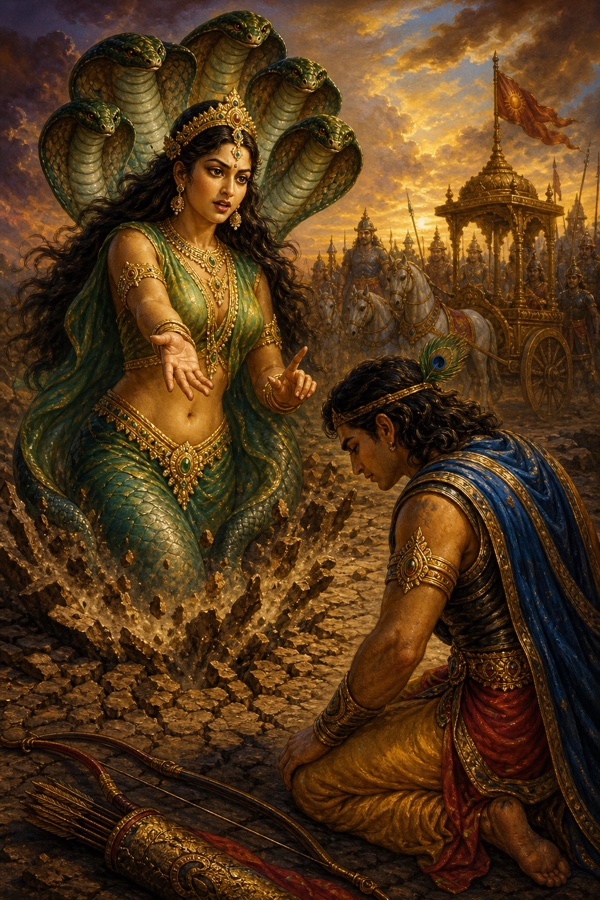
Ulupi learned what her husband was saying. She was the daughter of the serpent king, Arjuna’s wife and so the young king’s stepmother, and she could not bear it. She broke through the earth and came up on the spot. She saw her son standing there with his face hanging, miserable, while his father, who wanted a fight, rebuked him again and again, and the Naga princess went to him. “Know me: I am your mother Ulupi, the serpent’s daughter. Do as I tell you, my son, and you will earn great merit. Fight your father, this chief of the Kurus whom no one can stand against in battle. He will be pleased with you then; there is no doubt of it.” That was how his stepmother set King Babhruvahana on his father, and at last he made up his mind to fight.
He put on armor of bright gold and a helmet that flashed. He mounted a splendid chariot with quivers on it by the hundred, drawn by horses as fast as thought, raised his standard with its lion worked in gold, and drove out against his father. When he came up to the sacrificial horse he had it seized by men who understood horses. Arjuna saw the horse taken and was filled with joy. Standing on the ground, he set himself to hold off his son in the chariot, and the king hurt him with shower after shower of sharp arrows. No fight was ever like that one between father and son. It was like the old war of the gods and the Asuras, and each of them was delighted to have the other for an opponent. Then Babhruvahana, laughing, shot a straight arrow into Arjuna’s shoulder. The feathered shaft went into him as a snake goes into an anthill, passed clean through, and buried itself deep in the earth. The pain was sharp. Arjuna rested a moment, holding himself up on his bow, and to anyone watching he looked like a dead man. Then he came back to himself and praised his son warmly. “Excellent, excellent, son of Chitrangada! That was worthy of you, and I am very pleased with you. Now I am going to shoot at you, my son. Stand and fight.” And he sent a shower of arrows at the prince.
The arrows from the Gandiva came bright as Indra’s thunderbolt, and King Babhruvahana cut every one of them with broad-headed shafts of his own, some in two and some in three. Arjuna then shot down the standard on the king’s chariot, tall as a golden palm, and, laughing, he killed the king’s horses. Babhruvahana jumped down in a rage and fought his father on foot. Arjuna was pleased with the boy’s courage and began to press him hard. Babhruvahana took that for a sign that his father could no longer face him, and in a boy’s recklessness he drew with all his strength and shot a sharp, well-winged arrow into his father’s chest. It went through to the very seat of life. Arjuna, deeply pierced by his own son, fell to the earth in a swoon.
When Arjuna, who had carried the burdens of the Kurus, went down, Chitrangada’s son lost his senses too. He was worn out from the fight, he had been deeply wounded by Arjuna’s arrows, and he had just seen his father killed. He fell at the front of the battle with his arms about the earth. Word went to Chitrangada that her husband had been killed and her son was lying on the ground. She came to the field with her heart burning, weeping and shaking all over, and the mother of the ruler of Manipura saw her husband lying dead.
A key to reading this (lineage): Two of Arjuna’s wives are in this episode. Chitrangada, of the house of Chitravahana, is the mother of Babhruvahana, king of Manipura. Ulupi, daughter of the serpent Kauravya, is a Naga princess, another of Arjuna’s wives and so the young king’s stepmother, though she calls herself his mother and he obeys her as one. Babhruvahana is Arjuna’s own son, and the battle on this field is a father’s with his child.
The gist: At Manipura Arjuna’s son Babhruvahana comes out to welcome his father, and Arjuna abuses him for failing in a Kshatriya’s duty. Ulupi rises out of the earth and tells him to fight. He shoots his father in the chest, Arjuna falls as if dead, and the son faints beside him.
Chitrangada’s lament, and Arjuna’s revival by the gem
Chitrangada wept for a long time, and the grief burned her until she lost her senses and fell. When she came to, she saw Ulupi, the serpent chief’s daughter, and spoke to her. “Look, Ulupi. Our husband, who never lost a battle, has been killed in one by my young son, and it is your doing. Do you know how decent people behave? Are you a wife devoted to her lord? It is by your act that your husband lies here dead. If Arjuna has wronged you in every way a man can, forgive him; I beg you, bring that hero back to life. You know what is right, and the three worlds know you for it. How is it, then, that you have had your husband killed by my son and you do not grieve? I am not mourning for my son, daughter of the serpent chief. I mourn only for my husband, who has had this welcome from his son.”
Then she went to where her husband lay on the ground and spoke to him. “Get up, dear lord. You are dearer to the Kuru king Yudhishthira than anyone. Here is your horse; I have had it set free. You are supposed to be following it. Why are you lying still on the earth? You give other people their lives; how can you throw away your own today? Look well at this, Ulupi, your husband stretched on the ground. To have many wives is no fault in a man, lady. It is women who are blamed for taking more than one husband. So do not hold thoughts of that kind. The Ordainer himself made this bond between you and him. Honor it. You have killed your husband through my son, and if you do not revive him today before my eyes I will give up my life. I have lost husband and son together, and I will sit here in front of you and fast until I die.” She said that to her co-wife and spoke no more. She took her husband’s feet onto her lap and sat there sighing heavily.
King Babhruvahana recovered his senses and saw his mother sitting like that on the battlefield. “What could be more painful than this,” he said, “to see my mother, who was brought up in comfort, on the bare ground beside her husband where he lies? He was the best of all who carry weapons, and I have killed him in battle. It is plain that people do not die until their hour comes, since she and I are both still alive after such a sight. Brahmins, look at my father laid out on a hero’s bed, killed by his son! Tell me what penance I must perform, a cruel and sinful wretch who has killed his own father. I ought to wander the earth in misery, wrapped in his skin. Give me the two halves of my father’s head to carry, for there is no other expiation for me.” The king touched water in his grief and cried out, “Let every creature hear me, moving and unmoving, and you hear me too, mother. If my father Jaya does not rise, I will sit on this field and let my body waste. A man who kills a Kshatriya hero is made clean by the gift of a hundred cows. For killing my father there is no cleansing.” When he had said this, Arjuna’s son was silent, vowed to starve himself to death.
So the king of Manipura and his mother sat down together to die. Then Ulupi turned her thought to the gem that brings the dead back to life. That jewel is the great refuge of the serpent people, and the moment she thought of it it came to her. She took it up and spoke, and what she said put heart into every fighting man on the field. “Get up, my son. Do not grieve. You have not defeated Arjuna. No man can defeat him, and the gods cannot either, with Indra at their head. What you have seen is an illusion. I made it, and deceived your senses, for the good of your father. He came here to fight you because he wanted to learn what his son was worth in battle, and that is why I urged you to it. You accepted his challenge, and you must not think you did the smallest wrong. This jewel revives the serpents as often as they die. Lay it on your father’s breast, my son, and you will see the son of Pandu alive.”
The prince had done no wrong, and he loved his father, and he laid the gem on Arjuna’s breast. Arjuna revived. He opened his red eyes and sat up like a man who has slept a long time, and Babhruvahana bowed to him in reverence. As Arjuna woke from that sleep of death, Indra rained flowers from heaven. Kettledrums that no hand was beating sounded deep as thunder, and the sky was loud with voices crying, “Excellent, excellent!” Arjuna got to his feet and embraced his son and smelled his head. Then he noticed the boy’s mother sitting a little way off, bowed with grief, and Ulupi with her. “Why does everything on this field show grief and wonder and joy all at once? Why has your mother come out to a battlefield? Why is Ulupi here? I know you fought me because I ordered you to. What I want to know is what has brought the women out.” The king of Manipura bowed his head to him and said, “Ask Ulupi.”
The gist: Chitrangada accuses Ulupi of having had their husband killed and sits down to fast to death. Babhruvahana wakes, calls himself a father-killer, and takes the same vow. Then Ulupi thinks of the gem that revives dead Nagas, and it comes to her. The king lays it on Arjuna’s breast, and Arjuna rises as if from a long sleep.
Ulupi reveals the secret: the curse and expiation for Bhishma’s fall
Arjuna asked her. “What brought you here, daughter-in-law of the house of Kuru? And why has the mother of the ruler of Manipura come onto a battlefield? Do you mean well by this king, serpent’s daughter? Do you mean well by me? I hope neither I nor Babhruvahana here has done you some injury without knowing it. Has Chitrangada, who comes of the line of Chitravahana, done you any wrong?”
The serpent prince’s daughter smiled as she answered. “You have not offended me. Babhruvahana has done me no wrong, and neither has his mother, who is always as obedient to me as a handmaid. Do not be angry with me; I bow my head to you and ask it. Everything I did, I did for your good. In the great battle of the Bharata princes you killed Shantanu’s royal son by unrighteous means. You did not bring Bhishma down while he was fighting you. He was engaged with Shikhandi, and you used Shikhandi as your help and so brought about his fall. If you had died with that sin unexpiated, you would have gone to hell for it; that is certain. What you have just had at your son’s hands is the expiation.
“I heard it from the Vasus themselves, when they were with Ganga. After Shantanu’s son fell, those gods came to the bank of the Ganga and bathed in her water, and they called the goddess of the river and said a terrible thing. ‘Bhishma has been killed by Arjuna. He was engaged with another man at the time, goddess, and had stopped fighting. For that fault we will lay a curse on Arjuna today.’ And the goddess Ganga said at once, ‘So be it.’ I heard them, and I was in great distress. I went down into the lower world and told my father everything. He was struck with grief. He went to the Vasus and pleaded with them on your behalf, again and again, until they said to him, ‘Arjuna has a blessed son, a young man who rules Manipura. That son will stand on a field of battle and throw Arjuna down upon the earth. When that happens, prince of serpents, Arjuna will be free of our curse.’ He came back and told me, and in just this way I have set you free. The king of the gods himself cannot defeat you in battle. A son is a man’s own self, and that is why you could be defeated by yours. How would you blame me?” Arjuna’s heart lightened as he listened. “All that you have done, goddess,” he said, “is very welcome to me.”
Then he turned to his son, the ruler of Manipura, and spoke so that Chitrangada could hear. “Yudhishthira’s horse sacrifice will be held on the day of the full moon in the coming month of Chaitra. Come to it, king, with your mother and your counselors and officers.” Babhruvahana’s eyes were full of tears. “I will come to the great sacrifice as you command, father, and I will take on myself the work of serving food to the Brahmins. Show me one kindness now. Come into your own city with your two wives. Spend a single night in comfort in your own house, and follow the horse again in the morning.” Arjuna said, “You know the vow I am keeping. Until it ends I cannot enter your city. This horse goes where it likes, and I have to go behind it. Blessings on you. I must leave, and there is nowhere I may rest even for a little while.” His son paid him every honor, his two wives gave him leave, and he left that place and went on.
A key to reading this (the moral knot): Ulupi says in so many words that Arjuna killed Bhishma by unrighteous means: Bhishma was engaged with Shikhandi and had stopped fighting when Arjuna brought him down. The Vasus meant to curse Arjuna for it, with Ganga’s consent, and the terms they finally gave Ulupi’s father were that Arjuna’s own son must throw him to the ground in battle. The duel at Manipura and the gem that undoes it are how that debt is paid.
The gist: Ulupi explains. For the manner of Bhishma’s fall the Vasus were going to curse Arjuna; her father begged them off, and they agreed that Arjuna would be free once his own son had thrown him down in battle. Arjuna tells her he is glad of it, refuses a night in the city because of his vow, and follows the horse.
Meghasandhi of Magadha, and the journey through the remaining lands
The horse had now wandered over the whole earth as far as the sea that bounds it, and it turned its face toward Hastinapura, and Arjuna turned with it. Roaming as it liked, it came to the city of Rajagriha in Magadha. The king there was Meghasandhi, the son of Sahadeva and grandson of Jarasandha, a young man who kept a Kshatriya’s duties, and when he saw the horse inside his territory he challenged its guard. He drove out of his city in a chariot, with bow and arrows and a leather guard on his arm, straight at Arjuna, who was on foot, and what he said when he came up was a child’s speech with no art in it. “This horse of yours seems to go about with nobody except women to protect it. I am going to take it away. Try to get it back. My fathers never gave you a lesson in battle. I will do the honors of the house all the same. Strike me, because I am going to strike you.”
Arjuna smiled. “My eldest brother laid a vow on me: I am to resist whoever blocks my way. You know that, king. Strike as hard as you can. I am not angry.” The ruler of Magadha struck first, pouring arrows on him as Indra of the thousand eyes pours rain. Arjuna turned that whole cloud aside, and then he shot back, blazing arrows like snakes with fire in their mouths. He aimed them at the flag and the flagstaff, the chariot, its poles and yoke, the horses. He left the king’s body alone, and the driver’s. The prince of Magadha believed it was his own skill that kept him whole, and he shot arrow after arrow into Arjuna, until Arjuna, covered in wounds, looked like a palasha tree in flower in the spring. Then Arjuna’s temper rose. He killed the horses and took off the driver’s head. He cut the prince’s bow in two, and then the leather guard, and he cut down the flag and the staff with it. The prince snatched up a mace bright with gold and ran at him, and Arjuna’s arrows cut it to pieces as it came.
His enemy stood there without chariot, bow or mace, and Arjuna would not strike him. He spoke kindly to the downcast young man. “You have shown well enough that you keep the duties of a Kshatriya, my son. Go home now. You are very young, king, and what you did in this fight was a great deal. Yudhishthira’s command to me was that the kings who oppose me are not to be killed. That is why you are still alive.” The ruler of Magadha came to Arjuna with joined hands. “You have defeated me. Tell me what I am to do for you now, and count it already done.” Arjuna said, “Come to our king’s horse sacrifice. It is held at the coming full moon of Chaitra.” Sahadeva’s son said, “So be it,” and paid due worship to the horse and to Arjuna.
The horse went on at its will along the seacoast, through the countries of the Vangas, the Pundras and the Kosalas, and in those kingdoms Arjuna defeated one Mleccha army after another. Then he followed it southward. It wheeled about in its wandering and came to Shuktimati, the beautiful city of the Chedis, which has its name from the oyster. Sharabha, the son of Shishupala, a very strong man, fought Arjuna first and paid him honor afterward. From there the horse went into the countries of the Kashis, the Angas, the Kosalas, the Kiratas and the Tanganas, and Arjuna was received with honor in every one of them. Then he turned and went to the country of the Dasharnas. Their ruler was a strong king named Chitrangada, and the battle between him and Arjuna was a terrible one. Arjuna brought him under his rule.
Next came the country of the Nishada king, the son of Ekalavya, who met Arjuna with battle. That fight was fierce enough to raise the hair on the body, and Arjuna defeated the king who stood in the way of the sacrifice. He went on toward the southern sea and fought the Dravidas and the Andhras, the fierce Mahishakas, and the hill men of Kolva, and subdued them all without having to do anything very terrible. The horse led him into the country of the Surashtras, to Gokarna, to Prabhasa, and then to Dwaravati, the city that the Vrishni heroes guard. There the young men of the Yadavas laid hands on the horse, and King Ugrasena came out quickly and forbade them. Then the ruler of the Vrishnis and Andhakas came from his palace with Vasudeva beside him, Krishna’s father and the brother of Arjuna’s mother, and the two old chiefs did Arjuna honor. With their leave he went on where the horse led. It followed the coast of the western sea to the country of the five waters, and from there to the country of the Gandharas, whose ruler, the son of Shakuni, remembered with bitterness the grudge his father had borne the Pandavas.
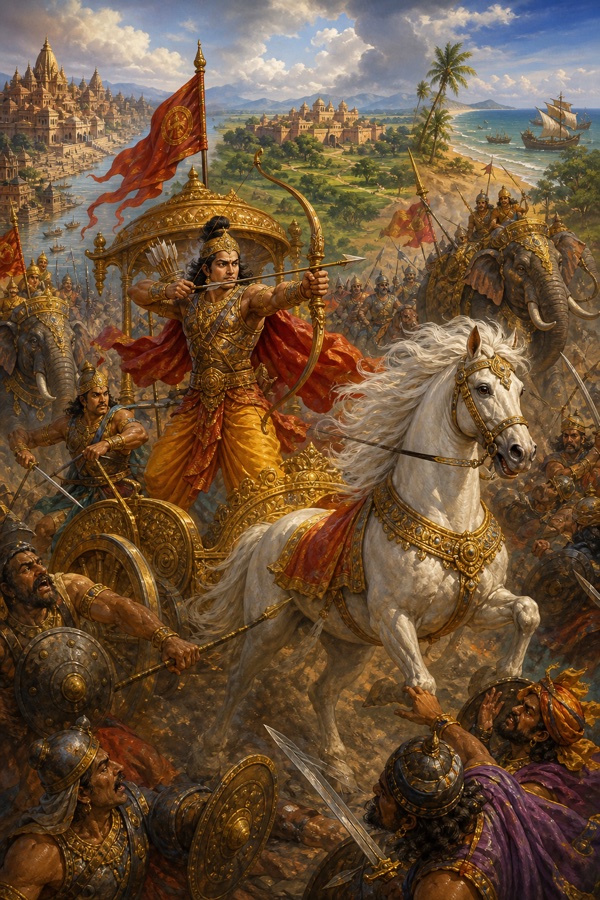
The gist: The boy king Meghasandhi of Magadha taunts Arjuna and attacks. Arjuna destroys his chariot, bow and mace around him without touching his body, and the king yields. The horse goes on along the seacoast, south through the Chedis, the Dasharnas and the Nishadas to the southern sea, then by Surashtra and Dwarka and the western coast to Gandhara.
The battle of Gandhara, and the horse’s return to Hastinapura
Shakuni’s son came against Arjuna, the Kuru hero of the curling hair, with a large force of elephants, horses and chariots, bright with flags and banners. His men could not forgive the killing of their king Shakuni, and they rushed at Arjuna together with their bows in their hands. Arjuna spoke to them peaceably and gave them Yudhishthira’s message. They would not have it, and they closed in around the sacrificial horse. That made him angry. Shooting from the Gandiva almost carelessly, arrows with heads like razors, he cut off the heads of many Gandhara warriors, and in their fear they let the horse go. Others still stood around him on every side, and he struck off the heads of many of them, calling out the name of each man before he killed him.
While the Gandhara fighters were dying all around him, Shakuni’s royal son came forward himself to stop Arjuna. He was fighting as a Kshatriya’s duty told him to, and Arjuna said to him, “Yudhishthira has commanded me, and I do not mean to kill the kings who fight with me. Stop fighting me, hero. Do not go looking for defeat.” The son of Shakuni, blinded by folly, ignored the advice and covered Arjuna with swift arrows. Then Arjuna, with a single crescent-headed shaft, cut the headgear off his enemy’s head and sent it flying a great distance, as he had once sent the head of Jayadratha. The Gandhara warriors saw it and were filled with wonder. Every one of them understood that Arjuna had chosen to spare their king.
The prince of the Gandharas ran then, and his warriors ran with him like a herd of frightened deer. Arjuna cut off the heads of many with his broad-headed arrows, and many lost an arm to those shafts and were so stupefied with terror that they did not know the arm was gone. At last the mother of the ruler of the Gandharas came out of her city in fear, with all the old ministers of state, carrying the offering of welcome for Arjuna. She forbade her brave son to fight any longer. Arjuna paid her honor and was moved to be kind to the Gandharas, and he comforted the son of Shakuni. “You did not please me when you set your heart on this hostility. You are my brother. I thought of my mother Gandhari, and I thought of Dhritarashtra, and for their sake I did not take your life. Many of your followers are dead by my hand. Do not let such a thing happen again. Let this enmity end. Come to our king’s horse sacrifice; it will be held on the day of the full moon in the month of Chaitra.”
Having said that, Arjuna set out again behind the horse, and the horse turned at last onto the road that leads to Hastinapura. Yudhishthira heard from his messengers that it had turned back, and that Arjuna was whole and well, and he was filled with joy. The twelfth day of the bright fortnight of Magha had come, under a favorable star. The king called his brothers together, Bhima and Nakula and Sahadeva, and spoke to Bhima. “Your younger brother is coming back with the horse. The time has come. The full moon of Magha is at hand, and the month is running out. Let learned Brahmins who know the Vedas look for a place where the horse sacrifice can be carried through.” Bhima went out with men who understood the laying out of sacrificial grounds and with Brahmins skilled in every rite, chose a beautiful site, and had it measured. Mansions by the hundred went up on it, and high, broad roads. The ground was leveled and set with jewels, and columns and tall, wide arches were raised, all of gold. He had quarters built for the women, for the kings expected from many countries, and for the Brahmins. Then, at the king’s command, he sent messengers to the great kings of the earth.
The gist: In Gandhara Shakuni’s son attacks to avenge his father. Arjuna shoots the headgear from his head to show that he is sparing him, and stops when the king’s mother comes out. He calls the king his brother, for Gandhari’s and Dhritarashtra’s sake. The horse turns for Hastinapura, and Bhima lays out a sacrificial ground of gold.
Arjuna’s return, and a stinging remark of Krishna’s
Krishna came too, with the Vrishnis, and Balarama at their head. Bhima received them with the deepest respect. Krishna and Yudhishthira talked, and the king asked again and again about Arjuna, who had grown thin with so much fighting. Krishna told him what he knew. A man he trusted, who lived at Dwarka, had seen Arjuna and reported that he was now very near. The same man had carried Arjuna’s words for the king. Many kings would be coming, and high honors should be paid to each of them. The king should do whatever was needed to prevent a slaughter like the one that had broken out at the giving of the arghya during the Rajasuya sacrifice. And the ruler of Manipura, his dear son Babhruvahana, would be coming, and should be honored well for his father’s sake.
Yudhishthira was pleased with what he heard. “Your words are sweet as nectar, Krishna, and they fill my heart. I have heard that the battles Arjuna has fought with the kings of the earth are past counting. Why is it that he is always kept apart from ease and comfort? When I am free of business I think of him constantly, and it hurts me. His body carries every lucky mark. What sign is there in that excellent body that condemns him to hardship always? I can see nothing in him that could be blamed for it. Explain the cause to me, if I am fit to hear it.”
Krishna thought about it for a long time before he answered. “I see nothing in that prince to find fault with, except that the cheekbones of this lion among men are a little too high. That is why he must always be on the road. I really can see nothing else that would make him so unhappy.” Yudhishthira said that it was so. Draupadi, however, gave Krishna an angry look from the side of her eye; she could not bear to hear any defect laid on Arjuna. Krishna took the look for what it was, a sign of her love for his friend, and he approved of it, for the princess of Panchala was his friend too.
A sub-tale: At Yudhishthira’s Rajasuya sacrifice the arghya, the offering of first honor, was given to Krishna. Shishupala, the ruler of Chedi, objected and insulted him before the assembled kings, and Krishna cut off his head with the discus. Arjuna’s message asks that nothing of the kind be allowed to happen at the horse sacrifice. It was Shishupala’s son Sharabha whom Arjuna had just fought, and been honored by, at the city of the Chedis.
They were still talking of Arjuna when a messenger came in from Arjuna himself and told the king that he had arrived. Tears of joy filled Yudhishthira’s eyes, and he gave the man rich gifts for such news. On the second day after that a great noise went up, and Arjuna came in. The horse walked close beside him, and the dust its hooves raised was as beautiful as the dust of Uchchaihshravas, the horse of the gods. The citizens called out to him as he came. “Thank fortune, son of Pritha, you are out of danger! Who except Arjuna could lead a horse over the whole earth, beat all its kings in battle, and come home? We never heard of such a thing being done even by Sagara and the other great kings of old.” King Yudhishthira came out to meet him with all his ministers and with Krishna, and they put Dhritarashtra at their head. Arjuna bowed at the feet of Dhritarashtra, who stood to him as a father, and then at the feet of the king. He paid his respects to Bhima and the others, and he embraced Krishna. Then he rested among them, like a shipwrecked man who has come to shore.
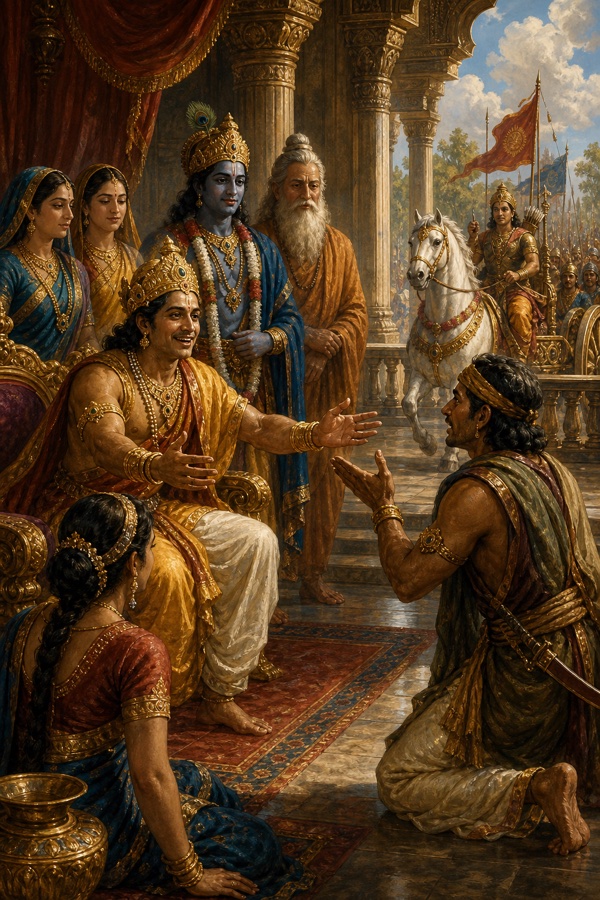
King Babhruvahana arrived about the same time with his two mothers, Chitrangada and Ulupi. He saluted all his elders of the Kuru house, and then he went into the house of his grandmother Kunti and greeted her in soft, sweet words. Chitrangada and Ulupi met Subhadra and the other women of the Kuru house with every courtesy. Kunti, Draupadi and Subhadra gave them gems and costly things, and the two of them made their home there, treated with affection by Kunti herself, who wished to please Arjuna. Babhruvahana went to pay his respects to Dhritarashtra and then to Yudhishthira and Bhima and the other Pandavas, and they embraced him and gave him large gifts of wealth. Then he went humbly to Krishna, as a second Pradyumna might go to his father, and Krishna gave him a splendid chariot, plated with gold and yoked with excellent horses.
The gist: Krishna passes on Arjuna’s messages: honor the kings, and let nothing happen like the bloodshed at the Rajasuya. Asked what mark condemns Arjuna to a life of hardship, he says the cheekbones are a little too high, and Draupadi glares at him for it. Arjuna comes home with the horse to the cheers of the city, and Babhruvahana arrives with his two mothers.
The Ashvamedha: the rite, the sacrifice, and the gift of the Earth
On the third day Vyasa came to Yudhishthira. “Begin your sacrifice from today, son of Kunti. The moment for it is at hand, and the priests are urging you on. See that it is performed so that no limb of it is wanting. So much gold goes into this rite that it has come to be called the sacrifice of profuse gold. Make the fee to the priests three times what is laid down, and let the merit of it be threefold. You will have the merit of three horse sacrifices, and it will free you from the sin of having killed your kinsmen. The bath a man takes when the horse sacrifice is complete cleanses him as nothing else does, and that merit will be yours.” Yudhishthira did as he was told and underwent the initiation, and the great sacrifice began.
The priests knew the Vedas, and they did each rite as it should be done; nothing departed from the ordinances. They performed the rite called Pravargya first, and then the pressing, the Abhishava; they drew the juice of the Soma and went through the Savana rite as the texts direct. Among all who came to that sacrifice there was no one downcast, no one poor, no one hungry and no one in grief, for Bhima at the king’s command had food served without a pause to anyone who wanted it. When the time came to raise the sacrificial stakes, six were set up of bilva wood, six of khadira and six of saravarnin, two of devadaru, and one of shleshmataka. Bhima had other stakes set up as well, made of gold and meant only for beauty. A fire altar was built of golden bricks, measuring eighteen cubits and rising in four tiers, and a golden bird was made in the shape of Garuda, with three angles. Then the priests tied the animals and birds to the stakes, each one assigned to its own god. Three hundred animals in all were bound there, and the horse was one of them. Narada was at that sacrifice, and Tumburu, and Vishvavasu and Chitrasena and others skilled in music, and in the pauses between one rite and the next those Gandharvas delighted the Brahmins with song and dance.
The other animals were cooked first, as the rite lays down, and then the priests sacrificed the horse that had wandered over the whole world. They cut it into pieces as the scriptures direct, and they had Draupadi sit down beside the divided animal, for she had the three things the rite requires, the mantras, the materials and the devotion. With calm minds the Brahmins took up the marrow of the horse and cooked it. King Yudhishthira and all his younger brothers smelled the smoke of that marrow, which can cleanse a man of every sin. The remaining limbs of the horse were offered into the fire by the sixteen priests of the sacrifice. So the rite was completed, and Vyasa and his disciples praised the king highly.
Then Yudhishthira gave away to the Brahmins a thousand crores of golden nishkas. To Vyasa he gave the whole earth. Vyasa accepted it and spoke to him. “I give you back the earth you have given me. Give me its price. Brahmins want wealth; they have no use for the earth.” Yudhishthira stood with his brothers among all the kings he had invited, and he answered the Brahmins. “The fee laid down in the scriptures for the great horse sacrifice is the earth. So I have given the earth that Arjuna conquered to the priests of the sacrifice. I will go into the forest. Divide the earth among you into four parts, as is done in the Chaturhotra sacrifice. I do not wish to take for myself what now belongs to the Brahmins. That has always been my intention, and my brothers’ too.” His brothers said it was so, and Draupadi said it with them. The announcement caused a great stir, and a voice no one could see spoke in the sky: “Excellent, excellent!”
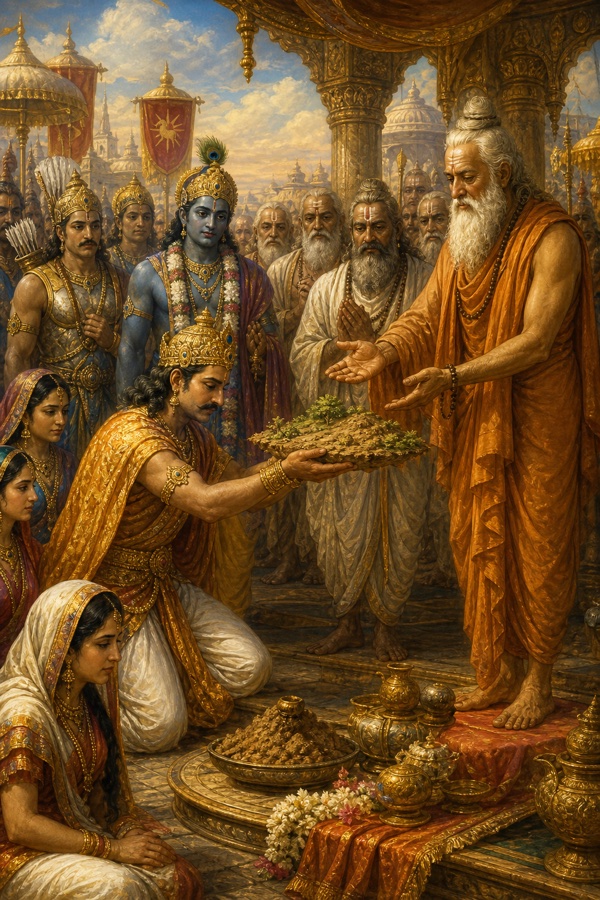
Vyasa praised him, and spoke again in front of the Brahmins. “You have given me the earth, and I give her back to you. Give these Brahmins gold, and let the earth be yours.” Krishna added his word: “Do as the holy Vyasa tells you.” Yudhishthira was glad at heart, and his brothers with him, and he gave away millions of gold coins, three times the fee laid down for the horse sacrifice. No king after him will be able to do what the Kuru king did that day, after the manner of Marutta. Vyasa divided the wealth into four shares and gave it to the sacrificial priests. With that wealth paid as the price of the earth, Yudhishthira was cleansed of his sins and rejoiced with his brothers. With his leave the Brahmins also divided among themselves the golden ornaments of the sacrificial ground, the arches, the stakes, the jars and the vessels, and what remained was carried off by Kshatriyas and Vaishyas and Shudras and by Mleccha tribes. Vyasa’s own share of the gold was very large, and he presented it to Kunti, who spent it on works of merit. To the assembled kings Yudhishthira gave jewels, elephants and horses, serving women and gold, and shone as he gave like Kubera, the lord of treasures. He sent King Babhruvahana home with wealth of many kinds. To please his sister Duhshala he set her infant grandson on the throne of his fathers. Last he paid worship to Krishna and to Balarama and to the other Vrishni heroes, and let them go home to Dwarka.
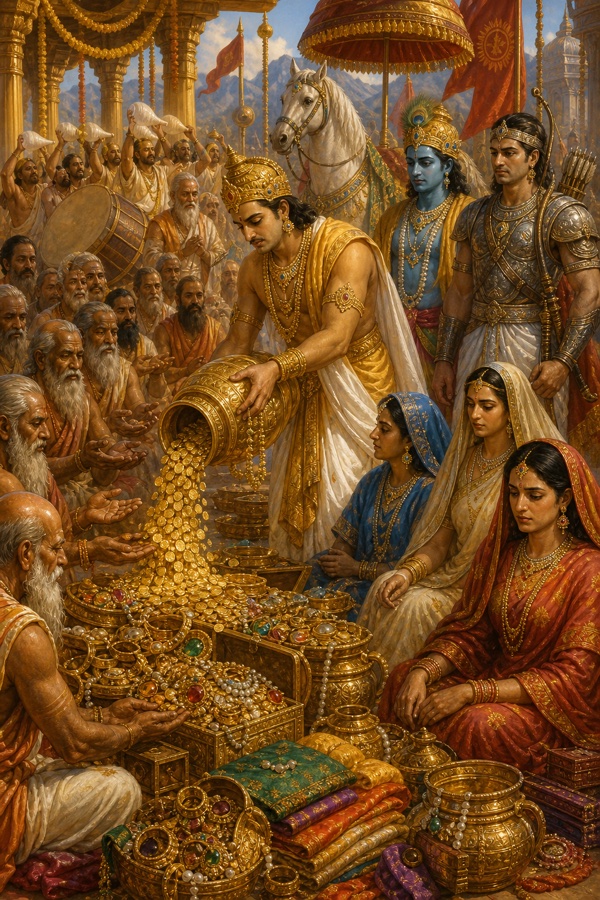
The gist: The fee is made threefold, for the merit of three horse sacrifices. The priests raise the stakes, build a fire altar of golden bricks, and bind three hundred animals. The horse is sacrificed, Draupadi sits beside it, and the king and his brothers smell the smoke that cleanses sin. Yudhishthira gives the earth to Vyasa, who returns it and takes gold as its price.
The half-golden mongoose, and one prastha of barley meal
Janamejaya had a question. “Tell me of any wonderful thing that happened at the sacrifice of my grandsires.” Vaishampayana had one to tell, and it happened at the very end of that great horse sacrifice. The Brahmins had all been satisfied by then, and the kinsmen and friends, and the poor and the blind and the helpless. The gifts that had been given in such abundance were being talked of on every side, and flowers were raining on the head of King Yudhishthira, when a mongoose came into the place. Its eyes were blue, and one side of its body had been changed into gold. It was a large creature, proud, a dweller in a hole, and it gave a cry as loud and deep as thunder that frightened every animal and bird. Then it spoke in a human voice.
“Kings, this great sacrifice is not equal to a prastha of powdered barley given away by a generous Brahmin of Kurukshetra who lived by the unchha vow.” The Brahmins who heard it were astonished. They came up to the mongoose and questioned it. “Where have you come from, to this sacrifice where the good and the pious gather? What is your strength, and what have you learned, and on what do you rely? How can you find fault with our sacrifice like this? No part of the scriptures has been neglected here. Those who deserve worship have been worshiped. The offerings have gone into the sacred fire with the proper mantras, and what ought to be given has been given without pride. You have come among learned men. Tell us truly what is true.”
The mongoose smiled. “What I said was not false, Brahmins, and I did not say it out of pride. You all heard me: this sacrifice is not equal in merit to the gift of a prastha of powdered barley. Give me your whole attention and I will tell you what happened, exactly as it happened. I saw it with my own eyes and I felt what came of it in my own body. A generous Brahmin of Kurukshetra who kept the unchha vow went to heaven because of it, with his wife and his son and his son’s wife, and because of it half my body was turned to gold.
“On the holy ground called Kurukshetra, where many good men live, there was a Brahmin who kept the vow called unchha, which is the pigeon’s way of living. He lived there with his wife and his son and his daughter-in-law, and all of them practiced austerities. He was a just man with his senses under command. Every day he ate at the sixth division of the day and at no other time. If there was nothing to eat when the sixth division came, he fasted, and ate at the sixth division of the next day.
A key to reading this (the unchha vow): A man keeping the unchha vow lives on grain picked up from the fields after the harvest, when the owners have cut the crop and carried it away. He gleans what is left on the ground, as a pigeon does. The guest in the story will say that this gleaner’s gift bore more fruit than many Rajasuya sacrifices or many horse sacrifices with all their gifts.
“Then a dreadful famine came on the country. That Brahmin had nothing stored in his house. The herbs and plants dried up and the whole kingdom was emptied of food. The hour for eating came around each day and he had nothing to eat, and it went on like that day after day. Everyone in his family was hungry, and they got through the days as best they could. In the month of Jyeshtha, with the sun at its height, he would be out picking up grain, in the heat, with hunger on him, and when he could find none he was soon worn out with hunger and toil. Then one day, after the sixth division had come, he managed to get a prastha of barley. Those ascetics ground the barley to make the meal called saktu. They finished their silent recitations and their daily rites and poured the offerings on the sacred fire, and then they divided that small measure among themselves, so that each one’s share came to a kudava.
A key to reading this (the measures): A prastha is four kudavas. The whole of what the family had was one prastha of barley, ground, and when it was divided among father, mother, son and daughter-in-law each of the four had exactly one kudava. Every time the guest is fed in what follows, one of those four shares is gone.
“They were just sitting down to eat when a guest came to their house. They were overjoyed to see him. They greeted him and asked after his welfare in the usual way. They were people of pure mind, self-controlled and full of faith, who bore no malice, had conquered anger, and were never pained to see another person happy. They told the guest what austerities they kept and what family they came of, and learned the same from him, and they brought that hungry man into their hut. ‘Here is the arghya for you,’ they said. ‘Here is water to wash your feet. Here is kusha grass spread for your seat. And here is clean saktu, honestly earned. We give it to you. Accept it.’ The Brahmin took the kudava of barley meal they offered him and ate all of it. It did not satisfy his hunger.
“The Brahmin of the unchha vow saw that his guest was still hungry, and he began to think what else he could set before him. His wife spoke. ‘Give him my share. Let him be satisfied, and then let him go wherever he likes.’ He could not agree to it. She was old and worn with toil, wasted to skin and bone, and shaking with weakness. ‘Even among the animals,’ he said to her, ‘even among worms and insects, the wife is fed and protected. You must not say this. A man who fails to protect his wife earns great disgrace here and goes to hell afterward.’ She answered him. ‘Our religious acts and our wealth are held in common. You are old, weak with hunger and thin with fasting. If you can give up your share, why should I not give up mine?’ So he took her share and gave it to his guest, and the guest ate it at once and was still hungry. Then the son spoke. ‘Take my share of the barley and give it to the guest. To maintain a father in his old age is the duty laid on the son.’ The father said, ‘If you lived to be a thousand years old you would still look like a little child to me. I know how fierce a child’s hunger is. I am old, and hunger hardly troubles me.’ The son said, ‘A son is called putra because he rescues his father. A man is born again as his own son. Rescue yourself, then, by means of yourself.’ The father took the son’s share and gave it to the guest with a smile, and the guest ate it, and his hunger was not satisfied.
A sub-tale: The story turns on four equal shares and a guest who eats each one. The father gives his own kudava of barley meal, then his wife’s, then his son’s, then his daughter-in-law’s, and each of the three has to argue him into taking it. When the last share is gone the guest names himself as Dharma, the god of righteousness, in human form, and sends all four to heaven in a heavenly chariot. The mongoose came out of its hole afterward, and the smell of that barley, the wet ground where the guest’s water had been poured, the flowers that had fallen from heaven and the grains the Brahmin had given away turned its head and half its body to gold.
“The old man was ashamed then, because he had nothing more to give. His daughter-in-law came to him carrying her share. ‘Through your son I will have a son. Take my barley and give it to this guest.’ He looked at her, a girl wasted by wind and sun, so faint with hunger that she was hardly conscious. ‘How could I break the law of righteousness so far as to take your share? You are a child, and you are hungry; it is for me to protect you.’ She said, ‘You are the elder of my elder and the god of my god. My body, my breath and my religious rites have one purpose, which is to serve my elder. Take my share.’ And he took it, and gave it to the guest, and at last the guest was satisfied. He was the god of Righteousness himself in a human body, and he spoke. ‘I am well pleased with this pure gift of yours, honestly earned and freely given. They are talking of it in heaven, and flowers have rained down from the sky. Hunger destroys a man’s wisdom; whoever conquers hunger conquers heaven. The man who has a thousand and gives a hundred, the man who has a hundred and gives ten, and the man who has nothing and gives a handful of water all earn the same merit. What you gave today bears more fruit than many Rajasuya sacrifices with their abundant gifts, or many horse sacrifices. A heavenly chariot is here for all of you. I am Dharma; look at me. Go now to heaven with your wife, your son and your daughter-in-law.’ And that Brahmin went to heaven with the three of them. When they had gone I came out of my hole. The scent of that barley meal was there, and the mud made by the water he had given his guest, and the flowers that had fallen from heaven, and the grains of the meal that good man had given away, and by those things and by his austerities my head became gold. Look at me: half of this large body of mine is golden. To have the rest of it turned to gold I go again and again, hopeful, to the retreats of ascetics and the sacrifices of kings. I heard of this sacrifice of the wise Kuru king and came here with high hopes, and I have not been made gold. That is why I said what I said. The grains of that prastha of barley turned me to gold, and this great sacrifice is not the equal of those grains.” The mongoose said this to the Brahmins and vanished from their sight. Vaishampayana had told the king the whole of that wonder, and he added a warning to it. Janamejaya was not to think too highly of sacrifice. Millions of seers have gone to heaven by their austerities alone, and harmlessness toward every creature, contentment, right conduct, sincerity, austerity, self-restraint, truthfulness and giving are each of them the equal of sacrifice in merit.
The gist: When the sacrifice is over, a mongoose with a golden head and half a golden body tells the Brahmins that all of it does not equal one prastha of barley meal. In a famine at Kurukshetra a gleaner, his wife, his son and his son’s wife each gave up a quarter share of their only food to a hungry guest, who was Dharma in human form. The mongoose was turned half to gold on the ground where that gift was made and has found no sacrifice since that could finish the work.
Source: the Mahabharata of Krishna-Dwaipayana Vyasa, Ashvamedhika Parva, Sections 1 to 96; this part draws on Sections 59 to 90. The Gita Press Hindi edition is the controlling witness. The Sanskrit e-text and an independent complete translation were used to verify names, sequence, and principal events. Where recensions differ, this retelling follows Gita Press.
Source: the Mahabharata of Vyasa (Gita Press, Gorakhpur)