On this page
A disciple with twelve questions, a tree whose seed is Brahman, and eight sages who walked every road, wore themselves out, and went to ask the Grandsire
Arjuna had just been told who the Brahmin and his wife of the old story really were, and in the assembly hall at Indraprastha he did not let the silence settle. Krishna had already said that he meant to go home to Dwarka, and Arjuna, who had begged to hear the lost truths again before his friend left, was not done asking. “Then teach me Brahman itself, Krishna, the highest thing a mind can come to know. By your kindness mine has begun to take delight in these fine-drawn matters.” Krishna gave him no doctrine of his own in answer. He reached for something older, as he had been doing ever since Arjuna confessed that the teaching of the battlefield had gone from him. “There is an old history told on this very subject,” he said, “of what passed between a preceptor and his disciple when the talk turned to Brahman. The preceptor was a Brahmin who kept hard vows, and he was sitting at his ease when the disciple, a young man with a good mind, came to him with a question. ‘What is the highest good? That is the thing I want to reach, holy one, and so I throw myself at your feet. With my head bowed I beg you, learned Brahmin, to explain to me what I ask.’ And the preceptor said to him, ‘I will explain to you everything you are in doubt about.’ The disciple was devoted to his teacher past all measure, and when he had been given that leave he joined his hands and spoke. You have the mind for this, Arjuna. Listen to what he said.”
“‘Where am I? Where do you come from? Explain to me what the highest truth is. From what source have all creatures sprung, those that move and those that stand still? By what do creatures live? What is the limit of their life? What is truth? What is austerity, learned Brahmin? What do the good call the attributes? Which paths deserve to be called auspicious? What is happiness? What is sin? You have kept excellent vows, holy one, and I ask you to answer these questions of mine correctly, truly and exactly. Who is there in this world besides you who could answer them? Answer them, you who know the duties better than any man living, for my curiosity is great. In all the worlds you are spoken of as the one most skilled in the duties that lead to release, and nobody else is able to clear away doubts of every kind. We have grown afraid of this worldly life, and we have come to want release.’ He had asked for instruction humbly, that disciple, and he had put his questions in the proper order. He was devoted to his preceptor, and he had tranquility in him. He behaved always in the way his teacher found agreeable, and he lived so constantly at the old man’s side that he had almost become his shadow. He had his senses in hand, and he led the life of a Yati and a brahmacharin, an ascetic’s life and a celibate student’s together. To such a disciple the preceptor, a man of intelligence who kept his own vows, explained every one of those questions in its turn.”
“All of this,” the preceptor said, “was declared in the old days by Brahma himself, the Grandsire of all the worlds. The greatest of the Rishis praised it and lived by it, it rests on a knowledge of the Vedas, and it asks one thing throughout: what the real entity is. We hold knowledge to be the highest object, and renunciation to be the best austerity. There is a true object of knowledge that no circumstance can alter, the soul that dwells in all creatures, and the man who knows it with certainty goes wherever he wishes and comes to be counted the highest. The learned man who sees all things lodged in one place, and sees them parted as well, and sees the unity inside the diversity, gets himself free of misery. The man who covets nothing, and who says of nothing that it is his, is counted one with Brahman while he is still living in this world. The man who knows the truth about the qualities of Pradhana, which is Nature, who is acquainted with the creation of everything that exists, and who has neither mineness nor pride in him, wins his release beyond any doubt. There is a great tree to be understood properly. The unmanifest is its seed sprout. The understanding is its trunk. The high consciousness of self makes its branches, and the senses are the cells its twigs come out of. The five great elements are its flower buds and the gross elements its smaller boughs. It is always in leaf and always putting out flowers, everything that exists depends on it, its seed is Brahman, and it is eternal. The man who understands that tree, and who cuts through every topic with the sharp sword of knowledge, reaches immortality and throws off birth and death. There are conclusions about the past and the present and the future, and about duty and pleasure and wealth, that the assemblies of the Siddhas know well. They belong to remote cycles of time and they are eternal, and I am going to declare them to you now, for you have the wisdom to receive them. They make up what is called the Good, and men of wisdom who understand them in this world arrive at success.”
Then the preceptor told his disciple where those conclusions had first been asked for. “Long ago the Rishis Brihaspati and Bharadvaja, Gautama and Bhargava, Vasishtha and Kashyapa, Vishvamitra and Atri came together to question one another. They met after they had traveled every path there is, and each of them was tired out with the acts he had performed. Those twice-born men set the sage son of Angiras at their head and went up to the region of the Grandsire, and there they saw Brahma, washed perfectly clean of all sin and seated at his ease. The great Rishis bowed their heads to him, and in all humility they put to him their grave question about the highest good. ‘How should a good man act? How is a man to be released from sin? Which paths are auspicious for us? What is truth, and what is sin? By what action are the two paths gained, the northern and the southern? What is destruction? What is release? What is the birth of all that exists, and what is its death?’ What the Grandsire said to them when they had asked, I will tell you now, my disciple, as the scriptures have it. Listen.”
The disciple had asked his preceptor what truth is, from what source all creatures have sprung, and by what they live. The eight sages had asked the Grandsire about truth as well, and it was with that word that he began; before he had spoken three sentences, the source of creatures and the thing they live by had been named too. “It is from Truth,” Brahma said to them, “that all creatures have been born, the moving and the unmoving. They live by austerity. Understand this, you who keep excellent vows: it is in consequence of their own actions that they live, having passed beyond their own origin. For Truth, when it is joined to the qualities, always comes to bear five marks. Brahman is Truth. Austerity is truth. Prajapati is truth. From Truth all creatures have sprung, and Truth is the whole universe of being. That is why Brahmins who are always given to yoga, who have left anger and sorrow behind them, and who look on duty as the causeway every creature must cross by if it is to stay out of the swamp below, take refuge in Truth. I will speak now of those Brahmins who hold one another in check and possess knowledge, and of the orders, and of those who belong to the four modes of life. The wise say that duty is one, though it stands on four quarters. I will speak to you, twice-born ones, of the path that is auspicious and brings good, the path men of wisdom have always walked in order to become one with Brahman. It is the highest path and it is exceedingly hard to understand, so follow me through every detail of what the highest seat is. The first step is the mode of life that belongs to brahmacharins, the celibate students. The second step is the life of the household. After that comes residence in the woods. After that, know, comes the highest step, the one that belongs to Adhyatma, the knowledge of the soul. Light, ether, the sun, the wind, Indra and Prajapati: a man goes on seeing these for exactly as long as he has not reached Adhyatma. I will declare the means of reaching it, and you must first understand them. The forest life, as ascetics follow it who live in the woods on fruits and roots and air, is laid down for the three twice-born classes. The life of the household is ordained for all the orders. Men of wisdom say that the chief mark of duty is faith. So I have declared to you the paths that lead to the gods. The good take them, and those whose acts have made them wise, and they are the causeways of piety. A man firm in his vows who takes up any one of these modes by itself always comes in time to understand how all creatures are produced and how they are destroyed. Now I will declare, accurately and with the reasons, the elements that reside in parts in every object. The great soul, the unmanifest, Egoism, the ten organs and the one, the five great elements, and the specific characteristics of those five elements: these make up the eternal creation. The number of the elements has been given as twenty-four, and one more. The man of wisdom who understands how all these elements are produced and how they are destroyed never meets with delusion, alone among all creatures. The man who understands the elements accurately, and all the qualities, and all the gods, washes himself clean of every sin, and with all his bonds off him he comes to enjoy every region of spotless purity.”
A key to reading this (the frame and the count): Krishna begins a fresh story here. The Brahmin and his wife are left behind, a preceptor and his disciple take their place, and inside their conversation eight sages put their questions to Brahma, so that from this point three voices are stacked: Krishna speaking to Arjuna, the preceptor speaking to his disciple, and Brahma speaking to the Rishis. Pradhana is another name for Nature, and mineness is the feeling that calls a thing one’s own. The son of Angiras whom the sages set at their head is Brihaspati, who also stands first in the list of the eight. Creatures are said to live beyond their origin because their origin is Truth, which is Brahman, and their own acts keep them apart from it. Adhyatma, the fourth and highest step, is the course of life whose whole object is knowledge of the soul. The count of the elements closes in this way: the great soul, the unmanifest and Egoism make three; the ten organs and the one, which are the organs of knowledge and of action with the mind, make eleven; the five great elements make five; and the specific characteristics of those five, smell in earth, taste in water, sound in ether and the rest, make five more. That comes to twenty-four. Brahma then says, and one more, and leaves the twenty-fifth unnamed.
The gist: Arjuna asks for Brahman itself, and Krishna answers with an old conversation. A disciple lays twelve questions before his teacher, from where am I to what is sin, and the teacher answers by setting knowledge highest and renunciation first among austerities, and by describing a tree whose sprout is the unmanifest, whose trunk is the understanding and whose seed is Brahman, with the sword of knowledge beside it to cut through every topic. Then he says where the answers came from: eight sages who had walked every path and worn themselves out with their own acts went up to Brahma and asked him. Brahma begins at Truth, climbs by the four steps of the four modes of life to Adhyatma, and closes on the count of the elements, which is twenty-four, and one more.
A city with nine gates and three channels running through it: Brahma sets out darkness, passion and goodness one quality at a time
The preceptor did not leave his disciple to rest on the count of twenty-four. He went straight on with what the Grandsire had told the eight Rishis next, and what came next was a map of the thing every one of them was sitting in. “That which is unmanifest,” Brahma said, “indistinct, all-pervading, everlasting and unchanging, becomes a city of nine gates, holding three qualities and built of five ingredients. Eleven surround it, and the mind, which tells one object from another, is counted among them; the understanding is its ruler, and this is the aggregate of eleven. Three ducts run through that city and hold it up without a pause. They are the three Nadis. They never stop flowing, and the three qualities are their essence: Darkness, Passion and Goodness. These are what is meant by the qualities. They are coupled with one another. They exist by depending on one another, they take refuge in one another, they follow one another, and they are joined to one another. The five elements themselves carry the mark of these three. Goodness is the match of Darkness, and Passion is the match of Goodness. Goodness is the match of Passion as well, and Darkness is the match of Goodness. Where Darkness is held down, Passion is seen to flow, and where Passion is held down, Goodness.
“Darkness has night for its essence, which is to say obscurity. It has three characteristics and it goes by a second name, Delusion. Unrighteousness is its sign, and it is present in every sinful act that is ever done. That is the nature of Darkness, and it also shows itself bound up with the other two. Passion has activity for its essence. It is the cause that makes one act follow another, and wherever it prevails among living beings its sign is production. Splendor, lightness and faith: these are the form of Goodness in all creatures, the form that is light, as every good man holds. I am going to tell you the true nature of their characteristics now, with the reasons, taking them together and taking them apart, and you must follow me. Complete delusion, ignorance, meanness with what one has, indecision when there is something to be done, sleep, haughtiness, fear, greed, grief, running down good acts, loss of memory, a judgment that never ripens, want of faith, the breaking of every rule of conduct, the inability to tell one thing from another, blindness, vile behavior, loud claims to have done what was never done, the presumption of knowledge in the midst of ignorance, unfriendliness, an evil disposition, want of faith again, stupid reasoning, crookedness, the incapacity to keep company with anyone, sinful action, senselessness, stolidity, lassitude, want of self-control, and degradation: all of these are known to belong to Darkness. Whatever other states of mind exist in the world that are tied to delusion belong to Darkness too. Speaking ill of other people again and again, abusing the gods and the Brahmins, tightfistedness, vanity, delusion, anger, an unforgiving temper, and hostility toward every creature are counted as its marks. So are undertakings that earn no merit because they are vain, gifts that earn none because the receiver is unworthy or the hour is wrong or the object improper, and eating that serves no purpose. Calumny, an unforgiving temper, animosity, vanity and want of faith are named among its marks once more. Whatever men there are in this world who carry these faults and others like them, and who break through the restraints the scriptures set, are all held to belong to the quality of Darkness.”
The Rishis had asked the Grandsire what sin is, and he had shown it to them as the sign of Darkness. Now he told them where it leads. “I will name the wombs in which these doers of sinful deeds have to take birth. They are ordained for hell, and they sink in the order of being. They sink into the hell that is birth among the brutes. They become things that cannot move, or animals, or beasts of burden, or eaters of flesh, or snakes, or worms and insects and birds, or creatures born from eggs, or four-footed things of every kind. They become madmen, or human beings who cannot hear or cannot speak, or men stricken with dreadful diseases whom others hold unclean. Showing always the marks of what they have done, these men of evil conduct sink in Darkness. Their course runs always downward. Belonging to Darkness, they sink in Darkness. Now I will tell you the means by which they mend and climb, and come at last to the regions that exist for the doers of good. Those who are born in orders other than the human grow up within sight of the religious ceremonies of Brahmins who keep the duties of their own order and wish well to every creature, and by the help of those purifying rites they ascend. Struggling upward, they reach at last the very regions those pious Brahmins reach. They go to heaven, and this is what the Veda is heard to say. Born outside humankind and growing old in the acts that belong to such births, they become human beings in this way, and human beings are ordained to return. Coming into sinful births, becoming Chandalas, or men who are deaf, or men whose lisping speech no one can make out, they rise from caste to higher caste in proper turn, and pass beyond the order of the Shudra and beyond the other qualities that belong to Darkness and abide in it through the wanderings of this world. Attachment to the objects of desire is held to be the great delusion, and in it Rishis and Munis and the gods themselves are deluded, wanting pleasure. Darkness, delusion, the great delusion, the great obscurity called anger, and death, the obscurity that blinds: these are the five. As for anger, that is the great obscurity. Learned Brahmins, I have now declared to you, accurately and in due order, everything about Darkness: its color, its characteristics and its source. Who is there that truly understands it? Who is there that truly sees it? For this is the very characteristic of Darkness, that a man looks at what is unreal and sees reality there. Its qualities have been set out for you in many ways, and Darkness has been described in its higher forms and its lower. The man who keeps these qualities always in mind will surely get free of every mark that belongs to it.”
Passion came next, and its roll is the longest in the whole discourse, since Passion is the quality that acts. “You who are first among beings and richly blessed, I will tell you accurately now what Passion is, and you must learn which qualities belong to it. Injuring others, beauty, toil, pleasure and pain, cold and heat, lordship, war, peace, arguments, dissatisfaction, endurance, might, valor, pride, anger, exertion, quarrel, jealousy, desire, malice, battle, the sense of mine, the protection of others, slaughter, bonds, affliction, buying and selling, lopping off, cutting, piercing, and cutting away the coat of mail another man has put on. Fierceness, cruelty, vilifying, pointing out the faults of others, thoughts given wholly to worldly affairs, anxiety, animosity, reviling, false speech, gifts that are false or empty, hesitancy and doubt, boastful talk, dispraise and praise, laudation, prowess, defiance, attendance on the sick and the weak, obedience to the commands of preceptors and parents, service, the harboring of thirst, dexterity of conduct, policy, heedlessness, contumely, possessions, and all the decorations that are found in this world on men and women, on animals, on lifeless things and on houses. Grief, incredulity, vows and regulations, acts done in expectation of a good result, public charities of every kind, the rites of Svaha with their salutations, the rites of Svadha and Vashat, officiating at other men’s sacrifices, giving instruction, performing sacrifices, study, the making of gifts, the acceptance of gifts, rites of expiation, auspicious acts, the wish to have this thing and that, the affection that is roused by the merits of whatever is loved, treachery, deception, disrespect and respect, theft, killing, the wish to conceal, vexation, wakefulness, ostentation, haughtiness, attachment, devotion, contentment, exultation, gambling, the relish of scandal, every relation that arises out of women, and a fondness for dancing, for instrumental music and for song. All of these, learned Brahmins, belong to Passion. The men on Earth who brood on the past, the present and the future, who are devoted to the three aims together, duty and wealth and pleasure, who act at the push of desire and exult when every desire of theirs is richly met, are wrapped in Passion. Their courses run downward. Born again and again into this world, they give themselves up to pleasure. They covet what belongs to this world and every fruit that belongs to the world hereafter. They make gifts and accept gifts, they offer oblations to the Pitris, and they pour libations on the sacrificial fire. So the qualities of Passion have been declared to you in all their variety, and the course of conduct it leads to has been properly described. The man who understands these qualities at all times frees himself, at all times, from every one of them.”
“After Passion I will speak to you of that excellent quality which stands third in our count,” the Grandsire went on. “It does good to every creature in the world, no blame attaches to it, and it is the conduct of those who are good. Joy, satisfaction, nobility, enlightenment and happiness, an open hand, fearlessness, contentment, a disposition toward faith, forgiveness, courage, abstaining from injury to any creature, equability, truth, straightforwardness, freedom from anger, freedom from malice, purity, cleverness, and prowess: these belong to Goodness. The man who is devoted to the duty of yoga, and who holds knowledge to be vain, conduct to be vain, service to be vain and the modes of life to be vain, reaches what is highest in the world hereafter. Freedom from the sense of mine, freedom from Egoism, freedom from expectation, an eye that rests equally on all, and freedom from desire: these make up the eternal duty of the good. Confidence, modesty, forgiveness, renunciation, purity, freedom from laziness, freedom from cruelty, freedom from delusion, compassion toward every creature, no inclination to slander, exultation, satisfaction, rapture, humility, good behavior, purity in every act that aims at tranquility, a righteous understanding, release from attachments, indifference, brahmacharya, complete renunciation, freedom from the sense of mine, freedom from expectation, the unbroken observance of righteousness, and the belief that gifts are vain, sacrifices vain, study vain, vows vain, the acceptance of gifts vain, the observance of duties vain and austerities vain. The Brahmins in this world whose conduct bears these marks, who hold to righteousness and abide in the Vedas, are the wise, and they see correctly. Casting off every sin, free of grief, those men of wisdom reach heaven and make many bodies for themselves. They attain the power of governing everything, and self-restraint, and minuteness, and by the working of their own minds they create as the gods create who dwell in heaven. Such men are said to have their courses turned upward. They are gods in truth, able to change all things. Having reached heaven they change all things by their very nature, and whatever objects they desire they get and enjoy. So I have described to you, first among the twice-born, the conduct that belongs to Goodness, and the man who understands it properly gains whatever he desires. The qualities of Goodness have been declared one by one, and the conduct they make up has been properly set out. The man who always understands these qualities enjoys the qualities and is never fastened to them.”
A key to reading this (who is speaking, and the three qualities): Three voices are stacked here. Krishna is speaking to Arjuna; what Krishna repeats is an old exchange between a preceptor and his disciple; and what the preceptor repeats is what Brahma said to the eight Rishis who came to him with the son of Angiras at their head, which is why every address is in the plural. Darkness, Passion and Goodness are the three qualities that the epic elsewhere calls tamas, rajas and sattva, and Brahma opens them out here as obscurity, activity and light. The eleven that surround the city of nine gates are counted by the commentator as the three qualities, the five elements, the group of organs and senses taken as one, Egoism, and the understanding. The animals that climb by the rites of Brahmins are read as the victims of the sacrifice, which regain their place by being offered. The five great afflictions are darkness, delusion, the great delusion, the great obscurity, and death, which is the obscurity that blinds; Brahma stops to say that the great obscurity is anger, where other reckonings of the five put aversion or hatred. Mineness, or the sense of mine, is the feeling that calls a thing one’s own.
The gist: Brahma describes the unmanifest as a city of nine gates with three channels running through it and the understanding for its ruler, and then takes the three qualities one at a time. Darkness has obscurity for its essence; its catalogue runs from delusion and sleep to abuse of the gods and the Brahmins, and its road goes down into birth as an animal, an insect, a man stricken with disease, with a way back up through the rites of the pious. Passion has activity for its essence, and its catalogue is so long that war and peace, theft and sacrifice, obedience to parents and gambling all stand in it together. Goodness has light for its form, its conduct is compassion and an equal eye, and its road goes up.
The three travel together: a sunrise that shows all of them at once, twenty names for the unmanifest, and the first two creations
Brahma had counted the three qualities one after another, and now he told the Rishis that they cannot be spoken of as wholly separate at all. “Passion and Goodness and Darkness are seen existing in a state of union. They are attached to one another. They depend on one another. They have one another for their refuge, and they follow one another. As long as Goodness exists, so long does Passion exist; there is no doubt of this. As long as Darkness and Goodness exist, so long does Passion exist. They make their journey together, in union, moving as one company, and it is in the body that they move, whether they act with a cause or without one. They act on one another however far they differ in their growth, and I will tell you how their increase and their decrease run. Where Darkness is present in a large measure, as it is in the lower creatures, Passion is present in a smaller measure and Goodness in a measure smaller still. Where Passion is present in a copious measure, as it is in creatures of the middle course, Darkness is present in a smaller measure and Goodness in a measure smaller still. Where Goodness is present in a copious measure, as it is in creatures whose course runs upward, Darkness is present in a small measure and Passion in a measure smaller still. Goodness is the spring from which the modifications of the senses arise. It is the great enlightener, and no duty has been laid down that is higher than Goodness. Those who abide in Goodness go upward. Those who abide in Passion stay in the middle. Those who abide in Darkness, marked as they are by qualities that are low, sink downward. Darkness is found in the Shudra, Passion in the Kshatriya, and Goodness, which is the highest, in the Brahmin, and in this way the three qualities exist in the three orders.
“Even from a distance, at the first glance, Darkness and Goodness and Passion are seen to exist in union and to move as one company, and they are never seen apart. Men of evil deeds see the sun come up and are filled with fear. Travelers on the road are scorched by its heat and suffer. The sun is Goodness in its full growth, the men of evil deeds stand for Darkness, and the heat the travelers feel is a quality of Passion. The sun as light is Goodness, the heat is the quality of Passion, and the shadow that eclipses the sun on the Parvana days stands for Darkness. In just this way the three qualities exist in every luminous body, and they act by turns, in different places and in different ways. Among things that cannot move, Darkness is present in a very large measure; those properties of theirs that are forever changing belong to Passion; and their oily properties belong to Goodness. The day should be understood as threefold, and the night has been ordained threefold, and so have the fortnight, the months, the years, the seasons, and the joinings where one season passes into the next. The gifts that are spread wide are threefold. The sacrifice that flows is threefold. Threefold are the worlds, threefold the gods, threefold is knowledge, and threefold the path or the end. The past, the present and the future; duty, wealth and pleasure; Prana, Apana and Udana: these too are charged with the three qualities. Whatever object exists in this world, everything in it is charged with the three. They act by turns in all things and in all circumstances, and they act always in a form that is unmanifest. The creation of these three, Goodness and Passion and Darkness, is eternal.”
The unmanifest itself, which is made of those three qualities, has many names, and the Grandsire gave the Rishis twenty of them. “It is called darkness, the unperceived, the holy, the constant, the unborn, the womb, the eternal, Nature, change, destruction, Pradhana, production, absorption, the undeveloped, that which is not small and is therefore vast, the unshaking, the immovable, the fixed, the existent, and the non-existent. Those who meditate on matters that concern the soul should know every one of these names. The man who knows accurately every name of the unmanifest, and the qualities, and the pure operations of the qualities, is well versed in the truth about all distinctions, and when he is freed from the body he is set free of all the qualities and enjoys happiness without limit.”
From that unmanifest, the Grandsire went on, the order of things begins. “First of all there sprang from it Mahat, the Great Soul, vast in intelligence and the source of all the qualities. That is called the first creation. The Great Soul is meant by all these words, which are names for one thing: the Great Soul, Intelligence, Vishnu, Jishnu, Shambhu of great valor, the Understanding, the means of acquiring knowledge, the means of perception, and fame, courage and memory besides. A learned Brahmin who knows this never has to meet with delusion. It has hands and feet on every side, and it has ears on every side. It stands pervading everything in the universe. That Being, great in power, is seated in the hearts of all. Minuteness, Lightness and Affluence are his. He is the lord of all, he is one with effulgence, and he knows no decay. In him are all who comprehend the nature of the understanding, all who are devoted to goodness of disposition, all who practice meditation, who are always given to yoga, who stand firm in truth, who have subdued their senses, who possess knowledge, who are free of greed, who have conquered anger, whose hearts are cheerful, who have wisdom, who are released from every idea of mine and yours, and who are without Egoism. All of these, freed from every kind of attachment, attain the state of Greatness. The man who understands that holy and high goal, the Great Soul, is freed from delusion. The self-born Vishnu becomes the Lord in the primary creations. The Lord lies in the cave, the supreme and ancient Being whose form is the universe, the golden one, the highest goal of all who have understanding, and the intelligent man who knows him so lives beyond the reach of the understanding itself.”
“That Mahat who was first produced is called Egoism,” Brahma told them. “When it sprang up as I, it came to be called the second creation. Egoism is the source of all creatures, because it is from its modifications that they have sprung. It is pure effulgence, and it is what holds consciousness up. It is Prajapati. It is a god, the creator of the gods and of the mind. It is that which creates the three worlds. It is that which feels, I am all this. For the sages who are content with the knowledge that concerns the soul, who have meditated on the soul, and who have won success by Vedic study and by sacrifices, that is the eternal world. It is by the consciousness of soul that anyone enjoys the qualities. That source of all creatures, that creator of all creatures, creates them in just this way. It is the thing that causes every change. It is the thing that causes every being to move. And by its own light it lights the universe as well.”
A key to reading this (Mahat, Egoism, and the twenty names): Creation in these sections means the appearing of the next thing in an order: the unmanifest yields Mahat, and Mahat, when it springs up as I, is Egoism, which is why Brahma calls these the first and the second creation. Minuteness, Lightness and Affluence are named as belonging to Mahat, and minuteness has already appeared once, among the powers that the men of Goodness attain in heaven. In the roll of twenty names for the unmanifest, the existent and the non-existent both stand, side by side and unreconciled, and Brahma moves on. Vishnu, Jishnu and Shambhu occur here among the names of Mahat itself. The changing properties of unmoving things, which Brahma gives to Passion, are explained as their pungency, sourness and sweetness, which alter with time and with cooking.
The gist: Having counted the three qualities one by one, Brahma says they can never be wholly separated. They travel together, and only their proportions change: Darkness is largest in the lower creatures, Passion in those of the middle course, Goodness in those whose course runs upward. A sunrise shows all three at once, for the light is Goodness, the heat is Passion, and the shadow that eclipses the sun is Darkness. He then gives twenty names for the unmanifest and opens the order that follows from it: first Mahat, the Great Soul with hands and feet on every side, seated in every heart, and then Egoism, which springs up as I, and from whose modifications every creature has come.
What a body is made of, and the god sitting at every one of its doors: the whole doctrine of Adhyatma, and the knower that no sign can catch
Brahma had brought the Rishis as far as Egoism, and he went on down the order without a pause. “From Egoism the five great elements were born. They are earth, air, ether, water, and light for the fifth. In those five great elements, in the matter of sound and touch and color and taste and smell, all creatures lose their way. When the great elements come to the end of their destruction and the dissolution of the universe draws near, a great fear, wise ones, falls on every living creature. Every existing thing is dissolved into that from which it was produced, and the dissolution runs in the reverse of the order in which creation ran. As for birth, they are born one from another. Then, when everything that exists has been dissolved, the moving and the unmoving together, the wise who are strong in memory are never dissolved at all. Sound, touch, color, taste, and smell for the fifth are effects. They are inconstant, and the name given to them is delusion. Greed produces them. They are no different from one another. They have no reality. They are tied to flesh and blood, they depend on one another, and they exist outside the soul, and so all of them are helpless and without power.
“Prana and Apana, Udana and Samana and Vyana: these five winds are always closely attached to the soul. Together with speech, mind and understanding they make up the universe of eight ingredients. There is a man whose skin, nose, ear, eyes, tongue and speech are held in, whose mind is pure, whose understanding never strays from the right path, and whose mind is never burned by those eight fires, and he attains that auspicious Brahman above which nothing exists. Now, twice-born ones, I will name one by one the eleven organs, as they are called, that have sprung from Egoism. They are the ear, the skin, the two eyes, the tongue, the nose for the fifth, the two feet, the lower duct, the organ of generation, the two hands, and speech for the tenth. These are the group of organs, and the mind is the eleventh. A man should subdue this group first, and then Brahman will shine out in him. Five of them are called organs of knowledge and five are organs of action. The five that begin with the ear are truly said to be joined to knowledge. The rest, which are joined to action, have no such distinction. The mind should be held to belong to both, and the understanding is the twelfth, at the top. So the eleven organs have been counted in their order, and learned men who have understood them think they have accomplished everything.”
What followed was an inventory, and Brahma gave it with a craftsman’s patience, three entries to a line: what a thing is on the side of the soul, what it is on the side of its object, and which god presides over it. “Ether is the first entity. As joined to the soul it is called the ear, as joined to objects it is sound, and its presiding deity is the quarters of the sky. Wind is the second entity. As joined to the soul it is known as the skin, as joined to objects it is whatever can be touched, and the presiding deity there is touch. The third is light. As joined to the soul it is known as the eye, as joined to objects it is color, and the sun is its deity. The fourth is water. As joined to the soul it is the tongue, as joined to objects it is taste, and the presiding deity there is Soma. The fifth entity is earth. As joined to the soul it is the nose, as joined to objects it is scent, and the presiding deity there is the wind. That is how the five entities are divided into sets of three, and now I will declare everything about the other organs. Brahmins who know the truth say that the two feet are named on the side of the soul; on the side of objects there is motion, and Vishnu presides there. The Apana wind, whose motion is downward, is called on the side of the soul the lower duct; on the side of objects it is the excrement cast out, and the presiding deity there is Mitra. On the side of the soul the organ of generation is named, the producer of all beings; on the side of objects it is the vital seed, and the presiding deity is Prajapati. Those who know the relations of the soul name the two hands on its side; on the side of objects there are actions, and the presiding deity is Indra. Next on the side of the soul comes speech, which relates to all the gods; on the side of objects it is what is spoken, and the presiding deity there is Agni. On the side of the soul the mind is named, which moves within the soul of the five elements; on the side of objects it is the working of thought, and the presiding deity is Chandramas, the moon. On the side of the soul stands Egoism, the cause of the whole course of worldly life; on the side of objects it is the consciousness of self, and the presiding deity there is Rudra. And on the side of the soul stands the understanding, which drives the six senses; on the side of objects it is that which is to be understood, and the presiding deity there is Brahma.”
The sages had asked him what the birth of all that exists is, and what its death. He had given them the death already, every existing thing dissolved back into what produced it. Now he gave them the birth, and first the places where it happens, of which he would allow three and no fourth. “Three are the seats of all that exists, and a fourth is not possible: land, water and ether. The mode of birth is fourfold. Some are born of eggs. Some are born of germs that spring upward, piercing through the earth. Some are born of filth. Some are born of fleshy balls in wombs. That is the fourfold mode of birth as it is seen among all living creatures. There are the lower beings, and those that range the sky, and these are born of eggs, as are those that crawl on their breasts. Insects are born of filth, and other creatures of that description with them; this is called the second mode of birth, and it is a low one. The living things that take birth after some time has passed, bursting up through the earth, are called the germ-born, you who stand first among the twice-born. Creatures with two feet, or with many feet, and those that move crookedly are the beings born of wombs, and among them some are deformed. The eternal womb of Brahma is of two kinds, austerity and meritorious acts. Such is the doctrine of the learned. Action should be understood to be of several kinds, such as sacrifice, the gifts made at sacrifices, and the meritorious duty of study, which lies on everyone who is born. Such is the teaching of the ancients. The man who understands this properly comes to be counted as one who has yoga, and know that such a man is freed from all his sins as well. In this way I have declared the doctrine of Adhyatma to you in full. Rishis, you know every duty: the knowledge of it is won by those who are counted men of knowledge.”
From the doctrine he passed to the practice. “A man should take all of these, the senses, the objects of the senses and the five great entities, and unite them, and hold them in the mind. When everything has been thinned away by absorption into the mind, he no longer prizes the pleasures of life, and learned men whose understanding is furnished with knowledge hold that to be true happiness. After this I will tell you of a renunciation that covers all entities, reached by means both gentle and hard, a renunciation that fastens a man to subtle things and brings good fortune with it. There is a conduct that treats the qualities as no qualities at all, that is free of attachment, that lives alone, that recognizes no distinctions, and that is full of Brahman, and that conduct is the source of all happiness. The learned man who draws every desire into himself from every side, as a tortoise draws in all its limbs, who is empty of passion and released from everything, is happy always. Holding all desires within the soul, destroying his thirst, gathered in meditation, a good-hearted friend to every creature, he becomes fit to be made one with Brahman. When all the senses, which are forever hankering after their objects, are repressed, and inhabited places are abandoned, the Adhyatma fire blazes up in the man of contemplation. A fire fed with fuel grows bright with the flames it puts out, and in the same way, when the senses are repressed, the great soul puts forth its light. When a man of tranquil soul sees all entities in his own heart, then, lit by his own light, he attains that which is subtler than the subtle and unrivaled in excellence.
“This much is settled about the body. Fire is its color. Water is its blood and its other liquids. Wind is its sense of touch. Earth is the hideous holder of its mind, its flesh and its bones, and ether is its sound. Disease and sorrow run all through it. Five currents sweep over it. It is made up of the five elements. It has nine doors and two deities. It is full of passion, it is unfit to be seen, it is made of the three qualities, and it has three constituent elements, wind, bile and phlegm. It delights in attachments of every kind, and it is full of delusions. It is hard to move in this mortal world, and the understanding is the support it rests on. That body is, in this world, the wheel of Time, revolving without rest. That body is a terrible ocean with no bottom to it, and its name is delusion. It is this body that stretches out, and draws in, and wakes the whole universe, the immortals with it. By restraining the senses a man casts off lust, anger, fear, greed, enmity and falsehood, which are eternal and for that reason exceedingly hard to cast off. Whoever has subdued these in this world, the three qualities and the five constituent elements of the body, has the Highest for his seat in heaven, and by him Infinity is attained. There is a river whose steep banks are the five senses, whose mighty waters are the inclinations of the mind, and whose lake is delusion. A man should cross it, and subdue both lust and anger. Free then of every fault, gathering mind within mind and seeing self in self, he looks on the Highest. Understanding all things, he sees his self, by his self, in all creatures, sometimes as one and sometimes as many, changing form from time to time. Beyond doubt he can perceive numberless bodies, as a hundred lights are lit from one light. Truly he is Vishnu, and Mitra, and Varuna, and Agni, and Prajapati. He is the Creator and the ordainer. He is the Lord, full of power, with faces turned in every direction. In him, the heart of all creatures, the great soul shines out. Him all the assemblies of learned Brahmins praise, and the gods and the Asuras, the Yakshas and the Pishachas, the Pitris, the birds, the bands of Rakshasas, the bands of ghostly beings, and all the great Rishis.”
The Grandsire turned next to the ranks of the world, and he went through them class by class. “Among men the royal Kshatriya has the middle quality. Among vehicles the elephant has it, and among the dwellers in the forest the lion; among sacrificial animals, the sheep; among all that live in holes, the snake; among cattle, the bull; and among females, the mule. There is no doubt that in this world the Nyagrodha, the Jambu, the Pippala, the Shalmali, the Shimshapa, the Meshashringa and the Kichaka stand first among trees. Himavat, Patipatra, Sahya, Vindhya, Trikutavat, Shveta, Nila, Bhasa, Koshthavat, Guruskandha, Mahendra and Malayavat: these stand first among mountains. In the same way the Maruts stand first among the Ganas. Surya is the lord of all the planets, and Chandramas of all the constellations. Yama is the lord of the Pitris, and the Ocean is the lord of all rivers. Varuna is the king of the waters, and Indra is the king of the Maruts. Arka is the king of all hot bodies, and Indra of all luminous bodies. Agni is the eternal lord of the elements, and Brihaspati of the Brahmins. Soma is the lord of herbs, and Vishnu stands first among all who have might. Tvashtri is the king of the Rudras, and Shiva of all creatures. Sacrifice stands first among all rites of initiation, and Maghavat among the gods. The North is the lord of all the points of the compass, and Soma, great in energy, is the lord of all learned Brahmins. Kubera is the lord of all precious gems, and Purandara of all the gods. Such is the highest creation among all entities. Prajapati is the lord of all creatures. Of all entities whatever, I, who am full of Brahman, stand first, and there is no entity higher than myself or Vishnu. The great Vishnu, who is full of Brahman, is king of kings over all. Know him for the ruler, the creator, the uncreated Hari. He is the ruler of men and Kinnaras and Yakshas and Gandharvas, of Snakes and Rakshasas, of gods and Danavas and Nagas. Among those whom people full of desire follow, there is the great goddess Maheshvari of the beautiful eyes, who is called by the name of Parvati as well. Know that the goddess Uma is the first and the most auspicious of women. Among women who are a source of pleasure, the Apsaras in their great splendor come first. Kings want to earn piety, and Brahmins are the causeways of piety, and so a king should always strive to protect the twice-born. The kings in whose dominions good men waste away are held to have lost the virtues of their order, and hereafter they have to go by wrong paths. The kings in whose dominions good men are protected rejoice in this world and are happy in the next, and those great souls attain the highest seat. Understand this, first among the twice-born.”
“After this I will state the everlasting marks of duty,” he said, and the marks came in the same measured way. “Abstention from injury is the highest duty, and injury is the mark of unrighteousness. Splendor is the mark of the gods, and men have their acts for a mark. Ether has sound for its characteristic, and wind has touch. The characteristic of lighted bodies is color, and water has taste. Earth, which holds all entities, has smell. Speech has words for its characteristic, words refined into vowels and consonants. Mind has thought for its characteristic, and thought in turn is called the characteristic of the understanding, for the things the mind thinks of are settled accurately by the understanding, and there is no doubt that the understanding, by perseverance, perceives all things. The characteristic of mind is meditation. The characteristic of a good man is that he lives unnoticed. Devotion has acts for its characteristic, and knowledge is the characteristic of renunciation, and so a man of understanding should keep knowledge before his eyes and practice renunciation. The man who has taken to renunciation and has knowledge, who passes beyond all the pairs of opposites and beyond darkness, death and decrepitude, attains the highest goal. So I have declared to you what the marks of duty are, and next I will tell you how the qualities are seized. Smell, which belongs to earth, is seized by the nose, and the wind that dwells in the nose is appointed to perceive it. Taste is the essence of water. It is seized by the tongue, and Soma, who resides in the tongue, is appointed to perceive it. The quality of a lighted body is color. It is seized by the eye, and Aditya, who resides always in the eye, has been appointed to perceive it. Touch belongs always to the wind. It is perceived by the skin, and the wind that resides always in the skin has been appointed to apprehend it. The quality of ether is sound. It is seized by the ear, and all the quarters, which reside in the ear, have been appointed to apprehend it. The quality of the mind is thought. It is seized by the understanding, and the upholder of consciousness, who resides in the heart, has been appointed to apprehend the mind. The understanding is apprehended in the form of certitude, and Mahat in the form of knowledge. And the unperceived, which is Prakriti, has plainly been appointed to seize all things once certitude is reached. Of this there is no doubt.
“The Kshetrajna is eternal, and in its essence it has no qualities, and no symbol can seize it. Being without symbols, the Kshetrajna has knowledge alone for its characteristic. The unmanifest resides in the symbol called Kshetra, and it is that in which the qualities are produced and into which they are absorbed. I see it always, and know it, and hear it, hidden as it is. Purusha knows it, and for that reason he is called Kshetrajna. The Kshetrajna perceives the qualities at their work, and perceives the absence of their work as well. The qualities are created again and again, and they do not know themselves, for they are unintelligent things, made to be created and furnished with a beginning, a middle and an end. There is something highest and great, beyond the qualities and beyond all that is born of the qualities, and no one else reaches it; the Kshetrajna alone reaches it. And so a man who understands the duties casts off the qualities and the understanding, has his sins destroyed, passes beyond the qualities, and enters the Kshetrajna. He who is free of all the pairs of opposites, who never bends his head to anyone, who is divested of Svaha, who is immovable and has no home, is the Kshetrajna. He is the Supreme Lord.”
A key to reading this (who is speaking, and the field and its knower): The frame is still three deep. Krishna is telling Arjuna what a preceptor told his disciple, and the preceptor is repeating what Brahma said to the eight Rishis, so the address stays plural throughout: twice-born ones, Rishis who know every duty. The speaker names himself in the ranking, where he says that of all entities he, who is full of Brahman, stands first, and that nothing is higher than himself or Vishnu. Kshetra is the symbol in which the unmanifest resides, and in which the qualities are produced and absorbed, and the Kshetrajna is so called because Purusha knows it; the Brahmin’s talk with his wife closed on the same pair of words. The two deities of the body with nine doors are read by the commentator as the Jiva and the Lord. In the animals and men given the middle quality, Passion is the quality that predominates. Arka is a name of the sun, and Maghavat and Purandara are names of Indra, who therefore stands in the ranking four times. Svaha is the word spoken in certain rites, and the man divested of it stands outside them.
The gist: Egoism produces the five great elements, and in their sound, touch, color, taste and smell creatures lose their way. Then the counts: five winds with speech, mind and understanding make a universe of eight, and the same eight are fires that can burn a mind. Eleven organs are named one by one, five for knowledge, five for action, the mind belonging to both, and the understanding twelfth, at the top. Every organ is then given its three faces, toward the soul, toward its object, and toward the god who presides over it. After the three seats and the four kinds of birth comes the practice, the senses drawn in as a tortoise draws in its limbs, and after the practice the body itself, taken apart element by element and called the wheel of Time and an ocean of delusion, with a river to cross whose banks are the five senses. The man who crosses it is Vishnu and Mitra and Varuna and Agni and Prajapati. Then come the first of every class, the marks by which things are known, the seizing of each quality by its organ, and at the end the Kshetrajna, which no symbol can seize and whose one characteristic is knowledge.
What comes first and what everything ends in: the firstborn of every class, and the wheel of life whose pole is the mind
The Kshetrajna has no beginning to tell of, and Brahma turned back from it to the things that have one: to their beginnings first, and then, since the sages had asked him what destruction is, to their ends. “I will tell you truly now about all that has a beginning, a middle and an end, all that carries a name and characteristics, and with it the means by which such things are apprehended. Day came first, it is said, and Night arose after it. The months are said to have their lighted fortnights first. The constellations have Shravana for their first, and the seasons have the season of dews, which is winter. Earth is the source of all smells, and water of all tastes. The light of the sun is the source of all colors, and the wind of every sensation of touch, and the source of sound is ether. These are the qualities of the elements. After this I will declare what is first and highest of all entities. The sun is the first of all lighted bodies. Fire is the first of all the elements. Savitri is the first of all branches of learning. Prajapati is the first of all the gods. The syllable Om is the first of all the Vedas, and the life-wind Prana is the first of all the winds. And all that is prescribed in this world is called Savitri. The Gayatri is the first of all meters. Of all sacrificial animals the first is the goat. Cows are the first of all four-footed creatures, and the twice-born are the first of all human beings. The hawk is the first of all birds. Of sacrifices the first is the pouring of clarified butter on the fire, and of all reptiles the first is the snake. The Krita is the first of all the Yugas; there is no doubt of this. Gold is the first of all precious things, and barley is the first of all plants. Food is the first of all things to be eaten or swallowed, and of all liquids to be drunk, water comes first. Of all things that do not move, without distinction, the Plaksha is the first, that ever holy field of Brahman. Of all the Prajapatis I am the first; there is no doubt of this. And the self-existent Vishnu, whose soul no thought can compass, is said to be above me.
“Of all the mountains the great Meru is the firstborn. Of all the points of the horizon, the cardinal and the subsidiary, the eastern is the chief and the firstborn. Ganga of the three courses is the firstborn of all rivers, and of all wells and reservoirs of water the ocean is the firstborn. Ishvara is the supreme Lord of all the gods and Danavas, of ghostly beings and Pishachas, of snakes and Rakshasas, of human beings and Kinnaras and Yakshas. The great Vishnu, who is full of Brahman, than whom there is no higher being in the three worlds, is the first of all the universe. Of all the modes of life, that of the householder is the first, and of this there is no doubt. The unmanifest is the source of all the worlds, as it is also the end of everything. Days end with the setting of the sun, and nights with its rising. The end of pleasure is always sorrow, and the end of sorrow is always pleasure. All accumulations end in exhaustion, and all ascents end in falls. All associations end in dissociation, and life ends in death. All action ends in destruction, and all that is born is certain to meet with death. Every moving and unmoving thing in this world is transient. Sacrifice, gift, austerities, study, vows, observances: all of these end in destruction. Of knowledge there is no end. And so the man of tranquil soul, who has subdued his senses, who is free of the sense of mine and empty of Egoism, is released from all his sins by pure knowledge.”
Then Brahma set a wheel turning before the Rishis, and he built it part by part. “The wheel of life moves on. The understanding is its strength. The mind is the pole on which it rests. The group of the senses are its bonds, the five great elements are its nave, and home is its circumference. Decrepitude and grief weigh it down, and diseases and calamities are its offspring. That wheel turns in time and in place. Toil and exercise are the noise it makes. Day and night are its rotations. Heat and cold encircle it. Pleasure and pain fire its joints, and hunger and thirst are the nails driven into it. Sunshine and shade are the ruts it leaves. It can be shaken in the short space of time it takes an eyelid to open and close. The terrible waters of delusion wrap it round. It is forever revolving, and there is no consciousness in it. It is measured by months and half-months. It is never uniform, for it is always changing, and it moves through all the worlds. Austerities and vows are its mud. The force of Passion is its mover. The great Egoism lights it, and the qualities hold it up. The vexations of not getting what was wanted are the fastenings that bind it round. It revolves in the midst of grief and destruction. Actions belong to it, and the instruments of action. It is large, and attachments stretch it further. Greed and desire make it unsteady. Many-colored Ignorance produced it. Fear and delusion wait on it, and it is the cause of the delusion of all beings. It moves toward joy and pleasure, and desire and anger are what it owns. It is made up of the entities that begin with Mahat and end with the gross elements. Production and destruction going on without a pause are its mark. Its speed is like the speed of the mind, and the mind is its boundary.
“This wheel of life is bound up with the pairs of opposites and has no consciousness in it, and the universe, the very immortals included, should cast it away, cut it short and check it. The man who always understands accurately how this wheel of life moves and how it stops is never seen to be deluded, among all creatures. Free of every impression, stripped of every pair of opposites, released from all sins, he attains the highest goal. The householder, the brahmacharin, the forest recluse and the mendicant: these four modes of life are all said to have the householder’s mode for their foundation. Whatever system of rules is laid down in this world, the keeping of it does good, and such keeping has always been highly spoken of. A man who has first been cleansed by the ceremonies, who has kept his vows properly, who belongs by birth to a family of high qualifications, and who understands the Vedas, should come home from his preceptor’s house. Devoted always to the wife he has married, living as good men live, with his senses subdued and full of faith, he should perform in this world the five sacrifices.
“He who eats what is left after gods and guests have been fed, who is devoted to the Vedic rites, who performs sacrifices and makes gifts according to his means, who is not restless with his hands and feet, who is not restless with his eye, who is devoted to austerities, and who is not restless with his speech or his limbs, comes under the name of Shishta, the good. A man should always wear the sacred thread and white, clean clothes, keep pure vows, and stay always in the company of good men, making gifts and practicing self-restraint. He should master his lust and his stomach, practice compassion toward all, and behave in the way that befits the good. He should carry a bamboo stick and a water pot filled with water. Having studied, he should teach. He should perform sacrifices himself, and officiate at the sacrifices of others. He should give gifts, and accept the gifts that are made to him. Truly a man’s conduct should be marked by these six acts. Know that three of them are the livelihood of Brahmins: teaching pupils, officiating at the sacrifices of others, and accepting gifts from one who is pure. The other three duties that remain, the making of gifts, study and sacrifice, are attended by merit. The man who knows his duties, who keeps to austerities and is self-restrained, who practices compassion and forgiveness toward all and looks on all creatures with an equal eye, should never be careless of those three. The learned Brahmin of pure heart who lives the life of the household and keeps hard vows, devoted in this way and discharging every duty as far as his power reaches, conquers heaven.”
A key to reading this (Savitri, Plaksha, and the five sacrifices): Savitri is named the first of all branches of learning, and Brahma then turns back to widen the word: all that is prescribed in this world is called Savitri, which the commentator reads as every form of worship that men observe. The Plaksha is a tree, set first among things that do not move and called the ever holy field of Brahman. Of the wheel, the commentator takes the bonds for the spokes, and explains that home is the circumference because a man’s house, his wife and his children, set the limit to the affections and acts of his life as the rim sets the limit to a wheel. The body was called the wheel of Time earlier in this discourse, and here that wheel is opened out from pole to rim. The return from the preceptor’s house is the end of studentship: a man goes there to study and to serve, and comes home to live as a householder. The five sacrifices are given as a number and are left unlisted.
The gist: First come the firsts of every class, from Day and the lighted fortnight and Shravana through the sun, fire, Om, the Gayatri, gold, barley, food, water, Meru, the east, Ganga, the ocean and the householder’s mode of life. Then come the endings: pleasure ends in sorrow, accumulation in exhaustion, association in dissociation, life in death, and sacrifice and gift and austerity and study and vows all end in destruction, while of knowledge there is no end. Then the wheel of life is assembled part by part, its pole the mind, its nave the five great elements, its rim the home, its nails hunger and thirst, its mud austerities and vows, its speed the speed of the mind. The teaching comes to ground on the householder, on whom all four modes of life rest: the good man is known by the quiet of his hands, his eye and his tongue, and six acts are named for him, three of them a livelihood and three of them merit.
Three ways of living: a staff of bilva wood and a belt of munja grass, fruit and leaves in the forest, and the beggar who waits until the smoke dies down
At the very start the Grandsire had promised the sages an account of those who belong to the four modes of life, and of the steps by which the wise climb to the highest seat. He had left the householder conquering heaven, and now he went back to the beginning of a life and walked the Rishis through each way of living in its turn, down to what a man eats and where he sleeps. He began with the student. “A man studies in the way I have described, as far as his powers allow, and lives as a brahmacharin. He is devoted to the duties of his own order. He has learning, he keeps to his austerities, and all his senses are under restraint. He gives himself to whatever is agreeable and useful to his preceptor, he is steady in the duty of truth, and he is always pure. Such a man should eat his food with his preceptor’s permission and without finding fault with it. His food is havishya, made from what alms have brought in, and he stands and sits and takes his exercise as he is directed. Twice a day, purified and with a gathered mind, he pours libations on the fire. He always carries a staff of bilva wood or of palasha. The robes of the twice-born student are linen, or cotton, or deerskin, or a cloth that is brown-red all through, and he has a girdle of munja grass as well. He wears his hair in matted locks and performs his ablutions every day. He wears the sacred thread, studies the scriptures, strips himself of greed, and is steady in keeping his vows. With his mind held in, he satisfies the gods with offerings of pure water. A brahmacharin like that is worthy of praise. With his seed drawn upward and his mind gathered to one point, a man devoted in this way conquers heaven, and having attained the highest seat he does not have to return to birth.
“Cleansed by all the purifying rites, and having lived his time as a brahmacharin, a man should next go out of his village and live as an ascetic in the woods, with every attachment renounced. He dresses in animal skins or in the bark of trees, and he performs his ablutions morning and evening. He lives always within the forest and never returns to an inhabited place. When guests come he honors them and gives them shelter, and he himself lives on fruits and leaves and common roots, and on shyamaka grain. Without growing slothful he lives on whatever water he gets, and on air, and on all that the forest yields, taking these in their due order as the rules of his initiation lay down. The guest who comes to him he honors with alms of fruits and roots, and then, still without sloth, he always gives whatever other food he has. He keeps his speech in check the while, and he eats after the gods and the guests have been satisfied. His mind is free of envy. He eats little, and depends always on the gods. Self-restrained, compassionate toward all, and forgiving, he wears both his beard and his hair uncut. He performs sacrifices and devotes himself to the study of the scriptures, and he is steady in the duty of truth. With his body always pure, with skill in him, dwelling always in the forest, his mind gathered and his senses in subjection, a forest recluse who devotes himself in this way conquers heaven too.”
Then Brahma came to the course that lies open to every one of the others, and with it to the thing the sages had asked him for by name, which was release. “A householder, or a brahmacharin, or a forest recluse who wishes to win release should take up what has been called the best course of conduct. He gives to all creatures his pledge that he will do them no harm whatever, and then he renounces all action completely. He adds to the happiness of all creatures, practices friendliness toward all, subdues all his senses, and is an ascetic. He lives on food that is got without asking and without trouble, food that has come to him of itself, and he makes a fire. He makes his round of begging in a place where the smoke has stopped curling up and where all who live there have already eaten. The man who knows the conduct that leads to release looks for alms after the cooking vessels have been washed. He is never to rejoice when he gets something, and never to lose heart when he gets nothing. Looking only for what is needed to keep life in him, with his mind gathered, he goes about his round, waiting for the proper time. He does not wish for earnings shared with others, and he does not eat where he is honored; the man who lives by begging hides himself, to avoid gifts that are given with honor. When he eats, he leaves alone what remains from another’s dish, and what is bitter, or astringent, or pungent, and the kinds of food that taste sweet as well. He eats only as much as is needed to keep him alive. The man who knows release gets his living without standing in any creature’s way, and on his rounds he never follows behind another who is out on the same errand. He never makes a show of his piety; he moves about in a secluded place, free of passion. For shelter he goes to an empty house, or a forest, or the foot of some tree, or a river, or a cave in a mountain. In summer he spends one night only in an inhabited place; in the season of rains he may live in one place. He moves about the world like a worm, with the sun pointing out his path. Out of compassion for living creatures he walks the Earth with his eyes turned down to it. He lays nothing by, and he avoids living with friends. The man who knows release does all his acts every day with pure water, and he always performs his ablutions with water that has been drawn up and carried to him.
“Abstention from harm, brahmacharya, truth, simplicity, freedom from anger, freedom from decrying others, self-restraint, and a settled freedom from backbiting: these are the eight vows, and with his senses held in he pursues them steadily. He keeps always to a sinless way of life, with nothing deceptive in it and nothing crooked. Free of attachment, he always sees that one who comes to him as a guest eats at least a morsel of food. He eats just enough for a livelihood, for the support of life. He eats only such food as has been got by righteous means, and he does not follow where desire leads. He never accepts any other thing than food and clothing, and of food he accepts only as much as he can eat and nothing more. He is not to be drawn into accepting gifts from others, nor does he make gifts to others; and still, because creatures are helpless, the man of wisdom always shares with them. He does not take what belongs to others, and he takes nothing unasked. Having enjoyed a thing, he does not grow so attached to it as to want it a second time. When he wishes to do some act he takes only earth and water, pebbles and leaves, flowers and fruits, such as have no owner and just as they come. He does not live by a craftsman’s trade, and he does not covet gold. He does not hate; he does not teach one who has not asked to be taught; and he has no belongings. He eats only what faith has consecrated. He keeps out of controversies. He follows the course of conduct that has been called nectar. He is never attached to anything, and never enters into intimacy with any creature. He does not perform, or cause to be performed, any act that involves the expectation of fruit, or the destruction of life, or the hoarding of wealth or goods. Rejecting all objects, content with a very little, he wanders homeless, behaving alike toward all creatures, the moving and the unmoving. He never troubles another being, and is never troubled by one. The man whom all creatures trust is counted first among those who understand release. He does not think of the past, nor feel anxious about the future, and he lets the present go by, biding his time with a gathered mind. He never defiles anything by eye, or mind, or speech, and he does nothing wrong, openly or in secret. Drawing in his senses as a tortoise draws in its limbs, he thins away his senses and his mind, cultivates a thoroughly peaceful understanding, and seeks to master every topic. Free of all the pairs of opposites, never bending his head in reverence, keeping from the rites that require the word Svaha, he is free of mineness and of Egoism. With a cleansed soul he never seeks to gain what he has not, nor to guard what he has. Free of expectation, divested of the qualities, wedded to tranquility, he is free of every attachment and depends on no one. Attached to his own self and comprehending every topic, he is released, without doubt.
“There are those who perceive the self, which has no hands and no feet and no back, which has no head and no stomach, which is free of the working of all the qualities, which is absolute, untainted and stable, which is without smell, without taste and touch, without color and without sound, which is to be comprehended by close study, which is unattached, which is without flesh, which is free of anxiety, unfading and divine, and which, though it dwells in a house, resides in all creatures. Those who perceive it escape death. The understanding does not reach there, nor the senses, nor the gods, nor the Vedas, nor sacrifices, nor the regions of bliss, nor austerity, nor vows. Men of knowledge are said to attain it without the grasping of any symbol. And so the man who knows the properties of that which has no symbols should practice the truths of piety. The learned man who takes up the life of the household should adopt the conduct that agrees with true knowledge. Undeluded himself, he should practice piety in the manner of one who is deluded, and find no fault with it. Finding no fault with the practices of the good, he should himself adopt such a way of practicing piety as will lead others always to slight him. The man whose conduct is of that kind is called the first of ascetics. The senses, the objects of the senses, the five great elements, mind, understanding, Egoism, the unmanifest, and Purusha as well: when a man has comprehended these properly, with the help of correct inference, he attains heaven with every bond off him. One who knows the truth, and understands these at the hour when his life is ending, should meditate, resting wholly on one point. Then, depending on no one, he attains release. Free of all attachments, like the wind in space, his accumulations spent, without distress of any kind, he attains his highest goal.”
A key to reading this (words and things): Havishya is food cooked in a prescribed way and offered to the gods; the commentator adds that it must be free of meat and cooked through in a single vessel. Bilva and palasha are the trees from which the student’s staff is cut, and munja is the grass twisted into the girdle at his waist. The due order of the forest recluse’s food is explained in this way: first fruits and roots and leaves, next water, and then air, the course being settled when he is initiated. The mendicant begs where the smoke has stopped rising and the vessels are washed because a householder who saw him earlier would feed him to the full. He bathes with water that has been drawn up and carried because he is never to plunge into a stream, a lake or a tank. The eight vows are abstention from harm, brahmacharya, truth, simplicity, freedom from anger, freedom from decrying others, self-restraint, and freedom from backbiting. The self is said to be without symbols, which is to say that it has no qualities by which it could be marked. The list that closes the section, from the senses up to Purusha, is the set this discourse has been counting all along.
The gist: The teaching leaves doctrine for the daily round. The student has his staff, his girdle, his robe and his two libations a day; the forest recluse lives on fruits and leaves under the rule that he never return to an inhabited place; and then comes the whole regimen of the man who wants release, which fixes the hour at which he may beg, the tastes he may not eat, where he may shelter, how much he may accept, and what he may never grow attached to. After the eight vows Brahma turns to the self that has no hands, no head, no color and no sound, which the understanding, the Vedas, sacrifice and austerity all fail to reach.
The tree of Brahman whose seed is the unmanifest, the gnat inside the fig, and the question that tore the whole teaching open again
The rule of the mendicant was finished, and Brahma gathered the whole of it into the word it had been circling. The disciple had asked his preceptor what austerity is, and the preceptor had told him at once that renunciation is the best austerity; here, in the Grandsire’s mouth, was the place he had it from. “The ancients, who spoke what is certainly true, say that renunciation is austerity. Brahmins who dwell in that which has Brahman for its origin understand knowledge to be the high Brahman. Brahman is very far off, and the reaching of it depends on a knowledge of the Vedas. It is free of all the pairs of opposites, it is divested of all qualities, it is eternal, its qualities are beyond thought, and it is supreme. It is by knowledge and by austerity that the wise see that which is highest: those whose minds are untainted, who are cleansed of every sin, and who have passed beyond all Passion and Darkness. Those who are always devoted to renunciation, and who know the Vedas, attain by the help of austerity to the supreme Lord, who is one with the path of happiness and peace. Austerity, they say, is light. Conduct leads to piety. Knowledge is the highest. Renunciation is the best austerity. The man who understands the self through an accurate settling of every topic, the self that is unperturbed, that is one with knowledge, and that resides in all entities, goes everywhere. The learned man who sees association, and dissociation, and unity in diversity, is released from misery. The man who never desires anything and who despises nothing becomes fit, even while he dwells in this world, to be made one with Brahman. The man who knows the truths about the qualities of Pradhana, who understands Pradhana as existing in all entities, and who is free of mineness and of Egoism, is released, without doubt. The man who is free of all the pairs of opposites, who bends his head to no one, who has passed beyond the rites of Svadha, attains by tranquility alone to that which is free of the pairs of opposites, eternal, and divested of qualities. Abandoning all action, good or bad, that grows out of the qualities, and casting off truth and falsehood both, a creature is released, without doubt.
“The unmanifest is the seed of its origin. The understanding is its trunk. The great principle of Egoism is its spread of boughs. The senses are the hollows of its little sprouts. The five great elements are its large branches, and the objects of the senses are its smaller branches. Its leaves are always present, flowers always adorn it, and fruits both agreeable and disagreeable are always growing on it. This is the eternal tree of Brahman, and it is the support of all creatures. The man of wisdom cuts and pierces that tree with the knowledge of truth for his sword, gives up the bonds that are made of attachment and that cause birth, decrepitude and death, frees himself of mineness and of Egoism, and is released, without doubt. There are the two birds, which are unchanging, which are friends, and which should be known as unintelligent. That other, who is different from these two, is called the Intelligent. The inner self knows nothing of Nature and is as it were unintelligent. When it becomes acquainted with that which is above Nature, then, understanding the Kshetra, and furnished with an intelligence that passes beyond all the qualities and apprehends everything, a man is released from all his sins.”
He went on to the ways in which men have pictured the thing. “Some regard Brahman as a tree. Some regard Brahman as a great forest. Some regard Brahman as unmanifest. Some regard it as transcendent and free of every distress. They think that all of this is produced from the unmanifest and absorbed into it. The man who becomes equable when his end comes, even for the short space of time that a single breath takes, and who reaches the self, fits himself for immortality. Restraining the self in the self, even for the space of a wink, a man goes through the tranquility of the self to that which is the inexhaustible gain of those who have knowledge. Restraining the life breaths again and again, controlling them by the method called pranayama, by the ten or by the twelve, he reaches what lies beyond the twenty-four. Having first won a tranquil soul in this way, he attains the fulfillment of all his wishes. When the quality of Goodness prevails in that which arises from the unmanifest, it becomes fit for immortality. Those who know Goodness praise it highly, and say that there is nothing higher than Goodness. By inference we know that Purusha depends on Goodness. There is no other means, twice-born ones, by which Purusha can be reached. Forgiveness, courage, abstention from harm, equability, truth, sincerity, knowledge, gift and renunciation are the characteristics of the conduct that arises out of Goodness. It is by this inference that the wise believe in the identity of Purusha and Goodness, and of this there is no doubt.
“Some learned men who are devoted to knowledge assert the unity of the Kshetrajna and Nature. That is incorrect. It is said that Nature is different from Purusha, and that too implies a want of consideration. In truth, distinction and association should both be known. Unity and diversity are both laid down, and that is the doctrine of the learned. In the gnat and the udumbara, unity and diversity are both seen. As a fish in water is different from the water, such is the relation of the two, and it is like the relation of drops of water to the leaf of the lotus on which they lie.” Here the preceptor, who had been speaking in the Grandsire’s voice through all these matters, spoke for a moment in his own. “When they had been addressed in this way,” he told his disciple, “those learned Brahmins, who were the first of men, felt certain doubts, and so they questioned the Grandsire of all creatures once more.”
What the Rishis asked was the question that had sent them up to him in the first place. “Which among the duties is held to be the most worthy of being performed? The many modes of duty, as we see them, contradict one another. Some say that it remains after the body is destroyed. Others say that it does not exist. Some say that everything is doubtful. Others have no doubts. Some say that the eternal principle is not eternal. Some say that it exists, and some that it does not exist. Some say that it is of one form, or twofold, and others that it is mixed. Some Brahmins who know Brahman and speak the truth regard it as one; others regard it as distinct; and others again as manifold. Some say that time and space both exist; others say that this is not so. Some wear matted locks on their heads and are clad in deerskins. Others have shaved their crowns and go entirely naked. Some are for giving up bathing altogether, and some are for bathing. Such differences of view are to be seen among the gods, and among Brahmins who know Brahman and have a perception of the truth. Some are for taking food, while some are devoted to fasts. Some praise action; others praise perfect tranquility. Some praise release; some praise enjoyments of many kinds. Some desire wealth of every sort; some desire poverty. Some say that means should be resorted to; others say that this is not so. Some are devoted to a life of doing no harm; others are given over to destruction. Some are for merit and glory; others say that this is not so. Some are devoted to goodness; others are settled in doubt. Some are for pleasure; some are for pain. Other people say that it is meditation. Other learned Brahmins say that it is sacrifice. Others again say that it is gift. Others praise austerities; others, the study of the scriptures. Some say that knowledge and renunciation should be followed. Others, who ponder on the elements, say that it is Nature. Some extol everything; others extol nothing. Duty being so confused, first of the gods, and so full of contradictions of every kind, we are deluded and can come to no conclusion. People stand up to act, saying, ‘This is good,’ and, ‘This is good.’ The man who is attached to a certain duty praises that duty as the best. For this reason our understanding breaks down and our mind is distracted. And so, best of all beings, we wish to know what is good. Declare to us, after this, what is so mysterious, and what is the cause of the connection between the Kshetrajna and Nature.” The preceptor finished the scene for his disciple: when those learned Brahmins had spoken to him in this way, the maker of the worlds, great in intelligence and righteous in soul, declared to them accurately what they had asked.
A key to reading this (who is listening, and a few words): For most of this discourse the Grandsire’s voice has run on without a break. Here the preceptor steps out of it for a moment and tells his disciple that the listeners, the eight learned Brahmins who had come up to Brahma, were left with doubts and questioned the Grandsire a second time; their doubts, the commentator says, are about the duties, whether they are to be done at all and whether they bear any fruit here or hereafter. That which has Brahman for its origin is the Veda. The words about knowledge, renunciation, unity in diversity and Pradhana, and the tree itself, are the words with which the preceptor opened his own answer to his disciple, found here in Brahma’s mouth. Of the two birds the passage says only that they are unchanging, friends, and unintelligent, and it gives the name Intelligent to a third. On the ten and the twelve of the pranayama passage the commentators differ, some reading them as counts of the limbs and virtues of yoga; the twenty-four is the number that the first section of this discourse gave for the elements, with one more beyond it. The gnat and the udumbara, the fish and the water, and the drops on the lotus leaf are three pictures of one relation: Purusha is in Nature and is different from it.
The gist: Renunciation is named as austerity, and the teaching climbs to the tree of Brahman, seeded by the unmanifest, with the understanding for its trunk and Egoism for its boughs, bearing agreeable and disagreeable fruit together, and cut down with the knowledge of truth for a sword. Then come the space of a single breath, pranayama, and the nine marks of the conduct that arises from Goodness, and an answer on the Kshetrajna and Nature that keeps unity and diversity both: the gnat in the udumbara, the fish in the water, the drops on the lotus leaf. After that the preceptor is heard in his own voice. The Rishis are left with doubts, and they recite a long list of the ways in which men’s duties and doctrines contradict one another, ending on the plain request to be told what is good, and how the Kshetrajna and Nature are joined.
Harmlessness stands above every other duty: a drop that will not settle on a lotus leaf, the boat a wise man leaves on the far shore, and the counting of what each element carries
The Rishis had laid the whole tangle of duty before him, and Brahma did not answer it from his own authority. He passed on to them something that a preceptor had once told a disciple who came to him. Inside it lay an answer for another disciple, the one who was hearing all of this from his own preceptor and who had asked what happiness is. “Very well. I will declare to you what you ask. Learn what a preceptor once told a disciple who had come to him, hear the whole of it, and then settle properly what it should be. Abstention from harming any creature is held to be the first of all duties. That is the highest seat, free of anxiety, and it is a mark of holiness. The ancients, who saw what is certainly true, have said that knowledge is the highest happiness, and so by pure knowledge a man is released from all his sins. Those who are engaged in destruction and harm, who are unbelievers in their conduct, have to go to hell, because greed and delusion fill them. Those who perform their acts without putting them off, driven to it by expectation, are born into this world again and again and sport here in joy. And those men who have learning and wisdom, who perform their acts with faith, free of expectation, with their minds gathered, are said to see clearly.
“After this I will declare how the Kshetrajna and Nature come together and how they come apart. Listen. The relation here is the relation between the object and the subject. Purusha is always the subject, and Nature is the object. This was explained in an earlier part of the discourse, where it was pointed out that they exist after the manner of the gnat and the udumbara. Nature is a thing to be enjoyed, and as such it is unintelligent and knows nothing. He who enjoys it is said to know it. The Kshetrajna is the enjoyer, and Nature is the enjoyed. The wise have said that Nature is always made up of the pairs of opposites and consists of the qualities. The Kshetrajna has no pairs of opposites and no parts; he is eternal, and in his essence he is free of the qualities. He resides in everything alike, and he walks with knowledge. He enjoys Nature always, as a lotus leaf enjoys water. Having knowledge, he is never tainted, even when he is brought into contact with all the qualities. Without doubt Purusha is unattached, like the unsteady drop of water on the lotus leaf. This is the certain conclusion of the scriptures, that Nature is the property of Purusha, and the relation between the two is like the relation between matter and its maker. As a man goes into a dark place taking a light with him, so those who wish for the Supreme go forward with the light of Nature. As long as matter and quality last, which are the oil and the wick, so long the light shines; when the oil and the wick are spent, the flame goes out. In this way Nature is manifest, while Purusha is unmanifest. Understand this, learned Brahmins.
“Now I will tell you something more. With even a thousand explanations, a man whose understanding is bad gains no knowledge, and a man who has intelligence attains happiness through a fourth share of them. From this it should be understood that the accomplishment of duty depends on means, for the man of intelligence who has knowledge of the means attains the supreme happiness. A man who travels along a road with no provisions for his journey goes on in great discomfort, and may even meet with destruction before he reaches its end; in the same way, know that in acts there may be no fruits. It does a man good to examine what is agreeable and what is disagreeable within his own self. The progress in life of a man who has no perception of the truth is like that of a man who rashly sets out on a long road he has never seen. The progress of those who have intelligence is like that of men who journey along the same road riding in a chariot to which fleet horses are yoked and which moves swiftly. Having climbed to the top of a mountain, a man should not cast his eyes back on the surface of the earth. Seeing a man afflicted and made senseless by pain, even though he is traveling in a chariot, the man of intelligence journeys in a chariot for as long as there is a chariot road. When the man of learning sees the chariot road end, he abandons his chariot and goes on. That is how the man of intelligence proceeds who knows the ordinances of truth and of yoga. Knowing the qualities, such a man goes forward, comprehending what comes next and what comes after that. A man who plunges into the terrible ocean without a boat, with only his two arms, out of delusion, is beyond doubt wishing for destruction. The man of wisdom, who knows distinctions, goes into the water with a boat fitted with oars and soon crosses the lake without fatigue, and having crossed it he reaches the other shore and casts off the boat, free of the thought that it is his. This has already been explained by the illustration of the chariot and the man on foot. One who has been overwhelmed by delusion, because of attachment, clings to it as a fisherman clings to his boat, and overcome by the idea of mine he wanders within its narrow range. Once a man has embarked on a boat, he cannot move about on land in it, and once he has mounted a chariot, he cannot move about on water. There are, then, different actions for different objects, and as action is performed in this world, so does it come back to those who perform it.
“That which has no smell, no taste, no touch and no sound, and which the sages meditate on with the help of their understanding, is called Pradhana. Now Pradhana is unmanifest. A development of the unmanifest is Mahat. A development of Pradhana, when it has become Mahat, is Egoism. From Egoism is produced the development called the great elements, and of the great elements, each in its turn, the objects of sense are the developments. The unmanifest is of the nature of seed, and it is productive in its essence. We have heard that the great soul has the virtues of a seed and is itself a product. Egoism is of the nature of seed and is a product, again and again. The five great elements are of the nature of seed and are products. The objects of the five great elements have the nature of seed in them and yield products. All of these have Chitta for their property.
“Among them, ether has one quality, and wind is said to have two. Light, it is said, has three qualities, and water has four. Earth, teeming with things that move and things that do not, has five. She is a goddess, the source of all entities, and she abounds in examples of the agreeable and the disagreeable. Sound, touch, color, taste, and smell for the fifth: these, first of the twice-born, are the five qualities of earth. Smell always belongs to earth, and smell is of many kinds, which I will state at length. Smell is agreeable or disagreeable, sweet, sour, pungent, diffusive and compact, oily and dry, and clear. In this way smell, which belongs to the earth, is of ten kinds. Sound, touch, color and taste are the qualities of water, and I will speak now of the qualities of taste, which is of many kinds: sweet, sour, pungent, bitter, astringent, and saline. Taste, which belongs to water, is in this way of six varieties. Sound, touch and color: these are the three qualities that light has. Color is the quality of light, and color is of many kinds: white, dark, red, blue, yellow and gray, and short, long, minute, gross, square and circular. Of these twelve varieties is the color that belongs to light, and they should be understood by Brahmins who are venerable in years, who know the duties and are truthful in speech. Sound and touch are the two qualities of wind. Touch is of many kinds: rough, cold and hot, tender and clear, hard, oily, smooth, slippery, painful and soft. Of twelve kinds is touch, which is the quality of wind, as Brahmins have said who are crowned with success, who know the duties and have a sight of the truth. Now ether has one quality only, and that is sound, and I will speak at length of the many qualities of sound: Shadja, Rishabha together with Gandhara, Madhyama, and Panchama; after these comes Nishada, and then Dhaivata. Besides these there are agreeable sounds and disagreeable sounds, compact sounds, and sounds of many ingredients. Sound, which is born of ether, is in this way of ten kinds. Ether is the highest of the five elements. Egoism is above it. Above Egoism is the understanding. Above the understanding is the soul. Above the soul is the unmanifest. Above the unmanifest is Purusha. The man who knows which is higher and which is lower among existing creatures, who knows the ordinances for all acts, and who makes himself the soul of all creatures, attains the Unfading Soul.”
A key to reading this (the counts, and two places where they do not add up): The gnat and the udumbara were named a little earlier in this discourse, where both unity and diversity are said to be seen in them; elsewhere in the epic the worm lodged inside the udumbara fruit is said to live with the fruit and to be no portion of it. The light of Nature by which a seeker goes into the dark is read by the commentator as knowledge. The traveler without provisions stands for the man who trusts to acts, which may or may not bear fruit, and the mountain top for knowledge, from which a man does not look back to the acts the scriptures enjoin. The seven names given among the kinds of sound are the seven notes of the scale, from Shadja to Dhaivata. Pungent, in the lists of smell and taste, means sharp, as distinct from bitter. In two places the total stated disagrees with the items listed. Touch is called twelve kinds, and eleven are named. Sound is called ten kinds, and the seven notes together with the agreeable, the disagreeable, the compact and the many-ingredient make eleven. Of the seed-natured things Brahma says only that they have Chitta for their property.
The gist: Asked which of all the contending duties to follow, Brahma opens with one sentence: to harm no creature is the first of them. He then sets out how the Kshetrajna and Nature stand to one another. Nature is the thing enjoyed and has no intelligence of its own, and Purusha rests on it as unattached as the unsteady drop of water on a lotus leaf. A run of images follows about means: the traveler with no provisions, the chariot that is left behind where the chariot road ends, and the boat that the wise man casts off on the far shore while the deluded man clings to his like a fisherman. He closes with the order of developments from the unmanifest down to the objects of sense, and then counts, one element at a time, what each of them carries, from the ten kinds of smell in earth to the single quality of ether that holds the seven notes of music.
The mind for a charioteer and the understanding for reins: the chariot of Brahman, the forest of Brahman, what austerity can force open, and the disclosure Krishna keeps until the end
Brahma had carried the count as high as Purusha, and he came back down to the mind, which was where all of it would have to be done. “Since the mind is the ruler of these five elements, both in holding them in check and in bringing them forth, the mind is the soul of the elements. The mind always presides over the great elements. The understanding proclaims power, and it is called the Kshetrajna. The mind yokes the senses as a charioteer yokes good horses. The senses, the mind and the understanding are joined to the Kshetrajna always. The soul within a creature mounts the chariot to which those great horses are yoked, with the understanding for its reins, and drives about on every side. With all the senses harnessed to it for horses, with the mind for its charioteer and the understanding for its eternal reins, there stands the great chariot of Brahman. The man of learning and wisdom who always understands the chariot of Brahman in this way is never overwhelmed by delusion in the midst of all entities.
“This forest of Brahman begins with the unmanifest and ends with gross objects. Things that move and things that do not move are within it. It takes its light from the radiance of the sun and the moon, and the planets and the constellations adorn it. On every side it is decked with nets of rivers and mountains, and waters of many kinds make it beautiful always. It is the means by which all creatures live, and it is the goal of all living creatures. In that forest the Kshetrajna is forever moving about. Whatever entities exist in this world, the moving and the unmoving, are the very first to be dissolved away. After them the qualities that compose all entities are dissolved, and after the qualities, the five elements. That is the order in which entities go. Gods and men, Gandharvas, Pishachas, Asuras and Rakshasas have all sprung from Nature; actions did not produce them, and no cause did. The Brahmins, who are the creators of the universe, are born here again and again. All that springs from them dissolves, when the time comes, into those same five great elements, as billows dissolve into the ocean. All the great elements are beyond the elements that make up the universe, and the man who is released from those five elements goes to the highest goal.”
The sages had asked at the outset how a man is to be released from sin. More than once the Grandsire had told them that pure knowledge does it. Now he named a second power, and he began with what the mind alone can do. “Prajapati, in his power, created all of this by the mind alone. In the same manner the Rishis attained to the state of gods by the help of austerity. In the same manner those who have achieved perfection, who were capable of the concentration of yoga and who live on fruits and roots, perceive the three worlds by austerity. Medicines and herbs and all the various sciences are acquired by means of austerity alone, for every acquisition has austerity for its root. Whatever is hard to get, hard to learn, hard to overcome, hard to pass through, can all be achieved by austerity, for austerity cannot be resisted. The man who drinks strong liquor, the man who kills a Brahmin, the man who steals, the man who destroys a child in the womb, the man who violates his preceptor’s bed: each is cleansed of such a sin by austerity well performed. Human beings and Pitris, gods, sacrificial animals, beasts and birds, and all other creatures, the moving and the unmoving, by devoting themselves always to austerities, are crowned with success by austerity alone. In the same way the gods, with their great powers of illusion, have attained to heaven.
“Those who perform acts without idleness and with expectations, being full of Egoism, come into the presence of Prajapati. Those great souls who have no mineness in them, and who are freed from Egoism through the pure contemplation of yoga, attain the great and highest regions. Those who best understand the self, who have attained to the contemplation of yoga and whose minds are always cheerful, enter into the unmanifest store of happiness. Those who are freed from the idea of mineness and from Egoism, and who are reborn after attaining the fullness of that contemplation, enter when they depart from such a life into the highest region reserved for the great, which is the unmanifest. Born from that same unmanifest and attaining to it once more, freed from the qualities of Darkness and Passion and holding to the quality of Goodness alone, a man is released from every sin and creates all things. Such a one is to be known as the Kshetrajna in perfection. He who knows him knows the Veda. Having attained pure knowledge by restraining the mind, the ascetic should sit with himself held in. A man necessarily becomes that on which his mind is set. This is an eternal mystery. That which has the unmanifest for its beginning and gross qualities for its end is said to have ignorance for its mark. Understand, for your part, that whose nature has no qualities in it. Death is a word of two syllables; the eternal Brahman is of three. Mineness is death, and the reverse of mineness is the eternal. Some men, led by a bad understanding, praise action. Those who are numbered among the great souls of old never praise action. By action a creature is born with a body that is made up of the sixteen. Knowledge swallows up the Purusha who is conscious of a body, and this is what the eaters of amrita find highly acceptable. For that reason those whose sight reaches to the far end have no attachment to actions. This Purusha is full of knowledge; action does not fill him. He does not die who understands Him who is immortal, unchanging, incomprehensible, eternal and indestructible, Him who is the restrained Soul and who is beyond all attachments. The man who understands in this way the Soul that has nothing before it, that is uncreated, unchanging and unconquered, and that even the eaters of nectar cannot comprehend, certainly becomes incomprehensible and immortal himself by these means. Driving out all impressions and restraining the Soul in the Soul, he understands that auspicious Brahman than which nothing greater exists. When his understanding grows clear he attains tranquility, and the sign of tranquility is like what takes place in a dream. This is the goal of the released who are intent on knowledge, and they see all those movements that are born of one development following another. This is the goal of those who are unattached to the world. This is the eternal usage. This is the gain of men of knowledge. This is the conduct with which no fault is found. This goal can be attained by one who is alike to all creatures, who is without attachment, who is without expectations, and who looks equally on all things. I have now declared everything to you, first among the twice-born Rishis. Act in this way, and at once, and you will win success.”
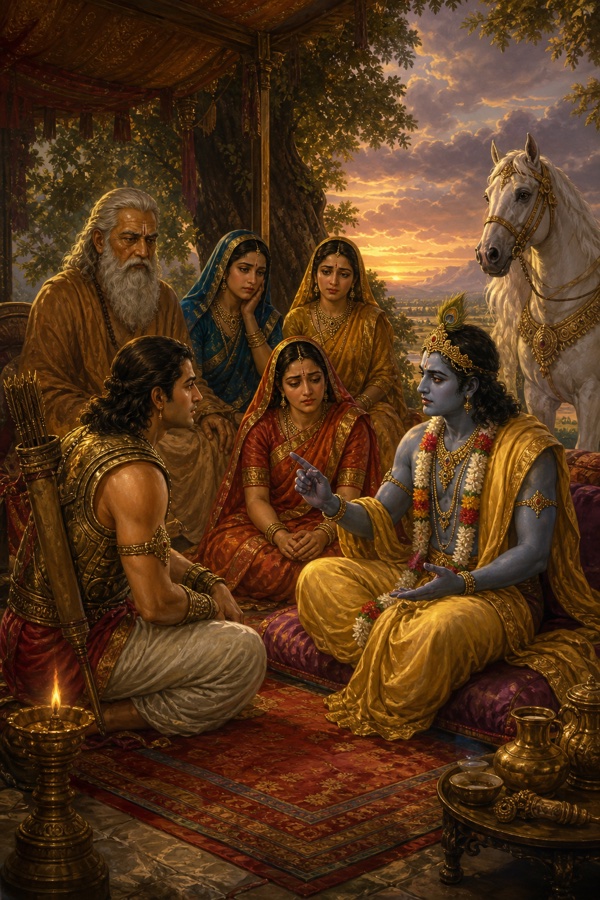
The layers came apart then, one after another. “When the preceptor Brahma had spoken to them in this way,” the preceptor told his disciple, “those sages acted accordingly, and afterward attained to many regions of bliss. You too, blessed one, you who are pure of soul, should act properly on the words of Brahma as I have declared them to you. Then you will attain success.” Krishna, in his own voice again, told Arjuna how it had ended. “So the pupil was instructed by his preceptor in the principles of the high law, son of Kunti, and he did everything accordingly, and then he attained release. Having done all that he should have done, he attained that seat where a man who reaches it has no more to grieve.” Arjuna had one question left, and it was the question he had asked at the end of the story before this one, when the Brahmin turned out to be Krishna’s mind and the wife his understanding. “Who was that Brahmin, Krishna, and who was the pupil? If it is fit for me to hear, then tell me truly.” “I am the preceptor,” Krishna said, “and know that the mind is my pupil. It is out of my affection for you, Dhananjaya, that I have told you this mystery. If you have any love for me, then, now that you have heard these instructions about the Soul, act on them properly always, you who keep excellent vows. When this law has been duly practiced you will be freed from all your sins and attain absolute release. Once before, when the hour of battle came, I declared this very law to you. Set your mind on it, therefore. And now, Arjuna, it is a long time since I saw my lord and father. I wish to see him again, with your leave.” Arjuna answered him at once. “We will go today from this town to Hastinapura, the city named for the elephant. When we have met the virtuous King Yudhishthira there and told him what you intend, you shall go on to your own city.”
A key to reading this (two syllables and three, and the sixteen): The line about death and Brahman turns on a count of syllables. Mrityu, death, is a word of two syllables, and so is mama, mine; the eternal Brahman is given three, and three is the count of na mama, which is the reverse of mine. This is why Brahma says that mineness is death and the reverse of mineness is the eternal. The sixteen that the body is made of are left uncounted in the passage; the commentator reckons them as the five great elements together with the mind and the organs of knowledge and of action. The Purusha that knowledge swallows up is the self that is conscious of a body, and the Purusha said to be full of knowledge is the self with that consciousness gone. The eaters of amrita are explained as those who never take food without first offering portions of it to the gods, the Pitris and guests. The tranquility that is like a dream is the state in which a man’s surroundings have become unreal to him. The understanding is called the Kshetrajna here because it exercises power over what the mind sets before it, though elsewhere in this discourse a man casts off the understanding to enter the Kshetrajna.
The gist: Brahma ends his teaching with a chariot whose horses are the senses, whose charioteer is the mind and whose reins are the understanding; then with a forest that runs from the unmanifest to gross objects, lit by the sun and the moon, with the Kshetrajna forever moving through it; then with austerity, which made Rishis into gods and cleanses even the gravest sins; and at the last with the saying that mineness is death. When the teaching is done the frames open one by one. The preceptor tells his disciple to act on Brahma’s words, Krishna reports that the pupil attained release, and Arjuna asks who the two of them were. The answer folds the whole chain into a sentence: Krishna is the preceptor, and the mind is the pupil. He reminds Arjuna that the same law was declared to him once before, when the hour of battle came, and asks leave to go and see his father.
Source: the Mahabharata of Krishna-Dwaipayana Vyasa, Ashvamedhika Parva, Sections 1 to 96; this part draws on Sections 35 to 51. The Gita Press Hindi edition is the controlling witness. The Sanskrit e-text and an independent complete translation were used to verify names, sequence, and principal events. Where recensions differ, this retelling follows Gita Press.
Source: the Mahabharata of Vyasa (Gita Press, Gorakhpur)