On this page
Devi Mahatmya
Chapter 7 · The Slaying of Chanda and Munda and the Birth of Chamunda · Final Charita
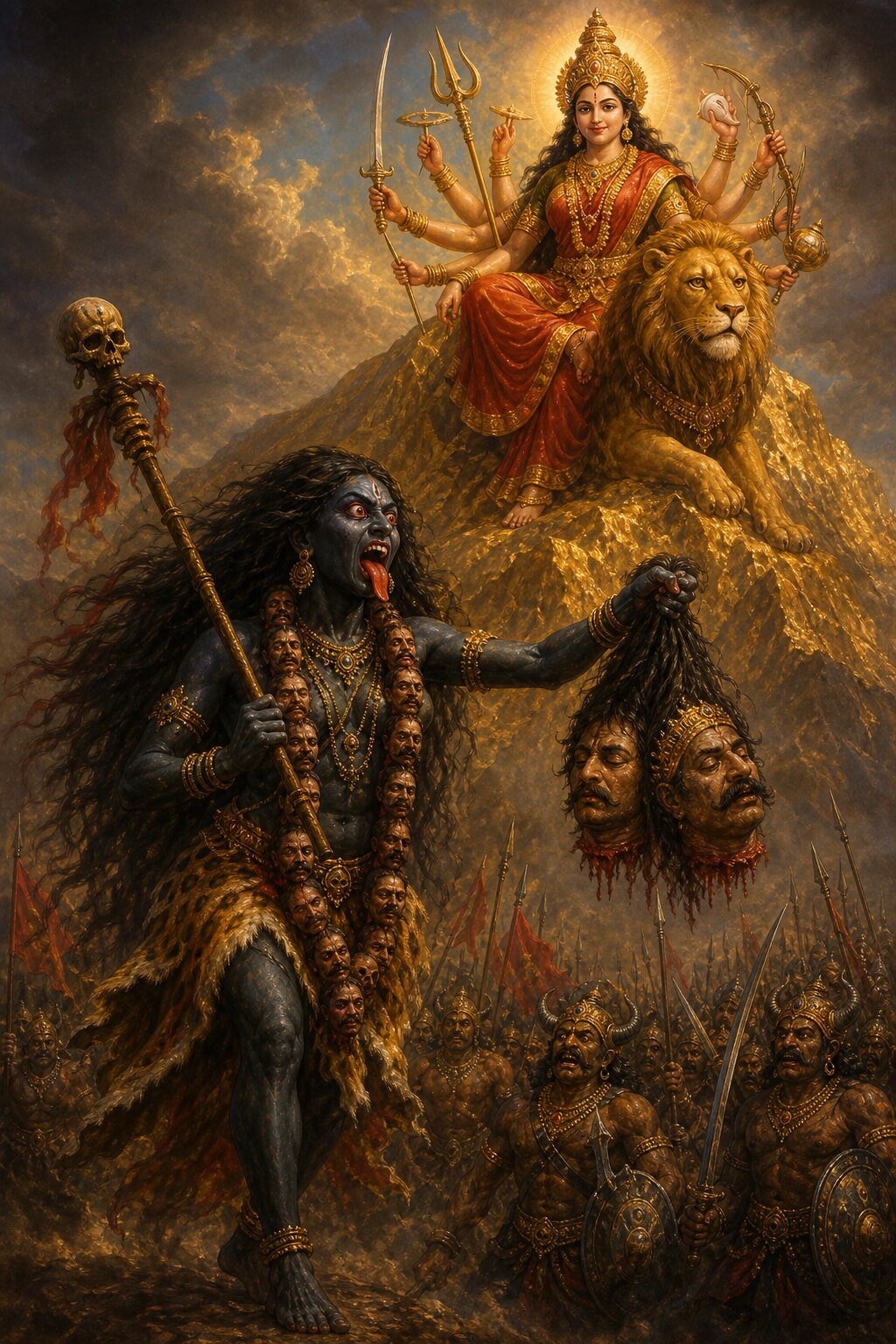
Chanda and Munda marched on the Goddess with a fourfold army at their backs. Wrath took hold of Ambika, and from her frowning brow sprang Kali, sword and noose in her hands, a skull-topped staff across her shoulder, a garland of human heads at her throat, a leopard’s skin for a garment. She swept the whole army into her mouth and devoured it. One stroke of her sword sent Chanda’s head flying; the same sword brought Munda down to the earth. Kali carried both heads to Chandika, and the Goddess gave her a name that fuses the two names of the slain: Chamunda.
1
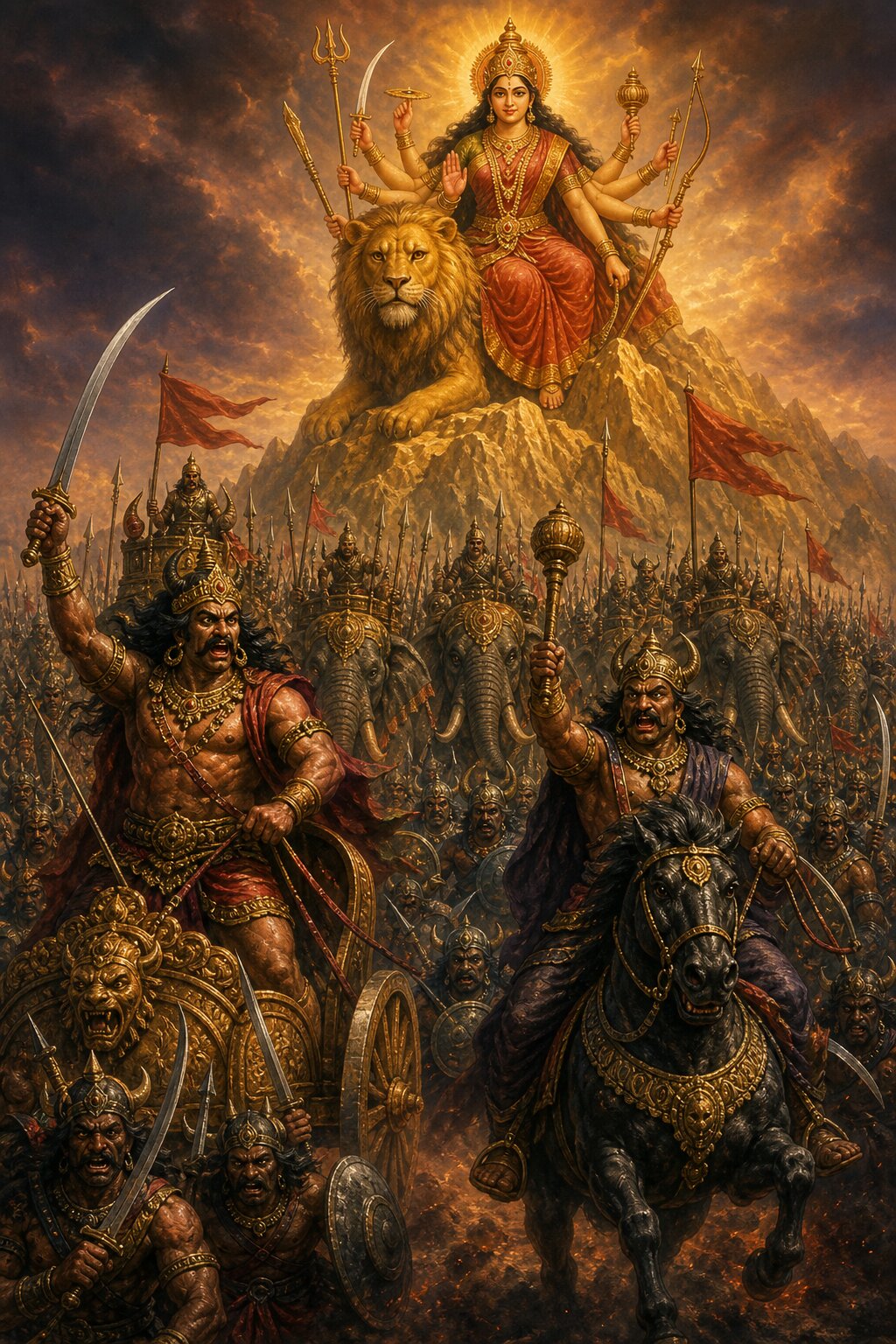
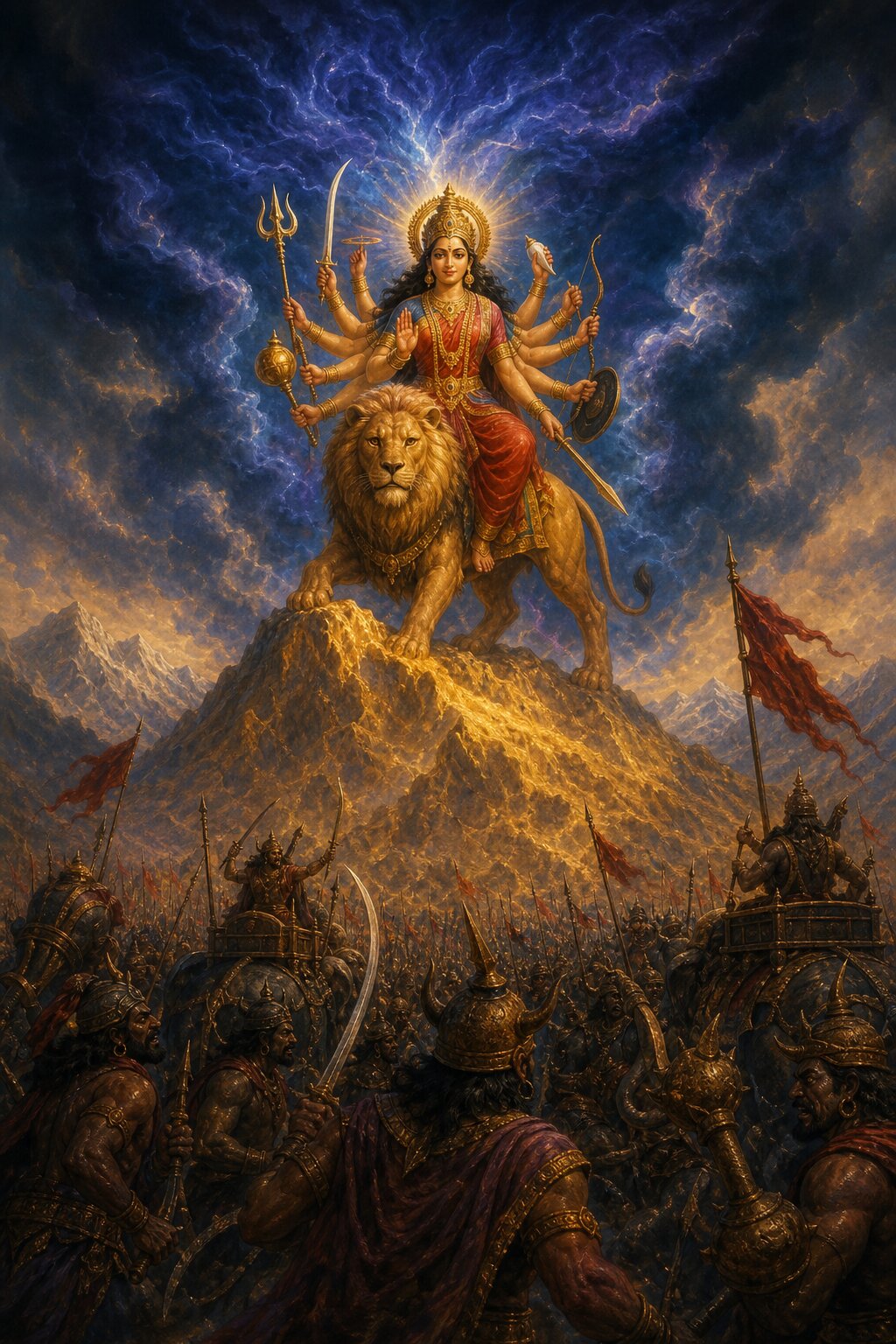
Dhumralochana lay dead, and Shumbha’s next command was already in motion. Chanda and Munda went out at the head of the daitya ranks, and behind the two generals massed a fourfold army, elephants and chariots, horsemen and foot soldiers, weapons lifted high against the mountain light. They came on and drew up before the Goddess, set on war, the same two who had once stood on these slopes and marveled at her beauty now sent to bring her in bonds.
2 · 3
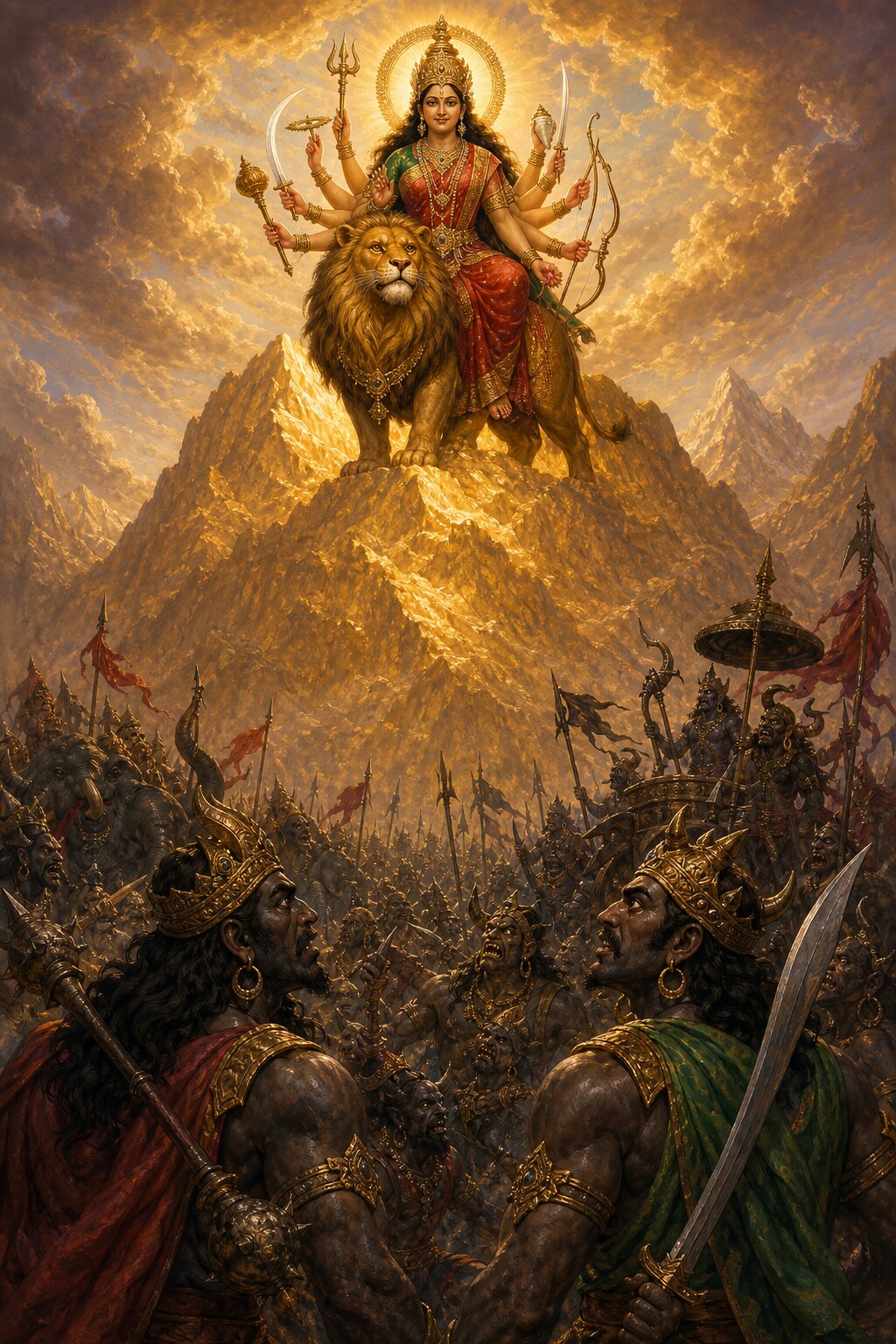
Arriving, they saw her: the Goddess seated with a faint smile resting on her lips, mounted on her lion, and the lion standing on a vast golden peak of the king of mountains, gold beneath her and snow beyond her, the whole scene arranged like a throne room the mountain itself had built. Even that vision left their arrogance whole. They set themselves to take the Goddess by force and drag her away. Some daityas came on with bows drawn and swords bared; some pressed in until they stood almost within reach of her, close enough to see that the smile had not moved.
4 · 5
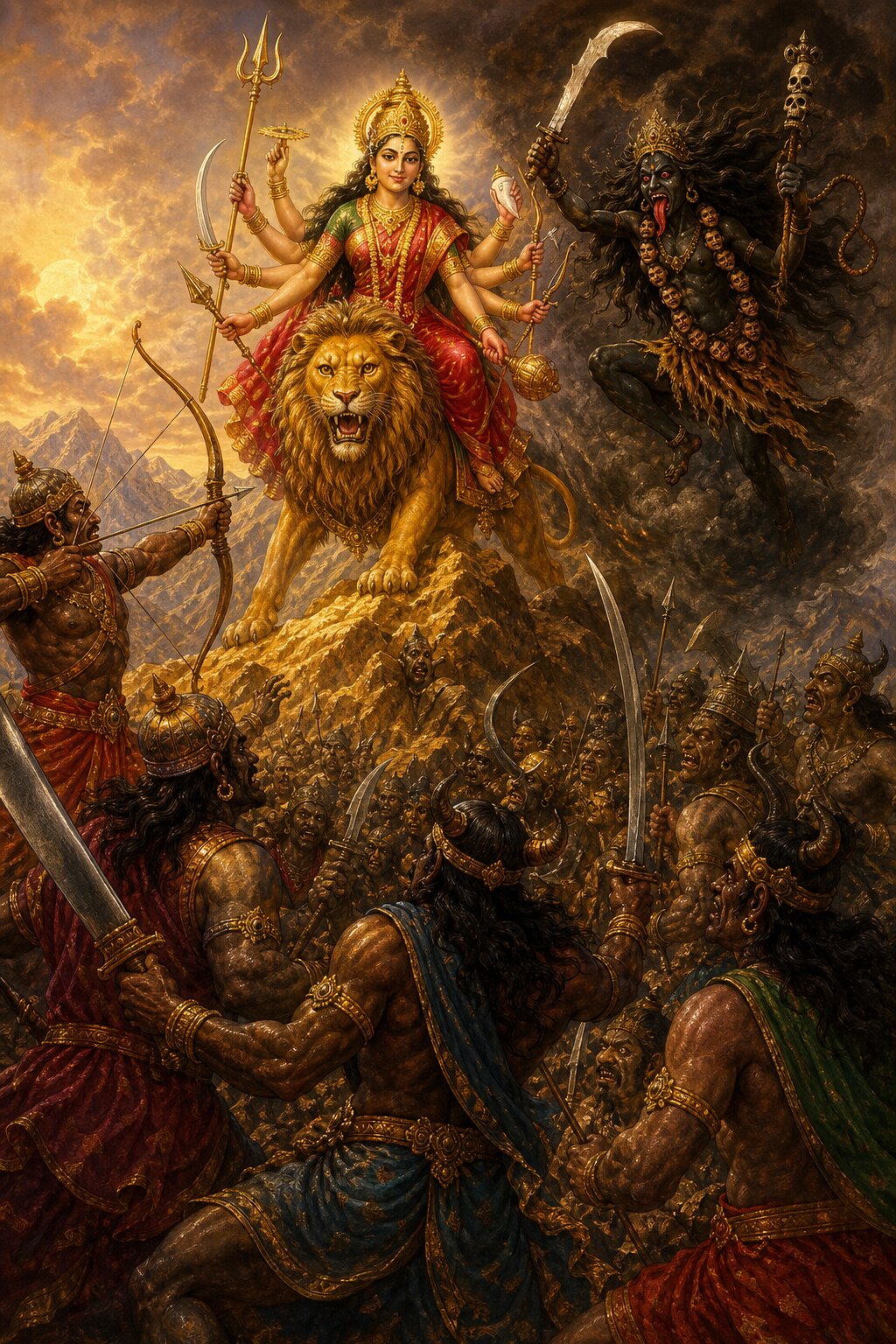
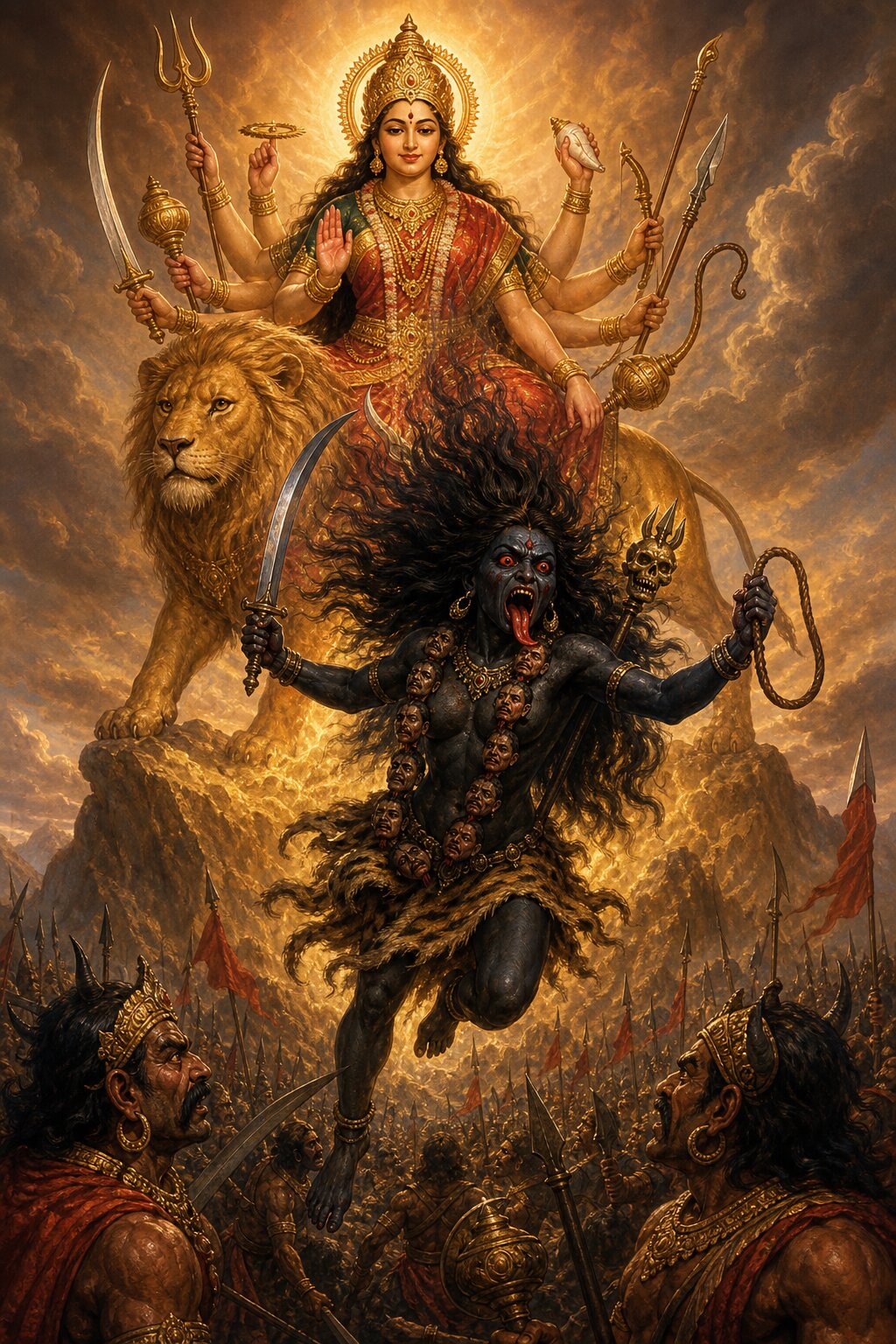
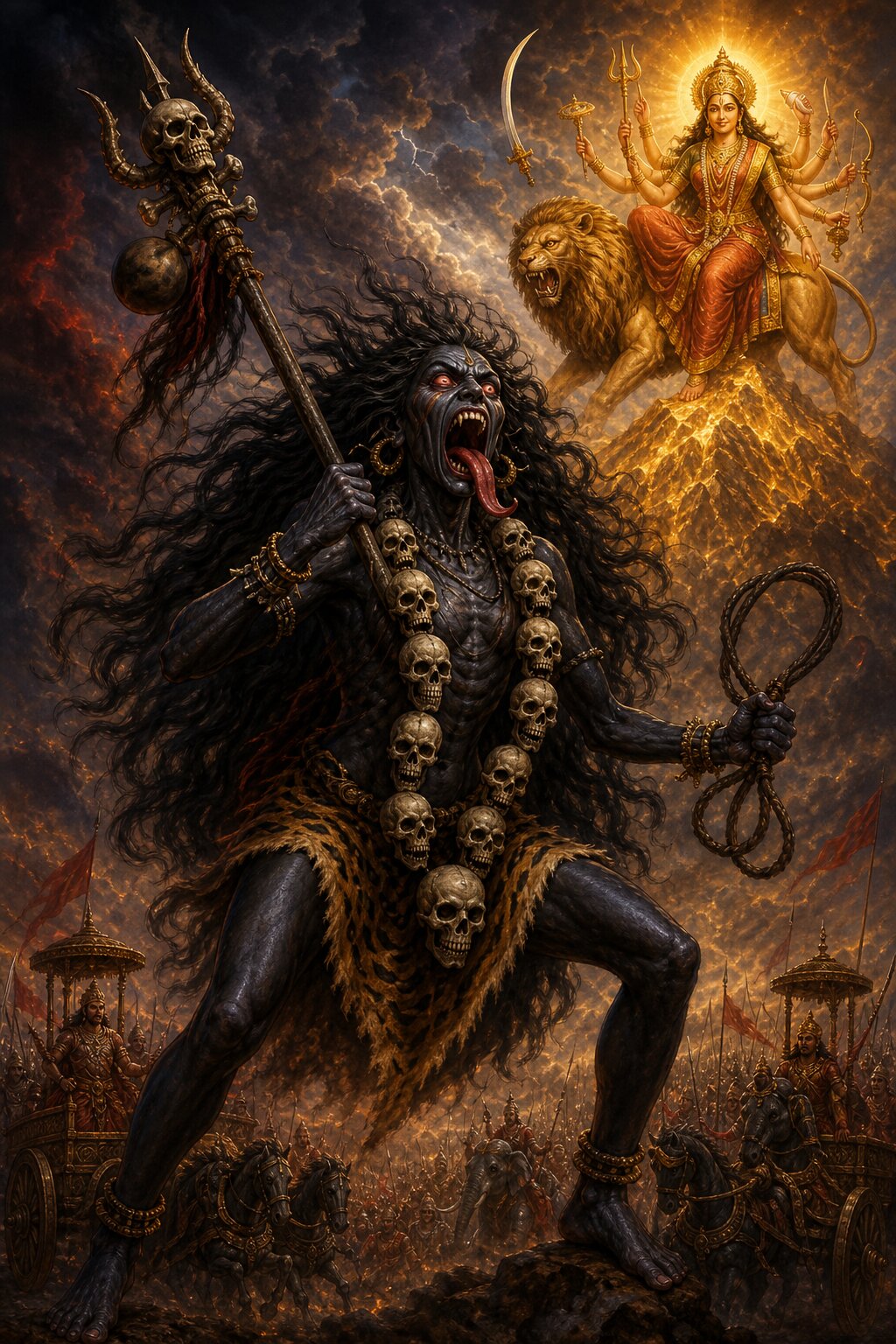
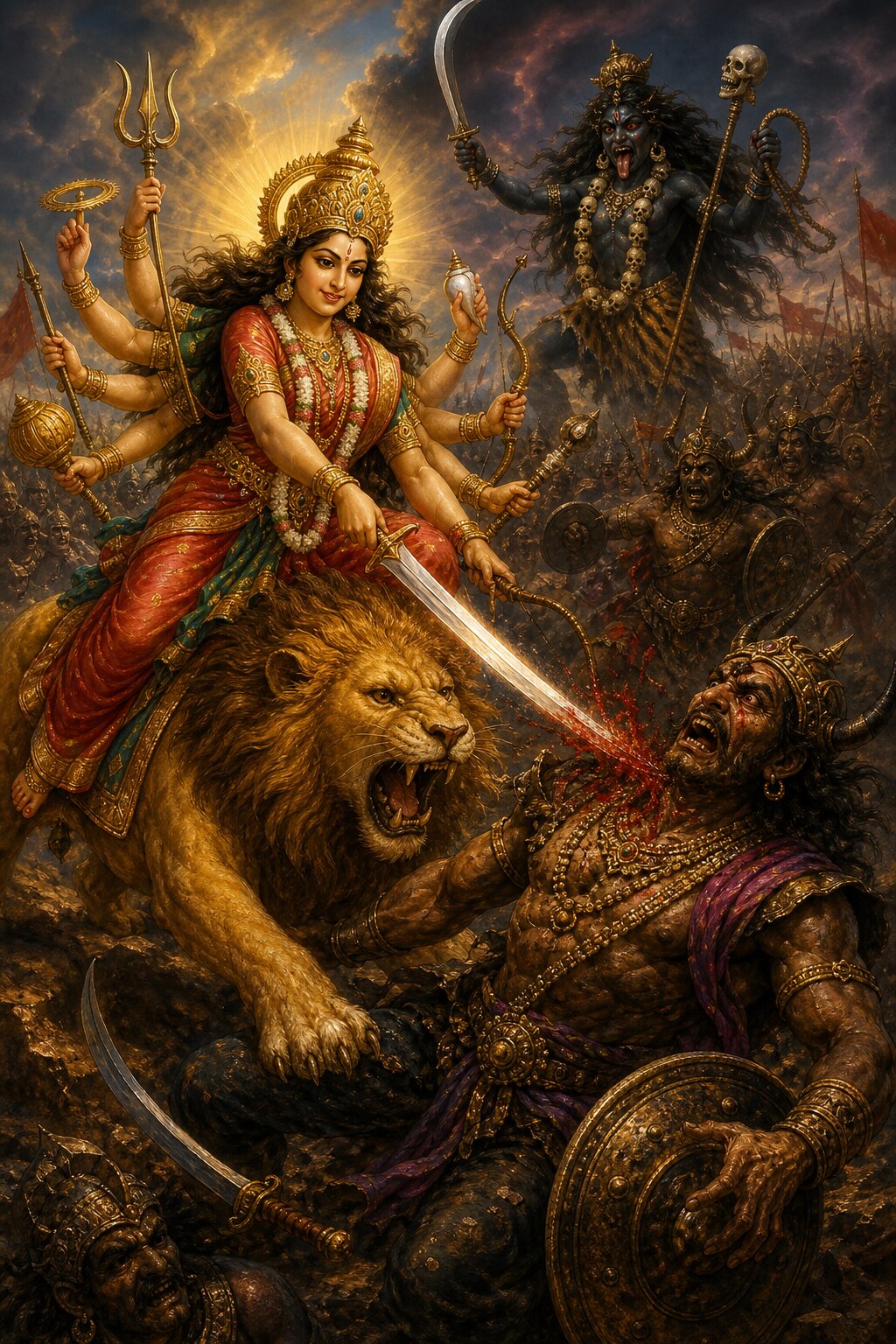
Then Ambika turned the full weight of her wrath on those enemies. As the fury gathered inside her, her face darkened, shade by shade, to the black of ink, the fair Goddess going dark the way a clear sky goes dark before the worst of storms. And out of that forehead, knotted in its furious frown, Kali tore free at tremendous speed, wrath itself given a body: her face dreadful to look upon, a sword in one hand, a noose in the other.
6 · 7
Her form itself was a house of terror. A wondrous many-colored skull-topped staff, the khatvanga, rode in her grip, a garland of human heads circled her throat, a leopard’s skin clothed her body, and the flesh dried tight over her bones made the figure more dreadful yet, as though famine itself had risen to fight. Her mouth gaped enormously wide, her tongue lolled and flickered, hideous to watch, her eyes sat sunken and red in their deep sockets, and her roar rolled outward until it had filled every direction of the sky.
8 · 9
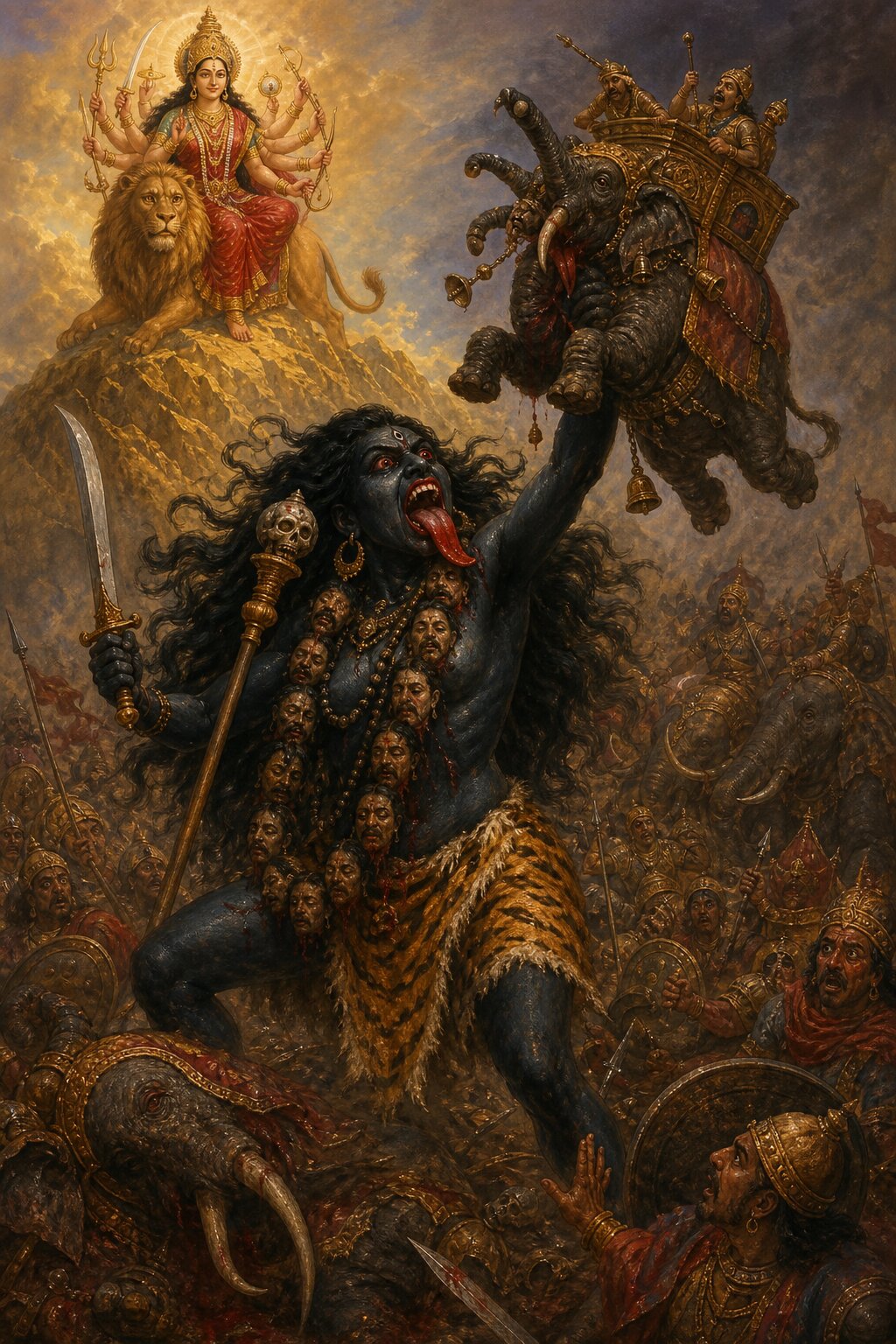
She fell upon the army at terrible speed. Cutting down the great asuras as she went, she devoured that whole host of the gods’ enemies where it stood. She caught up the war-elephants in a single hand, and with each beast went its rear-guard men, its goad-wielding drivers, its warrior-riders, and the bells swinging at its neck, and the whole of it she flung into her mouth, the bells still ringing as they went down. An army drawn up in the proud fourfold order discovered that ranks meant nothing to a mouth that wide.
10 · 11
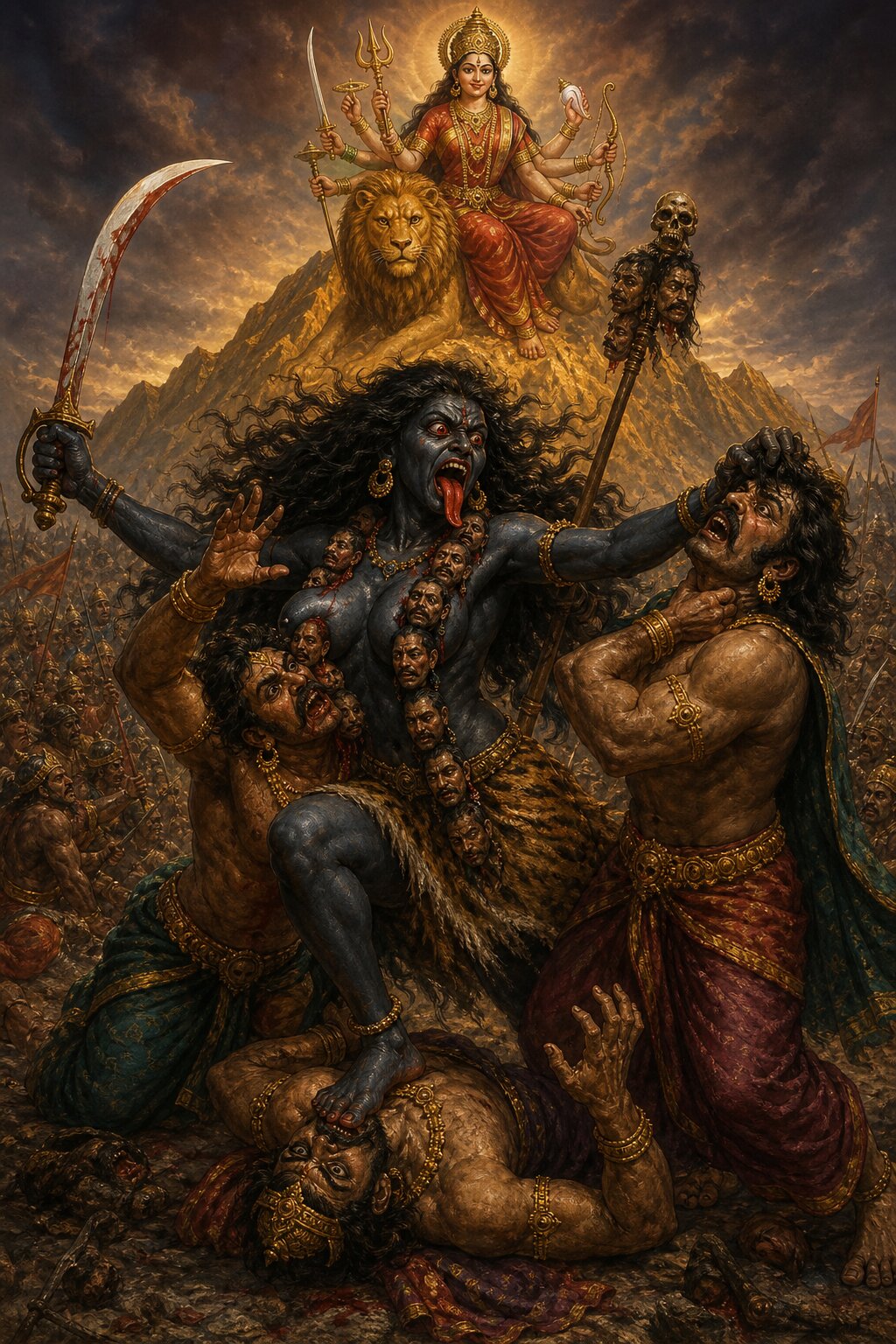
In the same way she flung a warrior into her mouth with his horses, and a whole chariot with its charioteer, and ground them between her teeth in a manner dreadful past telling. One asura she seized by the hair, another by the throat; one she stamped beneath her foot, another she crushed flat against her chest. The battle had no front line anymore; wherever a daitya stood, that place became her reach.
12 · 13
The weapons those asuras loosed at her, even their great missiles, she caught raging in her open mouth and splintered between her teeth like so much dry cane. Of that whole army of strong and vicious asuras, some she ground to pulp, some she swallowed whole, and some she beat down dead where they stood.
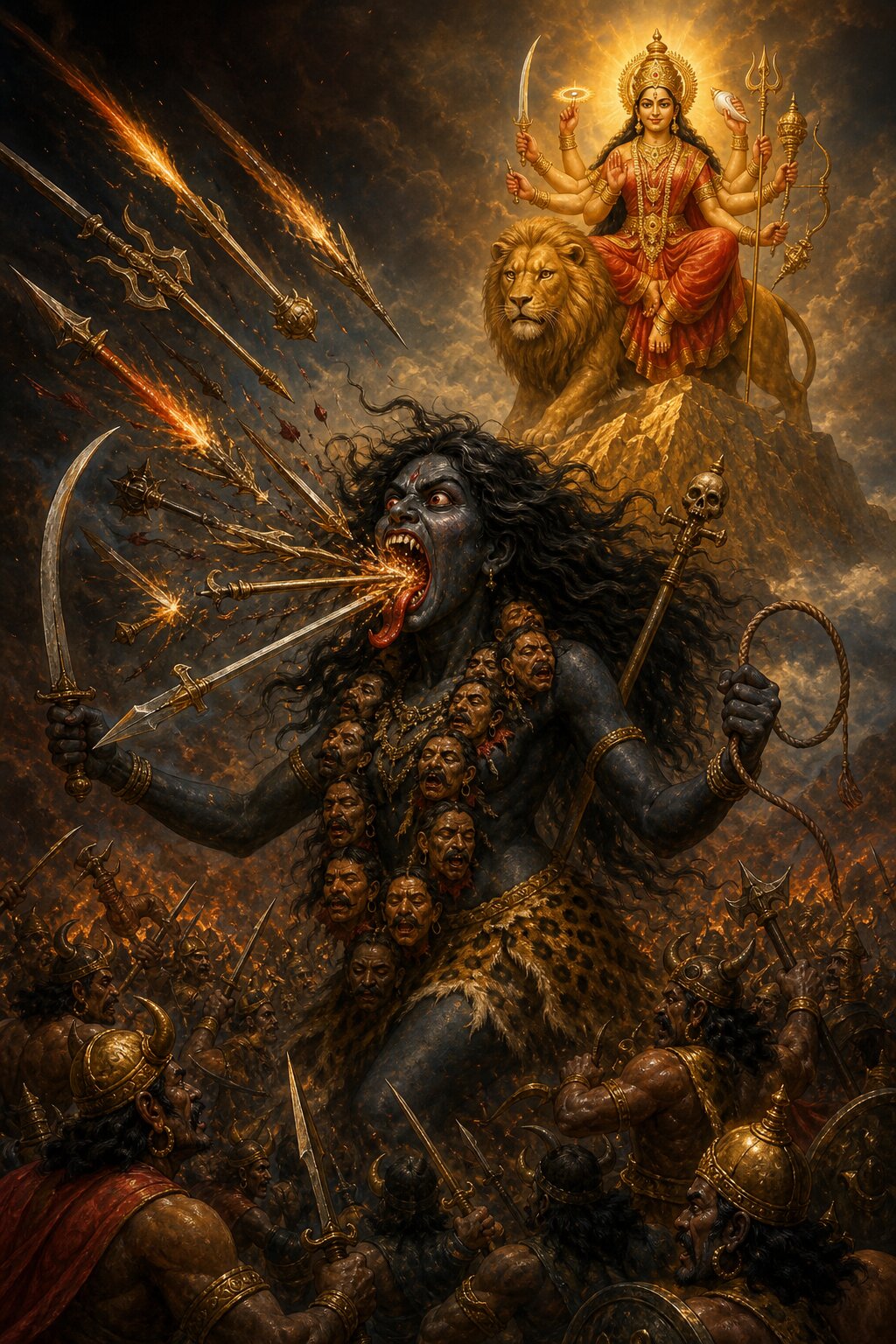
14 · 15
On that field one asura fell to the sword, one under the blows of the skull-staff, and one, gashed on the very points of her teeth, went to his destruction, so that her weapons and her own body had become one arsenal. Within a single moment that immense army of asuras lay felled upon the earth. And Chanda, seeing it, seeing everything he had marched up the mountain with gone, charged straight at that most terrifying Kali.
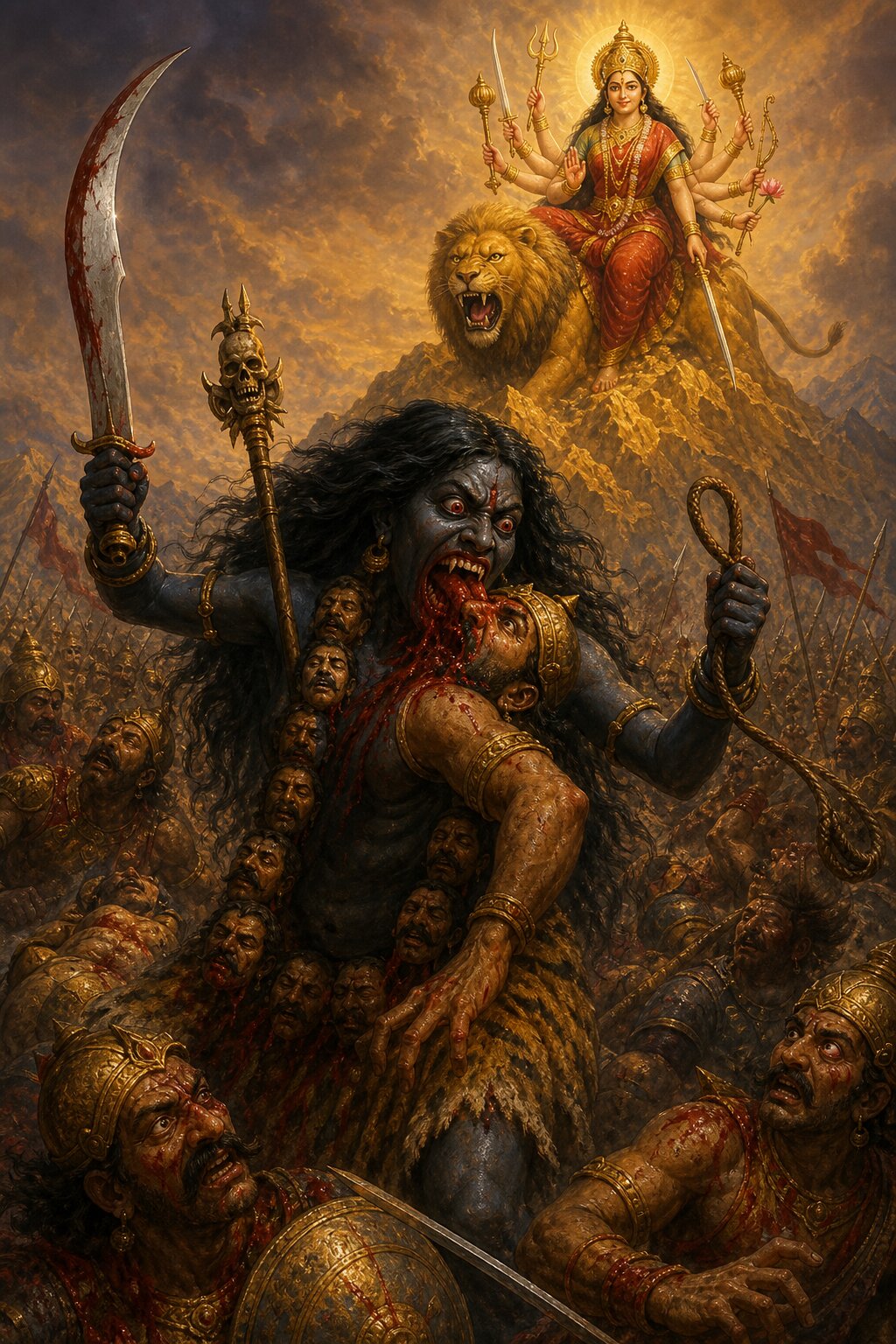
16 · 17
That great asura buried the terrible-eyed Kali under a rain of arrows dreadful past all measure, and Munda flung his discuses at her by the thousand, the spinning blades filling the air between them. And those uncounted discuses, streaming into her mouth, glowed there like so many disks of the sun swallowed into the belly of a dark storm cloud, a whole sky of suns going down into one darkness.
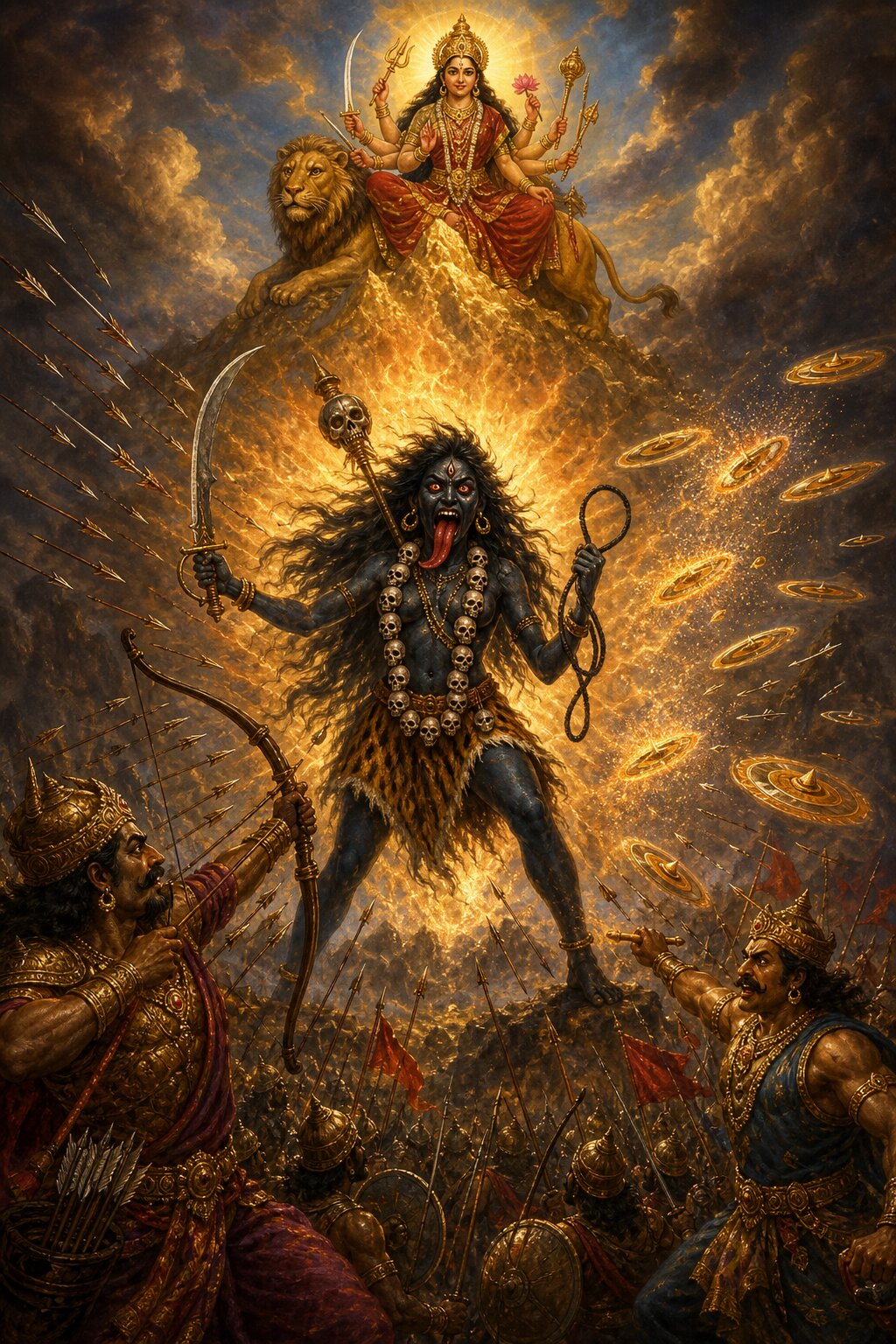
18 · 19
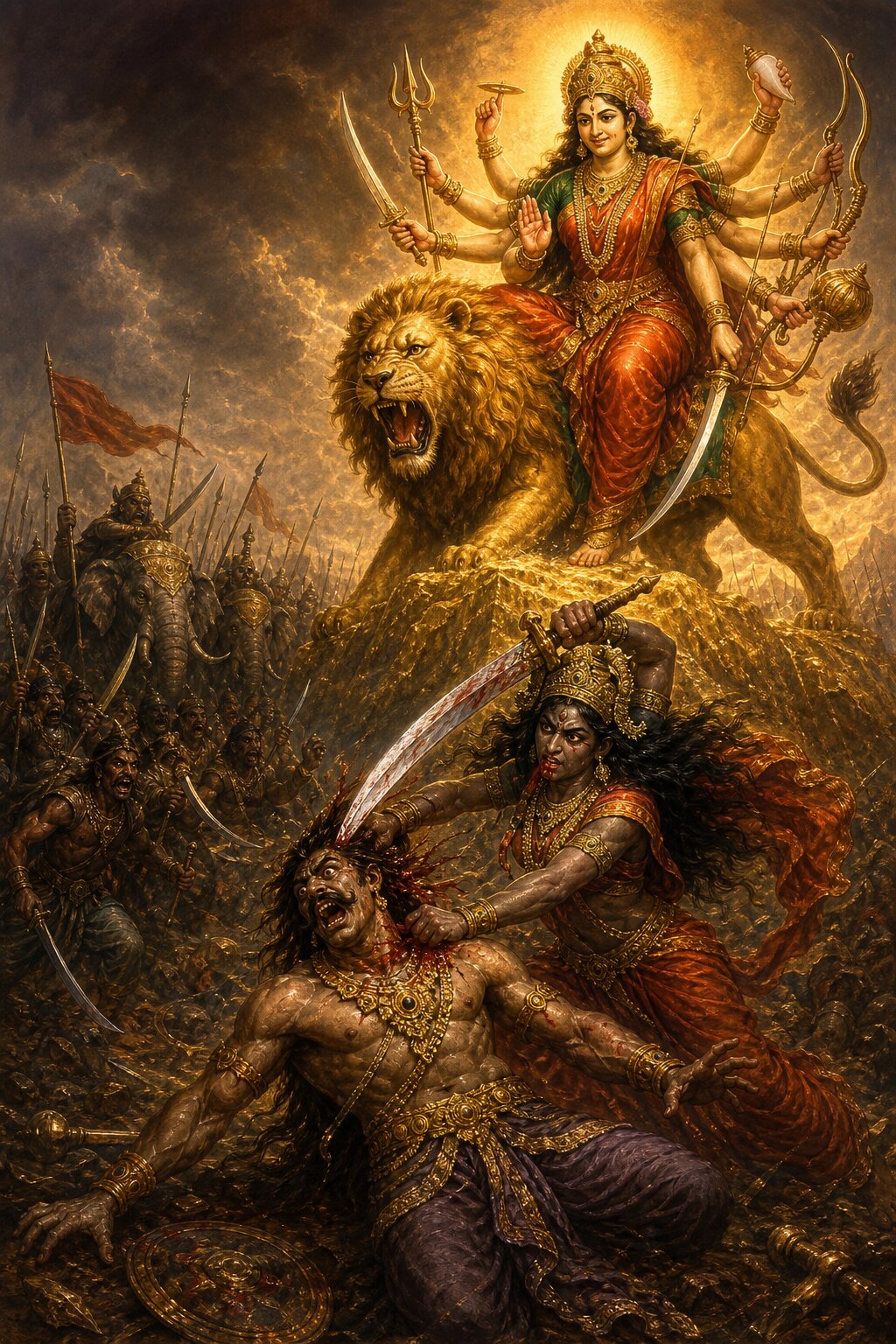
Then Kali laughed, a laugh thick with fury, breaking outward into a dreadful roar, and deep in her terrible mouth the teeth blazed, hard for any eye to hold. She swung up onto her great lion and bore down on Chanda, and the asura who had come to drag a woman off by her hair was himself seized by the hair; she knotted her fingers in it, and with a single stroke of that same sword she severed his head.
20 · 21
With Chanda’s head severed, Munda, lord among daityas, loosed a roar so vast and so dreadful that all three worlds shuddered at the sound, heaven and earth and the deeps below all hearing one daitya’s grief at once. Then, seeing Chanda sprawled on the ground, he hurled himself at Kali, grief and fury driving him onto the same blade, and Kali in her wrath struck him with the sword and brought him too down to the earth.
22 · 23
Chanda fallen, the mighty Munda fallen: what was left of that army broke and fled, terror-struck, to the far quarters, carrying into every corner of the world the story of what waited on that mountain. And Kali took the heads of Chanda and Munda in her hands and strode to Chandika, her wild laughter pealing across the field as she came, and spoke.
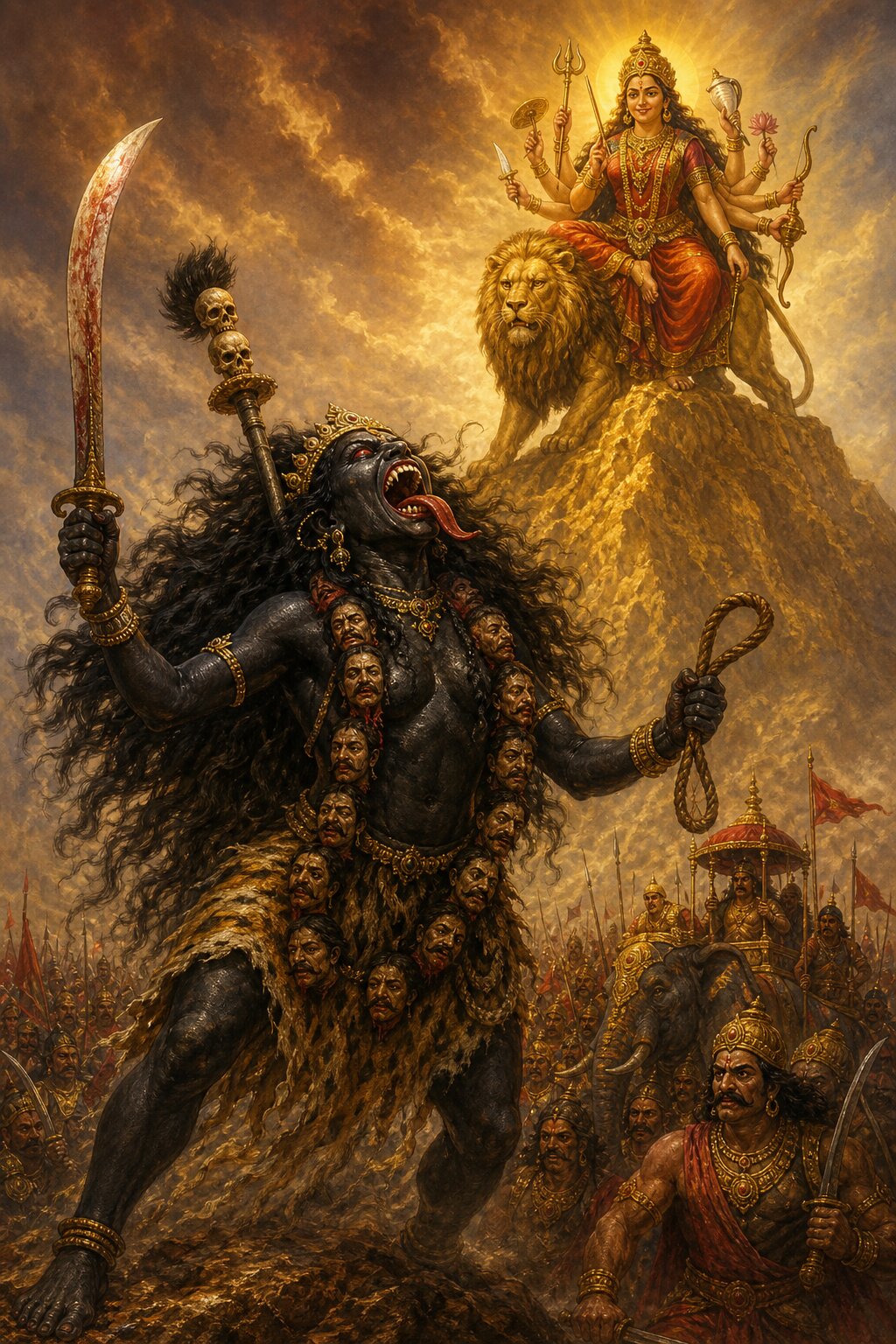
24 · 25
She said that in this yajna of battle she had presented her offering: Chanda and Munda, two great beasts of sacrifice, laid down for the Goddess’s sake as a priest lays the offering before the fire, and that Shumbha and Nishumbha the Goddess would now slay with her own hand, the crowning act of the rite reserved for her alone. And the gracious Chandika, seeing the two great asuras Chanda and Munda carried before her in this fashion, spoke to Kali in words gentle and sweet, the same voice that had just watched an army be devoured.
26
The blessed Goddess said: because you have seized Chanda and Munda and come to me carrying them, for that very deed, O Devi, the world will know you by the name Chamunda, the two names of the slain fused forever into the name of their slayer. So it stands to this day: wherever the Goddess is called Chamunda, this story is being told, whether the teller knows it or not.
Chapter close
Thus, within the Savarni Manvantara in the Sri Markandeya Purana, in the Devi Mahatmya, this seventh chapter, named the Slaying of Chanda and Munda, reaches its close here.
Ahead
In Chapter 8 the seven Matrikas appear, the seven mothers who arise from the energies of Brahma, Shiva, Kumara, Vishnu, Varaha, Narasimha, and Indra; and Raktabija is slain, the asura from every drop of whose spilled blood a new asura would rise up from the earth.