On this page
The afternoon is thinning in the courtyard of the hermitage. Behind the huts a boy is working at one line of the Sama Veda for the fourth time and putting the pitch wrong on the same syllable, and out past the fence the cattle are coming in off the grazing ground with their own dust hanging behind them. Into that ordinary hour walks a man whose arrival is never ordinary. Narada the devarshi goes where he pleases, between the worlds of the gods and the settlements of men, carrying news and songs from one to the other; no assembly has ever closed its door to him and no king has ever left him standing.
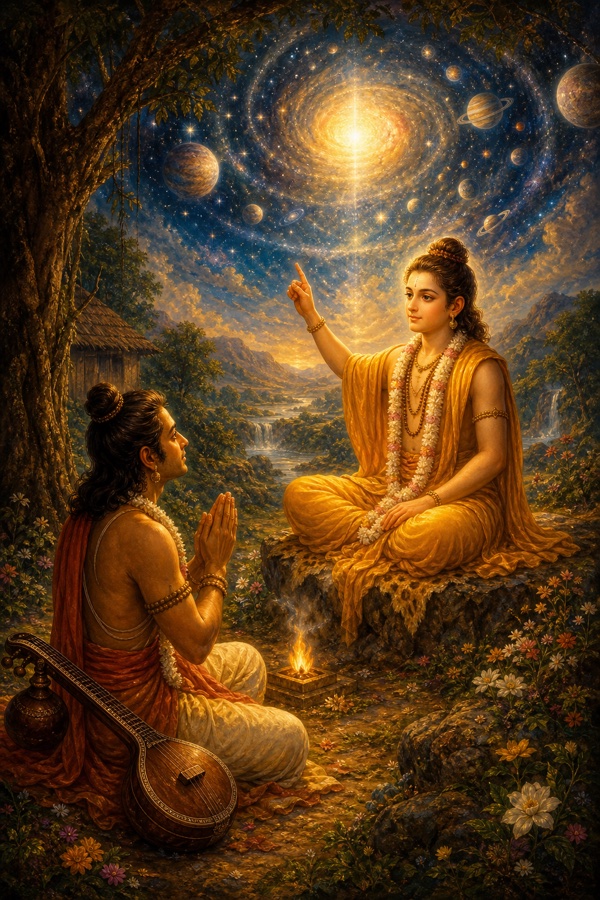
He does none of the things a visitor of his rank could do. He crosses the swept ground to where Sanatkumara is sitting, and he lowers himself to the earth in front of him. That single movement is the whole of an apprenticeship. A man puts himself below the man he means to learn from, close enough to hear a voice that will not be raised for him, and by sitting there he hands over the right to be corrected in public. Then his first sentence, four syllables, an imperative softened by a title: “अधीहि भगव”, teach me, lord.
Sanatkumara does not begin to teach. He lays down a condition instead, and it is the plainest sentence in the chapter: “यद्वेत्थ तेन मोपसीद”, come to me with what you know, and from above that I will speak. In a world where nothing is written down and every science lives inside somebody’s body, a teacher has no other way to find his student. He has to hear the inventory first. Everything about the climb ahead is settled inside that condition, because the lowest rung of the ladder will be laid exactly where this particular man happens to be standing, and not one step lower.
This is the seventh of the eight chapters of the Chandogya Upanishad, and with its twenty-six khandas it is the longest single conversation in the whole book. In the chapter just behind it, Uddalaka Aruni has said to his son Shvetaketu nine times over, tat tvam asi, you are that; there creation opens out of sat, being, and the movement runs downward. Here the direction reverses. Here the teacher lays his hand on the lowest rung, on nama, name, and each time the student asks his one question, whether anything larger exists, the teacher raises him one rung higher. This chapter is the record of that climb, and its true subject, underneath all the learning, is grief.
The main figures of this chapter
Narada: devarshi, master of the four Vedas and of dozens of sciences, and a student who is still restless inside after all of it.
Sanatkumara: the teacher who asks before he teaches, and who at the end shows the far shore of darkness and lets his student go; the Upanishad also calls him by the name Skanda.
The fourteen steps from name to breath: nama, vak, manas, samkalpa, chitta, dhyana, vijnana, bala, anna, apah, tejas, akasha, smara, asha and prana, each one coming forward in its turn and then giving the road to the one above it.
The seven links from truth to happiness: satya, vijnana, mati, shraddha, nishtha, kriti and sukha, the stairs the teacher goes down to reach the root of great speech.
Bhuma: the vast, where nothing else is left to see, to hear, or to know.
Adhihi bhagavah: the grief of a very learned man (khanda 1)
Narada meets the condition, and in meeting it he opens a long inventory. Rig Veda, Yajur Veda, Sama Veda, Atharva as the fourth, itihasa and purana as the fifth, the Veda of the Vedas, the rules for the rites of the ancestors, rashi or the science of number, daiva or the reading of portents, nidhi the lore of buried treasure, vakovakya or argument and debate, ekayana or statecraft, deva-vidya, brahma-vidya, bhuta-vidya, kshatra-vidya, nakshatra-vidya, and the lore of serpents and of the deva-janas. Shankara opens several of these names out: the Veda of the Vedas is grammar, rashi is mathematics, deva-vidya is nirukta, brahma-vidya is the cluster of shiksha and kalpa and chhandas, kshatra-vidya is the science of the bow.
Hear that list the way the people sitting in the courtyard would have heard it. There is no shelf anywhere to go and consult. Every item on it is a body of sound that a man has taken into himself by sitting in front of somebody who already carried it, hearing it, giving it back, being stopped, giving it back again, until the corrections stopped coming; and then holding it against forgetting by reciting it at dawn and at dusk for the rest of his life. The four Vedas alone are the better part of a youth. On top of them go grammar, which is the discipline that keeps the sounds from drifting out of true across generations; the arithmetic that lays out an altar to the finger’s breadth and keeps a calendar honest; the rules that tell a household which ancestor is owed which offering and on which day of the waning moon; the reading of comets, of haloes around the moon, of the direction a jackal crosses a road; and the art of public argument, in which a man stands up in a hall and is questioned by strangers until he either holds his ground or is seen by everyone to break. A man who owned the whole of that was the one a king sent for before he marched, the one a village sent for when an inheritance split a family down the middle, the one other learned men crossed a river to challenge and went home from quieter than they came. The list is built to win an assembly, and it would win any assembly in the world.
And then, in the same breath, with the inventory still hanging in the air, Narada says the sentence on which this entire chapter rests. “सोऽहं भगवो मन्त्रविदेवास्मि”, lord, I am a knower of mantras, and I am no knower of the atman, the self. I have heard from men like you, “तरति शोकमात्मवित्”, the one who knows the self crosses over grief. So, lord, I grieve. After all this reading a thorn is still lodged inside me. Carry me to the far side of this grief. Spoken in a debating hall, that sentence would finish a reputation, because the whole standing of such a man rests on there being no question he has to hand back. Spoken on the ground in front of a teacher, it starts something. No unlettered man says it. It comes from the one person present who holds the answer to every subject except his own.
Sanatkumara’s reply is short, and it goes in deep. “यद्वै किञ्चैतदध्यगीष्ठा नामैवैतत्”, everything you have studied is name, and only name. Rig Veda is a name, Yajur Veda is a name, itihasa and purana are a name, and so are logic and statecraft and the science of the stars. The thing a name points at stays beyond the reach of the name itself. A man with the entire structure of the sun by heart owns nothing of the sun. Narada held a complete inventory of the world, and the world stayed outside the inventory; and an inventory has never once touched anybody’s grief.
Notice what the teacher does with the list once he has weighed it. He leaves it exactly where it is. He takes nothing away from Narada and asks him to unlearn nothing. Worship the name itself, he says. Worship here is the name of a practice, not of a ceremony: take one thing, hold the mind on it until nothing else is in the mind, and treat it for the length of that holding as the whole of brahman. And the teacher states the fruit as plainly as a man stating the boundary of a field. Whoever worships name as brahman moves at will as far as name reaches. Every rung in this chapter comes with a fruit of that shape, a country with a fence around it, real ground and a real limit. That is the honest and complete worth of the first rung. Take full ownership of what is under your feet, and then look up. Grief survives this, and the feet find their footing.
Narada stops nowhere near that fruit. He asks the question that will be repeated thirteen more times: lord, is there anything greater than name? And the teacher gives the answer that will be repeated thirteen more times: yes, there is something greater than name. Then tell me that, says Narada. In a hall where every syllable is held by memory and nothing can be looked up later, repetition is the architecture, and a formula that comes around unchanged is how a long teaching is carried for a thousand years without a page. Fourteen times the same two sentences swing past. What they are carrying is the gait of the whole chapter, a quiet, stubborn, tireless curiosity that lays a hand on whatever it is given and asks what stands above it.
In short: The chapter opens on the grief of a very learned man, and its first diagnosis is that all of that learning reached only as far as name. The teacher leaves name standing and makes it the first rung. What matters is that Narada refuses to halt there, and that refusal is the engine of the entire conversation.
Speech and mind: two amalakas in a fist (khandas 2 and 3)
Here is the claim on the second rung, stated flat before the teacher decorates it: a name cannot sound by itself, and speech is what makes it sound, so speech has to be the larger of the two. Then the decoration, and the decoration is a roll call that runs far longer than Narada’s list. The four Vedas, itihasa and purana, grammar, mathematics, logic, statecraft, all the sciences; and with them the sky and the earth, wind and space, water and heat, gods and men, cattle and birds, grass and trees, the beasts of the forest, worms, moths, down to the ant. That is the world as it looks from the doorway of a house in a settlement of this kind, the whole of it, from the sky over the threshing floor to the line of ants on the threshold. Speech makes all of it known, brings all of it into our knowing, and until a thing has been made known it is hard to say whether it exists for us at all.
Then the teacher opens a second layer, finer than the first. Speech makes dharma and adharma known, truth and falsehood, the good and the bad, what pleases the heart and what offends it. And he says: if there were no speech, neither dharma nor adharma would be made known, neither truth nor falsehood, neither good nor bad. Sit with that inside the world it was spoken in. Nothing in that world is filed anywhere. A field boundary is where two families said aloud in front of witnesses that it was. A marriage holds because words were said over a fire with people watching. A debt is a sentence somebody spoke and other people remember. A verdict is a thing an elder pronounced in a courtyard, and its force lasts exactly as long as the memory of hearing it. Take speech out of such a society and the line between good and bad stops holding within a generation, because a distinction survives only while it can be said aloud. Therefore, the teacher says, worship speech.
Narada puts the same question again, and the teacher climbs one more rung. Mind is greater than speech. Here the Upanishad gives an image that nobody forgets after a single reading: as two amalaka fruits are held in a closed fist, the small hard sour green ones that a child picks up two at a time, or two kola berries, or two aksha nuts, so speech and name are both held inside the mind. The two things we had been calling large are lying in somebody else’s palm. Until the mind opens its hand, no name comes out, and no speech.
What the mind does is stated just as plainly. When a man thinks with his mind, let me recite the mantras, then he recites them; let me perform the rites, then he performs them; let me have sons and cattle, then he wants them; let me have this world and that world, then he wants them. Study, action, desire, worlds: the first switch for all of it sits with the mind. So the teacher closes this khanda on a sentence that sounds almost impudent: “मनो ह्यात्मा मनो हि लोको मनो हि ब्रह्म”, mind is the self, mind is the world, mind is brahman.
Read that sentence in the place where it was spoken. It stands as the fruit-word of the third rung, given to a student who is standing on the third rung, and a teacher in this tradition says the largest thing he can about whatever his student is holding at the moment, because a man will not put his weight on a rung he has been told is small. One method of upasana works exactly this way: take the rung under your feet as complete, pour your whole faith into it, and its truth presses out into your hand and the next rung comes into view. Narada does precisely that, and then asks again, is there anything greater than this? Yes, says the teacher, there is.
In short: Speech is greater than name, because whatever cannot be spoken never arrives in the world for us, and the whole distinction between dharma and adharma stands on speech. Mind is greater than speech, because name and speech both lie inside the fist of the mind. Every rung grows large by swallowing the one under it, and that is the law of this chapter.
Will and attention: the intention that joins the worlds (khandas 4 and 5)
Will is greater than mind, and the teacher proves it by putting the sequence in order and letting anyone check it against himself. A man forms a will first, then the thought rises in his mind, then he sets speech going, and speech he sets going into name; in name the mantras become one, and in the mantras the rites. The order we have been climbing from below runs downward like this: will, mind, speech, name, mantra, rite. Whatever rises first is the largest, because everything else walks along behind it. And samkalpa is a word with a fixed and public place in this world. No rite of any size begins without one. Before a single grain goes into the fire, the man performing it says aloud what he is about to do, on which day, in which place, with which purpose, and it is that spoken resolve that turns a handful of separate actions into one act with a shape.
And then the Upanishad lifts will out of the human interior and lays it across the whole of creation. Sky and earth held themselves by will, wind and space by will, water and heat by will. Their holding holds the rain, the rain’s holding holds the food, the food’s holding holds the breaths, the breaths’ holding holds the mantras, the mantras’ holding holds the rites, the rites’ holding holds the worlds, and the worlds’ holding holds everything there is. One link into the next, the next into a third; and the same sentence runs all the way down, that the things which hang together did not fall together on their own. They were held.
Hear the fruit as well, because in this khanda the language of fruit changes. The man who worships will as brahman attains worlds that hold, dhruva worlds, and attains them being himself dhruva, unshaken; established worlds, and himself established; worlds that do not tremble, and himself untrembling. For the first time the world a worshiper receives and the worshiper’s own bearing are tied into a single word. The ground under a man whose intention holds steady stays put beneath him.
Narada puts the same question in the same place, and chitta comes forward. Attention is greater than will, because awareness settles on a thing first, and then the will is formed, and then the mind moves, and then speech. An intention also fails to rise on its own; something awake is needed under it, something that looks, takes hold, and stays. What we call intention is the next step taken by that settled awareness.
And now the Upanishad gives an example that any assembly would recognize, because everyone in that courtyard has watched it happen. Let a man be very learned and empty of attention, and people say of him, he does not exist at all; whatever he knows, what is it worth; had he truly been learned he would carry more attention than this. Let a man know a little and have attention, and those same people want to listen to him, they come and sit near him. This is a society that ranks men by learning and says so out loud, and here it is quietly overturning its own scale in public. The weight of a person is made by the presence inside him, and the quantity of his information adds nothing to it. So the teacher says, “चित्तमात्मा चित्तं प्रतिष्ठा”, attention is the self, attention is the ground; attention is the one resting place of all these; worship attention.
In short: Will is greater than mind, because mind, speech, name, mantra and rite all walk behind it, and creation from the sky down to food stands on this same chain of holding. Attention is greater than will, because an intention needs a waking presence underneath it. People simply do not count a man who knows a great deal and carries no attention, and that is the sharpest line in this khanda.
Meditation, discernment and strength (khandas 6, 7 and 8)
Meditation is greater than attention. Attention had to settle on something; this rung is the settling itself, held long and held still, and the picture the teacher draws for it is among the loveliest in the chapter. “ध्यायतीव पृथिवी”, the earth meditates, as it were; the midspace meditates, as it were; the sky meditates, the waters meditate, the mountains meditate, and gods and men as well. Notice the small hedge the teacher keeps in his mouth, as it were, as though, because no one has ever gone and asked a mountain what it is doing. What can be seen from outside is that the things which are large keep silent and hold their place, and that their greatness lies in that holding. A great river makes no noise. A great mountain does not move.
And from here the teacher turns toward human beings, and the turn is sharp. Among men, those who arrive at greatness carry a share of that same meditation. Those who stay small are quarrelsome, carriers of tales, speakers behind a back; and in those who are genuinely capable the same share of meditation shows. Put those three faults where they belong, in a settlement of a few hundred people where every family knows every other family’s business and a quarrel over a boundary or a bride lasts three generations. A man who picks fights, carries what he heard from one house to the next, and works at somebody’s reputation while that person is out of the room is a man whose whole life has become other people. This is one of the chapter’s direct tests, and it still works today: a man with no stillness inside him scatters over small things, and his stature never grows.
Discernment is greater than meditation. Stillness by itself sits in the dark; vijnana here means recognition, the power to tell one thing from another, the understanding of what the thing in front of you actually is. By discernment a man knows the Rig Veda, the Yajur, the Sama, the Atharva, itihasa and purana, grammar, logic, statecraft, the sciences of the stars and of spirits and of serpents; and with them the sky, the earth, wind, space, water, heat, gods, men, cattle, birds, plants, worms and moths; and dharma and adharma, truth and falsehood, the good and the bad, what pleases the heart and what offends it, and food and juice, this world and that world. Meditation settles a man inside, and discernment gives that settling its eyes.
And strength is greater than discernment. At this turn the Upanishad sets down a merciless sentence: “अपि ह शतं विज्ञानवतामेको बलवानाकम्पयते”, one strong man shakes a hundred men of discernment. Anyone who has stood in an assembly has watched it happen, and the matter reaches well past the arm. The teacher goes on, and the sequence he lays out is the ordinary shape of a student’s day in that world. When strength arrives a man rises; rising, he serves; serving, he goes and sits near his teacher; and sitting near, he becomes one who sees, one who hears, one who reflects, one who understands, one who acts, one who knows. Nothing in that sequence is figurative. Serving means cutting and carrying the wood for the teacher’s fire, taking the cattle out and bringing them back, fetching water before light, and going out with a begging bowl for the household’s food; that labor is the whole of what a student pays, since no other fee exists. Only after the work does he sit close and get to listen. The whole sequence we call learning fails to begin at all without the strength to get up off the ground and do it.
And then the same point spreads outward. By strength the earth stands, by strength the midspace, by strength the sky, by strength the mountains, by strength gods and men, by strength cattle and birds, grass and trees, the beasts of the forest, worms, moths, down to the ant; by strength the entire world stands. Whatever appears to be standing is being held up at every instant by some force, and this is visible to the man who stops and looks. So the teacher says, worship strength.
In short: Meditation is greater than attention, and its marks are silence and stillness; quarreling and tale-carrying are named here as the marks of smallness. Discernment is greater than meditation, because it gives settled awareness the eye that recognizes. Strength is greater than discernment, because without the power to rise, to serve and to sit near a teacher, understanding never takes its first step.
Food, water, heat and space: the ladder opens outward (khandas 9 to 12)
Food is greater than strength, and to prove it the Upanishad argues nothing at all. It sets an experiment in front of you, and it is an experiment these people have watched run, in a vow taken too far and in a year when the grain ran out before the rains came. Let a man eat nothing for ten nights, and although he may stay alive, he becomes one who does not see, does not hear, does not reflect, does not understand, does not act, does not know. And the moment food goes in, that same man becomes one who sees, who hears, who reflects, who understands, who acts, who knows. The strength on which the last khanda stood is itself in somebody’s hand, and that hand is holding a plate.
Water is greater than food, and here too the argument walks in from the fields. Everything in that world hangs on a few weeks of rain: the sowing, the debt, the wedding that was planned for after the harvest, whether the cattle come through to the next year. When the rain is poor the breaths fall sick, thinking that food will now be scarce; and when the rain is good the breaths come into delight, thinking that food will now be plentiful. Then the teacher takes one more step: this earth, this midspace, this sky, these mountains, these gods and men, these cattle and birds and grasses and trees and forest beasts and worms and ants, all of it is water, water gathered into shape. Whatever looks solid is the stilled form of something that flows.
Heat is greater than water, and this scene is drawn in the sky above the same fields, in the weeks when everybody is watching it. Heat takes hold of the wind and warms the space. Then people say, it is hot, it is burning, it will rain. Heat shows itself first and releases the water afterward. And then the thunder runs with the lightnings, upward and aslant, and people say, it flashed, it rumbled, now it will rain. The same thing again: heat shows itself first, and the water follows. The water that was called the ground of everything a moment ago also waits its turn.
Space is greater than heat, and the reason is that heat needs somewhere to happen. Sun and moon are both in space, the lightning is in space, the stars are in space, the fire is in space. Through space a man calls out, through space he hears, through space he answers. In space a man delights, and in space he fails to delight. In space a thing is born, and toward space it is born. Without room, nothing can stay, nothing can happen, no sound can travel; and so the worshiper standing on this rung reaches worlds that are open, bright, unconstricted and wide.
Stop here and look at what has happened to the shape of the climb. From name we went up to mind, which is inside; then to will, attention, meditation and discernment, which are further inside; and then to strength, food, water, heat and space, which are wholly outside. The ladder has come out of the interior and spread into the cosmos. The teacher is showing what our inside is riding on, on whose shoulders it is seated; and whatever is the shoulder of everything is the largest thing there is.
In short: Food is greater than strength, because ten nights of fasting carry off the whole power to see, to hear and to understand. Water is greater than food, and everything that looks solid is called gathered water; heat is greater than water, because heat shows itself before the rain arrives; and space is greater than heat, because nothing can happen anywhere without room. Over these four rungs the search leaves the interior and spreads out to the ends of the universe.
Memory, hope and breath: the hub of the wheel (khandas 13, 14 and 15)
Memory is greater than space, and at this turn the whole climb changes its bearing and comes home. Until now every rung has been carrying us further out, and now the teacher asks who all that room is open for. Even if a great many people were sitting together, he says, if memory were absent inside them they would hear nothing, reflect on nothing, know nothing; and when they remember, then they hear, then they reflect, then they know. By memory a man recognizes his own children, by memory his own cattle. Say that to men whose four Vedas live nowhere except in memory, whose ancestors are kept alive by being named on the right day, whose whole property walks out to pasture in the morning and has to be told apart from a neighbor’s at dusk by eye. Even a space that large exists for us only while one link inside us holds it.
Hope is greater than memory. Kindled by hope, the teacher says, memory recites the mantras, performs the rites, wants sons and cattle, wants this world and that world. Memory does not burn on its own; it needs the heat of some wanting underneath it, some pull toward what lies ahead. The memory of a man who is moving toward nothing goes out slowly, the way a lamp goes out. And whoever worships hope as brahman has all his desires bear fruit, and his blessings never fall empty, which in a world where a respected man’s blessing is spoken over a marriage, a journey and a newborn is a fruit anybody in the courtyard would want.
And breath is greater than hope, because hope belongs to somebody who is alive, and being alive is prana. Here the Upanishad gives the simile that will be repeated in hundreds of places afterward, and it comes from the most finely made object these people own, the wheel of a chariot, cut and fitted by a specialist family and good for a war or a race: “यथा वा अरा नाभौ समर्पिता एवमस्मिन्प्राणे सर्वँ समर्पितम्”, as the spokes are set into the hub of a wheel, so is everything set into this breath. Breath moves by breath, breath gives breath, and it gives to breath. And then comes the line that threads the entire world of relations onto one string: “प्राणो ह पिता प्राणो माता”, breath is the father, breath is the mother, breath is the brother, breath is the sister, breath is the teacher, breath is the brahmana.
To carry that home the teacher sets down a bitter scene, and it is bitter in a way that has to be felt from inside that society to land. Let a man speak even a little harshly to his father, his mother, his brother, his sister, his teacher or a brahmana, and people curse him and say, you are a killer of your father, a killer of your mother, a killer of your brother, of your sister, of your teacher, a killer of a brahmana. There is no worse thing to be called. The man who has that said about him in a courtyard finds that invitations stop, that his daughters are harder to marry, that a rite he needs performed takes longer to arrange. And out of those same bodies, once the breath has left, let a man pierce them with a spike and burn them, and nobody will say to him, you are a killer of your father. Everyone in that courtyard has carried a father to the burning ground and set a fire at his head, and no one has ever been cursed for it. The same body, the same relation, and the whole of the difference belongs to that one thing which went out from inside. So the teacher says, breath becomes all of these.
And now, for the first time in this chapter, something is said about the worshiper that goes past fruit into rank. The man who sees this, thinks this, knows this, becomes an ativadi, one who speaks beyond what others speak. That is a heavy word in a culture of public debate, where the man who outtalks the hall takes the cattle and the standing that were staked on the question. And if people say to him, you are an ativadi, he should say, yes, I am an ativadi. He should keep none of it hidden. Modesty stands intact here, and this is the condition of standing beside a thing you have come to know.
In short: Memory is greater than space, because whatever is not remembered never happened for us. Hope is greater than memory, because memory needs the heat of a pull toward what lies ahead. And breath is greater than hope; everything is set into it like the spokes in the hub of a wheel, and the moment breath leaves, the names father, mother and teacher stop holding on that body.
The root of great speech: truth, discernment, reflection, faith, steadfastness, doing, happiness (khandas 16 to 22)
The conversation could have stopped there. Breath had been reached, the rank of ativadi had been granted, the fruit had been named, and the student had been given a title he could carry into any hall in the country. Sanatkumara adds one more sentence, and the second half of the chapter opens out of it: “एष तु वा अतिवदति यः सत्येनातिवदति”, the man who truly speaks beyond others is the one who speaks beyond them on the strength of truth. A hall can be won by a quick tongue and everyone knows it; the teacher has just closed that road. Narada answers at once: then, lord, let me speak beyond others on the strength of truth. Truth is what you must desire to know, the teacher says. Lord, says Narada, I desire to know truth.
And here the whole direction turns over. In the first half the question was what is greater than this, and every answer carried him upward. Now the question has changed. Now the search is for what the thing in front of him is standing on, and every answer takes him down, toward the root. The climb has become a dig. These are two halves of one search, first seeing what lies at the very top, then seeing what lies at the very bottom. The exchange also changes its meter. Each khanda from here is a single short turn, one step down and one line of assent from the student, and they come so fast that a listener can feel the floor dropping away under him.
The first stroke of the spade falls on discernment. A man speaks truth when he knows; without knowing he speaks no truth; knowing, he speaks it. Therefore desire to know discernment. Lord, says Narada, I desire to know discernment. The second stroke falls on reflection: a man knows when he reflects; without reflecting, nobody knows. Therefore desire to know reflection. The difference between information and knowledge sits at exactly this spot, and in today’s world it shows more plainly than ever.
The third stroke falls on faith. A man reflects when he has faith; without faith, nobody reflects. The mind refuses to stay long on a matter it does not trust, and where the mind will not stay there can be no reflection. The fourth stroke falls on steadfastness: faith comes to a man when he holds to one place, when he settles down near a teacher and digs himself into his own work. Faith fails to set in a man who keeps wandering, because faith asks for time. And the man being told this walks between the worlds and belongs to no household, which gives the sentence a private edge in this particular conversation.
The fifth stroke falls on kriti, on doing: a man holds when he does; without doing, nobody holds. Steadiness arrives through the hands, and bare resolve leaves it standing. And the sixth and last stroke falls where hardly anyone would think to dig, on happiness. A man acts when he finds happiness in the acting; without finding happiness nobody acts; finding happiness, he acts. Therefore desire to know happiness. Lord, says Narada, I desire to know happiness.
That answer takes courage, and it is also true. Under every act, all austerity, all study, all steadfastness, one thing is sitting, the hope of some happiness. A tradition of vows and fasting and long study could have been embarrassed by that and chosen to look away. The teacher feels no shame over it and hides none of it. He picks it up and drops it straight into the next question: then what is happiness? And on that question this chapter reaches its highest place.
In short: Great speech is great only while truth is carrying it, and under truth is discernment, under discernment reflection, under reflection faith, under faith steadfastness, under steadfastness doing, and under doing happiness. The first half of the chapter climbs and the second half digs, and the two meet in one place. The last root of every act is the hope of some happiness, and admitting it is what opens the next question.
Bhuma: where nothing else is left over (khandas 23 to 26)
Sanatkumara’s answer comes in a single line and stops there: “यो वै भूमा तत्सुखं नाल्पे सुखमस्ति”, the bhuma, the vast, is happiness; in the little, in the small, in the bounded, there is no happiness at all. The vast alone is happiness. Therefore, says the teacher, desire to know the vast. And Narada, who has been asking at every turn to be taken further, asks it here too: lord, I desire to know the vast. This is the highest rung of the whole conversation, and Narada has crossed fifteen rungs before setting a foot on it.
The definition that arrives carries no adjective at all. It arrives as a condition: “यत्र नान्यत्पश्यति नान्यच्छृणोति नान्यद्विजानाति स भूमा”, where one sees nothing else, hears nothing else, knows nothing else, that is the vast. And where one sees something else, hears something else, knows something else, that is the little. Then one more sentence, which drives the first in like a nail: the vast is deathless, and the little is mortal. All sorrow begins with the existence of that other, because where there is another there is distance, and where there is distance there is want.
Narada asks a very human question: lord, what is the vast established upon? Upon its own greatness, the teacher answers; and then he immediately puts a hole in that as well, or upon no greatness at all. And after this he goes and takes hold of the word the world calls greatness. People here call cattle and horses greatness, and “हस्तिहिरण्यं दासभार्यं क्षेत्राण्यायतनानि”, elephants and gold, servants and wives, fields and mansions. Everything in that list is a thing a man in that country would be measured by at a glance, the herd counted as he walks past, the horses in the yard, the gold on the women of the house, the fields anyone can pace out, the hall with its pillars. I speak in another way, says the teacher, because all of this stands one thing upon another. Whatever stands by the support of something else is the greatness of that other thing.
And then the curtain lifts, three times, in three languages. First: it is below, it is above, it is behind, it is in front, it is to the south, it is to the north; it is all of this. Then the teacher repeats the same sentence in the language of the I: I am below, I am above, I am behind, I am in front, I am to the south, I am to the north, I am all of this. And then, so that nobody mistakes it for the boast of a small personage and wanders off, he sets the same sentence down a third time in the language of the self: the self is below, the self is above, the self is behind and in front and to the south and to the north, the self is all of this.
The description that follows, of the man who sees this, thinks this, knows this, is among the brightest in this Upanishad: “आत्मरतिरात्मक्रीड आत्ममिथुन आत्मानन्दः”. He delights in the self, he plays in the self, the self is his companion, the self is his joy. “स स्वराड् भवति”, he becomes svarat, his own king, and his will runs in all the worlds. And those who know it in some other way have another man for a king, their worlds wear away and vanish, and in no world does their will run. To a listener who lives under a king, pays what a king asks, and marches when a king says march, that is not an abstraction. A clearer measure of dependence is hard to find anywhere.
In the last khanda the teacher turns the entire ladder over and reads it off from the top down in one breath. For the man who sees this, breath comes from the self, and hope from the self, and memory from the self, and so do space, heat, water, appearing and vanishing, food, strength, discernment, meditation, attention, will, mind, speech, name, mantra, rite, and all of this from the self. The rungs Narada climbed one at a time, each one a long hard argument in its own khanda, begin to look from up there like shoots coming out of one root.
And then comes the verse on which this chapter lays its whole weight: the one who sees does not see death, or illness, or sorrow; “सर्वँ ह पश्यः पश्यति सर्वमाप्नोति सर्वशः”, he sees everything, and he obtains everything, in every way. After this a strange string of numbers runs by: he becomes one, he becomes three, five, seven, nine, then eleven, then a hundred and eleven, and twenty thousand. The one flows out in countless forms, and counting takes nothing away from it.
At the end the road is given too, and it begins in the kitchen, at the far end of the house from anything anyone would call holy. When the food is pure the sattva inside is pure, and the line that follows says, “सत्त्वशुद्धौ ध्रुवा स्मृतिः स्मृतिलम्भे सर्वग्रन्थीनां विप्रमोक्षः”, with sattva pure the memory becomes unshakable, and with memory in hand all the knots come open together. To the man whose stain has been washed off, the blessed Sanatkumara shows the far shore of darkness. And in its last line the Upanishad gives him a new name, and says it twice, the way the closing of a chapter is always marked: they call him Skanda, they call him Skanda. The one who ferries across the man who arrived drowning in grief.
In short: Digging at the root of happiness turns up the vast, that limitless where nothing else is left to see, to hear or to know; the little is mortal and the vast is deathless. It rests on nothing outside itself, and the greatness made of cattle and horses and fields and mansions is no greatness of its own. It is below, above, in front and behind, it is the self, and whoever knows it becomes his own king.
And in the end, toward yourself
The most useful thing in this chapter is probably written at its lowest point, underneath everything else. Narada’s inventory is close kin to our own inventories, with the subjects changed. We too hold a large collection of names, of books read, of details observed, of arguments memorized, and we too keep it where it can be seen. Seated in the middle of that collection is the same old thorn, which Narada called grief in plain words in front of a man whose good opinion he had every reason to want. The first lesson of this chapter is to stop hiding that thorn. Sitting down in front of his teacher, this was the first thing Narada said.
The second lesson lies in the descent that runs from truth to happiness. When there is something you want to do and cannot, the trouble usually lies below you. If knowing will not come, perhaps reflection is not happening; if reflection will not come, perhaps trust has not settled; if trust has not settled, perhaps you have not sat anywhere long enough; if you have not sat anywhere, perhaps your hands have made nothing; and if nothing has been made, perhaps there is no happiness for you in that work at all. Go down this ladder one rung at a time and see which rung is faulty. It usually turns up on the third or the fourth.
And the third thing, which is the hardest. The definition of the vast carries no lofty adjective, only one fact, that nothing else is left over there. If you remember carefully the moments in which happiness truly reached you, they will turn out to be the moments in which distance briefly went away, in a song, in work, in somebody’s company, in a child’s laughter. The Upanishad says only this much, that you should stop letting that going away stay a matter of a moment, and should walk to its root. That root is nowhere outside, and the first condition for reaching it is named as cleanliness of food and conduct, which begins in the kitchen and in the day’s ordinary behavior, at a considerable distance from any pilgrimage.
Source: Chandogya Upanishad, chapter 7, khandas 1 to 26; read against the Sanskrit, with Shankara’s reading noted where readings differ.