On this page
A clay pan stands in Prajapati’s courtyard, filled to the brim with water. Two men are bent over it, one at either side, and the water is still enough to give each of them back his own face. One of them is king of the gods, the other king of the asuras, and the two peoples they come from have been contending with each other since the world was young. Thirty-two years they have lived here. They arrived on the same day with firewood in their hands, which is how a man says without speaking that he has come to be taught and will pay for it with his labor, and for thirty-two years they have cut wood and carried water and kept their mouths shut, and in all that time the teacher has told them nothing. Today he has said only this much: look at yourselves in the water, and tell me whatever you fail to understand about the self. Both of them lean in. Both see exactly what you and I would see, the whole likeness from the hair of the head down to the nails. One of them rises from there satisfied and goes home. The other stops on the road, and that stopping is the life of this entire chapter.
The Chandogya Upanishad has reached its last chapter. In the one before it Sanatkumara lifted Narada from mere name all the way to bhuman, the vast; and now this eighth chapter opens across fifteen khandas in what feels like two halves. The first half carries the dahara vidya, the teaching of the small: that little space inside the heart in which, the text says, even the sky and the earth are kept; then the causeway that day and night do not cross; then the hundred and one channels of the heart. The second half is a story, and inside that story one question gets answered four separate times. The chapter asks who exactly this thing is that we call our own self, and how long the answer takes to arrive.
The main figures of this chapter
Prajapati: the teacher who makes one announcement and then goes quiet, and then waits a hundred years for a student to walk back through his gate.
Indra: king of the gods, whom the story also calls Maghavan; he leaves satisfied with every answer and catches the flaw in it before he has reached home.
Virochana: king of the asuras, who halted at the first glimpse and carried that very understanding back to his own people.
The dahara space of the heart: the small room at the center of the body called brahmapura, the city of brahman, inside which the whole of the outside is said to be held.
Samprasada: that which has grown wholly still, which rises out of the body, reaches the highest light, and comes forth in its own form.
The setu: the causeway and embankment at which day, night, old age, death and grief all find their road closed.
That small space inside the heart (khanda 1)
The chapter’s first sentence starts with a pointing finger. The body is called brahmapura here, the city of brahman, and the word carries what it carried for the people who used it: a walled town with gates in it and a rampart around it, the safest thing anyone in that country had ever built. At the middle of that city stands a small house shaped like a lotus, a white lotus with its petals closed, which is the shape a heart is imagined in and roughly the shape a heart has. Inside that house there is a small space. The teacher’s sentence runs, “यदिदमस्मिन्ब्रह्मपुरे दहरं पुण्डरीकं वेश्म दहरोऽस्मिन्नन्तराकाशः”, this small lotus house in the city of brahman, and within it this small space: whatever lies inside that is the thing worth seeking out, the thing worth wanting to know. The remaining fourteen khandas unfold this single line.
Notice the shape the khanda is written in. It does not run as a lecture. It runs as a script for a man who is going to be argued with: if they should say to him this, then he should answer them that. Teaching in this world happens in front of people who are free to push back, and a student is handed his objections in advance along with the replies, so that the day somebody in an assembly stands up and asks the obvious hard question, the answer is already in his mouth.
The first objection is the one anybody would raise. What is kept in a space that small, that it deserves so much searching, that anyone should be so stubborn about knowing it? The answer given back is the largest reversal in this Upanishad. As wide as this outer sky is, exactly so wide is that space within the heart. “उभे अस्मिन्द्यावापृथिवी अन्तरेव समाहिते”, the sky above and the earth below are both set down inside it. Fire and wind, sun and moon, the lightning and the constellations, whatever of a man’s world is here and whatever of it is missing, all of it is held in that one place.
The second objection is blunter still, and it is the objection of a man who has watched a city fall. If everything has been stored inside this city of brahman, then on the day this body grows old, on the day it falls in, what happens to all of it, and what is left standing behind? The teacher’s answer comes in one breath. The aging of the body does not age that; the killing of the body does not kill that. Walls come down and the space the walls stood around is exactly where it was; nobody has ever carried off the room inside a ruin. This is the true brahmapura, and every desire a man has is kept within it.
Then eight names for that self are counted out, and each name has been made by taking a lack away. Apahatapapma, the one from whom evil has been shaken off. Vijara, in whom old age never settles. Vimrityu, where death has no reach. Vishoka, in whom grief finds no place to stand. Vijighatsa and apipasa, whom hunger never troubles and thirst never troubles. Satyakama, whose wishes are true. Satyasankalpa, whose resolve ripens of itself. Keep the eight in your ear the way a student in that courtyard would have kept them, as a single string of sound learned by heart and given back on demand. They come around again in the story ahead, twice recited word for word, and for a hundred years the whole examination runs on them.
The khanda closes by handing over a measure that everything else can be weighed against. A world won here by work runs out one day, the way a store of grain runs out however large it was; and a world won hereafter by merit runs out in exactly the same way. Those who rise from here without having found this self have no free movement in any world. Those who go having known this self and these true desires have kamachara in every world, the freedom to come and go as they please. (The copy read here gives anuvidya, having known, in both halves of that sentence; the printed editions read ananuvidya, without having known, in the first half, and the sense of the passage asks for it.) The line between what runs out and what never runs out is drawn right there.
In short: this chapter calls the body a city of brahman, and points to a small space in the heart at the middle of that city. As much is kept in that small space as in the whole of the outside, and when the city comes down it stays standing. The foundation laid in the first khanda walks along with the text all the way to the fifteenth.
Worlds raised by will, and the lid of falsehood over what is true (khandas 2 and 3)
The second khanda is a list, and partway down the list you begin to see that it could be anybody’s list. A man who wants the world of the fathers has only to will it, and the fathers stand up before him, and with that world in his hands he comes into his glory. Then mothers, then brothers, then sisters, then friends. Then perfume and garlands, then food and drink, then song and instruments, then women. Each time the same sentence comes around: by his will alone they rise up, and filled with that world he grows large.
Hear what that list is made of. It is the inventory of a good life in a house of some standing, the whole of it and nothing outside it: the elders whose feet you touch, the brothers you farm beside, the sisters married into other villages whom you see once a year, the friends you grew up with, sandalwood paste and a garland of flowers at a wedding, food set out for guests, a drum and a lute in the evening, the women of the household. It is also, item by item, the list of what a grieving man has lost or is afraid of losing. Something is hidden inside the repetition. In the place being described, the distance between wanting and having has closed. Here a man must assemble the road, the means, the hour and the opening before a thing arrives. There, whatever the mind turns toward stands up at once. The khanda shuts its case on exactly this point: whatever object he wants, whatever desire he wishes for, that rises up out of his will alone, and having it he comes into his glory.
The third khanda sets a bitter question on top of all that. If these desires are true, why is it that we never see them? The answer given is that they are true desires with a lid of falsehood over them, anritapidhana. Whoever belonging to a man has left here, that man cannot see again in this place. Yet the living who belong to him and the dead who belong to him, and whatever he wants and cannot lay hold of, all of it he finds on reaching that place, because his true desires are stored there already, covered over.
Then comes the comparison that stays with a reader long after one reading. A hoard of gold lies buried in the ground, and people who have no knowledge of the spot walk over it day after day and never come upon it. Buried gold was ordinary here. A household with anything worth keeping put it under the floor of the house or under a tree at a measured distance from a marked stone, and the knowledge of where it lay was handed down by mouth and lost when a generation died wrong; the lore of finding such hoards was itself one of the sciences Narada recited in the chapter just past. In exactly this way all these creatures go every day to this world of brahman and fail to recognize it, “न विन्दन्त्यनृतेन हि प्रत्यूढाः”, they do not find it, because falsehood keeps shoving them along. In the sixth khanda it will come out that this daily going happens in deep sleep. Arriving every day, and every day coming back without recognizing the place.
In this same khanda the word heart opens up. That self is in the heart, hridi, and from that the name was built: hridi ayam, this one who is in the heart, therefore hridayam. Splitting a name open to draw the meaning out is this Upanishad’s own habit, and the work it does here goes past etymology. Whoever knows this goes to the world of heaven every day. No far place is being described. A direction is being given, and the direction is bent inward.
The end of the khanda travels a long way in two sentences. That samprasada, the one who has grown wholly still, rises out of this body, reaches the highest light, and comes forth in his own form. This is the self, “एतदमृतमभयमेतद्ब्रह्म”, this is the deathless, this is the fearless, this is brahman. And a name for this brahman is given: satyam. Then the three syllables of that name are pulled apart and held up, sat is the deathless, ti is the mortal, and yam holds the two of them together. This line about samprasada will return unchanged in the twelfth khanda, and by then Indra will have completed his hundred years.
In short: worlds that rise at a man’s will are a measure of capacity in this chapter, and the reason we fail to reach them is given as a lid of falsehood lying over true desires. The comparison of people walking daily over buried gold catches exactly that. And by placing the self in the heart, this khanda leaves behind the sentence about samprasada on which the whole story ahead will rest.
The causeway that day and night do not cross (khandas 4 and 5)
The fourth khanda brings in a new word, setu. The self is called a setu here, and the word means the long raised earthwork that men throw up across low ground, the kind you walk along to cross a flooded field in the rains and the kind that keeps one man’s standing water out of the next man’s field. It is a road and a wall in one object, and both halves of that are wanted here. The self is called the dhriti by which all these worlds stand each in its own place and keep from running into one another. Water on this side of an embankment stays on this side, water on that side stays on that. Without that wall, name and form, day and night, one world and the next would all bleed into each other. What we take for a small thing seated somewhere within gets stood up here as the support of the entire arrangement.
Then the height of that embankment is measured, and the measure is given this way, “नैतꣳ सेतुमहोरात्रे तरतो न जरा न मृत्युर्न शोको न सुकृतं न दुष्कृतꣳ”, day and night do not cross this causeway, nor old age, nor death, nor grief, nor merit earned, nor evil done. Every one of those is a thing this society counts and keeps accounts of. Days are counted for the rites, years for a man’s age, merit and demerit are added up over a lifetime and are believed to buy the next one. All of it comes this far and turns around. All evils turn back from that point, since that world of brahman stands untouched by evil.
What follows is said in the language of healing, and the three cases are the three the village knows by sight. Having crossed this causeway a blind man becomes unblind, a pierced man unpierced, a man burning with fever becomes cool. And having crossed it, even night comes out as day, because that world of brahman is lit once and for all, sakridvibhata. Think what that claim sounds like where the day ends when the light goes and a lamp is a small dish of oil with a cotton wick that has to be watched and fed. There the light is never new in the morning. It has never once gone out, and nothing there needs kindling.
The fifth khanda gives the means of reaching that bridge, and in giving them it picks up the whole vocabulary of the sacrificial hall and sets it down in one place. What people call yajna is brahmacharya itself, since it is by brahmacharya that the knower finds him. What people call ishta is brahmacharya, since by that a man sacrifices and finds the self. What people call sattrayana is brahmacharya, since by that he finds the saving of the real self, the trana of sat. And what people call mauna is brahmacharya too, since by that he knows the self and then thinks upon it.
Every word in that paragraph names something expensive. A yajna is an enclosure, a set of fires laid to measure, priests brought in and paid in cattle, ghee and grain and soma bought and carried, days of it. A sattra is the long session, months and sometimes a full year of it, a company of men living inside the rite from start to finish. Mauna is the vow of silence held while everybody around you keeps talking. And against all of that the khanda sets one thing: a young man living in his teacher’s house, celibate, eating what he begs, doing the work, staying. What people call anashakayana, the fast carried to its end, is brahmacharya as well, because that self a man finds by brahmacharya never perishes. The text beyond this point is found broken in places in the older copies, and Shankara’s commentary reads aranyayana here, the going toward the forest. Then a picture opens without warning. In the world of brahman there are two seas named Ara and Nya, in the third heaven from here; there stands a lake named Airam Madiyam, there stands an ashvattha tree dripping soma, and there stands the golden hall built by the lord.
The picture looks like a map of somewhere outside, with named water and a named tree and a hall a person could walk into, and a reader may well ask how such solid geography got in. The khanda answers in its very next line. Those who by brahmacharya alone find those two seas, theirs is that world of brahman, and free movement in every world is theirs. The condition has stayed exactly what it was before. The map keeps changing; the terms of the walking stay where they are.
In short: this khanda calls the self an embankment at which day, night, old age, death, grief, merit and evil all find their road closed. Whoever crosses it leaves his damage behind him, and that world has been lit once and for all time. The means of getting there is given as brahmacharya, and yajna, ishta, sattrayana, silence and fasting have all been gathered up inside it.
The hundred and one channels of the heart (khanda 6)
The sixth khanda comes back inside the body and draws a map that still startles. The nadis of the heart are described and their colors counted off: pingala, shukla, nila, pita, lohita, tawny and white and blue and yellow and red. Then those very colors are shown in the sun. That sun is tawny, it is white, it is blue, it is yellow, it is red. The channel within and the sun without have been laid along one single band of color, and everything the khanda says from here on runs along that joint.
Then the comparison arrives, and it is a comparison drawn from village country, where a road is a real and named thing and a long one joining two settlements is the biggest work of engineering anybody has seen. As a long highway lies stretched out and goes to both villages, to this one here and to that one over there, so the rays of the sun go to both worlds, to this one here and to that one over there. They spread out from that sun and slip down into these channels, and they spread out from these channels and settle back into that sun. There is one road, and the coming and the going both happen on it.
By this same road the khanda arrives at sleep. When a man lies asleep, gathered wholly into himself, serene, and knows no dream at all, he has by then slipped into these very channels. No evil touches him at that hour, because at that hour he has been filled with light. The daily going described in the third khanda is this. Every person in that courtyard does it nightly and has no memory of having done it. And this is the state at which Indra will later come to a halt and turn back from.
Then comes the moment this chapter writes down without flinching, and anybody who has sat through a death in a crowded house has watched it. When a man has been brought very low, the people sitting around him lean in and ask him, “Do you know me? Do you know me?” That is the only question anyone thinks to ask, and it is asked over and over, by a wife, by a son, by a brother who has come a long way. For as long as he has not gone out of this body, he knows them. And when he does go out of this body, he climbs upward by these same rays. He goes up with Om, and in the time it takes to fling the mind once, he has reached the sun.
That place is called lokadvara, the door of the world: “एतद्वै खलु लोकद्वारं विदुषां प्रपदनं निरोधोऽविदुषाम्”, a way in for those who know and a wall for those who do not. And the khanda closes on a verse, “शतं चैका च हृदयस्य नाड्यस्तासां मूर्धानमभिनिःसृतैका”, a hundred and one are the channels of the heart, and one of them goes out toward the crown of the head. Going up by that one, a man reaches deathlessness; the rest go off in every direction at the hour of departure.
In short: the channels of the heart and the rays of the sun are two ends of one highway in this khanda, and there is traffic on it in deep sleep and again at the final hour. The scene of people sitting by a dying man, asking whether he still knows them, and of his knowing them, is here. And at the end the address is given of the one channel among a hundred and one that goes out toward the head.
Prajapati’s announcement, and two men with firewood (khanda 7)
The second half of the chapter begins at the seventh khanda, and all of it is story. First there is an announcement, “य आत्मापहतपाप्मा विजरो विमृत्युर्विशोको विजिघत्सोऽपिपासः सत्यकामः सत्यसङ्कल्पः सोऽन्वेष्टव्यः स विजिज्ञासितव्यः”, that self from whom evil has been shaken off, in whom there is no old age, no death, no grief, no hunger, no thirst, whose wish is true and whose resolve is true, that self a man should seek out, that self a man should want to know. And whoever seeks it out and knows it obtains all the worlds and all the desires. Having said that much, Prajapati goes quiet.
These are the same eight names that came in the first khanda for the space inside the heart. There it stood as doctrine; here it is about to become a story. And consider who Prajapati is in that story, because it decides how much the announcement weighs. He is the father of both the parties who are about to hear it. The gods and the asuras came from him, and they have been set against each other for as long as either can remember, two lines of the same house competing for the same worlds. When a father of that standing says once, in the hearing of both his families, that there is a thing which puts every world and every desire into a man’s hand, nobody in either camp can let it go.
Both heard it. Both said among themselves, come, let us search out that self, on finding whom a man obtains all the worlds and all the desires. From the gods went Indra, from the asuras went Virochana. Each side sent its king, which tells you what each side thought was at stake. One sentence had put both of them on the road.
They walked toward the same door, and they walked without telling each other what they had in mind, each traveling as though the other were not on the same errand. “समित्पाणी प्रजापतिसकाशमाजग्मतुः”, with firewood in their hands the two of them came into Prajapati’s presence. The stick of wood is the whole application. A man who wants to be taken as a student arrives carrying fuel for his teacher’s fire, and by holding it out he says that he comes to serve and asks for nothing, and the teacher accepts him by taking it. Two kings stood at that door holding sticks. And then thirty-two years. In those years there was no question, no demand, nothing beyond brahmacharya: the fire tended, the wood cut, the cattle taken out and brought back, food begged at doors in the settlement, and no woman, no wealth, no rank. Thirty-two years is long enough for a child born in the year they arrived to be a grown man with children of his own. This chapter is in no hurry, and the teacher is in no hurry either. When the thirty-two years had gone by, Prajapati himself asked what the two of them wanted, that they had stayed on so long.
For an answer the two of them repeat the announcement back to him, word for word, every one of the eight names in its place, and they add that this is how they understand the lord’s utterance, and that wanting this they have stayed. The thing to notice is that they have the sentence by heart, which after thirty-two years of recitation is the one thing you would expect them to have. The hundred years ahead are going to be spent on precisely that: on the distance between holding a sentence in memory and knowing the thing it names, and on how that distance gets crossed.
Prajapati’s answer is short. “य एषोऽक्षिणि पुरुषो दृश्यत एष आत्मा”, this person who is seen in the eye, that is the self; this is the deathless, this is the fearless, this is brahman. Both students ask at once, and which one is it, the one who shimmers in water or the one who shows in a mirror? Prajapati says, it is this same one who is seen in all of them. The sentence is wholly true, and left so wide open that a listener carries it only as high as his own understanding reaches.
In short: Prajapati’s announcement brings the eight names of the first khanda down into a story, and hearing it, Indra from the gods and Virochana from the asuras arrive with firewood at the same door. After thirty-two years of service the answer that comes is the one about the person seen in the eye, and that answer is open enough that every student will read his own understanding into it.
In the pan of water: Virochana’s satisfaction (khanda 8)
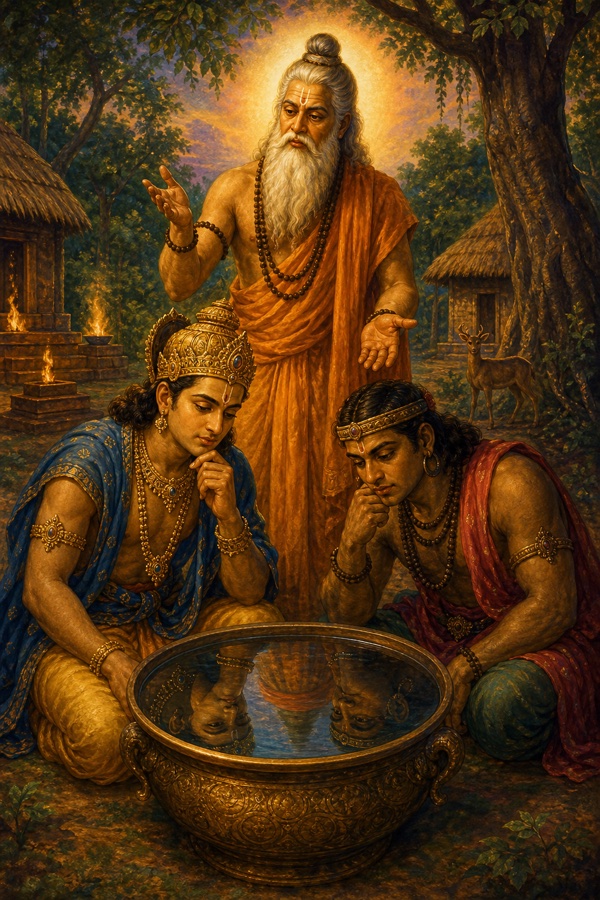
Now comes the scene this page opened with. Prajapati calls for a pan filled with water, an udasharava, and tells them to look at themselves in it and to report whatever about the self they fail to understand. A polished bronze mirror exists in that world and a king owns one; a pan of standing water is what everyone else has, and it is where most people who have ever lived have gone to find out what their own face looks like. Both of them bend down and look. Prajapati asks, “What do you see?” And the answer they give is the pivot on which this whole story turns.
They say, “सर्वमेवेदमावां भगव आत्मानं पश्याव आ लोमभ्यः आनखेभ्यः प्रतिरूपम्”, lord, the two of us see our whole self here, from the hair of the head down to the nails, the very likeness. Prajapati corrects nothing. He sets one more test instead. Go, he says, adorn yourselves well, put on good clothes, make yourselves trim, and then look into this same pan again. Two men who have spent thirty-two years in one cloth, with their hair grown out and their nails uncut, now go and dress like the kings they are: oiled and combed, nails pared, a fresh length of cloth, gold at the ears and the neck. They come back.
Prajapati asks again, what do you see. They say, just as the two of us are adorned, in good clothes, made trim, so are these two adorned, in good clothes, made trim. Prajapati says, this is the self, this is the deathless, this is the fearless, this is brahman. The two of them set off with quiet hearts. An answer that took thirty-two years to reach had looked complete within a few moments.
What Prajapati says while watching their backs recede is spoken to himself alone. They are going, he says, without having reached the self, without having known it. Whichever of the two, gods or asuras, make this their upanishad, they will be defeated. The teacher does not call after them. A man who has closed his own question cannot have it opened from outside, and this story says so without saying it.
Virochana carries his quiet heart back to the asuras and delivers this very upanishad to them: “आत्मैवेह महय्य आत्मा परिचर्यः”. The self alone is to be honored here, the self alone is to be served; honoring the self here and serving the self, a man obtains both worlds, this one and the one beyond. The words are correct. Every single word of them is correct. The self they are pointing at is the body that showed up in the water.
From here the khanda steps straight down into our own time. This is why, it says, even today, of a man who gives nothing, who has no faith, who performs no sacrifice, people say, so, an asura, since this is the upanishad of the asuras. A man who keeps what comes to him, who trusts nothing he is told, who lets the fire in his own house go cold and never feeds a guest, has an entire doctrine behind him whether he knows it or not. And they dress the body of the dead with alms, with cloth, with ornament, holding that by this they will win that other world. Out of one hasty moment at a pan of water a whole custom came, and the custom is running still.
In short: in the pan of water both of them see their own reflection, and on looking again in their finery they see the reflection in finery too. Virochana is satisfied with that, turns back, and delivers the same understanding to the asuras. Prajapati never calls after him, and from this very place the Upanishad exposes the root of the whole custom of decking out the body.
Indra comes back the first time, and the answer made of dream (khandas 9 and 10)
Indra is walking that same road, he has not even reached the gods, and halfway there he stops. What he has seen is called fear by this Upanishad, and it is worth pausing on that word, because what stops him is a plain observation of the kind anybody could make on any road. He thinks: as this one is adorned when the body is adorned, well dressed when the body is well dressed, trim when the body is trim, in the same way this one is blind when the body is blind, lame when the body is lame, maimed when a limb is cut away. He is the king of the gods and he has seen war; he knows what is done to a body and what is left afterward. And the moment this body perishes, that one perishes along with it.
Here the sentence comes out of his mouth that will come back three times over, “नाहमत्र भोग्यं पश्यामि”, I see nothing worth having in this. And he turns around. Think about the turning. He is most of the way home with an answer in his hands and a report to deliver to the gods who sent him, and he goes back instead, picks up firewood, and stands at the same gate again holding the same stick he held thirty-two years ago. Prajapati asks him, Maghavan, you went away with a quiet heart, you and Virochana together; wanting what have you come back? Indra repeats his doubt word for word, the same blind man, the same lame man, the same severed limb.
Prajapati’s answer is three words long: so it is, Maghavan. No scolding, no taunt about why he had failed to see it earlier, no question about what he had been doing all those years. He adds only this, that he will open the same thing further for him, and asks him to stay another thirty-two years. And Indra stays another thirty-two years. Nothing is said about those years, and everything about them can be guessed from the first thirty-two: the same fire, the same wood, the same begging round, the same silence, the same teacher walking past without stopping. In this story the price of every answer has been counted out in years, and that counting is the story’s real teaching.
After thirty-two years the second answer comes. The one who moves about in a dream, held in honor there, that is the self, this is the deathless, this is the fearless, this is brahman. This lies far ahead of the first answer. A man who dreams leaves his body behind, builds his own world as he goes, and while his body lies here he walks about elsewhere, honored, going where he likes. The image in the water has been left behind him. Indra sets off once more with a quiet heart.
And then that halting again. Before he has reached the gods, fear comes into view. He sees that when this body goes blind, that one does not go blind; when the body is lame, that one is not lame; that one takes no stain from the body’s defects, and the killing of the body does not kill him. So far all is well, and the second answer has carried him past everything the first one broke on. Yet in that same dream something seems to strike him, something seems to chase him, he seems to meet with what he dislikes, he even seems to weep. Everyone who hears this has woken at night with a wet face and no cause for it. A state in which weeping survives is hard to call fearless.
Indra comes back a second time, firewood in hand again. Prajapati asks the same question, Indra repeats himself the same way, and Prajapati says the same thing, so it is, Maghavan; I will open this further for you; stay another thirty-two years. By now the repetition has begun to nag at the reader, and that nagging is the method of the story. The same gate, the same firewood, the same question, and every time the student goes one layer deeper into himself.
In short: Indra halts on the road over the image seen in the water, since that image goes blind and lame and perishes along with the body. On his return he gets no scolding and thirty-two more years, and then the answer about the one who moves about in dream. That answer breaks on the same road, since weeping survives inside the dream.
The third return: the one in deep sleep, and five years more (khanda 11)
The third answer is the subtlest of them. Prajapati says, when a man lies asleep, gathered wholly into himself, serene, and knows no dream at all, that is the self, this is the deathless, this is the fearless, this is brahman. The state mentioned back in the sixth khanda has come around, the nightly slipping into the channels of the heart, and the story has arrived at it from the other side. Here the body’s pain reaches nobody and the dream’s terror reaches nobody. By now Indra has spent ninety-six years in that house. He sets off with a quiet heart, and this time his satisfaction looks more solid than before.
And a third time, before he reaches the gods, fear comes into view. This time his question is the sharpest of all, “नाह खल्वयमेवꣳ संप्रत्यात्मानं जानात्ययमहमस्मि”, this one, just now, does not even know of himself that he is this; nor does he know these beings. He has gone into destruction, as it were. I see nothing worth having in this. A stillness in which the knower himself has not survived is a thing he cannot carry back to the gods.
This question is the largest question in the entire chapter. In the state where no sorrow reaches a man, the one who knows has also gone; and what will anybody do with a thing he attains in which no knower is left? Indra stands at the gate a third time with firewood, an old man now in every way that counts, asking for the fourth time. Prajapati says the same three words, so it is, Maghavan, and this time he adds one thing more, that there is nothing else anywhere apart from this. Hearing that sentence, the reader understands that the last word is about to be spoken.
And then comes that small span: stay five years more. After ninety-six, five. Thirty-two, thirty-two, thirty-two and five. Together they make a hundred and one, and the Upanishad repeats the arithmetic itself: this is why people say that Maghavan lived a hundred and one years of brahmacharya with Prajapati. This figure of a hundred and one has now come twice in this chapter. The first time it came with the channels of the heart, of which one alone goes out toward the crown.
It is worth stopping here to ask why Prajapati had withheld the last word so long, since he could have said it on the first day and saved a century. The story answers out of its own construction. The reflection of waking, the wanderer of dream, the serene one of deep sleep, all three stood exactly where Indra was standing on the day each was given. Every answer was opened only as far as the student could see that day, and every time the fear that lifted him onto the next stair rose from inside the student himself.
In short: the answer about deep sleep carries Indra the farthest, and raises the deepest question right there, about what use a stillness has in which a man’s own being is no longer remembered. At the third return Prajapati asks for five more years, and the count comes to a hundred and one. Every earlier answer was opened only as far as the student could lift it that day.
Bodiless, and the highest person: the real answer, and the last words (khandas 12 to 15)
What Prajapati says after a hundred and one years begins with the body itself. “मघवन्मर्त्यं वा इदꣳ शरीरमात्तं मृत्युना”, Maghavan, this body is mortal, seized by death. And this is the seat of that deathless, bodiless self, the place where it takes its rest. Whoever has a body is gripped by the pleasant and the unpleasant, and while a man has a body there is no release from the pleasant and the unpleasant. For the one who has become bodiless the sentence runs, “न प्रियाप्रिये स्पृशतः”, the pleasant and the unpleasant do not touch him at all.
Then comes an example lifted out of the sky. The wind is bodiless; cloud, lightning and thunder, all of these are bodiless. As these rise out of that space, reach the highest light, and come forth each in its own form, so this samprasada rises out of this body, reaches the highest light, and comes forth in his own form. This very line has already appeared once, in the third khanda, before the story began. A hundred years have gone round and the text has come back to the same sentence, and now the man hearing it is ready for it.
Arrived there, he is the uttama purusha, the highest person. He moves about there, eating, playing, taking his delight with women, with carriages, with his own people, and he gives no thought at all to this body that stayed attached behind him. Then comes the comparison taken from a bullock cart, which is the machine everyone in that country understands. As the draft animal stands yoked to the cart, so this prana stands yoked in this body. The animal is harnessed to the cart for the length of the journey and walks out of the yoke at the end of it. What the cart is to the yoked animal, this much is what the body is to him.
After this Prajapati takes the senses one at a time and sets each of them aside. Where this eye is fixed upon space, there is the person of the eye, and the eye is there for seeing. The one who knows, let me smell, that is the self, and the nose is there for smelling. The one who knows, let me speak, that is the self, and speech is there for speaking. The one who knows, let me hear, that is the self, and the ear is there for hearing. Handing each sense its own task, the way a household hands each servant one duty and keeps the master’s work separate, he separates out the one seated behind them.
And the one who knows, let me think, that is the self, and mind is his divine eye. With that divine eye, with mind, he sees and takes his delight in those desires that are in the world of brahman. The real meaning of that person seen in the eye opens here at last. What Prajapati had said a hundred and one years earlier was exactly what he said then; to hear it, Indra had to come back three times out of his own interior, shedding one layer of his own understanding at each return.
The khanda ends where the announcement began. The gods worship this very self, and therefore all worlds are theirs and all desires. Whoever seeks out that self and knows it obtains all the worlds and all the desires. And then that one phrase is written down twice over, prajapatiruvacha, prajapatiruvacha, Prajapati said, Prajapati said. Doubling the last words is how a teaching in this book marks its own ending, the way a man finishes what he has to say and closes a door softly behind him.
The three khandas that remain are very short and all three carry the note of leave-taking. The thirteenth khanda is a single sentence, and it is spoken in the speaker’s own voice, the only place in the chapter where the I is the one walking. From the dark I go to the dappled, from the dappled to the dark; shaking off evil as a horse shakes out its hair, freeing myself as the moon frees itself from the mouth of Rahu, shaking off the body, my work accomplished, I reach that uncreated world of brahman that nobody has made. Both images come from things these people have watched: a horse coming out of water and shaking itself from nose to tail, and an eclipse, where the moon goes into a mouth and comes out again whole while the whole settlement stands outside and watches it happen.
The fourteenth khanda returns to space, back where the first khanda stood. Space is what carries name and form out and holds them apart, and what lies within these two is brahman, the deathless, the self. Then the same note again: I enter the assembly hall of Prajapati, his dwelling; let me be the glory of brahmanas, the glory of kings, the glory of the people; I have attained glory. And at the end a small prayer, that his going may never be toward that white, toothless, slippery place.
The fifteenth khanda counts out the line of transmission and rests on a householder’s daily round. Brahma gave this knowledge to Prajapati, Prajapati to Manu, Manu to his descendants, and with that last handing over it arrives at ordinary people. Having studied the Veda in the teacher’s house in the appointed manner, in the time left over from the teacher’s work, having come back to his own family, keeping up his study in a clean place, making his people righteous, settling all his senses in the self, injuring no living creature away from the places appointed for it, whoever carries on this way as long as he lives reaches the world of brahman, “न च पुनरावर्तते न च पुनरावर्तते”, and he does not come back again, he does not come back again. A hundred and one years at a teacher’s door, and the book closes on a man at home with a family and a field and a fixed hour for his recitation.
In short: the final answer hands the body over to death and calls it the seat of the bodiless self, and shows that samprasada coming forth in his own form in the highest light. Handing each sense its own work, it separates out the knower seated behind them, and calls the mind his divine eye. The last three khandas close on the shaking off of evil, on the brahman within name and form, and on the round of that householder who never comes back.
And in the end, toward yourself
The most useful thing in this chapter may well be that halting of Indra’s. He got an answer every time, walked away satisfied every time, and every time saw on the road how far that answer would carry him. Satisfaction refused to settle in him, and that was his real capital. Virochana had been given the very same answer, on the same day, in the same courtyard, bent over the same pan, after the same thirty-two years of the same work. The whole difference was that he asked nothing further.
And then the matter of the dahara space. Most of what we know about ourselves has come from mirrors, from other people’s eyes, from dressing well and keeping trim, and it needs fresh support every morning. Virochana’s answer is the one in every reflective surface we pass. The first khanda says there is as much room inside the heart as there is in the whole sky, and that the world above and the earth below are both kept there. On the day that sounds true for even one moment, the answer from the pan of water goes small on its own.
The last thing is the arithmetic. Thirty-two, thirty-two, thirty-two and five. By writing out a hundred and one years this chapter has said that what we want to grasp on first hearing does not come on first hearing at all. And it has also said that a teacher never scolds a student who comes back. For the one who returned, the gate stood open just as wide each time, and the one who reached the final answer was the one who came back three times.
Source: Chandogya Upanishad, chapter 8, khandas 1 to 15; read against the Sanskrit, with Shankara’s reading noted where readings differ.