On this page
The courtyard light is going amber and a young man stands at the gate. Deerskin over one shoulder, a staff in his hand, and in the set of his neck that stiffness which comes of having the whole Veda by heart at twenty-four. His name is Shvetaketu, son of Aruni. Twelve years ago this same boy walked out through this gate on his father’s word, and today he has walked back in. Uddalaka looks at him for a long while and says nothing. He is looking at a stranger with his own face, a man he last saw as a child of twelve. Then he seats the boy beside him and puts one question, the sort of question twelve years of study never answered. In a few moments every trace of pride drains out of the young face, and the most famous chapter of the Chandogya Upanishad opens right there.
Among the eight chapters of the Chandogya, this sixth one is the turning stone. The chapters before it have been teaching upasana, worshipful meditation: the inner method of the song, the greatness of prana, the secret of the fires, the five fires and the two roads a man walks after death. Here upasana steps back and the thing itself comes forward. Over sixteen khandas Uddalaka Aruni shows his son that one thing by knowing which everything else stands known, and nine times, at the end of nine separate illustrations, he repeats the single sentence that the whole later tradition will carry on its head and call the mahavakya, the great utterance. The Upanishad asks something very plain here: what we call our own existence, where is its root?
The main figures of this chapter
Uddalaka Aruni: a teacher of the Gautama line, who wants to take his son past the texts and show him sat, sheer being.
Shvetaketu: the son home at twenty-four after twelve years of study, whose pride sits down at the very first question.
Sat: that one existence without a second, out of which came fire, water and food, and back into which all of it goes.
The three deities: tejas (fire), ap (water) and anna (food), out of whose three colors fire, the sun, the moon and lightning are woven.
The old mahashalas and mahashrotriyas: the great householders and the deeply learned men of an earlier age, on whose authority Uddalaka says this knowledge is old.
The son who came home after twelve years, and a lump of clay (khanda 1)
The story starts from behind. Long before this evening, when Shvetaketu was twelve, his father had said to him, “श्वेतकेतो वस ब्रह्मचर्यं न वै सोम्यास्मत्कुलीनोऽननूच्य ब्रह्मबन्धुरिव भवति”, Shvetaketu, go and live as a brahmacharin and study, for in our family, dear boy, nobody goes unread and is called a brahmana on the strength of birth alone. The word he used for that kind of man was brahmabandhu, a relative of brahmanas, a man who has the family connection and nothing else, and it was the coldest thing one learned household could say about another. There was no taunt in it toward the boy. There was a condition. In this house a name carries no weight of its own; what a man has gone down into himself and fetched up, that gets counted. The boy went, and stayed away twelve years. He went to live in another man’s house, fetching wood and tending his fires and eating what was given, and taking the Veda into himself the only way it existed in that world, by voice, line after line, morning after morning, until the whole of it lived in his memory with no page anywhere to fall back on.
He came back at twenty-four. He had read all the Vedas, and he had brought one more thing home with him: the confidence that nothing was left to learn. That confidence had grounds. A young man who could hold all four Vedas in his memory was among the most accomplished people alive in that country, and he was walking home to a father who would now have to find him a wife, a household, a standing. The mula keeps three words for him, mahamana, anuchanamani and stabdha, a man who thinks himself great, a man who thinks himself learned, and a man gone stiff. His father read all three in one glance. He offered no scolding. He only asked whether the boy had also asked his teacher for that adesha, that instruction by which the unheard becomes heard, the unthought thought, the unknown known.
Shvetaketu had no answer. Such a question had never reached his ears. Nobody in twelve years had told him there was a further thing to ask for, and there is a small terror in learning that at the end of an education. What he asked back had a child’s honesty in it: surely those teachers did not know this themselves, for had they known it, why would they have kept it from me. Then he set his head before his father and said, now you tell me. He had walked in as a scholar and in the space of a few sentences he had become a student again, in his own house, to his own father. Uddalaka gave his assent in a word, so be it, dear boy. The whole sixth chapter comes out of that one word. Study had filled the boy; one question emptied him; and being empty is the first qualification here.
Now the father picks up the most ordinary thing within reach, clay. There was a potter in every settlement, and everything a house drank from and cooked in and stored grain in had come off his wheel. Uddalaka takes a lump of it in his hand and says, know this, and everything made of clay stands known. Pot, bowl, saucer, trough, what are these. The sentence in the mula is very sharp here, “वाचारम्भणं विकारो नामधेयं मृत्तिकेत्येव सत्यम्”, the modification is a handhold of speech, a name laid on, and what truly is, is clay. A pot breaks into a shard, a shard grinds down into dust, and the one thing that stands unbroken through all these conditions is the real one.
The same thing is said over again with gold. Know one nugget and you know the necklace, the earring, the bangle and the ring, because the names differ and the weight in every one of them is that same gold. A goldsmith’s customer knew this in his bones, since ornaments in that world were weighed at the counter and melted down and made again when a family’s needs changed, and the value never lay in the shape. Then with iron: know a single nail-parer and all dark iron stands known. Three times the refrain comes back, the name changes, the thing stays. Uddalaka says it three times because the mind refuses it on the first pass. The first time it sounds like a clever trick, the second time like a habit, and by the third the listener has begun saying the next line himself.
This illustration is more than a toy of logic. Uddalaka is showing that knowing comes in two kinds. In one you go on counting things and the list never closes. In the other you take hold of the single stuff out of which the list is made, and the list settles itself. In twelve years Shvetaketu had gathered a great deal of the first kind. His father is turning him toward the second, and the turn begins with a lump of clay, with no lofty word anywhere in sight.
In short: the condition in that house was that a man would be measured by his knowing and never by his name. The son came home read, and came home without having asked for the instruction by which all things are known. Showing him clay, gold and iron, the father lays the first step: shapes are names, and what stands through every shape is the truth.
In the beginning was sat: fire, water, food, and name and form (khandas 2 and 3)
Now the father takes him back, all the way to where no shape existed at all. He says, “सदेव सोम्येदमग्र आसीदेकमेवाद्वितीयम्”, dear boy, in the beginning all this was sat alone, one only, without a second. The words are plain and they are heavy. Sat means no deity here and no figure, it means being. And without a second means that nothing is left over to set beside it, no material to work on, no second craftsman standing by.
Uddalaka himself reports that some people say the reverse, that in the beginning there was asat, non-being, and out of that all this came. He is quoting a live opinion, held by men his son would meet in assemblies, and he puts it fairly before he touches it. Then he takes that position away with a question: how could it be so, how would being issue from non-being? This is the Upanishad’s manner. It throws no abuse, it asks, and the question is so plain that the answer has no cover left to reach for. A thing with no existence of its own, how does it become a parent? So follow the causes back as far as you can go, and at the end what you will find is being.
Then creation comes, and it comes by a glance. That sat saw: let me become many, let me spread. Out of that seeing, tejas came, heat and fire and light. Tejas saw the same thing, and out of it came ap, the waters. The waters saw the same thing, and out of them came anna, food. In the middle of this Uddalaka sets down two everyday proofs that bring the whole of the philosophy into the kitchen and the body. When a man grieves or burns, sweat comes out on him, so water is born of heat. And where the rain falls, there food grows thickest, so food is born of water. Both proofs were available to anybody standing in a field in the month before the rains arrived.
This order is worth keeping in mind, since the whole chapter will climb up and down this ladder: sat, tejas, water, food. No messenger arrives in the middle of it, no craftsman kneads the clay. What is, spreads out of its own inside, the way a seed splits from within. This is why, when the jiva comes up later on, it will be treated as that same sat, its edge run all the way in, and never as a guest who arrived from some outside place.
The third khanda brings all this down to living creatures. Three seeds are given for everything that takes birth: andaja, born from an egg, jivaja, born from a living mother, and udbhijja, born by splitting the earth open. A boy who had grown up near fields and byres and hedges could put a name to each of the three before his father finished the sentence. After this comes the line that is the backbone of the chapter. That deity thought, “अनेन जीवेनात्मनानुप्रविश्य नामरूपे व्याकरवाणि”, let me enter in as this living self and open out name and form, unfold them, set them apart from one another.
That one sentence holds the whole map of the world. Name and form were never pasted on from outside; they are opened out by the same sat seated within. And the one seated within is no other, it is the very deity that came in as the jiva. Then it announces that it will make each of these three deities threefold, trivritkarana, folding a share of the other two into each one. Here the father tells his son, now understand how this becoming threefold works, and the next khanda opens up in front of the eyes.
In short: in the beginning there was only sat, one and without a second, and being can never issue out of non-being. Out of that sat came fire, out of fire water, out of water food, and sweat and rainfall are the daily proof of it. Then that same sat came down inside as the living self and opened out name and form.
Fire, sun, moon, lightning: the accounting of three colors (khanda 4)
The fourth khanda starts at the household hearth. A fire is burning, the same fire the evening meal was cooked on. Uddalaka tells his son to look at it carefully, there are three colors in it. Anybody who has watched wood burn knows the three without being told: the red of the flame, the pale of the smoke, the black of the coal that is left. The red in it belongs to tejas, the white to the waters, the black to food. Once all three have been picked out, the fireness of the fire has gone off somewhere, and what is left is three forms. The word fire stays behind as a handhold of speech, that same vacharambhana which came up in the matter of the clay.
Then the same accounting is run on the sky. In the sun the red is tejas, the white is water, the black is food; the sunness of the sun opens out in the same way. In the moon, those same three. In the lightning, those same three. Saying it four times is a drill and no waste of breath. This was a household where things were learned by repetition until they sat in the body, and the father is using the method his son has lived inside for twelve years. The student is being given the habit of standing in front of any shining thing, refusing to stop at its name, going through to its components, and then through the components to their root.
After this Uddalaka gives a citation that keeps this chapter from standing alone. He says that the great householders and the great shrotriyas of the old days knew this, and used to say that nobody could any longer set before them a thing that was unheard, unthought, unknown. Those were the men whose names opened a hall, and quoting them is how a teacher told his son that the thing he was hearing was older than the house they sat in. That is the very adesha whose name came up in the first khanda. For a man who has seen this three-colored frame, no new object stays a stranger for long.
And they said this as well, that if something does look unfamiliar, it is a joining of these same three deities, a mixture of them. Red in it, then tejas; white, then water; black, then food; and whatever refuses to be identified is a blend of the three. This is an enormous relief. The world’s inventory looks endless, and its alphabet is small, and once the alphabet is known, every new word on the page can be read.
Then the father lays down the next turn. Up to here the talk has been of the outside, of fire and the sun and the moon. He says, now understand how these same three deities become threefold once they have reached a human being. From here this Upanishad comes down out of the sky into our plate and our sleep, and what has been a handsome doctrine until now becomes a fact inside the body.
In short: open fire, the sun, the moon and lightning into their three colors and each one’s own name is left standing as a handhold, with tejas, water and food remaining. It was on this strength that the old shrotriyas said nothing unknown was left for them. Whatever looks unknown is a mixture of these three.
The food eaten and the fast of sixteen parts (khandas 5 to 7)
The fifth khanda lifts the subject off the plate. Food once eaten goes in and divides three ways. The heaviest portion leaves as waste, the middle portion becomes flesh, and the finest portion becomes mind. Water once drunk divides three ways as well, the heavy portion into urine, the middle into blood, the finest into prana. Fire taken in divides three ways too, the heavy portion into bone, the middle into marrow, and the finest into speech.
This is why the line comes, “अन्नमयँहि सोम्य मनः आपोमयः प्राणस्तेजोमयी वाक्”, dear boy, the mind is made of food, prana is made of water, and speech is made of fire. It sounds upside down to us, since we go about treating the mind as a thing pitched above the body. Uddalaka pulls it down from no height; he only gives its address. The mind is an instrument hung in no air at all, it sits on the very ladder that bone and blood sit on, on the finest rung of it.
In the sixth khanda this is proved from the kitchen. Curd is being churned, which in that house was a sound heard before dawn every day of the year, the wooden staff turning in the pot on its looped rope. The finest part of it rises to the top and turns into ghee. In the same way the food that is eaten gets churned, and its fine part rises and becomes mind. The water that is drunk gets churned, and its fine part rises and becomes prana. The fire that is taken in gets churned, and its fine part rises and becomes speech. In the creak of the churning rope this whole philosophy is sitting.
Shvetaketu says again what he will now say every single time, tell me more, father. This time Uddalaka has him run an experiment. The seventh khanda is the strangest experiment in the whole literature of the Upanishads. The father says, a man is made of sixteen kalas, sixteen parts. Eat nothing for fifteen days, drink as much water as you please, since prana is made of water and will hold while you go on drinking. The boy goes fifteen days without food. There is no argument recorded, no asking why. He does it in his father’s house, with the kitchen going on around him, for the whole of a fortnight.
On the sixteenth day he comes to his father. The father says, recite for me, the riks, the yajus, the samans. Now understand what is being asked. Those texts existed nowhere outside the memories of the men who carried them. There was no shelf to take one down from and no copy in the house. A man who lost his recitation had lost the thing itself, and everything he was in the eyes of other men went with it. The boy folds his hands, nothing is coming to me. Twelve years of memorized learning are somewhere inside him and they will not rise. The father says, as when a great blazing fire is left with a single ember the size of a firefly, and very little can be burned with that one, so of your sixteen parts a single part is left, and the Vedas do not come into the grasp of one part.
Then he says, now eat, and my words will make sense to you. Shvetaketu eats and comes back. Now whatever his father asks him, the whole of it comes. Then the same image is turned over and set down again: put grass and straw on that one ember the size of a firefly and fan it, and it flares up, and now a great deal can be burned with it. In the same way, on getting food, your one surviving part flared up, and the Vedas came back to hand.
The message of this experiment is very humble. Memory, recitation, learning, reasoning, all of it rests on food, and food is a branch of that same sat. The learning Shvetaketu came home stiff about turned out to be a thing that goes out in fifteen days. His father showed him this by giving him the taste of it and never by telling him. From here the son becomes fit to listen, and from the next khanda begins the great utterance for which this whole chapter is known.
In short: food eaten, water drunk and fire taken in each divide three ways inside and reach up into mind, prana and speech, the way the fine part of churned curd rises and becomes ghee. A fast of fifteen days gave Shvetaketu the taste of this, and his memory, going out like a lamp, flared again the moment he ate.
Sleep, hunger and thirst: tat tvam asi for the first time (khanda 8)
The eighth khanda opens on an invitation. Uddalaka says, dear boy, understand from me the far end of sleep. When a man sleeps, he has joined with sat, he has gone home into his own. The Sanskrit word for sleeping, svapiti, the father breaks open and shows: sva and apita, gone into his own. That is why they say of him that he sleeps, because he has gone away to his own house. Every night we go back into that same sat, and we get up in the morning carrying none of the news.
Then he sets down the bird, a scene nobody forgets once he has read it. A string is tied to a bird’s leg and the other end of the string to a peg, which is what a man did with a caught bird in a courtyard where there was no cage. The bird flies off in this direction, flies off in that one, finds lodging nowhere, and comes to rest, tired out, on the very bond that holds it. The mind runs about in just this way, direction after direction, finds no place to settle in, and in the end comes to rest against prana. The father ties it up in one line, “प्राणबन्धनँ हि सोम्य मनः”, the mind is bound to prana.
Now hunger and thirst. Hunger in Sanskrit is ashanaya, and Uddalaka opens the sense of the word. When a man grows hungry, it is the waters that carry off what he has eaten. The way a man who leads cows is called gonaya, one who leads horses ashvanaya, one who leads men purushanaya, so those waters are called ashanaya, the leaders of food. Every one of those three words named a job somebody in the village actually held, and the father is using them the way a man uses tools he knows are in the house. The restlessness that goes by the name of hunger and gets us up onto our feet is the doing of water.
Then he speaks of the shoot. A thing that has broken through and come up stands on a root somewhere. So what root does the shoot of hunger stand on? On food. And food on what, on water. And water on what, on fire. And fire on what, on sat. With thirst the same walk is made. Thirst is called udanya, since in thirst it is fire that carries off what has been drunk, and that too comes down the same ladder and halts on sat.
Here the father speaks the sentence that is the ground of the whole chapter, “सन्मूलाः सोम्येमाः सर्वाः प्रजाः सदायतनाः सत्प्रतिष्ठाः”, dear boy, all these creatures have sat for their root, sat for their dwelling, sat for the ground they stand on. Taking hold of hunger and thirst, small things, daily things, things that put us to a little shame, Uddalaka brings the boy to the very place he had brought him by the story of creation. This is his way of teaching.
Then he draws the map of the hour of death, which will come back twice more in this chapter. When a man begins to go, his speech gathers into mind, mind into prana, prana into tejas, and tejas into that highest deity. Nothing is lost, everything turns inward, the way at dusk the shops close one after another down a lane and the lane goes back at last into the same darkness it woke out of in the morning.
And now, for the first time, the sentence arrives, “स य एषोऽणिमैतदात्म्यमिदँ सर्वं तत्सत्यँ स आत्मा तत्त्वमसि श्वेतकेतो”, that which is the finest essence, all this has that for its self, that is the truth, that is the atman, and Shvetaketu, you are that. Notice that the father says his son’s name at the end of it. He is naming the young man sitting in front of him, in his own courtyard, at the end of a sentence about the ground of everything that exists. The son listens, and then says the same thing over, tell me more, father. That request will rise eight times again, and each time the father will set down a new illustration and repeat the same closing line.
In short: in sleep a man goes back every night into that same sat, and forgets it on waking. The mind is bound to prana the way a bird is bound by a string. Dig at the root of hunger and thirst and out comes the sat on which all creatures are standing. At this place the sentence falls for the first time: you are that.
Honey and rivers: many names, one sap (khandas 9 and 10)
The ninth khanda opens on a hive. The bees fly all day long. One settles on a neem, one on a mahua, one on a jamun, one on some wild flower at the field’s edge. All of them come back carrying different saps and all of them pour what they carry into that one comb. Honey in that world was taken from wild combs hanging in the branches, and the man who took it knew every tree his bees worked. By evening the whole of it has mixed into one, and the name put on it is honey. Now draw out a single drop of that honey and ask it which tree it belongs to, and no answer will come.
This is what Uddalaka says. Those saps, while they stood apart, had no knowledge of the kind, I am the sap of such a tree, I am the sap of such another. In the same way all these creatures go into sat and merge there, and have no knowledge that they are merging into sat. In sleep, in dissolution, in death, this same thing happens each time. The names stay behind, the sap goes in, and once it is inside it stands no smaller and no separate from anything. That is the second time the closing sentence is spoken, over a comb of honey.
Then the father adds something a little bitter and very true. On the way back those creatures become again exactly what they were: a tiger a tiger, a lion a lion, a wolf, a boar, a worm, a moth, a gnat, a mosquito, whatever each of them is, that is what each becomes again. Going back into that one changes nobody by itself. A man who failed to recognize himself while awake puts the same old identity back on when he rises from sleep. Recognizing is work for the waking hours.
The tenth khanda moves onto water. Rivers run, some toward the east, some toward the west, and the ones this house knew ran east across the plain to the sea while others in the far country turned the other way. Water lifted out of the sea reaches the sea again, and having got there it becomes that same sea. Having arrived, they have no knowledge of the kind, I am the Ganga, I am the Yamuna, I am the Sindhu. Each of those names carried a stretch of country with it, its towns, its crossings, its fords, the men who were born on its bank and buried their fathers there. The names belonged to the banks and never to the water. The bank fell away, the name fell away, and what had come flowing lost nothing at all, it arrived at its larger form.
One thing runs alongside both illustrations and is worth catching hold of. Merging here is no extinction. In the honey the sap did not die, in the sea the river did not dry. What falls away is the claim of separateness, the border we have drawn around ourselves. What stays is being, which was the same being before as well, pressed down under a small name. For the third time the same line drops: you are that, Shvetaketu.
In short: the saps of hundreds of trees go into a comb and become one honey and forget their old address. All the rivers reach the sea and become the sea. Creatures go back into that same sat without knowing it. And going back without knowing loosens no old identity, it comes back again on waking.
The life in the tree and the seed of the nyagrodha (khandas 11 and 12)
The eleventh khanda takes us to a big tree. Uddalaka says, strike this tree at the root and sap will flow and the tree will go on living. Strike it in the middle and sap will flow and the tree will go on living. Strike it at the top and sap will flow there too and the tree will go on living. It stands filled through and through with the living self, drinking its sap, glad. A wound is made, the sap runs out, and the life seated inside stays exactly as it was.
Then he puts up the reverse picture. The life lets go of one branch of that same tree, and the branch dries. It lets go of a second, and that one dries. It lets go of a third, and that dries as well. And when it lets go of the whole tree, the whole tree dries. Anybody who has watched one limb of a tree go gray while the rest stays in leaf has seen the first half of this, and anybody who has cut up a dead tree for firewood has seen the second. Here the definition of living and dying comes out very clean. Being green is the mark of presence, drying the mark of absence. The wood is the same wood, the soil the same soil, the water the same water, and one thing withdrew and the whole of it became a stump.
On this comes the sentence that is the life of the khanda, “जीवापेतं वाव किलेदं म्रियते न जीवो म्रियते”, with the life gone out of it this dies, the life does not die. Notice that no consolation is being handed over here, an observation is being set down. The body is a lodging, and a lodging falls in once it has been emptied. On the one who emptied it the law of falling has no hold at all, since it never rested on any wall. The sentence comes a fourth time here, beside a tree with sap running out of a cut in its bark.
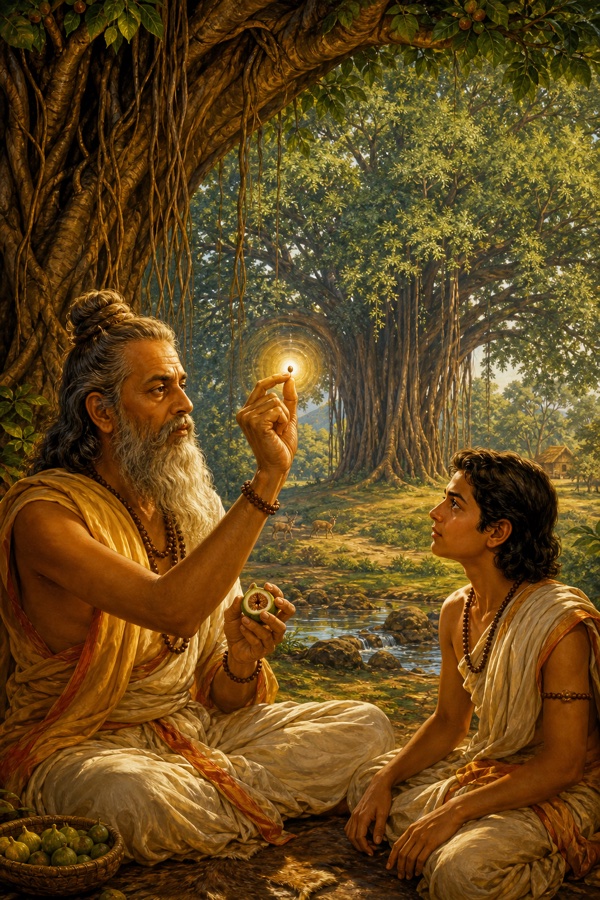
The twelfth khanda happens under that same tree, and the tree is a nyagrodha, the banyan that stood at the edge of every village and under which the whole settlement met, argued, traded and slept through the afternoons. The father says, fetch me a fruit of the nyagrodha from over there. The boy brings it. Break it open. I have broken it. What do you see in there. Tiny grains, sir. Break one of these. I have broken it. Now what do you see in there. Nothing at all, sir. This small exchange is the dearest thing in the whole chapter, because in it a twenty-four year old reciter of the Veda is standing with his hands open like a child, answering in three and four words, doing as he is told.
Then the father says, that fineness you are unable to see, out of that very fineness this great banyan stands up. And then he says two words that are the gentlest in this whole chapter, “श्रद्धत्स्व सोम्य”, dear boy, have faith. Here reasoning steps back a little and shraddha, trust, comes forward. The eye has its limit, and this thing lies on the far side of that limit. What lies there has to be granted first, and only then does it begin to show itself to the one who granted it. With that the sentence falls for the fifth time.
The banyan illustration goes deeper still if you have looked at a banyan. Aerial roots hang down from its branches, touch the ground, and become new roots. One tree spreads until it is a whole forest, wide enough to shade a market, old enough that nobody in the village remembers it being planted, and the entire map of that forest was sitting inside the invisible point that showed nothing even when it was split. This is the ground for saying, over a seed too small to see into, that what is finest of the fine is the self of all this, and that is you.
In short: strike the tree anywhere and the sap flows and the life keeps its hold; the branch it does let go of dries on the spot. With the life gone out of it this dies, the life does not die. And split the banyan seed and look, nothing shows inside, and out of that unseeable fineness the huge tree is standing.
Dissolved salt and the traveler from Gandhara (khandas 13 and 14)
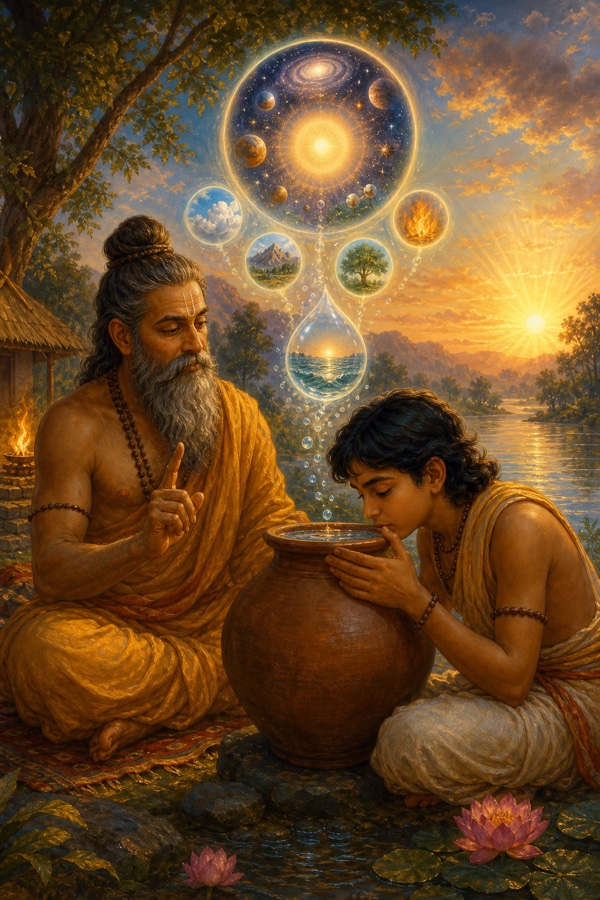
The thirteenth khanda begins at night and finishes in the morning. Salt in that country came in hard lumps carried inland by traders from the coast and the salt pans, and a household kept it the way it kept anything costly, in one piece, broken off as needed. The father says, put this lump of salt into water and come to me in the morning. The boy does exactly that. In the morning the father says, that salt you put into the water last night, fetch it out for me. The boy puts his hand into the pot, feels about in it, and finds nothing. The salt has dissolved. A thing that lay visible on the palm last night will simply not be caught by the hand today.
Then the father says, take a sip from the top. How is it. Salty. Take one from the middle. How is it. Salty. Take one from the bottom. How is it. Salty. The father says, now set it aside and come and sit with me. The boy does so, and the salt stays there exactly as it was, unseen. The whole experiment ties itself into one sentence here, “अत्र वाव किल तत्सोम्य न निभालयसेऽत्रैव किल”, dear boy, it is right here and you fail to perceive it, it is right here. On the strength of a taste in his own mouth, the son hears the sentence a sixth time.
The beauty of this illustration is that it changes the very method of proof. While the salt was a lump, the eye was its evidence. After it dissolved the eye went useless and the tongue became the evidence. With sat the case runs the same way. The senses that go looking for it outside will never show it, since it is an object laid down in no place. And its taste is present in every experience, exactly the way the salt was present in every part of the pot.
The fourteenth khanda begins with an abduction. Gandhara lay far to the northwest, weeks of walking from the country where this conversation is happening, past rivers and through territory where the speech changed. A man is carried off from there, his eyes bound with a cloth, and set down far away in an empty place. The cloth is still tied on. He cries out, facing east, facing north, facing south, facing west. I was brought here with my eyes bound, I was left here with my eyes bound. The directions stand all around him and every one of them is useless, since he can see nothing.
Then somebody comes along, unties the cloth from his eyes and says, Gandhara lies in that direction, walk that way. Now the man, who has sense in him, walks on asking from village to village, and reaches Gandhara. That is how a person crossed country in a world with no maps, by asking at each settlement for the name of the next one, and it took as long as it took. Uddalaka says that a man who has an acharya comes to know in just this way. And then he sets down the line that marks this khanda off from the others: his delay lasts only so long as it takes for this body to be let go, and then he merges into that. The sentence is spoken for the seventh time, over a man walking home.
Two things stand together here. First, the teacher builds no new place; he unties the cloth and names the direction. The walking has to be done by the walker, the asking from village to village by the asker. Second, Gandhara was that man’s own home. He had a return to make, with no foreign country waiting at the end of it. That is what this whole chapter is about, and that is why the sentence takes the form, you are that, with no becoming asked of you.
In short: the salt dissolved at night will not come to hand in the morning, and it meets you in every sip, because it has become a thing for the tongue and has stopped being a thing for the eye. And the man left blindfolded reaches home when the cloth comes off, with no knowledge of directions in him. The teacher unties that cloth, and the home was always his own.
The last hour and the heated axe (khandas 15 and 16)
The fifteenth khanda takes us into a room all of us have sat in at some time. Someone is very ill. In a house of that time the whole family was in that room, the dying man laid on the floor or on a low cot, the near relatives and the neighbors crowded in, because nobody was taken anywhere else to die. The people of the house sit around the bed and ask the same thing over and over, do you know me, do you know me. Each of them says his own name and waits. The Upanishad has set this scene down with great compassion and with no ornament laid on it. So long as his speech has not gathered into mind, mind into prana, prana into tejas, and tejas into that highest deity, so long he knows them.
And at the hour when that sequence completes itself, he knows nobody. The names go on being called and no answer comes back. The family takes this for the end. Uddalaka calls it a going home. The instrument by which recognizing was done has gathered inward, and so the language of recognition has closed. This is the same ladder that was shown in the eighth khanda in the matter of sleep, with no morning waking at the end of it this time.
Putting this khanda in this place is itself a teaching. Eight illustrations have gone by, clay, honey, river, tree, seed, salt, blindfold, and now this one. In the first seven the listener was a spectator. In this eighth he walks into the story himself, because this room is his own room, and the man lying in it will one day be him. This is why the same line falls heaviest right after this scene, and it is the eighth time it is spoken: you are that.
The sixteenth khanda takes us into a court. A man is brought in held fast by the hand, dragged in by the men who caught him, in front of the people who will decide what happens to him. The charge is that he has stolen, that he has committed a theft; heat the axe for him. Old justice had a hard custom, a heated iron axe was laid in the accused man’s hand, and the man’s own skin was allowed to give the verdict in front of everybody watching. Uddalaka takes this custom up as a mirror and never as justice, and he draws one inward thing out of it.
He says, if the man has really done it, he makes himself into a falsehood. Covering himself under falsehood, he takes hold of that heated axe, and he is burned, and he is put to death. And if he has not done it, he makes himself into truth. Putting himself under truth, he takes hold of that same heated axe, and he goes unburned, and he is let go free.
What is being said here is larger than a story of a miracle. Whatever a man takes cover under becomes his armor. The man who takes cover under falsehood grows as weak as that falsehood, and around the man who takes cover under truth stands the very sat out of which fire came. Fire is tejas, and truth is the root of tejas; for the branch to burn a man who is standing beside the root stops being possible.
And on this the chapter closes. For the ninth and final time the same sentence is said, you are that, Shvetaketu. This time the son asks for nothing further. Eight times he had said tell me more, father, and the ninth time he says nothing, and that silence in a courtyard at the end of a long conversation is the whole result of the chapter. The mula says only this much, “तद्धास्य विजज्ञौ”, he came to know it, he came to know it. The repetition is the mark of an ending, and the mark as well of a knowing that has stopped being borrowed. The stiffness this chapter began with is nowhere in the room.
In short: the dying man’s speech gathers into mind, mind into prana, prana into tejas, and tejas into that highest deity, and from then on he recognizes nobody. The man standing before the heated axe is armored by whatever he takes cover under. For the ninth time the same sentence falls, and this time the son asks nothing further.
And in the end, toward yourself
The nine illustrations that came through this chapter were all picked up from one place: the kitchen, the garden, the river, the court and the sickroom. Uddalaka took his son on no tour of the heavens. He picked up the very things Shvetaketu saw every day and had never once rested his eyes on. This is the most practical teaching in the chapter. What has to be found is kept in no other place, and the manner of looking has to change, and a change of manner wants a ladder, which gets built out of whatever is lying near the hand.
The second thing concerns the boy. He had come home taking it that his learning was finished. His father opened the whole account with one question, and the boy did the hardest thing there is: he granted that he did not know. After that, for sixteen khandas, he went on saying one sentence, tell me more. In our own lives, whatever has really opened has opened after that sentence. On the day we set down the claim of knowing everything, that is the day somebody puts a pot of salt water in front of us and says, taste it.
And the third thing. The sentence of this chapter hands you a piece of news that is already true, and it asks you to go and become nothing at all. In sleep you return there every night. Hunger reminds you every day of that same root. What refuses to show in the banyan seed is at work inside you. This much is left to do, that some day, in the middle of some mouthful, you stop and recognize the taste. What Uddalaka said to his son nine times, he said for that one pause.
Source: Chandogya Upanishad, chapter 6, khandas 1 to 16; read against the Sanskrit, with Shankara’s reading noted where readings differ.