On this page
Speech walked out of the body and stayed away a full year. When she came back she found the ones she had thought helpless without her all alive. They had gone on the way mute people go on, breathing with the breath, seeing, hearing, thinking. Speech entered again without a word. Then the eye went, then the ear, then the mind, and every time the same scene repeated itself. None of them could bring the body down by leaving it. Then the breath made ready to go, and the way a fine horse tears out the stakes that tether his feet with one toss of the head, it shook all the others loose at the root. They came running and gathered around it.
This fifth chapter of the Chandogya Upanishad runs through twenty four khandas, and three large episodes open one after another inside it. First the supremacy of prana, the breath, and a rite called the mantha that belongs to it. Then the defeat of Shvetaketu in the assembly of Pravahana Jaivali, king of the Panchalas, out of which come the five fires and the two roads a man takes after death. And at the end, in the courtyard of king Ashvapati Kaikeya, the lore of Vaishvanara given to six great masters of the Veda. One question stands under all three: the thing that holds everything up, where does it sit, and in what shape should a man worship it? The answer slides slowly from the outside inward, past space and the sun and down into a man’s own body.
The main figures of this chapter
Prana: the chief breath, at whose rising the body falls in a heap; the first and the last hero of this chapter.
Prajapati: father of the breaths, who answered his quarreling children with a test and withheld the verdict.
Shvetaketu Aruneya: a young man full of his learning, left without an answer to five questions in the assembly of the Panchalas.
Uddalaka Aruni: Shvetaketu’s father, a teacher of the Gautama line, with the nerve to own that he does not know and then to go off and learn.
Pravahana Jaivali: king of the Panchala country, who held the knowledge that had stayed in kshatriya hands until then.
Ashvapati Kaikeya: the king with no thief in his realm, who showed six masters of the Veda the whole of Vaishvanara.
The six great householders: Prachinashala Aupamanyava, Satyayajna Paulushi, Indradyumna Bhallaveya, Jana Sharkarakshya, Budila Ashvatarashvi, and Uddalaka himself.
Who is greatest: the contest of the senses and the test Prajapati set (khanda 1)
The chapter opens with five short sutras that hand out names to the powers seated inside a body. Every one of those names is a word a man of that world used about his own standing in a village, so the powers inside him are being ranked with the vocabulary used to rank people. The man who knows the eldest and the best becomes eldest and best among his own people, and “प्राणो वाव ज्येष्ठश्च श्रेष्ठश्च”, the breath is that eldest and best. The man who knows the vasishtha, the richest, becomes richest, and speech is the vasishtha. The man who knows pratishtha, the standing ground, stands firm in this world and in the world beyond, and the eye is pratishtha. The man who knows sampad, attainment, finds the desires of gods and of men walking toward him, and the ear is sampad. The man who knows ayatana, the resting place, becomes a resting place for his people, and the mind is ayatana.
The moment the names were handed out the rivalry began. Each one started saying, I am the best, I am the best. It is a truthful picture, since the same contest runs on inside us: some days the eye settles everything, some days the ear, some days the mind takes its own arguments for the whole world. Worn down, they went to their father Prajapati and asked, lord, which of us is the best. A father in that world was the court of last resort inside a household, and his ruling closed a quarrel for good. Prajapati refused to hand down a verdict. He gave them a test instead: the one whose going out leaves this body looking worse off than before, he is the best among you.
Speech rose first. She spent a year outside, came back and asked, “कथमशकतर्ते मज्जीवितुमिति”, how did you manage to live without me. The answer came: the way mute people live, without speaking, still breathing with the breath, seeing, hearing, thinking. The reply is unkind and exact, and it is built out of people everyone had seen, the mute man in the lane, the blind man at the door of the hall. Speech went back in. Then the eye went out, stayed a year, and got the same answer, the way blind people live. The ear went, and heard that they had lived the way deaf people live. The mind went, and was told that they had lived the way small children live, breathing and speaking and seeing and hearing with no mind at all. Every time, the body held. Each power learned that the house it thought it ran had gone on for a full turn of the seasons without it.
Now the breath wanted to go. It made the smallest motion of rising and every other power was pulled loose at the root, the way a fine horse tears out the tethering stakes around his feet with a single toss. Anybody who had ever tied a horse in a yard knew that sound, the stakes coming up and the rope dragging everything with it. Something in that comparison goes straight into the body of whoever reads it. It is the moment a man watches one day or another, standing beside the cot of someone he loves, when the chest lifts once and the rest of the person goes with it. They came running then and said, lord, stay, you are the best among us, do not go out.
What happens next is the loveliest thing in the khanda. Speech said, the richness that is mine is yours. The eye said, the standing ground that I am, you are. The ear handed its attainment over to the breath, the mind its resting place. The contest closed in surrender, and every title handed out at the start of the khanda ended up in one pair of hands. That is why this Upanishad says that people do not name these powers as speech and eyes and ears and minds; they call them all breaths, since the breath becomes every one of them. Language had already conceded what the body knew.
In short: every power inside a man takes itself for the center, and there is one test only, which of them can be pulled out before everything falls. Speech, eye, ear and mind each stayed away a year, and the body went on working. The breath stirred and everything stirred with it, and then each power signed its own quality over to that breath.
The food of breath, the garment of breath, and that night of the mantha (khanda 2)
Once its supremacy was granted, the breath asked a very domestic question: what will my food be? The answer came, “यत्किञ्चिदिदमा श्वभ्य आ शकुनिभ्य इति”, whatever there is here, down to the dogs and down to the birds, all of it is your food. Here the Upanishad opens a small knot in the language. Food, anna, is called the food of ana, and ana is the plain visible name of the breath. For a man who knows this, nothing in the world stays ananna, nothing is left that could fail to nourish. The mention of dogs and birds drags the statement deliberately down the ladder. In a world where a household kept a careful watch over who had touched its grain, where a shadow falling across a cooking pot could be a problem, this sentence puts the scraps a dog eats and the seed a bird takes inside the same word, so that no corner is left out in the name of purity.
Then the breath asked what its garment would be, and the answer was water. For this reason, the Upanishad says, a man rinses with water before eating and after eating, so that the breath is clothed and left in no nakedness. That mouthful of water at both ends of a meal, still alive in our houses, is given a meaning here. A man sits down on the floor, the leaf or the plate is set in front of him, and before his hand goes to the food he takes water into his palm and touches it to his lips, and he does it again when the meal is finished, and nobody has ever told him why. A picture was set behind an ordinary habit, and in that instant the habit turned into a rite. Satyakama Jabala passed this on to Goshruti Vaiyaghrapadya and said that if a man told it even to a withered stump, branches would break out of the stump and leaves would grow.
The khanda then lays out a rite for anyone who wants to reach something large, and it lays it out the way a manual does, with the days named and the materials listed. He takes the vow on the new moon day, the darkest night of the month, and holds it for the fortnight while the moon fills. On the night of the full moon he churns all the herbs in curds and honey into a drink called the mantha. Curds and honey were what a house offered a guest it wished to honor, so the drink itself is a welcome. Then offerings of clarified butter go into the fire, one by one, under those same five names that were handed out in the first khanda: to the eldest and the best, to the richest, to the standing ground, to attainment, to the resting place. After every offering the remainder in the ladle is poured down into the mantha. The five names come to rest that way in a single vessel, and the whole contest of the first khanda ends up in a cup a man is about to drink.
Then the man takes the mantha up in his cupped hands and murmurs over it, in the low voice used for words meant for nobody else. He says that your name is ama, since all this is with you; you are the eldest, the best, the king, the overlord; and he asks that the same eldership and rule and overlordship come to him, that he become all this himself. Then he sips at each foot of a verse of Savitri and drinks the rest at the last foot, four sips carried along a verse he has known since boyhood. He rinses the vessel, and lies down behind the fire on a deerskin or on clean ground, holding his speech, pressing for nothing. The fire is at his back, the way it is at a man’s back through every night watch. If a woman appears to him in sleep, he knows the work has ripened. The khanda sets down a verse on it: when men engaged in rites of desire see a woman in their dreams, let them know the thing has prospered, there in that seeing of the dream.
This passage can read strangely, a method for getting what you want dropped into the middle of high knowledge. The manner of the whole chapter opens right here. The desire was left uncovered and turned toward the breath. A man who wants to be great is told to water the root greatness grows from, and that root is the breath moving inside him. The same move comes back in the khandas ahead: first the thing a man actually wants, then, standing behind that thing, the one who does the wanting.
In short: the food of the breath is everything, down to dogs and birds, so for the man who knows this no object falls outside the meaning of food. Water is the garment of the breath, and the rinsing at both ends of a meal is the clothing of it. The mantha rite leaves desire in place and carries it to the root from which all prosperity rises.
Five questions in the assembly of Panchala (khanda 3)
Shvetaketu, grandson of Aruna, came into the assembly of the Panchalas. An assembly of that kind was where a learned man’s reputation was made in a single morning and lost in a single morning. The king sat, the men of the country sat, and anybody who had finished his years of study came in to be looked over, because a place in such a hall was the beginning of a career: patrons, invitations to conduct rites, students of his own. Shvetaketu had come out of his father’s house with the training complete, and his learning showed on his face, and so did his appetite for a seat among the great. Pravahana Jaivali looked at him and asked, boy, has your father taught you? Shvetaketu said, he has, lord. The king’s next sentence rang like the bell of an examination. He began to ask, and laid five questions one after another in the middle of the hall, in front of everybody who mattered in that country, questions at which a well read man stops for the first time in his life, since they rise from the two ends of living and out of no textbook.
First, do you know where creatures go from here? Second, do you know how they come back? Third, do you know where the road of the gods and the road of the fathers part from one another? Fourth, do you know why that world up there never fills? And fifth, “वेत्थ यथा पञ्चम्यामाहुतावापः पुरुषवचसो भवन्तीति”, do you know how, at the fifth offering, the waters come to be called a person? To every question Shvetaketu had one answer, no, lord, and to the fifth he said, no, none of it. Five times a young man said no in a full hall, and the hall heard it.
Then the king said the thing that cut. How could you say you had been taught? A man who knows none of these, how does he call himself taught? Shvetaketu went back to his father sore, and complained that you told me I had been taught and taught me nothing. His whole grievance is a son’s grievance, that his father had sent him out into a room like that unarmed. A royal man had put five questions to him, he said, and he could answer none. The father’s reply is the plainest sentence in the chapter. Uddalaka said that just as you have now told me these questions, so I too know not one of them, and had I known them, why would I have kept them from you? A teacher had just told his own son and student that the bottom of his learning had been reached.
Then the teacher went to the king himself. Everything about that journey ran against the grain of the order both men lived in. A brahmana teacher was the one who stood at rites for kings and took their gifts; he did not arrive at a king’s door with a question. The king had him honored, and in the morning, sitting in the assembly, said, lord Gautama, choose whatever you like out of the wealth of men. That offer was the correct thing to say to a brahmana who had come a long way, and it was also a way of keeping the visit inside the usual arrangement, where a king gives and a brahmana receives. Uddalaka’s answer was taut and courteous at once. King, let the wealth of men stay yours; say to me the speech you said in front of the boy. The king was put in a hard place. He ordered the teacher to dwell there a long while. The whole rule of the forest school sits in that one sentence: the knowledge that alters a life comes by living alongside, past anything a man can hear once and carry away.
When the stay was over the king said that as you have told me, Gautama, so this knowledge has never gone to the brahmanas before you, “तस्मादु सर्वेषु लोकेषु क्षत्रस्यैव प्रशासनमभूदिति”, and that is why in all the worlds the teaching of it has belonged to the kshatriya. There is an old honesty in that sentence. The source of knowledge is settled by fitness, with birth left out of it, and a king sits as the teacher of a teacher without making anyone small. Then the king opened the secret that comes out over the next six khandas in the shape of five fires.
In short: five questions weighed a well schooled young man’s whole education in a moment. The father owned his own ignorance, offered no excuse, and walked off to become a student. The king held the knowledge back and asked for a long stay first, since a thing like this settles only into a man who has come to rest.
The five fires: the sacrifice in which we are the offering (khandas 4 to 9)
The king began his answer in a strange way. Gautama, he said, that world up there is a fire. Every man listening knew a fire as a built thing: a pit dug in measured ground, wood laid in a set order, smoke, flame, coals, the sparks that leap when a log settles. The king takes that furniture and hangs it in the sky. Its kindling is the sun, its smoke the rays, its flame the day, its coals the moon, its sparks the stars. Learn to see a night sky that way once and it never grows old. “तस्मिन्नेतस्मिन्नग्नौ देवाः श्रद्धां जुह्वति”, into this fire the gods pour shraddha, faith, and out of that offering king Soma arises. Soma was the pressed juice at the center of the great rites, the one offering a man saved years for, spoken of as a king in its own right. The vocabulary of sacrifice turned the whole sky into a fire pit, and the first oblation poured there is faith, an offering with no object in it.
The second fire is Parjanya, the god of rain who rumbles in the clouds, and in a country where a late monsoon emptied the granaries he was watched more closely than any king. His kindling is the wind, his smoke the cloud, his flame the lightning, his coals the thunderbolt, his sparks the hail and the crash of it. Into this fire the gods pour king Soma, and out of that offering rain arises. The third fire is this earth. Its kindling is the year, its smoke space, its flame the night, its coals the quarters of the sky, its sparks the quarters between. Into this fire the gods pour rain, and out of it food arises. A farmer knows the chain this far; he can name every link of it from his own field; seeing it as a sacrifice, with somebody pouring at each stage, is another matter.
The fourth fire is a man himself. His kindling is speech, his smoke the breath, his flame the tongue, his coals the eyes, his sparks the ears. Into this fire the gods pour food, and out of it comes retas, seed. The fifth fire is a woman, and here the Upanishad neither flinches nor slips. Her kindling is the lap, her smoke the invitation that passes between the two, her flame the womb, her coals what is done within, and her sparks the delights that rise in that hour. Into this fire the gods pour the seed, and out of that offering the embryo arises. The same pit, the same wood, the same coals, laid out five times over, and the last of the five is the oldest room in any house.
Now the king comes back to the question on which Shvetaketu had stuck. At the fifth offering the waters come to be called a person. What set out from above as faith became soma, became rain, became food, became seed, and is now an embryo. Wrapped in its caul it sleeps inside ten months or nine, or whatever its term may be, and then it is born. Born, it lives out whatever span was given it. And when it goes, they carry it from here to the same fire it came from, the one it arose out of. The men carrying a body to the ground at the edge of town, with the wood already stacked and the eldest son waiting to light it, are completing a sequence that started in the sky. Read a cremation ground after that sentence and it looks like an offering going home.
The force of this lore lies in its reach. The birth of a child stops being an event inside one household, the sort of thing a family counts months for and sends word about. A ray of the sun is in it, and the rumble of a cloud, the grain of a field, the meeting of two bodies, all of it strung on a single order. A man who sees himself inside that order finds his own sense of ownership thinning, and out of that thinness comes the question the next khanda answers: whether there is any way out of the order at all.
In short: heaven, Parjanya, earth, man and woman are the five fires, and the same substance that set out as faith goes on becoming soma, rain, food, seed and embryo. At the fifth offering the waters come to be called a person. Birth turns into one link in a chain that way, and death into a return to the fire the journey began from.
The road of the flame and the road of the smoke (khanda 10)
Now the two roads open, the heart of those five questions. Those who know it in this way, and those who live in the forest worshiping faith and tapas, reach the flame. The forest here means men who had left a settled house behind, with its fields and its fires and its obligations, and gone to live where their food was uncertain. From the flame into the day, from the day into the bright fortnight, from the bright fortnight into the six months in which the sun goes north, from those months into the year, from the year into the sun, from the sun into the moon, from the moon into the lightning. The whole list is a list of increasing measures of light, a man climbing stair by stair into more of it, each step more open than the one below.
There, past the lightning, stands a person who is no human being. He carries them on to brahman. “देवयानः पन्था इति”, this is the devayana, the road of the gods, whose last step a man does not walk on his own strength. That sentence is the largest relief in the chapter. A seeker goes as far as going takes him, and then a hand comes to hold his. From this road there is no coming back, and the Upanishad says nothing beyond it, since nothing is left there to say.
On the other side are those who live in the village worshiping sacrifice and public works and giving, who have rites performed, who sink wells and build tanks. Those are the good men of any town, the ones whose names are remembered at the well they dug, and the Upanishad is careful to grant them everything they earned. They reach the smoke. From the smoke into the night, from the night into the dark fortnight, from the dark fortnight into the six months in which the sun goes south. Here the Upanishad adds a fine detail: these do not reach the year. That is the place where the two roads part. From the months they go to the world of the fathers, from there into space, from space into the moon. That is king Soma, the food of the gods, and the gods eat him.
Then, as long as the remainder of their merit lasts, they stay there, and after that they come back down the same road. Into space, from space into the wind; having become wind, smoke; having become smoke, mist; having become mist, cloud; and having become cloud they rain down. Here they come up as rice and barley, herbs and forest trees, sesame and beans, which is to say as the contents of an ordinary field and an ordinary kitchen. Getting clear of this is very hard, since whoever eats the food and whoever pours the seed becomes that same thing again. The chain begins over, and the wheel of the five fires starts turning.
Two sentences further on are hard and straight. Those whose conduct here was lovely have the prospect of a lovely womb, of a brahmana, a kshatriya or a vaishya. Those whose conduct here stank have the prospect of a foul womb, of a dog, of a pig, of a chandala, and the chandala in that society lived outside the village boundary and handled what nobody else would touch. Then the Upanishad names a third place, the place of those small creatures that keep turning back again and again, the insects that hatch and die inside a single season, of whom only this much can be said, “जायस्व म्रियस्व”, be born and die. That is the third station, and that is why the world up there never fills, since so much of what leaves never climbs that high. A man should hold himself well away from it.
Then comes a verse counting five: the thief of gold, the drinker of sura, the man who beds down where his teacher sleeps, the killer of a brahmana, and fifth, the one who keeps company with those four. These were the named ruinous acts of that world, the ones a man could be cast out of his own house for, and the fifth entry is the sharpest, since it convicts a man for the company he keeps. The last sentence of the khanda turns it all over. The man who knows these five fires in this way goes unsmeared by evil even while he moves among such people; he stays clean, he stays pure, his world is a world of merit. Knowing here goes well past the collecting of information. This is the knowing that turns into a man’s conduct, and once it does, the rule that binds everyone else stops applying to him.
In short: one road goes by the flame, the day, the bright fortnight and the northward sun up to the lightning, where a person who is no human being takes a man by the hand and carries him to brahman. The other goes by the smoke, the night, the dark fortnight and the southward sun to the moon, where merit runs out and the rain brings a man back down. Outside both there is a third place, where being born and dying simply go on.
Six great householders and the door of Ashvapati Kaikeya (khanda 11)
The third episode of the chapter begins at a sitting. Prachinashala Aupamanyava, Satyayajna Paulushi, Indradyumna Bhallaveya, Jana Sharkarakshya and Budila Ashvatarashvi were great householders, men of large houses, and great masters of the Veda, men who had heard much. Each of those titles was earned in public. A great house meant land, cattle, a kitchen that fed guests, students who came to sit at the door. A master of the Veda meant a man who had the text whole inside him, recited without a book because there was no book, kept exact by a discipline that ran through generations. They sat down together and began to weigh a question: “को नु आत्मा किं ब्रह्मेति”, what then is the atman, what is brahman? Notice that the question came up among men who ought to have had the answer in hand. One question is left over after all the texts are read, and the leftover question is usually very plain.
They settled it among themselves that Uddalaka Aruni was at present studying the Vaishvanara atman, so let us go to him. And they went. Uddalaka saw them coming and thought that these are all great householders and great masters of the Veda, they will question me and I may fail to tell them everything, so it would be well to send them on to somebody else. There is nothing grand in that thought. It is a man watching five formidable colleagues walk up his path and knowing exactly how the afternoon will go. This is the same Uddalaka who owned his ignorance before his son in the earlier episode. That habit of his serves him twice in this chapter, and both times a new knowledge opens out of it.
He said that Ashvapati Kaikeya at present knows this same Vaishvanara atman, let us go to him, and together they all reached the king. The king had separate honors prepared for each of them, which is how a court signaled that these were not petitioners in a queue. Rising in the morning he said that in my country there is no thief, no miser, no drunkard, no man who keeps no sacred fire, no man without learning, no adulterer, and where then would an adulteress come from? That list is a king’s account of his own reign, and every item in it is a claim about the running of a kingdom, since a house without a fire meant a household that had dropped its daily offering, and a man without learning meant a line that had let its recitation die. I am about to perform a sacrifice, he went on, and whatever wealth I give each of my priests I will give you as well, so stay here with me. The priests at a royal rite were paid in cattle and gold, and the payment was the making of a man’s year.
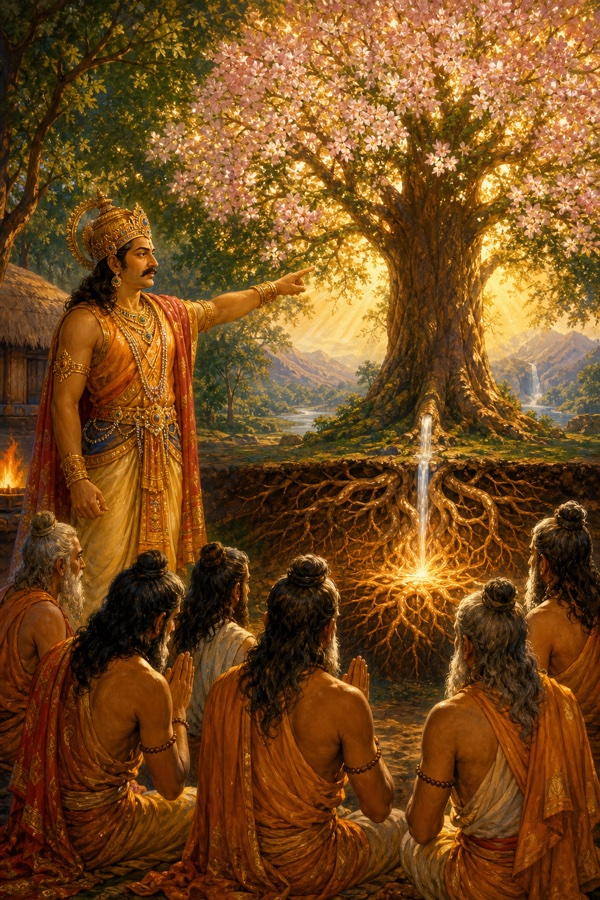
In reply they said a sentence that is a lesson in manners: a man should state the purpose he has traveled for. You at present know the Vaishvanara atman; tell us that. They set the offer of wealth aside without making the king small, and put their real request in front of him. The king said he would answer them in the morning. The next day they came with kindling in their hands, the way students come. A boy arriving at a teacher’s house brought split wood for the fire he would be feeding from that day, and it was the plainest declaration a person could make with his body. These were old men with households of their own, carrying firewood into a king’s courtyard. Laying fuel before a teacher says one thing, that a man has taken off his titles before walking in.
The king performed no upanayana for them, put them through no formality, and told them the knowledge straight out. That small sentence raises the dignity of the whole episode. The men before him were older than he was and far ahead of him in the Veda, and perhaps for that reason he took cover behind no procedure. A man who comes in the posture of asking is already a student, and a man who holds the answer should lose no time giving it. The six questions and answers begin here, the sweetest conversation in the chapter.
In short: five great masters of the Veda could not settle among themselves what the atman is, and Uddalaka admitted the gap in what he knew and took them all on to king Ashvapati. The king offered wealth, they asked for knowledge. Next morning they came with kindling in hand, and the king began to speak with no ceremony at all.
Six answers, and in each answer something unfinished (khandas 12 to 17)
The king asked each of them the same question, “कं त्वमात्मानमुपास्स इति”, which atman do you worship? The question assumes something a modern reader has to be handed. Every one of these men had a daily practice, a form he held in mind morning and evening while he made his offering, and the form a man chose shaped his household the way a trade shapes a man’s hands. Aupamanyava said, lord king, I worship heaven itself. The king said that what you worship as the atman is the Vaishvanara atman named Sutejas, the well lighted, and that is why the soma juice is seen in your family being pressed, and pressed again, and poured out. You eat food and you see what is dear, and the family of the man who worships this atman in this way has food and what is dear and the luster of the Veda. Yet, the king added, that is only the head of the atman, and had you not come to me your head would have fallen.
Satyayajna Paulushi said that he worships the sun. The king said that this is the Vaishvanara atman named Vishvarupa, of every form, and that is why much of every kind is seen in your family, a chariot drawn by she mules, a maidservant, a golden chain at the throat. Those three were the visible marks of a prosperous house, the things a neighbor counted. And this is the eye of the atman; had you not come, you would have gone blind. Indradyumna Bhallaveya named the wind as his atman. The king said that this one is Prithagvartma, the one that travels by separate roads, and that is why tributes reach you along separate roads and lines of chariots follow you separately, which is the picture of a man with a following, people arriving from several directions because they owe him something. That, though, is the breath of the atman; had you not come, your breath would have gone out of you.
Jana Sharkarakshya worshiped space. The king said that this is the Vaishvanara named Bahula, the abundant, and that is why you are full of offspring and full of wealth; yet that is the sandeha of the atman, the middle stretch where the trunk spreads, and had you not come it would have burst apart. Budila Ashvatarashvi worshiped water. The king said that this one is Rayi, riches, and that is why you are a wealthy man and a well fed one; yet that is the bladder of the atman, the lower vessel where water gathers, and had you not come it would have split.
Last the turn came to Uddalaka Aruni, the man who had brought the others here so that he would not have to answer, and who now had to answer anyway. He said, lord king, I worship the earth. The king said that this is the Vaishvanara atman named Pratishtha, the standing ground, and that is why you stand firm in offspring and in cattle; yet those are the two feet of the atman, and had you not come your feet would have withered away. All six answers are cast in one mold. Every worshiper had the exact fruit of his worship, no one had come away empty handed, and the shape of each man’s worship stands plain in his fruit: brilliance for the man of the head, form for the man of the eye, followers for the man of the breath.
The king’s warnings read frighteningly, and a plain thing sits inside them. A man who takes one limb of the vast form for the whole finds his worship growing as strong as that limb and as fragile as that limb. For the man who makes the head everything, the head becomes his boundary; for the man who makes the feet everything, the feet do. The king strips no one of his fruit; he builds the rest of a body around that fruit. Six separate acts of worship are joined to one another that way, as six limbs of a single body, and six men who had walked in as rivals in learning find themselves standing inside one form together.
In short: heaven is the head, the sun the eye, the wind the breath, space the trunk, water the bladder and the earth the two feet. Each worshiper had his fruit in hand, and each man’s fruit was bounded by the size of his worship. Taking a part for the whole leaves a worship standing and leaves it unfinished, and the king set that unfinished edge in front of them one by one.
A hand span of vastness and the fire offering of food (khandas 18 to 24)
Turning to all six together, the king said that you people eat your food knowing this Vaishvanara atman as though it were split into pieces. Then he put the real thing down. “प्रादेशमात्रमभिविमानमात्मानं वैश्वानरमुपास्ते”, the man who worships this Vaishvanara atman as pradeshamatra, of the measure of a hand span, and as abhivimana, measured from every side and filling every side, eats his food in all worlds, in all beings, in all selves. A hand span is the distance from the thumb to the tip of the little finger with the hand spread, a measure a man carries on his own body and uses all day to size a pot or a plank. What had been as wide as the sky a moment ago came down into that.
Then the king opens the whole map. The head of this Vaishvanara atman is Sutejas, its eye Vishvarupa, its breath Prithagvartma, its trunk Bahula, its bladder Rayi, and the earth its two feet. Then he turns a body into a sacrificial hall. The chest is the altar, the body hair the strewn grass, the heart the garhapatya fire, the mind the anvaharyapachana, and the mouth the ahavaniya. Every one of those was a real thing these men had set up with their own hands a thousand times: the ground marked out and dug, the grass spread around it so that nothing offered would touch bare earth, the round household fire that a man carries from his father’s house and never lets go out, the southern fire, the eastern fire into which the offerings go. A man who has spent his life lighting fires out of doors is told that all three have been burning inside him the whole time, and that he has poured offerings into them every day without knowing.
Now the method arrives, and it is so simple that it raises a laugh the first time. Whatever food comes to a man first at a meal, that is the oblation. Pouring the first offering, say, svaha to prana, and prana is satisfied. Svaha is the word a priest says at the instant the ladle tips, and here a man says it over his first mouthful. When prana is satisfied the eye is satisfied, when the eye is satisfied the sun is, when the sun is satisfied heaven is, and when heaven is satisfied everything is satisfied that heaven and the sun stand over. And behind all that satisfaction he is satisfied himself, with offspring, cattle, food, brilliance, the luster of the Veda.
The second offering goes to vyana. Vyana is satisfied, and then the ear, and from the ear the moon, and from the moon the quarters of the sky, and with the quarters everything that stands on them. The third goes to apana. Apana is satisfied, and then speech, and from speech the fire, and from the fire the earth, and with the earth everything that stands on it. The fourth goes to samana, and by it the mind and Parjanya and the lightning are satisfied. The fifth goes to udana, and by it the skin and the wind and space. Those five names are the five motions of the one breath, the drawing in, the spreading through, the pushing down, the evening out, the carrying up, and a man setting out five morsels is feeding all five. Every time the same line comes back, that behind the satisfaction of all that the worshiper is satisfied too. Five morsels, and the universe has eaten.
In the last khanda the king sets the two kinds of sacrificers side by side. The man who performs the agnihotra without knowing this does what a man does who rakes the live coals aside and pours his offering into ash. The agnihotra was the smallest and most constant of all the rites, milk poured at dusk and again at dawn, every day of a householder’s life, the one obligation he could never hand to anybody else. The form is complete, the fire is gone. And the man who performs the agnihotra knowing this has his offering fall in all worlds, in all beings, in all selves. All his evils are burnt away the way the down of a reed flares off the instant it is held in a flame.
Then comes a sentence to be read with the society of that time standing around it. A man who knows this may give the leavings of his own meal to a chandala, and even that is poured into his own Vaishvanara atman. Leavings from a plate were the most polluting thing in a household’s day, and the chandala was the person kept furthest from the kitchen; putting those two in one sentence would have stopped a room. For a man who sees one vast form in body after body, no place he gives to is left impure. And the closing verse of the khanda gathers the whole chapter into a household picture: “यथेह क्षुधिता बाला मातरं पर्युपासत”, as hungry children here sit around their mother, so all beings sit around the agnihotra.
In short: worship the vast form in the measure of a hand span, inside your own body, and it spreads out to every world and every creature. The chest is the altar, the heart the garhapatya, the mouth the ahavaniya, and the first morsel of a meal is the oblation. The man who offers without knowing this rakes the coals aside and pours into ash, and the man who eats knowing it satisfies the sun with one mouthful.
And in the end, toward yourself
All three stories in this chapter come to rest in one place, our own body. The first said that the entire contest inside a man runs on a single breath. The middle one turned birth and death into offerings poured into one fire, with the ray of the sun in them, the water of a cloud, the grain of a field. The last picked up the whole vast form and set it down between the chest and the belly. Together they say one thing: what we have been hunting for outside, above, far away, measures a hand span, and its address is our own body.
The first place this lands is the plate in front of us. For a man who has read it, lifting the first morsel becomes a small rite. He need say nothing aloud; it is enough to remember that the morsel is reaching a breath, and that breath the eye, and the eye the sun, and the sun the whole of the sky. In the same way that mouthful of water at either end of a meal becomes a garment put on the breath. Two or three daily habits remind a man of his place two or three times a day.
The second thing is the nerve that two people show here. Uddalaka said in front of his own son that he did not know, and then stood at a king’s door and stayed there a long while. Six great masters of the Veda sat down with kindling in their hands before a householder king. Owning that you do not know, and then walking off to learn, are the two acts standing just before every large knowledge in this chapter. On the day we can say to somebody, I do not have this, please teach me, the first stair of the road of the flame has come up under our feet.
Source: Chandogya Upanishad, chapter 5, khandas 1 to 24; read against the Sanskrit, with Shankara’s reading noted where readings differ.