On this page
It is the second watch of the night. Janashruti Pautrayana has had his bed carried up to the flat roof of his palace, the way men of his rank slept in the hot months, above the smoke and within reach of whatever wind the river sent. Below him the town is dark except along the roads, where the hearths of the almshouses he built are still burning. Travelers are fed at those hearths, and the fires are kept alive all night so that anybody arriving at an unlikely hour will find embers and a cook awake. He had raised every one of those houses in one quiet satisfaction, that in every direction people would be eating his food. Just then a line of swans passes overhead, low, the way birds fly when they are following water. The swan flying behind calls to the one in front, “Ho, Bhallaksha, you of the wide eyes, fly with care. The light of Janashruti is spread below us all the way to the sky. Do not graze it, do not be burned by it.” The swan in front laughs. This chapter opens out of that laugh, and after that night the king never sleeps the way he used to.
The first three chapters of the Chandogya Upanishad rested on chant and on the inner method of worship, on syllables sung in a hall by men trained from boyhood to sing them. The fourth chapter, across seventeen khandas, lifts that method up and sets it down in the middle of open life, and it hands the knowledge of brahman to hands that carry no credential: a man sitting under a cart scratching his skin, the son of a mother who does not know the name of her own line, and a forgotten student who tended fires in silence for twelve years. Every one of those three would have been turned away at the door of a proper school. The Upanishad says one thing here in several turns, that whatever gathers everything into itself is the giver, and that creation itself begins to speak in front of a person who holds to the truth. The two most beautiful stories in this entire Upanishad sit right here.
The main figures of this chapter
Janashruti Pautrayana: a king who gave with faith, gave much and cooked much, and whose entire charity turned small in the space of one night.
Raikva: the knower who lives with his cart, who holds the samvarga knowledge, and who laughs at a heap of cattle.
Satyakama: the boy who asks his mother for his lineage before leaving for school, and whose truth becomes his entire identity.
Jabala: Satyakama’s mother, who hands her son her whole plain truth in place of the shelter of a lie.
Haridrumata Gautama: the teacher who hears the truth in answer to his question about lineage and takes the boy in on the spot.
Upakosala Kamalayana: Satyakama’s student, whose twelve years of fire tending are answered in the end by the fires themselves.
The talk of the swans and the man under the cart (khandas 1 and 2)
About Janashruti Pautrayana this Upanishad says three things in one breath: he gave with faith, he gave a great deal, and a great deal was cooked in his house. Each of those was a public fact in a world where a king’s standing rose out of his kitchen. He had put up shelters and almshouses on every side, carrying the feeling that people everywhere would be eating his food. In the morning the bards would arrive at the gate and sing his fame, which was their profession and his pleasure at once, and the king would store that fame inside himself as a deep contentment. This was no small man. Giving ran in him as plain character; he did not have to be argued into it, and nobody who came to his door went away hungry. Along with that character a fine intoxication had attached itself, the intoxication of counting his own grain, of knowing the number of hearths and the number of mouths. To break that one thing this Upanishad sent two swans across the sky.
The swan behind warned the swan ahead that Janashruti’s light lay spread below them like daylight, and asked him to keep clear of it. The swan in front answered, “Who is this, whom you speak of as though he were Raikva of the cart?” The tone of the question matters more than its words. One bird had mistaken a bonfire for the sun. Sayugva Raikva, the Raikva who lives beside his cart; and along with that name he set down a picture from the dice board, where men of that age gambled through whole nights and every player knew the four throws by name: “यथा कृतायविजितायाधरेयाः संयन्ति”, as when the highest throw, the one called krita, has fallen and every lower throw is gathered into it, so all the good that the people do gathers into that Raikva. When krita comes up, the lower throws stop being separate winnings; they are swept across the board into the one pile. The whole ledger of merit that the king had been adding up, all those hearths and all that grain, had already been swept into a single throw in front of one man who knew.
The king overheard this. Having overheard it, he could not sleep. He lay there with the two remarks turning over, that he was a fire and that somebody else was the sun. At first light he called his kshatta, the attendant who drove his chariot and stood between the king and everyone who wanted to reach him, and repeated the entire conversation of the swans in front of him, dice simile included, and asked who this Raikva of the cart was. The servant went out to look, and he looked the way a palace man looks for anybody. He walked through towns, asked in markets, made inquiries in the assembly halls where the important men of a district sat, and came back with folded hands to say that he had found the man nowhere. The king’s reply is the most useful line in this whole story: go and seek him where a brahmana is sought. Hunting through the crowd of a city for a man who had left the crowd behind was labor spent for nothing.
This time the servant went along the river banks, out past the fields, toward the solitary places, toward the ground where knowers of brahman settle because there is water and firewood and nobody to interrupt. And he found him. The original text decorates this scene with not one word of ornament. The man was sitting under his cart, in the strip of shade a cart throws at midday, scratching the itch of his own skin. No hermitage, no line of students sitting in rows, no fire enclosure, no marking of any kind that would tell a stranger he had arrived somewhere. A man who taught for a living would have had all of those, because a teacher in that world was known by his household: the boys who fetched his wood, the patrons who sent him grain, the fee he was owed at the end of a term. Raikva had none of it, and the servant, who had been trained his whole life to read rank off a man’s surroundings, had to ask. He bowed and said, “Are you, revered sir, Raikva of the cart?” The answer came back just as unbothered: yes, I am the one. The servant ran back to say that the man had been found. The light the swans had spoken of with such caution was sitting in the shade of a broken cart.
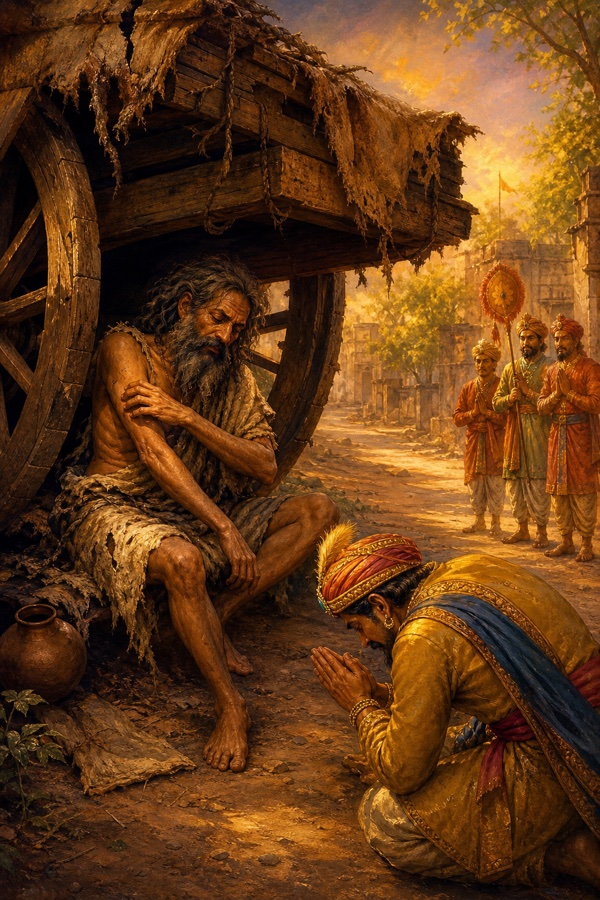
Now the king went himself, and he went the way kings travel when they intend to be taken seriously. He brought six hundred cows, which in an age with no coined money was a fortune anybody could count from a distance, the sort of herd that settled a marriage or a war. He brought a nishka, a heavy collar of gold worn at the throat, the single most personal ornament a man of his rank owned. He brought a chariot drawn by mules, which was the vehicle a king traveled in when the road was long. That procession came down to the edge of a field and stopped in front of a man with no roof. The king said, “Raikva, these six hundred cows, this collar, this chariot; revered sir, teach me the deity that you yourself worship.” He was doing what was done. A student came to a teacher with a gift, and the greater the student, the greater the gift, and no one in that country had ever offered more for a lesson. Raikva raised his eyes and said it flat, “Shudra, keep all of this beside you along with your cows.” A great deal of argument has gathered around that word shudra, and Shankara’s commentary holds it back from being read as the name of a caste; there it is an address formed from shuch, from grief. The king was a kshatriya and he had arrived filled with sorrow, and for that he was called by that name. The procession turned around. The man who had kept an account of all his giving had to pick the account back up and drive it home along the same road, past the almshouses, with the whole district watching.
The king came again, and this time he came fuller still: a thousand cows, the same collar, the same chariot, and the village in which Raikva lived, which meant its fields, its grain and the yield of every household in it handed over in one sentence. And with all that, his own daughter. There is no way to make that ordinary. A king’s daughter was the instrument by which houses were joined and borders were kept quiet; she was promised years in advance, and the promising was done between families with priests and witnesses present. To bring her out along a cart road and offer her to a man with sores on his skin and no lineage anybody could name was to hand over the last thing a king held back, in front of his own attendants. He repeated the same request, that the revered one teach him now. Raikva took the girl’s face in his hands, lifted it, and said, “Shudra, you have brought all of these; with this face alone you will force me to speak.” In that entire offering the one thing that reached Raikva was the ache of the king, which had come down as far as his dearest possession. The cattle and the gold had been arguments. The girl was the king’s grief with a face on it, and grief was the only fee this man accepted. From that day the villages of the Mahavrisha country where Raikva went on living were called Raikvaparna. And there, in that village, he spoke the knowledge to the king.
In short: the counting of charity and the singing of one’s fame give a pleasure that only a large wound can break, and for Janashruti that wound arrived as the talk of two swans. Knowledge is never bought with cattle; it comes on the day when the grief inside a man turns so honest that he goes back a second time and a third time to the same doorway, carrying the greatest thing he owns.
Samvarga: that into which everything is gathered (khanda 3)
What Raikva said is finished in four sentences, and a lifetime can go into digesting it. The first sentence looks outward: “वायुर्वाव संवर्गः”, the wind is the one that gathers everything in. When a fire goes out, it goes into the wind. When the sun sets, it is taken into the wind. When the moon wanes, that too into the wind. When the waters dry up, they too pass into the wind. The wind draws all of them into itself. Put out a lamp and ask where the flame went; the answer refuses to come to hand, and yet the flame went nowhere, it was gathered. Watch a wet courtyard in the hour after sunrise and the same disappearance is happening in front of you at a slower speed. The Upanishad calls this adhidaivata, the form seen at the level of the gods, which is to say the form the thing takes when you look at the sky and not at yourself.
The second sentence turns inward: “प्राणो वाव संवर्गः”, the breath is the one that gathers everything in. The evidence for this arrives every night and costs nothing to check. When we fall asleep, speech goes into the breath, the eye into the breath, the ear into the breath, the mind into the breath. In sleep we are left with no sight, no word, no thought; all of them return to a single place, and in the morning they come out again from that same place, in an order nobody arranges. The Upanishad calls this adhyatma, the very same form seen inside oneself. And then it joins the two in one line: these are the two gatherers, the wind among the gods and the breath among the senses.
The whole knowledge lies in that joining. The breath that fills the sky outside and the breath by which our chest rises and falls are two faces of one existence. For whoever has seen this, the wall between himself and the world grows thin. And then the counting of merit goes meaningless on its own, because in front of the one who holds everything within itself there can be no accounting of fragments. A man who has understood where his own breath comes from has stopped being able to say with a straight face that six hundred cows are his. This is what Janashruti had tried to buy with six hundred cows, and this was the very thing that cattle could never deliver.
Along with this knowledge the Upanishad attaches a small incident that changes the flavor of the whole chapter. Shaunaka Kapeya and Abhipratarin Kakshaseni were seated at the hour when the food was being served, two men of standing at a meal in a great house, when a brahmacharin came asking for alms. A student in those years ate by begging, and the begging was part of his training, a discipline set for him and no misfortune at all; he was expected to arrive, to be given, and to move on. The two of them gave him nothing, which was a small cruelty and an ordinary one. The student did not turn back. He stood where he was and threw out a riddle, and a riddle put to men who prided themselves on knowing the chants could not be ignored in front of a room. “Which single god swallowed the four great ones, he who is the guardian of the world? Kapeya, mortals never catch sight of him; Abhipratarin, he dwells in many forms. The food that belongs to him has been withheld from him.”
Shaunaka Kapeya listened, paused over it, and rose to answer that he is the self of the gods, the begetter of creatures, golden of tooth, the devourer, wise in truth; he himself is eaten by nothing and he eats even what is no food. “Brahmacharin, this is the one we worship. Give the man his alms.” And the alms were given. A hungry boy at the door had made two learned men say out loud what they claimed to know, and their own answer convicted them before he had finished eating. Then the Upanishad opens its ledger: outside, along with the wind, fire, sun, moon and water; inside, along with the breath, speech, eye, ear and mind; five and five, together ten, and ten is krita, the highest throw of all, the same throw the swan had named over the sleeping king. This ten the Upanishad calls Virat, the eater of food, by whom all this is seen, and whoever knows it becomes an eater of food himself.
In short: samvarga is that into which everything returns and is gathered, the wind outside and the breath within, and the two are one existence. The hungry student’s riddle opens the same door, that the food we call our own while handing it out or holding it back belongs in truth to the one who is eating everything and whom nothing can eat.
Jabala’s answer and Gautama’s kindling (khanda 4)
Now the Upanishad leaves the palace and the cart behind and walks into a hut. A boy is standing in front of his mother. His name is Satyakama and her name is Jabala. He has reached the age at which boys are sent away to live in a teacher’s house for years, learning by living there, fetching wood and tending cattle and sitting through the recitation morning and evening. Before any of that could begin he had to be able to say his gotra, the name of the father’s line, a single word that placed a boy inside a chain of ancestors and told the teacher which branch of which tradition he belonged to, whom he could marry, where he stood in a room. It was the first question anybody asked a stranger and the first question a teacher asked a boy at his gate. A person without that word was a person without a place to be put. The boy asks, “Mother, I want to go and live as a student. Tell me which gotra I belong to.” That question brings the hardest hour this house has known, because a straight answer to it is one thing his mother does not have.
It would have cost her nothing to invent one. Lines were long and families were scattered, and a name spoken with confidence by a mother is not a thing anybody checks. Every practical consideration pointed the same way, and the boy’s whole future ran through the word she was about to say. What Jabala did is the highest thing in this chapter. She fashioned no lineage, borrowed no name, taught her son no silence. She said it plainly, “Child, I do not know which gotra you belong to. In my youth I moved about a great deal and served in many houses, and in that time I came by you. So I do not know which family you are from.” Working in the houses of others was what a woman did when she had nobody, going where the work was, staying while it lasted, moving on. She was telling her son that she had been young and poor and on her own, that she had come by him in those years, and that the name he wanted did not exist for her to give. Then she gave him the sentence that became his identity for life: “जबाला तु नामाहमस्मि सत्यकामो नाम त्वमसि”, my name is Jabala and your name is Satyakama, so call yourself Satyakama Jabala. Boys were named after their fathers. She named him after herself, and a mother had turned her hardest truth into her son’s family name.
The boy carried exactly this to Haridrumata Gautama. He came the way a boy comes who wants to be taken in, on foot, with nothing, and he said, “Revered sir, I wish to live with you as a student; take me in.” A teacher was under no obligation to say yes. He was taking a child into his house for years, feeding him, answering for him, and putting the chants of his own line into his mouth, and so he asked what was bound to be asked, “Saumya, which gotra do you belong to?” That was the moment where the boy could have said anything at all. A name, a guess, a convenient silence, the kind of half answer that slides past and is never returned to. He repeated his mother’s whole answer, without subtracting one word, exactly as it was, her long wandering, her service in many houses, her not knowing, and at the end that name. “And so I am Satyakama Jabala, revered sir.” He had just said in a stranger’s courtyard, out loud, the one thing that could disqualify him.
In the reply Gautama gave, the definition of a brahmana came down into a single line: “नैतदब्राह्मणो विवक्तुमर्हति”, only a brahmana is able to speak out a truth this clean. The teacher took the word that had been withheld from the boy and handed it back on other grounds. Then he said, “Saumya, bring the kindling, I will initiate you, for you have held to the truth.” Kindling was how a student came to a teacher. He carried in split wood for the fire he would be feeding from that day, and the armload in his hands was the sign that he had been accepted and that his work had already started. The test lay in the manner of the answer, and the boy came through it at the very place where grown men slip. For a boy who had no father’s name, his own truth opened the door that a name never opens.
After the initiation Gautama set a second test, and this one ran longer than the first. He separated out four hundred lean and weak cows, the poorest animals in his byre, drove them in front of the boy and said, “Saumya, go along behind these.” No instruction came with them, no term was set, no lesson was given to carry along. Satyakama, starting the cattle forward, spoke a resolve of his own, that he would come back only when they were a thousand. Nobody had asked him for that number. And then he lived for years in the forest, alone, tending weak animals, with no lesson, with no scripture, moving where the grass was and stopping where the water was. No message came from the teacher and no complaint went from his side. The herd grew slowly, the way herds grow, one calf at a time through seasons that all look alike. One day the count reached a thousand.
In short: Jabala gave her son the truth in place of a lineage, and that truth became his strongest credential in front of the teacher. Gautama took him as a student and taught him nothing directly; he sent him into the forest behind a herd of thin cattle, because the knowledge being prepared here ripens in solitude and in service.
Bull, fire, swan and diver bird: the four quarters of brahman (khandas 5 to 8)
On the day the herd was complete, a voice came. The bull of the herd called out to him, “Satyakama!” And he gave the answer he would have given his teacher, “Revered one.” That reply is the whole of his training showing itself. He had spent years being addressed by nobody, and when a voice finally used his name he answered it with the word a student uses to the man he obeys. The bull said, “Saumya, we have become a thousand, take us now to the teacher’s house. And here, let me tell you one quarter of brahman.” The boy folded his hands and said, “Let my lord tell me.” The bull spoke: the east is one part, the west one part, the south one part, the north one part. “एष वै सोम्य चतुष्कलः पादो ब्रह्मणः प्रकाशवान्नाम”, saumya, this quarter of brahman with its four parts is named the shining one. Whoever worships it knowing it this way becomes shining in this world and wins the shining worlds.
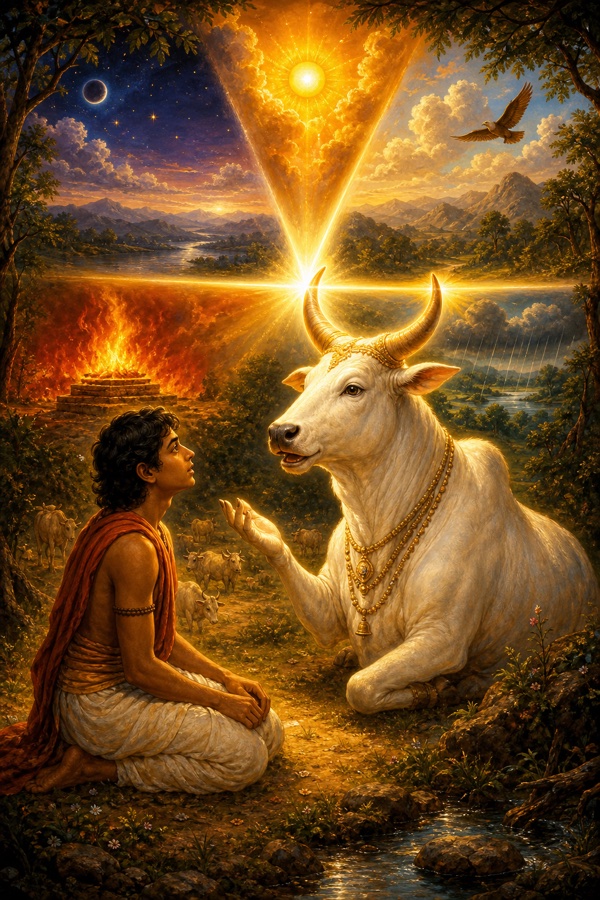
The bull left the matter half done and gave him the next address, that the fire would tell him the quarter after this. From here on a quiet rhythm settles into the story, which the original text repeats each time in almost the same words, the way a man’s days repeat. Next day he drives the cattle forward. Wherever the evening falls, there he builds a fire, pens the cows around him, lays kindling on the flame, and sits down behind the fire facing east. Every one of those actions was the same one a householder performed at dusk inside a settled house with a wife and a roof, and he was performing them alone in open country with a thousand animals breathing around him. That is his entire day, that is his evening worship. His practice lives inside that repetition, and inside that same repetition somebody speaks to him every time.
That night the fire called him, “Satyakama!” “Revered one.” The fire said, saumya, let me tell you one quarter of brahman. The earth is one part, the mid space one part, the sky one part, the sea one part; this quarter with its four parts is named the endless one. Whoever worships it knowing it this way becomes endless in this world and wins the endless worlds. The first quarter had given him the ring of the directions, the four ways a man can face. This one filled that ring with a world, from the ground below to the sky above and out to the seas along the edges. The boy listens, stays quiet, and walks off behind the cattle again the next morning, and there is no sign that he told anybody, since there was nobody to tell.
The third time a swan flew down and called him by the same name. It said, fire is one part, the sun one part, the moon one part, lightning one part; this quarter is named the luminous one, and whoever worships it knowing it becomes luminous in this world and wins the worlds of light. After the earth and the sea he was now given the things that burn of themselves, from the flame of a cooking hearth to the lightning that cracks inside a cloud. Everything that shines anywhere is a quarter of a quarter of that one, and the small fire he lit every dusk was on that list along with the sun. Three nights, three teachers, and the same humble answer each time, let my lord tell me.
The fourth arrival was the smallest creature of all, a madgu, a bird that dives into water and comes up with whatever it went down for. It said, the breath is one part, the eye one part, the ear one part, the mind one part; this quarter is named the one with a dwelling, and whoever worships it knowing it becomes one with a dwelling in this world and wins the worlds that give shelter. Here the whole circle turns inward. Directions, worlds, lights, and at the end this body, whose breath and eye and ear and mind are parts of that same brahman. What had been searched for outside in all four directions spoke, in the final lesson, from inside the seeker’s own chest.
Four quarters, four parts to each quarter, one whole brahman in sixteen parts; and to teach it no assembly gathered and no book was opened. In the world this boy came from, knowledge moved from a man’s mouth to a boy’s ear inside a house, in a fixed order, at fixed hours, and the right to receive it was settled before a single syllable was spoken. Out here a bull, a fire, a swan and a water bird became this boy’s teachers, and all four went about it exactly the way the tradition does, calling his name first, then taking his consent, then telling him. The Upanishad quietly lays down one point here, that when a mind becomes clean enough to hold no demand of its own, nothing in creation stays mute. The years of service had built inside Satyakama the very silence in which these four voices could be heard.
In short: the four quarters of brahman are the shining, the endless, the luminous and the one with a dwelling, and they open in order through the directions, the worlds, the lights and one’s own senses. Satyakama received this order in no school; he received it across those forest evenings when he built the same fire, tied the same cattle, and sat down in silence.
A face alight in front of the teacher (khanda 9)
The cattle reached the teacher’s house and behind them came the boy, who was no longer a boy. He had left with four hundred thin animals and he was coming back with a thousand, which any herdsman in the district could have read as the work of years done properly. Gautama called out the moment he saw him, “Satyakama!” “Revered one.” And then he said the thing only a teacher can see: “ब्रह्मविदिव वै सोम्य भासि”, saumya, you shine like one who knows brahman; who has taught you? Knowledge had left on his face the one thing that cannot be hidden. From under the years of dust and the tiredness of the forest, something was showing through that Gautama recognized, and the recognition came before any word had been exchanged about cattle.
Satyakama told no lie here either, and made no boast. He allowed only this much, that those who taught him were other than human. And then he asked for the thing that unlocks this whole story, “Let my lord himself tell me, that is my wish.” He had received the whole of brahman from four voices, and still he stood in front of his teacher with his hands open. He gave the reason himself, that he had heard this from people like his teacher: “आचार्याद्धैव विद्या विदिता साधिष्ठं प्रापति”, knowledge learned from a teacher carries one best of all to the goal. He was asking to be told what he already knew, by a man who had sent him away without teaching him anything, and he was asking for it as a favor.
Gautama told him all of the same, and the original text closes this story with a small remark, that here nothing was left out, nothing fell short. Between what came in the forest and what came from the teacher’s mouth, the difference measured out at nothing whatsoever. That is the strongest testimony in the episode. Honest experience rising from within and the word of a living tradition, when both are true coin, arrive at one place, and a student has need of both, one to wake him and one to hold him steady.
In short: knowledge comes out on the face, and a teacher recognizes it in the first moment. With everything already in his hands, Satyakama still wanted it repeated by his teacher, and in the telling nothing was lost; this meeting of one’s own experience with the word of the tradition is dear to this Upanishad.
Upakosala Kamalayana and the fires that spoke (khandas 10 to 13)
That same Satyakama is now a teacher, and the Upanishad tells a story in which the role of the teacher looks harsh for the first time. Upakosala Kamalayana lived in his house as a student, and for twelve years he tended his teacher’s fires, kept them burning, kept them in order, let them go out never once. Three fires stood in the ground of a house like that, and they were the house. One of them was carried in at the start of a marriage and fed for the rest of a man’s life, and letting it die was a failure that had to be repaired with a rite. Somebody had to wake before the household woke, clear the ash, lay the wood, and be there again at dusk, every day of every season, in the rain as well. Twelve years of that is no small stretch. Through that time Satyakama went on schooling the other students and sending them home at the end of their term, with the bath and the formal leave taking that marked a man as finished and let him marry and light fires of his own. Upakosala he neither taught nor sent home. Boys who had arrived after him walked out as householders while he stayed quietly beside the fires, asking nothing, complaining of nothing.
At home the teacher’s wife could no longer watch it. She had been watching it from inside the house for twelve years, which is where such things are watched. She told her husband, “This student has burned himself clean, he has served your fires with great skill. Let the fires not speak to him ahead of you. Teach him.” That warning is the sharpest line she could have chosen, and it turned out to be exactly what happened. Satyakama heard her out, and even so he left the country without a word to the boy. That silence looks cruel, and it is the finest place in the whole story, because everything that is about to happen ripens inside that silence. Some students are made ready by words and some by waiting.
Upakosala broke. Illness closed in on him and he made up his mind to stop eating. For a student that decision carried a particular weight, since the food he ate came from his teacher’s house and refusing it was refusing the one relation he had. The teacher’s wife saw it and said, “Student, eat. Why do you not eat?” His answer stands among the most human lines in this entire Upanishad, “There are many desires in this person here, running off in different directions; I am filled up with sicknesses; I will not eat.” He hid his pain from nobody and he threw it at nobody. There is no accusation in that sentence, no mention of the years, no mention of the other boys who went home. This is the same bare honesty his own teacher had once received from his mother, and here again that honesty opened the door.
Then the fires spoke among themselves, “This student has burned himself clean, he has served us with great skill. Come, let us tell him.” The wife’s warning had come true inside her own courtyard. And they said to him, “प्राणो ब्रह्म कं ब्रह्म खं ब्रह्म”, the breath is brahman, ka is brahman, kha is brahman. Upakosala’s reply is the reply of a true student, that he understands this much, that the breath is brahman, and that ka and kha he does not understand. Twelve years of waiting had not made him greedy enough to pretend. He refused to pass off something heard as something understood. The fires then spoke a sentence counted among the loveliest definitions in this Upanishad, that what is ka is kha and what is kha is ka, which is to say that happiness is the same as space.
Then one by one the three fires gave their own lessons. The garhapatya said: earth, fire, food and the sun; and the person who is seen in the sun, I am he. The second fire said: water, the directions, the stars and the moon; and the person who is seen in the moon, I am he. The third said: breath, space, the sky and lightning; and the person who is seen in the lightning, I am he. Shankara’s commentary identifies these two as the anvaharyapachana and the ahavaniya, the southern and eastern fires that Upakosala had been serving for twelve years. He knew their positions in the ground by heart, the distance between them, which one took which offering, the sound each made when the wood was fresh. Each fire added the same fruit, that whoever worships it knowing it this way is freed of sinful action, reaches a full span of life, and lives in brightness.
The frame of these three lessons is identical, and their heart is in that very sameness. Each time four outer things are counted off, then a finger is raised toward one person shining in the middle of them, and then the fire says, that is myself. The fire this boy had been feeding with wood and ghee for twelve years stood in front of him as the sun, the moon and the lightning. This is what service pays back. Whatever we tend for years without keeping accounts one day gives us its full introduction.
In short: twelve years of quiet service went nowhere wasted for Upakosala; the teacher who never taught him had fires that did. Their lesson is that breath, happiness and space are three names for brahman, and that the person seen inside the sun, the moon and the lightning is the face of the same fire principle he had been serving.
The person in the eye and the road of the gods (khandas 14 and 15)
Having finished their lesson, the fires drew an honest boundary, “Upakosala, saumya, this is our knowledge and the knowledge of the self as well; the way onward your teacher will tell you.” What they had given was knowledge that reaches as far as the worlds; what lay beyond that was outside their subject, and they said so instead of filling the gap. Just then the teacher came home. He looked at the boy and called, “Upakosala!” “Revered one.” And then the very sentence he had once heard from his own teacher in another courtyard, on another afternoon, with dust on his own feet, “Saumya, your face shines like the face of a knower of brahman; who has taught you?”
Here the original text takes a fine and beautiful turn. Upakosala deflected, “Who would teach me, sir?” He covered the matter over, and the cover was thin, because the answer he gave was a question about a house in which he was the only student left. And then, gesturing toward the fires, he let slip that these are of such a kind now, they were otherwise before. That half sentence said with a glance toward the flames is what caught him out. The teacher asked, “Saumya, what did they say to you?” He owned up that they had said this and this. Satyakama said, “Saumya, they have told you about the worlds; I will tell you what lies beyond that.” Twelve years of withholding ended in one sentence, and the man who had left the country without a word now sat down and taught. And then he gave a comparison this Upanishad does not forget afterward: “यथा पुष्करपलाश आपो न श्लिष्यन्ते”, as water does not cling to a lotus leaf, so sinful action does not cling to one who knows in this way.
Then he came to the thing for which twelve years had passed: “य एषोऽक्षिणि पुरुषो दृश्यत एष आत्मा”, the person who is seen here in the eye, that is the self. This is the immortal, this is the fearless, this is brahman. And with it he joined an illustration anybody can test on his own palm, that if you pour ghee into this eye, or water, it runs off along the edges, toward the lids, and nothing at all reaches the one inside. Whoever is looking out from within stays untouched by every wetness. The lotus leaf and the eye are two pictures of a single point.
He gave three names for this same person as well. He is called Samyadvama, because all lovely and welcome things come together into him; and to the one who knows this, all lovely things come together too. He is called Vamani, because he is the one who carries all the lovely things along. And he is called Bhamani, because he is the one who shines in all the worlds. The three names point one way, that the inner point from which we look out at the world is the point that draws the whole beauty of the world toward itself and carries it forward.
And then the Upanishad opens the road the fires had left for the teacher. For a knower of this kind, whether people perform the last rites or leave them undone, and those rites were the whole of what a family owed its dead, he reaches the flame, from the flame to the day, from the day to the bright fortnight, from the bright fortnight to the six months in which the sun travels north, from the months to the year, from the year to the sun, from the sun to the moon, from the moon to the lightning. And there stands a person, amanava, one who is no human being. He is the one who leads them to brahman. This is the path of the gods, the path of brahman; those who travel it come back no more into this human round. The names Upakosala had heard from the fires, the sun and the moon and the lightning, return in front of him as the stages of this road, so that the lessons of his twelve years turn out to have been a map.
In short: the one who sits looking out from inside the eye is the self, immortal and fearless, and sin settles on him the way water settles on a lotus leaf. The fires had given the worlds, the teacher gave the passage onward, and that passage runs through the stages from the flame to the lightning and up to the person beyond the human who ends all returning.
The sacrifice of the blowing wind and the silence of the brahma priest (khandas 16 and 17)
In the last two khandas this Upanishad leaves the storytelling and returns to the sacrificial hall, and its grip stays firm. A rite of any size was run by a team of priests, each with his own Veda and his own share of the work, hired and paid and expected to get every syllable right, because a rite was held to work by its exactness. Into that world the Upanishad drops a strange sentence. It says that this which blows is the sacrifice. The wind moves along and purifies all of this as it goes, and for that reason it is the sacrifice. And then it gives the picture on which the whole khanda stands: “तस्य मनश्च वाक्च वर्तनी”, that sacrifice has two tracks, mind and speech. The same samvarga that Raikva taught the king takes on here, in motion, the form of a sacrifice, and two rails lay themselves down under its wheel.
One of these tracks the priest called brahma tends with his mind, and the other the hotr, the adhvaryu and the udgatr tend with their speech. The hotr calls the gods with verses, the adhvaryu handles the fire and the offerings and mutters his formulas, the udgatr sings. All three are audible from outside the enclosure. The fourth, the brahma, sits and says nothing at all. He is the one who has all three Vedas, who follows every move the other three make, and who speaks only when something has gone wrong. Three priests speak and the fourth watches in silence. This fourth is the one who holds the entire rite together inside his own quiet. The Upanishad states his rule as well, that once the morning recitation has begun, and before the closing paridhaniya verse, if the brahma priest speaks out, he has tended one track only and the other has been left behind. Those two markers fence off the long stretch of a morning in which his job is to be still.
And what follows then is compared to something from any household courtyard. As a man walking on a single foot, or a chariot running on a single wheel, comes to harm, so his sacrifice comes to harm; and behind the harmed sacrifice the patron of the rite is harmed too, so that by sacrificing he lands in a worse condition than before. That was a live fear. A man spent a season’s wealth on a rite in order to be better off after it, and here is the text telling him that a talkative priest can turn the whole outlay against him. The other way around, where the brahma priest holds his silence from the morning recitation through to the paridhaniya, both tracks are tended and neither is left behind. As a man walking on both feet and a chariot running on both wheels stay steady, so his sacrifice stays steady, the patron stays steady, and by sacrificing he becomes the better for it.
In the last khanda the Upanishad explains where this brahma priest gets his power of repair. Prajapati brooded on the worlds, and out of the heated worlds he drew their essences: fire from the earth, wind from the mid space, the sun from the sky. Then he brooded on these three deities and drew their essences: the rig verses from fire, the yajus from wind, the saman from the sun. Then he brooded on this threefold knowledge and drew its essences: bhuh from the rig verses, bhuvah from the yajus, svah from the samans. Each pressing leaves behind what is heavy and carries forward what is potent, the way a man boils down milk. That threefold pressing gives the three vyahritis, the three small words in which all the worlds and all the Vedas are folded up, words a boy learns early and repeats every day of his life without being told what he is holding.
So if the sacrifice tears on the side of the rig, the brahma priest offers in the garhapatya fire with the words bhuh svaha; with that, by the essence of the rig verses and by their strength, he mends the tear in the rite. If it tears on the side of the yajus, then bhuvah svaha, and if on the side of the saman, then svah svaha. He is the only man in the enclosure who can do this, which is why he has been sitting silent all morning with all three Vedas in his head. The picture of the mending comes from an old craftsman’s bench: as gold is joined with salt, silver with gold, tin with silver, lead with tin, iron with lead, wood with iron, and wood is joined to leather, so the tear in the sacrifice is mended by the strength of these worlds, these deities and this threefold knowledge. Every joint in that list is a real one a workman knew, each metal bonded by the substance next to it, and the point is that a repair needs the right material and no other. Wherever a brahma priest knows this, the sacrifice is full of medicine, healing its own wound from within.
And at the end the Upanishad points toward an old verse, that among the officiants the brahma priest is the man who carries everyone through; Shankara’s commentary ties this odd line to the image of a mare, who guards the sacrifice as she guards her foals. Whoever knows in this way becomes the brahma priest and guards the sacrifice, the patron and all the officiants. This is why the Upanishad insists, repeating it twice, that one should make such a knower the brahma priest, never one who lacks this knowledge. A family choosing priests for a rite chose them the way a man chooses the people who will handle his savings, and the text is telling them where to spend their care. The root point of the whole chapter arrives here in its final form, that the silence of a knower holds up an entire assembly of speakers.
In short: the blowing wind is a sacrifice in motion, and its two tracks are mind and speech; three priests carry the speech and the brahma priest carries the mind with his silence. A brahma priest who has understood Prajapati’s pressing, the one that sits inside bhuh, bhuvah and svah, can mend even a torn sacrifice, and for that he is the one fit for the post.
And in the end, toward yourself
All three of the main men in this chapter have passed through one place. Janashruti had to give up the count of his charity, Satyakama had to give up the name of his family, and Upakosala had to give up the expectation that his turn would arrive. These are the three things we grip hardest in our own lives: what we have done, our name, and our turn. Any one of them slipping out of the hand carries us to that same rooftop on that same night, with swans passing overhead. That night does us no harm. It is only after a night like that one that a man leaves the city and goes out along the river to search.
The second lesson is hidden in the pace of this chapter. Brahman reached Satyakama in four instalments across four evenings, and each time it slid a little further inward, from the directions to the worlds, from the worlds to the lights, and from the lights to his own breath and his own mind. The work lying in front of us is probably to be done the same way, in one evening after another that looks alike, building the fire, tying up the cattle, sitting down in silence. Something in that repetition feels flat, and the voices that speak come out from inside that very flatness. People who get up in the middle usually get up just before the fourth evening.
And the last word belongs to that silent brahma priest sitting in the corner of the rite. In every piece of work we do, in every household, in every meeting, there are three who speak and there should be one who watches, who holds the whole thing together in his mind and stays out of the talking. That one man keeps the entire work steady, and the moment he speaks out of turn the chariot comes down onto a single wheel. Seat that brahma priest inside yourself. And whenever it feels as though a film is settling on what you have done, remember the one inside the eye, into which you may pour ghee or water and it runs off at the rims while the one within stays dry, like a lotus leaf.
Source: Chandogya Upanishad, chapter 4, khandas 1 to 17; read against the Sanskrit, with Shankara’s reading noted where readings differ.