On this page
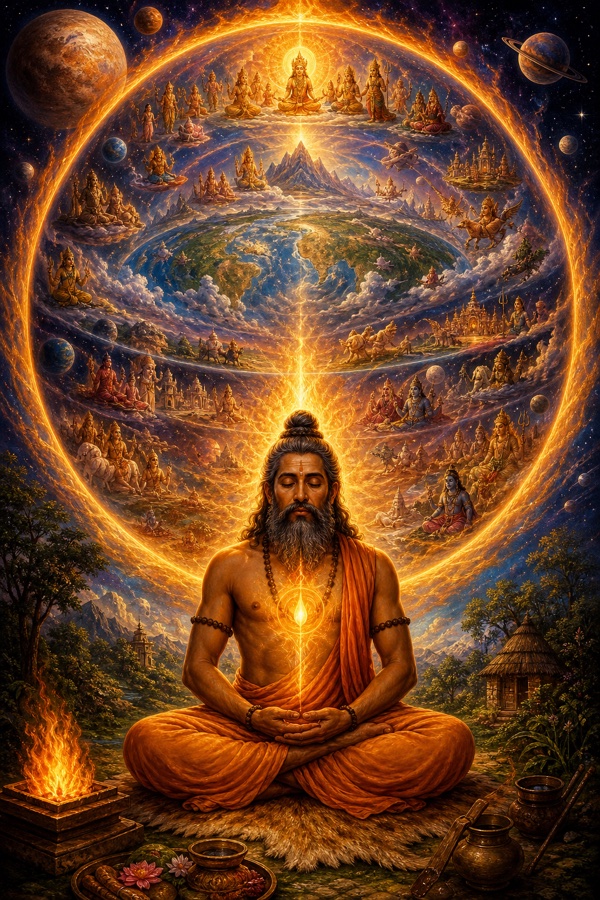
Imagine a teacher walking you into the courtyard at noon, raising a finger toward the sun and telling you that the burning disc overhead is a hive. The sky above it is the crossbeam the hive hangs from. The mid-space between is the comb of wax with the cells cut into it. The rays spreading in every direction are the young of that hive, newly hatched. “असौ वा आदित्यो देवमधु”, that sun is the honey of the gods. The third chapter opens with that one sentence and keeps us inside the hive for five khandas, until we grant that the thing crossing over our heads each day holds something that can be tasted.
The first two chapters of the Chandogya Upanishad teach the inner method of singing, the worships of the udgitha and the saman. The third chapter hangs that singing in the sky and then brings it slowly back down. Across nineteen khandas it walks one road: the honey of the sun, the hosts of gods who live on that honey, the state in which the sun neither rises nor sets, the Gayatri shrinking from speech down into the heart, the five doors of the heart, the declaration of Shandilya that the tradition has carried like a great utterance, the shape of a life as sacrifice, and at the end the story in which an egg forms out of nonbeing and a sun comes out of the egg. The Upanishad travels here from the large toward the small, and on reaching the small it finds the large already seated inside.
The hive has to be a real hive first. Nobody kept bees in boxes here. Honey was found, high up under a rock ledge or slung beneath a thick branch, and a man went after it with smoke and a rope and came down stung, holding a slab of dripping comb that his whole village would eat that evening. It was the one fully sweet thing anyone had. No cane sugar came to the table, and fruit ripened in its own short season, so honey was kept the way other things were not kept, in a sealed pot, brought out for what mattered. A guest arriving at a door that respected him was handed a mixture with honey in it before he was asked a single question about his journey. Honey went onto a newborn’s tongue. Honey went into the fire at the rites. To call the sun the honey of the gods is to reach for the highest thing on the shelf and hand it over.
The parts of the picture come from a comb anyone could recognize. A wild hive hangs from something, and the sky is what this one hangs from; the crossbeam is the branch. The wax slab with its rows of cells, thick and pale and heavy, is the mid-space. And the rays are the brood, the young of the hive going out in every direction, which is what rays actually look like at the hour the sun clears the trees. Once that picture is standing, the Upanishad puts the four Vedas inside it as the working bees, and the flower they draw from is the Veda itself.
Bear in mind what a Veda was in that room. Not a book. There were no books. The Rig Veda was a thing men carried whole in memory, passed from one mouth to one ear, the tones fixed, the syllable counts fixed, checked against other memories in the neighborhood so that a drift of one word could be caught and corrected. A household that held a branch of the Veda held its real property in the skulls of its men, and a famine or a fever that took the wrong man could take a portion of it out of the world. So the flower here is a living thing. The bee settling on it is a mind going over the same verse again, and the honey is what a man has after thirty years of that.
The main figures of this chapter
Aditya: the sun, which this chapter calls the honey of the gods, whose rays are the channels of that honey and whose five colors hold five nectars.
Vasus, Rudras, Adityas, Maruts and Sadhyas: five hosts of gods who live on those five nectars; their mouths are Agni, Indra, Varuna, Soma and Brahma in that order.
Brahma, Prajapati, Manu and Uddalaka Aruni: the line along which this honey teaching came down, at the end of which a father hands the secret to his eldest son.
Gayatri: the meter of twenty-four syllables, which in this chapter becomes speech, then the earth, then the body, and at the last the heart.
Shandilya: the seer who called the atman seated inside the heart smaller than a grain of rice and greater than all the worlds, and left an entire vidya under his name.
Mahidasa Aitareya: the knower who put a question to his own illness, asking why it was scorching him, and who lived one hundred and sixteen years.
Ghora Angirasa and Krishna Devakiputra: teacher and student, between whom the teaching of life as sacrifice passes in the seventeenth khanda.
The hive of the sun: the honey teaching (khandas 1 to 5)
The frame of the hive stands up in the very first sentence. The sun is honey, the world of light is the crossbeam it hangs from, the mid-space is the block of wax with cells cut into it, and the rays are the offspring of that hive. Where the honey comes from, the Upanishad tells us direction by direction. The rays running east are its eastern honey channels. The bees that fill them are the riks. The flower they settle on is the Rig Veda. And the sap they carry back is the deathless waters.
Then comes the making of the honey, and here the Upanishad picks up a very old word, tapas. The riks heated that flower of the Rig Veda, fixed their attention on it, warmed it through to the middle. Out of the heated thing came fame, splendor, the power of the senses, virility, the food fit to eat, sap. All of it flowed out and settled around the sun. Anyone watching the red glow of the morning sun is looking at the distillate of the Rig Veda. The Upanishad says exactly this: the red form of the sun is honey made by the riks.
The southern rays are a second set of channels. There the bees are the yajus mantras, the flower is the Yajur Veda, and the sap settled around the sun and became its white form, the hard noon brightness the eye cannot hold. In the western rays the bees are the samans, the flower is the Sama Veda, and their sap became the black form of the sun, the deep color that sits along the edges as it goes down. In the northern rays the bees are the atharvangirasa mantras, the flower is itihasa and purana, and their sap became the supreme black form, the densest one of all.
Four directions are done, and one is left, the upward one. In those rays the Upanishad names no Veda at all. The honey makers there are the guhya adeshas, the hidden teachings given with the mouth brought close to the ear. The flower is brahman itself. And when their sap went and settled around the sun, it took no color. The Upanishad says that the middle of the sun, the part that looks as though it were trembling, is that sap. Where the Vedas give color, the secret gives a shiver.
The closing sentence of the fifth khanda sets the whole hive on a weighing scale. These five saps are the saps of saps, since the Vedas themselves are sap and these are their sap. They are the nectars of nectars, since the Vedas are nectar and these are their nectar. Hold the sequence in mind. A rik that has been heard is one sap. What comes out of years of sitting with that rik is the sap of that sap. Reading is the first layer, heating is the second, and honey forms on the third. Tapas is the middle word, and it means heat in the plain sense: the heat of a pot kept on the fire past the point where the water has gone, the heat of a man sitting with one thing long past the point where it has stopped being interesting. What survives that treatment is thicker than what went in.
This entire honey teaching is built to carry one lesson, that what is visible above and what is happening within run on the same chemistry. The man who sang the Veda and set it down received words. The man who heated it received honey. And the mark of honey is that it never stays inside its maker; it collects in the hive and goes to whoever arrives. That is why in the khandas ahead this honey becomes the food of the gods, and further on the food of any human being who knows it.
In short: the sun is the hive of the gods, the sky its crossbeam, the mid-space its wax, the rays its offspring. In the rays of the four directions the four Vedas fill honey like bees and make the four colors of the sun; in the upward rays the hidden teachings draw sap from the flower of brahman and set the middle of the sun trembling. What comes out is the sap of saps.
Five nectars and the five hosts who live on them (khandas 6 to 10)
In the sixth khanda a meal is served, and there is no plate on the table. The first nectar, that red sap of the sun, is the living of the Vasus, and they take it through Agni as their mouth. Then comes a sentence that changes the taste of the whole chapter: “न वै देवा अश्नन्ति न पिबन्ति”, the gods neither eat nor drink. Seeing that nectar is enough to fill them. They enter that form and rise out of it again. This way of being filled runs on a different principle from ours, and the eye does the work of the mouth.
Then the Upanishad opens that door for a human being. One who knows this nectar in this way becomes one among the Vasus, takes Agni as his mouth, and is filled by seeing that nectar. He enters that form and rises out of it. As long as the sun goes on rising in the east and setting in the west, so long the lordship and the sovereign rule of the Vasus will keep coming around to him. Notice that the prize here is no ticket to a distant world; it is admission into an order that has been running all along.
The second nectar, the white sap, is the living of the Rudras, taken through Indra as their mouth. The same rule holds, that seeing is eating. The span, though, doubles. For twice as long as the sun rises in the east and sets in the west, it will rise in the south and set in the north, and for that long the knower holds the lordship of the Rudras. The third nectar, the black sap, belongs to the Adityas, Varuna is their mouth, and the span doubles again and runs until the sun rises in the west and sets in the east.
The fourth nectar, the supreme black sap, belongs to the Maruts, and Soma is their mouth; here the sun rises in the north and sets in the south, and the span doubles once more. The fifth nectar, the one that seems to tremble in the middle of the sun, belongs to the Sadhyas, and Brahma is their mouth; here the sun rises upward and sets downward, and the span doubles a final time. Five stairs, time doubling on every stair, and on every stair the frame of the directions swings once, until rising and setting lose their footing altogether.
Reading these five khandas, one thing becomes plain. The Upanishad repeats one sentence over and over, the way a mantra is told, and only the names change. The repetition is a method. Among the chandogas learning came through the ear, and the ear keeps hold of whatever comes around again. A man who is carried five times through one frame finds that on the sixth pass the frame stands up inside him on its own. That is why the leap of the eleventh khanda gives no shock when it comes; by then the feet are ready.
In short: the five colors of the sun are five nectars, and on them live the Vasus, Rudras, Adityas, Maruts and Sadhyas in order, whose mouths are Agni, Indra, Varuna, Soma and Brahma. The gods take no food or drink; they are filled by seeing. One who knows this becomes one of that host and shares in that same filling, and on every stair the span of time doubles.
What neither rises nor sets, and the secret that goes to the eldest son (khanda 11)
The eleventh khanda stops every clock in one sentence. After that, having gone up, it will neither rise nor set; it will stand alone in the middle. Having swung the directions five times, the Upanishad now removes the thing called direction. Where no east is left and no west, from which side would a rising come, and toward which a setting. And at exactly this place a shloka is set down, the highest line in the whole chapter: “न वै तत्र न निम्लोच नोदियाय कदाचन”, there nothing has ever set and nothing has ever risen. And then a prayer: O gods, on the strength of this truth, let me never fall away from brahman.
Where this “there” is, the next line answers. For one who knows this brahma-upanishad in this way, nothing rises and nothing sets; for him it becomes day once and for all, sakrid diva. The sentence has been speaking of the sky, and it walks quietly over into experience. The reckoning of day and night runs for the man who is standing inside the reckoning. In one who has seen the thing that does not change, a light settles that has no sunset marked for it.
Now the Upanishad gives the address of this vidya. Brahma told it to Prajapati, Prajapati to Manu, Manu to his offspring. And a father told this same brahman to his eldest son Uddalaka Aruni. A reader of the Chandogya knows that name, since in the sixth chapter this same Uddalaka will sit his son Shvetaketu down and have him break open the fruit of a banyan. Here he stands in the place of the one who receives; there he will stand in the place of the one who gives.
Then a condition arrives that can sound hard to a modern ear. A father may tell this brahman to his eldest son, or to an antevasin genuinely fit for it. To no one else. Even if a man handed over this whole earth girdled by waters and filled with wealth, still no, because “एतदेव ततो भूय इति”, this is greater than that, this is greater than that. The Upanishad says the sentence twice, as though the man asking the price will take it in on the second hearing.
Hear that rule the way the men in the room would have heard it. There is no copy of this anywhere. It exists in one man’s memory, and it will exist in the world tomorrow only if it gets into another memory tonight, and the only channel available is a mouth close to an ear. Every teaching that ever went out of circulation went out this way, by a holder who chose wrong or waited too long. So the choice of who receives it is the whole of the transmission, and the man making it has to weigh a son, a student, the years each of them has put in, and how much of his own life he has left. The refusal of the earth is a sober refusal, and not a flourish. A man who can hand over land can hand over land again; what is being discussed here can be handed over once, to somebody who will hold it, and giving it to a man who would trade an earth for it is the surest way to lose it.
The real meaning of that condition is a demand for fitness. A vidya that reaches a man and leaves him unchanged has gone somewhere to die. The eldest son and the fit antevasin are two names for the person who has given the thing time, who has spent years sitting close by. And the earth being turned down here is no small offering; the point is that everything whose rising and setting are fixed shrinks beside the one that neither rises nor sets.
In short: after five stairs the sun goes up and neither rises nor sets, standing alone in the middle; and for one who knows this, day comes once and for all. This vidya came down from Brahma to Prajapati, to Manu and to Uddalaka Aruni, and it is given to no one outside the eldest son or a fit student, even in exchange for an earth filled with wealth.
Gayatri: the meter that shrinks from speech into the heart (khanda 12)
One thing has to be in place before the twelfth khanda can do its work. Gayatri is the name of a meter, and a meter in this world is a count of syllables: twenty four of them, laid out in three feet of eight. The verse composed on that count, addressed to the light of the sun, is the verse an initiated man says facing east at first light and again as the light goes, every day, for the rest of his life. It is the first thing a teacher puts into a boy’s ear at his initiation, spoken low, sometimes with a cloth over the two of them so that nobody else hears it; from that morning the boy is a man who says the Gayatri, and it will be with him through every place he ever lives, every illness, every burial he attends. Of all the lines ever composed in that language, this is the one that has passed through the most mouths. So when this chapter opens by calling the Gayatri everything, the claim lands on people who have each said it a few thousand times already and who will say it again before dark.
The twelfth khanda begins with a startling claim: “गायत्री वा ईदꣳ सर्वं भूतं यदिदं किं च”, the Gayatri is all this that has come to be, whatever there is. Then it opens the claim out. The Gayatri is speech, and speech is all this, since speech sings and also saves. Both actions sit inside the name, gayati and trayate. What is sung reaches the listener, and what reaches him can pull him out of a pit. The meter is identified here by the work it does, with the count of its syllables left aside.
Now the Upanishad steps down a stair. That Gayatri is this earth, since all beings rest on it and pass no further. Another stair. That earth is this body inside a human being, since the pranas rest in it. Another. That body is this heart inside a human being, since the pranas rest in it. In four paces the meter comes down from the cosmos into a fistful of room, and on every stair the reasoning holds steady: the place a thing rests on is the real thing.
This is the Gayatri that the Upanishad calls four-footed and six-formed, and on it a rik is quoted: “पादोऽस्य सर्वा भूतानि त्रिपादस्यामृतं दिवि”, one foot of it is all beings, and three feet are the deathless in the world of light. What is visible comes to a quarter. Readers of the Purusha Sukta will find the line familiar, and its work here is to remind us that the greatness under discussion keeps its larger part outside every count we can make.
And the last turn of the khanda. What they call brahman is the space outside the person. That outer space is the space inside the person. That inner space is the space inside the heart. In three sentences the wall between outside and inside comes down. This space is full and unmoving, purnam apravarti; nothing is added to it and nothing falls away from it. And the man who knows it in this way is given a shri that is full in the same manner and never falls away either.
Watch the walk of this khanda. It set out from a meter that is everything and arrived at an empty room inside the heart. Every link between was joined by the one question of what a thing rests upon. This habit will show again: the Upanishad makes no list of large things, it keeps putting them inside one another until the smallest box arrives. And then it opens that box and shows that the space inside is the one it started from.
In short: the Gayatri is everything; she is speech, speech is the earth, the earth is the body, the body is the heart, since each time the pranas are found resting there. One foot of her is all beings and three feet are the deathless in the world of light. And what they call brahman is the space outside, the same space within, the same space inside the heart, full and never diminishing.
Five doors of the heart, and the light that burns inside (khanda 13)
If there is space inside the heart, there will be ways of going in. The thirteenth khanda counts them and calls them deva-sushi, the openings of the gods. The opening toward the east is prana, and it is the eye, and it is Aditya; it is worshiped as splendor and food, and one who knows it becomes full of splendor and an eater of food. The southern opening is vyana, and it is the ear, and it is the moon; it is worshiped as shri and fame, and the knower becomes prosperous and renowned.
The western opening is apana, and it is speech, and it is Agni; it is worshiped as brahma-varchasa, the glow of sacred learning, and as food. The northern opening is samana, and it is the mind, and it is Parjanya; it is worshiped as kirti and vyushti, as a name and as that brightening which breaks open at dawn. And the upper opening is udana, and it is the wind, and it is space; it is worshiped as vigor and greatness. Five openings, five breaths, five senses, five gods, and a fruit tied to each one.
Then the Upanishad gives these five a name, brahmapurusha, and a duty, the gatekeeping of the world of heaven. For whoever knows these five gatekeepers in this way, a hero is born in his family and he reaches that world. The image of the gatekeeper is itself a teaching. The heart is no open ground where anybody can wander in. Every road that leads to it has a watch posted on it, and the name of the watch is knowing that road properly.
The seventh mantra lifts the eye without warning. The light burning beyond this world of light, on the back of all, in the highest of high worlds, is the very light inside a human being. And then the question nobody expects: how is this inner light to be seen, how is it to be heard. The Upanishad answers, and the answer is so direct that the hand moves to the body on its own while reading it.
The seeing of that light is this, that when we touch this body and find warmth in it, the warmth is its own. The hearing of it is this, that when we close both ears and something hums inside, a rumble, a sound like a burning fire, that too is its own. One should worship it as thus seen and thus heard; the knower becomes pleasing to the eye and known by name. The light that people cross worlds to look for has its proof placed in the warmth of a palm and the hum of a stopped ear.
In short: the five openings of the heart are tied to five breaths, five senses and five gods, and these five brahmapurushas are the gatekeepers of the world of heaven. The same khanda calls the light shining beyond the world of light the light within, and gives two marks by which to recognize it: the warmth found on touching the body, and the fire-like hum heard when the ears are closed.
The teaching of Shandilya: sarvam khalvidam brahma (khanda 14)
The fourteenth khanda is short, four mantras long, and it holds one of the most often repeated lines in the whole Chandogya. “सर्वं खल्विदं ब्रह्म तज्जलानिति शान्त उपासीत”, all this is surely brahman, born from it, dissolving into it, breathing in it; therefore let a man grow calm and worship it. Three actions are bound into one word, coming out, going back, and moving along in between. One condition is set on the worship, calm. A man shaking on the inside can repeat this sentence; he cannot yet live inside it.
In the next breath Shandilya says something that changes the accounting of a whole life. This person is kratumaya, made of will. Whatever will a man holds in this world, on going from here he becomes that. Therefore let him form a will. This stands above action, since action shows on the outside while will ripens on the inside. The thing the mind keeps returning to becomes, slowly, the build of that man, and it is that which carries him forward.
Now Shandilya describes that atman, and the description is a string of epithets that allows no breath in between. “मनोमयः प्राणशरीरो भारूपः सत्यसङ्कल्प आकाशात्मा”, made of mind, having prana for a body, light for a form, his will coming true, space for his nature. He is made of mind, prana is his body, light is his form, his will comes true, space is his nature; he is of all works, all desires, all fragrances, all tastes; he has filled all this, and he is silent, and he stands there with no demand of any kind. Holding everything inside himself and asking for nothing, this joining is the signature of Shandilya.
Then the sentence that turns into a picture and stays there. This atman of mine, inside the heart, is smaller than a grain of rice, than barley, than a mustard seed, than a millet seed, smaller even than the kernel inside a millet seed. “अणीयान्व्रीहेर्वा यवाद्वा सर्षपाद्वा”, and this ladder of smallness does not stop, the grain growing finer on every rung. Then in the same breath it turns over: this atman of mine, inside the heart, “ज्यायान्पृथिव्या ज्यायानन्तरिक्षात्”, is greater than the earth, greater than the mid-space, greater than the world of light, greater than all these worlds.
The khanda ends in a vow. This is brahman; going from here I shall become this. In the man in whom that settles firmly, no doubt is left standing. So said Shandilya, Shandilya. The name is written twice, as though the tradition had put its seal on the passage. That doubling is why these four mantras became a vidya of their own, and why the debates of Vedanta came back to this spot again and again in the centuries that followed.
A passage carrying a man’s name is worth noticing. Most of what is said in these chapters is said by nobody in particular; the text states a worship and moves on. Here a person signs. Shandilya-vidya became a thing a student could be sent to learn, a thing a teacher could be said to hold, a unit of knowledge with an owner’s name on the outside of it, the way a family keeps a recipe or a route. Centuries later men who never met him would argue about what he had meant by his own heart, and one of the reasons the argument had a fixed place to happen is that somebody put a name at the end of four sentences.
One thing here is worth pausing over. Shandilya never says that the atman is to be searched for. He says, this is my atman, inside the heart, and going from here I shall become this. The language belongs to a man who is recognizing something, and not to a man who is acquiring it. That is why this khanda, while sitting in a list of worships, rises clear of the list: here the distance between the worshiper and the worshiped thins away until a single act of acknowledgment is all that remains.
In short: all this is brahman, born from it and dissolving into it; one should grow calm and worship it. A man is made of will, and as his will is, so he becomes ahead. The atman seated inside the heart is smaller than a mustard seed and greater than all the worlds; going from here I shall become that, and the man in whom this settles keeps no doubt.
The vasudhana chest and the calf of the directions (khanda 15)
The fifteenth khanda opens a chest. Its belly is the mid-space, its floor the earth, and it never grows old. The directions are its corners and the world of light its upper opening. This is the kosha they call vasudhana, the holder of wealth, and the whole universe is set inside it. The image of a chest is exact here because a chest looks like one thing from outside and a great deal comes out of it from inside, and its worth lies in its filling, with the timber counting for little.
Then the names of the directions come, and they are nothing from daily speech. The east is Juhu, the ladle that pours the offering into the fire. The south is Sahamana, the one who endures. The west is Rajni, the queen. The north is Subhuta, she who has come well into being. The four directions turn into cows here, and the wind is their calf. Whoever comes to know this wind as the calf of the directions never weeps the weeping that is wept for a son.
And then the Upanishad says something very private, in the first person. I know this wind as the calf of the directions, “मा पुत्ररोदꣳरुदम्”, let me not have to weep for a son. In the whole chapter this is the one place where the speaker steps down into his own voice and names a fear out loud. The loss of a child was the heaviest wound of those days, and it was a common one. Children died of fevers that arrived in a night and of hungers that came with a bad season, and a household planted more than it expected to keep. Every man hearing this line had stood at somebody’s cremation ground for a small body. So the vidya is being set up in front of that wound. Knowledge here is giving no elevation; it is being held out ahead like a shield.
The rest of the khanda is a formula of refuge, spoken aloud, in which the seeker says over and over that he takes refuge in this unhurt chest, by this, by this, by this; in prana; in bhuh, in bhuvah, in svah. And then he opens up for himself what he has just said. Taking refuge in prana meant that prana is all this. Refuge in bhuh meant refuge in earth, mid-space and the world of light. Bhuvah meant Agni, Vayu and Aditya. And svah meant the Rig Veda, the Yajur Veda and the Sama Veda.
This self-commentary is the loveliest thing in the khanda. The man saying the mantra stops and reports what was packed inside his own words, like someone untying his own knot in front of you. These three words are not obscure to anybody present. Bhuh, bhuvah, svah are the vyahritis, the three utterances that go in front of the Gayatri at every twilight, the syllables a man says before the verse the way a hand is placed on a door before it is pushed. Three vyahritis, said a few times every morning of every life in that settlement, open here into nine things, and the picture of the chest is complete: worlds, gods and Vedas all lying inside the same box whose floor is the earth and whose mouth is the sky.
In short: the universe is a chest whose belly is the mid-space, whose floor is the earth, whose corners are the directions and whose upper mouth is the world of light, and which never grows old. The four directions are Juhu, Sahamana, Rajni and Subhuta, and the wind is their calf; one who knows this weeps no weeping for a son. In the refuge formula bhuh, bhuvah and svah open into three worlds, three gods and three Vedas.
The person is the sacrifice: Mahidasa’s years and the teaching of Ghora Angirasa (khandas 16 and 17)
The sixteenth khanda turns an entire life into a sacrificial ground in one sentence: “पुरुषो वाव यज्ञः”, this human being is the sacrifice. And then the accounting begins. His first twenty-four years are the morning pressing, the pressing of soma at daybreak, because the Gayatri has twenty-four syllables and the morning pressing belongs to the Gayatri. The Vasus are joined to this pressing, and who are the Vasus, the text asks; the breaths are the Vasus, since they settle all this in its place. Meter, lifespan, deity and the breath of a body are strung on one thread.
Two counts are doing the work in that sentence, and both were common property. A meter is measured by syllables, and the standard ones come in fixed sizes: the Gayatri at twenty four, the Trishtubh at forty four, the Jagati at forty eight. Any singer or reciter could tell you those numbers the way a carpenter tells you the length of a standard beam. And a soma sacrifice runs in three pressings, morning, midday and afternoon, each with its own gods and its own portion of the day. So the sentence sets the lengths of a man’s life against the lengths of the meters, and the stages of his life against the stages of a single working day on the sacrificial ground. A life is one day of the rite, stretched out.
Then a practical matter comes up that brings this chapter very close. If some affliction reaches him at that age, if a disease begins to scorch him, let him say: O breaths, O Vasus, stretch this morning pressing of mine as far as the midday pressing; I am the sacrifice, and let it come to no break in the middle of the breaths and the Vasus. The Upanishad says that he gets up out of that affliction and becomes free of disease. No begging has been put in the sick man’s mouth here, only a reminder, that what is under way should not be left unfinished.
The forty-four years after that are the midday pressing, because the Trishtubh has forty-four syllables, and the Rudras are joined to this pressing; the breaths are the Rudras, since it is they who make all this weep. And the forty-eight years after that are the third pressing, because the Jagati has forty-eight syllables, and the Adityas are joined to it; the breaths are the Adityas, since it is they who take up all this. The same prayer is repeated at each pressing, with only the next stage changing, and at the third it asks for a stretch to the full length of life.
Add twenty-four, forty-four and forty-eight and you get one hundred and sixteen years, and at the close of the khanda that span arrives as the story of a man. Mahidasa Aitareya, who knew this, said to his own illness, why are you scorching me, since I am one who will not die of this. And he lived one hundred and sixteen years, which is the sum the three pressings come to and the full span this reckoning allows a man. Whoever knows it in this way, the Upanishad adds, lives as long. A man addressing his disease face to face with no alarm in his voice: that is the most human picture in the chapter.
The seventeenth khanda takes the figure of the sacrifice into fine detail, and to feel it you need the shape of a soma rite in front of you. It opens with the diksha, a consecration in which the patron goes under hard restriction, eating little, speaking little, keeping to one place, wearing what he is told to wear, sometimes for days, until the ordinary man he was has been set aside. Then come the upasads, a run of lighter days of approach in which the restrictions ease and the offerings go on. Then the pressing days themselves, with the hymns of praise and the recitations, the singers working in shifts, the household feeding everyone. And at the end the avabhritha, the closing bath, when the patron walks down to water, washes, puts on fresh cloth and goes home a man who has completed something. Every person hearing this khanda had either done it or watched a neighbor do it.
With that shape in mind, hear what the Upanishad does with it. When a man goes hungry, when he goes thirsty, when nothing gives him pleasure, those are his dikshas. The lean stretches were never a delay in the proceedings. They were the consecration, and they were already under way. When he eats, when he drinks, when he takes pleasure, he is moving along with the upasadas. When he laughs, when he feasts, when he goes to his wife, he is moving along with the hymn of praise and the recitation. And tapas, giving, straightness, harming no creature and speaking the truth are his dakshinas.
This is why, the Upanishad says, people use words like soshyati and asoshta for a birth; his being brought forth once more is his rite of second birth, and his dying is his avabhritha, the bath at the end of the sacrifice after which the sacrificer walks home. Death is called here the closing bath of the rite, and no accident. For a man who has taken his whole life as a sacrifice, the last day is one more limb of the procedure, arriving on schedule.
And right here, in the sixth mantra of this khanda, comes the sentence on which later centuries rested a great deal. The mula says only this much: Ghora Angirasa spoke this very teaching to Krishna, the son of Devaki, and having spoken it he said further, “अपिपास एव स बभूव”, he became one wholly without thirst, his thirst went from him entirely. Apart from this there is nothing here about Krishna Devakiputra, no story of a birth, no place, no other episode of any kind. A teacher’s name, a student’s name, and one result of the teaching, and that is the whole of what this Upanishad holds about him.
The rest of the teaching is set down in the same place. At the last hour let the seeker take refuge in these three sentences: “अक्षितमस्यच्युतमसि प्राणसꣳशितमसि”, you are the unwasting, you are the unfallen, you are the sharpened edge of prana. And then two riks arrive, the second of which fixes the closing note of the chapter: looking upon the light that rises past the darkness, looking upon that highest one, we have come to Surya, the god among gods, to the highest light of all. The chapter that began by calling the sun a hive takes its leave by calling the sun a light.
In short: the human being is the sacrifice; his twenty-four, forty-four and forty-eight years are three pressings, joined to the Gayatri, the Trishtubh and the Jagati and to the Vasus, the Rudras and the Adityas, and in illness he asks the breaths to stretch his pressing onward. Hunger and satisfaction, laughter and restraint, all are limbs of the rite, and dying is its closing bath. Ghora Angirasa spoke this same teaching to Krishna Devakiputra, and his thirst went from him.
Mind and space, and the sun that rose out of nonbeing (khandas 18 and 19)
The eighteenth khanda issues two instructions at once. Worship the mind as brahman, which is the side of adhyatma, the inner reckoning; and worship space as brahman, the side of adhidaivata, the reckoning by the gods. Both sides are shown together, the one within and the one without, so the worshiper does not stall on a single bank. This habit of the Chandogya shows up over and over in the third chapter: whatever gets said, one end of it is driven into the body and the other into the cosmos.
Then this brahman is declared to have four feet. On the side of adhyatma, speech is one foot, breath is one foot, the eye is one foot, the ear is one foot. On the side of adhidaivata, fire is one foot, wind is one foot, the sun is one foot, the directions are one foot. The two lists are laid out facing each other, and each pair forms itself: fire across from speech, wind across from breath, the sun across from the eye, the directions across from the ear. Whatever is at work inside has a companion seated outside.
After that one sentence is repeated on every foot, and a promise is hidden inside the repetition. Speech is the fourth foot of brahman; with fire as its light it shines and it also burns; and the man who knows this shines and burns with fame, with renown, with the glow of sacred learning. The same thing is said of breath with the wind, of the eye with the sun, and of the ear with the directions. Shining and burning arrive together every time, since a thing that shines is seen, and a thing that burns changes what it touches.
Then the nineteenth khanda comes, the last door of this chapter, and it opens straight onto creation. The instruction is that Aditya should be worshiped as brahman, and the explanation is a story. In the beginning this was asat, the state in which nothing had yet come to be. That became sat. It grew. It turned into an egg. The egg lay there for the measure of a year. Then it broke open. And two halves of the shell came out, one of silver and one of gold.
Now the story names one piece after another and the world stands up in front of the listener. The silver half is this earth. The gold half is the world of light. The outer membrane is the mountains. The inner membrane is cloud and mist. The veins are the rivers. The water standing inside is the sea. No part of the egg was wasted; the geography of a body has been made into the geography of the earth.
And the one born out of that egg is this Aditya. As he was being born, sounds of gladness and cries of triumph rose all around him, and all beings rose up, and all desires along with them. This is why, the Upanishad says, even today when he rises and when he turns back the same sounds go up, and all beings and all desires stand up with them. The chatter of morning stops being an ordinary noise here; it is the echo of that first sunrise, repeated one more time every day.
The last sentence of the chapter is a gentle blessing. For the man who knows in this way and worships Aditya as brahman, the likelihood stays open that good sounds will come to him and will bring him ease. Across nineteen khandas the sun was the hive of the gods, then the vessel of five nectars, then the light that neither rises nor sets, and at the end it stands as a deity whose worship bears its fruit as a sweet sound arriving at the ear.
In short: the mind is to be worshiped as brahman from within and space as brahman from without; this brahman has four feet, speech, breath, eye and ear, whose companions are fire, wind, the sun and the directions. In the last khanda nonbeing becomes being, being becomes an egg, the two halves of the shell become earth and the world of light, and the sun born from it still lifts every being and every desire to its feet at dawn.
And in the end, toward yourself
The most usable thing in this chapter may well be the scale set down at the close of the fifth khanda, the sap of saps. All of us keep gathering something, what we have read, what we have heard, what we have seen. All of it is sap. Honey forms when one thing keeps heating inside us over a long stretch of time. The line we come back to for years, the work we go on doing without counting, the person we sit beside again and again, that is where the thing this Upanishad calls the sap of sap comes out of. Everything else stays in storage. This is what flows.
The second thing is that sentence of Shandilya, that a man is made of will, and as his will is, so he becomes ahead. There is no need to read it as some distant reckoning. Whatever the mind turns toward on its own tonight before sleep will have shifted tomorrow morning’s build of us a little. And the same Shandilya told us where the one to be worshiped is found, nowhere far away, inside the heart, smaller than a mustard seed and greater than all the worlds, both true at the same moment.
And the third thing, which is perhaps the plainest of all. The thirteenth khanda gave two proofs of the inner light, the warmth of the body under the palm and the hum that rises when the ears are stopped. Both can be checked in this very minute, with no preparation, without anyone’s permission. And the sixteenth khanda told us our life is already a sacrifice, that hunger is its consecration, that its fee is speaking the truth and tormenting no creature, and that its closing bath is a day that will arrive. This Upanishad asks us to start no new practice. It gives a name to the practice that has been running all along.
Source: Chandogya Upanishad, chapter 3, khandas 1 to 19; read against the Sanskrit, with Shankara’s reading noted where readings differ.