On this page
The hot months have run their course. For weeks the ground has been cracking open, the tanks have gone down to mud, the cattle have been driven further every morning to find anything green, and everybody in the village has been watching the northeast the way a man watches a door. Then the clouds mass over the courtyard, the light goes copper, the air turns cold in one minute, and thunder breaks. There is nothing else in that world that makes a sound of that size. No engine has ever been built, no machine turns anywhere on the earth, and the loudest thing most people have heard is a herd crossing a wooden bridge. When the sky goes off overhead, the packed earth of the courtyard shakes under the feet, the dogs go under the carts, and children put their hands over their ears. An old teacher sitting in that courtyard lifts his face and smiles. In that rolling sound he hears one syllable struck three times, “द, द, द”, da, da, da. Listen, he tells his students, that is the same voice Prajapati gave his three kinds of children at the beginning of the world, and every one of them heard in it the order he needed. The fifth chapter of the Brihadaranyaka is built out of small bright pieces like this one, where a syllable, a word, a single breath is made wide enough to hold the whole of brahman.
For four chapters this Upanishad has moved in long conversations: Janaka’s assembly, Gargi’s questions, Maitreyi pushing wealth away. In the fifth its gait changes. Here stand fifteen short brahmanas (sections), and each one is a separate upasana, a practice of looking at some single thing as brahman. The heart. Truth. Lightning. Speech. The fire inside. The breath. The Gayatri. These are pieces cut to the size of a working life, a sentence a man could hold in his mouth while he walked to the field or stood at the water in the morning, since the people this was made for had no way to consult anything and had to carry what they knew inside them. Tradition calls this portion the khila kanda, the supplementary book, and yet stay with it a while and you find the chapter asking where the knowledge of the earlier chapters sits in a day’s breath, a day’s bread, and the last hour of a life.
The main figures of this chapter
Prajapati: father of all creatures, who gives his three kinds of children three teachings inside a single syllable.
The gods, human beings and the asuras: Prajapati’s three broods, who finish their years of brahmacharya and hear one “da” in three ways.
Kauravyayaniputra: the teacher whose single sentence, space is brahman, stands recorded in the opening lines of this chapter.
Pratrida and his father: a short exchange between father and son, in which the secret of the pairing of food and breath opens in two syllables.
Janaka of Videha and Budila Ashvatarashvi: the emperor of Videha and the scholar who claimed to know the Gayatri and still did not know her mouth.
Pushan, the sun: the deity asked, at the hour of death, to draw back the golden lid.
From the whole the whole rises: the peace mantra and space
The chapter’s first line is the one that sounds at the opening of every gathering of seekers today, “पूर्णमदः पूर्णमिदं पूर्णात्पूर्णमुदच्यते”, that is whole, this is whole, from the whole the whole rises. And then the next line: take the whole out of the whole, and the whole is what stays behind. In the mantra, adah means that, the brahman lying beyond the reach of the senses, and idam means this, the world spread out in front of your eyes. Both are whole. The world has come out of brahman, and its coming out has taken nothing away from brahman, the way a lamp lit from a lamp leaves the first flame standing at its full height. That was a familiar sight in every house, since fire was carried from wick to wick and hearth to hearth all evening, and nobody ever came back from lighting a neighbor’s lamp to find his own burning lower.
The language of arithmetic struggles here, since in arithmetic whatever you remove from a quantity leaves less behind. The Upanishad steps away from arithmetic and walks toward experience. A wave rises from the sea. It has its own shape, its own name, its own lifting and falling. How much water did the sea lose when that wave stood up? The wave is entirely sea, and the sea, after the wave has risen, is entirely sea. So it is with this world, and so it is with us. This is why the verse is called a peace mantra. In anyone who accepts it, the fear of running short settles down and goes quiet. That fear was a working fear in the world this was spoken into. A household lived out of jars of grain that had to last from one harvest to the next, and everybody could see the level going down, and a late monsoon meant a year of counting handfuls. To say that something exists from which nothing can be subtracted was to say something enormous to people who spent their lives watching stores go down.
The Upanishad next records the saying of an old teacher. Kauravyayaniputra used to say, “खं ब्रह्म”, space is brahman. That space is purana, ancient, older than the making of the world, and the wind moves inside it, so it is space filled with wind. The word here points to the endless openness in which everything finds room and which is itself hemmed in by nothing. Some recensions carry the syllable om at the head of this line, and Shankara reads the sentence that follows from that same om: the brahmanas know this veda, which is to say this syllable, and by it everything worth knowing is known.
In its first lines the chapter already shows its method. Short formulas, to be said over and over, eyes closed, until they go down inside you. From the whole the whole rises. Space is brahman. This is knowledge for living with more than for reading through, and the fourteen brahmanas that follow open different doors onto that living. One door opens at a clap of thunder, one at your own pulse, one at a hum heard with the ears stopped shut, and the last one at the prayer of a man standing in front of a setting sun.
In short: The first brahmana sets down two things. Brahman is whole, and the world that came out of it is whole, since taking from the whole leaves the whole undiminished. And space, that endless openness in which everything rests, is the most natural sign of brahman. Both are said here to lift the fear of running short.
“Da, da, da”: one syllable, three commands
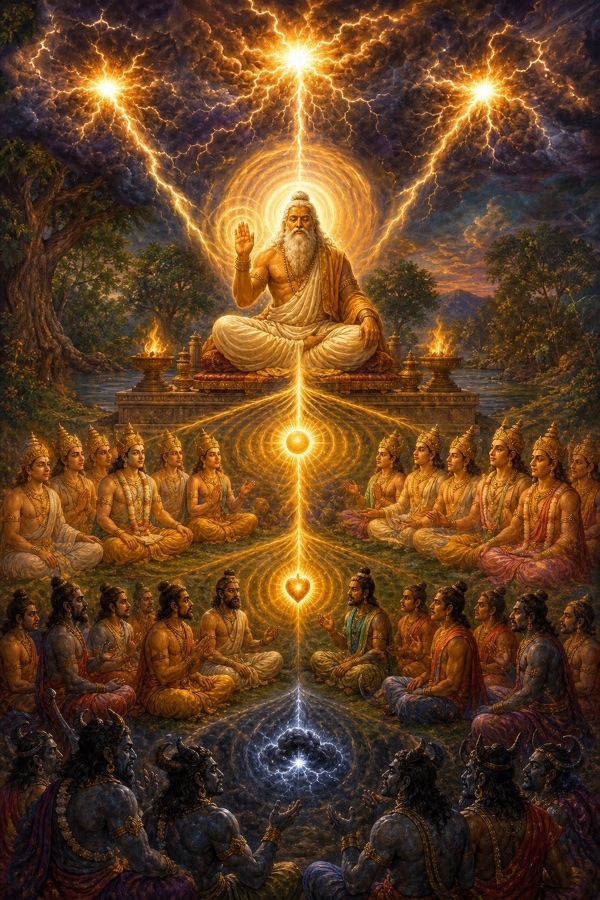
The story belongs to the first days of the world. Three kinds of children of Prajapati (the maker of creatures, the father of all that lives) stood before him with their brahmacharya completed, their years of study in the teacher’s house finished. That phrase covers a long stretch of somebody’s life. A student went to his teacher as a boy and stayed for years, living in his house as one of the household, sleeping on the floor, keeping the fire alive, grazing the cattle, going out with a bowl in the evening to ask for food for the whole establishment, and taking the text line by line from the teacher’s mouth with nothing written down anywhere. Nobody left when the material ran out. A man left when his teacher said he was finished, and on that last day he came and stood in front of him and asked for one more thing to carry away. The gods came first, then human beings, and the asuras last. Each group folded their hands and said, “Teach us something, sir.” Each time, Prajapati spoke one syllable, “द”, da. And each time he asked, “Did you understand?” The text writes that question on a drawn out note, vyajnasishta3, the way a teacher tilts his head and asks, well, did you now?
The gods said, “We understood. You are telling us damyata, restrain yourselves, hold the senses in hand.” Prajapati said, “Om. You understood.” Then human beings came. The same “द”. They said, “You are telling us datta, give, share what you have.” Prajapati said, “Om, that is it.” Then the asuras came, the same “द”, and the asuras said, “You are telling us dayadhvam, show mercy.” Prajapati said that same “Om” once more. Notice that the teacher’s yes is itself the syllable om. One sound, three sets of students, three separate commands, and the teacher’s seal on all three. Notice too what he did not do. He gave no explanation, offered no second attempt, and corrected nobody, since every one of the three had answered correctly.
The Upanishad then says that this story runs forward out of the old time into this one. “तदेतदेवैषा दैवी वागनुवदति स्तनयित्नुर्द द द”, this same divine voice goes on repeating it, the thunder, da, da, da. Damyata, datta, dayadhvam. And then the instruction arrives flat and plain, “तदेतत्त्रयं शिक्षेद्दमं दानं दयाम्”, these three are the things to be learned, restraint, giving, compassion. The sentence is meant for every ear that can hear thunder. The farmer standing in his field, the king seated in his hall, the ascetic sitting in the forest, the sky speaks to all three of them in one voice.
Take that claim literally for a moment and see what it asks of a listener. There was no other public voice in that world. No proclamation reached a village except through a man on a horse, no sound was ever produced anywhere that everybody heard at the same instant. Thunder did that. It arrived over a whole district at once, from above, with nobody making it, and it came in the one season when everything depended on what the sky decided to do. A people who lived under that had no trouble at all hearing a sky full of noise as a voice with something to say. What this brahmana does is take the most public sound in existence and put an instruction inside it that each person has to finish for himself.
The marvel here is that the teacher gave no three separate lessons at all. The word was one. The difference sat inside the listener. Every student filled that unfinished syllable with his own deepest lack. Whatever a man was short of, that is what he heard. The gods live steeped in pleasure and plenty, so they heard an order to hold themselves in. Human beings gather and keep their fists closed, so they heard an order to open their hands. The nature of the asuras leans toward cruelty, so they heard mercy. Each one of them heard the medicine for his own disease. A teacher who had said, you gods should practice restraint, would have handed out three corrections and made three men defensive. This one made three men diagnose themselves out loud and then confirmed the diagnosis.
And then comes something that turns the reader back on himself. Gods, human beings and asuras are all three the children of Prajapati, and all three keep brahmacharya in the same house. These three temperaments are three leanings of one mind, and the names of distant races are only their costume. Some days the mind runs toward pleasure, some days toward hoarding, some days toward the small bitter satisfaction of saying the thing that stings. On such a day, picking the right “da” for yourself out of the thunder is the whole practice this brahmana asks for.
In short: Prajapati gave the gods, human beings and the asuras one syllable, “द”, and each heard, according to his own lack, restraint, giving and mercy. The thunder repeats those three commands still. A true teaching works as a mirror, and these three medicines are meant for the three leanings seated inside every one of us.
The three syllables of the heart, and the great yaksha named truth
The next brahmana opens with a sentence meant to be read slowly, “एष प्रजापतिर्यद्धृदयम्”, this heart here, this is Prajapati. Then: this is brahman, this is everything. In the brahmana before, Prajapati sat outside, in the teacher’s place. Here he is found inside, in the middle of the chest, beating. By the word heart the Upanishad means far more than the piece of muscle that pushes blood. The heart is the place where mind, breath and the power of knowing sit down together, the place we go back to in sleep and come out of on waking. It is also the one organ a man can hear without any instrument. Lie down on a quiet night in a house with no clock in it and no sound outside except the animals shifting, and the thing knocking steadily under the ribs is the loudest event in the room.
Then the Upanishad breaks the word open and shows it. Hridayam holds three syllables: hri, da, yam. Hri belongs with harana, bringing; to the man who knows this, his own people and strangers as well bring their offerings. Da belongs with giving; his own and strangers give to him. Yam belongs with going, eti; he goes to the world of light. This play with syllables can look strange to a reader today, and yet in the Upanishadic tradition the sound of a word and its meaning are held to be braided into each other. These were people whose entire learning arrived through the ear and lived in the mouth, who spent years being drilled on the exact pitch and length of every syllable of a text, and for whom a word was first of all a sequence of sounds made in the body. To hear a word syllable by syllable is to know the thing itself syllable by syllable.
The fourth brahmana gives that same heart a second name. What was the heart was this, and it is truth itself. Then the large sentence arrives: whoever knows it as the mahad yaksha, the great and venerable presence, and as prathamaja, the first born, and says satyam brahma, truth is brahman, conquers these worlds. The word yaksha stands here for that vast, astonishing, worshipful presence that showed itself before anything else, the same one the Kena Upanishad also calls yaksha. There the gods stood in front of it at the edge of their own assembly and none of them could say what it was, and the word carries that particular feeling, of something enormous standing close by that will not give its name. Heart, Prajapati, truth, great yaksha, four names for one thing, and that thing is beating inside your own chest.
A small question and its answer lie buried in the middle of this brahmana. The text says jita innvasavasat, will he ever be conquered? And the answer is carried in the very tone of the passage: one who knows in this way is never defeated. The line is pressed so tight by sandhi that readers have divided it in several ways; Shankara reads it to say that no enemy can conquer the man who knows truth as brahman. And at the close, the plain sentence, “सत्यं ह्येव ब्रह्म”, truth indeed is brahman. Whatever is, is brahman. Truth here begins with honesty in speech and widens until it takes in the truth of being. In a world where a man’s word was the only record of anything, where a boundary or a debt or a marriage stood on what somebody said he had seen, that first sense was already close to load bearing, and this brahmana takes it all the way up.
In short: The heart is Prajapati, is brahman, is everything; its three syllables hri, da and yam name the fruits of bringing, giving and going. That same heart is truth, the great yaksha born before all else, and the man who worships it as satyam brahma wins the worlds and is himself never defeated.
Sa, ti, yam: the untruth ringed by truth, and the person in the sun
The fifth brahmana begins the making of the world from water. In the beginning all this was water. That water made truth, truth is brahman, brahman made Prajapati, Prajapati made the gods. And the gods worship that truth. The order deserves a look: water, then truth, then Prajapati, then the gods. The gods themselves arrive after truth, and the object of their worship is truth as well. What the gods adore stands as the highest thing a human being can adore.
Then the syllable craft returns, this time on the word truth. The Upanishad calls it satiyam and cuts it into three: sa, ti, yam. The first syllable and the last are truth, and the middle syllable, ti, is anrita, untruth. By sound, sa joins with sat, and yam joins with the ending of satya, while the middle ti carries the memory of words with falsehood hidden in them. Then the sentence arrives: this untruth is gripped on both sides by truth, and by that grip it becomes truth itself. Untruth does no harm to the man who knows this.
There is a large mercy folded into this small piece. The Upanishad knows that untruth enters a human life somewhere in the middle, sometimes out of fear, sometimes by a slip. It knows too that when a life begins on truth and ends on truth, that crooked middle piece is squeezed from both sides and washes clean. This is a word of courage for the man who takes one fall and decides that everything is ruined now. Keep the two ends honest, and the pressure of the ends straightens the bend in the middle.
The Upanishad then says that this truth is the aditya, the sun in the sky. And a beautiful pairing is laid down here. The person in the disc of the sun and the person in our right eye rest upon each other. The person of the sun is settled in the person of the eye by way of the rays, and the person of the eye is settled in the person of the sun by way of the breaths. The light outside and the power of seeing inside are two ends of one truth. That pairing was practiced, not merely thought. Twice a day, at the two joints of the day, a man stood facing the sun with water in his cupped palms and looked at the disc while he recited, so that the meeting of the eye and the sun was a physical appointment kept every morning of his life from the age of eight. And when the person in the eye is about to leave the body, the disc appears to him pure, stripped of its rays; the rays no longer come back to him. Old people used to say that the sun looks faded to a dying man, and this line sets down that very experience.
One body is drawn for both persons. Bhuh is his head, one syllable, one head. Bhuvah is the two arms, two syllables, two arms. Svah is his footing, his two feet, two syllables, two feet. These are the three vyahritis with which the chanting of the Gayatri begins, the three words a boy learns to say before the mantra itself and goes on saying at both ends of every day for the rest of his life, and here they turn into the body of a person. Then the hidden name of each is given, which the text itself calls its upanishad, its secret name. The secret name of the person in the sun is ahah, day. The secret name of the person in the eye is aham, I. Both names are drawn from the roots han and ha, to strike evil down and to leave it behind; the man who knows this strikes his evil down and leaves it behind.
Stay a moment on that aham. The one looking out through the eye carries I for his real name, and he is the twin of the day seated in the sun. The sixth brahmana places this same person inside the heart: he is the manomaya person, made of mind, and bhahsatya, whose true form is light, and he is the size of a grain of rice or barley within the heart. Those two grains were the things a household measured everything by, poured, weighed, counted, and traded, the smallest unit anybody handled by hand. So small, and still the ishana of all, the overlord of all, the ruler of everything there is. The seventh brahmana sees him in the lightning of the sky: lightning is brahman, because it performs vidana, it splits the dark and cuts it away; for the man who knows this, it cuts his evils away in the same stroke. Anyone who has stood outside on a black night when a sheet of lightning goes off knows the effect the word is built on, the whole landscape out to the horizon delivered in one instant and taken away again.
In short: In the three syllables of truth, the untruth in the middle is ringed by truth on both sides and becomes truth. That truth is the sun, and the person of the sun and the person of the right eye rest upon each other; their secret names are ahah and aham. That same person sits in the heart the size of a barley grain, ruler of all, and stands in the sky as lightning cutting the dark.
The cow named speech, and the roar of the fire within
The eighth brahmana talks like a cowherd, “वाचं धेनुमुपासीत”, speech is to be worshiped as a milk cow. That cow has four teats: svahakara, vashatkara, hantakara and svadhakara. All four are words of sacrifice and of giving, and all four were sounds a person actually heard, the way we hear a doorbell. Saying svaha and vashat, offerings are poured out to the gods, so the gods live on those two teats. Those are the calls made at the moment the ghee goes into the flame, the priest’s voice going up on the last syllable and the fire answering. Saying hanta, which means here, take this, food is handed to human beings, so that teat belongs to them. That is the word said across a courtyard when a leaf plate is put into a guest’s hands. Saying svadha, the offering goes to the ancestors, so that teat is theirs. Svadha belongs to the rites for the dead, said while rice balls are set out on grass for three generations of a family who are addressed by name. Breath is the bull of that cow, and mind is her calf.
Open the picture out and you have the whole economy of speech. A spoken word feeds three worlds, the gods above, the people in front of you, the ancestors left behind. And a cow gives her milk only while the calf stands near; anyone who has milked knows that the calf is brought up first and allowed to start, and that the letting down stops the moment she is uneasy about where he has gone. Speech carries meaning only while the mind stands with it in the same way. The bull is breath, since no word forms without a breath to carry it out, and since the herd exists at all because of him. In a house where speech is raised this way, every word feeds somebody. Where the calf has wandered off, where the mind has gone elsewhere, the teats go dry and the words come out hollow.
The ninth brahmana goes inward. This fire inside a person is vaishvanara, the fire that lives in all human beings, by which the food eaten is cooked. And then a statement that every reader can test right now, this minute. The Upanishad says this fire has a ghosha, a hum, which is heard when you shut your ears. Cover both ears with your palms, and there is a faint, continuous sound inside, like a fire burning somewhere far away. That is the sound of vaishvanara. And when a person is about to leave the body, this hum stops being heard.
In the fifth brahmana the dying man saw the sun without its rays; here the fire inside falls silent. The two lines take the frightening face off death and turn it into a signal: the light outside and the hum inside both keep company with the breath, and when the breath goes they return to their own sources. For the man who hears that hum while he is alive and looks at it as brahman, the fire inside becomes a door to meditation while it goes on cooking his bread. The word for that cooking is the same word used for what happens on a hearth, and the image behind it is exact. Food goes into a body the way fuel goes onto a fire, and something in there works on it out of sight, and heat comes off the result. The warmth that rises in the belly after every meal is the work of that same vaishvanara, and to know it this way is already a practice.
In short: Look at speech as a cow whose four teats feed the gods, human beings and the ancestors; breath is her bull and mind her calf, without whom no milk comes. The vaishvanara fire within cooks the food, and its hum is heard when the ears are shut; that hum falls quiet as the breath departs.
The road after the body is left, the highest tapas, and the pair of food and breath
The tenth brahmana is a map of the road the worshiper walks after leaving the body. When a person goes out of this world, he comes to the wind. The wind opens for him there, as wide as the hole in the hub of a chariot wheel, and through that he climbs. Then he comes to the aditya; the sun opens for him as wide as the mouth of a lambara, a large drum. Then he comes to the moon; the moon opens for him as wide as the mouth of a dundubhi. Every measure in that list is a thing these people could put a hand on. The hub hole of a chariot wheel is a tight dark socket that a wheelwright bores and greases and that the axle fills exactly. The lambara and the dundubhi were real instruments with known mouths, the war drum among them, the one beaten at the head of an army and at the announcements of a king. Every gate is larger than the gate before it, as though the road went on widening the higher it climbed.
And then the line that is the destination of this whole map, “स लोकमागच्छत्यशोकमहिमम्”, he arrives at the world where there is no sorrow and no cold. There he dwells for everlasting years. Sorrow and cold were the two things the rishis of the forest knew most intimately, the ache inside and the shivering outside. Men who slept under a tree through the cold months with one cloth, who woke in the dark with the river fog coming up through everything, knew what they were asking to be spared. A world with neither of them in it was for those men the plainest definition of heaven. Tradition treats this brahmana as the declaration of the fruit of every worship that came before it.
The eleventh brahmana picks up the word tapas and changes what it holds. Tapas ordinarily means hardship taken on by choice, fasting, standing in cold water at dawn, sitting between fires in the hot season, the disciplines a man announced and then carried out in front of everybody. The Upanishad says: the highest tapas is when a man is laid low by illness and burns with it. The highest tapas is when they carry the dead man out to the forest. The highest tapas is when they lay the dead man on the fire. Each of those three is a scene everybody there had witnessed, the fever going up for days in a corner of the house, the body carried out on a frame by four men with the village walking behind, the wood stacked and lit in a clearing by the river. Illness, death and the burning come to everyone unasked, and whoever looks at them as tapas has turned them into a sacrifice. To accept a suffering you never chose is to choose it, and that acceptance is tapas here.
The twelfth brahmana opens on an old argument. Some say food is brahman. The Upanishad answers that it is otherwise, since without breath food rots. Some say breath is brahman. The answer is the same, since without food breath dries up. These two deities reach the highest state by becoming one. Bread and breath, body and awareness, the pair of them together is life, and the pair is what carries a man to the door of brahman. The man who only feeds his body and the man who only drills his breathing are both asked here to sit down side by side.
A short exchange between a father and a son is recorded on this very point. Pratrida said to his father, “For the man who knows this, what good can I do him, and what harm?” The father stopped him with a movement of the hand, ma pratrida, hold, do not ask that. The text has the word panina here, with the hand; Shankara reads it as the father lifting his hand to quiet the boy, since the good and the harm of such a knower lie in nobody else’s hands at all. Then the father asked, “Which of these two, becoming one, reaches the highest state?” And he gave the answer himself, in two syllables. This is how the teaching moved in a household. A boy asked something with an edge on it, a hand came up, and the question was replaced with a better one by the same man who had raised him.
The first syllable is vi. Food is vi, because all creatures are vishta in food, entered into it. The second syllable is ram. Breath is ram, because all creatures take their delight, ramante, in breath. Join the two and you have viram, and the Upanishad says that into the man who knows this all creatures enter, and in him they take their delight. The method is the one used on the syllables of the heart and of truth: open a word and show the meaning seated inside it. A father hands his son two syllables and hands him a whole way of seeing, and the son carries it down the generations.
In short: After leaving the body the worshiper climbs through the opening gates of wind, sun and moon and reaches the world where neither sorrow nor cold exists. To take illness, death and the burning as tapas is the highest tapas. Food and breath reach the highest state only together, and Pratrida’s father folded this into two syllables, vi and ram.
Uktha, yajus, saman, kshatra: the four breaths
The thirteenth brahmana takes four words and turns each one of them into breath. The first is uktha, the Rigvedic hymn sung aloud at a sacrifice. The Upanishad says breath is uktha, because breath raises all this up, it lifts. What gets us out of bed in the morning is breath; what lifts the seed out of the soil is breath as well. And the fruit: in the house of the man who knows uktha a strong son stands up, and he wins sayujya with uktha, oneness with it, and salokata, a dwelling in the same world as it.
The second word is yajus, the prose formulas of the sacrifice that bind its acts together. Breath is yajus, because in breath all creatures are yukta, joined. As long as the breath is there, hands and feet, eyes and ears all work joined together; once the breath goes, they fall apart from one another. The third word is saman, the chanted mantra. Breath is saman, because in breath all creatures come together evenly, samyanchi, they arrive in one voice. For the man who knows this, all creatures combine to make him foremost.
The fourth word comes from outside the sacrifice: kshatra, the power of rule, the strength that guards. Breath is kshatra, because breath gives trana from injury, it saves. When the body is cut somewhere, what closes the cut is breath; so kshatra, whose work is protection, has breath for its real form. The man who knows this gains a kshatra that needs no other protector, and gains oneness with kshatra and a dwelling in its world. Three limbs of the three Vedas and the strength of a king, all four gathered by this brahmana into one breath.
Watch the move this brahmana makes. Every one of those first three words named a job held by a different man at the same fire. The hotri called the hymns, the adhvaryu muttered the formulas and did the handling, the udgatri sang. Between them they made a sacrifice happen, and a man could spend his life mastering one of the three and be known for it across a region. This brahmana shows breath inside the very words each of them speaks. This Upanishad does the same thing again and again. It takes nothing away from the man of ritual, and it turns the meaning of his ritual inward. A man singing the uktha who knows that the breath doing the singing is itself the uktha has turned his singing from prayer into meditation. And a king proud of his strength learns here that his strength is borrowed from the same breath moving in every man of his people.
In short: Uktha, yajus, saman and kshatra are all four breath: breath raises, joins, brings into one voice, and saves from injury. The man who knows this gains oneness with them and a dwelling in their world. Seeing the words of the daily sacrifice inside your own breathing is the whole of this worship.
The four quarters of the Gayatri, and Janaka’s question to Budila
The fourteenth brahmana is the longest and the most loved part of this chapter, and its subject is the mantra given into a child’s ear at every upanayana, the Gayatri. That ceremony is the hinge of a boy’s life. He is eight or so. His head is shaved, he is bathed, he is given a staff and a skin to wear and a cord over his left shoulder, and he stops being a child of the house and becomes a student who will now leave it. At the center of the day the teacher draws a cloth over the two of them so that they are alone under it, takes the boy’s hand, and speaks this one verse into his ear, a few words at a time, until the boy can say it back. From that morning until his last, he will say it at first light and again at dusk. The Upanishad leaves the words of the mantra aside and starts by counting its quarters. Bhumih, antariksham, dyauh, those three words are eight syllables, and one quarter of the Gayatri is eight syllables. So the first quarter is the three worlds; the man who knows it wins as much as there is in all three of them. Richah, yajumshi, samani, eight syllables again; the second quarter is the three Vedas. Pranah, apanah, vyanah, eight syllables again; the third quarter is breath, everything here that breathes.
And then the fourth quarter, which the text calls turiya, and darshata, the one that is seen, and parorajas, blazing above all dust, above all the worlds. It is this sun, burning up there. Turiya means fourth; darshata because it shows itself to the eye; parorajas because it burns above and beyond all these worlds. The man who knows this fourth quarter burns in that same way, with shri and with fame. So the three quarters of the Gayatri can be counted out, worlds, Vedas, breath, and the fourth quarter can only be looked at. It never comes into the counting.
From here the brahmana builds a beautiful stair. The Gayatri rests on that fourth quarter. That quarter rests on truth. And what is truth? “चक्षुर्वै सत्यम्”, the eye is truth. Because when two men come quarrelling, one saying I saw it and the other saying I heard it, we put our trust in the one who saw. That is a courtroom scene from a world with no court. Two men with a dispute went to the elders of the village, each brought whoever would speak for him, and the whole thing was settled on the spot by weighing one man’s word against another’s. Everybody listening knew exactly how much more an eye was worth than an ear. Then that truth rests on strength, and strength is breath. This is why it is said, balam satyadogiyah, strength carries further than truth. The line startles, and its reading is disputed; Shankara takes it as ojiyah and understands it to mean that truth stands only on the support of strength, which is breath, since a man without strength cannot even speak a true word. In this way the Gayatri is established adhyatma, inside your own body.
Then the secret of the name. The Gayatri protected the gayas; gaya means the breaths; she protected the breaths, and from that she has her name, Gayatri. And the savitri a teacher recites to a student at his upanayana is this very one; it protects the breaths of the one he recites it to. Some teachers recite the savitri in the anushtubh meter, saying that anushtubh is speech and speech is what we are reciting. The Upanishad says: do not do that; recite the Gayatri herself as the savitri. This is a working instruction aimed at teachers who were making a substitution, and the text steps in to stop a practice from drifting. And then a very human line: even if the man who knows this accepts a great deal in gifts, it comes to nothing beside a single quarter of the Gayatri.
Behind that line sits an anxiety that ran through the whole of this class of men. A brahmana lived on what was given to him, and taking a gift was held to transfer something of the giver along with it, so that an unfit gift could sit on a man for years and had to be burned off. Deciding what to accept and from whom was a daily calculation with a man’s standing inside it. The Upanishad measures the thing out. If a man accepted these three worlds filled full, he would have got the first quarter of the Gayatri. If he accepted as much as the three Vedas hold, the second quarter. If he accepted everything here that breathes, the third quarter. And the fourth quarter, that burning sun, can be got from nobody at all, so from where would a man accept so much? No weight of gifts can settle on the man who knows the Gayatri, since his learning is larger than any gift. The story of Janaka further on turns this over and shows a scholar on whom that weight had settled.
Then comes the upasthana of the Gayatri, the salutation spoken standing before her. “Gayatri, you are of one quarter, of two quarters, of three quarters, of four quarters. And you are without quarters, since you are never attained. To that fourth quarter, seen, blazing above the dust, salutation.” Then the worshiper adds his own wish: let this desire come to me; or, of a man he hates, let that man’s desire fail to prosper. The Upanishad says plainly that the desire of the man against whom such a salutation is made does not prosper. The line can leave a reader today uneasy; the text records it honestly, since Vedic worship went forward with all of a man’s wishes laid out in the open, the good ones and the bitter ones together.
And the brahmana closes on a story. Janaka, king of Videha, said to Budila Ashvatarashvi, “You used to say you were a knower of the Gayatri. Then how is it that you are hauling loads, turned into an elephant?” The insult lands on a specific picture. An elephant in that country was the strongest working animal anybody owned, and what it did all day was carry what it was told to carry, timber, stone, a howdah full of people, under a driver with a hook. Janaka is telling a learned man in front of everybody that his learning has turned into freight on his back. Budila said, “Emperor, I had not known her mouth.” And the Upanishad tells us that the mouth of the Gayatri is fire. However much wood you put into a fire, it burns all of it; in the same way the man who knows this, however much wrong he does, burns all of it and comes out clean, purified, unaging, undying. To know the mouth is to know which fire the thing you have taken must be offered into. Budila knew the quarters, and the mouth that turns things to ash had slipped past him.
In short: The three quarters of the Gayatri are the three worlds, the three Vedas and breath; the fourth is the sun, which can be seen and can never be got. The Gayatri rests on truth, truth on strength, strength on breath, and her name comes from her protection of the breaths. The story of Janaka and Budila says the mouth of the Gayatri is fire, and without knowing it even learning turns into a load.
The golden lid, and the prayer at the hour of death
The closing lines of the chapter are a string of mantras, said for a dying man, or by the dying man himself. These same mantras stand at the end of the Isha Upanishad, since the Isha belongs to this same Shukla Yajurveda. Here they should be read as the ripening of every worship in the chapter. To hear them properly you have to put the morning behind them. Every day of his adult life this man has gone down to the water before first light, stood in it to the knees, cupped water in both palms and let it fall, said the three vyahritis and then the Gayatri with his eyes on the place where the sun is about to come up, and waited there until the disc cleared the trees. He has done that perhaps twenty thousand times. Now he is lying on the ground near that same water, and he can no longer stand, and the last thing he says is addressed to the same sun he has been facing since he was eight. The first line is “हिरण्मयेन पात्रेण सत्यस्यापिहितं मुखम्”, the face of truth is covered over by a golden vessel. The blazing disc of the sun is that golden lid, and behind it stands the truth this chapter has been speaking of since the fifth brahmana.
Then the prayer: Pushan, draw it back, so that one whose law is truth may see. Pushan is a name of the sun, the nourisher, the one who finds what is lost and brings the herds home. Then he is called by further names: ekarshi, the solitary seer; yama, the one who holds the reins; surya; prajapatya, son of Prajapati. Gather in your rays, draw your blaze together. This is a prayer turned around; all our lives we ask the sun for light, and here he is begged to pull his light in, so that the form behind the brilliance can show itself. The vessel in the picture is an ordinary object. A golden dish laid face down over a thing keeps it hidden precisely by being splendid, and the eye that stops on the shine of the lid never gets past it. And then, the form of yours that is most blessed, I am seeing it.
And in the same breath comes the sentence that holds the whole of this Upanishad, “योऽसावसौ पुरुषः सोऽहमस्मि”, that person there, that one, I am he. The pairing made in the fifth brahmana, the person of the sun and the person of the eye, ahah and aham, becomes one thing here at the last moment. The dying man looks at the sun and says, I am that. The aham brahmasmi of the first chapter has come down onto the tongue of a man letting go of his breath. What was once settled by argument in a royal assembly is now being whispered on a riverbank, in front of a sinking sun, with his family standing behind him and the wood already gathered.
Then the body, with no weeping over it, “वायुरनिलममृतमथेदं भस्मान्तं शरीरम्”, the breath goes to the wind, to the deathless, and this body ends in ashes. Both halves of that line are plain statements of what will happen within the hour. The breath will merge into that undying wind, and the body will be ash, and everyone present knows exactly which clearing by the river the ash will be made in. After this, “ओं क्रतो स्मर कृतं स्मर”, om, kratu, remember, remember what was done. Kratu is the resolving mind. At the hour of death the mind is being spoken to: remember, hold on to what you have done; and the line is said twice over, the way you repeat yourself while gripping someone who is slipping. Tradition holds that the memory of the last hour settles the next direction, and the Gita’s teaching on remembrance at the end grew out of this seed.
The last mantra is addressed to fire: “अग्ने नय सुपथा रायेऽस्मान्”, Agni, lead us to our wealth by a good road; you know all our works. Take the crooked wrong away from us. We give you our words of homage again and again. This is the same fire the fourteenth brahmana called the mouth of the Gayatri, and the same fire into which the eleventh brahmana said the laying of the dead is the highest tapas. It is also the fire this man lit on the day he married and fed twice a day ever since, carried with him when he moved house, and it is the fire his son will bring to the pyre. The fire that will burn the body is asked to show the road. So the chapter closes by braiding all its threads into one place: truth, sun, person, aham, breath, memory, fire.
In short: The prayer at the hour of death asks the sun to draw back the golden lid so that the truth behind it can be seen, and then says, that person there, I am he. The body will be ash, the breath will merge into the undying wind, the mind is to hold what it has done, and fire is asked for a good road.
And in the end, toward yourself
Closing this chapter, the thunder comes back to mind. The next time the sky cracks open, stop for a moment and listen for which “da” is meant for you today. On the day the mind runs toward pleasure, dama. On the day the fist stays shut, dana. On the day something turns bitter and sweet inside you at another person’s mistake, daya. Prajapati spoke the same syllable three times over; it is spoken to us daily in the same way, and daily we fill it out with whatever we are short of. The hard part of that practice is the honesty it takes to hear the syllable you would rather not hear, since all three are available every time and only one of them is yours this morning.
And two small practices this chapter puts straight into your hands. One, shut your ears and listen to the hum of the fire inside, and simply listen, knowing it as the sound of the breath that is keeping you company. Two, looking at the morning sun, asking for nothing, say once in the mind, that person there, I am he. The Upanishad set this sentence on the tongue of a dying man, and for anyone who says it every morning while alive, that hour will arrive as no stranger. That is the whole logic of a daily practice in this tradition. A thing done twenty thousand times is available on the one day a person can no longer reach for anything.
The three syllables of truth are worth carrying away as well. Somewhere in the middle of all our lives there is a ti, a turn where we moved off the truth. This chapter says: keep the ends honest. Truth at the beginning, truth at the end, and the bend in the middle straightens under the pressure from both sides. From the whole the whole rises, and the whole is what stays behind; nothing has been subtracted from us, there is only a golden lid in the way, and the prayer for its drawing back has been taught to us already.
Source: Brihadaranyaka Upanishad, chapter 5, brahmanas/khandas 1 to 15; read against the Sanskrit, with Shankara’s reading noted where readings differ.