On this page
The hall is dressed and Emperor Janaka is on his seat. Videha lies in the east, a wealthy country of black soil and standing water, and its court is the one place in that world where a man who has thought something through can get a hearing and be paid for it. Janaka has spent years filling his court with teachers the way another king fills a treasury. Yajnavalkya comes in through the door. Janaka fires his question the moment he sees him, “Yajnavalkya, what brings you today, cattle, or a bout of subtle questions?” The teacher laughs and says, “Both, your majesty.” That one exchange opens the temper of the whole chapter. Nothing is kept back here, no learning and no appetite. Cattle were what wealth was made of in that country, a herd that walked and bred and could be counted by anyone standing at the fence, and a thousand head with a bull elephant behind them was a gift a kingdom noticed. The king has that standing ready behind every answer, and the teacher has one more answer waiting underneath every answer he gives.
This fourth chapter is the long conversation at the middle of the Brihadaranyaka where the whole Upanishad settles onto its single question, who this knower seated inside is and what holds him up. In the third chapter Yajnavalkya took the questions of the assembled scholars at a great sacrificial session, a gathering that ran on for days with the fires kept alive in shifts, priests chanting in relays, cooks feeding hundreds, and the learned men of Kuru and Panchala arrived from every direction to see who would come out on top. A thousand cows stood roped in the yard with ten measures of gold tied to each pair of horns, and Yajnavalkya had told his pupil to drive them home before the debating began. He walked out of that hall with the herd and with the field cleared behind him. Here the questioner is Janaka alone, and Janaka holds the boon of kamaprashna, leave to ask whatever he pleases whenever he pleases. Across six brahmanas the chapter travels from the unfinished answers of six teachers to the light of the self, through dream and dreamless sleep to death and rebirth, and on to the question from Maitreyi after which Yajnavalkya walks out of his own house.
The main figures of this chapter
Yajnavalkya: teacher of the Videha assembly, who carries every answer to its last step and then rises and leaves it standing there.
Janaka Vaideha: emperor of Videha, holder of the boon of kamaprashna, who opens his treasury at every answer he is given.
The six teachers: Jitva Shailini, Udanka Shaulbayana, Barku Varshna, Gardabhivipita Bharadvaja, Satyakama Jabala, and Vidagdha Shakalya, whose sayings Janaka lays out one by one from memory.
Maitreyi: Yajnavalkya’s wife, a speaker of brahman, who asks for the road to deathlessness in place of her share of the property.
Katyayani: Yajnavalkya’s other wife, whose mind rests in the understanding of a household.
The teachers of the line: the long file from Pautimashya up to the self-born brahman, who carried this knowledge from one ear to the next.
Six teachers, six answers, and every answer standing on one foot
Janaka has listened to many teachers in his life and has kept one sentence from each of them. This was a world with no books to consult, no shelf to go back to, no way to check a saying against a page. What a man knew, he knew because he had heard it from a mouth and held it in his memory, and a king who wanted knowledge sent for the man who had it and gave him a seat and food and cattle and asked him to speak. Over the years Janaka has done that many times, and each visit has left him with one line lodged in his head, carried the way another king carries the names of his horses. Now he sets those sentences in front of Yajnavalkya the way a man turns a strongbox over and spills the coins across a table.
The pattern holds every time. Janaka says, this teacher told me this. Yajnavalkya listens and nods, “A man who has a mother, a father, and a teacher would say exactly that,” meaning the saying has come down a sound line. That sentence is worth slowing over. To have a mother and a father here means to have been raised inside a household where the rites were kept and the speech was clean, and to have a teacher means to have sat in front of one man for years and taken the Veda from him a line at a time. Being able to say so about a man was his credential, and Yajnavalkya grants it without argument in every one of the six cases. Then he drives in a nail. “Did he also tell you its ayatana, its seat, and its pratishtha, the ground it stands on?” Each time Janaka gives way and says, “He did not.” And the verdict follows, “एकपाद्वा एतत्सम्राट्”, this thing is standing on one foot, your majesty.
The demand behind the nail is a working one. A meditation in this tradition is a thing a man sits down with daily for years, and it has to be built to carry weight. It needs a seat, the place where it rests, and it needs a ground, the wider thing that holds the seat up, and it needs a name to be held under. Take any of the three away and the practice wobbles the way a stool wobbles on one leg, upright for as long as nobody leans on it. Every one of the six sayings Janaka has collected is true. Every one of them is also a stool with one leg.
The first coin is Jitva Shailini’s, that speech is brahman. Yajnavalkya completes it. Speech itself is its seat, space is its ground, and it is to be worshiped as prajna, awareness. Janaka asks what awareness is. The answer comes back, speech. By speech a man is recognized as one of his own. Think about what that meant. A stranger came down the road and the first test anyone applied was to let him talk, since accent and vocabulary and the formulas he used placed him instantly, his region, his school, his family, his standing. By speech the Rigveda, the Yajurveda, the Samaveda, the Atharvangirasa, history, ancient lore, the branches of learning, the upanishads, verses, aphorisms, glosses and commentaries, what is offered in fire, what is given to eat and to drink, this world and the world beyond and every creature, all of it is known. That whole list lived in nobody’s library. It lived in throats. Speech never abandons the man who worships it with this knowledge, all creatures flow toward him, and he becomes a god and goes to the gods.
The second coin is Udanka Shaulbayana’s, that prana, the breath, is brahman, since without breath nothing of anyone remains. Yajnavalkya says prana itself is its seat, space is its ground, and it is to be worshiped as priya, what is dear. Where that dearness shows is a piercing answer. For love of his breath a man performs a sacrifice for someone he should never serve, takes a gift from hands he should refuse, and walks into a country where he may be killed. Each of those three was a real disgrace with a name attached in that society. A priest who officiated for the wrong patron was talked about for the rest of his life. A gift accepted from an unfit giver was held to stick to the man who took it. A country where a stranger could be cut down was a matter of common knowledge among traders, and men went into those places anyway because the alternative was going hungry. So that the breath may continue, he bends every rule he keeps. Prana is the supreme brahman for that reason, and prana never abandons the man who knows it.
The third coin is Barku Varshna’s, that the eye is brahman, and here the worship is of satya, truth. Ask anyone who has seen a thing whether he saw it. He says yes, I saw it. With that, the thing becomes true. The whole traffic of the world rests on what an eye can witness, and in a place with no written record it rested there entirely. A boundary between two fields, the price agreed on for a bullock, a marriage, a debt, a death, all of it stood on men who had been present and could be called to say so. The eye was the archive. The fourth coin is Gardabhivipita Bharadvaja’s, that the ear is brahman, and here the worship is of ananta, the endless. What is endlessness? The directions. Walk in any direction as long as you like and no edge arrives, since the directions have no end, and the directions are the ear. A sound that can come from any side stretches the ear out on every side. At night, with the doorway open and the fields black past the courtyard wall, the ear is the only sense still on duty, and everything that happens in the dark arrives through it from a direction.
The fifth coin is Satyakama Jabala’s, that the mind is brahman. Its worship is of ananda, delight. By the mind a man is drawn toward his companion, and from her a son is born in his own likeness, and that is delight. A son in this world was continuity itself, the one who would keep the fire, feed the ancestors, and carry the family name past his father’s death, so the delight being named here has the weight of a whole lineage behind it. The sixth coin is Vidagdha Shakalya’s, that the heart is brahman, and its worship is of sthiti, standing firm. The heart is the seat of all creatures, the heart is the ground of all of them, in the heart all creatures rest.
Six times, as each answer is finished, Janaka says, “I give you a thousand cows along with a bull elephant.” Six times Yajnavalkya returns the same sentence, “My father held that one should take nothing without first giving the whole teaching.” This is a large thing to keep refusing. A teacher in this world lived on what kings and patrons handed him, and a herd of that size was a household secured for a generation, pasture and milk and bullocks for the plow and daughters married well. The man turning it down has already shown in the third chapter that he takes cattle when they are his. Here he is holding to a rule he had from his father, that a fee follows a finished teaching and never a half one. The gift stops there, the lesson moves on.
Notice that the teacher has called no teacher false. All six doors are true and all six have been named supreme brahman. What remained was to see each door with its seat and its ground, and that ground turns out to be the same one every time, space. The name of the worship changes at each door, awareness, what is dear, truth, the endless, delight, standing firm, as though one jewel were turning in the light and showing six faces in turn.
In short: A true saying you have heard can still be unfinished while its seat and its ground go unknown. Speech, breath, eye, ear, mind, and heart all carry a man to brahman, on the condition that he sees them resting on space. And Yajnavalkya pulls his hand back from the fee every time, because the teaching is still half given.
Indha in the right eye, and the fearlessness of neti neti
Six answers have been opened and a stillness settles over the hall. Then Janaka does what emperors seldom do. He climbs down from his kurcha, the high woven seat that marks who he is in that room, and stands on the floor in front of the teacher. Everyone present sees it happen. The whole arrangement of that court is built on who sits where and how high, and the man at the top of it has just put his feet on the same ground as everybody else, in front of his own officers, because a question has gone past his stock of answers. “नमस्तेऽस्तु याज्ञवल्क्य”, salutation to you, Yajnavalkya, “अनु मा शाधि”, now instruct me. Power has come down and taken a lower place, and the second movement of this chapter opens here. Yajnavalkya praises the preparation the king has done. “As a man setting out on a long road has a chariot yoked or a boat made fast, so you have equipped yourself with these upanishads.” Both pictures are pictures of leaving. A journey in that country meant river crossings and nights in the open and no certainty of arriving, and a man got his cart and his boat ready before he went. The king has provisioned himself well. The road has still to be walked.
Then he puts the question that shakes all the royal splendor loose. “You are honored, you are wealthy, you have studied the Vedas, you have heard the upanishads. When you are released from here, where will you go?” Janaka answers straight. “Revered sir, I do not know where I shall go.” That admission is the largest asset the man owns. A king in open court, asked a question in front of the people who serve him, has said the three words his position most discourages. On it the teacher says, “Then I will tell you where you will go.” And he opens the map that has been lying inside the body all along.
In the right eye there is a person whose name is Indha, the kindler, the one who burns bright. People call him Indra instead, by an indirect name, and the Upanishad adds something delightful here, that the gods love indirect names and dislike being addressed plainly. That habit runs through the whole of this literature. A thing of power gets approached from the side, through a cover name, the way a man in that world would never call his elder or his wife by the name given at birth, and would use a title, a relation, a roundabout phrase instead. Directness was for equals and for servants. The form in the left eye is his wife, Virat. Their meeting place is the space inside the heart. Their food is the red lump inside the heart, their covering is the netlike tissue inside the heart, and the road they travel is the channel that climbs upward from the heart. Fine as a hair split a thousand times, the channels called hita are set in the heart, and through them this inner sap keeps moving.
The whole picture is solid, close to a page of anatomy, and it comes from people who had opened bodies. These were men who cut apart sacrificial animals by a fixed procedure, who knew where the membranes lay and what color the tissue was under them, who had held a heart in the hand while it was still warm. Then in one stroke the teacher leaves all of it behind. He pairs the directions with the breaths, east, south, west, north, above, below, and says that all the directions are all the breaths. And then comes the sentence the whole Brihadaranyaka rests on, “स एष नेति नेत्यात्मा”, this is the self, of whom only this much can be said, he is not this, and he is not this either. He is not grasped, since there is nothing of him to take hold of. He does not break, since there is no breaking in him. He does not cling, he is not tied down, he is not troubled, he comes to no harm.
Then the teacher makes the declaration that will return again and again in this chapter, “अभयं वै जनक प्राप्तोऽसि”, Janaka, you have reached fearlessness. The fruit of the entire knowledge stands in a single word, safety from fear. Consider what a king had to fear and the size of the word grows. Rival kingdoms on three sides, a court in which somebody is always calculating, a crop that fails when the rain comes late, a body that will age like any other body, and at the end of it the question he has just confessed he cannot answer. Janaka hands the word back at once. “May fearlessness come to you as well, Yajnavalkya, since it is you who tell us where fearlessness lives. Salutation to you. These Videhas are yours, and I am yours along with them.” The king has laid down his kingdom and himself in one motion, and this time the teacher refuses nothing, since the teaching is complete.
In short: Yajnavalkya first opens a fine map inside the body, the pair in the eyes, the space in the heart, channels a thousand times finer than a hair. Then he walks past his own map and halts on neti neti. What no name can hold is free of fear for that very reason, and that freedom is what Janaka receives.
What is the light of this person: down from the sun to the self
At the next meeting Yajnavalkya walks over to Janaka himself, and the text notes that he had made up his mind on the way not to say anything. The talk turns on the agnihotra, the fire offering a householder makes at first light and at dusk every day of his life, milk poured into the flame at the two joints of the day. Pleased with the discussion, the teacher offers the king a boon. Janaka asks for kamaprashna, open leave to ask whatever comes to mind. It is a shrewd request. A boon spent on cattle or land is spent once, and a boon spent on permission to ask keeps paying out for as long as the teacher lives. Now the first question belongs to the emperor, and that small question becomes the spine of the chapter. “Yajnavalkya, what is the light of this person?” By what light does a man get up, sit down, and do his work?
The teacher answers easily. “The sun is his light, your majesty.” Janaka drives the nail in at once. “And when the sun has set?” “Then the moon becomes his light.” “And when the moon has set too?” “Then fire.” “And when the fire has gone quiet?” “Then speech is his light.” Take the sequence as a real night in a real village and it stops being a list. The sun goes and work stops with it. On the nights the moon is up, a man can still cross a courtyard and find the water pot and see the shape of someone coming toward him. On the nights it is dark, there is the hearth, banked and breathing, throwing enough light to sit by while the last of the eating is done. Then the fire is covered for the night and the house goes black, and black in that world is total, no line of a doorway, no gray at the window, nothing at arm’s length. Here the teacher sets down a very human scene. Let the dark be thick enough that a man cannot make out his own hand, and let someone call out from somewhere in it, and he walks toward that voice. A human sound is the lamp of that hour.
Now Janaka pulls the last curtain aside. “The sun has set, the moon has set, the fire has died, speech has fallen silent, what is the light of this person then?” And the answer arrives, “आत्मैवास्य ज्योतिर्भवति”, the self becomes his light. By the light of the self he sits, he goes out, he does his work, he comes back. The four outer lights were borrowed. They went out one after another, and what remained was his own.
The king does not stop there. He asks which self that is. And here the chapter opens its deepest stretch. The teacher says, the person made of knowing who lives among the breaths, the light inside the heart, that one. Staying one and the same, he travels both worlds. He seems to think, he seems to stir. Becoming a dream, he steps across this world and leaves the forms of death behind. The forms of death here are the very things the senses chase all day and come back tired from, the food and the quarrels and the money and the standing, everything that will be gone and takes a lifetime of attention while it lasts.
Then comes a line that settles the whole account of birth and death in two breaths. This person, being born, taking on a body, is joined to evils. This same person, going out, dying, leaves those evils behind him. The teacher goes on to say that this person has two places only, this world and the world beyond, and between the two a third, a place of joining, the place of dream. Standing in that seam he sees both places, this one and that one. Holding on to the climb by which he is to reach the world beyond, he looks over the sorrows and joys of both sides. Anyone who has surfaced halfway out of a dream at four in the morning, with the room and the dream both present and neither one settled, has stood in that seam for a few seconds.
In short: Put out the four outer lights one at a time, sun, moon, fire, and voice, and what stays behind is the self. That self is the knowing person seated among the breaths, who stands in the seam of dream between the two shores of waking and the world beyond, and sees them both.
The maker of the dream: chariots, roads, and ponds built on the spot
Now the teacher lays a hand on the door of sleep. When this person sleeps, he takes up only as much of this gathered world as he needs, he throws it down himself, he builds it up himself, and he sleeps by his own radiance, his own light. And then comes the sentence that is the axle of this whole brahmana, “अत्रायं पुरुषः स्वयंज्योतिर्भवति”, here this person becomes self-luminous. No sun rises in a dream, no lamp is lit there, and everything is seen all the same. Whatever is seen there is seen in his own light.
The picture that follows is plain. There are no chariots there, no horses, no roads, and he makes chariots, horses, and roads. There is no delight there, no gladness, no rejoicing, and he makes them. There are no pools there, no lotus tanks, no running streams, and he makes those too. Every item on that list is a thing a man of that time longed for while awake. A chariot with horses was the possession of a great house. A made road was a rare and expensive thing in a country of cart tracks that dissolved in the rains. A stepped tank with lotuses was what a king built and put his name on, so that a village would have water through the hot months. The dream hands out all of it free, in a moment, out of nothing, and takes it back before morning. Then the Upanishad stamps it in three syllables, “स हि कर्ता”, for he is the maker. The material he builds with is also his own.
Some verses turn the state into a picture. Striking the body down with sleep, himself unsleeping, he watches the sleeping ones, and gathering his brightness he returns to his own place, the golden person, the single swan. Guarding the low nest with his breath, he moves outside the nest, deathless, and goes wherever he wishes. Moving high and low inside the dream, the shining one shapes many forms. The nest is the body, the bird is out of it and back before the night is over, and the one thing left on guard at the door is the breath, which is why a sleeping man goes on breathing while everything else about him has gone somewhere else.
Then a very tender line arrives. People see the field where he plays, and no one sees him. That is why they say a sleeping man should never be shaken awake all at once, since the one he fails to find his way back to is hard to cure. This was practical household instruction. A man asleep has gone out, and the body on the mat is a house with the owner away, and hauling him up by the shoulder risks a mismatch that no physician can set right. Others say his dream state is much the same as his waking state, since whatever he sees awake he also sees asleep. The Upanishad has written down this small disagreement, the way a clerk records both voices in an assembly, and leaves the reader holding both.
Now those hita channels come back, fine as a hair split a thousand times, filled with white and blue and yellow and green and red sap. When it seems in a dream that someone is striking him, someone is holding him down, an elephant is running him over, or the ground has slid out from under his feet and he is falling into a pit, the fear he has seen while awake stands up in front of him again through ignorance. Look at the four terrors on that list. A beating, a man pinned and helpless, an elephant at a run, and the ground giving way. Those were the ordinary dangers of that life, a fight in the dark, a rope, a war animal loose in a lane, a well shaft under leaf litter, and they come back at night exactly as they were met by day. And when he feels himself to be like a god, like a king, and it rises in him that all of this is what I am, that is his highest world. Inside one night’s sleep, the terror and the splendor are both of his own making.
In short: Nothing enters a dream from outside. The chariots, the roads, the ponds, and the fear are all built on the spot, and the builder works by his own light. That is why the Upanishad calls a man the maker here. The fear of the waking day comes back at night and stands in front of him, and the same mind, when it recognizes its own size, finds its highest world.
The fearless embrace of deep sleep, and the ladder of joy
After the dream the teacher goes deeper still. He sets out a picture. As a hawk or some other great bird tires of circling in the sky and folds its wings and drops straight toward its resting place, so this person runs toward that end of himself where, asleep, he wants nothing and sees no dream. Anyone who has watched a raptor work a thermal all afternoon knows the moment the picture is taken from. The bird hangs up there for hours on almost no effort, turning and turning over the fields, and then the wings come in against the body and it goes down in a line, fast, with no further interest in the sky. After a whole day of flying, the folding of the wings is picture enough for deep sleep.
That is his form beyond wanting, free of evil, free of fear. To explain it the Upanishad picks up a very human comparison, and picks it up without embarrassment. “तद्यथा प्रियया स्त्रिया संपरिष्वक्तो न बाह्यं किं चन वेद नान्तरम्”, as a man in the arms of a woman he loves knows nothing outside and nothing within, so this person, held in the arms of the knowing self, knows nothing outside and nothing within. This is his form with every wish granted, where the self is the only wish, where no wish is left over, where the shore of sorrow arrives. The comparison is doing exact work. In that embrace a man loses track of the hour, the room, the noise in the lane, and his own separate outline, and what he loses he loses without a moment of fear, which is the whole point being made about the state where nothing is seen at all.
And then comes the extraordinary list that sets every identity down on the spot. There a father is no father, a mother is no mother, the worlds are no worlds, the gods are no gods, the Vedas are no Vedas. There a thief is no thief, the killer of an embryo is no such killer, a chandala is no chandala, a paulkasa is no paulkasa, a shramana is no shramana, an ascetic is no ascetic. Merit does not reach him, evil does not reach him, since in that hour he has crossed all the sorrows of the heart. Hear that list the way a listener of the time heard it. Those names were the hardest facts in his world. A chandala or a paulkasa lived outside the village, took the work nobody else would touch, and carried a status his children would inherit whole. A thief and the killer of an unborn child bore a stain that ritual could barely reach. A shramana had walked away from house and property, and an ascetic had taken on a discipline that marked him for life. Birth, crime, and vow were the three things a man could never put down while he was awake. Every name we carry on our backs through the day slides off our shoulders every night.
Someone may then ask whether consciousness has gone out, since seeing and smelling and hearing have all stopped. The teacher answers eight times in one mold. When he does not see, he is seeing even then and does not see, since the sight of the seer never lapses, it is imperishable. There is simply no second thing apart from him there for him to see. The same is repeated for smelling, tasting, speaking, hearing, thinking, touching, and knowing. The repetition is deliberate and is meant to be heard aloud, eight identical turns, each closing off one more way of asking the same question. And where everything has become one’s own self, there “सलिल एको द्रष्टाद्वैतो भवति”, he becomes one like water, a seer without a second. Water poured into water leaves no seam anywhere in it, and no line can be drawn afterward between what was poured and what was there. This is the world of brahman, your majesty.
After this the Upanishad builds a ladder of joy, each rung a hundredfold. Take the most successful of men, the wealthiest, lord over others, furnished with every human enjoyment. In that world he is a man with herds he cannot count, granaries full through a bad year, sons alive and married, and people who stand up when he enters. His is the highest human joy. A hundred such joys make one joy of the ancestors who have won their world. A hundred of theirs make one joy of the world of the gandharvas, a hundred of those one joy of the karmadevas who reach godhood by their work, a hundred of those one joy of the ajanadevas, a hundred of those one joy of the world of Prajapati, and a hundred of those one joy of the world of brahman. Multiply a hundred by itself six times and the human figure at the bottom of the ladder has stopped being comparable to anything. At every rung one line returns, that this same joy belongs to the shrotriya who is free of crookedness and unstruck by desire. A shrotriya is a man who has heard the Veda properly and holds it entire. The ladder stands open to the man who has become straight and unhurt while living here.
Janaka repeats the same thing at every answer, “I give you a thousand, now speak further, for liberation.” And here the Upanishad writes down something rarely written about a teacher. At this turn Yajnavalkya was afraid, thinking, this king is clever, he has driven me out of every corner. The man who cleared the assembly in the third chapter and sent the cows home before the debate began is now in a room with one questioner and has run out of room to stand. The patience of the questioner is so large that the answerer has been drawn out to his last word.
In short: Deep sleep is the folding of wings and the drop into one’s own nest, where every name and every stain slides off. Consciousness stays lit there, and only the second thing to be seen is missing. And the ladder of joy that rises a hundredfold to the world of brahman has every rung open to the straight shrotriya whom desire has left unhurt.
The hour of leaving: the loaded cart, the ripe fruit, and the caterpillar at the leaf’s edge
To explain the coming and going of the self, the teacher sets down a river. “तद्यथा महामत्स्य उभे कूले अनुसंचरति”, as a great fish swims along both banks of a river, this one and the far one, so this person moves along his two ends, the end of dream and the end of waking. Watch a big fish in a slow river and the picture is exact. It works the near bank in the shade of the overhang, then crosses the open middle and works the far bank, and it belongs to neither side. Whatever he sees at either end leaves no residue on him, since this person is unattached.
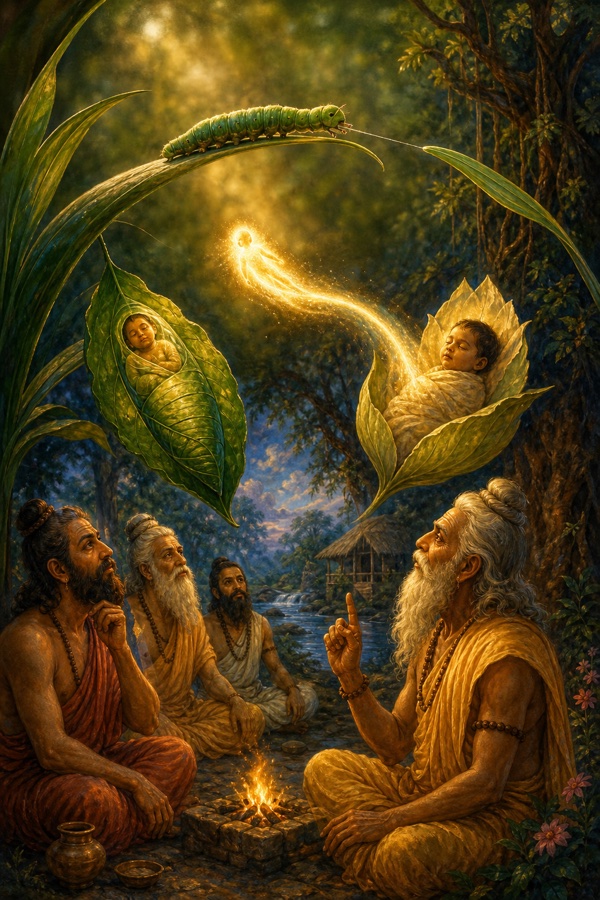
Then comes the picture of the last hour. As a cart loaded past its limit goes creaking along, so this self with a body, carrying the knowing self upon it, goes creaking along at the time when the breath begins to rise. The sound is one everybody there had in the ear. A bullock cart with ungreased wooden axles and a load of grain sacks above the sides makes a noise that carries across a field, slow, protesting, a groan at every turn of the wheel, and you hear it long before you see it come around the trees. That is the noise of a body in its last days. And when this body grows thin, worn down by age or by illness, then as a mango or a fig or a pipal fruit works itself loose from its stalk and falls, so this person slips free of these limbs and returns by the same road toward the breath. A ripe fruit is released by no hand. It hangs, and hangs, and at some hour of an afternoon when nobody is watching the stem lets go on its own account and the fruit is on the ground.
Two more pictures come with it, and both are royal. As officers and charioteers and village heads gather food and water and lodging for a king who is on his way, so all creatures make ready for the man who knows this, saying, brahman is coming. When a king traveled, riders went out ahead of him along the road, and the headman of every village on the route had to have grain husked, water drawn, fodder cut, and a place swept and ready by the time the dust of the column showed. And as those same officers close around a king who is about to leave, so at the hour of departure all the breaths close around this self. The same men who ran ahead of him gather at his stirrup when it is time to go.
Now the teacher describes that exact moment. This self grows weak and comes into something like a swoon. Then these breaths gather around him. He draws the portions of brightness together and comes down toward the heart. And when the person seated in the eye turns back and away, he stops recognizing forms. The people standing around say, he has become one, he does not see. He has become one, he does not smell, he does not taste, he does not speak, he does not hear, he does not think, he does not touch, he does not know. That is all that shows from outside, and anyone who has sat by a bed through a last night has heard those sentences said in a low voice by people in the room.
What happens inside, the Upanishad tells. “तस्य हैतस्य हृदयस्याग्रं प्रद्योतते”, the tip of that same heart lights up. The word is the word for a lamp catching. Picture the small clay saucer with oil in it and a twist of cotton lying over the lip, and the moment when the flame takes hold of the wick and steadies and the room comes into view. That is what the text says is happening at the heart’s tip while the face on the bed is going blank. The breaths have come in from the edges of the body and gathered there, the way a household gathers in one room, and the light at the center is lit for the leaving. By that light this self goes out, sometimes by the eye, sometimes by the crown of the head, sometimes by another door of the body. As he goes out, the breath goes out after him, and after the breath all the other breaths. He goes out with consciousness, and consciousness walks along behind him. Three things join him, knowledge, work, and purvaprajna, what he has already understood. Whatever was a costume he wore in life stays behind here. Whatever went all the way in travels with him.
And now the comparison this whole brahmana rests on. “तद्यथा तृणजलायुका तृणस्यान्तं गत्वान्यमाक्रममाक्रम्यात्मानमुपसंहरति”, as the caterpillar, the grass leech that crawls along a blade and a leaf, comes to the end of the leaf, reaches its front part out, takes a new hold, and then draws itself in to that hold, so this self, having struck this body down and put ignorance away, takes another hold and gathers itself into it. Go and watch one. It humps up along the blade in its looping gait until the blade runs out, and then it stands up on its back claspers and waves the whole front of its body slowly through the air in a wide arc, feeling for something, and there is a long moment when a third of the animal is out over nothing at all. It does not fall, because the back end has not moved. The front feet find the next stem, take grip, test it, and only then does the back end release and come up. The old twig stays gripped until the next twig is in hand. Death gets drawn here as that moment of reaching, with the grip on the old blade still holding. The second comparison belongs to a craftsman. As a peshaskari takes a piece of gold and works it into a newer and lovelier shape, and Shankara reads this worker as a goldsmith, so this self, having struck this body down and put ignorance away, makes for itself a newer and lovelier shape, of the ancestors, of the gandharvas, of the gods, of Prajapati, of Brahma, or of other creatures. A goldsmith in that world sat on the floor of his shop with a small charcoal fire and a blowpipe, and family ornaments came to him to be melted down and drawn out again in this year’s pattern. The gold stays the same, the ornament changes, and the weight on the scale is the weight it always was.
In short: Death is drawn here without terror, like a ripe fruit coming loose from its stalk. The tip of the heart lights up, the breaths follow behind, and knowledge, work, and the old understanding travel along. Like the caterpillar, the self keeps the old hold until the next hold is in its grip, and like the goldsmith it works the same gold into a new ornament.
As a person acts, so he becomes, and the one who wants nothing
The next step moves toward cause. The teacher says this self is brahman, and it is made of knowing, made of mind, made of breath, made of earth, made of water, made of air, made of space, made of brightness and of no brightness, made of desire and of no desire, made of right and of wrong, made of everything. And then comes the formula this Upanishad keeps returning to, “यथाकारी यथाचारी तथा भवति”, as a man acts, as he conducts himself, so he becomes. He who does good becomes good, he who does harm becomes harmful. By merit a man becomes meritorious, by evil he becomes evil.
Then the Upanishad records another view, one that goes further in. Some say this person is made of desire, shaped out of his own deepest wanting. As his desire is, so is his kratu, his settled resolve. As his resolve is, so is the work he does. As the work is, so is what he arrives at. From wanting to resolve, from resolve to work, from work to destination. The whole doctrine of karma is tied into that one chain, and its end is fastened inside a man’s own innermost wanting. Nothing in the chain is written by anyone else, and no register is being kept anywhere outside him.
A verse follows. Attached to the thing his mind is wound around, he goes there along with his work. Having reached the end of whatever work he did here, he comes back from that world to this world, for work again. That is the account of the man who wants. Even the heaven he earns is a stay with an end to it, since a stock of merit gets spent the way a stock of grain gets eaten. Then the other end opens. The man who wants nothing, who is free of desire, whose desire is fulfilled, whose desire is the self, his breaths do not go out. Being brahman already, he goes into brahman. Another verse opens it further, that when all the desires lodged in the heart are let go, the mortal becomes immortal and reaches brahman right here. Then the picture, as the sloughed skin of a snake lies dead and cast off on an anthill, so this body lies, and the bodiless deathless breath is brahman itself, brightness itself. Everyone there had come across one of those, a dry gray shell of a snake caught on the rough clay of a termite mound, whole down to the scales over the eyes, with the animal itself long gone into the grass.
After this comes a string of verses, the densest stretch in the chapter. There is a path, narrow, stretching far, ancient, touched and found. By it the steady ones who know brahman rise and go free. In it are named white and blue and yellow and green and red. Those who worship ignorance go into thick darkness, and those who take their pleasure in knowledge alone go into a darkness deeper still. Those worlds called joyless are wrapped in blindness, and the people who die without knowing, without waking, arrive there.
Then the line that turns the whole thing over. If a man knows the self as this is what I am, then wanting what, for whose sake, would he go on burning himself up over this body? Whoever has found the self and woken it inside this dense and difficult thicket of a body, he is the maker of everything, the builder of everything, the world is his and he is the world. And a warning plainer still, that if we know it while we stand here, it is well, and if we fail to know it, the loss is great. Those who know it become immortal. The rest walk toward sorrow.
In this same string stands the sentence that became the signature of the Brihadaranyaka, “मृत्योः स मृत्युमाप्नोति य इह नानेव पश्यति”, whoever sees anything here as though it were many goes from death to death. He is to be seen by the mind alone. There is no manyness here at all. See him in one form only. He cannot be measured, he is fixed, he is spotless, he is beyond space, he is unborn, he is great. And knowing him, let the steady brahmana practice awareness and give up chasing many words, since that only wearies the voice. That last instruction has a target in view. This was a culture of professional talkers, men who made their living by out-arguing other men in halls exactly like the one this conversation is happening in, and it is one of them saying that the words are where the tiredness comes from.
At the end the teacher returns to that great unborn self, made of knowing among the breaths, who sleeps in the space inside the heart. He is the ruler of all, the lord of all, the sovereign of all. Good work does not make him larger, bad work does not make him smaller. He is the master of all, the sovereign of creatures, the keeper of creatures. He is the embankment that holds these worlds from running into one another. The word is the word for the raised earth bank between two flooded fields, the thing a farmer walks along in the rains and repairs with his hands, the only reason one man’s water stays out of another man’s rice. Brahmins seek to know him by recitation of the Veda, by sacrifice, by giving, by austerity, by fasting. Knowing him a man becomes a muni, and it is out of longing for that world that wandering men leave their homes. Whoever knows this becomes calm, restrained, withdrawn, patient, and collected, and sees the self in the self, sees everything as the self. Evil does not carry him away, he carries all evil across. Here the teacher says, this is the world of brahman, your majesty, and you have been brought to it. Janaka answers by handing over the Videhas and himself along with them, as a servant. And this great unborn self is unaging, undying, deathless, fearless, brahman, since brahman is fearlessness itself.
In short: The writing of the next body is set down in today’s innermost wanting, in no outer ledger. From wanting to resolve, from resolve to work, from work to destination. And when a man’s wanting comes to rest on the self, his breaths go nowhere, the sloughed skin lies where it fell, and he becomes brahman right here.
To Maitreyi, the same teaching again: the lump of salt and the one who knows
The curtain of the assembly falls and the scene becomes a household. Yajnavalkya had two wives, Maitreyi and Katyayani. Maitreyi was a brahmavadini, a woman who spoke and heard the talk of brahman, which in that house meant she had been present at the arguments and could follow them and had opinions of her own. Katyayani’s mind rested in the understanding of a household, the fires, the stores, the guests, the seasons of work, the running of a place that fed everyone who came to the door. Now Yajnavalkya is about to begin another course of life. A man of his standing, at a certain age, with his sons grown and his teaching done, walked out of his own house with nothing and lived from then on wherever the evening found him, and the day he did it he stopped being anybody’s husband and anybody’s householder. Before that, the property had to be divided, since the two women would go on living in the world he was leaving. He calls out, “Maitreyi, I am going away from this place. Come, let me make a settlement between you and Katyayani.” Before he leaves the house he wants the accounts clear.
Maitreyi’s question stops where every settlement stops. “Revered sir, if this whole earth filled with wealth were mine, would I become immortal by it?” She is being offered a division of a large estate, and she asks what the largest possible version of it would be worth. Yajnavalkya answers in two words. “No. Your life would become what the life of people with means is. There is no hope of immortality through wealth.” And then Maitreyi speaks the clearest question in this Upanishad. “What shall I do with a thing that will never make me immortal? Tell me what you know.” She has just refused an inheritance in front of the man leaving it, and asked for the only thing he owns that will go with him.
The teacher melts. “You were dear to me already, and now you have said a dear thing. Come, I will open it out. While I speak, hold it in nididhyasana”, which is to settle the mind on it again and again, the way a man returns to one thought every morning for years until it stops being a thought he has and becomes the ground he stands on. Then comes the long chain that takes every relation down to its root. A husband is dear for the sake of the self, and no husband is dear for the sake of a husband. A wife is dear for the sake of the self. Sons, wealth, cattle, brahman, kshatra, the worlds, the gods, the Vedas, all creatures, everything there is, the dearness of each of them is tied off at the same place. This is said in a house on the day it is being broken up, by a husband to a wife, with the property lying there waiting to be divided, and it is the first thing on the list. And then the famous instruction, “आत्मा वा अरे द्रष्टव्यः श्रोतव्यो मन्तव्यो निदिध्यासितव्यः”, Maitreyi, the self is to be seen, to be heard, to be pondered, to be meditated on. When the self is seen, heard, held in mind, and known, all of this is known.
Then the teacher says the same thing from the other side. Brahman abandons the man who knows brahman somewhere apart from the self. So it goes with kshatra, with the worlds, with the gods, with the Vedas, and with all creatures, since all of it is this same self. Then come three illustrations of sound. While a drum is being beaten, the separate sounds scattering outward cannot be caught, and catch the drum or the drummer and the whole sound is caught. The same with a conch, the same with a vina. Try it the way the text intends. Sit in front of a drum being played and try to seize one of the sounds going out of it across the yard, and there is nothing in the air to close a hand on. Put a hand on the drumhead and every sound it will ever make is under the palm.
Then the comparison that gathers the whole mass of the Veda into one breath. As smoke of every kind rises on all sides from a fire of damp wood, so from the breathing out of this great being have come the Rigveda, the Yajurveda, the Samaveda, the Atharvangirasa, history, ancient lore, the branches of learning, the upanishads, verses, aphorisms, glosses, commentaries, sacrifice, oblation, food, drink, this world, the world beyond, and all creatures. Wood that has taken the rain smokes before it burns, and the smoke comes off it in slow heavy volumes from every side at once, with no effort anywhere in it. All of these are his breathing out. And as the sea is the one gathering place of all waters, so the skin is the gathering place of all touches, the nose of all smells, the tongue of all tastes, the eye of all forms, the ear of all sounds, the mind of all intentions, the heart of all learning, the hand of all works, each door of its own satisfactions, the foot of all roads, and speech the gathering place of all the Vedas.
Now the lump this passage cannot do without. As a lump of salt has no inside kept apart and no outside kept apart, and is one solid mass of savor all the way through, so this self has no inside kept apart and no outside kept apart, and is one solid mass of knowing, a prajnanaghana. Salt came into a household in that world as rock, in hard gray lumps that had traveled a long way by cart, and it was broken with a stone and ground as it was needed. Break a lump anywhere and the new face tastes exactly like the old one. There is no rind on it and no core inside it, no part of it holding back the savor. Rising out of these elements, it disappears back into them. And the teacher adds that after death that separate naming awareness does not remain. Maitreyi stumbles right there. “Revered sir, here you have thrown me into confusion. I cannot follow this.” She says it plainly, in her own house, to her own husband, which is the behavior of somebody who has been listening hard enough to know exactly where she lost the thread.
Yajnavalkya’s answer is very gentle. He is saying nothing confusing, he tells her. This self is imperishable. It admits of no destruction. It is only that where there is something like duality, there one sees another, smells another, tastes another, speaks to another, hears another, thinks of another, touches another, knows another. And where everything has become the self, who would see whom and by what, hear by what, know by what? “येनेदं सर्वं विजानाति तं केन विजानीयात्”, by what could one know the knower through whom all this is known? That self is the one of neti neti, ungraspable, unbreakable, unattached, unbound, untroubled, undamaged. “Maitreyi, you have received the teaching. Immortality reaches this far.” Having said it, Yajnavalkya went away. There is no farewell in the text and no scene at the door. The last thing the man does in this Upanishad is finish a sentence and leave.
In short: Maitreyi pulls the question of immortality out of a property settlement, and that question opens Yajnavalkya’s last teaching. Every dearness is tied off at the self, and the self is one knowing all the way through, inside and outside, like a lump of salt. The knower can be known through nothing else, and this knowing is immortality.
The line of teachers: from ear to ear, up to the self-born brahman
After saying a thing that large, the Upanishad does something unexpected. It writes out a long file of names, and puts over it only the word vamsha, the line. Pautimashya received it from Gaupavana, Gaupavana from Pautimashya, that Pautimashya again from Gaupavana, Gaupavana from Kaushika, Kaushika from Kaundinya, Kaundinya from Shandilya, Shandilya from Kaushika and Gautama. Then Agniveshya, Gargya, Gautama, Saitava, Parasharyayana, Gargyayana, Uddalakayana, Jabalayana, Madhyandinayana, Saukarayana, Kashayana, Sayakayana, Kaushikayani. Then Ghritakaushika, Parasharya, Jatukarnya, Asurayana and Yaska, Traivani, Aupajandhani, Asuri, Bharadvaja, Atreya, Manti, Gautama, Vatsya, Shandilya, Kaishorya Kapya, Kumaraharita, Galava, Vidarbhikaundinya.
The file does not end there. Vatsanapat Babhrava, Pantha Saubhara, Ayasya Angirasa, Abhuti Tvashtra, Vishvarupa Tvashtra, then the two Ashvins, then Dadhyanch Atharvana, then Atharvan the divine, then Mrityu Pradhvamsana, then Ekarshi, Viprajitti, Vyashti, Sanaru, Sanatana, Sanaga, Parameshthin, and Parameshthin received it from brahman. And the last line, “ब्रह्म स्वयम्भु”, brahman is self-born, “ब्रह्मणे नमः”, salutation to that brahman.
At first sight the list looks dry. Stand with it a moment and the thing just said, that the self is ungraspable, that there is nothing by which the knower can be known, turns out to be hanging on something after all. It came here from one ear to the next, name by name, generation by generation. Each of those names is a man who sat down in front of another man before dawn, repeated what he was given until he had it exactly, and years later sat on the other side of the same arrangement with somebody else’s son in front of him. No copy existed anywhere except in heads. A break of one generation anywhere along that file and none of this would have reached anyone. The names nobody recognizes today are the ones who held it safe.
One more thing is worth noticing. The Ashvins and Dadhyanch Atharvana stand in this same file, the same Dadhyanch whose story came in the second chapter of this Upanishad along with the honey knowledge, where the Ashvins fitted him with a horse’s head so that he could tell them. So this line is a register of teachers and students, and the threads of stories already told are knotted into it as well. The whole Upanishad ties its own knot here and puts its humility into a single salutation.
In short: The chapter closes with a file of names in place of a declaration, and every name in it is one ear and one tongue. The knowledge just called ungraspable arrived here on the strength of these names. And the head of the file rests on no person, it rests on the self-born brahman.
And in the end, toward yourself
The largest thing in this chapter may be the small scene where Emperor Janaka steps down from his high seat. He had everything, a kingdom, sacrifices, and six correct answers heard from six teachers. Still, when he was asked where he would go once he was released from here, he said, I do not know. That one admission carried him forward. We also keep a stock of correct answers, read, heard, repeated, and most of them came to us the way his came to him, from somebody credible, in a single sentence, with the seat and the ground left out. The question worth asking is how many of them stand on their own feet and how many are wobbling on one.
The second thing is the ladder of lights. All day we walk by borrowed light, someone’s praise, a position, good company. While those are burning, our own light gets no attention. The night they all go out is the night that tells us something of our own has been burning the whole time. And that light is no distant object. We touch it every night in deep sleep and come back, with no name, no rank, no stain on us, the way the father in that list stops being a father and the thief stops being a thief, and the lightness we feel on waking is the taste left over from that touching.
The third thing belongs to the caterpillar. This chapter frightens nobody. It shows a gait. The old hold stays until the next hold is found, in a life and in the matter of a body alike. Anybody who has changed work, or moved countries, or walked out of something that had gone bad, has felt that long moment of reaching with the front of the body out over nothing and the back end still gripping, and has found out that the reaching is the whole of it. The wanting seated deepest in us today is already choosing the next hold. So look at today’s wanting for a while, give it a name, and raise it a little. That is the most practical work in this whole chapter. The fearlessness Yajnavalkya handed Janaka comes down into a person through this practice of looking, and through no answer that can be repeated.
Source: Brihadaranyaka Upanishad, chapter 4, brahmanas 1 to 6; read against the Sanskrit, with Shankara’s reading noted where readings differ.