On this page
The sacrificial fires in the capital of Videha had not yet gone cold. Outside the assembly hall stood a thousand cows, and to the horns of every one of them were tied ten padas, small pieces of gold. Two thousand horns caught the morning light at once, and inside, several hundred learned men of Kuru and Panchala sat in silence. King Janaka had just told them that whichever of them knew brahman most deeply should stand up and drive the cattle home. Nobody stood. Then a voice came, unhurried, speaking to a pupil, “Samashrava, my dear, drive these home.” That was Yajnavalkya, and with one sentence he turned the assembly against himself.
The first two chapters of the Brihadaranyaka, the Madhu Kanda, move like instruction given at close quarters. With the third the Yajnavalkya Kanda opens, and the Upanishad changes its bearing. Now there is a crowded hall on the stage, challengers who rise one at a time, and among them a man who wants the cattle and will concede nothing to keep them. Across nine brahmanas, the sections of this chapter, eight people put questions, Gargi twice. The questions begin at the sacrificial fire, pass through death, climb the ladder of the worlds, and come to rest on the one who cannot be seen because he is the one seeing. The chapter asks where questions stop, when behind every answer another question is already standing.
The main figures of this chapter
Janaka Vaideha: king of Videha, who wants to know who in his hall knows brahman most deeply, and who stakes a thousand cows to find out.
Yajnavalkya: Janaka’s favored teacher, who takes the cattle first and establishes his title to them afterward.
Ashvala: Janaka’s hotri, the priest who recites the verses of the Rigveda, whose opening question is already about getting past death.
Jaratkarava Artabhaga: who asks what does not leave a man when he dies, and who receives his answer outside the hall, alone.
Gargi Vachaknavi: the one woman in the assembly, who rises twice, the second time like an archer with two arrows in hand.
Uddalaka Aruni: a teacher of the Gautama line, who carries his question about the thread and the inner ruler from a gandharva.
Vidagdha Shakalya: who asks for a count of the gods, and who does not know how to stop.
The thousand cows and Ashvala’s challenge
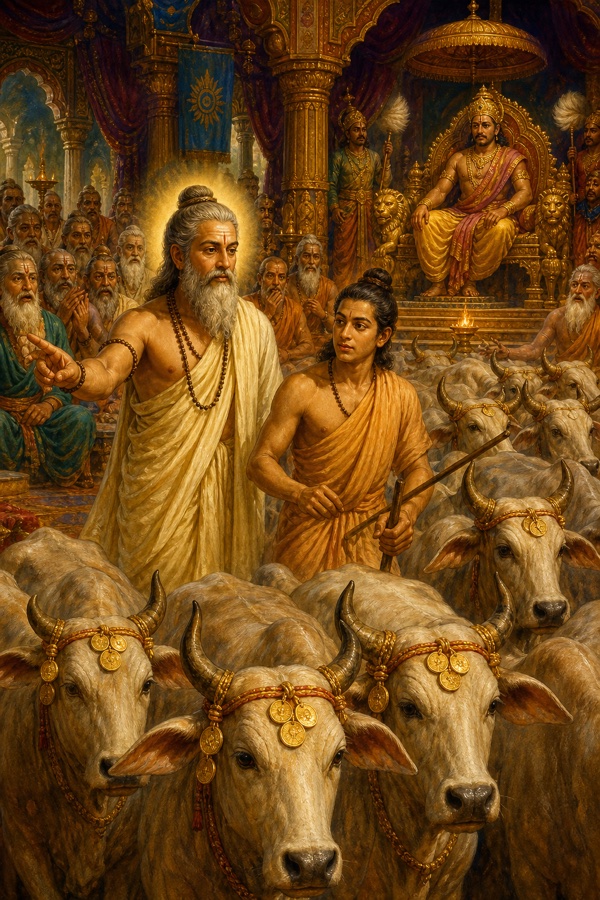
Janaka Vaideha had mounted a sacrifice with heavy gifts for the priests. Brahmins of Kuru and Panchala had gathered for it, and a curiosity took hold of the king: which of these men was anuchanatama, the one who had read the Veda deepest. His method was plain. He had a thousand cows penned within sight of the hall, ten padas of gold bound to the horns of each, and said, “Revered ones, let whichever of you is the greatest knower of brahman drive these cows away.” Count what was standing in that yard. “दशदश पादा एकैकस्याः शृङ्गयोराबद्धा बभूवुः”, ten padas apiece, tied to the two horns of every single one. A thousand animals, gold on every head, penned where the men inside could see them through the doorway and hear them shifting and calling all morning. Wealth in that country walked on hooves. A cow gave milk and curd, butter for the fire, a calf most years, bullocks for the plow, and a herd of a thousand meant a household set for a lifetime, land that need not be asked for, daughters married without worry, students fed, guests received, a name that traveled as far as the cattle did. Janaka had put the whole of it out in the open in front of men who owned little and knew much, and attached one condition to it.
Nobody moved. “ते ह ब्राह्मणा न दधृषुः”, the Brahmins did not dare. Their difficulty was public and immediate. To stand up was to say, in front of every learned man of Kuru and Panchala, that you stood above all of them, and the saying of it opened you on the spot to a brahmodya, the formal contest of speech about brahman, in which anyone in the hall could rise and question you until you ran dry. These were occasions with consequences. A man whose answers gave out sat down in front of witnesses who would carry the story home to two kingdoms, and his fees, his students and his seat at the next sacrifice went with it. The assemblies of that age also kept a harder sanction, and this chapter says it aloud twice: ask past the limit, or claim what you have not understood, and your head falls off. So a thousand cows stood in the yard with the gold on them catching the light, in front of a hall of men who could price them to the last calf, and the hall stayed in its seats.
Yajnavalkya never made the claim. He looked toward his brahmachari Samashrava and said only, “My dear, drive them home.” The pupil started the cattle moving and a swell of anger went through the hall. How did this man call himself the greatest knower of brahman with all of us sitting here? Ashvala, Janaka’s hotri, rose and asked it straight, “Yajnavalkya, are you then the greatest knower of brahman among us?” The answer given is the key to the whole chapter, “नमो वयं ब्रह्मिष्ठाय कुर्मो गोकामा एव वयं स्म”, our salutation to whoever is the greatest knower of brahman; we are simply men who want cows. Ashvala took this for evasion and came down to questions.
Ashvala had a position of his own to defend in that room. He was Janaka’s hotri, the priest who calls the gods with the verses of the Rigveda at the king’s own fire, which put him at the head of the men the king had paid to be there and made him the natural voice of the offended hall. What follows is a day of single combat conducted seated. Eight people rise across the length of it, one at a time, each waiting while the one ahead of him is emptied out, and each opening on the ground he knows best, the fire, dying, the far travels of old kings, the self, the weave of the worlds, the thread, the count of the gods. Nothing is written down and nothing is private. Every question lands in a room full of people who can tell instantly what an answer is worth, and the cattle stay in the yard, still belonging to the man who took them, for as long as he can hold the floor.
The first question was the heaviest. “All this is overtaken by death, all of it held in death’s grip. By what means does the sacrificer get free?” Yajnavalkya said: by the hotri priest, by fire, by speech. Speech is the hotri of the sacrifice; this speech is that fire, it is the hotri, it is release, it is release beyond release. Ashvala asked next about the grip of day and night: by the adhvaryu priest, by the eye, by the sun. About the grip of the bright and the dark fortnights: by the udgatri priest, by the breath, by the wind. And by what ladder the sacrificer climbs past the middle region, which offers nothing at all to hold, and reaches the world of heaven: by the brahman priest, by the mind, by the moon. Four priests, four faculties, four deities, and one thing said four times over.
The pith of it is clear enough. Death, day and night, the fortnights, all of these are limits, and whatever is bound inside a limit has no power of its own to step past it. When the hotri seated at the fire knows that the speech in his mouth and the flame in front of him are one element, his eye and the sun one power of seeing, his breath and the wind one motion, he stays inside his small boundary and belongs at the same time to the large one. What can day and night take hold of in a man whose reach runs to the sun? The sacrifice becomes an act performed outside and a recognition carried inside, and that recognition is what atimukti names.
Ashvala then turned to the arithmetic of the rite, what the text calls sampad, the correspondences. How many verses will the hotri use today? Three: the puronuvakya, the yajya and the shasya, and with them he wins whatever has breath in it. How many oblations will the adhvaryu pour? Three. Those that blaze up win the world of the gods, because that world shines; those that crackle win the world of the fathers, because that world is loud; those that sink down win the world of men, because it lies below. With how many deities does the brahman priest guard the southern flank? With one, the mind; the mind is without end, the Vishvedevas are without end, and by it a world without end is won. The udgatri’s three stotriyas are prana, apana and vyana, and with them the earth, the middle region and the sky are won. At that Ashvala fell silent.
In short: every act of the sacrifice has an inner shape. Speech is fire, the eye is the sun, the breath is the wind, the mind is the moon. Whoever recognizes himself in those larger shapes stands past the grip of death and time while living inside it. Yajnavalkya took the cattle first and showed his title afterward.
Artabhaga: eight holds, and the food of death
Now Jaratkarava Artabhaga stood up. His first question was a count. “Yajnavalkya, how many grahas are there, and how many atigrahas?” A graha is a seizer; an atigraha seizes the seizer. The answer: eight and eight. The breath is a graha, and smell has it in its grip, because a man smells with the breath. Speech is a graha, held by name. The tongue is held by taste, the eye by form, the ear by sound, the mind by desire, the hands by work, the skin by touch. We suppose the eye takes hold of a form. Yajnavalkya says the form has taken hold of the eye. The sense moves out toward its object, the object binds it there, and that clamp holds for a lifetime.
Artabhaga’s second question came at an angle. “All this is the food of death. Which is that deity whose food death itself is?” Yajnavalkya said: fire is death, and fire is the food of water. Whoever knows this conquers a second dying. Fire eats everything, every body, every stick of fuel, and in front of water it goes out. Whatever can be eaten cannot be the last thing, and death stands among the things that are eaten. So whatever is larger than death eats death. Punarmrityu, the dying that comes around again, stops with that understanding.
The third question went further in. “When this person dies, do the breaths go up out of him?” Yajnavalkya said no. They are gathered in right there. The body swells, it fills with air, and the dead man lies there swollen. “And when this person dies, what does not leave him?” The name. The name is without end, the Vishvedevas are without end, and by the name he wins a world without end. The body comes apart, and the call by which he was called stays in the air. The answer looks simple, and folded inside it is everything the body fails to take down with it.
Then came the question this brahmana is remembered for. “When this person dies and his speech goes into fire, his breath into the wind, his eye into the sun, his mind into the moon, his hearing into the directions, his body into the earth, the space in his heart into space, his body hair into the plants, the hair of his head into the trees, and his blood and his seed are set down in the water, where is this person then?” Yajnavalkya decided the assembly was the wrong place for it. “Artabhaga, my dear, give me your hand. The two of us alone will know this. It is nothing to say in a crowd.” They went outside and talked. What they spoke of was karma. What they praised was karma.
The text gives only this much, “पुण्यो वै पुण्येन कर्मणा भवति पापः पापेन”, a man becomes holy by holy action and evil by evil action. Why was that answer kept from the crowd? Perhaps because in careless hands it flattens into a household rule: do good and good will come to you. In private it carries more weight. The body, the senses, the breath, each returns to the deity it belongs to, and what remains is a shape built out of a lifetime of choices. A man goes on living inside his own action. Whichever way he leaned, that same lean goes looking for its next body. Hearing this, Jaratkarava Artabhaga fell silent.
In short: the senses seize their objects and the objects seize the senses; that is the clamp of eight against eight. Death eats everything, and to whatever is larger than death, death is food. When a man dies each part of him returns to its own deity, and what stays is the name and the karma, the shape we gave our own life.
Bhujyu’s tale: where the Parikshitas went
Bhujyu Lahyayani rose next, and began with a story. “Yajnavalkya, we were wandering in the land of Madra as charakas, students who study on the road. We came to the house of Patanchala Kapya. His daughter was possessed by a gandharva. We asked it, who are you? It said, Sudhanvan Angirasa. Then we asked it about the ends of the worlds, and we asked it, where did the Parikshitas go? Now I put the same question to you, Yajnavalkya. Where did the Parikshitas go?” The Parikshitas were descendants of Parikshit, kings whose horse sacrifices were famous. Bhujyu carried the gandharva’s answer in his pocket, and wanted to see whether this man would arrive at it.
Yajnavalkya said, “It must have told you that they went where the performers of the horse sacrifice go.” “And where do they go?” With that, a map opened. This world is as wide as thirty-two days of the chariot of the gods. The earth surrounds it on all sides, twice as wide. The ocean surrounds the earth, twice as wide again. And there, in between, the gap is as fine as a razor’s edge, as fine as a fly’s wing. Indra took the form of a suparna, a great winged bird, and handed them to the wind. The wind held them within itself and carried them where the horse sacrificers were. So it was the wind the gandharva had been praising all along.
Then the conclusion. The wind is the individual, blowing separately in each thing, and the wind is the whole, one in all of them. Whoever knows this conquers a second dying. Bhujyu Lahyayani fell silent. Two things run together in this answer. One is that however many rings the worlds are wrapped in, the opening between them is as thin as the edge of a blade, and the fruit of a sacrifice passes through that same slit. The other is that one power carries anyone through, the wind, the same wind in our breathing and the same wind that holds the worlds in their places. The Parikshitas were taken into what comes and goes in every breath.
In short: Bhujyu asked after the whereabouts of old kings and the answer came to rest on the wind. The rings of the worlds are vast, the gap between them as thin as a razor’s edge, and one power alone carries anyone across. What moves in the breath holds everything, in each thing separately and in all at once.
Ushasta and Kahola: to see the one who sees
Ushasta Chakrayana put his question directly on brahman. “Yajnavalkya, explain to me the brahman that is present and plain, the self that is within everything.” Yajnavalkya said, “एष त आत्मा सर्वान्तरः”, this is your self, the one within everything. “Which one, Yajnavalkya?” The one who breathes in with your in-breath, he is your self, the one within everything. The one who breathes out with your out-breath, who spreads with your vyana, who carries upward with your udana, that is your self. The one who draws the breath in, lets it go, holds it in the middle, lifts it, and behind all four the single one.
The answer struck Ushasta as hollow. He said, “That is like saying, this is a cow, that is a horse. You have pointed; you have explained nothing. Explain the brahman that is present and plain, the self that is within everything.” Then came the sentence this brahmana lives by, “न दृष्टेर्द्रष्टारं पश्येः”, you cannot see the seer of seeing. You cannot hear the hearer of hearing, you cannot think the thinker of thinking, you cannot know the knower of knowing. That is your self, the one within everything. “अतोऽन्यदार्तम्”, whatever is other than this is afflicted, perishable and held in pain. Ushasta Chakrayana fell silent.
Then Kahola Kaushitakeya rose and repeated the same question word for word: explain the brahman that is present and plain, the self that is within everything. Yajnavalkya said, this is your self, the one within everything. “Which one, Yajnavalkya?” The one that passes beyond hunger and thirst, beyond sorrow, beyond delusion, beyond old age, beyond death. Knowing this self, Brahmins rise up from the craving for sons, the craving for wealth and the craving for worlds, and go out to live on alms. For the craving for sons is the craving for wealth, and the craving for wealth is the craving for worlds; all of them are cravings, three names for one appetite.
Then Yajnavalkya set out the steps of the seeker. Let a Brahmin know learning through and through, be done with it, and stand in balya. Knowing both balya and learning, done with both, let him become a muni. Knowing both silence and the absence of silence, let him become a Brahmin. “And how does that Brahmin live?” However he lives, he is such as he is. Whatever is other than this is afflicted. Kahola Kaushitakeya fell silent. Readers stumble on balya here. Shankara reads it as the clear temper of a child, free of display and cunning; some take it in the sense of inner strength. Both readings share one thing: a man becomes a muni by setting down the weight of his learning.
In short: the one who sees cannot be seen and the one who hears cannot be heard; that is the self within everything, standing beyond hunger, sorrow, old age and death. Whoever knows it rises from the single appetite that wears the names of sons, wealth and worlds, and goes past learning into the silence of a muni.
Gargi’s first question: on what is water woven
Now Gargi Vachaknavi rose, the only woman named in that hall, a brahmavadini of the line of Vachaknu, which is to say a woman who had taken up the Veda and the argument about brahman as her work and was known for it. Kings invited such women to these gatherings and other scholars sat down when they spoke, and the fact remains that when she got to her feet in Janaka’s hall every other voice in the record of that day belonged to a man. She had been listening through the fire, through death, through the Parikshitas and the seer of seeing, watching how this man handles a question, and she had arrived at the way to take him. Her method was her own; she laid a single question down like a staircase. “Yajnavalkya, all this is woven through water, warp and woof. On what, then, is water woven?” “On the wind, Gargi.” “And the wind?” “On the worlds of the middle region, Gargi.” “And the worlds of the middle region?” “On the worlds of the gandharvas.” “And the worlds of the gandharvas?” “On the worlds of the sun.” “And those?” “On the worlds of the moon.” “And those?” “On the worlds of the stars.” “And those?” “On the worlds of the gods.” “And those?” “On the worlds of Indra.” “And the worlds of Indra?” “On the worlds of Prajapati, Gargi.” “And on what are the worlds of Prajapati woven?” “On the worlds of brahman, Gargi.”
Gargi did not pause for breath. “And on what are the worlds of brahman woven?” Here, for the first time, Yajnavalkya stopped someone. “गार्गि मातिप्राक्षीः”, Gargi, do not ask beyond the limit. “मा ते मूर्धा व्यपप्तत्”, do not let your head fall off. You are asking further about a deity about whom no further question can be framed. Gargi, do not ask beyond the limit. And Gargi Vachaknavi fell silent.
The hall heard that, and everyone in it knew what had been said. The warning is the standing sanction of these contests, the one Uddalaka will use against Yajnavalkya within the hour and the one Yajnavalkya will use late in the day against Shakalya, who will learn that it is meant. So the room now has a woman standing in it who has been told, in public, that she is one question away from the penalty. She takes the answer. She sits. Nobody in the assembly speaks up for her, and nobody laughs either, because they have all just watched her walk the man up eleven rungs of his own ladder without a stumble and stop him at the top of it.
The stop sounds harsh, and it repays a closer look. Water, the wind, the middle region, the ladder of the worlds, all of these are strung on one chain of cause and effect, and every link asks for another support underneath. The staircase climbs as far as the worlds of brahman because up to there everything rests on something. What lies past that is itself the warp on which all the rest is woven. The question “on what?” cannot be formed about it, the way nobody can ask how long the length of distance is. The warning about the head marks the tangle in which the intellect gets crushed under its own question. Gargi will come back, and her question will arrive from the other side of the same wall.
In short: the ladder of cause climbs from water to the worlds of brahman, and every step asks for one more step above it. Where that demand ends, the question “on what?” breaks apart in the mouth. Gargi stopped there, and her second question was made out of that stopping.
Uddalaka: the thread and the inner ruler
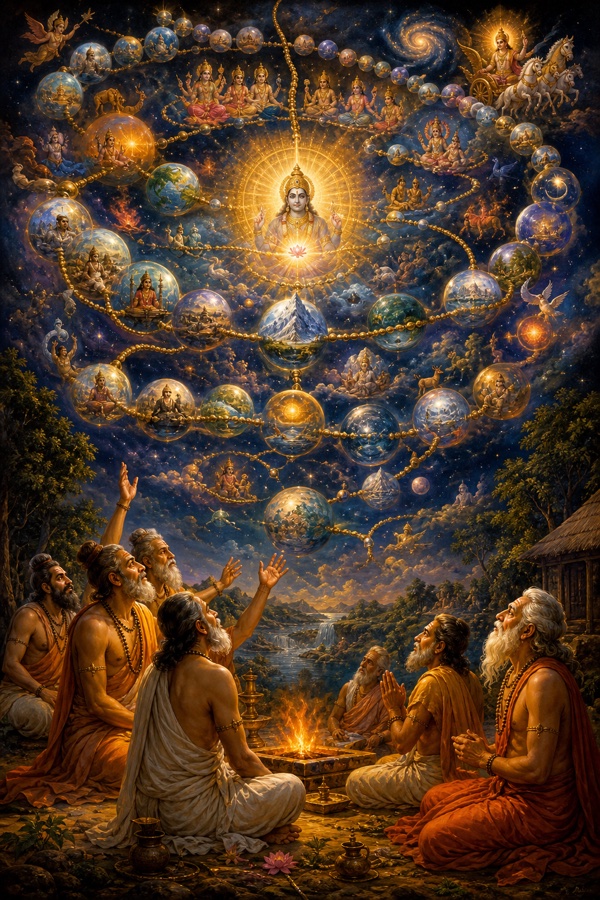
Uddalaka Aruni rose, the son of Aruna and a formidable teacher of his day, the man from whom Yajnavalkya himself had studied, as the sixth chapter of this Upanishad reports. He too opened with the land of Madra. “Yajnavalkya, we were staying in Madra at the house of Patanchala Kapya, studying the sacrifice. His wife was possessed by a gandharva. We asked it, who are you? It said, Kabandha Atharvana. Then it asked Patanchala Kapya and all the ritualists, Kapya, do you know that thread on which this world and the other world and all beings are strung? Patanchala said, revered one, I do not know it.”
“The gandharva asked again, Kapya, do you know that inner ruler who rules this world and the other world and all beings from within? Patanchala said again, I do not know. Then the gandharva said, Kapya, whoever knows that thread and that inner ruler knows brahman, knows the worlds, knows the gods, knows the Vedas, knows the self, knows everything.” Uddalaka looked across at Yajnavalkya. “That much I know. Yajnavalkya, if you have driven off the cows of brahman without knowing that thread and that inner ruler, your head will fall off.” Yajnavalkya said quietly, “Gautama, I know that thread and I know that inner ruler.” Uddalaka cut in. “Anyone can say I know, I know. Say it as you know it.”
Yajnavalkya opened the thread first. Gautama, the wind is that thread. By the thread of the wind this world and the other world and all beings are strung together. That is why, Gautama, people say of a dead man that his limbs have come loose, because they were held together by the thread of the wind. While the breath runs through a body, the hands, the feet, the eyes and the ears stay joined in one rhythm; once the breath is out, every limb is on its own, the way beads scatter when the string gives way. Uddalaka nodded. “It is exactly so, Yajnavalkya. Now tell me the inner ruler.”
And then began the cadence that gives the Antaryami Brahmana its name. The one who dwells in the earth and is inside the earth, whom the earth does not know, whose body the earth is, who rules the earth from within, “एष त आत्मान्तर्याम्यमृतः”, he is your self, the inner ruler, the deathless. Then the same sentence with water, fire, the middle region, the wind, the sky, the sun, the directions, the moon and stars, space, darkness and light; this is the divine ordering. Then with all beings; this is the elemental ordering. Then with the breath, speech, the eye, the ear, the mind, the skin, understanding and the seed; this is the ordering of the self. One frame, twenty-one times over, from the widest world outside to the most private corner within.
At the close of the cadence Yajnavalkya said what he had said to Ushasta, now in other words, “अदृष्टो द्रष्टाश्रुतः श्रोता”, unseen, he sees; unheard, he hears; unthought, he thinks; unknown, he knows. There is no other seer, no other hearer, no other thinker, no other knower. That is your self, the inner ruler, the deathless; everything else is afflicted. Uddalaka Aruni fell silent. In a strung garland the thread is out of sight and every bead in plain view, and the garland is a garland by that thread alone. The inner ruler is like that. Every world and every sense is a bead of his, and he holds them all without a single one of them knowing him.
In short: the wind is the thread on which the worlds and the limbs of a body are strung, and the limbs come loose the moment the breath leaves. Inside the thread is the inner ruler, who lives in everything from the earth to our own understanding, moves it, and stays unknown to it. He sees, he hears, and he is your self.
Gargi’s two arrows, and the imperishable
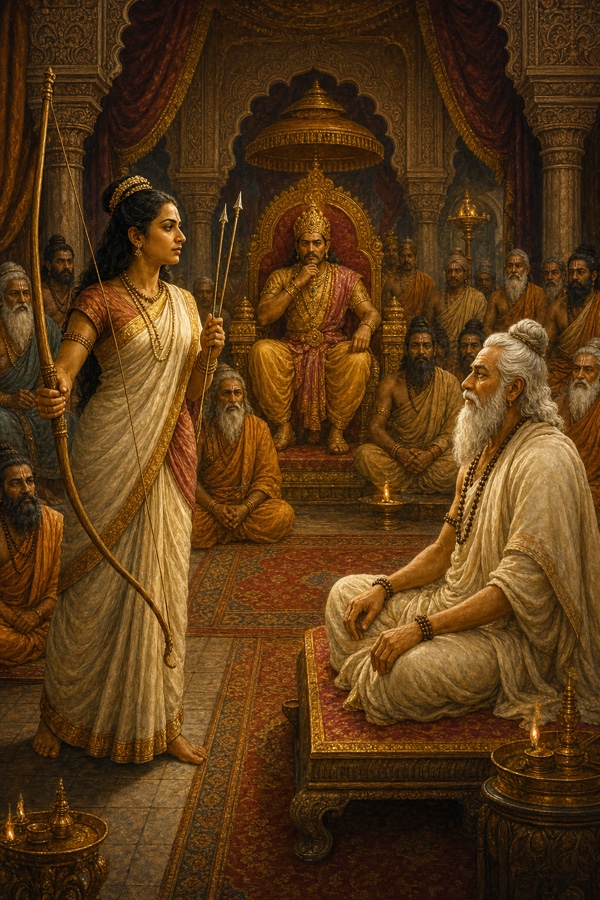
Now Gargi rose again, and this time she spoke first to the hall. “Revered Brahmins, I am going to put two questions to this man. If he answers both, none of you will ever beat him in a brahmodya, in this contest about brahman.” Hear what she has done with that sentence. She has taken the case of every man in the room into her own hands and told them she is about to settle it. If her questions land, the contest is over and they can all stop pretending otherwise. If they land and he answers, they have their verdict from the one person who is willing to say it out loud. Nobody objects. Yajnavalkya said, “Ask, Gargi.”
Then Gargi drew the picture of her own challenge, and she reached for the one image in that world that made the stakes unmistakable. “Yajnavalkya, as a warrior’s son of Kashi or of Videha might string his slack bow and stand up with two keen, enemy-piercing arrows in his hand, so do I stand in front of you with two questions. Answer them.” The sons of those two houses were the fighting men everybody in the hall had seen at close quarters, and the detail she chooses is the stringing. A bow is kept unstrung so the wood keeps its spring, and a man bends it and sets the cord only when he means to use it now. She is telling a hall of scholars that she has carried these two questions unstrung all day, that she has bent the bow at this moment and at no earlier one, and that the arrows in her hand are the kind made for going through an enemy. Yajnavalkya answers with two words. “Ask, Gargi.”
The first arrow. “That which is above the sky, that which is below the earth, that which is between the two, and that which people call the past, the present and the future, on what is it woven, warp and woof?” “Gargi, it is woven on space.” Gargi bowed her head. “Homage to you, Yajnavalkya, you have untied that one. Ready yourself for the second.” “Ask, Gargi.” And the second arrow was the same arrow, word for word: above, below, between, the three times, woven on what? “On space itself, Gargi.” “And on what is space woven, warp and woof?” Gargi had walked back to the exact place where she had been stopped before. The second arrow was the first question again, brought in from the far side, and she had built the approach so that this time the man had answered his way into it himself. The hall had gone quiet enough to hear the cattle outside. Every person in it remembered what had been said to her the last time she stood at this door. This time Yajnavalkya answered.
“एतद्वै तदक्षरं गार्गि”, Gargi, this is that imperishable, and the knowers of brahman call it this: neither coarse nor fine, neither short nor long, not red, not moist, without shadow, without darkness, neither wind nor space, unattached, without taste, without smell, without eye, without ear, without speech, without mind, without heat, without breath, without mouth, without measure, with nothing inside it and nothing outside it. It eats nothing, and nothing eats it. Everything that can be said has been taken away here, and what stands after the taking away is the imperishable, the one that never wears down. Shankara reads the space of Gargi’s question as the unmanifest, the seed without name or form in which creation lies asleep; the imperishable is past even that.
Then Yajnavalkya described what this imperishable does. “Gargi, under the government of this imperishable the sun and the moon are held apart. Under its government the sky and the earth keep their places. Under its government the moments, the days and nights, the fortnights, the months, the seasons and the years hold their rhythm. Under its government some rivers run east from the white mountains and some west, each in the direction it runs. Under its government men praise the giver of the sacrifice, the gods depend on the ladle of offering, and the fathers follow that same offering.” The word for government deserves attention. It is the language of issuing orders, and this order belongs to something with no mouth; the imperishable holds everything by the fact of its being.
Then a warning and a promise in one breath. “Gargi, whoever offers oblations in this world without knowing this imperishable, whoever sacrifices, whoever performs austerity for thousands of years, all of it comes to an end for him. Whoever leaves this world without knowing it is a miser. Whoever leaves this world knowing it is a Brahmin.” That imperishable is unseen and it sees, unheard and it hears, unknown and it knows; apart from it there is no seer, no hearer, no thinker, no knower. “Gargi, on this imperishable space is woven, warp and woof.” Gargi turned to the hall and gave them the verdict she had promised them. “Revered ones, count it a great deal if you get away from this man by bowing to him and no more.” She had staked the assembly’s case on two questions, both had been answered, and she said so in front of everyone, cutting short an afternoon that could otherwise have dribbled on. And Vachaknavi sat down. The one person in the record of that day who asked twice, was warned off once, came back, and drew the deepest answer in the chapter, closes her own case herself.
In short: Gargi climbed the same ladder from the other side, and this time received the answer that lies past space: the imperishable, spoken of only by taking things away, eating nothing and eaten by nothing, under whose government everything from the sun to a river keeps its rhythm. Without knowing it, a thousand years of austerity still come to an end.
Shakalya’s question: how many gods are there
Seven challengers had taken their seats. Now Vidagdha Shakalya rose, steeped in the recitation of the Veda, and asked the plainest-looking question of them all. “Yajnavalkya, how many gods are there?” Yajnavalkya answered from the nivid of the Vaishvadeva hymn, the roll call that praises all the gods. “Three hundred and three, and three thousand and three.” Shakalya said om, meaning so be it, and asked again. “But how many gods are there really?” “Thirty-three.” “So be it. But how many really?” “Six.” “So be it. How many really?” “Three.” “How many?” “Two.” “How many?” “One and a half.” “How many, Yajnavalkya?” “One.” Then Shakalya took hold of the first thread. “Then who are those three hundred and three and those three thousand and three?”
“Those are their powers,” Yajnavalkya said. “There are thirty-three gods.” “Which thirty-three?” Eight Vasus, eleven Rudras, twelve Adityas, which makes thirty-one, and Indra and Prajapati carry it to thirty-three. “Who are the Vasus?” Fire, the earth, the wind, the middle region, the sun, the sky, the moon and the stars; in them all this wealth, this vasu, is set down. “Who are the Rudras?” The ten breaths in this person, meaning the ten senses, and the self as the eleventh, the mind. Going out of this mortal body, they make people weep. “Who are the Adityas?” The twelve months of the year, which move along taking everything with them. “Who is Indra, and who is Prajapati?” Thunder is Indra, the sacrifice is Prajapati. “What is thunder?” The lightning bolt. “What is the sacrifice?” The animals.
Then the count came down. “Who are the six?” Fire, the earth, the wind, the middle region, the sun, the sky; all this is in these six. “Who are the three?” These three worlds, because all the gods are in them. “Who are the two?” Food and the breath. “Who is the one and a half?” The one that blows here, the wind. “This blows as one. Why one and a half?” Because in it all this grew and spread out, adhyardhnot, and so it is adhyardha. “And who is the one god?” The breath. They call it brahman, tyat, that. This descent from thirty-three to one is among the finest passages in the chapter. Every number is correct, and each is the spreading out of a smaller one; the gods went on being counted, and under the counting a single breath came out.
Now Shakalya came to the eight persons. “The one whose seat is the earth, whose world is fire, whose light is the mind, whoever knows that person, the resort of every self, truly knows. Yajnavalkya, do you know him?” “I do. He is this person in the body. Tell me, Shakalya, who is his deity?” Shakalya said, “The deathless.” Then desire as the seat and the heart as the world: the person made of desire, whose deity is women. Form and the eye: the person seated in the sun, whose deity is truth. Space and the ear: the person of the echo, whose deity is the directions. Darkness: the person made of shadow, whose deity is death. Form and the heart: the person seen in a mirror, whose deity is truth. Water: the person in the water, whose deity is Varuna. Seed: the person made of a son, whose deity is Prajapati. Each time Yajnavalkya named the person and handed the deity back to Shakalya.
When that eightfold exchange ended, Yajnavalkya looked at Shakalya directly for the first time. “Shakalya, have these Brahmins made you their tongs for lifting coals?” You are picking up the burning coals on behalf of all of them, and it is your hand that burns. Seven men had been beaten and were sitting down, and the eighth carried their fight on his own shoulders. Shakalya paid it no attention. He answered with the very question Ashvala had opened with, sharper this time. “Yajnavalkya, you have talked down these Brahmins of Kuru and Panchala. Which brahman do you know?”
In short: the gods are three thousand three hundred and six, and also thirty-three, and also one; every count is true and every smaller count is the root of a larger one. The Vasus are those in whom wealth is settled, the Rudras those who make people weep as they leave, the Adityas those who carry everything off; and under them all is the breath, which they call brahman. Shakalya heard it and kept the fight going.
The directions, the heart, and neti neti: Shakalya’s end
“I know the directions,” Yajnavalkya said, “with their deities and their foundations.” Shakalya seized on it. “Then tell me. In the east, which deity is yours?” “The sun.” “And in what is that sun founded?” “In the eye.” “And the eye?” “In forms, because it is with the eye that forms are seen.” “And forms?” “In the heart. It is by the heart that forms are known.” “It is exactly so, Yajnavalkya.” In the south, Yama; Yama in the sacrifice; the sacrifice in the priestly gift; the gift in faith, since a gift is given only where there is faith; and faith in the heart. In the west, Varuna; Varuna in water; water in seed; seed in the heart, which is why a father says of his son that he came out of my heart.
In the north, Soma; Soma in the initiation; the initiation in truth, which is why they tell an initiate to speak the truth; and truth in the heart. In the fixed direction overhead, fire; fire in speech; speech in the heart. Five directions, five deities, and every road arriving at the heart. Then Shakalya asked, “And in what is the heart founded?” Yajnavalkya’s patience broke. He called Shakalya ahallika, a ghost, and said, “If you suppose the heart to be somewhere outside us, then know that the dogs would have eaten this body and the birds torn it apart.” Where the heart is, there the man is; asking for its address outside the body is treating a living man as a corpse.
Shakalya set his foot on the last step. “Then in what are you and the self founded?” “In the in-breath.” “And that?” “In the out-breath.” “And that?” “In the diffused breath.” “And that?” “In the up-breath.” “And that?” “In the even breath.” And then Yajnavalkya halted the staircase where it halts of itself, “स एष नेति नेत्यात्मा”, this is the self, of whom one says, not so, not so. He is ungraspable, for he is never grasped. He does not break. He does not stick. He is not bound, he does not shake, he takes no wound. To say of whatever is said, this is not that, and to go on past it, is the way toward him, because he stands behind every sayable thing as the one who says.
Then Yajnavalkya put his own question. “There are eight seats, eight worlds, eight deities, eight persons. The one who drew these persons out, one by one, and drew them back, and went past all of them, that person of the Upanishads is what I ask you for. If you fail to tell me, your head will fall off.” Shakalya did not know him. “तस्य ह मूर्धा विपपात”, his head fell off. And the text adds one hard line: thieves carried off even his bones, taking them for something else.
The sentence is set down without any ceremony, in the same voice the chapter has used all day for counting oblations. A man had been questioning since morning. He had been offered an exit twice, once when Yajnavalkya asked whether the others had made him their tongs for lifting their coals, and once when he was told plainly what the failure to answer would cost. He took neither. Then a question came back the other way across the floor, he had nothing, and the record says his head fell off and the road took the rest. Whatever a listener makes of how that happened, the assembly he was sitting in treated it as a thing that can happen, which is the reason every warning in this chapter sounds the way it does. Eight persons and their seats and their worlds and their deities he knew. The one who put those persons out and drew them back he did not know, and the head that falls is the head that claims without knowing. Gargi got the same warning and sat down with it. Shakalya went on.
“Revered ones,” Yajnavalkya said to the assembly, “let whichever of you wishes question me, or all of you together. Or I will question whichever of you I wish.” The Brahmins did not dare. So he questioned them in verses. As a tree is of the forest, just so is a man, and this is the truth. His body hair is the leaves, his skin the outer bark. Blood runs from the skin as sap runs from bark, coming out of a wounded man the way sap comes out of a struck tree. His flesh is the inner bark, his sinews the fibers, his bones the wood within, his marrow like pith. A felled tree grows again from the root; from what root does a man grow again once death has felled him?
“Do not say from the seed,” Yajnavalkya stopped the answer himself. “Seed comes out of a living man. A tree grows from a seed even after the tree has died. Pull a tree up with its root and it grows no more. So from what root does a man grow again once death has felled him?” The hall stayed quiet. Then the final verse came, an answer and a door at once. Whoever is born is born no second time; who would beget him again? “विज्ञानमानन्दं ब्रह्म”, brahman is understanding and bliss, the resort of the gift of the giver, and the resort also of the one who knows it and stands firm. Hunting the root of birth and death, the assembly arrived at the one who was never born, and who stands for that reason outside the question of being born again.
In short: the road from every direction arrives at the heart, and the man who asks where the heart is kept is reminded that a living man is its address. The self is neti neti, beyond grasp, beyond breaking, and a claim made without knowing it falls the way Shakalya’s head fell. One question is left standing that the assembly cannot answer: from what root does a man grow again once death has felled him.
And in the end, toward yourself
What do we stand up from this assembly carrying? First, perhaps, the sentence Yajnavalkya gave Ashvala, that his salutation goes to whoever is the greatest knower of brahman, and that he himself only wants cows. The one who knows is released from the need to make claims; if he wants the cattle he takes the cattle, and his learning speaks for itself afterward. Most of us run the sequence backward, the claim first and then a whole life spent defending it. The eight challengers of this chapter were caught in that same sequence, and seven of them learned in time how to sit down.
The second thing belongs to Gargi. She was stopped once and she sat down; and sitting there, she sharpened the question. When she rose the second time she held the same question with its face turned the other way, and this time the answer went all the way to the imperishable. Our lives have walls of that kind too, walls that break only heads. Stopping in front of one is a different thing from losing. A question thought through in the pause finds the door in the wall. Shakalya’s story is the other face of that wall: whoever has no idea how to stop ends underneath his own question.
And the third thing is the one this chapter says three times over, to Ushasta, to Uddalaka, to Gargi: you cannot see the seer of seeing. Tonight when you close your eyes, try for a moment to see who is doing the trying. What you will find is a thought, a picture, a sound; and behind all of them someone who is watching them and who slips every grasp. This Upanishad calls him your self, the inner ruler, the deathless, and the whole noise of this assembly was made in order to reach that one silence.
Source: Brihadaranyaka Upanishad, chapter 3, brahmanas/khandas 1 to 9; read against the Sanskrit, with Shankara’s reading noted where readings differ.