On this page
The palace at Kashi. A man lies asleep in an inner chamber, and two people stand at his pillow: a king and a scholar. Ajatashatru bends over the sleeper and calls to him, “Great one, you who wear white, king Soma!” The man does not so much as turn over. The king calls again. Nothing happens. Then he presses the sleeper’s shoulder with his hand, and the man sits up with a start. Gargya, the scholar beside him, who has just finished defining brahman twelve times over, watches without a word. The moon-person he had worshiped under the name of brahman could not lift this man out of sleep. Something else woke him, something that was already inside.
This second chapter of the Brihadaranyaka is the latter half of the Madhu Kanda, the honey section. The first chapter told the story of creation and arrived at the declaration “I am brahman”; this one carries the same claim inward through four separate doors. At the first door there is a sleeping man. At the second, the two forms of brahman and the instruction neti neti. At the third, a conversation between a husband and a wife on the day he leaves home. At the fourth, the honey teaching that cost a sage his head. The chapter closes with a long roll of teachers that carries the knowledge back to brahman, self-born. One question keeps returning here: the one who knows, who will know him?
The main figures of this chapter
Ajatashatru: king of Kashi, who takes a proud scholar as his pupil, walks him to the bedside of a sleeping man, and shows him brahman on that spot.
Driptabalaki Gargya: a learned man of the Garga line whose very name carried dripta, the proud one; he offers twelve answers and then falls silent.
Yajnavalkya: the sage of the Shukla Yajurveda line, who says the deepest thing of his life to his wife on the day he walks out of his house.
Maitreyi: Yajnavalkya’s wife, who leaves her share of the property lying where it is and asks her question about deathlessness.
Katyayani: Yajnavalkya’s other wife, the one between whom and Maitreyi the property is to be divided.
Dadhyanch Atharvana and the Ashvins: the sage who spoke the honey teaching through the head of a horse, and the twin physicians of the gods who fitted that head on.
Gargya’s twelve answers, and the king’s single reply
Driptabalaki Gargya was an anuchana of the Garga line, a man who had studied the Veda and taught it, and his confidence in his own learning was so complete that the epithet dripta, the proud one, had fastened itself to his name and stayed there. He came to Ajatashatru, king of Kashi, and said without preamble, “Let me tell you brahman.” The king answered at once, “For that one sentence we give you a thousand cows. People run about crying Janaka, Janaka, as though one king alone in the world honored learning. Give us the chance as well.” A light challenge lay folded inside the king’s generosity, and Gargya did not hear it yet.
The shape of that meeting carried more weight than anything said inside it. The world these two lived in kept its ranks in plain sight. A brahmana was born into the keeping of the Veda. He learned it as a boy in a teacher’s house, fed the fire there and grazed the teacher’s cattle for years while the verses went into him line by line, and he came out of it holding a thing no one could take off him. He recited at the sacrifices, he was fed at the head of the row, and kings paid him for the work. A kshatriya was born to rule, to hold the borders and to pay for the rites that kept the country steady, and his portion in learning was to support it and be honored by the men who carried it. Knowledge went down the one line and wealth came up the other. So a Gargya walking into a hall at Kashi and announcing that he will explain brahman is doing what his birth and his training entitle him to do, and there is a quiet pleasure in it, the pleasure of the man who holds the one thing a rich man cannot purchase.
The king’s reply has a hook set in it. A thousand cows, offered for a sentence that has yet to be spoken. A herd of that size was a fortune in a country where wealth walked on four legs and a man’s standing could be counted in the yard at milking time. And the remark about Janaka is aimed with care. Janaka ruled Videha across the river and had made his court the place learned men went to, so that the road east was full of scholars with an eye on his generosity, and people ran about calling his name as though there were one patron in the world. Kashi is saying: you need not make that journey, I pay as well as he does, and now let me hear what you have. Gargya, hearing money and hearing praise, misses the third thing in the sentence, which is a king clearing space in which to test him.
Gargya laid down his first answer. “The person who is in the sun, him I worship as brahman.” Ajatashatru stopped him in the middle of the sentence. “मा मैतस्मिन्संवदिष्ठाः”, do not dispute with me on this one. Then he said, “I worship him as the head of all beings, the king who sits above them all. Whoever worships him so becomes the foremost, the head, the king of all beings.” That was the king’s method. Whatever form Gargya named, the king took it in, gave it its correct name and its correct fruit, and in the taking showed how narrow the fruit was. Worship of the sun-person yields a kingdom, and the knowing of brahman lies far past any kingdom.
Eleven more answers came, one at a time. The person seated in the moon, whom the king called the great one, Soma the king who wears white, whose worshiper never runs short of food. The person in the lightning, who is tejasvi, full of blaze. The person in space, who is full and unstirring. The person in the wind, who is Indra Vaikuntha, the army that is never beaten. The person in fire, who is Vishasahi, the one who withstands all things. The person in the waters, who is Pratirupa, answering to the shape of whatever holds him. The person in a mirror, who is Rochishnu, the shining one. The person in the sound that rises behind a man as he walks, who is Asu, the breath. The person in the directions, who is Dvitiya, the companion that never leaves. The person in the shadow, who is death. And last, the person in one’s own self, whom the king named Atmanvi, possessed of a self.
Twelve times is the number to sit with. Once is a correction. Twelve is a man being walked down the length of his own learning and shown the end of it. Every round ran the same way. Gargya named a place and said, him I worship as brahman. The king put his hand up before the sentence was finished, “मा मैतस्मिन्संवदिष्ठाः”, do not dispute with me on this one, and then gave the same person a better name than Gargya had given him and stated exactly what his worship is worth, a kingdom, a full granary, a shining face, a following that stays. Whatever standing there was in the room moved across the floor a little further with each exchange. A brahmana was being corrected on brahman, in his own subject, by a man whose office was the sword and the treasury, while attendants and whoever else stood along the wall of a king’s hall listened. A scholar of that time carried his whole worth in his mouth. His fees, his seat at a sacrifice, the students who would come to his door, the marriages his children could make, all of it rested on being known as a man who does not get answers wrong.
After the twelfth answer Gargya fell silent. He had no form left to offer. Ajatashatru asked, “That much, then?” Gargya said, “That much.” The king said, “By that much it is not known.” That sentence is the hinge of the whole brahmana. Gargya had put his finger on twelve places, and in every place a limited person turned up, whose worship carried a limited reward. Brahman is the one who watches all twelve and is never found resting in a place of his own. Gargya set his pride down and said, “उप त्वायानि”, let me come to you. Four syllables, and a life rearranged inside them. To come to someone in that phrase is to ask for the relation of pupil to teacher, which in that world had a shape everybody knew: you live in his house, you serve him, you bring the wood for his fire, you eat after him, you do not answer back, and what you receive you receive at his pleasure and in his time. The man who had walked into the hall to teach brahman was asking a king to take him in on those terms.
In short: Gargya looked for brahman in twelve forms, and the king handed each one back to him with its proper name and its narrow reward. Brahman is the seer standing behind every form, and for that reason no single form holds him. The first condition of learning turned out to be the setting down of pride.
The sleeping man: dream, deep sleep, the spider and the sparks
Ajatashatru paused a moment and said, “प्रतिलोमं चैतद्यद्ब्राह्मणः क्षत्रियमुपेयात्”, this goes against the lie of the hair, that a brahmana should approach a kshatriya expecting to be told brahman. “Even so, I will make you know it.” Pratiloma is the word for stroking an animal backward along its coat, and it covered anything done in the reverse of its proper order, the kind of wrongness a body registers before the mind can name it. The king says it out loud in front of the man it concerns, and then says he will teach him regardless. Shankara notes that the king kept the honor of the old order with that remark and agreed to teach anyway. There is a courtesy in the order of it. Ajatashatru names the awkwardness so the scholar is spared carrying it alone, disposes of it, and goes on to the lesson. He took Gargya by the hand and rose. The two of them came to a man who lay in deep sleep. The king called him by the very names Gargya had given the moon-person, “Great one, you who wear white, king Soma!” The sleeper stayed where he was. The king woke him by pressing on him with his hand, and he sat up.
Now the king put the question for which the whole scene had been arranged. “Gargya, this person made of knowing, this one who knows, where was he when he lay asleep? And from where has he come back now?” The original says only that Gargya did not know this. Consider what the king has done with his choice of evidence. He has not opened a text, called for a debate, or sent for another teacher to be defeated. He has walked his guest to a bed and pointed at a man who does this every night of his life, as Gargya does, as the servants in the corridor do, as anyone hearing the story afterward does. The proof stands in a room that every person has lived in and nobody has watched himself enter. And the matter was plain. The name Gargya had rested his whole teaching on, the moon-person, could not reach the sleeper. The name stayed outside. What woke was woken from within, from some corner that no sun reaches, no moon, no lightning, no direction. Of the twelve answers, none went as far as that corner.
Then Ajatashatru explained it himself. When this person made of knowing sleeps, he draws the knowing power of the pranas, of the senses, into his own knowing, and lies down in the space within the heart. Once he has taken them in this way, people say the person is asleep. At that hour the breath is held, speech is held, the eye is held, the ear is held, the mind is held. To anyone watching from outside it looks as though the man has gone somewhere. The original has him pulling his spread out powers back in and keeping them by him, the way a shopkeeper gathers his goods indoors at dusk, and he stays there in that gathered form.
Then came the matter of dreaming. When this person moves about in dream, the worlds he moves in are his own. There he becomes a great king one moment and a great brahmana the next, and wanders into high places and low places past counting. The Upanishad offers a fine comparison here: as a great king takes the people of his country with him and moves about his own land wherever he pleases, so this person takes the pranas with him and moves about his own body wherever he pleases. All the splendor of a dream, all its terror, all its travel, happens on ground that belongs to the dreamer. Nothing whatever is borrowed from outside.
And when he is in sushupti, in deep sleep, when he knows nothing of anyone, what happens then? The original gives a picture drawn from the body. Seventy two thousand channels called hita run out from the heart and spread to the puritat, the membrane lying around the heart. Down these channels he goes, and sleeps in the puritat. And what is that sleep like? As a young boy sleeps, or a great king, or a great brahmana, when he has gone to the far limit of delight and lies down, exactly so does this one sleep. King or beggar, scholar or a proud man like Gargya, in deep sleep the delight of all of them is one, because the things that tell one from another have been gathered in.
At the end Ajatashatru gave two comparisons that keep sounding well past this chapter. As a spider climbs upward along its own thread, and as small sparks fly out in every direction from a fire, so from this self come out all the pranas, all the worlds, all the gods, all beings. And its secret name, its upanishad, is “सत्यस्य सत्यम्”, the real of the real. The pranas are real, and he is their real. Whatever looks alive and true holds its truth on the credit of this one. Gargya had been hunting brahman in the sun; the king showed him that the sun too is a single spark in that flying swarm.
In short: in sleep the knower gathers the senses in and comes to rest in the space within the heart. Dream is a journey over ground the traveler owns, and deep sleep is a delight in which a king and a small boy become one. From this self everything issues like sparks from a fire, and so its name is the real of the real.
The infant named prana, and the cup turned upside down
The second brahmana opens with a riddle, the way an old man sets a puzzle for children. Whoever knows the infant along with its adhana, the thing it is set upon, its pratyadhana, the thing it leans against, its sthuna, the post, and its dama, the cord, keeps off his seven hostile kinsmen, the relatives who have turned enemy. Then the Upanishad unties its own knot. The infant is this middle breath, the breathing seated at the center of the body. Its adhana is this body, its pratyadhana is this head, its post is the strength of the breath, and its cord is food, because food is the rope by which this calf stays tied to its peg.
Seven akshitis, seven that never run out, stand in attendance on this infant. And all seven are seated in our eye. By the red lines of the eye Rudra is joined to this breath. By its water, Parjanya, the god of rain. By the pupil, Aditya. By the dark part, Agni. By the white part, Indra. By the lower lid, the earth, and by the upper lid, Dyaus, the sky. Whoever knows this never runs short of food. Seven gods are seated in one small eye, and the seven together feed the infant that is breathing inside us.
“अर्वाग्बिलश्चमस ऊर्ध्वबुध्नः”, a cup whose mouth is turned down and whose bottom is turned up. The Upanishad says this is our head: the mouth open downward, the skull above. In that cup lies glory of every form, and glory here means the pranas, which come down into every shape there is. On the rim of that cup seven sages are seated, and these seven sages are the pranas as well. The eighth is speech, which is joined to brahman, to the Veda. An ordinary skull has been turned by this Upanishad into an assembly of sages.
And who are these seven sages? These two ears are Gotama and Bharadvaja. These two eyes are Vishvamitra and Jamadagni. These two nostrils are Vasishtha and Kashyapa. And speech is Atri, because by speech, which is to say by the mouth, food is eaten; the one who eats is atti, and from that the name Atri was made. Whoever knows this becomes the atta, the eater of everything; all of it turns into his food. The seven sages shine overhead as stars, and here the same seven are the open gates set in our face.
What is the marrow of this riddle? Shankara takes the seven hostile kinsmen to be the attachments that run outward through these same seven gates and scatter the strength of the breath. A man who understands that this body is a cup, that these senses are sages, and that an infant tied by a cord of food is breathing inside, becomes the sacrificer in his own body. This is what the Upanishad keeps doing: it takes the thing that looked immense and far off and shows it seated within our flesh, so that the search never has to travel anywhere.
In short: the breath within is an infant, held up by body, head, strength and food, with the seven gods of the eye standing in attendance. The head is a cup turned upside down with seven sages seated on its rim. Whoever comes to see his own body this way never runs short of food, and everything becomes his to enjoy.
The two forms of brahman, and the instruction: neti neti
“द्वे वाव ब्रह्मणो रूपे”, brahman has two forms and two only. The third brahmana opens on that sentence and then splits the two forms into four pairs: formed and formless, mortal and deathless, standing and moving, sat and tya. Sat here means what stands present in front of you, and tya means that, the one out of sight, the one that can only be pointed toward. The Upanishad hunts for these four pairs first in the world outside, among the gods, and then within, in the self, so that a reader can see that whatever is out there is seated in here as well.
Look outside first. Everything other than the wind and the mid-space, the earth, the waters, fire, the hills, the rivers, is formed, mortal, standing, sat. The essence of all this formed thing, its rasa, is the one that burns, the sun. The wind and the mid-space are formless, deathless, moving, tya. The essence of the formless is the person who is in the disc of the sun. Notice what has happened here. The body of the sun is the essence of the formed, and the person seated inside that same body is the essence of the formless. One sun is the summit of both forms.
Now come inside. Everything other than the breath and the space within the self, bone, flesh, skin, is formed, mortal, standing, sat. Its essence is the eye, as the sun was the essence of the formed outside. Breath and the space within are formless, deathless, moving, tya, and their essence is the person who is in the right eye, as the person in the sun’s disc was the essence outside. The thing we worship by the name of sun has its counterpart seated in our right eye and looking out. This is why Gargya’s sun-person was half an answer: he had found the summit outside and left its counterpart within untouched.
What does that person look like? The Upanishad gives six comparisons, and each one is a flash of color. Like a cloth dyed in maharajana, the deep yellow of turmeric. Like pale wool from a sheep. Like the indragopa, the small scarlet insect that crawls on the grass in the rains. Like a flame of fire. Like a white lotus. Like one flash of lightning. And then the fruit: whoever knows this, his splendor becomes like one flash of lightning. The list reads like a painter’s inventory, and its point is that the person glints in every color and is caught by none of them.
Immediately after this comes the sentence that settled the whole vocabulary of Vedanta: “नेति नेति”, not this, not this. That is the instruction. The original says there is no higher naming past this word of denial. And then the name follows, the real of the real: the pranas are real, and this is their real. Shankara reads neti neti as a denial of both forms, of the formed along with the formless, so that the gesture swings toward what stands beyond the two and makes the two possible. All those colors were glimpses of that person, and the person himself stays outside the count of glimpses.
In short: brahman shows itself in two forms, outside and within, solid and subtle, and at the summit of both stands a person, in the sun’s disc outside and in the right eye within. He glints like turmeric, like wool, like the scarlet insect, like flame, like a lotus, like lightning. And then the Upanishad says: neti neti, not this either, and past that denial there is no further word.
Yajnavalkya and Maitreyi: what use is a thing that leaves us mortal
The fourth brahmana opens on the threshold of a house. Yajnavalkya, the sage of the Shukla Yajurveda line whom nobody in Janaka’s assembly could defeat, is about to rise out of the householder’s life and take the road to the forest. In the original he says that he is going up from this place, “उद्यास्यन् वा अरेऽहमस्मात्स्थानादस्मि”. Before he goes, the accounts of the house have to be squared. He has two wives, Maitreyi and Katyayani. He called Maitreyi to him. “Maitreyi, I am going up from this place. Come, let me make a settlement between you and Katyayani.” It was a plain matter, the last duty of a householder, and he meant to discharge it and walk out.
Hear what those words announced in that house. A man going up from this place was ending a life and leaving nothing of it behind him. The fire that had burned on his hearth since his marriage would be let go out. He would keep no house, own no field, carry no second garment, light no fire of his own again, and eat what was put in his bowl by strangers on whatever road he was walking. His name would drop out of the list of men who give and receive at weddings and funerals. Nobody expected him back, and nobody would send word to him. For a wife, this was closer to a death in the household than to a departure, with the difference that the man was seated in front of her, speaking, and had chosen it.
Which is why the settlement came first. The wealth of that house was a countable, liftable thing. Cattle in the pen, grain in the jars, gold and silver ornaments, copper vessels, cloth, the land and whatever a lifetime of fees from kings and patrons had piled up. All of it now had to be split between two women, because what a woman held after her husband withdrew was the whole of what stood between her and dependence on other people’s kindness for the rest of her life. Yajnavalkya was doing the correct and careful thing. He had called the wives in, he had the property in front of him, and he was preparing to halve it. What he had not prepared for was one of the two declining to take her half until she had asked him a question.
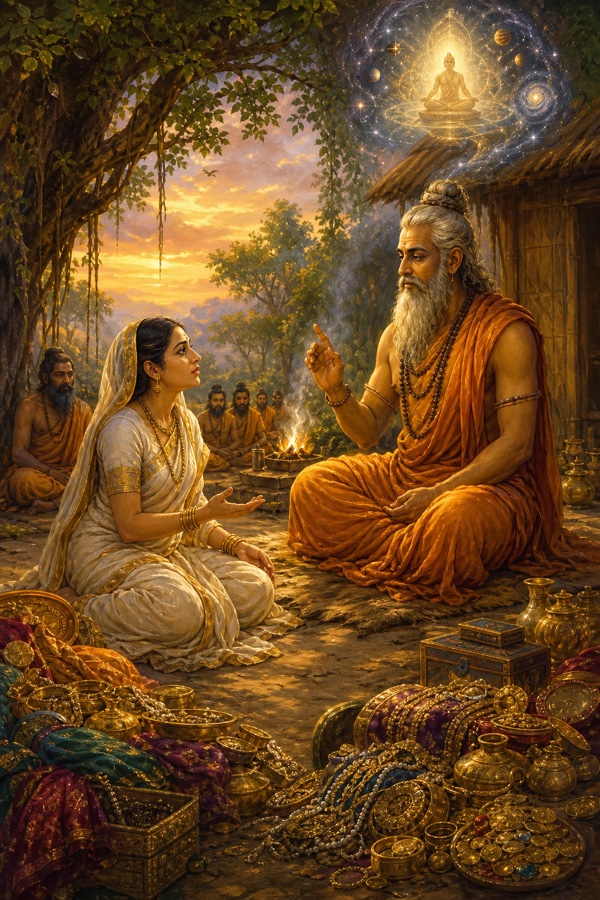
Maitreyi kept her hand away from the settlement. She asked a question of her own, and she framed it larger than the heap in front of her, because the size of a share was beside the point she meant to make. “Revered one, if this whole earth filled with wealth were mine, would I become deathless by it?” Yajnavalkya answered, “No. Your life would become the life of people who have means, and that is all.” Then he said it in the words of the text, “अमृतत्वस्य तु नाशास्ति वित्तेन”, there is no hope of deathlessness through wealth. He gave the answer straight. He knew that the woman seated in front of him had asked for something other than comfort. Further on, this Upanishad calls Maitreyi a brahmavadini, one who speaks of brahman, and this question is the first sight of her.
Maitreyi said, “What use to me is a thing by which I do not become deathless? Tell me only that which you know.” Yajnavalkya’s voice changed. “You were dear to us before, and now you speak what is dear. Come, sit down. I will explain it to you, and while I am explaining, hold to it and dwell on it.” That last instruction lays out the terms of listening as well: the teacher keeps speaking and the listener performs nididhyasana on every sentence, letting it settle inward. The threshold where a property settlement was about to be made had become a seat for the knowledge of brahman.
Something in the arrangement of that room turns over at this point. A moment earlier the man was the one with things to give and the woman was the one who would receive a portion. Now what she has asked for happens to be the only property in the house that cannot be halved. Cattle can be counted into two herds and gold weighed into two piles, and every division of that kind leaves each holder with less. The thing she wants stays whole in the giving, and both of them know that a man about to leave the world has no reason left to hold any of it back. He says come and sit down, and the word he uses for her is the word a man of that house would use to someone who belongs to him, and the last hours of the marriage go on knowledge.
The first thing Yajnavalkya said stands among the most quoted lines in this whole Upanishad. “A husband is dear for the sake of the self; it is the self’s own desire that makes a husband dear.” Then the same sentence was laid down one at a time for the wife, for sons, for wealth, for the brahmana order, for the kshatra, for the worlds, for the gods, for all beings, and at the end for everything whatsoever. Whomever we love, it is our own self we are loving in them. Husband, wife, children, wealth, all of these are the ground that love rests on, and the true address of love is the self that looks out from behind all of them.
Then came the utterance that lays out the whole path of practice in one breath: “आत्मा वा अरे द्रष्टव्यः श्रोतव्यो मन्तव्यो निदिध्यासितव्यो मैत्रेयि”, Maitreyi, the self is the one to be seen, to be heard, to be reflected on, to be dwelt upon. By the seeing of the self, by hearing, by thought, by knowledge, all this is known. And then the warning: whoever knows the brahmana order as something apart from the self, the brahmana order abandons him. The kshatra abandons him, the worlds, the gods, all beings abandon the man who looks for them outside the self. Because this brahman, this kshatra, these worlds, these gods, these beings, all of it, is this self.
In short: before leaving home Yajnavalkya offered to divide his property, and Maitreyi asked about deathlessness. The answer was that whomever we love, we love our own self in them, and so the self is what deserves hearing, reflection and steady dwelling. Everything walks away from the man who hunts for it outside himself.
The drum, the conch, the vina, and the lump of salt in water
Now Yajnavalkya strings a series of comparisons together, and each one shows the same thing from a fresh angle. While a drum is being beaten, a man cannot lay hold of the sounds that spread out from it; by laying hold of the drum, or of the one who beats it, the sound is held. While a conch is being blown, the sounds traveling out cannot be caught one by one; catch the conch or the man blowing it, and the sound comes into your hand. And so with the notes of a vina, which are held by holding the vina or its player. The countless shapes of the world are those scattered sounds, and the self is the player; hold him and everything is held.
Then another picture. As smoke goes out in every direction from a fire laid with damp wood, so the breathing out of this great being is the Rig Veda, the Yajur Veda, the Sama Veda, the Atharvangirasa, the histories, the ancient lore, the sciences, the upanishads, the verses, the aphorisms, the glosses and the commentaries. All of these are its breathings. The very book we are reading is smoke off that same breath. Yajnavalkya keeps the dignity of the Vedas with this list and at the same time turns Maitreyi toward the one whose breath the Vedas are, since whatever breathes them out is larger than they are.
The third picture is of the ekayana, the single place where everything goes and meets. As the ocean is the one meeting place of all waters, so the skin is the meeting place of all touches, the nostrils of all smells, the tongue of all tastes, the eye of all forms, the ear of all sounds, the mind of all resolves, the heart of all knowledges, the hands of all acts, the organ of generation of all delights, the outlet of all discharges, the two feet of all roads, and speech of all the Vedas. A thousand touches in one skin, a thousand roads in two feet. And where do these senses themselves meet? The comparison that follows answers that.
Throw a lump of salt into water and it dissolves into the water and cannot be lifted out again, and wherever you taste the water, it tastes of salt. So, Maitreyi, this great being is endless, without shore, a solid mass of knowing, and knowing is what it is made of. Rising out of these elements it vanishes along with them. And then Yajnavalkya said, “न प्रेत्य संज्ञास्ति”, after departing there is no particular consciousness. Maitreyi stopped short. “Revered one, you have bewildered me at this very point. You said a solid mass of knowing, and then you said that after departing there is no consciousness.”
Yajnavalkya said, “I am speaking no bewilderment. This is enough for knowing.” Then he explained. Where there is something like duality, one smells another, one sees another, hears another, speaks to another, thinks of another, knows another. Where everything has become the self, by what and whom would one smell, by what and whom see, by what and whom know? “विज्ञातारमरे केन विजानीयात्”, by what would one know the knower? Shankara reads samjna here as the particular identity bound to a body and its senses: that identity goes out, and the mass of knowing stands. The lump of salt spreads into every drop, and in the same way the knower is present in every act of knowing.
In short: the sounds of a drum are caught by catching the player, and the world is known by knowing the self. The Vedas are its breath, the senses are each an ocean for their own objects, and it is everywhere, like salt dissolved in water. There is no second instrument for knowing the knower, because no second thing is left over.
Madhu vidya: everything is the honey of everything else
The fifth brahmana begins with a sentence that spreads slowly, the way honey spreads: “इयं पृथिवी सर्वेषां भूतानां मधु”, this earth is the honey of all beings, and all beings are the honey of this earth. Honey here reaches past sweetness. Honey is made from a thousand flowers and feeds a thousand creatures, and no single flower can be picked out of it again. The earth is made of every being and feeds every being, and every being is made of the earth and feeds the earth. The drinking runs both ways, and the eater and the eaten are dissolved into one another.
Then comes the second half of the sentence, which will return every time. The person made of light, made of deathlessness, who is in this earth, and the person made of light, made of deathlessness, who is within oneself in this body, this is he, this is the self. This is the deathless, this is brahman, this is everything. The earth outside and the body within are the two ends, and one shining deathless person is seated in both. The secret of the honey teaching lies in that third thing: the one who joins outside to inside, on whose account anything at all can be the honey of anything else. Without him, earth and creature would stay two strangers.
And then the mold is used fourteen times, each time an element outside and its counterpart within. Water is paired with the seed. Fire with speech. The wind with the breath. The sun with the eye. The directions with the ear and the echo that returns in it. The moon with the mind. Lightning with the heat of the body. Thunder with our voice and our sound. Space with the space in the heart. Dharma with the sense of dharma inside us. Truth with the sense of truth inside us. Humankind with the human being inside. And the fourteenth, the self with the self. Each time the same declaration follows: this person is the very one who is this self, this deathless, this brahman, this all.
After the fourteen the Upanishad says that this self is the overlord of all, the king of all beings. And then the picture of a chariot: as all the spokes are set into the nave and into the felly of a wheel, so into this self are set all beings, all gods, all worlds, all breaths, and all these selves. The spokes never touch one another, and they are still one wheel, because every spoke is driven into the nave. That is exactly the secret of the honey: creatures touch one another by way of the nave, and the nave is the self.
The word madhu does two jobs at once here: what is made out of something, and what feeds something. In whatever we eat there are earth and water and sun and wind dissolved, and one day we will be the earth’s food. The same fire that burns in the hearth is in our speech. The same wind that moves through the leaves of the peepal is in our breath. The Upanishad keeps this as an account, counted out fourteen times, and at the bottom of the account one self is left standing. For anyone who has looked at that account once with attention, calling another creature a stranger becomes hard work.
In short: there are fourteen elements from the earth up to the self, and each one is the honey of all the rest, made out of them and feeding them. One shining deathless person sits in every element and in every body, which is why the sweetness runs both ways. All beings are fixed in that self like spokes in a wheel.
The teaching spoken through a horse’s head, and the cord of teachers
After the fourteen declarations the Upanishad says three times over: this is the honey that Dadhyanch Atharvana spoke to the Ashvins. And each time it brings in a verse of the Rig Veda that the sage saw and uttered. In the first verse the sage tells the Ashvins that he makes their mighty deed known the way thunder makes the rain known, that Dadhyanch Atharvana spoke the honey to them through the head of a horse. The second verse is plainer still: O Ashvins, you fixed a horse’s head on Atharvan’s son Dadhyanch, and keeping to the path of rita he spoke to you the honey of Tvashtri that had been kept secret from you.
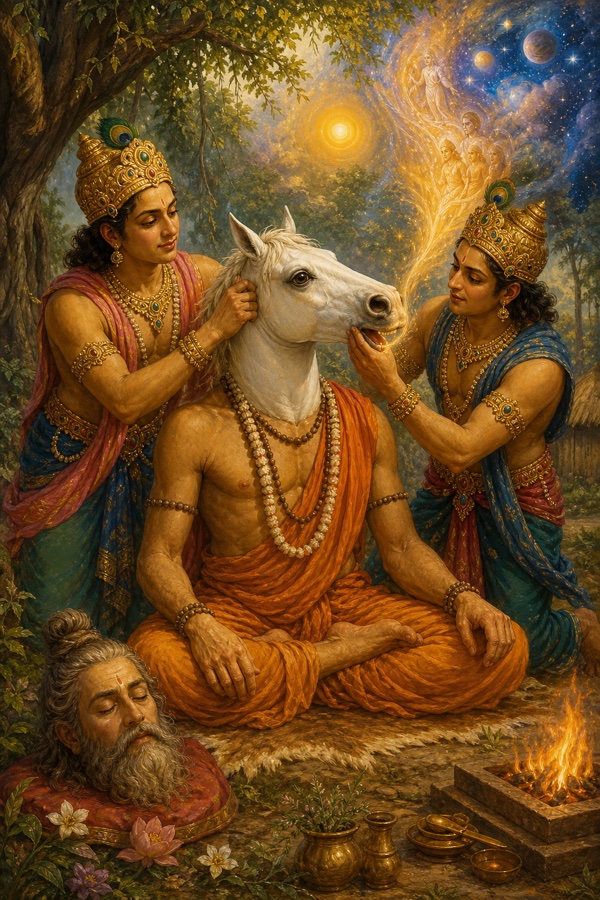
The original gives no more than this hint; the story is filled in by Shankara and by the tradition of commentary on the Rig Veda, and it runs this way. Indra had taught this knowledge to Dadhyanch Atharvana and had said, “If you teach this to anyone else, I will cut off your head.” The Ashvins, the twin physicians of the gods, came to learn it. The sage told them the danger. The Ashvins said, “Trouble yourself over nothing. We will take off your own head and keep it safe, and in its place we will fit the head of a horse. Speak the knowledge with that mouth. The head Indra strikes off will be a horse’s. Then we will put your head back.” And that is what happened.
The story leaves a reader with two things. First, this knowledge was held so great that giving up a head, and having a head exchanged, looked like a cheap price for it. Second, the Upanishad speaks through whatever mouth has brahman in it, even a horse’s; the caste of the head has no say in the caste of the knowledge. The third verse turns back to the person: he made the strongholds of the two footed, he made the strongholds of the four footed, and becoming a bird he entered those strongholds as the person within. This person lies in every stronghold, purishaya, asleep in every fort; nothing anywhere is covered from him, nothing is left outside. The original itself opens the word purusha this way.
The fourth time, the verse arrives that is the closing key of this chapter: “रूपंरूपं प्रतिरूपो बभूव”, for every form he became the counterform of that form, and this form of his is there for the sake of recognizing him. Indra goes about in many shapes by his powers of maya; ten hundred horses are yoked to him. And the Upanishad says: this self is those very horses, this is the ten, this is the thousand, this is the many, this is the endless. This is brahman with nothing before it, nothing after it, nothing within, nothing outside. “अयमात्मा ब्रह्म सर्वानुभूः”, this self is brahman, the one who experiences everything. This is the teaching, this is the instruction.
In the mold of a bird a bird appears, in the mold of a horse a horse, in the mold of a man a man. Why so many forms? The original answers, pratichakshanaya, for the sake of recognition. Every form is his face, so that in one face or another we might know him again. Our trouble is that we see a single face and fail to join it to the rest of the faces, and that separation turns into sorrow. The honey teaching is the medicine for that separation: on the day when touching one is touching all, no opposition is left standing and no loneliness either. Indra wanted this knowledge kept hidden, and the Upanishad lays it out in the open.
The sixth brahmana is a long roll of teachers, and the Upanishad calls it a vamsha, a lineage. Pautimashya learned from Gaupavana, Gaupavana from Pautimashya, and so one name climbs holding the hand of the next: Kaushika, Kaundinya, Shandilya, Gautama, Agniveshya, Bharadvaja, Parasharya, Jatukarnya, Atreya, Galava, and onward. At the end of the list stand the very names whose story we have just read: the Ashvins from Dadhyanch Atharvana, Dadhyanch from Atharvan Daiva, Atharvan from Mrityu Pradhvamsana, Mrityu from Pradhvamsana, and then Ekarshi, Viprachitti, Vyashti, Sanaru, Sanatana, Sanaga, Parameshthin, and Parameshthin from brahman. Brahman is self-born. The list halts on a salutation: salutation to brahman. This knowledge too has come hand to hand, mouth to ear, like honey.
In short: the honey teaching was held so great that Dadhyanch spoke it through the head of a horse. That person sleeps in every stronghold and has become the counterform of every form, so that he can be recognized. This self is brahman, the experiencer of everything, and the knowledge travels an unbroken cord of teachers back to brahman, self-born.
And in the end, toward yourself
Three people learn something in this chapter, and each of them learns from where he stands. Gargya arrives swollen with the pride of learning and falls silent at the pillow of a sleeping man. Maitreyi sits down at a meeting about property and picks up deathlessness in place of her share. The Ashvins want a knowledge for which a sage has to stake his own head. Which of these are we sitting beside? All three, most likely. We have our twelve answers too, the things we have read and heard about brahman. We have our own settlement as well, a share we want, knowing all the while that it will leave us mortal.
This chapter suggests a simple exercise. Tonight when sleep comes, watch the moment when eye and ear and mind are drawn in one by one. Tomorrow morning when you wake, watch the moment when they are spread out again. The one who draws them in and spreads them out was neither asleep nor awake. That is what Ajatashatru showed Gargya, and the scene is played again on our own bed every night. And in the daytime, when the sight of someone you love fills the chest, remember Yajnavalkya’s sentence: this love is for the self that is looking out through that face. The root of the love becomes visible then, and the love grows deeper for it.
And at the end, the honey. The next time bread is in your hand, stop for a moment and see how much earth is in it, how much water, how much sun, and see that one day we go back into the same account. In that there is a recognition of the wheel whose nave holds the spokes that all of us are. Dadhyanch said this through the head of a horse. We can say it with our own head, from our own mouth, in our own house. That is the whole of what this Upanishad asks of us.
Source: Brihadaranyaka Upanishad, chapter 2, brahmanas 1 to 6; read against the Sanskrit, with Shankara’s reading noted where readings differ.