On this page
The first light is breaking. Outside a sacrificial hall a horse stands tethered, anointed, groomed and garlanded, and the sage beside it looks the animal over and says that the head of this horse is the dawn, its eye the sun, its breath the wind, and its open mouth the fire that digests the world. The horse stops being a horse while he speaks. Its back becomes the sky, its belly the middle air, its flanks the quarters of space, its bones the constellations. When it yawns, lightning runs through the clouds. When it shakes its hide, thunder answers. When it stales, rain comes down on the fields. The Brihadaranyaka Upanishad opens on exactly this scene, and in its first sentence it tells us that nothing here is only the thing it appears to be.
This first chapter is the doorway to everything that follows. It comes out of the last kanda of the Shatapatha Brahmana, so the dust of the sacrificial ground is still on its language: a horse, a pressing of soma, an udgatri chanting, an offering poured into flame. Every ritual occasion in it gets turned quietly inward. Across six brahmanas, its sections, the chapter does three things. First it shows that the whole world outside is a single body. Then it asks who inside that body is indispensable, and the answer comes back, prana, the breath. And then it says the largest thing it has to say, that the one who was alone at the beginning knew himself and spoke: I am. All this chapter wants from us is that we look at our own I with a little more attention.
The main figures of this chapter
The sacrificial horse: the animal of the ashvamedha, with dawn, sun, sky and seasons settled into its limbs; the first lesson in seeing the outer world as one body.
Death, which is ashanaya, hunger: the first power, standing as hunger, which had covered everything before creation, and out of whose heat came water, earth and fire.
The devas and the asuras: two sets of children of Prajapati, who came onto the sacrificial ground to defeat each other with the udgitha, the high chant of the Samaveda.
The chief breath, Ayasya Angirasa: the breath lodged inside the mouth, which the asuras could not pierce, and which was afterward called Brihaspati, Brahmanaspati, saman and udgitha.
The atman shaped like a man: the solitary one of the beginning, who looked around, found nothing besides himself, was afraid, grew weary, and split himself in two to make the world.
Yajnavalkya and the rishi Vamadeva: two names that arrive for a single line each; one offers the image of a half fragment, the other cries out, I became Manu, I became the sun.
Father and son: the household of the fifth brahmana, where a dying father hands over everything he owns in three words.
The sacrificial horse whose body holds the whole world
The ashvamedha was the largest thing a king of that age could attempt, and it began with one animal being let go. A stallion was chosen in the spring, washed, sprinkled, spoken over by the priests, and then turned loose at the edge of the capital with no rider on its back and no rope on its neck. From that morning the horse went where it pleased. It was not to be ridden, not harnessed, not put to any work. Armed young men of the court followed it at a distance for a full year, close enough to keep it from harm and forbidden to steer it. Whichever way the animal drifted after grazing became the day’s business of the state.
That is what made the rite enormous. A horse wandering at its own pleasure walks across borders. Every king in whose fields it stopped to eat had a decision to make in front of his own people. He could stand aside while it cropped his barley, which announced in public that he accepted the overlordship of the man who had released it, or he could turn it back, and then the guard behind it drew their weapons and a war had begun over an animal eating grass. A year of that. Riders coming home along the dust roads with reports of which country the horse had entered, which lord had stepped back, which had called up his men. By the time the animal turned toward the capital again, the question of who owed what to whom had been settled across a large piece of the world by the appetite of one horse.
At home the year went into preparation. The king lived it under vow. Cattle were counted out for the priests’ fees, grain was stored, timber was cut, and new ground was measured and leveled for the fires, with the hall and the enclosures raised on it. Priests arrived from many schools, each holding one office and no other, the one who recites the verses of invitation, the one who chants, the one who pours the offering, the one who sits through the whole of it in silence watching for a fault and mending it the moment it appears. Kings who had yielded came with their households to attend. Singers were kept through the long days to praise the patron by name. And the treasury emptied steadily into the crowd, because a man laying claim to the whole earth has to be seen giving it away. “तं संवत्सरस्य परस्तादात्मन आलभत”, after the passing of a year he offered it up for himself. That is the animal standing in the opening sentence of this Upanishad, groomed, garlanded, a year of roads in its legs, with a kingdom’s wealth and a kingdom’s pride resting on what happens to it at daybreak.
Into the middle of all that, the Brihadaranyaka Upanishad walks up to the horse and says, look at it properly. “उषा वा अश्वस्य मेध्यस्य शिरः”, the dawn is the head of the horse fit for sacrifice. The sun is its eye, the wind its breath, the fire Vaishvanara its gaping mouth, and the samvatsara, the full turning year, is its body. The sky is its back, the middle air its belly, the earth the ground its hooves press. The quarters of space are its two flanks, the intermediate quarters its ribs, the seasons its limbs, months and half months its joints, days and nights its feet, the constellations its bones, the clouds its flesh.
The Upanishad does not stop there. The half digested food in its stomach is the sand of the riverbeds. Rivers are its intestines, mountains its liver and lungs, herbs and great trees the hair on its hide. The rising sun is its forward half and the setting sun its hindquarters. When it yawns, lightning flashes. When it shakes itself, thunder rolls. When it stales, the rain comes. And its voice is speech itself. This is the map of a discipline. A patron who spends the whole year looking at the horse in this way knows, by the morning of the offering, what he is placing in the fire: the entire world, which stands at no distance from his own body.
In the second mantra the Upanishad sets two vessels before and behind the horse. In front stands the day, born from the eastern ocean, and behind it the night, born from the western. Where the rite placed a gold vessel ahead of the animal and a silver one behind, the day and the night have taken their places. The same creature becomes haya and carries the gods, becomes vajin and carries the gandharvas, becomes arva for the asuras and ashva for human beings. One animal, called by a different name in every world it enters. Its kinsman and its womb is the ocean, the endless water that everything came out of. The horse runs, and its root stays where it began.
A question rises here on its own. The Upanishad has come to speak of atman, the self. Why begin with a horse? Because a mind that has treated sacrifice as an outward act for years can be turned inward only by degrees. It has to see first that the sun and the eye, the wind and the breath, the cloud and the flesh are of one piece. For anyone who gets that far, the next step comes easily: who lives inside this vast body. The figure of the horse is the first stair of the whole Upanishad.
In short: The first brahmana turns the horse of the ashvamedha into the entire cosmos, dawn for its head, the sun for its eye, the constellations for its bones. This is an exercise in a way of seeing, that everything outside is one living body. From that seeing the Upanishad begins its journey inward.
The hunger that is death, and the world that came out of it
The second brahmana lifts the curtain behind that horse, and what stands there sits a long way from any decorated story of creation. “नैवेह किं चनाग्र आसीत्”, in the beginning there was nothing here at all. No sky, no earth, no day, no eye to see with. And then comes the line the whole chapter rests on, that all this was covered over by death, and that death was hunger. In the next breath the Upanishad unties the knot. “अशनाया हि मृत्युः”, hunger indeed is death. Where there is a craving to get something, the law of wearing away is already seated in the room. What stood there was an unsatisfied want, and out of that want everything was going to come.
That hunger made mind, and mind made the first wish, that I might come to have a self, that I might be embodied. Then he moved on, worshiping as he went, and from that worship the waters were born. The Upanishad catches something lovely here. The delight he found in worship gave the fire its name, ‘अर्क’ (arka), because in arcana, in worship, there was ‘क’ (ka), delight. Whoever knows the arka-hood of the arka comes into that same delight. What settled on the surface of the waters hardened and became the earth. On that earth he labored and grew hot, and out of that exhausted, heated body the essence of brilliance ran, and it became fire.
Then he divided himself in three, into fire, the sun and the wind. One breath, seated in three places, and here the Upanishad brings the figure of the horse back. The eastern quarter is its head, the intermediate quarters its forelegs, the west its tail, south and north its flanks, the sky its back, the middle air its belly and this earth its chest. He stands established in the waters, and whoever knows this stands firm wherever he goes. The horse tethered outside in the first brahmana is now woven into the bones of creation.
Alone again, he desires: let a second self be born to me. With mind he joined speech in a pairing, and the seed that formed became the year. Here the Upanishad says something startling, that before this there had been no year at all. Time itself was born of that union. He carried it as long as a year lasts and then released it. The moment it was born he opened his mouth to eat it, and the infant cried out in fright, and that cry became speech. The first sound in creation is a call let out in front of the open mouth of death.
Then he considered: if I devour this one now, food will run short later. So with that speech and with that body he made all of it, the rich verses, the yajus formulas, the samans, the meters, the sacrifices, the creatures and the cattle. And everything he made, he began to eat. The Upanishad opens a name with a smile: she eats everything, and this is the aditi-hood of Aditi. Whoever knows this becomes the eater of everything, and everything becomes his food. In a world built out of hunger, eating and being eaten are two faces of one coin.
His wanting was still unquiet: let me sacrifice again with a greater sacrifice. He labored, he performed tapas, and out of that heated body his glory and his vigor went out of him. The Upanishad tells us plainly that this glory and vigor were the pranas, the breaths. Once the breaths had left, the body began to swell, and mind stayed behind in the body. Then he wished that this body of his might become fit for the offering, and from it the horse came to be. What swelled became fit, and the Upanishad says this is the ashvamedha-hood of the ashvamedha. After a year had passed he offered it to himself and handed the other animals over to the gods, which is why a consecrated animal is still counted as belonging to Prajapati.
In the last mantra the Upanishad hangs the whole sacrifice in the sky. That which burns up there, the sun, is the ashvamedha; the year is its body; this fire here is the arka; and all these worlds are its selves. Arka and ashvamedha look like two, and the deity is one, and that deity is death. Whoever knows this wins past dying over and over; death does not catch him; death becomes his own self; and he lives out his whole span. The hunger a man spends his life running from loses its terror at the moment he recognizes it.
In short: The second brahmana puts hunger at the root of creation and calls hunger death. Out of the worship of that hunger come water, earth, fire, time and speech, and the one who eats them all is called Aditi. For anyone who knows the arka and the ashvamedha as a single deity, death stops being an enemy.
The contest of the udgitha, and the breath the asuras could not pierce
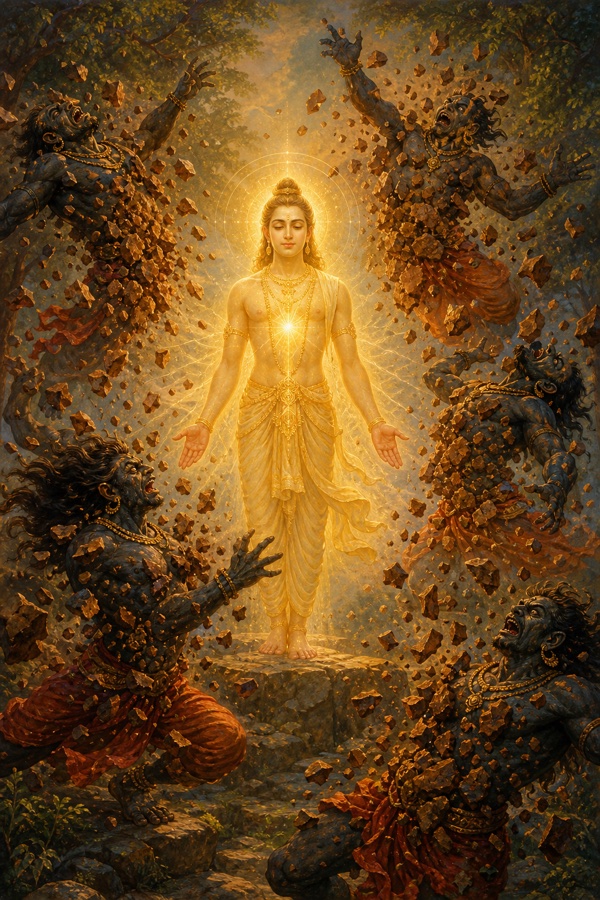
The third brahmana opens with a story that sounds like an old war and turns out to be our own insides. Prajapati had two kinds of children, gods and asuras. The gods were fewer and smaller, the asuras many and large. They fell to contending over these worlds, and the gods said among themselves: come, let us overcome the asuras at the sacrifice by means of the udgitha.
To hear what the gods are proposing, it helps to stand for a moment on the ground they are standing on. A sacrifice of that size was laid out like a body, with a place marked for every voice in it. One priest called the gods with verses. One murmured the formulas under his breath while the ladle tipped into the flame. One sat through the entire performance saying nothing at all, listening, and spoke only to repair a fault the instant it was made. And one, the udgatri, sang. The udgitha is the great central stretch of his chant, the part that opens on a single syllable held until the breath in him is nearly spent, and it is sung over the soma while the pressing stones are working. The rite moved on that voice. A patron paid for it the way he paid for cattle, and a household could rise on the reputation of a son who had it. So when the gods say they will pass beyond the asuras at the sacrifice by means of the udgitha, they are reaching for the sharpest instrument in the hall, and everyone listening to this story in its own century knew that. The gods and asuras of it are two tendencies inside our own senses.
The gods went first to speech and asked her to chant for them. Speech agreed and began. Here the Upanishad catches a very fine thing. Whatever enjoyment lies in speaking, she chanted out to the gods, and whatever was auspicious in her speech she kept for herself. The asuras saw at once that the gods meant to pass beyond them by means of this chanter. They ran at speech and pierced her with evil. And what is that evil? The Upanishad tells us by a gesture: whatever unfitting thing gets spoken, that is the evil. The instant speech held something back for herself, a crack ran through her.
In a hall built on exact speech, that damage had a taste people could recognize. The verses had to fall syllable for syllable as they had been received, in the pitch they had been received in, because a word bent out of shape was believed to travel where it was sent and do the work it had been turned into. Boys learned the recitation for years in a teacher’s house before they were let anywhere near a fire, and the silent priest sat at the edge of the ground precisely to catch the moment when a tongue slipped. So the picture of speech coming away from the contest pierced through, capable from then on of the coarse word, the boast, the lie told smoothly at a gathering, landed on its first listeners as a loss of something that had been kept clean at great expense.
Then the gods asked the breath in the nose, then the eye, then the ear, then the mind. Each time the same order repeated. Every sense chanted, every sense kept its own pleasure for itself, and every time the asuras pierced it and went on. This is why there is foul smell as well as fragrance, why ugliness shows itself as well as beauty, why unfitting things are heard alongside fitting ones, why a good intention rises in the mind beside a bad one. In the Upanishad’s view no outside enemy did this. It is the fruit of a grip inside the sense itself, which cuts its own share out of every experience and keeps it.
Then the gods turned to the chief breath lodged inside the mouth and asked it to chant for them. It agreed and began. The asuras understood what they had understood before and ran to pierce this one too. What happened next the Upanishad puts in a single image, “यथाश्मानमृत्वा लोष्टो विध्वंसेत”, as a clod of earth flung against a stone is smashed to powder, so they were scattered and destroyed in every direction. Anyone who has thrown dry earth at a rock face knows the sound of it and knows that the rock is not marked. In that moment the gods became gods and the asuras were finished. Nothing from outside stains the breath within, because it holds no experience back as its own share; it only keeps moving.
The gods asked one another who it was that had held them so. The answer came: this one here, inside the mouth. From this it took the name Ayasya Angirasa, because it is the rasa, the sap, of the limbs. The Upanishad says this deity carries another name too, ‘दूर्’ (dur), because death stays far from it, and death goes far from whoever knows this. Then it lifted the evil and death of these gods and carried them to the place where the quarters of space come to an end. This is why it was said, go no further than that boundary, or the evil may come away with you.
Then that same breath carried the gods across death one by one, and this is the loveliest scene in the chapter. Speech went first, and the moment it was released from death it became fire, which burns today beyond death. Then the breath in the nose, which became the wind and blows beyond it. Then the eye, which became the sun and burns there. Then the ear, which became the quarters of space. Then the mind, which became the moon and shines there. Whoever knows this deity in this way is carried across death by it in the same manner.
At the end it chanted food for itself, since whatever food is eaten anywhere is eaten by this alone. The gods said, “एतावद्वा इदं सर्वं यदन्नम्”, as much as all this is, so much is food, and you have chanted it for yourself; give us a share in it. It said: then come and sit around me. They settled around it on every side, and this is why the food this breath eats satisfies all of them.
The picture underneath that sentence is an ordinary evening in a house of the period. The cooking is done at one hearth. The man of the house is served first and the others take their places around him on the swept floor, the wife, the children, the elders, the students living in the house, the guest who arrived at dusk and cannot be turned away, and everyone eats out of what one fire produced. Nobody at that circle holds a portion of his own. So when the Upanishad says that a man who knows this has his own people settle around him in the same manner, that he becomes their support, first among them, master of food, it is describing a place at a meal that every listener had seen occupied, and saying that the breath occupies it inside the body.
In short: Speech, smell, eye, ear and mind were all pierced because each one held back its own share of enjoyment. The chief breath inside the mouth came through unbroken, and the asuras shattered against it like clods of earth. That same breath carries the senses across death and earns the food that feeds them all.
The many names of the breath, and a prayer still sung today
Now the Upanishad counts out the names of that breath, and every name opens a fresh identity. First it repeats that this is Ayasya Angirasa, because it is the sap of the limbs, “प्राणो वा अङ्गानां रसः”, the breath indeed is the sap of the limbs, and the body itself supplies the proof. Whatever limb the breath goes out of dries up on the spot. Hand or foot, as long as breath runs in it, it stays warm and alive, and the moment breath withdraws it turns to wood. Rasa here carries no sense of flavor; it is the moistness by which a thing is called living.
That same breath is called Brihaspati, because speech is the brihati meter and this is her lord. It is Brahmanaspati as well, because speech is brahman and this is her master. And it is the saman, and here the Upanishad opens the name in two ways. One: speech is ‘सा’ (sa) and breath is ‘अम’ (ama), and joined they make saman. Two: saman carries the sense of sameness, and this breath is equal to an ant, equal to a gnat, equal to an elephant, equal to these three worlds. Where the difference between the small and the great has gone, there is the true saman.
It is the udgitha as well. Prana is ‘उत्’ (ut), since by breath all this is held up, and speech is ‘गीथा’ (githa), and together they are udgitha. A small scene from a court arrives at this point. Brahmadatta Chaikitaneya, drinking soma, burst out that if Ayasya Angirasa chanted the udgitha by anything other than speech and breath, let this king Soma strike his head off. With so fierce an oath he meant one thing only, that song happens where breath and word meet. This is why the Upanishad says that a man about to serve as priest should want tone in his voice, since the wealth of the saman is its tone.
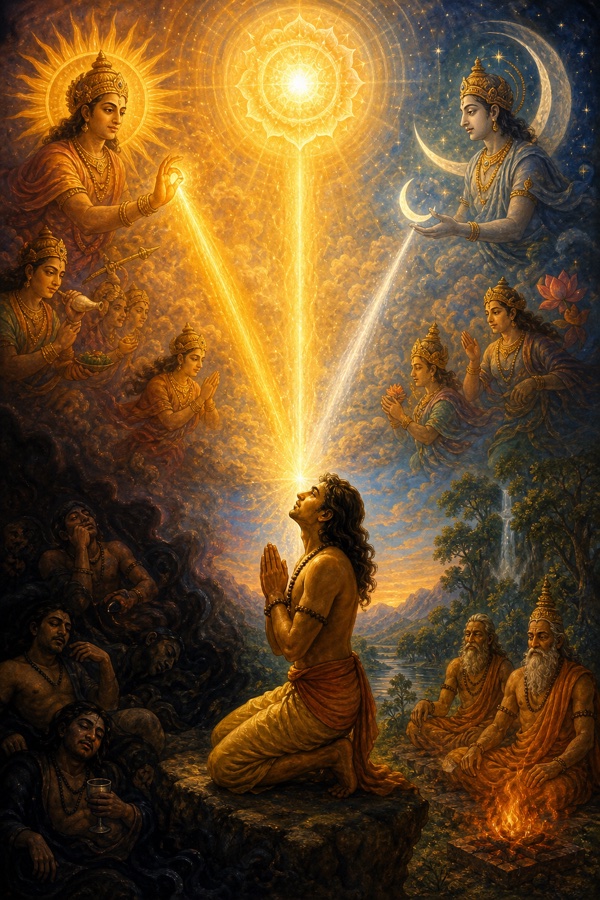
And now comes the place that people across the world sing without knowing it began here. The Upanishad says that during the pavamana hymns, when the prastotri begins the saman, the patron should quietly repeat these lines, “असतो मा सद्गमय, तमसो मा ज्योतिर्गमय, मृत्योर्मामृतं गमय”, lead me from the unreal to the real, lead me from darkness to the light, lead me from death to deathlessness. Three lines, and one plea in all three, that I be carried past what I am.
The Upanishad opens these lines in its own way as well. When a man says lead me from the unreal to the real, the unreal means death and the real means the deathless, so what he is truly saying is, make me immortal. When he says lead me from darkness to the light, again darkness is death and light is the deathless. And about the third line the Upanishad says plainly that nothing stands hidden here; it asks for what it asks. In the remaining hymns the udgatri may ask for whatever he desires, since this saman is a conqueror of worlds.
In short: That same chief breath is Brihaspati, Brahmanaspati, saman and udgitha, because every one of those names is made where speech and breath meet. From the ant to the three worlds it is equal to everything, and for that it is called saman. And in the middle of its worship sits the three line prayer that asks to be carried past the unreal, the dark and death.
Alone in the beginning, and the first word, I am
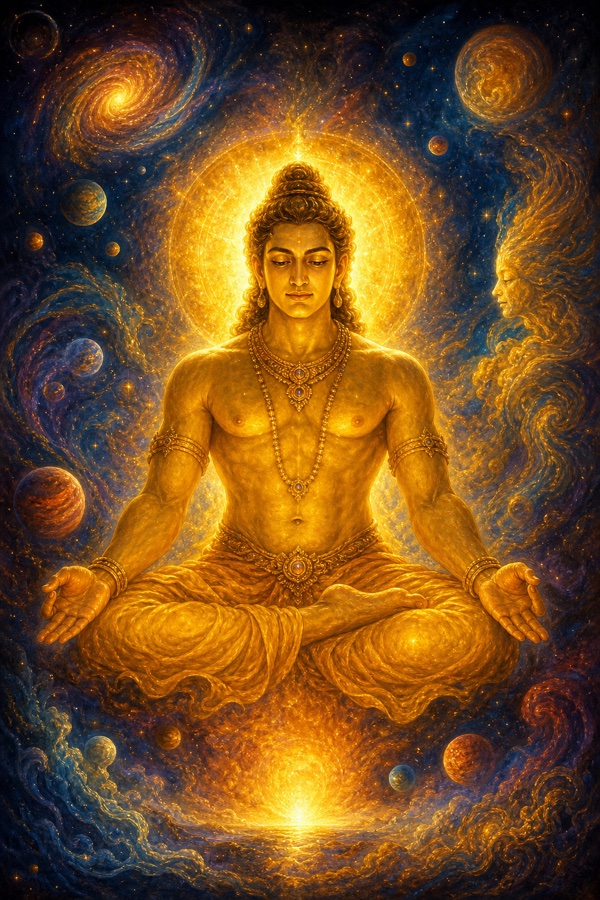
The fourth brahmana is the heart of this chapter, and it opens with the story of someone alone. “आत्मैवेदमग्र आसीत्पुरुषविधः”, in the beginning all this was the self alone, and it had the shape of a man. He looked around him and found nothing besides himself. Then for the first time he said “सोऽहमस्मि”, I am he. From that moment “अहम्”, I, became a name. The Upanishad shows us the proof in a daily habit. Call to anyone even now and the first answer that comes back is, it is I, and the name follows after. The I arrives first and the name second, and that order is as old as creation.
Then that solitary one was afraid. The Upanishad draws a plain conclusion straight out of it, that this is why a man alone is afraid. He stayed with the fear and reasoned it through: when there is nothing at all apart from me, what have I to be afraid of? With that thought the fear went out of him. “द्वितीयाद्वै भयं भवति”, fear arises from a second, and where there is no second, where would fear find a footing? This sentence stands among the most practical in the Upanishad, because every fear we carry is built on the imagining of someone else.
Even with the fear gone he took no pleasure in himself. Being alone gave him no delight, and the Upanishad looks our way again and says this is why one who is alone finds no delight. He desired a second. He was as large as a woman and a man locked in an embrace. He let himself fall into two pieces, and from those two pieces came husband and wife. Yajnavalkya used to say on this account that the body feels as incomplete as a half fragment, and that the empty place left in it is filled by woman. The two came together, and from them human beings were born.
Now the story takes an unusual turn. The woman thought: he has begotten me out of himself, how then can he couple with me; let me hide. She became a cow and the other became a bull, and from them cattle came. She became a mare and he a stallion; she became a she ass and he an ass, and from them the single hoofed animals came. She became a she goat, he a he goat; she became a ewe, he a ram. In this way every pairing down to the ants was made from him. Each attempt at hiding turned into a new species. And then he knew, I am this creation, since I have made all of it.
Then he brought his hands to his mouth, churned, and produced fire, which is why the palms and the inside of the mouth are both without hair. The Upanishad says a large thing here: when people say sacrifice to that god, sacrifice to this other one, all of these are his own outspreading, and he alone is every god. Whatever is moist was made from his seed, and that is soma. Soma is food and fire is the eater of food. This is his over-creation, because while subject to dying himself he made the deathless.
Now the Upanishad sets down a quiet, deep sentence. At that time all this was undifferentiated, without name and without form; then it was opened out by name and form, that this has such a name and such a shape. That same self has entered this body right up to the tips of the nails, the way a razor lies hidden in its case, the way fire lies in its nest. People fail to see him, because he shows himself in pieces. Breathing he is called prana, speaking he is speech, seeing he is the eye, hearing the ear, thinking the mind. These are the names of his doings. So the Upanishad instructs us to worship him as the self, because it is there that all of these become one.
And then comes the line that touches everyone living in the middle of a household. This self is dearer than a son, dearer than wealth, and it sits further inside than anything else. To a man who calls something else dearer than himself it can be said that what he holds dear will be taken from him one day, and so it comes to pass. Therefore worship the self as the thing that is dear, because for one who holds the self dear, what he loves is never destroyed.
In short: The solitary one at the beginning was afraid, and then understood that fear has no ground where there is no second. Out of weariness he made himself two, and from those two came human beings, cattle and every pairing down to the ants. That same self is hidden in us today to the tips of the nails and goes by the names of breath, speech, eye and mind.
Aham brahmasmi, and the society that stood up after it
Now the Upanishad raises an objection in the middle of its own argument, and it is worth hearing it the way it was first heard. These chapters keep the shape of rooms where men argued face to face, a teacher on a mat with the fire banked low, students seated close, and somebody getting to his feet because a claim in the air has gone further than he can let it go. People say that by the knowledge of brahman men will become everything. Say it is so. Then what did that brahman know, by which it became everything? The question has a blade in it. If knowing makes you everything, something must have been known first, and there was nothing in existence yet to teach it.
The answer is the sentence this Upanishad is known for, and the scene it comes out of is the emptiest scene in the book. “ब्रह्म वा इदमग्र आसीत्”, in the beginning all this was brahman. No sky over it, no ground under it, no second presence anywhere to be addressed, no name it had been given by anyone, no teacher, no older authority to consult, no fire to sit beside. Whatever was there had only itself to turn toward. “तदात्मानमेवावेत्”, it knew its own self. And the knowing came out as a sentence: “अहं ब्रह्मास्मि”, I am brahman. Words spoken into a silence that held nothing capable of hearing them, and by them it became all of this.
Two things about that moment stay with a reader. The first is that nothing is prescribed. No sitting posture, no years of service in a teacher’s house, no fee, no offering, no permission from anyone above. A recognition, arrived at by looking where the looking already was. The second is the grammar. The sentence is in the first person, present tense, and it is about the speaker. Every listener saying it aloud after the text says it is saying it about himself, which is exactly the risk the Upanishad is taking and exactly the reason it keeps being quoted.
The Upanishad then says that this door was opened for no single class of being. Among the gods, whoever woke to it became that. The same happened among the rishis, and among human beings. The rishi Vamadeva, seeing this, said “अहं मनुरभवं सूर्यश्च”, I became Manu, and I became the sun. And even now, whoever knows in this way that I am brahman becomes all of this. The gods themselves cannot stop him, since by then he has become their self as well.
On the other side, a man who worships some god holding that the god is one thing and I am another does not know. The Upanishad gives a very sharp image here. Such a man is like a beast to the gods. As a householder keeps many animals and takes work from them, so each single human being feeds the gods. And as the loss of even one animal displeases its owner, so it gives the gods no pleasure that men should come to know this. This Upanishad is known for exactly that fearlessness.
After this it weaves the whole of society into one creation story. In the beginning brahman was alone, and being alone it did not spread. So it created its finer form, the kshatra, those ruling gods whose names are Indra, Varuna, Soma, Rudra, Parjanya, Yama, Mrityu and Ishana. This is why there is nothing higher than the kshatra, and why at the rajasuya a brahmana sits below the kshatriya and worships him. And the Upanishad puts the balance back at once: the womb of the kshatra is brahman itself, so however high a king may climb, he comes back at the end to that same root of his, and anyone who injures that root cuts through his own.
Still it did not spread. Then it created the vish, those classes of gods counted in troops, the Vasus, Rudras, Adityas, Vishvedevas and Maruts. When that too fell short, it created the shudra order in the form of Pushan, and added that this earth is Pushan, since it is the earth that nourishes everything. And even that left it incomplete, so it created a form finer still, dharma. Dharma is the kshatra of the kshatra, and there is nothing higher than dharma. A man with no strength can hope to prevail over a strong man through dharma. And at the end the Upanishad makes the two one, “यो वै स धर्मः सत्यं वै तत्”, what dharma is, that is truth.
In the closing mantras the chapter turns inward again. A man who departs from this world without having seen his own world, meaning his own self, gets no enjoyment from that world, the way an unrecited Veda yields no fruit. Even the greatest act of merit, done without this knowing, runs out in the end. So the Upanishad says, worship the self as your own world, because the work of a man who does so is never worn away.
And this self is the world of every creature, of no one man alone. By offering and sacrificing it becomes the world of the gods, by recitation the world of the rishis, by gifts to the fathers and by having children the world of the fathers, by giving men shelter and food the world of men, by finding grass and water for animals the world of animals, and by letting the beasts and the birds and even the ants in a house live, their world too. As every man wants his own world kept safe, so all creatures want the man who knows this kept safe. At the close of this brahmana the four desires are brought inside as well: mind is his self, speech his wife, breath his child, the eye is a man’s wealth, and the self is his work.
In short: Brahman knew itself and said, I am brahman, and by that recognition it became everything, among the gods, among the rishis and among men. A man who worships a god as separate from himself stays a beast of the gods. And over the society that spread out from this, the Upanishad sets dharma, and then calls dharma truth.
Seven foods, sixteen parts, and the trust handed from father to son
The fifth brahmana starts with a verse. The father produced seven foods by wisdom and by tapas. Of these he kept one as common to all, allotted two to the gods, made three for himself, and gave one to the animals. Everything rests on these, whatever breathes and whatever does not. Then the verse raises its own question: these foods are eaten every day, so why are they never used up? The answer arrives further on, that whoever knows this inexhaustible source eats food with his mouth, reaches the gods, and lives by strength.
The Upanishad then opens the verse line by line. The food common to all is this very food that is eaten daily, and a man occupied with the worship of that alone stays caught in evil, because it is a mixed thing. The two given to the gods are the huta and the prahuta offerings, which some call the new moon and full moon rites. The one given to the animals is milk, since in the beginning both men and animals live on milk. This is why a newborn child is first given ghee to lick, and why it is said of a newborn calf that it is not yet eating grass.
Here the Upanishad corrects a belief that was current. People used to say that by offering milk into the fire for a year a man escapes repeated dying. Do not take it that way, the Upanishad says, because a man conquers that death on the very day he makes the offering, provided he knows in this manner. And the inexhaustible source is no mine lying somewhere outside; the purusha himself is that inexhaustible thing, since he keeps producing this food again and again by his wits and by his work. What comes to the table daily comes out of labor.
The three foods he kept for himself are mind, speech and breath, and from here the brahmana descends inward. For mind the Upanishad gives the example we live through every day: a man says, my mind was elsewhere, so I did not see; my mind was elsewhere, so I did not hear. It is the mind that sees, the mind that hears. Desire, intention, doubt, faith and want of faith, steadiness and unsteadiness, shame, understanding and fear, all of this is mind. Whatever sound there is, that is speech. And prana, apana, vyana, udana, samana, all of this is breath. These three together are our body, and this self is made of speech, made of mind, made of breath.
Then the Upanishad folds the whole world into those same three. The three worlds are these: speech is this world, mind the middle air, breath the world above. The three Vedas are these: speech is the Rigveda, mind the Yajurveda, breath the Samaveda. Gods, fathers and men are these. Father, mother and child are these as well, mind the father, speech the mother, breath the child. What has been known is the form of speech, what remains to be known the form of mind, and what is never known the form of breath. The body of speech is the earth and its light is fire; the body of mind is the sky and its light the sun; and from the union of those two the breath was born, which is Indra, who has no rival.
Now a beautiful piece of arithmetic arrives. The year is Prajapati, and he has sixteen parts. Fifteen of his parts are his nights, and the sixteenth part is fixed and unmoving. He fills himself by nights and wanes by nights. On the night of the new moon he enters into every breathing creature by that sixteenth part and is born again in the morning, which is why on that night one should take the life of no creature, down to a lizard. Then the same arithmetic is laid on a man. His fifteen parts are his wealth and the sixteenth is his self. The self is the hub of the wheel and wealth is the rim.
Then three worlds are counted. The world of men is won by a son, the world of the fathers by work, the world of the gods by knowledge. The world of the gods is the best of them, and this is why knowledge is so highly praised. And here comes the scene the Upanishad calls sampratti, the handing over. A household of that world was held together by things that had to pass from one body to another while the first body could still speak. The fire on the hearth had been carried from the father’s marriage forward and was never to go out. The verses had come down by mouth, one throat to the next, with nothing written anywhere to check them against. Debts stood open, guests were owed shelter, the yearly offerings to the dead had to be kept up by somebody or the dead went hungry. All of it waited on one conversation. So when a father feels that the time to go has come, he calls his son to him and says, “त्वं ब्रह्म त्वं यज्ञस्त्वं लोकः”, you are brahman, you are the sacrifice, you are the world. And the son answers, I am brahman, I am the sacrifice, I am the world. Whatever has been recited, the unity of all of it is brahman; and of all the worlds there are, the unity is world.
When a man who knows this departs from this world, he enters his son together with these breaths. And if anything crooked has been done by him, the son releases him from all of it, and for that reason his name is putra. Then the divine breaths enter into him. From the earth and from fire the divine speech enters, that speech by which whatever is said comes to pass. From the sky and from the sun the divine mind enters, by which a man stays in gladness and does not grieve. From the waters and from the moon the divine breath enters, which is neither troubled nor destroyed whether it moves or stays at rest.
This brahmana ends with one more story, which the Upanishad calls the inquiry into the vow. Prajapati created the works of the senses, and the moment they were made each one resolved that this work is mine alone. Then death came in the form of weariness and took hold of them, which is why speech tires, the eye tires, the ear tires. The breath seated in the middle it could not take. Then the other senses knew that this one is the best of us, so let us all become its form, and this is why they are all called pranas today. Among the gods the wind is the same thing, because the other gods set and the wind never sets. So at the end the Upanishad names a single vow: breathe in and breathe out.
In short: Beginning with the count of seven foods, this brahmana comes to rest on mind, speech and breath, and folds the worlds, the Vedas and the family into those three. The arithmetic of the sixteen parts shows wealth rising and falling while the self stays unmoved. And at the end a dying father hands over everything he has to his son in three sentences.
Name, form and work, three that are one
The sixth brahmana is very short, three mantras only, and it ties the knot of the whole chapter. The Upanishad says that all this is three: name, form and work. Nothing stands outside them. Whatever you know has a name, has an appearance, and does something. The entire world comes inside a count that plain, and there lies the force of this brahmana.
Of these three, the uktha of names is speech, since all names rise out of her; she is their saman, since she is equal to all names; and she is their brahman, since she holds all names up. In the same way the uktha of forms is the eye, since all forms rise from it and rest on it. And the uktha of works is the self, since all works rise from it and move by its support.
And then the last sentence, “तदेतत्त्रयं सदेकमयमात्मा”, these three, being three, are one, and that one is this self, and the self, being one, is these three. Names look separate, forms look separate, works look separate, and the thing they all stand on is one. A chapter that began by counting the limbs of a horse gathers its counting back in here.
The closing line draws a fine picture. This deathless thing is covered over by the real. Breath is the deathless, and name and form are the real, and by these two the breath is covered. What shows on the surface carries no falsehood in it, it is the real itself, and it lies there like a wrap, and the breath moving underneath it is the thing that never dies. The horse whose names and forms were counted out in the first brahmana has, by the sixth, been shown with its breath running beneath.
In short: The whole world comes into three, name, form and work, and behind them stand speech, the eye and the self in turn. The three of them together are one self. And that deathless breath goes on moving under the wrap of name and form.
And in the end, toward yourself
The first thing this chapter puts in our hands is the matter of hunger. What the Upanishad placed at the root of creation was a want, a hunger with no ornament of divinity about it, and that want it called death. Hold your own day against that measure. Of the things we keep pulling toward ourselves, how many come out of hunger and how many out of fullness. The moment the hurry to acquire something subsides, that old fear loosens a little as well, because, as the solitary one at the beginning understood, fear is always built out of the imagining of another.
The second thing comes out of that contest of the breaths. Speech, the eye, the ear and the mind were all pierced because each had cut its own share out of experience and kept it. The one that came through unbroken was the one that stores nothing and simply keeps moving. The same difference gets made in us every day. Work done for the sake of one’s own name tires a person out, and work done without a reckoning goes on like breathing. This is why, after a whole chapter, the Upanishad named only one vow, that we breathe in and breathe out.
And the third comes out of that household where a father, on his way out, tells his son, you are brahman, you are the sacrifice, you are the world. This is the transfer of a trust, the handing over of a thread that says, whatever I lived, the line of it is now in your hands. The largest sentence in the chapter does the same work. “अहं ब्रह्मास्मि” is the plain business of recognizing yourself, spoken about what already stands here, and the Upanishad says that on the day someone truly knows it, that day he becomes everything. All this chapter wants from us is that we look once at the breath inside us with no name and no form laid over it.
Source: Brihadaranyaka Upanishad, chapter 1, brahmanas 1 to 6; read against the Sanskrit, with Shankara’s reading noted where readings differ.