On this page
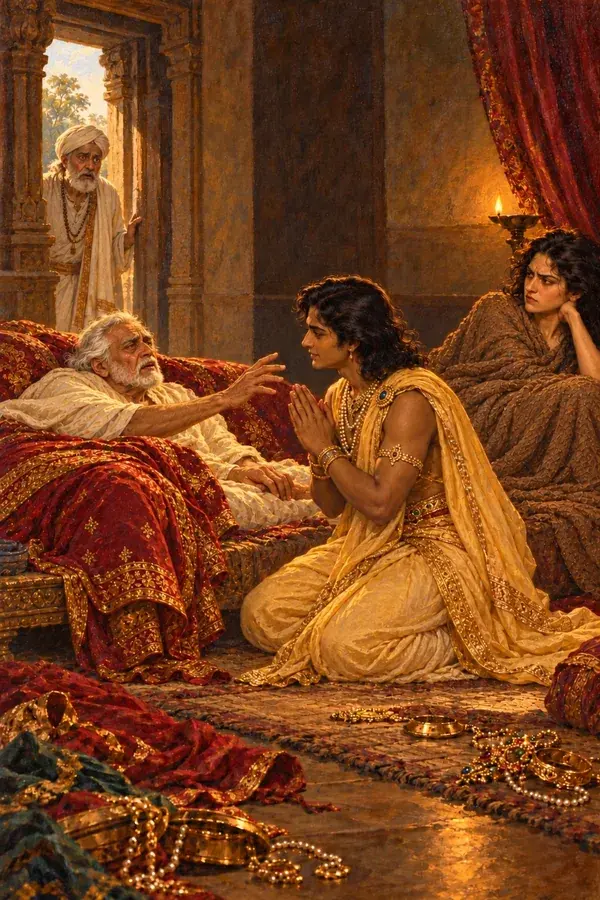
The king, crying Rama, Rama, prays in his heart that morning not come and that no one go and tell Rama. Morning comes. Sumantra is sent to wake the king, and Kaikeyi sends him to bring Rama. She tells Rama of the two boons, and Rama answers her before he says a word to his father.
In this episode of the Ramcharitmanas Rama is brought to his father and sees his state. He asks Kaikeyi the cause. When she has told him, he smiles in his mind. He says that meeting the sages in the forest is his good in every way, and that Bharata will get the kingdom. He has one grief above all, his father’s state, and he puts her on oath to tell him truly. His father holds him to his breast and prays in his mind that he stay, and does not speak. Rama asks him to give up worry and to give the order with a glad heart.
Rama, Dasharatha, Kaikeyi, and Sumantra
The main figures in this episode
- Rama the son the king prays will not be told. Sumantra brings him to his father. He asks Kaikeyi the cause, hears of the two boons, and smiles in his mind. He says that meeting the sages in the forest is his good in every way, and puts her on oath to tell him truly. When his father has held him to his breast, he asks him to give the order with a glad heart.
- Dasharatha the king, who prays in his heart that morning not come. He is found fallen on the ground, colorless. When he hears that Rama has come, he takes him to his breast, and a stream of water runs from his eyes. In his mind he prays to the Creator and to Shiva that Rama stay home, and he does not speak.
- Kaikeyi the queen, in rage near the king. She tells Sumantra to bring Rama. She tells Rama of the two boons and of the king’s strait, and tells him to take the order on his head if he can. She takes his simple words as crooked. She swears by him and by Bharata that she knows no other cause, and asks him to explain it to his father.
- Sumantra the minister, sent to wake the king. He goes into the palace, finds the king on the ground, and is sent on to bring Rama. He tells Rama the king’s order and brings him. Later he tells the king that Rama has come. Steadying the king, he seats him.
- Bharata of whom Rama and Kaikeyi speak. Rama says that Bharata, dear as life, will get the kingdom. Kaikeyi swears by him.
The night the king would keep from ending
The king cried Rama, Rama, distraught. It was as if he were a bird without wings, helpless. In his heart he prayed that morning not come, and that no one go and tell Rama.
The prayer in his heart went on, to the sun. “Do not rise, sun, guru of Raghu’s line. At the sight of Ayodhya, a pang will come into your breast.” The commentary reads the guru of Raghu’s line as its first ancestor.
The Creator had made the king’s love and Kaikeyi’s hardness each at its utmost.
Lamenting, the king came to dawn. Vina, flute, and conch sounded at the door. Bards recited, and singers sang his virtues. To the king, hearing them, it was as if arrows struck.
None of the auspicious things pleased him at all, as ornaments do not please a woman going with her husband in death. That night no one slept. There was longing and eagerness for the sight of Rama.
At the door there was a crowd of servants and ministers. Seeing the sun risen, they said: “The lord of Ayodhya has not woken yet. What special cause is there?”
Sumantra’s steps, and the silence of the palace
The servants and ministers went on. “The king always wakes in the last watch. Today we feel great wonder. Go, Sumantra. Go and wake him. Once his order is had, let the work be done.”
Then Sumantra went into the palace. Seeing it fearful, he was afraid as he went. It was as if it would run and devour him. It could not be looked at. It was as if trouble and dejection had made it their dwelling.
He asked, and no one answered. He went to the house where the king and Kaikeyi were. Saying “Victory, and long life,” and bowing his head, he sat. Seeing the king’s state, he dried up.
The king had fallen on the ground, distraught with worry, colorless. It was as if a lotus had left its root. The minister was afraid, and could not ask. Kaikeyi spoke, full of ill and empty of good.
“The king had no sleep in the night. The Lord of the world knows the cause. Crying Rama, Rama, he brought the morning in. He does not tell the secret. Quickly call Rama and bring him. Then come and ask the news.”
Sumantra went, knowing the king’s mood. He saw that the queen had taken some evil course. Distraught with worry, he could not set his foot on the road. In the commentary’s reading, he thought: “Having called Rama, what will the king say?”
Holding patience in his breast, he went to the door. Seeing him downcast, everyone asked. Having set them all at rest, he went to where Rama was. Rama saw Sumantra coming, and honored him, counting him as a father.
Looking at his face and telling him the king’s order, Sumantra set out, bringing Rama. Rama went with the minister in an ill way. The commentary reads it as going without any retinue. Seeing it, people here and there were distressed.
The father’s state, and Kaikeyi’s answer
On arriving, Rama saw the king in an utterly sorry state. It was as if an old king of elephants had cowered and fallen at the sight of a lioness.
The king’s lips were drying, and every limb was burning. It was as if a serpent were wretched without its jewel. Rama saw Kaikeyi near him, in rage. It was as if death were counting the hours. The commentary says the hours are the king’s last.
Rama’s nature was full of compassion, and soft. This was the first grief he had seen. He had never heard of one. Yet, holding patience and considering the hour, he asked his mother Kaikeyi in sweet words.
“Tell me, mother, the cause of father’s grief, so that the effort may be made that removes it.”
Kaikeyi answered. “Listen, Rama. The whole cause is this. The king has great love for you. He said he would give me two boons. I asked for whatever I liked. At hearing it, worry came into the king’s breast. He cannot set aside his regard for you.”
“A son’s love on this side, the word on that. The king has fallen into a strait. If you can, take the order on your head, and wipe away the hard affliction.”
Sitting without a qualm, she spoke bitter speech. At the hearing, hardness was greatly agitated. Her tongue was a bow, and her words were many arrows. It was as if the king were a soft target.
It was as if harshness had taken a body, a fine warrior, and were learning archery. Having told Rama the whole matter, she sat as if cruelty had taken a body.
Rama sees his good in the forest
Smiling in his mind, Rama, by nature a treasury of bliss, spoke words free of every fault, soft and charming. They were as if ornaments of speech.
“Listen, mother. That son is fortunate who loves the words of father and mother. A son who satisfies mother and father is rare, mother, in all the world.”
“Meeting the hosts of sages, above all in the forest, is my good in every way. In that is my father’s order, and moreover, mother, your consent.”
“Bharata, dear as life, will get the kingdom. Today the Creator is favorable to me in every way. If I do not go to the forest, even for such a purpose, count me first in the company of fools.”
“There are those who serve the castor plant, leaving the wish-tree, and who, giving up nectar, ask for poison. Even they, given such a chance, would not miss it. Consider it in your mind, mother, and see.”
One grief that stays with Rama
“Mother, one grief I have above all, seeing the king utterly distraught. For a small thing my father has heavy grief. I cannot believe it, mother.”
“The king is steady, a fathomless sea of virtues. Some great offense has come from me, for which the king says nothing to me. On my oath, tell me truly.”
Rama’s words were simple by nature. Kaikeyi took them as crooked. A leech moves crookedly in water, though the water is level.
The queen rejoiced at finding Rama’s mood. She spoke, showing guileful love. “I swear by you, and by Bharata. I know no other cause.”
“You are not one fit for offense, son. You give happiness to mother, father, and brothers. Rama, all you say is true. You are devoted to the words of father and mother.”
“I would give myself for you. Explaining it to your father, say the thing by which no infamy comes in his fourth age. The merit that gave sons like you should not be dishonored.” The commentary reads the fourth age as old age.
In the foul mouth the good words sat as Gaya and the other holy places sit in Magadha. All the mother’s words pleased Rama, as water that has gone into the Ganga is handsome.
At his father’s breast, as if a lost jewel were found again
The swoon passed. Remembering Rama, the king turned over on his side. Telling him that Rama had come, the minister made entreaty fit for the hour.
Hearing that Rama had come, and holding patience, the king opened his eyes. Steadying the king, the minister seated him. The king looked on Rama falling at his feet.
Distraught with love, he took him to his breast. It was as if a serpent had found again the jewel it lost. The king stayed gazing at Rama. A stream of water ran from his eyes.
Overcome by sorrow, he could say nothing. He held him to his heart again and again. In his mind the king prayed to the Creator that Rama might not go to the forest.
The king’s prayer, unspoken
Remembering Shiva, he pleaded with him, in his mind. “Hear my entreaty, Shiva. You are pleased at once, and you give without stint. Take away the anguish, knowing me a wretched servant.”
“You are the mover in every heart. Give Rama that wit by which, leaving my word, he stays home, giving up good conduct and love.”
“Let infamy come in the world. Let good fame perish. Let me fall into hell, or let heaven go. Make me bear every unbearable grief. Let Rama not be out of my sight.”
So the king thought in his mind, and did not speak. His mind shook like a pipal leaf.
Rama asks his father to give the order gladly
Rama knew his father to be in the power of love. He guessed that the mother would say something more. The commentary adds that this would pain the father.
Considering according to place, time, and occasion, he spoke humble words. “Father, I say something, and I am bold in it. Forgive what is improper, knowing it a child’s.”
“For a very small thing you have suffered grief. No one told me first and let me know. Seeing my master, I asked mother. When I heard the matter, my limbs were cooled.” The commentary reads the cooling as a great joy.
“In the auspicious hour, give up the worry that love has put on you, father. Give the order, glad in your heart.” As he said it, Rama’s limbs thrilled.
The course of the morning
Seeing the sun risen, the servants and ministers sent Sumantra to wake the king. Kaikeyi told the minister to bring Rama, and he brought him. Rama asked Kaikeyi the cause of his father’s grief. She told him of the two boons, and told him to take the order on his head if he could. Rama answered that meeting the sages in the forest was his good in every way. He put her on his oath to tell him truly. She swore by him and by Bharata that she knew no other cause, and asked him to explain it to his father. Out of his swoon, the king held Rama to his breast and gazed at him. His prayers to the Creator and to Shiva that Rama stay were made in his mind, and he did not speak. Rama asked his father to forgive what was improper as a child’s. He asked him to give up worry and to give the order, glad in his heart.
The same story, elsewhere: Valmiki’s Ramayana, chapter 8: The Exile of Rama, the City’s Lament, Guha, and Chitrakuta.
Source: the Gita Press edition of Tulsidas’s Ramcharitmanas, Ayodhyakand, doha 37 to 45, read with Hanuman Prasad Poddar’s Hindi commentary.