On this page
At the fathomless well, Atri tells Bharata that this place has been perfected from the beginning, that time hid it, and that no one knew of it. Rama knows in his mind that today is a good day, and he is embarrassed to say it. Bharata sees his bent, and he asks Rama’s order to go and serve Ayodhya through the term. In many ways Rama instructs him. Without a support, Bharata’s mind finds neither content nor peace. In grace, Rama gives Bharata his sandals.
In this episode Bharata sends on the water vessels and goes with Shatrughna, Atri, and the sadhus to the well. Atri says that people will call it Bharatakupa, and tells Rama of its merit and power. Bharata and Shatrughna go about Rama’s forest on foot, without shoes, and the earth grows soft. For five days Atri tells Bharata the origin, name, virtue, merit, and power of each place. Bharata says that he trusts Rama to keep everyone and to carry it through on both sides. Rama says that the care of both brothers is the guru’s and the king’s, and that their highest aim is to keep their father’s order. He likens the head to the mouth. Bharata places the sandals on his head and is glad. Indra’s foul play becomes life to their lives. Rama gives up his patience, and water flows from his eyes. The sages, the guru, and the steady like Janaka sink in the brothers’ love.
From Bharata’s well to the asking of leave
The main figures in this episode
- Bharata who sets the holy water in the holy spot and, over five days, sees every place in the forest with Atri. At dawn he sees Rama’s bent, rises, and asks his order to go and serve Ayodhya. He asks for counsel for the term, by which he may see Rama’s feet again. Rama, he says, knows everyone’s wish and will carry it through to the end on both sides. Without a support his mind finds neither content nor peace. He takes the sandals with respect and places them on his head.
- Rama who knows that today is a good day, is embarrassed to say it, and looks at the ground. He answers Bharata’s entreaty with counsel. The care for them both, he says, is the guru’s and the king’s. Their highest aim, he says, is to keep their father’s order, and the head should be like the mouth. In the power of hesitation and love, he gives Bharata his sandals in grace. Embracing his brother, he gives up his patience, and his eyes run with water.
- Shatrughna Bharata’s younger brother, who goes with him to the well and walks the forest with him on foot.
- Atri who tells Bharata that time had hidden this perfected place, and that people will call it Bharatakupa. He tells Rama what merit and power the holy place holds. Over five days he answers Bharata about each place in the forest, from its origin to its power.
- Vasishtha, Vishvamitra, and Janaka the guru, the sage, and the king of Mithila, who stand over the heads of the two brothers in Rama’s words. The commentary names the sage as Vishvamitra. Janaka is in the company that gathers at dawn. Rama tells Bharata that the guru and the king hold the care of both brothers, and that the dust of the guru’s feet bears the burden of the land. The guru and Janaka, their minds tried like gold, are sunk in the brothers’ love.
- Indra who finds an ill occasion and, in his crookedness, makes the people restless. His foul play turns good for all, and the gods’ army becomes a giver of good and a guard.
A place for the water of the holy places
At Atri’s command Bharata sent on all the water vessels. He went himself with his younger brother Shatrughna, with the sage Atri, and with the sadhus, to where the fathomless well was. There he set the holy water in the holy spot. Atri, glad with love, spoke. “Son, this place has been perfected from the beginning. Time hid it, and no one knew of it. Then the servants saw the moist ground. They made a special well there for good water. In the power of the Creator, the world was served. The thought of dharma, so hard to reach, became easy.” The commentary makes the servants Bharata’s.
Atri went on. “Now people will call it Bharatakupa. With the waters of the holy places joined in it, it is most holy. A living being who bathes in it with love and rule will become spotless in deed, mind, and speech.”
Telling the well’s glory, they all went to where Rama was. Atri told Rama the merit and power of the holy place.
The two brothers walk without shoes
Dharma and the histories were told with love. Dawn came, and that night had passed in happiness. Bharata and Shatrughna, the two brothers, finished their daily rites. With the order of Rama, Atri, and the guru, and with the company, all in plain gear, they set out on foot to go about Rama’s forest.
Tender feet walked without shoes. The earth, embarrassed in her mind, grew soft. Kusha grass, thorns, pebbles, and cracks, every bitter, harsh, and bad thing, she hid. She made the roads charming and soft. The threefold breeze blew, carrying happiness. The commentary names the three as cool, gentle, and fragrant.
The gods rained flowers, and the clouds made shade. The trees flowered and fruited, and the grass gave its softness. The deer looked at him, and the birds spoke in fine speech. All served him, knowing him dear to Rama.
For even a worldly man saying “Rama” while yawning, every success is easy. For Bharata, dear as life to Rama, this is no great thing.
Five days among the places and holy spots
In this way Bharata went about the forest. Seeing his rule and his love, the sages were embarrassed. The holy waters, the parts of the land, the birds, beasts, trees, and grass, the hills, woods, and gardens were all lovely, varied, especially holy, and divine. Seeing them, Bharata asked about each. Hearing him, Atri, glad in mind, told the origin, the name, the virtue, the merit, and the power of each.
Here Bharata bathed, and there he saluted. Here he looked at what delighted the mind. There he sat at the sage’s order, remembering the two brothers, Rama and Lakshmana, with Sita. Seeing his nature, his love, and his fine service, the forest gods were glad and gave blessings. When two and a half watches of the day had gone, Bharata turned back. He came and looked at Rama’s feet.
In five days Bharata saw all the places and holy spots. While the fair fame of the Lord and Shiva was told and heard, the day passed, and evening came. The commentary names the Lord here as Vishnu.
Dawn, and Rama’s reserve
At dawn all bathed, and the company gathered: Bharata, the brahmins, and the king of Mithila. Knowing in his mind that today was a good day, Rama was embarrassed to say it. The commentary makes it the sixth day, and reads the good day as a day for sending everyone off. Rama looked over the guru, the king, Bharata, and the assembly. Embarrassed, he turned and looked at the ground. Praising his good conduct, the whole assembly thought that nowhere was there a master as reserved as Rama.
Wise Bharata saw Rama’s bent. Rising with love and holding especial patience, he prostrated himself. Joining his hands, he spoke. “You have kept, master, all my wishes. For my sake everyone bore pain, and you suffered grief in many ways. Now, master, give me the order. Let me go and serve Ayodhya the whole term. By whatever means your servant may see your feet again, kind to the humble, please give me that counsel for the term, keeper of Kosala, merciful one.”
Trust that he will carry it through on both sides
Bharata went on. “The townsfolk, the household, and the people, master, are all pure, and full of savor through love and kinship. For your sake, burning in the grief of existence is good. Without you, Lord, the gain of the highest state is in vain.” The commentary reads the highest state as moksha.
Bharata went on. “You, master, are wise. Knowing the wish, the yearning, and the way of life of everyone, and of your servant’s heart, the keeper of those who bow will keep everyone. And you, lord, will carry it through to the end on both sides. So I have great trust in every way. When I think it over, not a straw’s worth of worry remains. My distress and my master’s affection have together made me bold by force. Removing this great fault, master, and giving up hesitation, please counsel your follower.”
Hearing Bharata’s entreaty, a swan’s way of parting milk from water, all extolled it. Hearing his brother’s humble, guileless words, Rama, skilled, spoke words fitting to the place, the time, and the occasion.
The father’s order, and the keeping of the people
Rama said, “Dear one, the care for you, for me, and for the household, at home and in the forest, is the guru’s and the king’s. Over our heads are the guru, the sage, and King Janaka. For me and for you there is no affliction, even in a dream. My highest aim and yours, the worldly good, fair fame, dharma, and the highest good, is that we two brothers keep our father’s order. The king’s goodness is good in the world and the Veda.” The commentary takes the sage over their heads to be Vishvamitra. It reads the king’s goodness as the keeping of his vow.
Rama went on. “When the counsel of guru, father, mother, and master is kept, the foot does not fall into a pit, even when it walks a bad road. Considering so, and leaving aside all worry, go and keep Ayodhya the whole term. The burden of the land, the treasury, the household, and the family rests on the dust of the guru’s feet. Heeding the counsel of the sage, the mothers, and the ministers, keep the earth, the people, and the capital.” The commentary takes the sage here to be Vasishtha.
Rama went on. “The head should be like the mouth. The mouth is the one for eating and drinking, and it keeps and nourishes all the limbs with discernment. The whole of a king’s dharma is just this much, as a longing lies hidden in the mind.” He instructed his brother in many ways. Without a support, Bharata’s mind found neither content nor peace.
The sandals placed on his head
With Bharata’s good conduct, and with the guru, the ministers, and the company, Rama was in the power of hesitation and love. In grace, he gave the sandals. Bharata took them with respect and placed them on his head. In the commentary’s reading, love for Bharata made Rama wish to give him the sandals, while he also felt hesitation before the guru and the others.
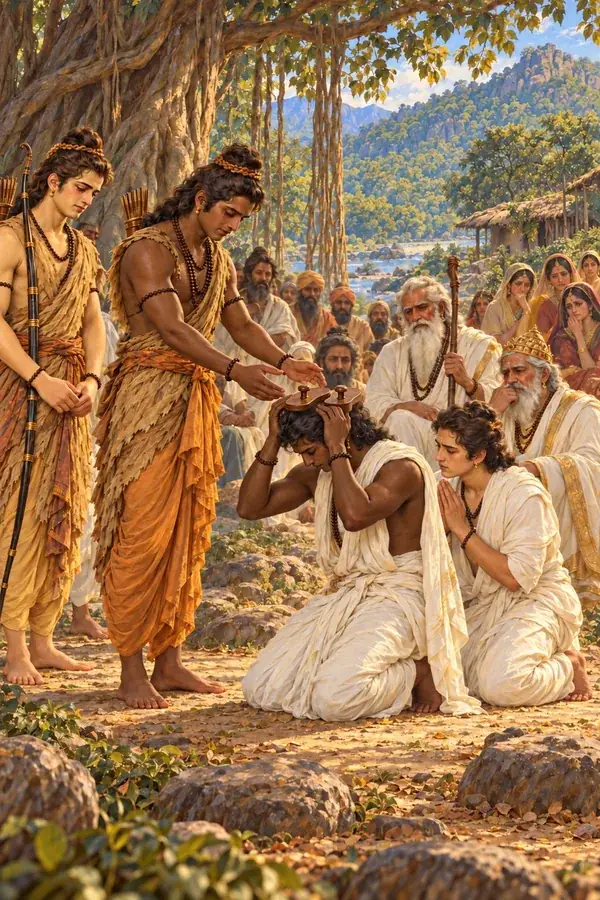
Rama’s footrests were as if two watchmen of the people’s life. They were a casket for the jewel of Bharata’s love. They were as if the two letters for the soul’s striving. The commentary reads the two letters as those of Rama’s name. They were doors for the line, hands for good deeds, and spotless eyes for the fine dharma of service.
At getting the support, Bharata was glad. His happiness was such as Sita and Rama’s staying would have given.
The foul play that turned good for all
Bharata asked leave, making his salute, and Rama took him to his heart. Crooked Indra made the people restless, finding an ill occasion. That foul play turned good for all. Like the hope of the term, it became life to their lives. The commentary calls it life-giving. Otherwise, at parting from Lakshmana, Sita, and Rama, all the people, trembling, would have died of the ill sickness.
By Rama’s grace the tangle was set right. The gods’ army became a giver of good and a guard. Rama embraced his brother Bharata, his arms filled. The savor of Rama’s love cannot be told. Love surged in body, mind, and speech. The foremost of the steady gave up his patience. Water flowed from his lotus eyes. Seeing his state, the assembly of the gods was unhappy.
Minds tried like gold in the fire of knowledge
The sages, the guru, and the steady like Janaka had minds tried like gold in the fire of knowledge. Brahma had made them unstained. They were born in the water of the world like lotus leaves. They too, looking at the matchless, boundless love of Rama and Bharata, were sunk in it in mind, body, and speech, with their dispassion and their thought. The commentary reads that thought as discernment.
The counsel asked for, and the support given
Bharata set the holy water in its holy spot. Atri said that people would call the well Bharatakupa, and told what bathing in it would do. The two brothers walked on foot, and the earth hid every harsh thing on the road. For five days Atri answered Bharata about each place he asked of. At dawn Rama knew the day was good and was embarrassed to say it. Bharata saw his bent and asked for the order to go, and for counsel for the term. He told Rama that he trusted him to keep everyone and to see both sides through to the end.
Rama answered that the guru and the king held the care of them both, and that keeping their father’s order was the brothers’ highest aim. He named those whose counsel Bharata was to heed in his keeping of earth, people, and capital, and likened the head to the mouth. Rama instructed him in many ways. Without a support, Bharata found no content. In grace, Rama gave him the sandals. Indra made the people restless, and the foul play turned good. Rama embraced Bharata and gave up his patience. The steady, their minds tried like gold, sank with their dispassion and their thought in the love of Rama and Bharata.
The same story, elsewhere: Valmiki’s Ramayana, chapter 10, part 2: Bharata meets Rama at Chitrakuta.
Source: the Gita Press edition of Tulsidas’s Ramcharitmanas, Ayodhyakand, doha 310 to 317, read with Hanuman Prasad Poddar’s Hindi commentary.