On this page
Bharata embraces Guha with great love, and the people envy the way of love. Later, hand in hand with his friend, Bharata asks to be shown the place where Sita, Rama, and Lakshmana slept at night. When he has said fie on himself, his friend answers him on oath.
In this episode of the Ramcharitmanas a sound of “blessed, blessed” goes up, and the gods rain flowers and speak of the Name. The people of Ayodhya find happiness in hearing them. Bharata asks after Guha’s welfare, and Guha says what the sight of Bharata’s feet has given him. Shatrughna meets him, the queens bless him, and the servants make lodgings. At the sight of Shringaverapura Bharata’s limbs go slack. He salutes Rama’s ghat and asks the Ganga for natural love. He takes account of everyone and honors all the mothers. Then he goes with Guha to the tree where Rama rested. There he salutes the bed of kusha, puts the footprints’ dust to his eyes, and on his head he sets two or four specks of gold. He speaks of Sita’s father, her father-in-law, and her husband, of Lakshmana in the forest, of Rama asleep on kusha, of Kaikeyi, and of himself. Guha answers that Rama praised him again and again that night, and asks him to come and take rest.
The people at the camp
The main figures in this episode
- Bharata Rama’s younger brother, who embraces Guha and asks after his welfare. He salutes Rama’s ghat, and of the Ganga he asks a boon, natural love for the feet of Sita and Rama. He takes account of everyone at the camp and presses the feet of all the mothers. Then he asks Guha to show him where the three slept at night. At the bed of kusha grass he touches his eyes with the dust of the footprints, and sets the specks of gold on his head. He speaks of Sita, of Lakshmana, and of Rama, says fie on Kaikeyi and on himself, and hears his friend’s answer.
- Guha the Nishada king, Rama’s friend, whom Bharata embraces. Seeing Bharata’s good conduct and love, he becomes bodiless, and then, with joined hands, he says what his welfare is. He says his name to the queens, leads the company along, and signals to all his servants, who make the lodgings. Hearing Bharata’s words, he feels dejection and takes him at once to the tree where Rama rested. When Bharata reproaches himself, Guha says the fault is the contrary Creator’s, and tells of Rama’s praise that night. He swears that none is as dear to Rama as Bharata, and asks him to come and rest.
- Shatrughna Bharata’s younger brother, who meets Guha after seeing his love and hearing his entreaty. After the worship of the gods he goes with Bharata to Kausalya. Bharata entrusts the service of the mothers to him before going with Guha to the bed of grass.
- Sita, Rama, and Lakshmana of whom Bharata and Guha speak. Bharata salutes Rama’s ghat and asks to be shown where the three slept. He counts the specks of gold as Sita. He speaks of Sita’s kin, of Lakshmana’s hardship in the forest, and of Rama asleep on the ground. Guha tells Bharata that Rama praised him with respect that night.
- The mothers and the people of Ayodhya the company that comes with Bharata. The people find happiness in the gods’ words. Knowing Guha like Lakshmana, the queens bless him, and the city’s men and women are happy at the sight of him. The men and women of the city bathe in the Ganga and ask for love of Rama’s feet. The mothers bathe, and Bharata presses their feet and speaks soft words to them.
The gods speak over an embrace
Bharata embraced Guha with great love. The people envied the way of love. A sound of “blessed, blessed” went up, the root of blessing. The gods rained flowers in praise.
The gods said, “The world and the Veda count him low in every way. At the touch of his shadow one must sprinkle oneself with water. Him Rama’s younger brother meets in a full embrace, his body thrilling through and through.”
“Before those who yawn saying ‘Rama, Rama’, heaps of sin do not come. This one Rama took to his breast. He made him, with his family, a purifier of the world.”
“The Karmanasha’s water falls into the Ganga. Say, who does not put it on his head? The world knows that, repeating the name backwards, Valmiki became like Brahman.”
“The dog-eater, the Shabara, the Khasa, the Yavana, the dull and the base, the Kol and the Kirata, saying ‘Rama’ they become supremely pure and famous in the worlds. There is no wonder in it. Age after age it has come down. To whom has Rama not given greatness?” The commentary reads the name said backwards as “mara, mara.”
The gods told the glory of Rama’s name. Hearing it again and again, the people of Ayodhya found happiness.
What welfare means to Guha
Meeting Rama’s friend with love, Bharata asked after his welfare, his good fortune, and his well-being. Seeing Bharata’s good conduct and love, Guha at that moment became bodiless. In the commentary’s reading, love made him forget his body.
Shyness, love, and joy grew in his mind. He stood gazing at Bharata without a blink. Holding patience and bowing again at his feet, he made entreaty with love, his hands joined.
He said, “Seeing your lotus feet, the root of welfare, I have counted my welfare in all three times. Now, lord, by your supreme grace, there is blessing for me and for ten million of my line. Whoever, considering my deeds and my family and seeing Rama’s glory in his heart, does not worship Rama’s feet, is cheated by the Creator in the world. I am deceitful, cowardly, ill-minded, and low-born, outside the world and the Veda in every way. From the moment Rama made me his own, I have been the ornament of the worlds.”
Of his deeds, his family, and Rama’s glory, the commentary says that the master of endless worlds made this creature of low birth and deeds his own by causeless grace.
The queens’ blessing, and the lodgings
Seeing his love and hearing his pleasing entreaty, Shatrughna then met him. Saying his own name in fine words, Guha made obeisance to all the queens with respect.
Knowing him to be like Lakshmana, the queens gave a blessing. “Live happily a hundred times a hundred thousand years.” Seeing Guha, the men and women of the city became happy, as if they were seeing Lakshmana.
They said, “This one has gained the gain of life. Rama embraced him, filling his arms.” Hearing the greatness of his fortune, Guha, delighted in mind, led them all along.
He signaled to all his servants. They set out, getting their master’s bent, and went and made lodgings in houses, under trees, by lakes, in gardens, and in woods.
A prayer to the Ganga for natural love
When Bharata saw Shringaverapura, all his limbs went slack with love. Leaning on Guha, he shone as if entreaty and love had taken a body. The commentary sets his hand on Guha’s shoulder.
So, with all the army, Bharata went and saw the world-purifying Ganga. He saluted Rama’s ghat. His mind was absorbed, as if he had met Rama. The commentary places the ghat where Rama bathed and said his evening prayer.
The men and women of the city saluted, glad at the sight of the water that is Brahman in form. Bathing, with joined hands they asked for no small love for Rama’s feet.
Bharata said, “Ganga, your dust gives every happiness. To a servant it is the gods’ cow. Joining my hands I ask for this boon, natural love for the feet of Sita and Rama.”
Having bathed so and received the guru’s command, and knowing that all the mothers had bathed, Bharata led the camp on.
From the mothers’ service to the tree where Rama rested
The people made camp here and there. Bharata took account of everyone. The commentary reads it as finding out whether all had settled in comfort. After the worship of the gods, receiving leave, the two brothers went to Kausalya.
Pressing feet and saying soft words again and again, Bharata honored all the mothers. Entrusting the service of the mothers to Shatrughna, he himself called Guha.
He set out hand in hand with his friend, his body slack with no small love. He asked his friend, “Show me that place, and cool a little the burning of my eyes and mind, where Sita, Rama, and Lakshmana slept at night.”
As he said it, the corners of his eyes filled with water. Hearing Bharata’s words, Guha felt dejection. At once he took him there, where under the holy shimshapa tree Rama had rested. There, with great love and with respect, Bharata prostrated himself in salute. The commentary names the tree an ashoka.
The bed of kusha grass, and a few specks of gold
Seeing the handsome bed of kusha grass, he saluted it, going round it.
He put the dust of the footprints to his eyes. The abundance of his love cannot be told.
He saw two or four specks of gold. He set them on his head, counting them as Sita. The commentary has them fallen from Sita’s ornaments and clothes.
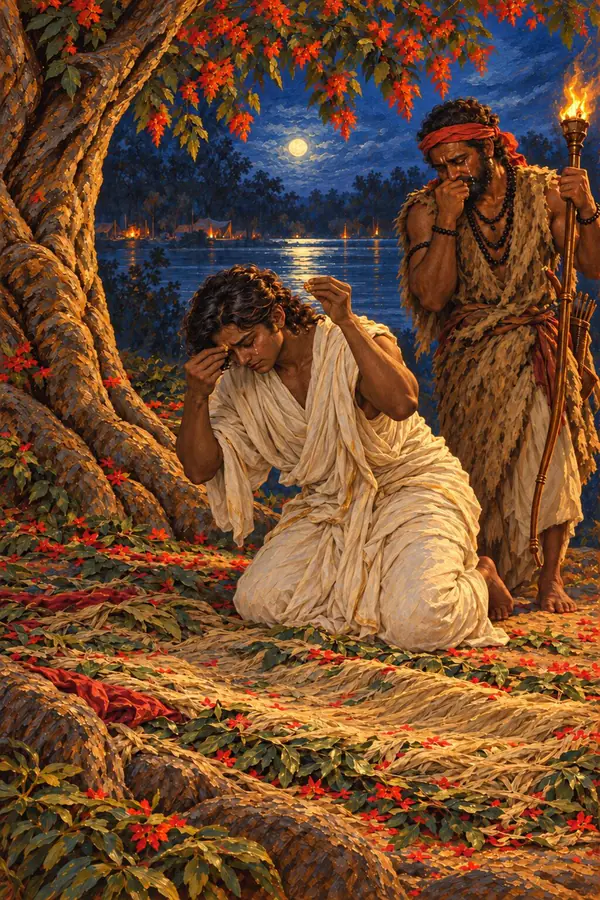
His eyes were wet, and there was remorse in his heart. He spoke to his friend in fine words. “They are lusterless and dim in separation from Sita, as the men and women of Ayodhya are wasting away. Her father is Janaka. To whom shall I liken him, who holds enjoyment and yoga in the palm of his hand in the world?”
“Her father-in-law is the king, the sun of the Sun’s line, whom Indra envies. Her husband, the master of her life, is Rama, the master. Whoever is great is great by Rama’s greatness. At the sight of the bed of grass of Sita, the jewel of good wives who hold their husband as a god, the heart does not shudder and split. O Shiva, it is far harder than the thunderbolt.”
Two brothers remembered, and Bharata’s self-reproach
Bharata went on. “Young Lakshmana is lovely and fit to be fondled. Such a brother never was, is, or will be. He is dear to the townspeople, cherished by father and mother, and dear as life to Sita and Rama. His image is soft and his nature tender, and no hot wind ever touched his body. He bears every kind of hardship in the forest. This breast has slighted ten million thunderbolts.”
The commentary adds that otherwise it would have burst long ago.
Bharata went on. “Taking birth, Rama lit up the world. He is the sea of form, conduct, happiness, and every virtue. To the townspeople and the family, to the guru, to father and mother, to everyone, Rama’s nature gives happiness. Even enemies speak Rama’s greatness. His speech, his way of meeting, and his entreaty steal the mind. Ten million Sarasvatis and a thousand million Sheshas cannot count Rama’s virtues.”
“Rama, happiness embodied, the treasury of blessing and joy, sleeps on kusha spread on the ground. The Creator’s course is very strong.”
“Rama never heard of grief with his ears. The king guarded him like the tree of his life. As eyelids guard the eyes and a serpent its jewel, all the mothers guarded him day and night. He now wanders the forest on foot, eating tubers, roots, fruit, and flowers. Fie on Kaikeyi, the root of ill, who turned against the one dearest as life.” The commentary takes the one dearest as life to be her husband.
Bharata went on. “Fie, fie on me, an ocean of sin, unfortunate, for whom all this upheaval came. The Creator created me as the stain of the line. My bad mother made me a betrayer of my master.”
Guha tells of Rama’s praise that night
Hearing it, Guha consoled him with love. “Master, why grieve in vain? Rama is dear to you, and you are dear to Rama. This is the settled truth. The fault is the contrary Creator’s.”
“Hard is the doing of the contrary Creator, who made your mother mad. That night Rama praised you again and again, with respect. No one is as dear to Rama as you. I say it on oath. Knowing that the end will be blessed, bring patience into your heart.”
“Rama knows the heart within. He is the home of shyness, love, and grace. Considering this, and bringing firmness to your mind, come and take rest.”
The course of the episode
After the embrace the gods spoke of the Name, and the people of Ayodhya found happiness in it. Bharata asked Guha of his welfare. Guha stood gazing, then bowed at his feet and said what the sight of those feet had given him. Shatrughna met him. The queens blessed him. The city’s men and women said he had gained the gain of life. Guha led everyone along, and his servants made the lodgings. When Shringaverapura came in sight, Bharata’s limbs went slack, and he leaned on Guha. He saluted Rama’s ghat, and the city bathed and asked for love of Rama’s feet. Bharata asked the Ganga for natural love. Having bathed and received the guru’s command, he led the camp on.
He took account of everyone, went with Shatrughna to Kausalya, and honored all the mothers. He left their service to Shatrughna and went hand in hand with Guha. Guha, in dejection, took him to the shimshapa where Rama had rested. Bharata made his prostration, saluted the bed of kusha grass, and touched his eyes with the footprints’ dust. On his head he set the specks of gold. With wet eyes he asked to whom Janaka could be likened, named the king whom Indra envies, and called Rama the master of Sita’s life. He said that his heart did not split at the sight of her bed of grass. He spoke of the hardship Lakshmana bore in the forest, and of Rama sleeping on kusha. He said fie on Kaikeyi, and fie, fie on himself. Guha answered that the fault was the contrary Creator’s, and that Rama had praised Bharata again and again that night. He swore that no one was as dear to Rama, and asked him to come and take rest.
The same story, elsewhere: Valmiki’s Ramayana, chapter 10: The Coming of Bharata, and the Sandals.
Source: the Gita Press edition of Tulsidas’s Ramcharitmanas, Ayodhyakand, doha 194 to sortha 201, read with Hanuman Prasad Poddar’s Hindi commentary.