On this page
The gods, the nagas, the kinnaras, and the guardians of the quarters come to Chitrakuta, and Rama salutes them all. Raining flowers, the company of the gods tells him that today they have a protector, and making entreaty they tell their unbearable griefs. The Kols and Kiratas will offer to serve him in every way, saying they have looked over the forest’s thickets, hills, caves, and ravines step by step. Whenever Rama remembers Ayodhya, his eyes will fill, and remembering his family and Bharata’s love, he will grieve. Sita and Lakshmana will grow distraught at the sight.
In this episode of the Ramcharitmanas sages come too, hold Rama to their breasts, and reckon all their practices fruitful. The forest people come with leaf cups of bulbs, roots, and fruit, and Rama hears them as a father hears his children. Since he came, the trees flower and fruit, and the birds call. Elephants, lions, and deer roam together, free of enmity. The rivers praise the Mandakini, and the mountains sing Chitrakuta’s fame. Lakshmana serves and gives no thought to home even in a dream. To Sita the deer and birds are a dear family, and the bed of grass gives happiness like a hundred beds of Kama. Rama tells old stories, and he shines with Lakshmana and Sita in the dwelling of leaves.
Those who came to Chitrakuta
The main figures in this episode
- Rama who salutes the gods and prostrates to the sages. Saying dear words, he honors the Kols and Kiratas, and he satisfies them with soft words nourished with love before he sends them off. Since he came and stayed, the forest has been a giver of blessing, and he roams it on the hunt. He does and says whatever gives Sita and Lakshmana happiness. Whenever he remembers Ayodhya, water fills his eyes. Remembering his family and Bharata, he grieves, and he holds patience, considering the ill time.
- Sita whose beauty the sages look on, with Lakshmana’s and Rama’s. She stays happy with Rama, forgetting city, family, and home. The forest seems as dear to her as a thousand Ayodhyas, and the leaf hut is dear with her beloved. The sages’ wives are like a mother-in-law to her. Seeing Rama grieve, she grows distraught, and hearing his holy stories, she finds happiness.
- Lakshmana who serves in deed, mind, and word, with good conduct and love that cannot be told. Seeing Sita’s and Rama’s feet moment by moment and knowing their love for him, he does not think of brothers, mother, father, or home, even in a dream. Seeing Rama grieve, he too grows distraught, and he finds happiness in the holy stories.
- The gods and the sages who come to Chitrakuta. The gods gain the gain of their eyes. They rain flowers and say they have a protector today. They tell Rama their unbearable griefs and go home glad. The sages hold Rama to their breasts, bless him, and reckon all their practices fruitful at the sight of the three. Honored as is fitting and sent off, they do yoga, chanting, sacrifice, and tapas freely in their own hermitages. Day and night the gods call Chitrakuta’s birds, beasts, creepers, trees, and every kind of grass heaps of merit.
- The Kols and Kiratas the forest people, who get the news and set out glad, with leaf cups filled with bulbs, roots, and fruit. They set their gifts before Rama, greet him, and stand here and there as if painted in a picture. With joined hands they speak humble words. They call blessed the earth, forest, paths, and hills where he has set his foot, and themselves with their families. They offer every kind of service, and they say they are his servants, with their families.
- Bharata who is remembered. Remembering mother, father, family, and brothers, and Bharata’s love, good conduct, and service, Rama grieves.
Gods and sages come to Chitrakuta
At that time the gods, the nagas, the kinnaras, and the guardians of the quarters came to Chitrakuta. Rama saluted them all. Gaining the gain of their eyes, the gods were glad.
Raining flowers, the company of the gods said, “Master, today we have a protector.” Making entreaty, they told him their unbearable griefs. Glad, they went to their own homes. The commentary gives the gladness a cause, the assurance that their griefs would end.
Hearing again and again the news that Rama had settled at Chitrakuta, sages came. Seeing the glad company of sages coming, Rama prostrated. The sages held Rama to their breasts and gave him blessings for success. They looked at the beauty of Sita, Lakshmana, and Rama, and they reckoned all their practices fruitful.
Honoring them as was fitting, Rama sent the company of sages off. In their own hermitages they did yoga, chanting, sacrifice, and tapas, freely. The commentary adds that this freedom came of Rama’s coming.
The forest people, with leaf cups of gifts
The Kols and Kiratas got this news. They were glad, as if the nine treasures had come to their house. Filling leaf cups with bulbs, roots, and fruit, they set out, as if paupers were setting out to loot gold.
Some of them had seen the two brothers. The others asked them as they went on the way. Telling and hearing of Rama’s beauty, all came and saw him.
Setting their gifts before him, they greeted him. They gazed at Rama, very full of love. As if painted in a picture, they stood here and there. Their bodies thrilled, and the water in their eyes rose.
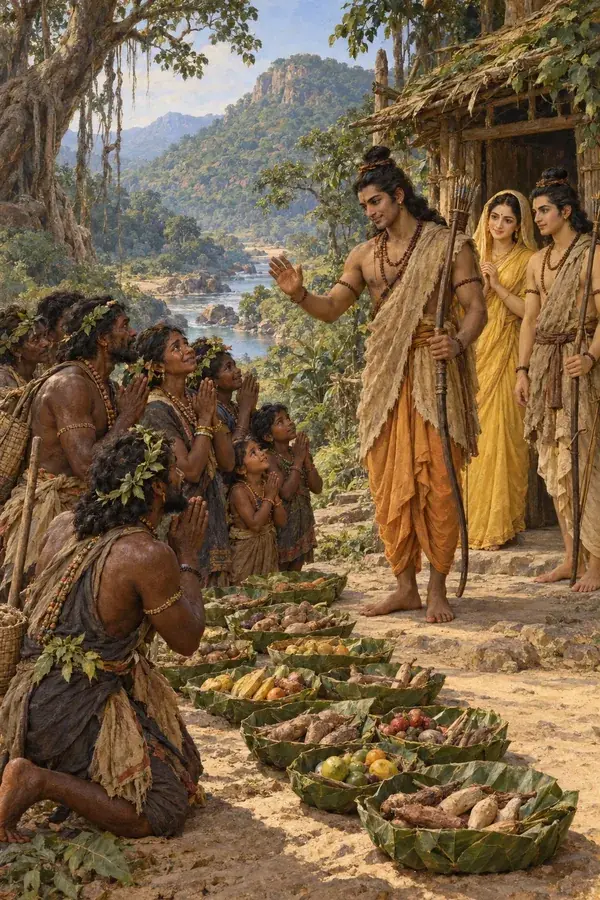
Rama knew them all sunk in love. Saying dear words, he honored them all. Greeting Rama again and again, with joined hands, they spoke humble words.
“Now, master, we all have a protector, seeing your feet. Your coming is our fortune, king of Kosala.”
A forest they have looked over step by step
The forest people went on. “Blessed are the earth, the forest, the paths, and the hills, master, where you have set your foot. Blessed are the birds and beasts that roam the forest. At the sight of you, their births bore fruit.”
“We are all blessed, with our families. We have seen you with eyes full. You have taken a good place to live, considering it. Here you will stay happy in every season.”
“We will serve you in every way, keeping off elephants, lions, snakes, and tigers. The thickets of the forest, the hills, the caves, and the ravines, all of them, lord, we have looked over step by step.”
“There we will have you hunt, and we will show you the lakes, the springs, and the watering places. We are your servants, with our families. Master, do not be embarrassed in giving orders.”
The words of the Vedas and the minds of the sages do not reach Rama, the abode of compassion. He heard the words of the Kiratas as a father hears the words of his children.
To Rama only love is dear. Whoever is a knower, let him know it. Then Rama satisfied all the forest people, saying soft words nourished with love.
He sent them off. Bowing their heads, they went, and telling and hearing of Rama’s virtues they came home. In this way the two brothers dwelt in the forest with Sita, giving happiness to gods and sages.
Fruiting trees, birdsong, and beasts roaming together
Since Rama came and stayed, the forest became a giver of blessing. Trees of many kinds flowered and fruited. Pleasing canopies of fine creepers twined.
Handsome by nature, like the gods’ tree, they were as if they had left the gods’ forest and come. The commentary names that forest Nandana. Rows of bees hummed most pleasingly. A threefold breeze blew, giving happiness. The commentary gives its three qualities: cool, gentle, and fragrant.
Peacocks, cuckoos, parrots, chataks, chakravakas, and chakoras called in many kinds of calls. The calls gave happiness to the ear and stole the mind.
Elephants, lions, monkeys, boars, and deer roamed together, free of enmity. The boars are the commentary’s reading of the line. Seeing the beauty of Rama as he roamed on the hunt, the herds of beasts were especially glad.
The praise of the Mandakini and Chitrakuta
All the gods’ forests in the world, seeing Rama’s forest, envied it.
The Ganga, the Sarasvati, the Sun’s daughter, Mekala’s daughter, and the Godavari, blessed rivers, praised the Mandakini. So did all the lakes, seas, rivers, and many great rivers. The commentary names the Sun’s daughter the Yamuna and Mekala’s daughter the Narmada.
The mountains of the sunrise and the sunset, Kailasa, Mandara, and Meru, all abodes of the gods, sang Chitrakuta’s fame. So did the Himalaya and all the other mountains. The Vindhya, glad of mind, could not contain its happiness. It had gained great honor without toil.
“Chitrakuta’s birds, beasts, creepers, trees, and every kind of grass are all heaps of merit, all blessed.” So the gods said, day and night.
Those with eyes, seeing Rama, gained the fruit of their birth and became free of sorrow. The unmoving, touching the dust of his feet, were happy. They became fit for the highest state. The commentary counts mountains, trees, earth, and rivers among the unmoving, and reads the highest state as liberation.
That forest and hill were handsome by nature, full of blessing, most sacred, making the sacred pure. How could their glory be told, where Rama, the sea of happiness, lived?
Leaving the sea of milk and leaving Ayodhya, Sita, Lakshmana, and Rama came and stayed there. A hundred thousand thousand-mouthed ones could not tell the splendor of that forest, if there were so many. The commentary reads them as Sheshas. How am I to describe it and tell it? Can a tortoise of a pond lift Mandara?
Lakshmana’s service
Lakshmana served in deed, mind, and word. His good conduct and love could not be told.
Seeing moment by moment the feet of Sita and Rama, and knowing their love for him, Lakshmana did not think of brothers, mother, father, or home, even in a dream.
The leaf hut, dear to Sita
Sita stayed happy with Rama, forgetting city, family, and home. Seeing her beloved’s moon face moment by moment, she was most glad, as if a young chakora.
Seeing her master’s love grow each day, she stayed glad, as a chakravaka hen by day. Sita’s mind was full of love for Rama’s feet. The forest seemed as dear as a thousand Ayodhyas.
With her beloved, the leaf hut was dear. The deer and birds were a dear family. The sages’ wives were like a mother-in-law, and the chief sages like a father-in-law. Food of bulbs, roots, and fruit was like nectar.
With her master, the handsome bed of grass gave happiness like a hundred beds of Kama. Could the play of the senses charm her, at whose glance beings become guardians of the worlds? The commentary adds that the glance is a kind one.
Remembering Rama, people leave the play of the senses like straw. For Sita, Rama’s beloved and the mother of the world, there is nothing to wonder at.
Eyes that fill at the memory of Ayodhya
Whatever gave Sita and Lakshmana happiness, Rama did it and said it. He told old stories and tales, and Lakshmana and Sita listened, taking great happiness.
Whenever Rama remembered Ayodhya, water filled his eyes. Remembering mother, father, family, and brothers, and Bharata’s love, good conduct, and service, Rama grieved. He held patience, considering the ill time.
Seeing it, Sita and Lakshmana became distraught, as a shadow follows a man.
Seeing the state of his beloved and his brother, Rama began to tell some holy stories. Hearing them, Lakshmana and Sita found happiness.
Rama, with Lakshmana and Sita, shone in the dwelling of leaves, as Indra dwells in the city of the immortals with Shachi and Jayanta. The commentary names the city Amaravati, and Shachi and Jayanta Indra’s wife and son.
The course of the episode
At that time the gods came to Chitrakuta, and Rama saluted them. They rained flowers, told him their unbearable griefs, and went home glad. Hearing the news, the sages came, and Rama prostrated to them. They held him to their breasts and blessed him, and seeing the beauty of the three, they reckoned their practices fruitful. Sent off with honor, they did yoga and tapas freely. The Kols and Kiratas set out glad with leaf cups. They set their gifts before Rama and gazed at him. They offered every service, and Rama heard their words. He satisfied them and sent them off, and they went home telling his virtues.
The two brothers and Sita dwelt in the forest. Since Rama came and stayed, trees flowered and fruited, bees hummed, a breeze blew, and birds of many kinds called. Beasts roamed together free of enmity, and the herds were glad at the sight of Rama on the hunt. The gods’ forests envied Rama’s forest. The Ganga and the other rivers praised the Mandakini, and Kailasa, Meru, and the Himalaya sang Chitrakuta’s fame. The Vindhya gained great honor without toil. Day and night the gods called Chitrakuta’s birds, beasts, and plants blessed. Those with eyes gained the fruit of their birth at the sight of Rama. The unmoving were happy at the touch of his feet’s dust and became fit for the highest state.
In deed, mind, and word Lakshmana served, and even in a dream he did not think of home. Sita, forgetting city and family, stayed happy with Rama. The forest seemed dear to her, and the deer and birds were her dear family. Rama did and said what gave the two happiness, and he told them old stories. Whenever he remembered Ayodhya, his eyes filled. He grieved at the memory of his family and of Bharata, and he held patience. Seeing it, Sita and Lakshmana grew distraught. Seeing their state, he began to tell some holy stories, and hearing them, they found happiness. With Lakshmana and Sita, Rama shone in the dwelling of leaves.
The same story, elsewhere: Valmiki’s Ramayana, chapter 8, part 2: From Ayodhya to Chitrakuta.
Source: the Gita Press edition of Tulsidas’s Ramcharitmanas, Ayodhyakand, doha 134 to 141, read with Hanuman Prasad Poddar’s Hindi commentary.