On this page
The village women ask Sita who the two with her are to her. She names Lakshmana, and tells them by a sign of her eyes that Rama is her husband. Some men and women do not come on the occasion, and do not get to see Sita and Rama.
In this episode of the Ramcharitmanas the women fall at Sita’s feet, bless her, and make an entreaty with joined hands. Lakshmana asks about the road, and the people who tell it grieve. Turning back, they lay the fault on fate. Some of them say the travelers appeared of themselves, and some count themselves blessed. The women wish they could keep the travelers in their eyes. In village after village men and women call blessed the parents who bore them. The brothers walk on in the dress of ascetics with Sita between them, and whoever sees them comes to the end of the hard road of becoming.
The village women who ask, and the three travelers
The main figures in this episode
- Sita who hears the village women’s question, is shy, and smiles in her mind. Looking at them, she looks at the ground, shy with a twofold shyness. She names Lakshmana, her husband’s younger brother. Covering her face with the end of her garment, she tells the women by a sign that Rama is her husband. She receives their blessing and their entreaty, and satisfies them with sweet words. On the road she shines between the brothers. She walks it fearful, setting her feet between the marks of Rama’s feet.
- Rama whom Sita shows by a sign to be her husband. He goes on with Lakshmana and Sita, turns the people back with dear words, and takes their minds along with him. The people who turn back say the Creator sent the princes to the forest. Wherever he goes, people come into the power of love. Giving the people of the road happiness, he goes on looking at the forest. He walks in front. As a traveler he steals the thoughts of birds and beasts.
- Lakshmana whom Sita names to the village women, handsome and fair of body, her husband’s younger brother. Knowing Rama’s inclination, he asks the people about the road in a soft voice. Behind Rama he looks well in the dress of ascetics. Sparing the footprints of Sita and Rama, he walks keeping them to his right.
- The village women and the village people the women who ask Sita who the two are, fall at her feet, and bless her. With joined hands they entreat her, if she turns back by this road, to give them sight of her. The men and women who grieve when Lakshmana asks about the road, take patience, and tell an easy road. Turning back, they say the Creator’s works are reversed. Some of them say the Creator did not make the travelers, and some count themselves supremely blessed. The women who ask why the road was not made of flowers, and wish to keep the travelers in their eyes. Those who did not come on the occasion. The able among them run and look. The weak women, children, and old wring their hands. The people of village after village who say that the father and mother who bore them are blessed, and every place they go.
Who the two are to her
The village women went on. “These who put ten million Kamas to shame, fair-faced one, say, who are they to you?”
Hearing their loving, charming words, Sita was shy, and she smiled in her mind. Looking at them, she looked at the ground. The one of fine complexion was shy with a twofold shyness. In the commentary’s reading, to say nothing would grieve the village women, and to answer would be shame. Shyly and with love, fawn-eyed and cuckoo-voiced, she spoke sweet words.
“The one of a natural disposition, handsome and fair of body, is named Lakshmana. He is my husband’s younger brother.”
Then she covered her moon of a face with the end of her garment. Looking at her beloved and arching her brow, with lovely sidelong wagtail eyes, Sita told them by a sign that he was her husband.
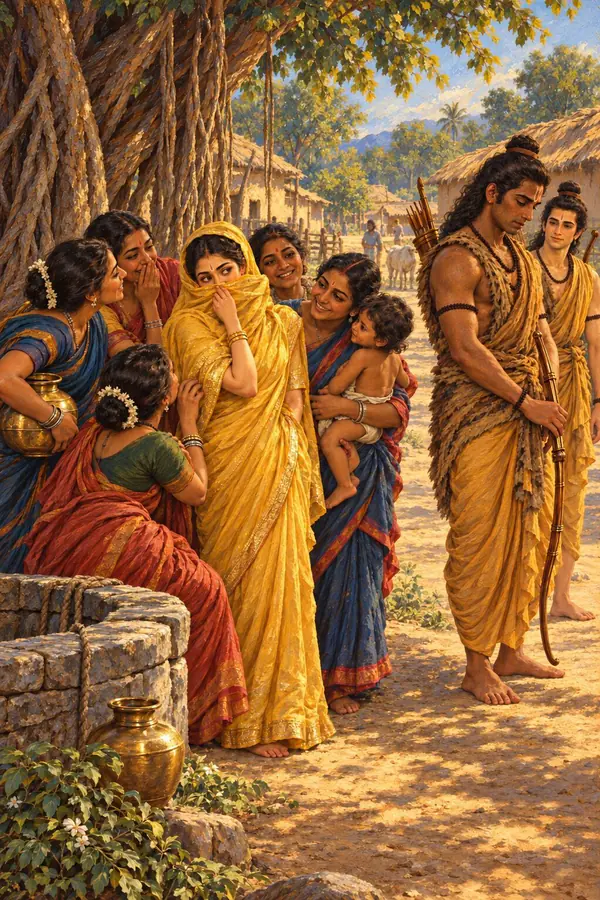
All the village women were glad. It was as if paupers had looted heaps of wealth.
A blessing, and an entreaty to meet again
Falling at Sita’s feet with great love, they blessed her in many ways. “May you ever be in your married state, as long as the earth rests on the serpent’s head. Be dear to your husband as Parvati is. Goddess, do not give up your kindness to us. Again and again, with joined hands, we entreat. If you turn back by this road again, give us sight of you, knowing us your own servants.”
Sita saw them all thirsty with love. Saying sweet words again and again, she satisfied them. It was as if moonlight had fed the night-lilies.
Eyes that fill when Lakshmana asks about the road
At that very time, knowing Rama’s inclination, Lakshmana asked the people about the road in a soft voice. Hearing it, the women and men were grieved. Their bodies thrilled, and there was water in their eyes.
Their joy vanished, and their minds grew downcast. It was as if the Creator were snatching back a treasure he had given. Understanding the course of karma, they took patience. Settling on an easy road, they told it.
Then Rama went on with Lakshmana and Sita. Saying dear words, he turned them all back, and he took their minds along with him.
The people turn back, and reproach the Creator
Turning back, the women and men regretted greatly. In their minds they laid the fault on fate. With dejection they said to one another:
“All the Creator’s works are reversed. Utterly unbridled, pitiless, and fearless is he who made the moon diseased and stained, the wish-tree a tree, and the sea salt. That same one sent the princes to the forest.
“If he gave these life in the forest, the Creator made pleasures and enjoyments in vain. These walk the road without footwear. In vain the Creator made vehicles of many kinds. These lie on the ground, spreading kusha and leaves. Why does the Creator create handsome beds? The Creator gave these great trees for a dwelling. Building and building white palaces, he toiled.
“If these, beautiful and very delicate, wear the dress of sages and matted hair, the Maker made ornaments and clothes of many kinds in vain. If these eat bulbs, roots, and fruit, nectar and such foods in the world are in vain.”
Some say the travelers appeared of themselves, and some count themselves blessed
Some said: “These are handsome by nature. They appeared of themselves. The Creator did not make them.” The commentary reads their beauty as eternal and natural.
They went on. “As far as the Vedas have described the Creator’s doings, within the reach of ear, eye, and mind, searching through the fourteen worlds, see. Where is such a man? Where is such a woman? At the sight of these, the Creator’s mind grew full of love, and he began to make fit likenesses. He toiled much, and none came. From that envy, bringing them to the forest, he hid them.”
Some said: “We do not know much. We count ourselves supremely blessed. Moreover, in our reckoning, those are heaps of merit who see them, who will see them, and who have seen them.”
Saying dear words in this way, they filled their eyes with water. “How will very delicate bodies walk the hard road?”
A road of flowers, and travelers kept in the eyes
The women were distraught, in the power of love. It was as if they were chakravaka hens shining at the hour of dusk. The commentary reads the hens as grieving, in pain at the parting to come. Knowing the feet soft and the road harsh, with pained hearts they spoke fine words.
“At the touch of the soft red feet the earth shrinks, as our hearts do. If the Lord of the world gave these the forest, why did he not make the road of flowers? If what we asked were to be had from the Creator, friend, we would keep these in our eyes.”
Those who did not come on the occasion
The men and women who did not come on the occasion did not get to see Sita and Rama. Hearing of their fine form, they asked, distressed, “How far have they gone by now, brother?” Running and going, the able looked at them. They returned glad, having gained the fruit of their birth.
The weak women, the children, and the old wrung their hands and regretted. The commentary counts among the weak women those with child and those newly delivered. In this way people came into the power of love wherever Rama went.
Blessed the people, blessed the places
In village after village there was bliss like this, at the sight of Rama, the moon to the night-lilies of the Sun’s line. Those who got any news laid the fault on the king and the queen. The commentary names them as Dasharatha and Kaikeyi.
Some said, “The king is very good, who gave us the gain of our eyes.” Men and women exchanged simple, loving, pleasing talk. “Blessed the father and mother who bore them. Blessed the city they came from. Blessed the land, the hill, the forest, and the village. Wherever they go, blessed is that place. Brahma found happiness in making the one these love in every way.”
The pleasing story of the travelers Rama and Lakshmana spread over the whole road and forest. In this way Rama, giving the people of the road happiness, went on looking at the forest with Sita and Lakshmana.
Three likenesses for three travelers
Rama walked in front, and behind him Lakshmana looked well. Both shone in the dress of ascetics they had put on. Between the two, Sita shone as maya shines between Brahman and the living being.
Again I tell the image as it dwells in the mind. It was as if Rati shone between Spring and Kama. Again, searching the heart, I tell a likeness. It was as if Rohini shone between Budha and the moon. The commentary gives the kinships: Rati is Kama’s wife, Budha is the moon’s son, and Rohini is the moon’s wife.
Sparing the footprints on the road
Placing her feet between the marks of Rama’s feet, Sita walked the road fearful. The commentary gives the fear its object, that her foot might rest on those marks. Lakshmana walked keeping the footprints of Sita and Rama to his right, sparing them. The commentary reads it as the keeping of propriety.
The handsome love of Rama, Lakshmana, and Sita is beyond words. How can it be told? Birds and beasts were absorbed, seeing the image. Rama the traveler stole their thoughts.
Whoever saw the dear travelers, the two brothers with Sita, came to the end of the hard road of becoming, in bliss and without toil. The commentary reads that road as the dreadful road of wandering through birth and death, and its end as freedom from the round of coming and going.
The course of the episode
The village women asked Sita who the two were to her. Shy, she smiled in her mind and named Lakshmana. By a sign she showed that Rama was her husband, and the women were glad. They fell at her feet and blessed her. They entreated her for sight of her, should she turn back by that road. She satisfied them with sweet words.
Lakshmana asked about the road. The people grieved, took patience, and told an easy road. Rama went on with Lakshmana and Sita and turned them back with dear words. They laid the fault on fate and called the Creator’s works reversed. Some said the travelers had appeared of themselves, and that from envy the Creator had hidden them in the forest. Some counted themselves supremely blessed. With full eyes they asked how very delicate bodies would walk the hard road. The women asked why the road had not been made of flowers, and said they would keep the travelers in their eyes if the Creator granted it.
Those who had not come on the occasion asked how far the travelers had gone. The able ran and looked at them. The weak women, the children, and the old wrung their hands. Those who got any news laid the fault on the king and the queen, and some said the king was very good. Men and women called the parents who bore them blessed, and every place they went. The story of Rama and Lakshmana spread over the road and the forest. Rama walked in front and Lakshmana behind, with Sita between them. Sita walked fearful, stepping between the marks of Rama’s feet, and Lakshmana kept the footprints of both to his right. Birds and beasts were absorbed at the sight. All who saw the three came, without toil, to the end of the road of becoming.
The same story, elsewhere: Valmiki’s Ramayana, chapter 8, part 2: From Ayodhya to Chitrakuta.
Source: the Gita Press edition of Tulsidas’s Ramcharitmanas, Ayodhyakand, doha 117 to 123, read with Hanuman Prasad Poddar’s Hindi commentary.