On this page
By the Tamasa, Rama sees the people in the power of love, and great grief comes to his kind heart. At Shringaverapura Guha begs him to come into the town, and Rama answers with his father’s order. Seeing Rama asleep, Guha weeps and speaks his grief to Lakshmana.
In this episode the people fall asleep, and the minister drives off, hiding the chariot’s tracks. At dawn the people find no track and go back to Ayodhya. At the Ganga, Rama alights and prostrates. Guha brings fruit and roots, and the village men and women look on the three. Guha spreads a bed of grass. Lakshmana keeps watch with his bow, and Guha sits by him. Guha speaks of the king’s palace, and of Sita and Rama asleep on the ground. Lakshmana speaks of karma, of dreams and the night of delusion, and of love for Rama’s feet.
Guha and his guests
The main figures in this episode
- Rama who sees the people’s love, and grieves. He consoles them in many ways, and gives them many teachings of dharma. He comes into the power of a quandary. When two watches of the night have passed, he tells the minister to drive on, wiping out the tracks. He mounts the chariot with Sita and Lakshmana, and they bow their heads to Shiva’s feet. At Shringaverapura he prostrates to the Ganga and tells the minister, his brother, and Sita its greatness. He asks after Guha’s welfare, seating him near. He answers Guha’s plea with his father’s order. He lies down after the meal. Lakshmana tells Guha that Rama is Brahman.
- Sita who mounts the chariot with Rama and Lakshmana, and bows her head to Shiva’s feet. With the minister and the two brothers she reaches Shringaverapura. She salutes the Ganga, and hears Rama tell its greatness. Men and women of the village look on her with the two brothers. She eats with the others. In Guha’s words she sleeps on the bed of grass, weary, with Janaka for her father, Dasharatha for her father-in-law, and Rama for her husband.
- Lakshmana the brother who presses Rama’s feet after the meal. He rises, knowing Rama asleep, and tells the minister in a soft voice to sleep. A little way off he keeps watch in the hero’s posture, his arrows and bow made ready. Guha sits by him and speaks to him. His words to Guha are sweet and soft, steeped in knowledge, dispassion, and bhakti. He tells Guha that all enjoy the karma of their own doing, and that the world is to be seen like a dream. He calls love for Rama’s feet the highest truth of all.
- Sumantra the minister. After two watches Rama tells him with love to drive the chariot, wiping out its tracks. He drives it off at once, hiding the tracks this way and that. With Sita and the two brothers he reaches Shringaverapura, salutes the Ganga, and bathes with the others. He eats bulbs, roots, and fruit with Rama, and Lakshmana tells him softly to sleep.
- Guha the Nishada. Glad at the news, he calls his dear kin and sets out with loads of fruit and roots as a gift. He prostrates and sets the gift before Rama. He begs Rama to be gracious and set his feet in the town, and grieves at Rama’s answer. He judges a shimshapa tree enchanting, and shows Rama the place. He spreads the bed of grass, and sets out leaf cups of fruit and roots, with water. He posts trusted watchmen and sits by Lakshmana with quiver and bow. Seeing Rama asleep, he weeps. He tells Lakshmana of the upper rooms of the king’s palace. At the sight of Rama and Sita asleep on the ground, he feels heavy dejection.
The night at the Tamasa, and a love that will not turn back
Rama saw the people in the power of love, and in his kind heart there was great grief. Rama is full of compassion. Another’s pain reaches him at once.
Saying soft, pleasing words with love, he consoled the people in many ways. He gave many teachings of dharma. In the power of love, the people would not turn back when turned.
Good conduct and love cannot be left. Rama came into the power of a quandary. In the power of sorrow and weariness the people fell asleep, and the gods’ maya somewhat clouded their wit.
When two watches of the night had passed, Rama said to the minister with love: “Wiping out the tracks, drive the chariot, dear one. By any other remedy the thing will not be done.”
When Rama, Lakshmana, and Sita had mounted the chariot and bowed their heads to Shiva’s feet, the minister at once drove it off, hiding its tracks this way and that.
At dawn, no chariot
At dawn all the people woke. Rama had gone, and there was great uproar. They found the tracks of the chariot nowhere. Crying “Rama, Rama”, they ran in all four directions.
It was as if a ship had sunk in the sea, and a great company of merchants were distraught. They gave one another this teaching: “Rama has abandoned us, knowing our affliction.”
They blamed themselves and praised the fish. In the commentary’s reading, they said: “Fie on life without Rama. If the Creator made parting from the beloved, why did he not give death when we asked for it?”
Making many laments in this way, they came to Ayodhya filled with burning grief. The dreadful parting cannot be described. All kept their lives by the hope of the term. The commentary reads the term as the fourteen years.
Men and women began to keep rules and vows for the sight of Rama. It was as if the chakravaka, the chakravaki, and the lotus were pitiful without the sun.
Before the waves of the Ganga
With Sita and the minister, the two brothers reached Shringaverapura. Rama alighted, seeing the river of the gods, and prostrated with great joy.
Lakshmana, the minister, and Sita saluted. With them all, Rama found happiness. The Ganga is the root of all joy and blessing. She makes all happiness and takes away all pain.
Telling tens of millions of stories, Rama gazed at the waves of the Ganga. He told the minister, his brother, and his beloved the surpassing greatness of the river of the gods.
They bathed, and the weariness of the road went. As they drank the pure water, their minds were glad. Rama is the one by whose remembrance the load of weariness ends. His weariness is the way of the world. The commentary reads that load as the weariness of birth and death, and the way of the world as a play in human form.
Pure, the root of being, consciousness, and bliss, Rama does deeds in the manner of a man. They are a bridge over the sea of rebirth.
Guha’s town, and the father’s order
When Guha the Nishada got this news, he gladly called his dear kin. He took fruit and roots as a gift, filling carrying loads, and set out to meet them. In his heart was boundless joy.
Prostrating, and setting the gift before Rama, he gazed at him with great love. Wholly in the power of natural love, Rama asked after his welfare, seating him near.
Guha answered. “Master, all is well at the sight of your feet. I have come to be counted among the fortunate in the reckoning of men. The land, the wealth, and the home, lord, are yours. I am a lowly servant, with my family. Be gracious, and set your feet in the town. Establish your servant, and let everyone envy me.”
Rama said: “All you have said is true, wise friend. Father has given me another order. Fourteen years of dwelling in the forest, with a sage’s vows, dress, and food. Living in a village is not fitting.” Hearing it, Guha felt heavy grief.
A place to stay under the tree
Seeing the forms of Rama, Lakshmana, and Sita, the men and women of the village spoke with love. One woman said, “Tell me, friend, what kind of father and mother are they, who sent such children to the forest?”
Some said, “The king did well. The Creator gave us the gain of our eyes.” Then Guha considered in his breast, and judged a shimshapa tree enchanting. The commentary names the tree an ashoka.
Taking Rama, Guha showed him the place. Rama said it was handsome in every way. Making their obeisance, the townspeople went home. Rama went to perform his evening prayer.
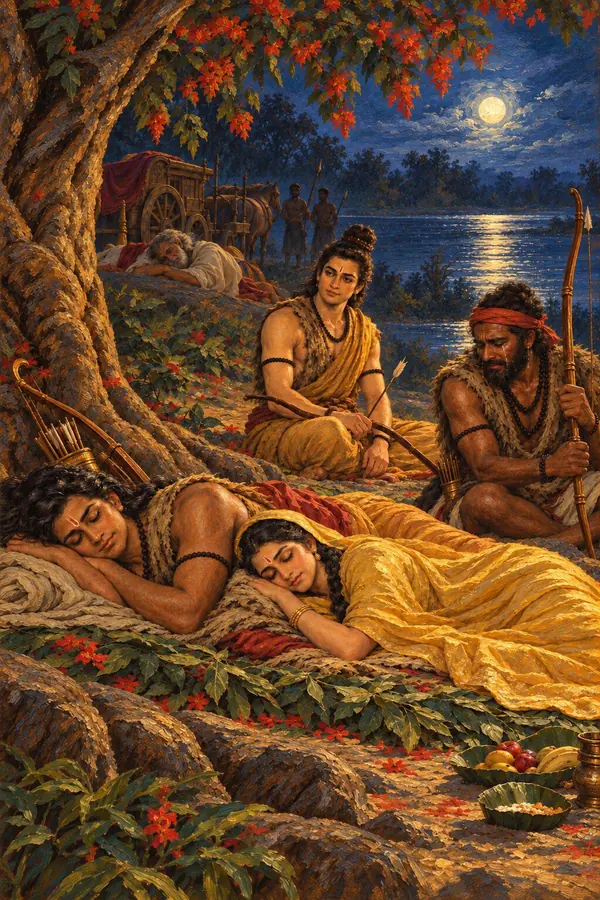
Making ready the bed of grass, of kusha and tender leaves, soft and handsome, Guha spread it out. Knowing the fruit and roots to be pure, sweet, and soft, and filling leaf cup after leaf cup, he set them down with water. The commentary also reads the line as Guha filling the cups with his own hands.
Eating bulbs, roots, and fruit with Sita, Sumantra, and his brother, Rama lay down, his brother pressing his feet.
Lakshmana rose, knowing Rama asleep. Telling the minister in a soft voice to sleep, and making ready his arrows and bow a little way off, he began to keep watch, sitting in the hero’s posture.
The bed of grass before Guha, and the king’s palace in his words
Calling trusted watchmen, Guha posted them at place after place with great love. He himself went and sat by Lakshmana, with the quiver at his waist and an arrow set on the bow.
Seeing Rama asleep, Guha, in the power of love, felt dejection in his heart. His body thrilled, and water flowed from his eyes. He spoke words of love to Lakshmana.
“The king’s palace is handsome by nature. Indra’s house is no match for it. Its lovely upper rooms are made of jewels, as if Kama had made them ready with his own hands.”
“They are pure, most wondrous, full of fine enjoyments, and fragrant with the scent of flowers. There are charming beds and jewel lamps, and every comfort in every way.”
“There are cloths, pillows, and mattresses of many kinds, like the foam of milk, soft, bright, and handsome. There Sita and Rama slept at night, and with their beauty took away the pride of Rati and Kama.”
“That same Sita and Rama sleep on the bed of grass, weary, without cloths. They cannot be looked at. Mother, father, kin, the people of the city, friends, and good-natured maids and servants guarded him like their own lives. That same master Rama sleeps on the ground.”
“Sita’s father is Janaka, whose power is known in the world. Her father-in-law is Dasharatha, Indra’s friend, and her husband is Rama. That same Sita sleeps on the ground. To whom is the Creator not contrary? Are Sita and Rama fit for the forest? People say truly that karma rules.”
“Kaikeyi, dull-witted, did a hard crookedness. She gave Rama and Sita grief on the occasion of happiness. She became an axe to the tree of the Sun’s line. Her ill thinking made the whole world grieve.”
Guha felt heavy dejection, seeing Rama and Sita asleep on the ground.
Lakshmana speaks of karma, and of the dream
Lakshmana spoke in a sweet, soft voice, steeped in the savor of knowledge, dispassion, and bhakti. “No one is the giver of happiness or grief to anyone. All enjoy the karma of their own doing, brother.”
“Union and parting, enjoyments good and bad, friend, foe, and neutral are snares of confusion. Birth and death, as far as the net of the world reaches, fortune and misfortune, karma and time. Land, home, wealth, town, and family, heaven and hell, as far as dealings reach. All of it that is seen, heard, and pondered in the mind has delusion for its root. It is not the highest truth.”
“In a dream a king becomes a beggar, and a pauper becomes the lord of heaven. On waking there is no gain or loss at all. See the world’s display so in your heart.”
“Considering this, one should not be angry, nor lay fault on anyone in vain.”
From the night of delusion to Rama’s feet
Lakshmana went on. “All are sleepers in the night of delusion, and dreams of many kinds are seen.”
“In this night of the world the yogis are awake, seekers of the highest truth, parted from the world’s display. A being is to be known as awake in the world only when he has dispassion for all the play of the senses.”
“When discernment comes, the confusion of delusion flees. Then there is love for Rama’s feet. Friend, this is the highest truth of all. It is love for Rama’s feet in mind, deed, and word.”
“Rama is Brahman, the highest truth in form. He is unknowable, unseen, without beginning, beyond compare, free of all change, and without difference. The Vedas always describe him by saying ‘not this’.”
“For the good of devotees, the earth, brahmins, cows, and gods, Rama in his mercy does deeds, taking a human body. When they are heard, the net of the world falls away.”
The course of the episode
Rama saw the people’s love and grieved. He consoled them and taught them dharma, and they did not turn back. They fell asleep in the power of sorrow and weariness. When two watches had passed, Rama bade the minister drive, wiping out the chariot’s tracks. The three mounted and bowed to Shiva, and the minister drove off. At dawn the people woke, found no track, ran crying Rama’s name, and came back to Ayodhya. There men and women took up rules and vows for the sight of Rama. The four reached Shringaverapura, and Rama prostrated to the Ganga, told its greatness, and bathed with the others. Guha came with a gift and begged Rama to enter his town. Rama told him of his father’s order, and Guha grieved. The village spoke of the three with love. Guha showed Rama the place, made the bed ready, and set out fruit, roots, and water. After the meal Rama lay down. Lakshmana pressed his feet, then rose, told the minister to sleep, and kept watch. Guha posted watchmen and sat with him. He wept and spoke to Lakshmana of the king’s palace. He felt heavy dejection at the two asleep on the ground. Lakshmana told him that no one gives another happiness or grief. He told him to see the world as he would a dream. He spoke of all who sleep in the night of delusion, and of the yogis who are awake. Love for Rama’s feet, he said, is the highest truth of all. Rama, he said, is Brahman, and does deeds in a human body for the good of devotees, the earth, brahmins, cows, and gods.
The same story, elsewhere: Valmiki’s Ramayana, chapter 8, part 2: From Ayodhya to Chitrakuta.
Source: the Gita Press edition of Tulsidas’s Ramcharitmanas, Ayodhyakand, doha 85 to 93, read with Hanuman Prasad Poddar’s Hindi commentary.