On this page
Yoga Vasistha · Story 35
Shikhidhvaja: From the Palace to Mandarachala
King Shikhidhvaja gives away wealth, completes pilgrimages, and still finds no peace. He leaves Chudala and Malava after midnight, crosses the wilderness for twelve days, and spends eight years perfecting an ascetic life. Then his wife returns as an unknown teacher and asks the question his austerities have never answered.
The Knowledge He Could Not Yet Receive
Queen Chudala had become accomplished in yoga and established in self-knowledge. Her understanding had grown within the same palace, marriage, and duties that she had always known. She continued to care for King Shikhidhvaja and spoke to him repeatedly about the nature of the Self.
Shikhidhvaja listened with affection and respect. The words reached his hearing, yet their meaning found no stable place in him. He still assumed that freedom must be obtained through a change of circumstance or a demanding achievement. Chudala saw his sincerity and also saw that his inquiry had not matured enough to test that assumption.
Vasistha explained this difficulty to Rama. A teacher and a sacred teaching can direct attention, clarify a question, and remove confusion. Recognition still has to occur in the learner’s own understanding. Until the mind becomes receptive, even precise instruction may remain an idea remembered from someone else.
To illustrate the point, Vasistha recalled a miser searching for small cowrie shells. The search unexpectedly brought him upon a cintamani, the legendary jewel said to fulfil a wish. His original object did not possess the value of what he found, yet the effort of looking placed him where the greater discovery could occur.
The illustration did not make effort sufficient by itself. It showed how scripture, a teacher, and repeated inquiry can prepare an encounter that the learner could not plan in advance. Chudala’s words were already available to Shikhidhvaja. His mind still interpreted every instruction through the conviction that freedom lay elsewhere.
The king’s unrest deepened after he left Chudala’s presence one day to bathe. He reviewed the pleasures available to a ruler and the unease that accompanied their passing. What had once promised satisfaction now seemed brief, repetitive, and burdened by the fear of its end.
He began to give away his wealth. Cows, land, gold, temples, and other possessions passed to Brahmins, poor people, guests, and those entitled to receive them. Chudala asked ministers and learned advisers to remind him that outward enjoyments were transient and that inward happiness required clearer attention.
Shikhidhvaja then undertook pilgrimages. He bathed at sacred waters, practised charity, visited holy places, and sought the company of those devoted to spiritual life. Each journey occupied his body and disciplined his conduct. When he returned to the palace, the disturbance within him had not ended.
The king did not treat these practices casually. He observed the vows associated with travel, bathing, and giving, and he approached sacred people with the respect expected of a seeker. The rites changed his daily conduct and placed generous acts where royal enjoyment had stood.
Yet he kept asking each act to deliver a peace that could survive the return home. The palace remained the same after pilgrimage, and the mind that entered it still divided life between an obstructing kingdom and a liberating forest. That division now governed the decision forming within him.
The failure of these efforts did not make him careless. It made his conclusion more urgent. He believed the duties and surroundings of kingship were keeping him from the stillness he wanted, and he began to look toward the forest as the proper place for tapas.
A Conversation in the Palace
One night Shikhidhvaja spoke to Chudala after the day’s affairs had quieted. “Enjoyment has become painful to me,” he said. “The kingdom appears empty. I wish to go into the forest and practise tapas.”
Chudala heard the resolve beneath his words. She asked him to consider the responsibility already entrusted to him. A ruler who still had the strength to protect his people should continue that work, she said, and accept forest life when age made retirement timely.
“When we have grown old, we can go together,” she told him. “The kingdom needs care now. Leaving the people before the proper time carries its own serious consequence.”
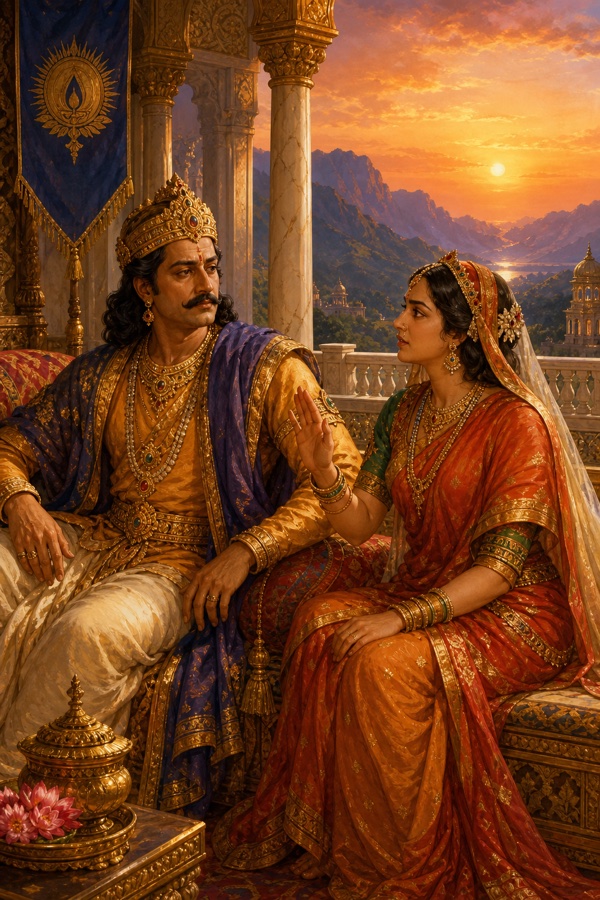
Her proposal kept companionship, retirement, and duty within one orderly life. Chudala was willing to enter the forest with him when the responsibilities of their present stage had been completed. She asked him to see the subjects as people whose welfare could not be dismissed as another palace possession.
Shikhidhvaja had already joined peace to departure in his mind. He asked her not to obstruct him and described the forest as adequate company. He also claimed that its hardships were unsuitable for a woman and told Chudala to remain in the palace and govern.
His judgment reflected the assumptions of his time and his own unreadiness to receive her as a teacher. Chudala had already attained the knowledge he sought and possessed the yogic power to move through the sky. She did not enter a contest over either fact. She allowed him to state his decision and watched the direction his mind had taken.
Shikhidhvaja spoke from a sincere exhaustion with pleasure, and Chudala did not ridicule that exhaustion. She recognised the difference between the impulse that drove him away and the understanding that would eventually free him. The first could carry him to Mandarachala. The second required him to examine the one who wanted distance.
The king’s decision also transferred the entire burden of rule to the person whose counsel he had declined. Chudala accepted that burden without using it to bargain for his obedience. Her response allowed the consequences of his choice to unfold while preserving the people from disorder.
Her restraint carried no indifference. She understood that forcing a teaching upon him would make him defend the very ideas that kept him restless. Time, discipline, and the direct result of his chosen life might prepare a more honest question.
Shikhidhvaja completed his bath and the ordinary royal duties of the day. At evening he performed the prescribed observances, returned to the private chamber, and lay down beside Chudala. Nothing in his manner announced that the decision would be acted upon before dawn.
The Departure After Midnight
After midnight, when Chudala and the palace attendants were asleep, Shikhidhvaja rose quietly. He took his sword and left the chamber without waking his wife. At the gates he told the guards to remain at their posts while he went alone on a task beyond the city.
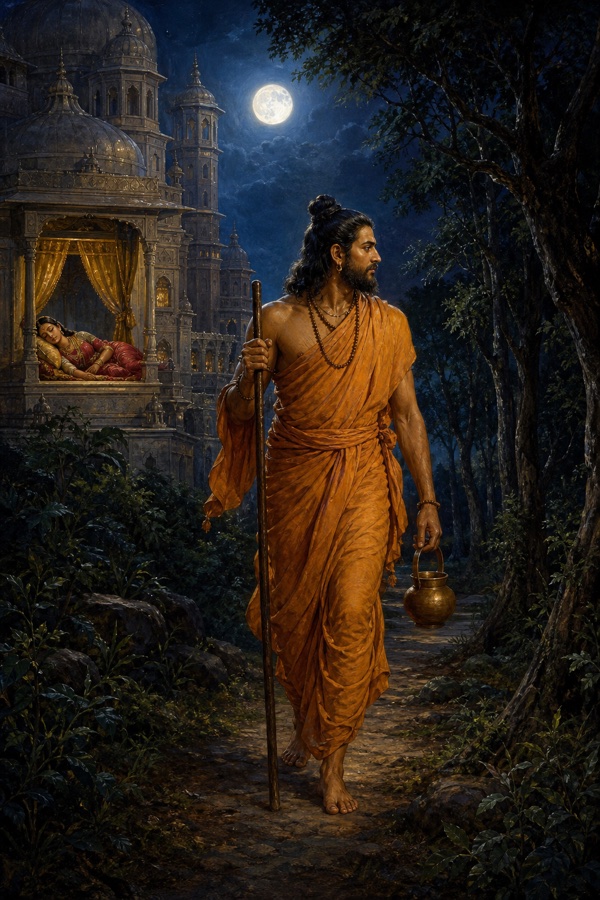
He passed through the final streets, saluted the kingdom he was leaving, and entered the darkness outside Malava’s capital. No retinue accompanied him. The sword was his only protection as the cultivated land gave way to thickets, uncertain paths, and the sounds of wild creatures.
The salute acknowledged the royal fortune and the realm that had sustained him. It also marked the separation he believed necessary. Beyond the gates he could no longer call for horses, guides, food, or a guarded camp. Every practical choice now belonged to the solitary traveller.
The great forest was frightening through the remaining hours of night. Shikhidhvaja continued until sunrise and kept moving through the day. He feared that palace servants might follow his tracks and persuade or compel him to return, so he put distance between himself and the city as quickly as he could.
When the time for observance arrived, he bathed, performed sandhya, and ate forest fruit. Then he resumed the journey. Renunciation had begun for him as continuous movement, with royal comfort behind him and an unknown destination ahead.
The observance during travel mattered because Shikhidhvaja had left an office, not the discipline by which he ordered sacred time. Even under the pressure of distance and possible pursuit, he paused for bathing and prayer. His new life grew from the practices he already trusted.
The route lasted twelve days. He crossed inhabited regions, mountains, rivers, and successive forests. Each crossing removed another familiar sign of his former office. He chose roads and paths that carried him farther from cities and crowds.
At last he reached a remote forest on Mandarachala. Water ran nearby, fruit-bearing trees and flowering vines grew around cool grass, and traces of older Brahmin hermitages marked the land. He selected a clean, square site bordered by water and distant from settled life.
The place met every need he had attached to solitude. Water and edible plants made survival possible, the remains of earlier hermitages confirmed its suitability for tapas, and the distance from habitation reduced the likelihood of interruption. He could now test the conviction that peace would appear when royal surroundings disappeared.
Shikhidhvaja built a leaf hut to shelter himself from rain and exposure. He made or gathered the few implements needed for worship and daily survival: a bamboo staff, a fruit bowl, an arghya vessel for ceremonial water, a vessel for flowers, a kamandalu, rudraksha prayer beads, a cloth against the cold, and a deerskin seat.
The king who had administered a realm now arranged a dwelling in which every object had one defined use. There was no court to observe the change. Mandarachala gave him the solitude he had asked Chudala to accept as his chosen companion.
The Order of the Hermitage
Shikhidhvaja ordered the main work of his day across four traditional praharas. During the first division of the morning he performed sandhya and japa. His attention followed the prayers and repeated formulas that gave shape to the opening hours.
In the second prahara he went out to gather flowers. He bathed, returned to the hut, and worshipped the deities with what the forest supplied. The vessels, beads, staff, and seat kept each act in its proper order.
His food consisted of wild fruit. The fuller account also names roots and lotus stalks gathered from the surrounding country. He ate what was available, continued his japa, and spent the night alone, taking the measure of rest his body required.
The third and fourth portions of the ordered day carried the meal, renewed repetition, and the approach of night. Shikhidhvaja used the sequence to prevent solitude from becoming aimless. Gathering, bathing, worship, eating, recitation, and rest followed one another without the interruptions of court.
Day followed day in the same disciplined sequence. Shikhidhvaja did not return in memory to courtly pleasures or abandon the practice when no immediate revelation came. The austerity was exacting, and his commitment to it was genuine.
He also preserved the obligations of a hermitage. Flowers were prepared for the worship of gods and for any guest who might arrive. The remote setting did not cancel hospitality, and the former king remained attentive to a visitor whose coming could not be predicted.
Years of repetition changed his body and strengthened his command of attention. They also left the basic direction of the search intact. Shikhidhvaja still treated liberation as the result of a practitioner successfully completing an ascetic program.
The routine quieted many demands that had occupied him as a ruler. It also strengthened the identity of the solitary practitioner who had left a kingdom to seek freedom. Chudala’s earlier teaching had questioned the assumptions beneath identity itself, and that inquiry still remained unfinished.
Vasistha’s account allows both truths to stand within the action. The forest discipline prepared Shikhidhvaja’s attention and endurance. His own nature could not be produced by a hut, a schedule, or a change of clothing. The teacher who understood this was still governing the kingdom he had left behind.
Chudala Follows and Returns
Chudala awoke after her husband had travelled far and found the bed empty. She read the signs of his departure and considered following him. Through yogic power she rose into the sky and crossed the distance that had taken him through the night.
From above she saw Shikhidhvaja moving alone through the forest with his sword. She could have appeared beside him and ended the separation immediately. Before doing so, she examined the likely course of his mind and the timing of any instruction she might offer.
His unresolved tendencies had not yet ripened into receptivity. If she approached as the wife whose counsel he had declined, he would hear another attempt to bring him home. If she spoke as the teacher he had failed to recognise, the old assumptions would still shape his answer.
Chudala turned back. In the capital she reassured the ministers and citizens that the king had gone for a purpose and that the realm would remain protected. She then assumed the work he had placed in her hands.
She governed Malava with care. Decisions were made, the subjects were protected, and public order continued during the king’s absence. Her self-knowledge did not remove her from political responsibility. It allowed her to carry that responsibility without losing the clarity with which she had judged her husband’s course.
Ministers who might have expected uncertainty after the king’s disappearance received reassurance and direction. Citizens continued to receive protection. Chudala did not reveal every detail of Shikhidhvaja’s solitary movement, since public stability required confidence that the realm still had a functioning sovereign.
Their different locations served connected purposes. Shikhidhvaja was learning endurance in a hut. Chudala was exercising discernment amid people, institutions, and decisions. She could wait for him because her own understanding did not depend upon either setting.
Meanwhile, Shikhidhvaja continued the ordered life at Mandarachala. The primary chronology gives eight years for his tapas and for Chudala’s rule. Other tellings give eighteen years, a separate reading that does not alter the eight-year course followed here.
Across those eight years, neither abandoned the task at hand. The king gathered flowers, bathed, worshipped, ate forest food, and repeated his japa. The queen governed the people, waited, and watched inwardly for the point at which a new approach might reach him.
Chudala’s waiting was active. She did not mistake duration for readiness and did not assume that hardship must automatically yield knowledge. When the appointed interval had passed, she examined whether Shikhidhvaja’s disciplined mind might finally tolerate a question directed at the foundation of his effort.
The Return to Mandarachala
When the governing interval had passed, Chudala considered that discipline and time might have made Shikhidhvaja ready to examine what he had once dismissed. She left the palace through the sky and travelled toward Mandarachala.
As she moved, longing and the memory of her husband arose in her mind. She observed that movement without becoming confused by it. Her knowledge did not require the absence of affection. It kept affection from deciding the form and timing of her next act.
Through yogic perception she located the remote hermitage. Shikhidhvaja sat on the ground, stringing flowers for the worship of gods and guests. Years of austerity had left him darkened by exposure, emaciated, dressed in bark, and crowned with matted hair.
The sight joined continuity to change. The man before her was physically far removed from the king who had lain beside her in the palace, yet the careful preparation of offerings revealed the same seriousness with which he had once performed royal and ritual duties.
Chudala looked beyond the visible signs of discipline. He remained steadfast in tapas and had gained the composure of a long routine. He had yet to recognise his own nature, and the distinction between the seeker and the object of his search remained active in him.
She considered approaching in her familiar form. That appearance would call up the palace conversation, his belief that she had come to disturb the retreat, and his former refusal to grant authority to her understanding. A different form could allow the teaching to be heard before the identity of the speaker became the issue.
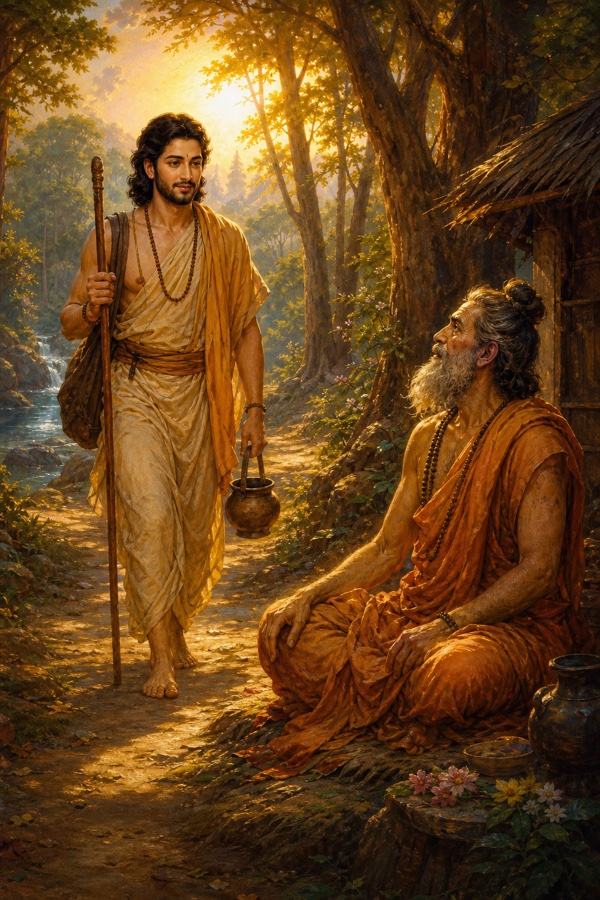
Chudala therefore assumed the appearance of a luminous young brahmachari. Rudraksha beads and a kamandalu accompanied the form. A deerskin lay at the neck, sacred ash marked the body, and a white sacred thread crossed the chest.
Every element made the visitor immediately legible within Shikhidhvaja’s world. The form suggested celibate discipline, sacred learning, and the freedom of a travelling ascetic. He could offer hospitality before needing to decide whether the stranger possessed authority.
Although she had reached Mandarachala through the sky, she approached the final distance on foot. The path presented her as a travelling ascetic arriving by ordinary means. Shikhidhvaja would meet a guest before him, with no display of the power by which the guest had come.
The Visitor at the Leaf Hut
Shikhidhvaja saw the radiant Brahmin youth nearing the hermitage and rose from the ground. He set aside what he was doing, placed his sandals away, and prepared to receive the visitor according to the duties of hospitality.
He offered a leaf seat, arghya, water for the feet, flowers, and a garland. The king who had relinquished a court still knew how to honour a guest, and his years alone had not weakened that courtesy.
“Your arrival has made this day fortunate,” he said. “Please tell me where you have come from and what brings you to this remote forest.”
The disguised Chudala returned his greeting and accepted the welcome. She praised the order of the hermitage, the severity of his discipline, the steadiness of his self-control, and the peaceful attention with which he had received an unknown traveller.
Shikhidhvaja had expected a question about the guest’s origin and journey. Chudala first turned attention toward the life visible around them. Her words allowed him to feel accurately seen. The discipline was real, its order was evident, and its incompleteness could be approached without denying either fact.
Her praise concerned what he had actually accomplished. He had crossed twelve days of difficult country, built a life from the forest, and kept its demanding rhythm for eight years. The question that followed did not erase the value of that work. It directed the work toward the matter still unexamined.
“Have you also undertaken any tapas for self-knowledge?” she asked.
The words reached Shikhidhvaja without the history attached to his wife’s voice. Before him stood an unfamiliar ascetic whose appearance he respected and whose question entered the exact opening created by his years of effort.
The question made self-knowledge the immediate purpose of tapas. It asked whether all the regulated action had ever been directed toward seeing the practitioner clearly. Shikhidhvaja could answer only by reviewing what the eight years had actually examined.
The story pauses there. Shikhidhvaja has learned to leave comfort, endure solitude, regulate his days, and honour a guest. Chudala has learned when to wait, how to govern, and which form will let truth be heard. Their longer exchange begins only after this first question has made the purpose of the forest life newly uncertain.