← Collection
Yoga and VedantaMind, awakening, and nonduality

The Hundred Rudras

Story · 32

The Hundred Rudras: One Consciousness, a Hundred Forms

A mendicant slept and in his dream became a king. That king dreamed, and became a brahmin, and the brahmin dreamed, and became a bird. A hundred dreams like this, one inside the next. At the last a swan looked within himself, and out of him came Rudra. Then, moving backward, one by one, all of them woke.

Rama asked, “Gurudev, can we dream a second dream inside a first?”

Sage Vasistha, white-bearded in pale robes, seated under a tree teaching the young prince Rama who listens attentively, a riverside hermitage at twilight, painterly classical-Indian color, dignified, no text

Vasistha said, “Then listen, Rama, to the story of the hundred Rudras. It is a story of dreams within dreams. It begins with a mendicant and comes to rest, at the last, upon a single Rudra. And the moment Rudra recognizes who he is, he turns back along the way and wakes every dream in turn. It is a very strange story.”

The mendicant

A gaunt nameless mendicant in simple ochre cloth sitting outside an old weathered stone temple, his water-pot and blanket beside him, soft daylight, painterly classical-Indian color, dignified, no text

There was once a mendicant whose name no one knew. He lived outside an old temple, in plain clothes, a water pot and a blanket beside him.


All day the mendicant sat outside the temple. People came. Some dropped something into his bowl, some simply walked on.

At night he slept in the same corner. His life had passed this way for many years.


One day he grew very tired and said to himself, “My life is nothing at all. I only sit here all day, then I sleep, then I sit again.”


That night he fell asleep early.


And a dream came to him.


The king

In the dream he was a king.


The king’s name was Purugupta, ruler of Magadha, forty-five years old.


His palace was vast, seven storeys high. From the top floor he could see the city, and beyond the city the fields, and beyond the fields the river.


King Purugupta of Magadha, crowned and middle-aged, standing on the balcony of his seven-storey palace before sunrise holding a silver bowl of saffron milk, city and river beyond, painterly classical-Indian color, dignified, no text

Purugupta loved to rise before the sun. He would go and stand on the balcony, a silver bowl in his hand, warm milk in it with a little saffron floating on top.


His wife was named Malavika, and her voice was very soft. Purugupta loved her laugh, because when she laughed she would raise one hand to cover her mouth. Once she had asked him, “My king, why do you love that little habit?”

“Because a little girl is hidden in it, my love. You are a queen, yet when you laugh that girl steps forward.”


Malavika hid her face.


Purugupta had three sons and two daughters.


For many years the king dispensed justice. Once a thief was caught who had stolen five cows. Purugupta asked him, “Why did you steal them?”

“My king, my mother is ill.”


Purugupta thought for a while, then said, “Return two of the cows and keep three. And every month the kingdom will send your mother grain.”

The thief broke into tears.


The king said, “Do not weep. Only, next time, ask. Do not steal.”


Many years passed this way.


But one day Purugupta stood on the balcony, sixty-five years old now. Malavika had died of illness two years before.


He looked at the river, at the city, at the fields.


Within him a thirst awoke.


“All of this is good, and still something remains unfinished.”


That night the king slept, and a dream came to him.


The brahmin

In the dream he was a brahmin.


The brahmin’s name was Vaidarbha, and he lived in a village near the Godavari.


His hut was small, mud walls and a thatched roof, and a door that swelled shut in the rains.


The brahmin Vaidarbha in white, right hand on his chest softly reciting a mantra at dawn before his small mud-walled thatched hut, his wife standing nearby holding milk, painterly classical-Indian color, dignified, no text

Vaidarbha had a habit. Every morning he laid his right hand on his chest and recited a mantra in a low voice, and his wife stood near him holding his milk.


His wife was named Bharati. Some injury in childhood had left a slight limp in her leg, yet she never complained of it.


They had two children, a son and a daughter. The son was quiet and the daughter very talkative.


One day the daughter came to Vaidarbha and said, “Father, why do you recite that mantra every morning?”


Vaidarbha said, “Because my father recited it, child, and his father before him. It is a very old habit.”

“But what does it mean?”


Vaidarbha said, “To tell the truth, I do not know its full meaning either.”

“Then why recite it?”


Vaidarbha thought a moment, then said, “Because something happens when I recite it, child. I reach my father, and he reaches his. A kind of chain forms.”


The daughter did not understand it fully, yet it seemed beautiful to her.


Vaidarbha practiced deeply, performed his yajnas, made his recitations, took up tapas.


Yet within him a thirst remained.


One night he fell asleep with his hand on his chest.


And a dream came to him.


The bird

In the dream he was a bird.


A blue-throated roller bird with brown wings tinged pale blue, perched on a vast ancient banyan tree of countless leaves, its mate and chicks nearby, painterly classical-Indian color, dignified, no text

He was a blue-throated roller, a line of blue at his throat, his wings brown with a faint wash of pale blue.


The bird lived in an old banyan tree. The tree was enormous, with ten thousand leaves and more.


The bird had a mate who lived with him. In two seasons they had had their young. The earlier chicks had flown off to trees of their own, and the four newest were still small.

The mate had a hard temperament, and she and the bird often quarreled, though before the chicks the two of them stayed silent.


One day the smallest chick fell from the tree, and below a cat sat waiting in ambush.


When the bird saw this he dived down very fast and lunged at the cat, striking his beak into its eye.


The cat fled and the chick was saved.


In that lunge one of the bird’s wings broke, but he took the chick in his beak and carried her back up.


The mate watched the bird a long while, then said softly, “You are good.”


The bird paid his broken wing no mind and only went to sit beside her. It was the first time in his life a wing of his had broken.


Many seasons passed this way.


The bird grew old, his wings weakening, and his eyes as well.


One night he fell asleep on his branch.


And a dream came to him.


The fisherman

In the dream he was a fisherman.


The fisherman Kumbhaja in a headcloth sitting at dawn in his small boat on the calm Yamuna north of Mathura, net in hand but not cast, his thatched hut on the bank, painterly classical-Indian color, dignified, no text

His name was Kumbhaja, and he lived on a bend of the Yamuna, north of Mathura.


His hut stood very close to the water, so in the rains the river often came inside.


Kumbhaja’s wife was named Koshti, short of stature. From cleaning fish her hands were always wet.


They had three children. The eldest was fifteen and went out on the boat with his father.


There was one thing Kumbhaja loved. Early in the morning, when he sat on his boat, the water still cold and the fish not yet awake, he would only sit with the net in his hands and not cast it.


He would sit like that for a long time.


Once his son asked, “Father, why do you not cast the net yet?”

“The fish are still sleeping, son. Let them sleep a little too.”


The son laughed. “Father, that is no fisherman’s way of talking.”

“Perhaps not, but it is mine.”


Many years passed this way.


One night Kumbhaja’s wife fell ill, a high fever that held for three days.


On the fourth day she died.


Kumbhaja looked at his wife’s face. Those hands that were always wet lay dry now.


Kumbhaja did not weep, only sat a long while. Then he rose and performed the last rites.


That night Kumbhaja went out alone on the boat and stayed on the water the whole night.


When he returned in the morning his body was tired, but within him something had settled. The words came out of him, “Koshti, where are you?”


No answer came.


Many years passed.


Kumbhaja grew old.


One night he fell asleep.


And a dream came to him.


More dreams

Prince Vasu of Pataliputra at night, grieving, slipping his ring off his finger and dropping it into a stone well in a moonlit palace courtyard, painterly classical-Indian color, dignified, no text

In the fisherman’s dream there was a prince named Vasu, of Pataliputra. He had one particular habit: while he talked, he would keep turning the ring on his finger. He married the princess Suruchi and a son was born to them, but the boy fell from a horse and died. That night the prince slipped the ring off his finger and dropped it into a well, and then he slept.


In the prince’s dream there was an ascetic named Acharya Kosha, who lived in Kashi, long matted hair on his head and an ochre cloth at his waist. He had a student who had left him, and the wound of it stayed with him for many years. Even as he died he remembered that same student.


In the ascetic’s dream there was a thief who did not know even his own name. His mother had abandoned him in childhood, and all his life he had broken into people’s homes. One night a woman caught him in the act of stealing, yet she did not strike him. She gave him food. The thief broke into tears.


In the thief’s dream there was a king named Dharana, very cruel, who had imprisoned his own brother. One day the brother’s son killed Dharana. As he died Dharana understood nothing, only a wonder that there was so little pain in dying.


In the king’s dream there was a woman named Radha, from some village. Her husband was a merchant who lived far away, and so Radha spent twenty years alone. Once a thought came into her mind: “I am inside someone else’s dream.” Where the thought came from she never knew, and she could not tell it to anyone. Her husband returned, and Radha did not tell him.


In Radha’s dream there was an ascetic woman in the Himalayas, eighty years old, named Anasuya. All her life she had chosen solitude. At the end, when she sat down for her last breath, she laughed softly, “So this is all it is?”


In the ascetic woman’s dream there was a goddess named Sati, worshipped in a small temple. She had one devotee, a little girl who brought flowers every morning. One day the girl asked Sati, “Goddess, who are you really?” Sati gave no answer, yet the girl felt she had received one.


In the goddess’s dream there was an insect that had no name, only a tiny insect that crawled along the leaves. Its life was three days long.


In the insect’s dream there was a mosquito, whose life was half a day long.


And in the mosquito’s dream there was a mote of dust drifting in the air.


There were many such dreams. In each there was a life, some love, some sorrow, and now and then, for a moment, a faint stirring: “I am inside someone else’s dream.” But then they would forget.


There were a great many such dreams.


But why did they forget?


Because this is the nature of a dream. If, inside a dream, you fully realize that it is a dream, the dream breaks and you wake.


But these beings were not to wake yet. They were to remain, for now, inside their dream.


So within each of them there lived only a faint stirring.


Heard now and then, and then forgotten.


The swan

At the last there was a dream in which there was a swan.


A white swan with yellow-orange beak gliding on the crystal-clear waters of Lake Manasarovar, snow-capped Mount Kailash rising behind, its mate and downy cygnets nearby, painterly classical-Indian color, dignified, no text

The swan floated on Lake Manasarovar. The water was so clear that every ridge of sand below could be seen. Behind it rose Kailash, snow frozen all the way to its peak.

The swan’s body was white, its beak yellow with a glint of orange in it, and its eyes small, deep, and brown.


His mate floated close by. Between the two of them there was no need for talk. To swim together was their whole language.


They had four young cygnets whose feathers had not fully come in, and they swam along behind their mother.


The swan loved the water of Manasarovar, cold and clear, with a faint sweetness in it.


He spent many years this way.


One day he said to his mate, “There is something within me.”


His mate looked at him and asked, “What is it?”

“I do not know. But I am not only a swan.”


His mate said, “You think a little too much.”

“Perhaps.”


The swan went alone to a small island in the middle of the lake and settled there.


He closed his eyes.


And looked within.


First many images rose up: a fisherman, a bird, a brahmin, a king, a mendicant, a woman, a thief, an ascetic woman, a goddess.


The swan watched in wonder. “Am I all of these?”


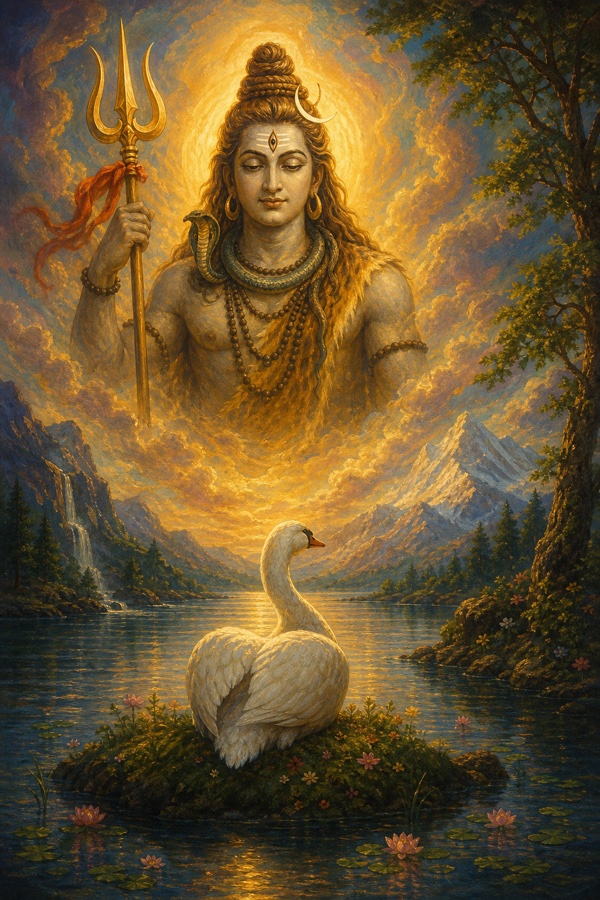
The swan on a small island gazing inward as a luminous timeless figure of Rudra (Shiva) appears in vision, holding a trident with a third eye on his forehead, very ancient and still, painterly classical-Indian color, dignified, no text

Then one more image rose, very clear. A man whose age could not be guessed, very ancient and very still, a trident in his hand and a third eye on his forehead.


For a moment the swan held his breath. “Rudra.”


Rudra looked at the swan.


Rudra spoke.

“Child, you are that, and I am that.”


Waking

The swan’s eyes opened.


But he was no longer a swan on the island now.


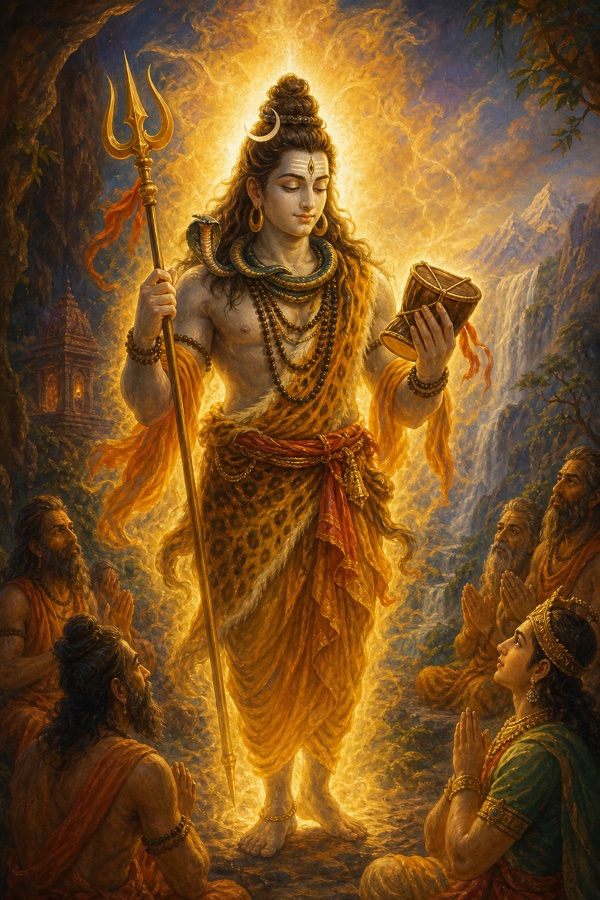
He stood in a human body, and far more than a body, a body of light.


Rudra awakened in a radiant body of light gazing at his own hands, a trident in one hand and a damaru drum in the other, a closed third eye on his forehead, painterly classical-Indian color, dignified, no text

He looked at his hands. In one was a trident and in the other a damaru drum, and on his forehead a third eye, closed for now.


Rudra.


Rudra drew a breath for a moment.


“I am Rudra.”


Then a jolt struck him, a wave of vertigo.


“But only a little while ago I was a swan.”


Rudra turned and looked behind him.


The line behind

Rudra saw a line.

The line was very long, perhaps a hundred, perhaps a thousand.


Nearest of all was the swan. Behind him a mote of dust, behind that a mosquito, behind that an insect, behind that a goddess, behind that an ascetic woman, behind that a woman, behind that a king, behind that a thief, behind that an ascetic, behind that a prince, behind that a fisherman, behind that a bird, behind that a brahmin, and behind that a king.


And at the very end of the line, furthest back, was a small mendicant, outside an old temple, with a water pot and a blanket beside him.


Vertigo took Rudra again.


“Am I all of these?”


“And at the far end of all their dreams, that mendicant?”


“And the mendicant’s dream is all of this?”


Rudra held still for a while, and then he understood.


“The mendicant does not dream me. I dream the mendicant.

“And yet the mendicant holds me within him too.

“We are one. All are one.”


Waking the others

Rudra opened his third eye.


Light burst forth.


The light ran along the line and reached the swan, who was nearest.


The swan was sitting on his island. He felt a brightness within him.


The swan opened his eyes.


He looked at his mate, at the water, at Kailash behind. But now everything had changed. Before, all of this had been his world. Now all of it was only a part of what lay within him.


The swan laughed softly.

(A swan’s laugh is a small sound that rises in the throat, one that very few people would ever have heard.)


His mate looked at him and asked, “What is it?”

“Nothing. And everything.”


His mate did not understand, yet she saw something new in the swan’s eyes.


The light moved on.


It woke the mote of dust, then the mosquito, then the insect.


Within each of them a faint light awoke.


(The mosquito lasted a moment and then died, for its life was only half a day long. But that half a day it lived in the form of Rudra, very light, and real.)


The light moved further on.


It woke the goddess, then the ascetic woman.


The ascetic woman was seized by vertigo. All her life she had searched for solitude, and now she understood that the solitude she had been searching for was herself.

The ascetic woman laughed softly.


The light moved on.


It woke Radha. Radha was asleep in her house, her husband beside her.


Radha opened her eyes.


That stirring, so many years old, now came to her clearly: “I am inside someone else’s dream.”


But this time she did not forget the stirring. Radha held on to it.


Radha looked at her husband, then at herself, then up at the ceiling.


Radha broke into a smile.

“I am. But I am not only Radha.”


Her husband was asleep. Very gently, Radha laid her hand on his head.


The light moved on.


It woke the king, then the thief, then the ascetic, then the prince.


Each one woke, each saw his own line, and vertigo came to each.


(The prince Vasu remembered the ring he had thrown into the well. He laughed. The ring, the well, the son, all of it had only been a dream.)


(The ascetic Acharya Kosha remembered the student who had left him. But now he felt no anger toward the student, only a light understanding that the student had been in his own dream and the guru in his, both of them two forms of a single dream.)


The light moved still further back.


Now it reached the fisherman Kumbhaja.


Kumbhaja sat alone on his boat at night, his eyes closed.


The light descended into him.


Kumbhaja opened his eyes. An image of his wife Koshti was within him, but the image was no longer bound tight now. It was light.


Kumbhaja laughed. “Koshti, you too.”


As if a faint voice came from within: “Yes, Kumbhaja.”


The light moved on.


Now it reached the bird, the blue-throated roller.


The roller was asleep on his branch, very old, his wings weak.


With the light the roller opened his eyes.


He sat a while, then looked at his mate, who was sleeping close by.


The roller gave a soft chirp.

His mate opened one eye and asked, “What is it?”

“I have learned something.”

“What?”

“I will tell you later.”


His mate closed her eye. The roller sat on, and that broken wing of his now began to feel very light to him.

The light moved on.


Now it reached the brahmin Vaidarbha.


Vaidarbha was asleep with his hand on his chest, and the light woke him.


Vaidarbha opened his eyes.


He remembered his father, then his father’s father, then the father before him.


The same chain his daughter had once asked about.


Now he saw the chain clearly.


That chain belonged to no single lineage. It ran through every body, every form.


Vaidarbha laughed softly. “Child, now I can tell you.”


But the daughter was asleep. Vaidarbha touched her head gently, then quietly recited his mantra.


This time he received the full meaning of the mantra.


The light moved on.


Now it reached the king Purugupta.


Purugupta sat on his balcony at night, stars shining overhead.


The light touched him.


Purugupta raised his eyes toward the sky.


He remembered Malavika.


Purugupta laughed softly. “My love, you too were a dream, and you were real as well. Both.”


Above him a star flashed, and Purugupta gently nodded his head.


The light moved on.


The mendicant

The light reached the furthest back.


Outside the temple.


The mendicant lay asleep in his place, wrapped in his blanket.


The light descended into him.


The mendicant opened his eyes.


First he looked around himself, the temple, the stone, his water pot, his blanket. Everything was as it had been.


But within him lay a whole line.

The king Purugupta, the brahmin Vaidarbha, the bird, the blue-throated roller, the fisherman Kumbhaja, the prince Vasu, the ascetic Acharya Kosha, the thief, the king Dharana, Radha, the ascetic woman Anasuya, the goddess Sati, the insect, the mosquito, the mote of dust, the swan, and Rudra.


All of them were within him.


The mendicant sat up.


He sat like that for a while, then laughed softly.


“So I was the last of all to wake.”


(Because returning back along the chain is slow. Sinking into each dream had been quick, and rising out of each dream was slow.)


The mendicant looked at his hands, old and thin, but there was something in them now.


Morning was coming.


A woman came to the temple with a little grain in her hands. “Baba.”

The mendicant said, “Thank you.”


The woman looked at him closely and said, “Baba, today you seem different.”

“Yes, child.”

“Why?”


The awakened mendicant on the temple steps in dawn light, smiling and speaking gently to a young woman offering grain in her hands, his alms bowl beside him, sunrise behind, painterly classical-Indian color, dignified, no text

The mendicant laughed softly and said, “Today, child, I saw a line.”

“What kind of line?”

“Within me there is a king, a brahmin, a bird, a fisherman, and many more. And within you as well.”


The woman laughed. “Baba, what sort of joke is this?”

“It is no joke. Tonight you will sleep and you will dream. If, for a single moment inside that dream, you can think, ‘I am in a dream,’ and not forget it, then you too will see this line.”


The woman did not understand, yet there was something in Baba’s eyes that she liked.


She went away.


The mendicant went on sitting outside the temple.


Many years passed this way.


Whoever came to him, he would speak of this same thing.


Some people laughed, some listened closely, and some tried it the very next night.


One day the mendicant’s body fell away, right there outside the temple, sitting just as he always did, his eyes closed.


But no one saw his line. Only those who had already spoken with him had begun to see their own.


Vasistha’s word

Rama, this story was told to me by an old rishi. He said this to me as well.

“Vasistha, every night you go into your dream, yet the one who is dreaming stays awake. The next night you dream a new dream again, yet the one who watches remains the same.

“In every birth you are in a new body, yet within, the one who watches remains the same.

“In every creation you are in a new story, yet within, the one who watches remains the same.

“That watcher is Rudra, within every one. He only waits to be recognized.”

I heard this, yet at the time I did not fully understand it. Understanding took me many years.


Rama, now you are hearing it. Perhaps you too will not fully understand it yet, but one day you will.


Rama asked, “Gurudev, so am I too someone’s dream?”

“Perhaps.”

“And the one who dreams me, is that one also someone’s dream?”

“Perhaps.”

“And where does it end?”


Vasistha said, “At the end, Rama, there is only one consciousness. We are all its stories, its dreams, its forms.

“Rudra is within all of us.”

At this Rama nodded.


Rama looked toward the sky. It was night, and overhead the Saptarishi, the seven stars, and many others were shining.

Rama asked, “Gurudev, are these stars too Rudra?”

Vasistha said, “You are understanding quickly, Rama.”

Rama smiled.


Rama spoke again. “Gurudev, there is one more thing in the story of the hundred Rudras.”

“What?”


“He woke them all one by one, moving backward, yet the mendicant, who came first of all, woke last of all. Why is that?”


Vasistha said, “Because returning back along the chain is slow, Rama.”

“Explain it to me.”


“Rama, sinking into each dream was quick, and rising out of each dream was slow. Because in waking we let go of everything old and take on everything new. That work goes slowly.”


Rama asked again, “Gurudev, one more question. When the mendicant woke at the last, was he too Rudra?”

“Yes.”

“But he was so ordinary.”


Vasistha said, “Rama, within every ordinary person a Rudra is seated, only he does not know it. The mendicant’s dreams opened him, and when he came back, he knew it.”


Rama nodded.


“Gurudev, will such dreams come to me as well?”


Vasistha said, “They come to everyone, Rama, but not everyone remembers them. They come to you as well, and in the morning you wake and forget.”


Rama said, “Gurudev, I will pay attention.”


The two of them were quiet for a while.


Rama asked again, “Gurudev, what might my most ordinary form be?”


Vasistha said, “That is a strange question, Rama.”

“Why?”

“Because you are a prince, and you should not be asking such a question.”

“But was there some older body of mine?”


Vasistha said, “Yes, Rama. One old body of yours was very ordinary.”

“What was it?”

“A small mendicant, sitting outside a temple.”


Rama started. “Gurudev, was that me, the one in the story of the hundred Rudras?”


Vasistha said, “Perhaps yes, Rama, perhaps no. But on one level, yes. In every mendicant there is a Rama, and in every Rama a mendicant.”


Rama nodded.


The two of them were quiet for a while.


“Gurudev, if I was the mendicant, then when did my story begin?”


Vasistha said, “That is a very deep question, Rama.”

“Tell me.”


“Rama, no story has any beginning. Every story issues from an older story before it. You were the mendicant; before that perhaps a king, before that perhaps an animal, and before that perhaps something else. There is no first.”


Rama said, “Gurudev, this is a very heavy thing.”

“Yes.”


“And no last one either?”

“No.”

“Then?”


“Rama, the story simply goes on, without a beginning and without an end. But you can rise above the story. Then you watch the story, and you no longer live inside it.”


Rama said, “Gurudev, this teaching is reaching me.”

“Very good.”


Rama looked up. The Saptarishi were very still.

Rama asked, “Gurudev, are they too above the story?”


Vasistha said, “Yes.”


Rama laughed softly. “One day I will be too.”

“Perhaps.”


The two of them were quiet for a while.


Rama looked up.


The Saptarishi were still just as they had been, but now it seemed to Rama that those seven stars were a line, and behind each star another line, and at the end all of them one.


Rama closed his eyes for a while.


Within him a faint stirring rose.


Rama opened his eyes.


“Gurudev, a stirring came to me.”


Vasistha said, “Only, do not forget it.”


Rama nodded.


The river went on flowing.


Literary source

This story is drawn from the Yoga Vasistha, in its Nirvana Prakarana, cantos 6a.62-65. The hundred Rudras waking out of dreams within dreams is an ancient piece of nested storytelling. It begins with a mendicant, moves across a hundred dreams to a swan, then to Rudra, and then to a waking that runs backward. This structure is a very old version of modern meta-fiction.

The philosophical view

A mendicant, sleeping, dreams many lives across many dreams. In one dream there is a swan; the swan recognizes himself as Rudra, and as Rudra he goes back and wakes the entire chain. One after another, the character of each dream wakes, and in the end all of them, become the hundred forms of a single Rudra, become one. The story says that consciousness is a chain of its own dreams, and that waking can begin from any one end and rouse the whole chain in reverse.

The Austrian physicist Erwin Schrödinger (1887-1961) held, in his What is Life? (1944) and the later My View of the World (Meine Weltansicht, published after his death in 1961), that consciousness may give the illusion of being many, while in truth it is one, and that every living being is a single angle of that one. The story of the hundred Rudras is a visual form of exactly this oneness. The many dreams display the many angles of a single consciousness, and when one of them wakes, a path opens for all the rest to wake.

हिन्दी