On this page
Yoga Vasistha · Story 6
Chudala: Queen, Yogini, and Guru
Chudala finds the Self while governing beside her husband, and Shikhidhvaja laughs at what she tells him. Years after he slips out of the palace at midnight for a forest at the foot of Mount Mandara, she comes to him as Kumbha, a Brahmin boy who claims the sage Narada for a father. Two parables, a bonfire of his hermit’s gear, and a marriage under a curse expose the attachment hidden inside his renunciation, and the tests that follow prepare the two of them to go home and rule in freedom.
The Questions That Entered Malava
Vasistha had just finished with Bhagiratha, the king who gave up a throne and brought the Ganga down from heaven, and he turned the lesson on the young man in front of him. Keep your eye on one thing, he told Rama, and hold the flying bird of your mind inside your chest the way the resolute prince Shikhidhvaja once held his. Rama had never heard the name. “Who was this Shikhidhvaja, sir, and how did he keep his purpose so firm?” Vasistha set the story in a Dvapara age long gone, and then said a strange thing: the two people in it would be born again, in the same manner and at the same place. Rama asked how the past could come back. Such is the law of destiny, Vasistha answered; creation repeats its rounds, some things return in their old forms, some in a likeness, some never, and in an age still to come a prince of the same stamp would be born into the Kuru family near the Vindhya mountains. The story itself belonged to the country of Malava.
There was a prince there named Shikhidhvaja: handsome, firm, patient, master of himself, brave and inclined to say little. He kept the sacrifices, beat the best bowmen at archery, endowed the poor of the land, and listened to the Vedas with the ease of a man who knows a great deal and never mentions it. Women he would no sooner touch than a straw. His father died when the boy was sixteen, and at that tender age he held the realm: he beat back the enemies pressing in on every side, took the surrounding provinces, and ruled his people justly enough that he had nothing left to fear from them. So the years passed, brightened by his intelligence and the wisdom of his ministers, until he came into his youth as a year comes into spring.
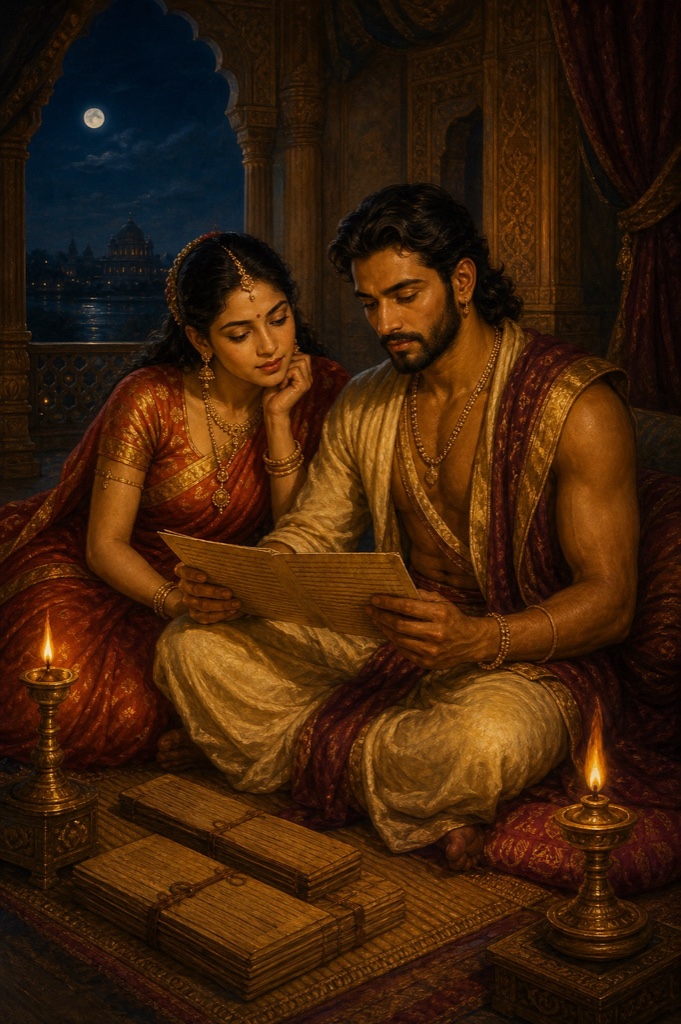
It was spring when it happened. He walked the inner gardens at night under the moon, past bowers hung with blossom, and found that every flower on every bank set him longing for a woman he had never met. When would he swing with her in the pleasure garden, when would they play in the lotus lake? Reading signs is the business of ministers, and his read these and sat down to deliberate on his marriage. They proposed the daughter of the king of Saurashtra, a girl just come into the prime of her youth, and the prince married her. Her name was Chudala, and the whole land knew it. The two were made for each other, both skilled in love and in music, so bound by affection that each became the other’s counterpart. She had been trained from childhood in every branch of learning; he learned dancing and the playing of instruments from her lips, and the sastras of the one and the painting of the other passed between them until each held what the other had. People said they were Uma and Shiva in a single body. They kept the laws, attended to the people, and took their pleasure in the arts, and all of it they did together.
They reveled in their youth for many years. Then the years began to wear the youth away, as a cracked pitcher lets its water out, and the two of them sat with it and talked. Our bodies are as frail as breakers on the sea, they said, and as ready to fall as ripe fruit from the tree; no one has ever turned death aside. The cup of our life drips away day by day, like water held in the palm sliding out between the fingers. Life is a magic play; our pleasures are few and painful and fly off like arrows from the bow. Where in this world is the pleasure that never goes stale? We should look for the one thing that will support us in every condition of life. So they turned together to the inquiry into the soul, since nothing else could ease the colic of worldliness, and for a long time they studied and shared what they found. Chudala took to it with a particular hunger. She attended the sermons of the Divine teachers whenever they spoke, and having heard from their mouths the words that save, she kept turning them over by day and by night.
Alone, she began to question the one thing nobody questions. “Where does this error of my personality come from, why does it grow, and where does it live? It cannot be in this gross body, which does not know itself and is ignorant of everything. Surely I am not this body; my sense of myself lies beyond it.” She went through herself the way a jeweler goes through a tray. The organs of sense and action depend on conditions and know nothing on their own. The mind drives the body as a bat drives a ball, and a bat is matter. Egoism is a channel, inert, carrying what runs through it. The jiva, the living self everyone takes for granted, turned out on inspection to be a false notion kept alive by the intellect. One by one the things she had called I came up for examination and were set down again, and each of them, when she looked closely, was lit and known by something that did not come and go with it.
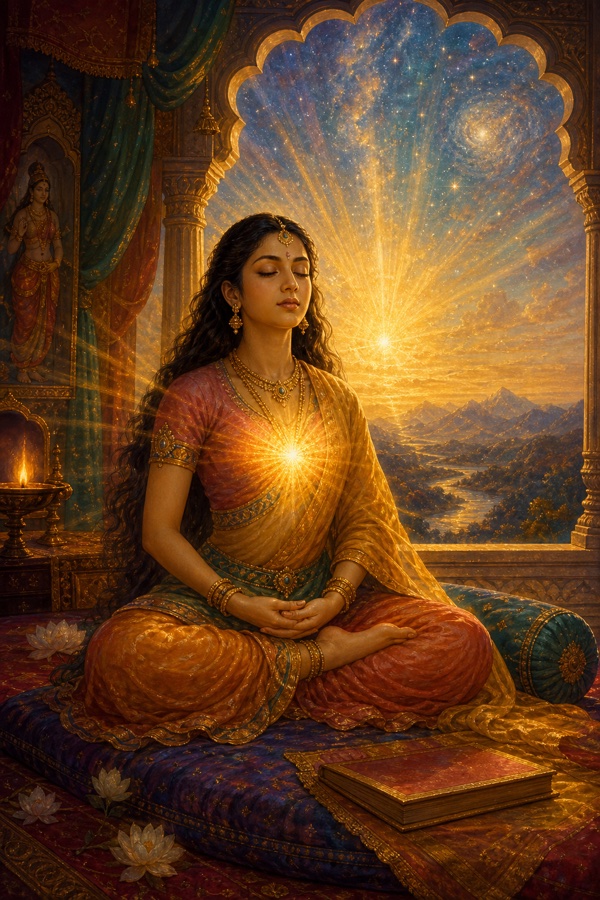
She pondered a long time in this way, and then she found what she had been looking for. “At last I have known the imperishable one,” she said to herself, “the only thing worth knowing.” All other learning, of mind and understanding and sense, is a staircase up to that one knowledge. There is one Intellect, and it is what the sages call Brahma. It is not born and does not die; nothing cuts it or burns it. The world is its appearance, as a bracelet and a ring are appearances of the same gold, and the one who sees and the thing seen are the same intellect wearing two faces. Settled there, Chudala became as calm as an ocean no wind has ever touched, absorbed in the eternal while her hands went on with the day.
From then on the princess lived day by day in the rapture of her own soul. She had no passion and no hatred, coveted nothing and avoided nothing, while remaining persistent in her course and vigilant in her pursuit. She had crossed the wide gulf of the world and shaken off the snare of doubts, and her name began to sound on everyone’s lips as the model of a perfection that had no equal. The height did something visible to her: she grew as fresh as a new plant, her face bright as a flower that opened that morning.
One day the prince came into her apartment and stopped. He had never seen her like this. “How is it, my dear one, that you have your youthful bloom again, like a flowering plant in spring? You are more brilliant than the world under a full moon, as if you had drunk the ambrosia of the gods. I see your mind spurning the three worlds as if they were straws, tranquil and cool and deep. Tell me: have you drunk the ambrosia? Have you been given sovereignty over an empire, or gained immortality from the elixir of life, or found it through yoga, Hatha or Raja? Have you got a kingdom, or found the philosopher’s stone that turns everything to gold, or something no one on earth has ever had?” Chudala answered him, and every answer came back to the same refrain. “I have not lost my old form, and I am not changed into a new one; I am your fortunate lady and wife, as ever. I have let go of everything untrue and unreal and taken hold of what is true and real, and that is how I remain your fortunate consort as before. I am as content with my enjoyments as without them. I delight in one empty thing that has taken possession of my heart, and I take no pleasure in the royal gardens and sports, and so I am your fortunate princess as ever. I am this, and I am not this; I am the real and nothing real; I am the ego and no ego; I am everything and nothing in particular, and so I remain your charming lady. I know, my lord, that everything I see with my eyes, perceive with my senses, or conceive in my mind is nothing in reality, and so I see something inside myself that no organ perceives and no mind conceives, and that bright vision of the spirit is what has made me so bright to your sight.”
Her husband had not the wit to dive under the words, and he took them as a game. “How incongruous your speech is, and how unbecoming to your age, that being only a girl you talk of great things. You say you have left everything and live in the meditation of a nothing; if you had, how could a nothing make you so graceful? A hermit who lives on empty air is a ghost without a body. That I am not the body, nor bodiless, that I am nothing yet everything: words that contradict themselves like that come from no sane understanding. I find you the same ignorant, unsteady girl, my frolicsome playmate, and I only tease you because you have been teasing me.” He finished with a loud laugh, saw that it was noon and time for his bath, and rose and left her apartment. The princess sat where he had left her. “The prince has quite missed my meaning,” she said to herself, “and has no idea what I meant by my rest in the spirit.” Then she turned to the duties of the day.
A Teaching He Could Not Yet Hear
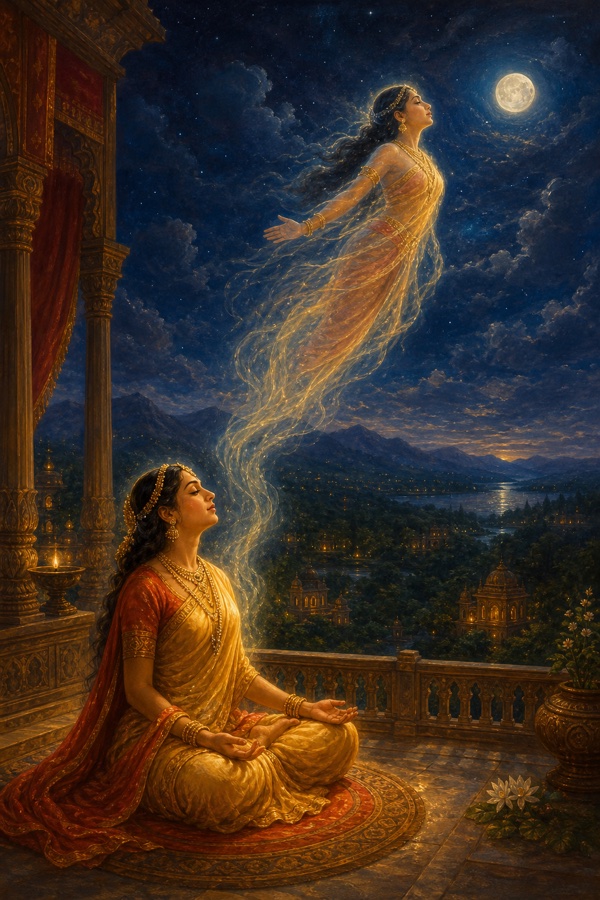
After that she kept her silent meditation in seclusion and passed the rest of her hours with the prince in the royal sports, and nobody at court saw any difference. Then one day, with no desire left in her heart, the princess turned her mind to the method of flying through the air, and found that she wanted to make that journey. While the prince was away from home she withdrew to a secluded spot, gave up food, shut out her companions, sat with her body held perfectly still on its seat, and drew her rising breath up and held it between her eyebrows, and there she stayed, her whole attention on the flight she meant to make.
Rama broke in here. “Everything that moves in this world, whatever has a body, moves by the working of that body and the push of its breath. How can anyone rise by holding both of them still at once? Tell me what exercise of the breath, what force in it, gives a person the power to lift off the ground and travel the air. How does a yogi come to that attainment, and what does the practice ask of him?”
“There are three ways of reaching any end, Rama,” Vasistha said. “The first is upadeya, the effort to obtain the thing you want. The second is heya, in which the thing is pushed away with distaste. The third is upeksha, indifference, the middle road, in which a person is as content with the thing’s loss as with its gain. Whatever pleases is sought by everyone, whatever pains is avoided by everyone, and the middle thing is neither sought nor shunned. But the moment an intelligent seeker comes to the knowledge of his own self, all three vanish from his sight; he feels them to be one and the same. He sees these worlds full of the presence of God, his mind takes its delight in that, and he rests in the middle state of indifference, or loses sight even of that. Now hear the means to attainment. Every success comes in its proper time and place, through an action and its instruments, and these four gladden a person’s heart the way spring renews the earth. Of the four, action is the chief. Now, there are many instruments for traveling the air: pills, the application of collyrium to the eyes, the wielding of a sword and others like them, and every one of them brings evils with it that are the enemies of holiness. There are gems and drugs for it, mystic syllables and charms and formulas, and if I explained them in full you would find them harmful to yoga. Meru and Himalaya and certain holy places are named as seats of inspiration, and a full account of those would do the same harm. So I will tell you about the restraint of the breath, which has attainment for its consequence, and which belongs to the story of Shikhidhvaja.”
“Drive every desire out of the heart except the one object in view. Close the openings of the body, keep the trunk, the head and the neck erect, and practice what the yoga shastra lays down. Take pure food and sit on a clean seat; ponder the deep sense of the scriptures; keep to right conduct in the company of the good; stay out of worldly entanglements; refrain from anger and greed and from improper food and pleasures; and over a long time accustom yourself to holding the breath. The wise man who knows the truth and has command of the three breaths, puraka, rechaka and kumbhaka, the breath drawn in, the breath let out and the breath held, has every action of his under his command, as a master has all his servants. Know this, Rama: a person’s whole well-being is under the command of his vital breath, and by that breath he may equally win sovereignty on earth or secure his own liberation.”
“Now hear where this power sits. The breath circulates through the inner channel of the breast that encircles the entrails, feeding every artery with life. And there, at the lowest base of the body, lies a curved artery, shaped like the disc at the head of a lute, like an eddy in the sea, like the bent half of the letter Om. It sits at the base of the bodies of gods and demigods, of men and beasts, of fishes and birds, of insects and worms and every creature of the water. It lies coiled like a snake folded up in winter, until the heat unfolds it and it lifts its hood. This is the kundalini. It runs from the base, passes through the cavity of the heart, touches the opening between the eyebrows, and vibrates without pause under the wind of the breath. In its midst dwells a mighty power, like the pith inside the soft stem of the plantain, thrilling like the strings of a lute; that is the first moving force that sets every part and every power of the body in motion. It breathes without rest like an angry snake and keeps blowing upward with its open mouths to give force to all the organs. When the vital breath enters the heart and is drawn in by this coiled artery, the consciousness of the mind arises, the ground in which the seeds of all its faculties lie. As the kundalini thrills in the body like a bee hovering over a flower, so our consciousness throbs in the mind and perceives the finest sensations. Every vein of the body joins this great artery; they flow together into the cavity of the heart and rise and fall there like rivers in the sea, and from that ceaseless rise and fall it is called the common root of every sensation and perception.”
Rama stopped him. “How is it that our consciousness, which comes from the infinite intellect and is everywhere at every moment, is confined like a minute particle of matter in the cell of this coiled artery, and rises and falls there by turns?” “It is true, Rama,” Vasistha said, “that consciousness is the property of the infinite intellect and is present everywhere with it. Even so, in finite material bodies it is compressed into the form of a minute atom, the way the sunshine that lights the whole universe seems to be no more than a flush of light on a wall. In some bodies it is lost altogether, as in minerals, which know nothing of their own existence; in some it is fully developed, as in the gods and in human beings; in some it is imperfectly developed, as in plants; and in some it appears in a perverted form, as in the lower animals. So everything has its consciousness in one form or another. As every cavity and empty space is comprised under the one word air, so every intelligent and unintelligent being is comprised under the one ever-existent intellect, which pervades all things the way vacuum does. That one unchanging intellect is situated in one place as pure consciousness and in another as the subtle form of the five elements, and that fivefold consciousness is multiplied into many other fives, as many lamps are lit from one lamp: the five vital airs, the mind and its five faculties of understanding, the five inner and five outer senses with their organs, the five elemental bodies, each with its growth and decay and its states of waking, dreaming and sleep. These fives inhabit the different bodies of gods and mortals according to their natures and inclinations, and this world is their production. As a wave of the sea rolls in one place and lies in a lull in another, so this power of the intellect is in full force in some bodies and quiescent in others. The body of fives moves by the vital airs; the jiva is intelligent by cause of its intelligence; rocks have neither, and trees have a sensibility of their own because the winds move them. And it is the differing desires of the mind that, ripened in time, dispose these elements into the forms they prefer. Some beings have their desires dormant in them, as the plants and minerals of the earth; some have desires that never sleep, as the gods, the daityas and men; some are glutted with desire, as the worms in the dirt; and some are rid of desire, as the liberated yogis. Rama, the slightest desire of any of these, as small as an atom, becomes the seed of aerial trees that bear the fruits of future births in the shapes of the things desired. The organs of sense are the flowers of that tree, the sensations of their objects are the fragrance, our wishes are the bees that flutter about its stems, and every being now alive or yet to be born is its fruit, growing, blooming and falling in turn. The multitude of bodies, the playthings of these fivefold essences, is destined to rove this world forever, unless they come under the dominion of reason and are freed from further wandering.”
“The seeds of these fives are held inside the great artery, and they expand with every vibration of the vital breath. When that vibration stops, the intellect is roused by its touch, and with it rise its powers: it is the living principle from its vitality, the mind from its mental powers, the will from its willing, the understanding from its understanding of things; it becomes egoism with its eight properties, the puryashtaka, and remains as the principle of life in the body in the form of the kundalini. There the intellect abides as three winds. Passing downward through the bowels it takes the name apana; moving about the abdomen it is called samana; seated in the chest and rising upward it is udana. The apana empties the bowels, the samana sustains the body, and the udana, rising and being let out, fills and strengthens the frame. If with all your effort you cannot repress the passing of the downward wind, death follows by its forcible escape; if with all your effort you cannot hold the rising breath and it forces its way out of the mouth or nostrils, your expiration follows. But the one who by continual attention can repress the outward and inward passage of the vital breath, and keep his disposition calm, is sure of long life and freedom from every disease. Know that the disturbance of the smaller arteries brings distempers of the body, and the disturbance of the great ones brings serious consequences.”
Rama asked how health and sickness hang on the organs and channels of the body, and Vasistha took him through it. Uneasiness of the mind and sickness of the body both cause pain; medicine relieves them for a while, and their killing at once by liberation is what brings true felicity. Both rise from inordinate desire, and ignorance of the nature of things is the source of both. Without knowledge, and without the government of one’s appetites, the heart string loses its fineness and even course and is swollen and hurried by passion; the exultation of gain and the ardor for more boil the blood of the heart and shroud the mind like an impervious cloud in the rains. Greed drives men to distant countries for a livelihood; work at improper hours, improper actions, the company of infamous men, too little food on one side and too much on the other, derange the humors, and from that disorder a great many diseases grow, as a river turns foul both in flood and in low water. The ordinary cares of life go when their objects are supplied, and the diseases bred of those cares go with them. The infirmities bred in the blood and bone go only with the knowledge of the soul, as the snake seen in a rope goes only when the rope is examined. The diseases that come from outside yield to drugs, to mantras, to charms and to the treatments of the medical science Rama already knew; so Vasistha spent no more words on those. Rama asked how a cause inside produces a disease outside, and how anything other than a drug can cure it. The disturbed mind disorders the body, Vasistha said, as the angry man loses sight of what stands before his eyes and runs off the broad road into the thickets like a stag with an arrow in it. The troubled spirit disturbs the vital airs, which breathe in fits and snatches as a river churned by a herd of elephants rises over its banks; the irregular breath deranges the vessels, as misrule in a government throws the laws of a realm into disorder; it leaves some channels empty and dry and others full and swollen, it ruins digestion and dries up the chyle and blood the food should make, and the crude matter left in the intestines becomes the source of a multitude of maladies. So the diseases of the body come from the perturbed mind and go with the end of anxiety. As the haritaki fruit purges by its own nature, so the mind’s work on the hidden meaning of the mantras purges the body’s crude diseases; and pious acts and holy service cleanse the mind of its impurities as gold is purified on the touchstone. A pure mind delights the body as the rising full moon spreads its beams on the earth, the vital airs breathe freely out of that purity, the food is well cooked in the stomach, and the germs of disease are destroyed.
“So much for the rise and fall of diseases,” Vasistha said, “in connection with the great artery. Now hear the main point, the attainment of siddhi by the practice of yoga. The life of the eightfold body, the puryashtaka, is confined in the kundalini as the fragrance of a flower is held in its inner filament. When a yogi fills the channel of this great artery with his inhaled breath, shuts it at its mouth, and sits as sedate as a stone, he attains the fixity of a rock; that is the siddhi called garima. When the body is filled with that air, and the wind confined in the kundalini is carried upward by the breath from the tube at the base to the cell of the skull, it touches the consciousness seated in the brain and drives off the fatigue of the labor. Then the wind rises as smoke rises into the air, carrying with it the powers of all the arteries attached to it like creepers clinging to a tree, and stands as erect as a stick, its head lifted like the hood of a snake. That rising force carries the whole body, filled with wind from crown to toe, into the upper sky, as a light thing floats up on water. That is how the yogis make their excursions in the air, and they are as happy at it as a poor man given the dignity of Indra. And when the force of the exhaled breath from the tube of the skull holds the power of the kundalini at a distance of twelve inches outside the upper valve between the eyebrows, and keeps it there a moment, letting it enter no other passage, at that instant a person comes to see the supernatural beings before his sight.”
“Tell me how we can see the siddhas,” Rama said, “without feeling them by the rays of our eyesight and without any supernatural organ of our own.” “You are right that the aerial spirits of the siddhas are invisible to earthly mortals with the imperfect organs of their bodies,” Vasistha said. “It is by the clairvoyance that the practice of yoga gives that those beneficent beings become visible to us, as the figures in our dreams become visible. The sight of a siddha is like the sight of a person in a dream, with this one difference: the sight of a siddha brings many real benefits and blessings to the one who sees him. And it is by the practice of posting the exhaled breath twelve inches outside the mouth that it can be made to enter into the body of another person.”
Rama asked how the bodies of yogis are made thin enough to pass through a narrow opening and large enough to fill a wide space. “As the rubbing of wood and saw splits the wood,” Vasistha said, “and as the friction of a flint and a stone brings fire out between them, so the rubbing together of the inhaled and exhaled breath divides the two airs, prana and apana, and produces the fire of the belly. There is a muscle in the abdomen of this ungainly inner machine that stretches above and below the navel like a pair of bellows, their mouths joined, shaking to and fro like a willow moved by water and wind. Under that bladder the kundalini rests in her quiet state, lying like a string of pearls in a casket of yellow gems; there she turns and twirls like a string of beads counted around a finger, and coils with her head drawn back and a hiss like the hood of a snake struck by a stick. She thrills in the string of the lotus-like heart as a bee flutters over the honey cup of the flower, and she kindles our knowledge in the body like the sun shining between the earth and the sky. Then the action of the heart moves every vessel in the body to its work, as the breeze outside shakes the leaves of the trees. As high winds rage in the sky and break the weaker leaves from the branches, so the vital airs coil in the body and crush the soft food in the stomach, and as the winds batter the lotus leaves until they dissolve into their native element, so the inner winds break the food down into chyle, blood, flesh, skin, fat, marrow and bone, one after another. The inner airs clash against one another and bring out the fire of the belly, as bamboos in a wood make living fire by their friction, and the body, which is cold by nature, is warmed in all its parts by that inner heat, as every part of the world is warmed by the sun. This inner fire that pervades the frame and flutters like golden bees over the lotus of the heart is what the ascetic yogis meditate on as twinkling stars; reflection on those lights brings the full blaze of the intellectual light, and by it the meditating yogi sees in his heart things millions of miles away. Fed continually with the fuel of food, that fire burns in the lake of the heart’s lotus as the submarine fire burns hidden in the waters of the sea. But the clear, cool light that is the soul of the body bears the name of the serene moon, and because it is the product of the body’s other fire this is called the dwelling of the moon and the fire. All hotter lights in the world go by the name of suns, all colder lights by the name of moons, and the learned call the light of intelligence knowledge, sun and fire, and the unrealities of ignorance dullness and darkness and the coldness of the moon.”
“I understand that the fire comes from the friction of the breaths,” Rama said, “and that the air proceeds from the moon. But tell me, where does the moon come from?” “The fire and the moon are the mutual causes and effects of one another,” Vasistha said. “They produce each other and destroy each other by turns, as the seed and its sprout do, of which no one knows which is cause and which effect; they return as day and night return, and they last a while and vanish, like the succession of light and shade. The absence of a cause is as real a cause as any that is present to the senses: who can deny that it is the absence of fire that makes the cold? Watch how the fire goes up in the air as fumes, which gather as clouds in the blue sky and become the cause of the moon; how the fire put out by cold sends its watery particles upward, and that moisture produces the moon; how the submarine fire that feeds on the foulness of the seven oceans swallows their brine and sends up its fumes, which fly as clouds to the upper sky and drop their purified waters as sweet milk into the milky ocean; how the hot sun devours the cold ball of the moon at the dark of the month and lets her out again in the bright half, as a stork throws off the lotus stalk it has taken. Where the fire is absent the moon is present, and where the moon is absent there is fire; when the fire is destroyed the moon takes its place, as the departing day brings in the night. Now, in the interval of day and night, in the interim of daylight and darkness, in the midst of shade and light, there is a midmost point, and a certain figure in it, which is unknown to the learned. That point is no nullity and no empty void, and it is no positive entity either. It is the real pivot and the connecting link of both sides, and it never shifts its central place between the two extremes of this and that, of being and not being. By the two opposite principles of the intelligent soul and inert matter all things exist in the universe, as the two contraries of light and darkness bring on day and night in their regular succession. Know, Rama, that the beams of the sun are made of fire, that the solar light is the effulgence of the intellect, and that the body of the moon is a mass of dull darkness until it is lit by its borrowed light. If you look on your intellect as the cooling moon, it turns as dull and cold as that satellite, as a lotus looked at by night never seems as full-blown as in sunshine. The rising breath, prana, which is hot by nature, is the fire; the setting breath, apana, which is cold and slow, is the soma, the moon; they abide as light and shade in every body, the one rising and passing by the mouth, the other going down. The cooled apana gives rise to the hot prana, which remains in the body like a reflection in a mirror, and there was a certain consciousness at the beginning of creation that joined these properties of heat and cold in the making of the human body and mind. Strive, Rama, to settle yourself at that point outside the mouth where the sun and the moon of the body, the prana and the apana, meet in conjunction, as at the dark of the moon.”
“Now hear how the bodies of yogis expand and contract at will. Above the lotus of the heart there is a blazing fire, throwing off sparks like gold-colored butterflies flitting about it and flaring like lightning in the evening clouds. The animating spirit fans it and rouses it, as if blowing on it with the breath of the wind; it pervades the whole body without burning it and shines as brightly as the sun in the form of our consciousness. Then, kindled into a blaze in an instant, like the first rays of the rising sun on the morning clouds, it melts down the whole body to its toes and nails, as a furnace dissolves gold in the crucible. No water can put it out. It burns the whole outer body down to the feet, then coils inside and remains in the form of the mind in the ativahika body, the spiritual body of a person; it reduces the inner body likewise, and then it dies down of itself, like frost at the blowing of the wind. The force of the kundalini, put out of the artery at the base, remains in the vacuity of the spiritual body like the shadow of the smoke of a fire. That smoky shade parades over the heart like a dark-skinned maiden, and she holds in her bosom the subtle body made of the mind and the understanding, the living principle and its egoism. She has the power to enter the porous fibers of a lotus, to penetrate rocks, to stretch out over the grass, to slip into houses and stones, to pry into the sky and ply in the ground, and to stay or move anywhere she likes by her own will. This power produces consciousness and sensibility by the sap it supplies to the whole body, and it is itself filled with juice, like a leather bag dipped into a well. Filled with that juice, the great artery forms the body in any shape it likes, as an artist draws the lines of a picture in whatever form he holds in his mind, and it gives the seed placed in the mother’s womb the power to grow into the flesh and bone of its future body, as the tender sprout grows in time into a hard, woody tree. Know this certain truth, Rama, which the wise acknowledge: the living principle acquires the state and the stature it desires, be it that of a mountain or of a bit of straw.”
“You have heard of the powers of diminishing and increasing the body’s bulk by the practice of yoga; now hear how the same capacities come by knowledge, by jnana. Know for certain that there is only one intelligent principle, the intellect, inscrutable, pure and most charming, minuter than the minutest, perfectly tranquil, and nothing of this world or of any of its actions or properties. That same chit, gathering itself into an individuality out of the undivided whole and taking on the power of will, sankalpa, becomes the living soul by the change of its pure nature to an impure one. The will is a fallacy and the body is a mistake, and only the ignorant distinguish the living soul from the universal spirit, as an ignorant boy sees a demon in a shadow. When the lamp of knowledge brings the mind to the full light of truth, the error of willing drops from the living soul, as the clouds of the rains scatter in autumn. The body has its rest after the wishes have subsided in the mind, as a lamp goes out when its oil is spent, and the soul that sees the truth has no more knowledge of its body, as a man awake no longer has the apparitions of his dream before him. Taking the unreal for the real is what gives the color of reality to these material bodies, and the knowledge of the truth removes the error of the body and restores the soul to its native splendor. But the error of taking the material body for the immaterial soul is so deep-rooted that it is as hard to remove as it is for the strongest sunbeams to find the gloom inside a person’s mind. That impervious darkness is to be seen only by the sunshine of knowledge: that the soul is the seat of the immaculate, all-pervading spirit of God, and that I myself am nothing other than the pure intellect within me. Those who have known the supreme soul meditate on it in themselves in this way, until by the intensity of their thought they find themselves assimilated to it. It is by this, Rama, that some men turn deadly poison into sweet ambrosial food and change delicious nectar into bitter gall; whatever is thought upon with intensity, in any manner and on any occasion, comes to pass, as many instances show. Seen in the light of a reality, the body is found to be a real existence; looked upon as an unreality, it vanishes into nothing.”
“That is the way of knowledge, Rama. Now attend to another method of gaining these powers. By the exhalation of your rechaka breath you can draw your vital power out of the cell of your kundalini and infuse it into another body, as the winds carry the fragrance of flowers into the nostrils. The former body is left lifeless, like a log of wood or a block of stone; such is the relation of the body to its life as that of a bucket to the water poured out of it to enliven the plants. In this way life is infused into all things that move and all that do not, so as to enjoy the pleasures of their several states at will; and the living soul, having relished the bliss of that state, returns to its former body if it still exists, or goes and settles somewhere else, wherever best suits its taste. So the yogis pass into all bodies and live in them with their conscious souls, and fill the world by magnifying their spirits over all space. The yogi who is lord of himself by his enlightened understanding, and knows all things together with their attendant evils, obtains in an instant whatever he wants to have, and it stands before him in the effulgence of the divine light.”
So the princess came into these powers of contracting and expanding her form at will, and by continual practice she grew so expert in them that she made her journeys through the air and sailed at her pleasure over the expanse of the waters, and moved on the surface of the earth as the Ganga glides on in her silent course. She had her place in her lord’s bosom as the goddess of prosperity has hers in Hari’s, and in a moment she traveled with her mind over every city and every country on earth. She fled through the air and flashed like lightning with the flashes of her eyes, and passed over the earth like a shadow, as a body of clouds passes over a range of mountains. Without any hazard she passed through grass and wood, stone and clod of earth, fire, water, air and empty space, the way a thread passes through the eye of a needle. She skimmed lightly over the mountain peaks, looked into the regions of the regents of every side of heaven, pierced the hollows of the empty womb of space, and made a pleasant trip of whatever flight she chose. She conversed freely with every living thing, the beasts that walk the earth and the snakes and insects that crawl on it; she talked with the savage Pisacha tribes and communicated with men and with the immortal gods and demigods.
She tried, many times, to give her husband what she knew. He could take none of it. To him she was his young princess and the mistress of his house, skilled in the arts of coquetry and housewifery and nothing higher; he had no idea, to this day, that she had made her way through the spiritual science as a student makes his way through the branches of learning. So she grew reserved, and kept her learning from her unenlightened husband the way a Brahmin keeps his secret rites from a man with no right to them.
Rama heard this and objected. “If a seeress of consummate wisdom could not give her knowledge to her own husband, with all her effort to enlighten him, how is anyone else to come by spiritual knowledge by any means at all?” Vasistha answered him with the rule of the teacher’s precept and the pupil’s own intelligence, and then with the story of the miserly Kirata of the Vindhya woods who lost a single cowrie in the grass and found a jewel. That answer, that story, and everything that followed it are told in full in Shikhidhvaja: From the Palace to Mandarachala.
Twelve Days into the Forest
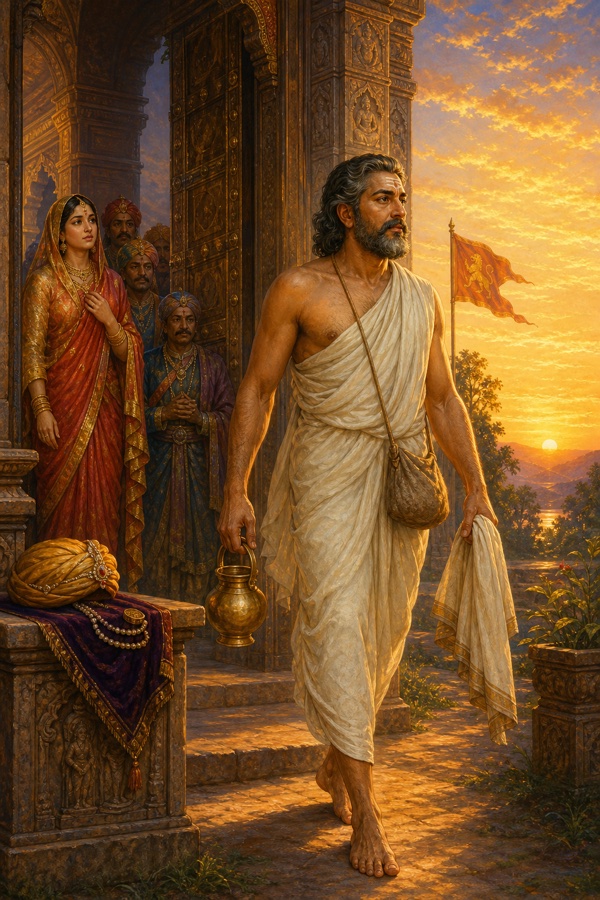
The prince, meanwhile, went on in the dark, and nowhere did he find the consolation he was digging for. One day he told Chudala that he would go to the woods; she answered him as an equal and set the season of his life and his duty to his people against it, and he held to his choice. At midnight he slid out of his half of the bedclothes and walked out of his princedom, crossed country for twelve days and twelve nights to the foot of Mount Mandara, and built himself a cell of leaves there, while Chudala, who had followed him by her yoga, seen what fate held for him and gone home again, took the reins of the government into her own hands. All of it is told in full in Shikhidhvaja: From the Palace to Mandarachala. Eighteen years went over them, and more years after those, until the hermit prince’s hair went white, and Chudala made up her mind to go to Mount Mandara and join her husband where he was.
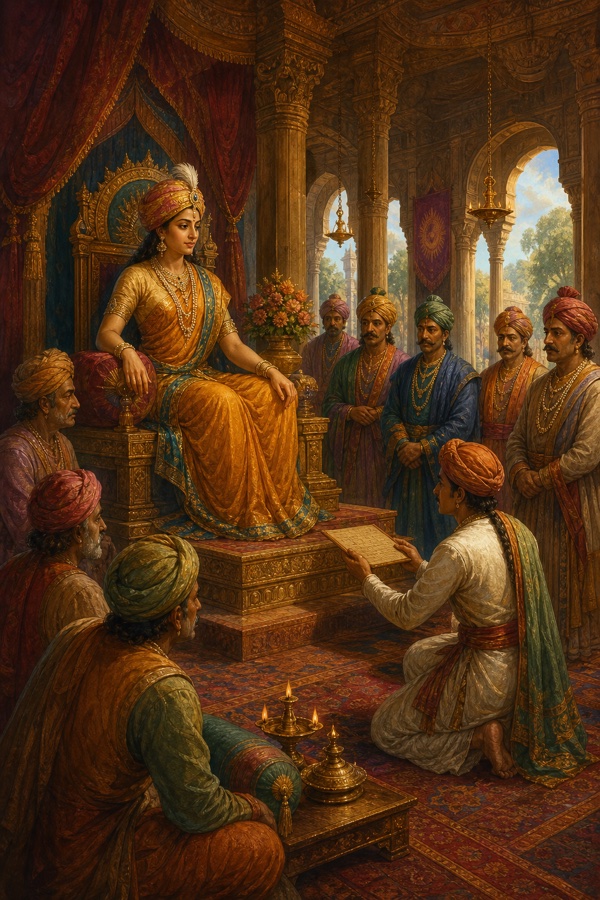
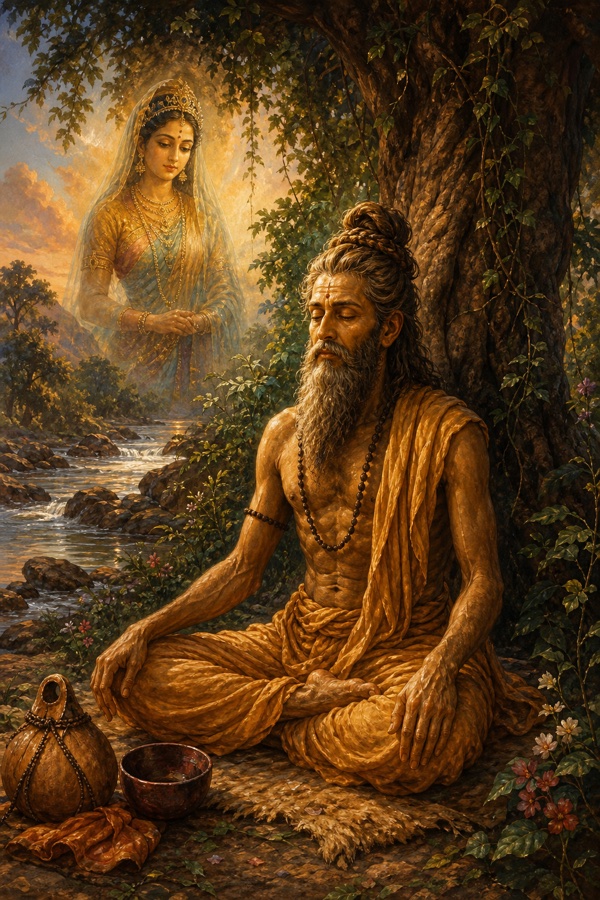
Kumbha at Mount Mandara
She went up at night on the wings of the air, entered the grove at Mandara unseen, found her husband grown lean and dark as a dead leaf, and came down to earth before him in the figure of a Brahmin boy. He welcomed the boy with every offering a guest is due, saw in his face a likeness to the queen reigning over his kingdom, and asked him what god he was and whose son. That flight and that welcome are told in full in Shikhidhvaja: From the Palace to Mandarachala.
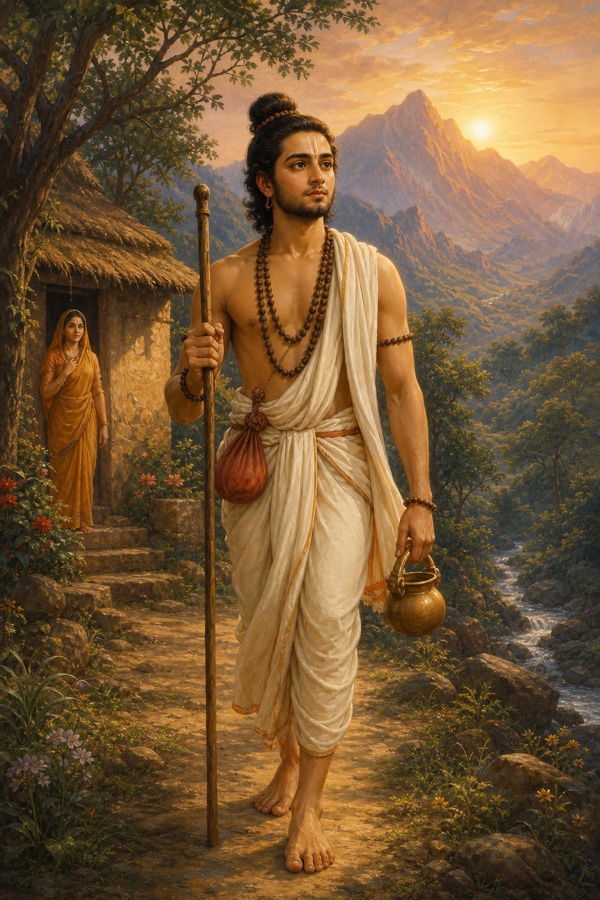
The boy told him. There is a holy saint named Narada, he said, and once this saint sat in devotion in a cavern of the golden mountain where the Ganga comes crashing down, and he stepped out onto the bank to watch the river go by. He heard the tinkle of bracelets and a murmur of voices, and looked, and saw a company of young women who equaled the nymphs Rambha and Tilottama in beauty, come out to bathe in the holy river where no man could see them, naked, with their breasts uncovered, blooming like golden lotus buds on the lake. The sage’s mind was ravished. He lost his reason, and the excess of his rapture broke out of him as a summer cloud breaks into rain, and afterward he turned as wan as a waning moon. Shikhidhvaja stopped him there. How could a sage who was liberated in his lifetime, who wanted nothing and had lived celibate from the beginning, lose his countenance like that? “Every living being in the three worlds, the gods included, has a body composed of both ingredients, good and evil. A man may be deep in his inquiry into the spirit, and one moment’s neglect of it darkens his light, and the world appears again like a thick cloud. In the ignorant the impression sticks for good, as red dye sticks in a cloth; the knower of truth is not dyed. Small desires free a man. Large ones bind him.”
Narada, the boy went on, curbed the elephant of his mind with the bridle of prudence, caught the fluid in a crystal water pot he kept at his side, carried the pot to a cavern on one side of Mount Meru, and filled it with milk that he produced by his will. He brooded over the pot as a bird broods on its egg, and in the course of a month a child grew in the milk as the reflection of the crescent moon grows in the milky ocean. Narada gave the boy the tonsure and the thread and poured all he knew into him as one pours from one vessel into another, and one day took him up to the heaven of his own father, Brahma, who set the child on his lap, blessed him, and named him Kumbha, the pot. “So I am the son of the sage Narada, hermit, and the grandson of the lotus-born Brahma himself. The goddess Sarasvati is my mother and the Gayatri hymn is my aunt. I wander the wide world for my pleasure, on no errand at all; I walk over the earth without touching it with my feet. Today, in the course of my journey through the sky, I saw your hermitage and came down to see you.” By the time he finished the sun had gone, and they parted for the evening ablution and met again at sunrise.
In the morning the prince began to praise him: the hoarded merit of all his former lives had brought this guest; the boy’s presence was worth more than a kingdom. Kumbha cut it off. “Please stop, sir, and give me an account of yourself as I have given you mine. Who are you, what are you doing on this lonely mountain, how long have you lived this forester’s life, and what is your object? Tell me the bare truth; an ascetic has no business saying anything else.” The prince answered that a god’s son must know all of it already, and told him anyway. “I am Shikhidhvaja, the ruler of a country, which I gave up long ago for a seat in the forest. It is my fear of the trapdoors of the world, and of being born into it again, that drove me to this wilderness. This accursed world is nothing except pain and pleasure, life and death, over and over, and I came out here to my austerities to evade all of it. I give myself no rest; I keep my vigils like a miser over his little stock. I make no effort and get no fruit; I am alone and so I am helpless; I am poor and so I am friendless. I am a man pining in this forest like a withered tree bored through by worms. I observe every one of my sacred rites without fail, and still I fall out of one sorrow into an ocean of sorrows.”
Kumbha told him what Brahma had once said when asked which was more useful to mankind, the observance of duties or their non-observance for the sake of knowledge. Knowledge is the supreme good, Brahma had said, because it leads to the unity of the Deity and of oneself; action is laid on man as the duty of his life. Let those who have no inner light be kept busy in their duties; a man with no silk robe does not go naked, he wraps himself in a blanket. The ignorant act on desire and get their objects as the reward; the knower, with no desire in his mind, gets no reward from either. And an act without an object comes to nothing, like the kusa grass that flowers in season and never fruits. Shikhidhvaja objected: desire is vain, the sastras say, and egoism a fallacy, like the sea a man sees on burning sand; the knower whose ignorance is gone has no desire rising in him at all. Kumbha turned it on him. “It is true that knowledge is the chief good; Brahma says so, and every sage. And knowing that, why do you sit in this state of gross ignorance? What are these pots and staffs, these wooden stools and seats of kusa grass, and why, royal prince, do you delight in these false games of fools? Why do you not employ your mind to inquire what you are, and how this world came to be, and how and when it will cease? Do you want to pass your life in painful austerities, like an insect that spends its days boring the stone it lives in? You can have the delight you seek easily enough, if you will only serve holy men and argue the spirit with the tolerant and the wise. Or stay in your grotto on your simple food, and get rid of the evil propensities of your mind, and live here like an insect in a hole in the ground.”
That did it. The prince melted into tears, and with his face wet he spoke to the boy. “Divine child, it is after a long time that you have woken me to my senses. I see now that it was my own weak head that drove me from decent company into this lonely forest. From now on I count you my monitor and my father and my best friend forever, and I acknowledge myself your pupil. I bow at your feet; have pity on me. You said knowledge is the supreme good. Tell me which knowledge saves: the knowledge of particulars that leads to the special, or the knowledge of the general that leads to the transcendent?”
Kumbha answered with a condition. “I will tell you what I know of it, and I will not throw my words away like ravens cawing around a headless trunk. Words spoken to a man who asks and does not heed are wasted on him, as his eyesight is wasted in the dark.” The prince said that the boy’s words were as acceptable to him as the ordinances of the Veda. “Then receive my words as a boy receives his father’s,” Kumbha said, “knowing they are spoken for his certain good, and listen as you listen to music, without asking for the reason or the rhyme.”
“Now hear a story,” he said, “about a certain person whose conduct and character resembled yours in every way, and who was brought back to his senses after a long aberration.” And he told two.
The Jewel, the Elephant, and the Fire
Kumbha told two stories: of the rich man who toiled for the philosopher’s stone, could not trust his eyes when it lay before him, and gave away everything he had for a shining piece of glass; and of the great elephant of the Vindhya mountains, who broke his iron bar, let the fallen hunter go unhurt, and went down into the pit that same hunter had covered over for him. Then he laid both open: the searcher and the elephant were Shikhidhvaja himself. He asked why the prince had declined the advice of the princess Chudala, and told him that his realm, his home, his wife and his wealth had never been his to give up; his egoism alone was his, and he had not yet got rid of it. The prince gave up the forest, then his cell and grove, and at last piled every vessel and seat of his rites in one spot, bade each of them farewell, and set them alight. The two stories are told in full in The Wish-Fulfilling Gem and the Piece of Glass and The Elephant of Vindhya and the Pit of Ignorance.
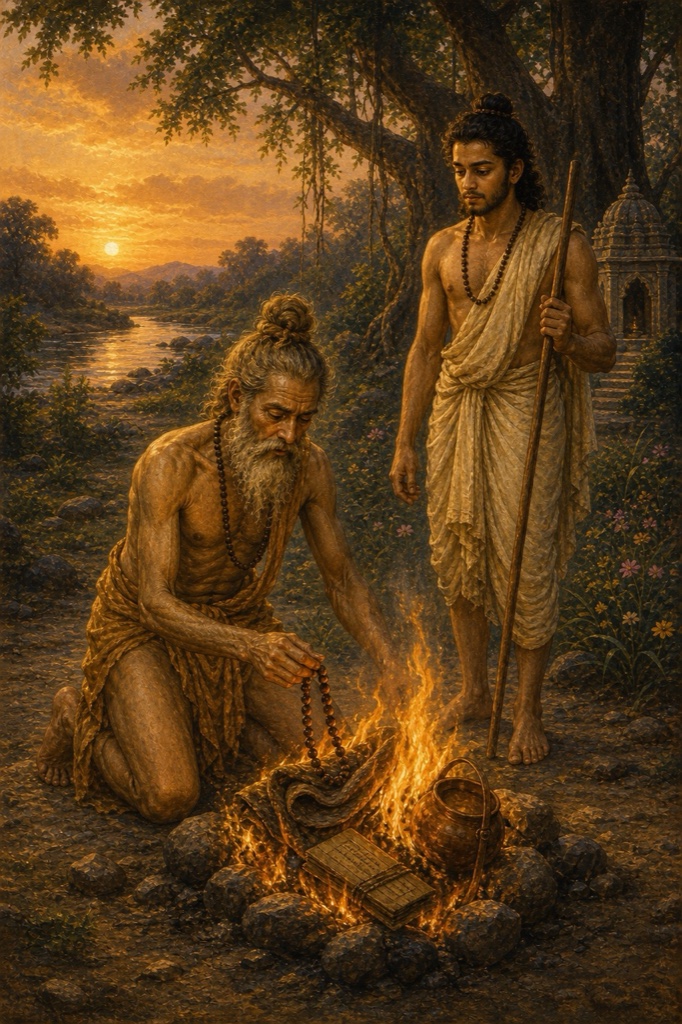
Then he got up and set fire to his hut of dry leaves and grass, and whatever was left of the hermit’s goods he burned in silence, with a composed and unconcerned mind, and flung away his stored food and his clothing with the same contentment. The timid fawns fled the flames for distant country like townsmen fleeing a burning quarter, and where a man had lived an hour before there was a desolation, like the ruins of Daksha’s sacrifice after Virabhadra’s fire went through it. The prince looked at the blaze on every side of him and seemed quite content, with nothing left in his possession except his body. “I am an all-abandoning saint now, by my abandonment of every desire and every object. I am as nude as the open sky and as roofless as the vault of space; I see the wide world as an expanse of emptiness and myself as a nullity inside it. Tell me, divine boy, is there anything still wanting to my complete renouncement of all?” “You must still be aware, prince,” Kumbha said, “that you are never released from the bonds of this life by giving up every mortal thing that belongs to your mortal and transitory state. I see the purity of your soul in the way you have thrown off the seeds and sprouts of fond desire that rise like thistles on a man’s breast. And it is not enough.”
The prince thought about it for a short while, and he was not easily moved. “Tell me, heaven-born child, what else you see remaining in me, except this body, which is a heap of flesh and blood and bones. If this body is counted an appendage of mine, then I will climb to the top of this mountain and let it fall and be dashed to pieces on the ground, and so be rid of my mortal part forever.” And he set off to do it, up the craggy hill in front of him.
Kumbha called him back. “What is it you are going to do, prince? Why destroy this innocent body of yours from that hideous height, like an enraged bull hurling its calf down a hill? What is the body but a lump of dull, gross matter, a dumb, poor, painstaking thing? It never does you any harm; why do you want to destroy something so harmless? It is a beast of burden, moved to and fro by other agencies, as a plank is tossed by the current. The body is guiltless of all the pain and pleasure that visit the living soul in turn, as a tree is unconcerned with the fruit and leaves the wind knocks off it; tell me how you can charge the tree with the fault of letting its best produce fall. Even the immolation of your body is not enough to make your renouncement of all; sarva tyaga is no easy matter. There is an enemy of this body that shakes it as an elephant shakes a tree, and if you can be rid of that mortal enemy of body and soul, then you are freed from everything. Otherwise, kill the body however you like, you can never stop it growing again in some form or other.” The prince stopped on the slope. “Then what is it that shakes the body? What is the root of our transmigrations and of the doings and sufferings of our future lives? What is the thing by whose avoidance we forsake everything in the world?”
What Remains When the Mind Releases Its Claim
“It is neither the forsaking of your realm nor of your body,” Kumbha said, “nor the burning of your hut and chattels, nor all of these together, that makes your renouncement of all. There is one thing that is in everything and everywhere, and it is by resigning everything into that one thing that a man becomes the renouncer of all. It goes under many names: the living soul, jiva; the life, prana; and more. It is neither active nor inactive, and it is called the mind, which is forever liable to error. The mind is the source of your body and your estates, the root of your hermitage and of everything else, as one tree holds the seed of another. Give up that seed of all events and you have truly resigned everything in the world. The man under the subjection of his mind is subject to care whether he rules his realm or runs from it to a forest; the man of a well-governed mind is content in every condition. It is called buddhi, or ahamkara, or prana, according to the function it is performing at the moment, and when it has nothing to do it is the silent soul. Whoever wants to know what resignation is, understand this: it is the resignation of the mind that makes the renunciation of all things.” He went on a long while in this vein, and near the end of it he said that it was by virtue of resigning everything that Sakyamuni stood dauntless amid the troubles of the Kali age, as firm as a rock; and he told the prince to forget his abdication of the crown and his bonfire in the hermitage both, and to drive away the pride of having given up everything, and to put on a clear and cheerful face.
The prince had a practical difficulty. “My mind flutters always, like a bird in the open sky of my chest, and lurks in the wilderness of my heart like an ape. I know how to restrain it, as fishermen hold fish in a net. I do not know how to get rid of it. Tell me first what the mind is, and then how to relinquish it forever.” “Cupidity is the intrinsic nature of the mind,” Kumbha said. “Take the word desire as a synonym for it. Abandoning the mind is very easy, easier than stirring it, and more delightful than possessing a kingdom. For the ignorant it is very hard; as hard as for a boor to hold the reins of a kingdom, or for a heap of grass to stand as high as a mountain.” “I understand that the mind is full of desires. And I find getting rid of it as impossible as swallowing an iron bolt. Tell me how it may be removed with ease.” Kumbha described a tree. Its seed is egoism, and every word for me and mine; its field is the supreme soul, which the deluded mind takes itself to be the first sprout of. The sprout ripens into buddhi, the understanding; the understanding, once desires get into it, becomes chitta; the body of skin and bone is the trunk, and the organs of sense are the branches, which reach a long way out and die at last seeking their enjoyment. You may lop the branches with reason, one by one, or you may burn the seed first and have the whole trunk gone to ash. “Tell me, my sage guide, what fire can burn the seed of the tree of mind, which is sheathed all over in the skin of egoism.” “Prince, the fire that consumes the seed of that noxious plant is the question, pressed home: what am I, that bear this bodily form?”
“I have put that question to myself over and over,” Shikhidhvaja said, “and I have found that my ego does not consist in anything of this world, nor in the woods that cover it. It is nowhere in the hills and forests where I have lived, nor in the shaking of the leaves in front of me, nor in any part of my gross body, its flesh or bones or blood; it is not in the organs of action nor the organs of sense, nor in the mind, nor in the understanding. As we see the form of a bracelet in gold, I conceive my egoism to consist in the intelligent soul. I know full well that it is a shadow cast by my inner soul and ought to be wiped off; what I regret is my ignorance of the spirit from which it has to be wiped.” Then what, Kumbha asked, did he think himself to be in reality? “I feel myself to be that intelligent and pure soul, which is of the form of intelligence, which tells me of everything that exists. And I perceive my egoism attached to my body, and whether it is a caused or a causeless thing I am perfectly ignorant. I cannot rub it out as unreal, and that is what I regret.” Kumbha took him through it like a geometer. What is the cause of this egoism? The prince said it came from maya. Then that the objects of sense caused thought. Kumbha held him to one rule: nothing exists without a cause, and an effect takes its cause’s nature. What caused the body? The father. And the father? The grandfather, and so back, until there was Brahma, and what caused Brahma? Nothing in that chain held; and what appears without a cause is the water of a mirage, there to the eye and nowhere to the hand.
“Brahma is neither cause nor effect,” Kumbha said. “Having no causality at all, he creates nothing. And a world with no cause is nothing. With nothing established except the supreme Being, we can form no conception of anything, and with no conception there is no sense in supposing an ego or a you.” The shell is taken for silver until the hand picks it up; the rope is a snake until the lamp is brought; the waves have no stuff of their own apart from the sea. Shikhidhvaja sat with that for a moment and found it was true. “Sir, I perceive the truth now, and the reasonableness of all you have said. I see now that I am the pure and free soul, quite apart from any bondage or any liberation from bonds. I understand Brahma as the cause of nothing, since he has no causality, and the world as a nullity, since it has no cause, and so there is no category whatever: no mind, no seed of it, no growth and no decay. I bow down to myself, of which alone I have any consciousness. I am tranquil, calm, settled in the spirit of God; I neither rise nor fall nor move from this prop.”
He had found his rest, and he held it a few moments like the steady flame of a lamp in a windless room, and then he began to slide into trance, and Kumbha’s voice cut across it. “Prince, I see you are about to go under in the sleep of your entranced meditation. You must neither be absorbed in your contemplation nor be a stranger to it altogether. The mind that is undivided in its attention is cleansed of duplicity, and freed of its knowledge of parts and particulars, it is emancipated while it lives.” Roused, the prince shone like a rich gem taken out of its wrapping. In his quiet he had seen the unreality of visible things; now he saw them spread all around him again, and he had questions. How does the impure conception of the universal soul, the Virat that holds the whole world in it, mix with the pure idea of the supreme soul, which is ever calm and transparent? Kumbha answered at length: the Supreme at a kalpa’s end is pure intellect, and as the universal soul it is called Virat; the world rises in it as waves rise in water and bracelets in gold, with no separate cause of their own; there is no such thing as a mind, which is only another name for ignorance; and knowing there is no mind removes it, as knowing the rope removes the snake.
When the lectures were done the prince sat for some time in silent and deep meditation, his eyes fixed, speechless, a carved statue without motion or sensation. After a while his eyes twinkled and he came back, and Kumbha asked him how it had been. “So, prince, how was your short trance? Were you awakened in your inmost soul, set at large beyond the region of error and darkness? Have you known the knowable one and seen what is to be seen?” “It was by your good grace, sir, that I saw a great glory in the highest heaven of heavens. I saw a state of bliss full of ambrosial delight, never known to mortals. It is in your company today that I have felt a delight I never felt in my life before.” “It was before midday today,” Kumbha said, “that I came to know of the regeneration of your soul. You are awakened and emancipated; your mind is driven out of your heart.” He explained the difference between the mind and the thing that remains in a liberated man: the gross desire that germinates into wishes and causes rebirth is what is called mind, and in the knower of truth it is extinct; the desire that guides the knower through his active life is called sattva, goodness, and it never produces another birth. “You have got that equanimity, samata, which marks the consummate yogi; this is the total renunciation of all. Austerities buy only a short cessation of pain; the happiness that never decays is found only in evenness under every circumstance of life. Let those who have no gold wear brass; let the ignorant keep to their rituals. But you, prince, have come happily to your knowledge and your happiness in the company of Chudala and others. Why then are you still devoted to austerities? Penance is prescribed for the expiation of prior misdeeds, and not for anyone’s salvation.” Motion and rest of the intellect, he added, are one and the same thing.
Then Kumbha made his excuse. “I have told you how all this phenomenon of the world springs from Brahma and disappears in him again. You are at liberty now, prince, to repose in the supreme bliss you have felt in yourself. I must go up to my heavenly abode, at this conjunction of the moon, when the sage Narada is very likely to have come before the assembly of the gods. He may be angry if he does not find me there, and it is not mannerly in the young to tease their elders.” The prince gathered a handful of flowers to throw after him in farewell, and before he could raise his arm the boy had vanished and mixed with the air.
Shikhidhvaja stood like a painted picture with his thoughts on his vanished friend, and he was plunged in sorrow. Then the strangeness of it struck him. “Where is this sage Narada, and who is his son, this Kumbha, to me? How did it come to happen, after so long, that I should be woken by him? How long I lay in the mud of my acts, rolling on the wheel of what was right and what was wrong to do. How pure and cold and quiet my present state is. I am calm, alone, one with the unity; I have no desire for so much as a straw.” Thinking this he sat down as still as a statue carved in wood or stone, immovable as a mountain peak, and freed from fear in an instant, he stayed a long time in the tranquility of his soul, with his soul shining like the rising sun.
Chudala, meanwhile, had dropped the shape of Narada’s son in the empty sky; the enchanted form melted and she was a woman in the air. She bent her course to the palace in the city, showed herself as queen to her assembled courtiers, and discharged the royal duties of her absent lord. After three days she put Kumbha on again and came back to the hermitage, and found the prince in his woodland seat, in deep meditation, like a figure carved in wood.
She was afraid for him. “I must wake him out of his trance in the supreme Being, or his soul will soon leave its mortal frame, out of disregard for it, now that his worldly bondage is at an end. He should live a while longer, with his royalty in the palace or his devotion in this forest, and then the two of us will depart together. I could never train him in all seven stages of devotion; I will train him in the practical part of yoga only.” She gave a loud shout, which startled the wild beasts; the prince did not stir, though she shouted again and again. She shook him with her hands, and threw him to the ground, and he neither woke nor came to his senses. Then another thought came to her. Why wake a deified spirit back into sensation at all, when he is so well absorbed in his disembodied meditation, a videha, free of the frame? She too wanted to be rid of her female form and reach that beatitude, free of further birth. She was on the point of abandoning her own body when her better understanding called her back. Let me feel the prince’s body first, she said, and see whether there is any pulse in his heart. If he lives, he will walk about like me, a living liberated soul. If he is dead, I will follow him to the next world. She felt him and found the relic of life still pulsing in his breast. Rama interrupted: how could a yogi lie that long in trance and still live? Vasistha told him that life stays in the heart as an atom; the yogi of even mind neither wastes nor grows; and a body with neither mind nor life in it rots, so the warmth was proof enough.
Chudala left her own body, the framework of the senses, and entered his, and set a vibration going in the intellect of her living lord, and came back to her own body, as a bird flits onto a twig, shakes it, and returns to its nest. She rose up in the figure of Kumbha, sat on a flowery bed, and began to chant hymns of the Sama Veda in soft tunes like the chime of bees. The prince’s dormant life woke at the sound as a lotus bud opens to the spring; his eyelids opened to the light, and he saw the Brahmin boy singing in front of him, fair as the divinity of music in person. “How fortunate I am, to find my friend Kumbha before me again,” he said, and picked up flowers and offered them. “Prince, my mind has been on you ever since I left you. I do not get as much delight in the delightful region of heaven as I do in your presence. I have no friend dearer to my soul than you, and no faithful pupil like you in this world.” Then come and live with me in this forest, the prince said; for his own part, blessed with the gift of samadhi, he had his perfect repose in God in this very place and no desire for heavenly delights at all. Kumbha asked him three things. “Have you had your repose in the state of supreme felicity, free of the unhappiness that always accompanies the knowledge of duality? Have you rooted out your taste for the insipid pleasures of this earth? Has your mind rested in that even indifference which has no liking for the desirable and no dislike for the undesirable, and is content with whatever comes at any time?” “By your favor, sir, I have reached beyond the edge of the universe and obtained the best and most certain bliss. I need no further advice from anyone. I have nothing to know that is unknown to me, and nothing to obtain that is not obtained; I have forsaken whatever is not worth having, and my soul rests in the supreme essence. I am free of fear and error and apathy, even and equal in my mind and equal in my soul with all others, free of all imagination, as the clear sky is free of cloud.”
So these two knowers of the knowable went on talking of spiritual things until the third watch of the day. Then they rose together and wandered the delightful dales and the cool lakes and roved that forest for eight full days. Then Kumbha said, let us walk to some other forest, and the prince said om, and they walked on over many forest lands, past lakes and hills and rivers and villages and towns and holy places, two friends of equal age and one temper. They worshiped the gods and the ancestors in the holy places and ate whatever they got; nowhere was home to them and everywhere was alike. Some days they walked in flying dust and some in the long fragrance of sandalwood forests; now daubed with ash and now smeared with sandal paste; now in good clothes and now in leaves. Within some days of this the prince became as perfected in his nature as another Kumbha himself. And Chudala, looking at the divine form of her husband, began to think. “How divinely fair my husband has become, and how charming these woodland scenes are; living long in this place, we are easy prey for the god of love. I see that a man may be liberated in his lifetime and still not be freed by it from the obligation of tasting the pleasures set in front of him; it is ignorance in a king to refuse a proffered enjoyment. With a noble-minded husband free of all disease, and a flowering grove in front of her, it would be a wretched woman who did not go to her lord. So I must contrive some artifice in this forest by which I can succeed in making my husband join with me.”
Madanika and the Two Tests
In the shape of Kumbha she spoke to the prince like a kokila calling to her mate from a flowering bower. “This is the first day of the new moon of the month of Chaitra, a day of great festivity in the court of Indra in heaven. I must go up to the assembly of the gods and present myself before my father there. Expect me back by evening; amuse yourself in these flowery arbors in the meantime. I will positively come back out of the blue sky by dusk.” She gave him a stalk of flowers from the Nandana forest, the garden of the gods, as a token of her affection and a pledge of her return before it faded. “You must come back soon,” the prince said, and she was gone, mixed with the air like a thin autumn cloud. He threw flowers up after her and stood watching the sky where she had been, as a peacock watches a cloud go. She went to the palace, attended to the affairs of state, and came back to him at evening with a sad face.
The prince got up at once, troubled to see him so sorry. “I greet you, Kumbha, but why do you look so sad today? You are the son of a god and must not grieve at anything. Holy saints and knowers of the knowable like you are never moved by joy or grief; they stay untouched, as lotuses stay dry in the water.” Kumbha sat, and answered in a voice as thin and soft as a bamboo flute. “Knowers of truth who are not patient under bodily accidents are no truthful men; they are cheats. The sesame seed has its oil in it by nature, and the body has its incidents the same way; a man who is not subject to his bodily accidents can cut the wind with a sword. Even Brahma and the gods are subject to their bodily frames, and cannot avoid what is fixed by destiny, which carries the wise and the unwise to the same goal, as rivers run to the sea, until they are released from the body.” Then he told what had happened. “Listen to the strange accident that has befallen me. After I left you I went up to the home of the gods; I met my father there and went with him to the court of the great Indra, and parted from him at his abode. Coming down through the middle air I saw the indignant sage Durvasa gliding fast among the watery clouds, wrapped in a vest of cloud and girdled with lightning, hurrying like a maiden to meet her lover; in fact he was hurrying to his evening devotion on the bank of the Ganga. I saluted him and said, ‘Wrapped in your blue vest of cloud, sir, you seem to be hurrying like an amorous woman to meet her lover.’ The reverend sage was incensed. ‘Then be an amorous woman yourself, as you think me to be. Go your way, and bear my curse: every night you shall become a woman, with swelling breasts and long braided hair, with all a woman’s grace and dalliance.’ I was thunderstruck, and before I could speak the old muni had vanished. How shall I tell my father the shame of being a swollen-breasted maid at night? What a joke I will be to the boys of the gods in heaven, and what a shame before the sages.” With that Chudala went mute, as if she had fainted. Then the pretended Kumbha seemed to collect himself. “Why do I wail like the ignorant over a change in a changeful body, when my soul suffers no change by it?”
“Why sorrow for the body, sir,” the prince said, “you who are the son of a god? Let it become whatever it becomes; it can never touch the intangible soul. Whatever pain or pleasure comes to us in this life goes with the changing body and never reaches the unchanging soul. If you, who know the Vedas, let yourself be moved by such accidents, what will become of other people? To be sorry in sorrow is very sorrowful in the wise. You have spoken these precepts yourself; stay as unmoved as you have always been.” So the two friends sat in the cool of the grove and consoled each other by turns, and the sun went down like an oilless lamp, and they said their evening prayers. Then, in front of him, Kumbha changed. “Sir, I could melt away in tears to see myself turned to a woman here in front of you. See how quickly the hair on my head has lengthened into curling locks, with strings of pearls sparkling in them; look at these two snowy balls swelling out of my chest, like white lotus buds rising on the water in spring; look how my long robe falls to my heels and mantles my whole body like a woman’s. Tell me, friend, what am I to do and where am I to go with this female form?” The prince looked at her a long while before he spoke. “It is very sorrowful and pitiable to see you transformed into a woman. And you who know the truth know also that there is no contending with fate. Whatever is destined must come to pass, and the wise are neither startled by it nor sorry for it, because all such events happen to the body and cannot affect the inward soul.” “So it is,” Kumbha said. “I must bear my feminine form with an unfeminine soul.” They passed the night in peace and slept in the same bed without touching each other, and in the morning Kumbha rose in his masculine form again, without a trace of the night.
So it went on. By day Kumbha was the prince’s friend; by night she lived with him as a virgin maid; a two-formed creature, Brahmin boy by day and princess by night, clinging to her husband like a necklace on a neck. They wandered on together through different countries and over distant hills, and after some days of this she spoke to him in Kumbha’s shape, in good earnest. “Listen, prince. Since I am obliged to become a woman every night, and will be forever, I wish to fulfill the part of my womanhood by joining myself to a husband in lawful marriage for all that time. I want to taste the pleasure of conjugal union with a dear friend, who of his own accord is so very friendly to me; so I hope you will put no difficulty in my way. I choose you, sir, as my husband out of everyone in the three worlds. Please accept me as your wife every night. The delight of conjugal union has come down to us from the beginning of creation, and obeying the ordinance of nature can bring no guilt on us. I desire this so that we may do as we like, without desiring or disliking anything, and without expecting anything from what we like or dislike.”
“I see neither any good nor any evil in accepting your proposal, friend,” Shikhidhvaja said, “so you are at liberty to do as you like. My mind is indifferent to everything in the world; I see everything in the same and equal light, and I leave you your option.”
“Then today is very favorable for the ceremony,” Kumbha said. “It is the full moon of Shravana, and the asterism is lucky by my best calculation. Our marriage can take place in the Gandharva form, by mutual choice and consent, on the summit of Mount Mahendra or in the grotto of some mineral mine by the light of its shining gems. The trees will shed their flowers on the ceremony, and the moon and his train of stars will witness it from the sky. Rise, prince, for your marriage, and let us go cull the forest flowers and prepare the sandal paste and gather up the scattered gems to deck our nuptial seats.” They rose together and gathered flowers and gems and stored them in a golden grotto, and went down to the Mandakini, the heavenly Ganga, to bathe, and there Kumbha served as priest and poured the holy water over the prince’s head and shoulders as Indra’s clouds pour rain on a hilltop, and the prince in turn washed the body of his princess in the shape of Kumbha, each anointing the other, old consort and future consort at once. Bathed and purified, they worshiped the gods, the munis, and the ancestors, for honor’s sake only and without wanting anything from them, and dressed in the whitish bark of the kalpa tree for wedding clothes, with its fruit for wedding cakes. The sun went down behind its mountain as if to leave them in private; they said the evening service, and the stars came out to witness it. As night came on, now changed to her female form, Kumbha anointed the prince with sandal paste, agallochum, camphor and powdered musk, hung him with bracelets of flowers, dressed him in a robe of thin kalpa bark, and decked him from head to foot with clusters of parijata. She was in her bridal garb and her maiden’s figure, with all her youthful grace, and she thought: here am I, a lovely bride, and there is my husband, and this is no time to let slip. She went to him where he sat apart in the wood, like Rati going to Kama, and bowed at his feet with her loose locks falling forward. “I am Madanika by name, and your loving wife, and I bow at your feet with the regard due to a husband. My lord, adorn me with ornaments too, and then light the nuptial fire to attest your acceptance of my hand.” And she praised him: fairer than the god of love himself when he first wedded Rati; the flower strings on his chest like the Ganga sliding down the breast of Sumeru.
They sat together on a golden seat of the mineral mountain, decked in garlands and gems and pearls and fine cloth, forgetful, for the moment, that they had ever been married before. He adorned her and blessed her. The altar was studded with strings of pearls and hung with bunches of flowers, with four large coconuts over the four sides of its square and pots of Ganga water set around it, and in the middle of it the matrimonial fire burned on sandalwood. They went around the flaming fire keeping it on their right and sat down on seats of leaves facing east. They fed the fire and offered sesame seeds and fried rice into the flames; they went around it again and offered each other their own selves and their love as dowries; they went around once more, scattered fried rice on the fire, and let go of each other’s hands, with their faces smiling like the moon on the first night. Then they went to the flower bed they had made ready in a secluded spot, when the moon had already run the first watch of the night. In the morning the sun came up gold over the world, and the queen consort of Shikhidhvaja changed her form from Madanika to the Brahmin boy Kumbha, and stood confessed as such before her friend in the cavern where they had lived as a pair of sylvan deities by night.
So they went on, two loving friends by day and a wedded couple by night, never apart for an hour. They roved the caverns and arbors of the mountain and then further: the skirts of Dardura, Kailasa, Mahendra, Malaya, Gandhamadana, the Vindhya and Lokaloka. Every third day or night, when she found the prince fast asleep, Chudala put on her old form as the princess and went to her palace, settled the affairs of state as before, and came back to her husband in the forest. They stayed a month in a gem-lit grotto of Mahendra under the sarala trees, where the sylvan deities and the Kinnara foresters grew fond of them; a fortnight in an arbor on Mount Suktimat; two months on the southern ridge of winged Mainaka, under parijata; a month in the Jambu valley at the foot of the Himalaya, eating the jam fruit that gave the whole continent its name; ten days through the northern Kuru country; and twenty-seven days in the districts north of Kosala. Many months went by in this way, until a thought arose in Chudala’s mind to make a trial of her partner. “I will test the heart of my companion and see whether it has any attraction left toward beauty and pleasurable objects.” So by her magic she showed him Indra, the king of the gods, sporting in that forest with a company of celestial nymphs. The prince went forward and worshiped him as he deserved, and asked what had brought him down from his far seat in heaven. “It is the attraction of your virtues,” Indra said, “that has drawn us down to these woods, as a kite in the air is drawn to earth by the string in its breast. Rise and come with us to heaven, where the celestial nymphs are eager to see you, having heard of your wondrous virtues. Wear these sandals, hold this sword, anoint your body with the ointment of these pills, and go up through the sky to heaven the way the siddhas and the perfect yogis do. No holy man ever neglects an occasion offered for his prosperity; do not scorn to take your heavenward course with us now.”
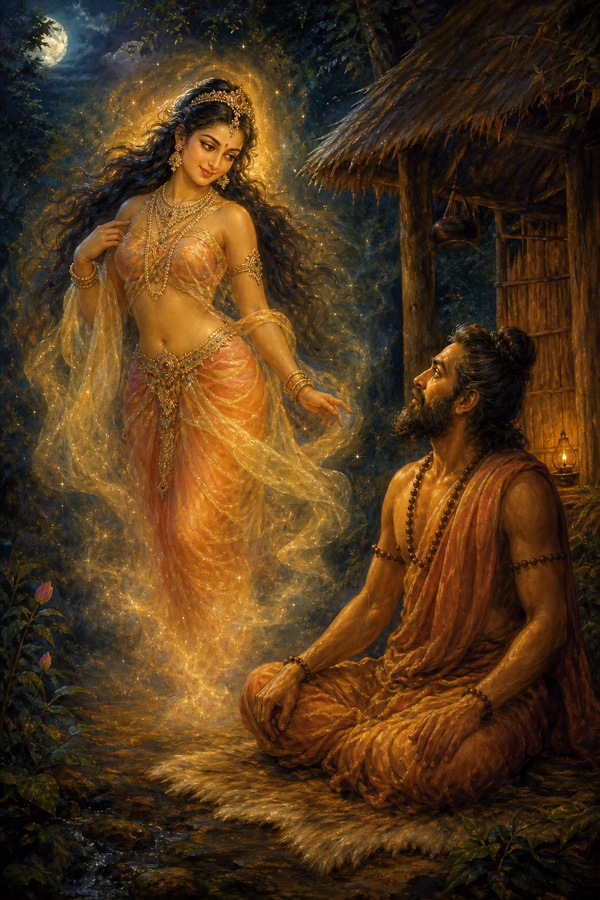
“I know the delights that abound in heaven,” Shikhidhvaja said. “But I have my heaven everywhere, and there is no particular place I count as heaven. I am content everywhere and pleased with every place; my soul wants nothing, being full in itself. If what you call heaven is to stay forever in one place and one state, then pardon me, for I decline it.” Indra tried once more. The wise who have known the knowable are indifferent to sensual gratification, he granted; still, it is not the part of the wise to reject an enjoyment that comes to them by the gracious allotment of destiny. The prince said nothing. “If you are resolved not to leave this place,” the god said, “then I must leave you here and take my way to heaven.” “I must not go there now,” the prince said. Indra took his leave, and he and the whole train of gods behind him vanished together, as the surges of the sea subside with their foam when the gale drops.
The princess took back the enchantment and was glad: he had stayed perfectly tranquil in the presence of Indra, fearless and unmoved by the persuasions of a god. “I will try once more, by some artifice or other, whether this prince is subject to the passions of anger or annoyance or any other feeling of the kind that only blindfolds the understanding.” With that intention she took the form of the chaste Madanika at the approach of night, when the moon was already up over the forest and the prince was sitting beside a river at his evening devotion. She went into her bower of twining creepers hung with garlands, lay down on a bed of flowers she had decked herself, and conjured a paramour onto the pillow beside her.
When his devotion was done the prince went looking for her through the gardens and groves, and found her at last asleep in the bower with a pretty lover’s arms around her neck. The young man’s hair hung loose on his shoulders, his beautiful body was smeared with sandal paste, and his chaplet of flowers had slipped off his head and rolled on the pillow; her braids fell in two folds on her golden shoulders. He saw the amorous pair with their smiling faces, kissing and embracing each other as ivy winds around a big tree, both of them infatuated and bruising their breasts on each other’s chests. Shikhidhvaja felt no change in himself at the sight. If anything, he was pleased to see them sleeping so happily in each other’s arms. “Remain as you are, lovers, to your hearts’ content,” he said. “I will put no obstacle in your way, nor make you afraid of me by my presence here.” And he withdrew.
At once she took back the charm and came out, and found the prince sitting on a crag of the mountain in the posture of intense meditation, with both his eyes open. She went to him with a bashful face and sat down silent at his side, with downcast eyes, as if ashamed of her misconduct. After a moment he came out of his meditation, turned his eyes on her, and spoke with an exceedingly sweet voice. “Lady, why have you come to me so soon and left off enjoying your happiness? Happiness is the end and aim of every being on earth. Go back to your lover and gratify him with all your endearments; mutual love is what everyone wants and almost no one finds. Do not think, madam, that I am angry or sorry about this affair at all. I am always content in myself, knowing the True One, which alone is to be known. My companion Kumbha and I are always dispassionate, and you, who were made a woman by Durvasa’s curse, are at liberty to do whatever you like without any displeasure from us.” Madanika pleaded her nature. Women are ten times more passionate than men, she said, and ought not to be scolded for gratifying what is natural to them; she was a frail woman and had found him absorbed in meditation, deep in the forest, at night, and could not choose otherwise than to take a partner; and forgiveness is the foremost mark of holiness. “Anger has no seat in my heart, my lovely,” he said, “as no plant grows in the sky. It is only for fear of incurring the ignominy of good people that I must decline to take you as my spouse. But I can keep company with you as before, in mutual friendship forever, with no yearning and no grudge in either heart.”
Chudala sat beside him and was overjoyed by the nobleness of his mind. “What transcendent tranquility my lord has gained; his dispassion has set him above anger, and he has attained his living liberation. No delight attracts his heart, no excellence allures his soul; he is not elated by pleasure or prosperity nor cast down by pain or calamity. Now is the proper time to bring everything about myself back to his memory: to give up the figure of Kumbha and show myself to him as Chudala.”
The Queen Reveals the Teacher
She shook off the shape of Madanika and took the complexion of Chudala on herself, and she came out as Chudala from inside the body of Madanika and stood confessed in front of him, like a jewel lifted out of its chest. The prince saw his own wife before him like a lotus opening in spring, and he stared at her in mute astonishment, and when he found his voice it faltered. “What are you, lotus-eyed maid, and where have you come from? Why have you come here, and how long have you been here, and for what purpose do you stay in this forest? Your gait and figure, your features and form, your sweet smile and manners, all tell me plainly that you are the very image of my wedded wife.” “So it is, my lord, just as you think. I am your princess Chudala, no doubt of it, who has met you today in her natural, undisguised form. I took on the counterfeit shapes of Kumbha and the others only to remonstrate with you on your mistaken course, and I used every art and stratagem to recall you to the right path. Ever since your foolish renunciation of your kingdom for austerities in the forest, I have had recourse to every art to reclaim you. Kumbha and the rest were no real persons; they were magical appearances before you, and you, who know the knowable, can discern the whole affair in your meditation. You will be convinced of it if you look into it by that light, and in no other way.”
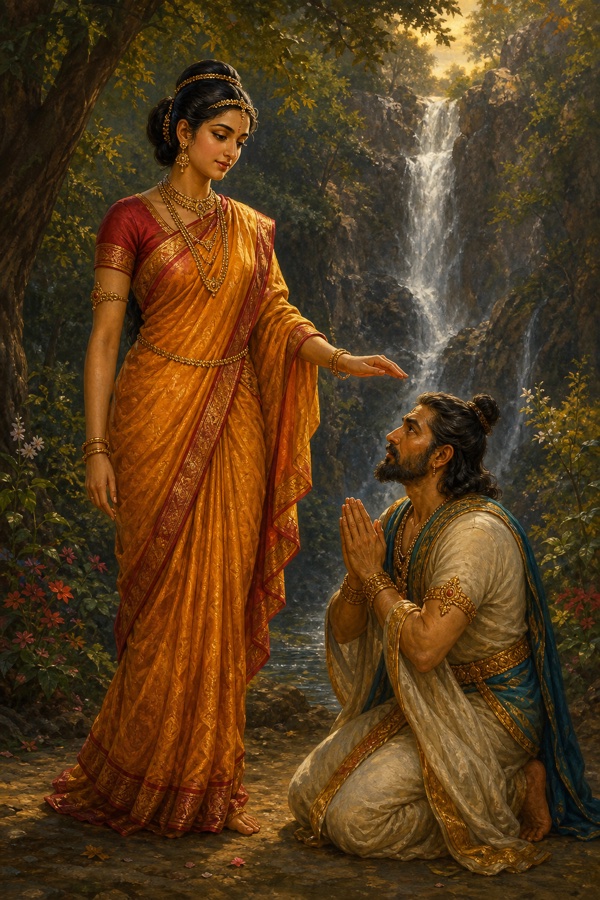
He sat down in the posture of meditation, and the whole affair rose and showed itself plainly to his mental vision, from the renunciation of his royalty to this meeting with Chudala at the end: the midnight bed, the twelve days, the cell at Mandara, the golden boy, the gem and the elephant, the fire, the climb up the crag, the lectures, the Sama Veda, the curse, the wedding, Indra, the bower. All of it in one moment of his meditation. He was glad in himself at the sight, and when it was over and his eyes were wide open again he rejoiced. He stretched out both arms with the hair standing up on his body, his face shining and the tears running down, and he held her to his chest a long time, the way a weasel holds its mate, until at last they came apart and sat staring at each other in a mute amazement with their hearts as light as two emptied pots. Then the prince put his hand under the chin of his lawful royal consort and spoke to her in soft words dripping with honey. “It is the true virtue of faithful wives to raise their fallen husbands, more than the sastras or learning or riches or the spiritual guide and his teaching can ever save a man from his degradation. A faithful and affectionate wife is of more service to her husband than a brother or a relation or any friend or servant, or even a guru. She is the raft on which her husband crosses the perilous ocean of the world. How shall I repay you, whom I now count the wisest and best of all the virtuous women in the world? I think Arundhati and the other ladies whose names are immortal for their virtues will be jealous of you when they learn of your chastity and your other admirable qualities. So let me hold you again.” And he did. Chudala said what she had to say in two sentences. “My lord, I was sorry to find you entirely devoted to your dry ceremonial duties, and that is why I took such pains to dissuade you from them and lead you to the knowledge of the intelligent soul. Now tell me, what shall we do in this place, and what is the use of extolling my virtues any further?”
“You are at liberty here to do whatever you think best,” he said; “it is the prerogative of respectable ladies to manage everything in their own way.” She tested him first. “Now that you know you are released from the net of this world, you must have seen that your past austerities were all in vain. You must know how empty it is to say, I do this or that, and I will get its reward; do you smile to think of those vagaries of your simple understanding? Do you see that they were the creatures of your avarice and your fancy, as unreal as mountains in the empty air? Tell me what you have learned after all, what you depend on, and what you seek now.” He answered that he stood where she stood. He had nothing to expect from anyone; he was that essence which exists as extinct everywhere; he was what he was and could not describe it. “I bow down to you as my instructor, because it is by your good grace that I have come across the turbulent ocean of the world. I am calm and easy, quiet and free of passion, undivided in attention, beyond all things, and situated as I am.” Then what, she asked, was now most agreeable to his noble disposition? “I know of nothing that is either delectable or detestable to me, good lady. I do as you do and am of exactly your mind in everything. I leave it to you to choose and do whatever you think proper for us. I will act as you act, like your shadow or your reflection in a mirror; my mind has no desire and no effort in it, and I will bear whatever comes. I will neither urge nor prevent nor praise nor blame anything you do.”
“If that is so,” Chudala said, “then listen to what is best to be done now. Set yourself to imitate the conduct of the living liberated. We are both as empty of desire as the empty sky is of people; and the thing I wish to do is the thing you do not wish at all. What man neglects his life and livelihood and lives in his intellect alone? There are three stages of human life, its beginning, its middle and its end, and we stand in the middle one and must do the duties of it before we go on to the last. We are prince and princess of a realm by birth, and it falls to us to rule our state and pass our days in the duties of our royalty until our end. Why do you let the feebleness and the hermitage of old age overtake you in the prime of your youth, when it is your duty to sit in your city and your palace and govern? And I will reign there as your consort queen, and every young girl in the city will dance for joy to see her prince and princess back in the palace, and the city with its flags up and its drums beating and its wreaths of flowers everywhere will look like a garden in spring.” The king answered with the simplicity that came of his frankness of soul. “If it is your pleasure to incite me to earthly pleasures, then tell me what cause I had to slight the heavenly happiness that the god Indra offered me.” “I too have no taste for earthly enjoyments, prince, and no great zest for grandeur. I have no relish for heavenly joys or earthly royalty, and I get no pleasure from the performance of virtuous and manly acts. My delight is in the undisturbed equanimity of my mind and the positive rest of my position. It is only after I have lost my feeling of pleasure in one thing and of pain in another that I gain my equanimity toward both, and settle in perfect rest.” “You have rightly said, with your calm and cool understanding, that it is all alike whether we get or lose a kingdom, since we take no lasting good from its gain and no great evil from its loss. Let us stay at ease, shunning every thought of pleasure and pain, free of envy and emulation and jealousy.” So the day went by in their endearments and their talk, and the two who had disdained the bliss of heaven slept in the same bed, loving and loved, and the long night went swiftly in a happiness that was like heaven.
The sun came up out of its casket and dispelled the dark, and the pair rose from their flower bed in the grotto of the gold-bright mountain and sat on cool leafy seats to say their morning prayers. Then Chudala stood up before a golden urn of water and bathed the prince with the waters of the seven oceans of the earth, as kings are consecrated. She seated him beside the sacred water pot facing the rising sun in the east, and there, in that sequestered retreat, she performed the rite of his installation in his kingdom. When the ceremony was done she said: “Now, my lord, leave off your quiet character of a muni, and take on the vigor of the eight rulers of the upper and the nether worlds.” He assented; he would do as she bade him and return to his realm with her. Then he turned to the princess standing in attendance on her newly installed lord. “Now, my dear, I will install you in the rank of queen regent in my turn, and in return for yours.” He had the holy ablution done in a pool close by and installed her as the reigning queen of his realm. Then he asked her to use the powers of her yoga and produce a force and retinue fit for their dignity, and the princess produced by her yoga a body of forces as large as the clouds of the rainy season: lines of horses and elephants, flags flying like scattered clouds, foot soldiers covering the forest floor, music ringing in the mountain caves, the flash of coronets driving the dark out of the sky. The royal pair mounted a royal elephant streaming with ichor and sat on the same seat, with the army on both sides of them. From Mount Mahendra the prince went on through mountains and flatlands, rivers, forests, and the habitations of men, and showed his consort, as they passed them, the places where he had stopped on his way out from the city, and in a little while they were there.
His chiefs and chieftains came out to meet their prince and welcomed him with shouts of victory, from joy, or from hope revived. He entered the city with his two regiments on either side and bands of musicians playing in concert with the singers and dancers. He went through the marketplace and looked at the beauty of the shops one after another, and groups of the city’s women hailed him and pelted him with handfuls of flowers and fried rice as he passed. Flags and banners flew on every side; strings of pearls hung over the doorways; the women of the city sang and danced all around, and it looked like Kailasa, the happy abode of the gods. He entered his palace with his whole retinue, was welcomed by his courtiers, gave due honor to all his servants, and dismissed the train as he went into the inner apartment. He ordered a festivity to be kept for a week, and then set himself to the management of the state’s affairs, and to his meditation in the inner apartment. He reigned over his realm for a thousand and ten rains. Then he and his royal consort set down the burden of their bodies at about the same time, and having quit his mortal frame he went out like a lamp with no oil, into the state from which the high-minded soul does not come back to be born again on earth. It was his equanimity, Vasistha said, his sama drishti, the even sight that looks at every person and thing in the same light, with no fear and no sorrow, no pride, no envy and no enmity, together with his observance of the duties he was born to, that gave him a peaceful reign of more than a thousand years and let him live and die beside the princess with whom he became extinct in the Deity at last. “Now, Rama, try to imitate this prince and be like him in everything. He enjoyed every enjoyment of life and lived a long life and came at last to his immortality. Pursue your own calling, and never be sorry at any accident in life. Be prompt and vigilant in your duties, and enjoy the prosperity of this world and the liberation of the spirit at once. Now I have told you the whole story of Shikhidhvaja, and I hope you will follow his example and set yourself free of every sorrow. Shut the visible world out of your sight, shut your passions up close inside your heart, and keep your mind dispassionate and fixed always on the supreme spirit. Rule your kingdom with the detachment of Shikhidhvaja, and so conduct yourself that the fruit of both worlds is yours. As Shikhidhvaja came by degrees to his enlightenment, so Kacha, the son of Brihaspati, received the light of his reason, as I will now tell you.”