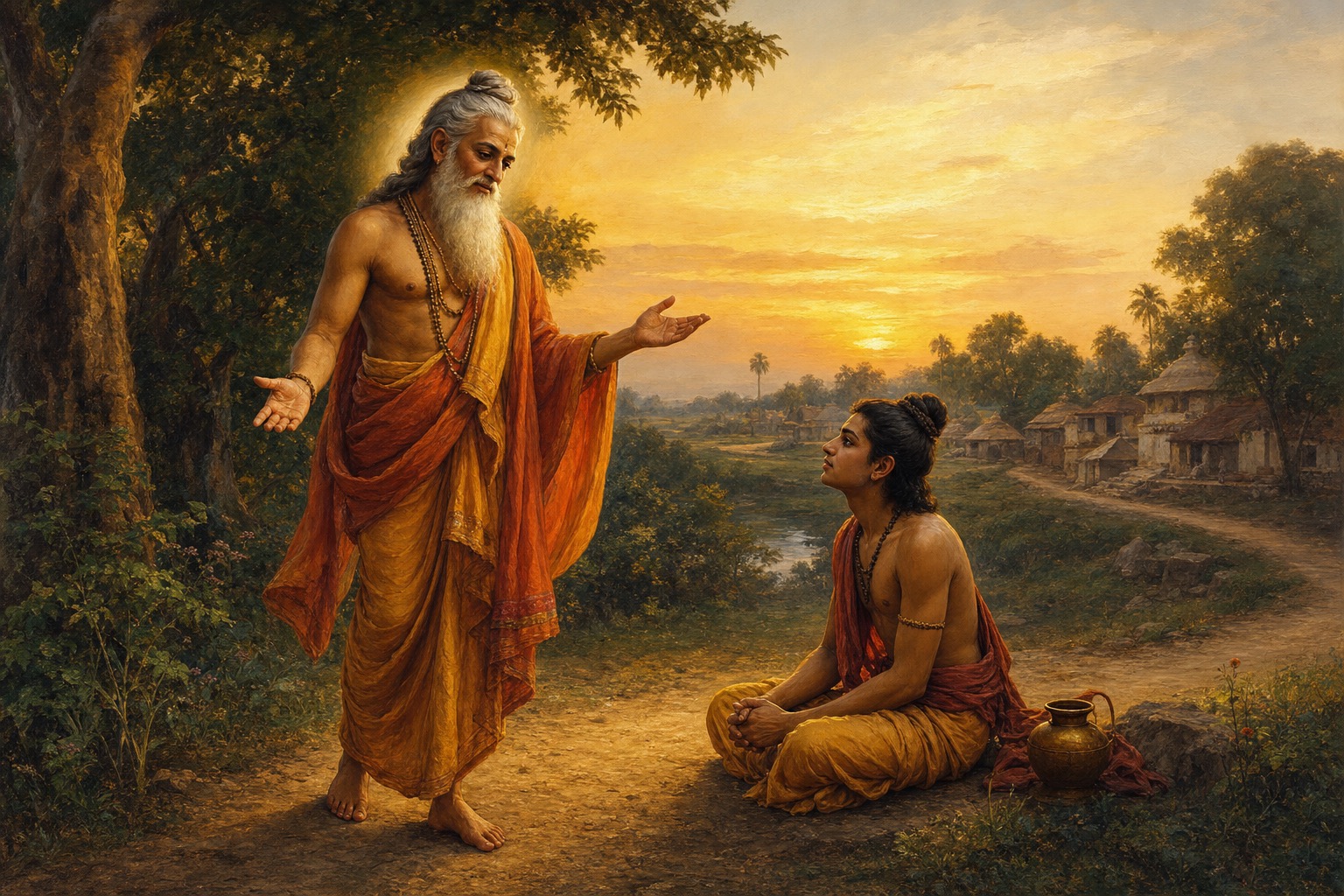
Jada Bharata told the king of Sauvira an old story, the story of the great sage Ribhu and his student Nidagha. Ribhu, a son of Brahma, was by his very nature a knower of the highest truth. Nidagha, son of Pulastya, was his student, and Ribhu had taught him the whole of true knowledge with great affection. Yet Ribhu saw that Nidagha, for all his mastery of the scriptures, had not come to rest in non-duality; the knot of separateness still held. On the bank of the river Devika stood a lovely, prosperous city called Viranagara, and there Nidagha lived. When a thousand divine years had passed, Ribhu went there to see his student.
At that hour, having finished the bali and vaishvadeva offerings, Nidagha stood at his door waiting for a guest. The moment he saw his teacher there, he led him inside with reverence, washed his hands and feet, seated him, and said, “Please eat.” Ribhu said, “Noble brahmin, what sort of food will your house set out? I have no taste for coarse fare.” Nidagha said, “There is sattu in the house, and barley porridge, roots and tubers and fruit, and sweet fried cakes; take whichever pleases you.” Ribhu said, “These are all ordinary foods. Serve me instead something delicious, made with halva, kheer, and fine sugar.” Nidagha spoke to his wife, and with great care she prepared a sweet and delicious meal, and the teacher ate it to his full content.
After the meal, Nidagha asked with great humility, “Tell me, are you full and satisfied? And tell me this too: where do you live, where are you going, where have you come from?” Ribhu smiled and said, “Hunger comes to one who can be hungry, and fullness to that same one; I am never hungry, so why ask about fullness? Hunger and thirst are conditions of the body; they have no claim on me. Well-being and contentment are conditions of the mind; the atman, the self, has no part in them. And as for what you asked, where I live and where I go, listen: the atman is all-pervading, like space itself, so what coming is there, and what going? I go nowhere, I come from nowhere, I dwell in no single place. In truth there is no ‘you,’ no ‘other,’ no ‘I.’ And this delicious meal you spoke of: the food that tastes pleasant today turns unpleasant in time, so what is truly savory and what is not? This body is a house of clay, and barley and wheat, ghee and milk, fruit and sweets are all earthen atoms that nourish it. Knowing this, make your mind look upon all things with an equal eye, for equanimity is the only means to moksha, to liberation.”
Hearing these words steeped in the highest truth, Nidagha bowed at his teacher’s feet and said, “Lord, be pleased with me. Who are you, who have come to grace me with your kindness? Hearing these words of yours, all my delusion has fallen away.” Ribhu said, “Twice-born one, I am your teacher, Ribhu; I came to instruct you because of the love you bear me. To hold the self as one and undivided in all things, this is the essence of the highest truth, and I have told it to you in brief.” Having said this, Ribhu left of his own accord.
Who Is Above, Who Is Below
Another thousand years passed, and again Ribhu came to that same city to give Nidagha knowledge. This time he saw the city’s king entering with a great army and much pomp. Drawn apart from the crowd, carrying kusha grass and firewood gathered in the forest, hungry and thirsty, Nidagha stood off to one side. Ribhu went up to him and said, “Twice-born one, why do you stand here alone like this?” Nidagha said, “The king is entering this lovely city today, the road is thick with crowds, and so I stand here.” Ribhu said, “You know everything about this place; tell me, which of them is the king and which are the others?” Nidagha said, “The one mounted on that rutting royal elephant, tall as a mountain, he is the king; all the rest are his retinue.”
Ribhu said, “You have shown me the king and the elephant together, but you have not told me the difference between the two. Tell me, which of them is the king and which the elephant?” Nidagha said, “The one below is the elephant, and the one above him is the king. Who does not know the relation of the one carried to the one who carries?” Ribhu said, “Even so, explain it to me this way: what does the word ‘below’ mean, and what do you call ‘above’?” At this Nidagha suddenly leaped up and sat astride Ribhu’s back and said, “Listen, I will show you exactly what you asked. Right now I am above, like the king, and you are below, like the elephant. I have shown you this illustration only to make it clear.” Ribhu smiled and said, “Best of the twice-born, if you are above like the king and I am below like the elephant, then tell me this as well: which of us two is ‘you,’ and which is ‘I’?”
With that question, Nidagha’s eyes opened. He climbed down at once, took hold of both his teacher’s feet, and said, “Surely you are my master, the great sage Ribhu! Who else could carry a mind so seasoned in non-duality? You have come to me again as my teacher.” Ribhu said tenderly, “Nidagha, before this you honored me greatly with your service and your attentive care; for that same love I have come once more to instruct you. Listen: to hold the self as one and undivided in all things, this is the essence of the highest truth. Know this whole world as the single form of Vasudeva, the Supreme Self; in it there is no division at all.” Nidagha said, “Very well,” and bowed, and his teacher Ribhu left of his own accord. Through that teaching Nidagha too grew intent on the contemplation of non-duality; he came to see all living beings as one with himself, and in the end he reached the supreme state of moksha.
Having told this story, Jada Bharata said to the king of Sauvira, “Just as that Brahman-devoted Nidagha won supreme moksha, so too you can be free in this very life, holding the same regard for enemy and for friend. As one and the same sky looks white and blue to a deluded eye, so one and the same self appears in the form of difference. Whatever exists in this world is all a single imperishable self; give up this delusion of seeing difference.” Hearing only this much, the king of Sauvira let go of the idea of difference, and taking refuge in the vision of the highest truth, he was liberated in that very life.
Source: Vishnu Purana (Gita Press, Gorakhpur)