On this page
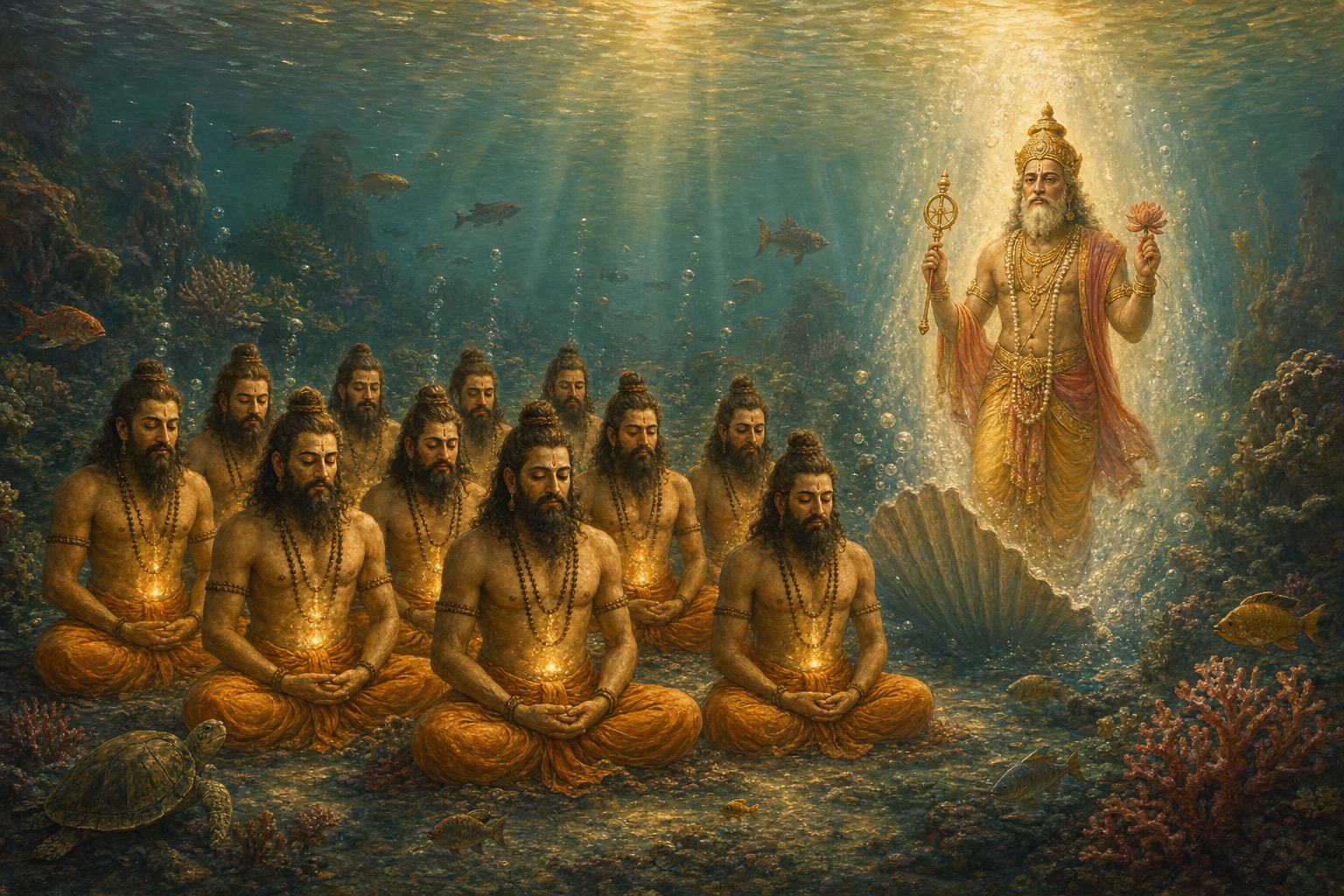
In the line of Prithu, generations later, there arose a great Prajapati named Prachinabarhi. In his time the yajnas were so many that the sacred kusha grass, its tips pointing east, spread across the whole earth, and for that reason he came to be called “Prachinabarhi.” By Savarna, the daughter of the ocean, he had ten sons, all renowned by the name Prachetas, and all masters of the science of archery.
One day, moved by the will of the Prajapati above him, their father Prachinabarhi summoned them and spoke with grave affection. “My sons, Brahma, the god of gods, has commanded me to increase the peoples of the earth, and I have given him my word. So, for my contentment, take up the work of increase, and do it with care.” The sons asked, “Father, by what act will we be equal to this? Explain it to us.” Their father said, “It is by the worship of Vishnu, the giver of boons, that a man wins what he longs for. If you desire success, then worship Govinda, the lord of all beings.”
Thousands of years of tapas beneath the sea
Having received their father’s command, all ten Prachetas sank beneath the waters of the ocean and began their tapas with great care. Fixing their minds on Narayana, the refuge of every world, they praised the Lord there within the water for ten thousand years, their attention single and unbroken. They called him the form of time, the form of the moon, the form of the sun, the form of fire and of wind, and the seed of the entire universe, and again and again they bowed before him. They went on saluting that imperishable supreme state which is neither long nor short, neither gross nor subtle, which neither the gods know nor the sages.
Pleased by this tapas of ten thousand years, the Lord Shri Hari appeared to them there within the water, in a divine form whose glow was that of a blue lotus in full bloom. Seeing Shri Hari mounted upon Garuda, the Prachetas bent low under the weight of their devotion. The Lord said, “I am pleased. Ask the boon you desire.” The Prachetas bowed and made the very request their father had voiced, the boon of increasing the peoples of the earth. Granting them the boon they wished, the Lord vanished, and they rose up out of the water.
The burning of the trees and the truce of Soma
Through all these years, while the Prachetas were absorbed in their tapas, the earth lay without a guardian, and the trees overran it, and a great part of the peoples perished. The trees had risen so thickly that they filled the very sky, so that no wind could move and no creature could so much as stir. Rising from the water and seeing this, the Prachetas were seized with fury, and from their mouths they loosed wind and fire. The wind tore the trees up by their roots and dried them, and a raging fire burned them to ash.
Watching this terrible ruin of the forests, when only a few trees were left standing, their king Soma, the sovereign of all trees, came to the Prachetas and said, “O kings, let your anger cool. I will make a truce between you and the trees. Here is Marisha, a girl born of the trees, lovely of complexion and precious as a jewel. Knowing what was to come, I nourished her long ago with my own rays and raised her. She was brought forth for this very purpose, to be your wife and increase your line. From half my radiance and half yours, from her womb will be born a Prajapati named Daksha, who, blazing like fire, will multiply the peoples of the earth in abundance.”
The story of Marisha
Then Soma told the story of Marisha’s birth. In an age long past there lived a sage named Kandu, the greatest among the knowers of the Vedas. On the exquisite bank of the Gomati he performed a fierce tapas. To break that tapas, Indra sent an apsara named Pramlocha, and she of the sweet smile drew the great rishi from his path. Enchanted by her, he lived for hundreds of years in the caves of Mount Mandara, lost in the pleasures of the senses.
One day Pramlocha said, “Brahmin, now I wish to return to the world of the gods; give me your leave.” The sage, still bound to her, said, “Stay a few days more.” At his word the beautiful woman remained another hundred years, tasting one pleasure after another. Each time she spoke of leaving, the rishi said the same thing, “Stay a little longer.” One day he stepped out of the hut in great haste, and she asked, “Where are you going?” The sage said, “The day is setting; I must now perform the evening worship, or my daily observance will be lost.” She laughed. “O knower of all dharma, has your day set only today? This day has come to its close after many, many years.” The rishi was startled. “But you arrived only today.” Pramlocha said, “What you say would be right, except that nine hundred and seven years, six months, and three days have passed since that time.”
Hearing this, the sage felt disgust with himself. At first he began to lay the blame on the woman, then he steadied himself and said, “What fault is hers in this? The fault is entirely my own, for it was I who failed to master my senses.” Then he said to Pramlocha, “Go now. Depart to wherever your heart desires.” Sent away with repeated reproaches, she left the hermitage, and as she traveled the path of the sky she wiped her sweat upon the leaves of the trees. In that moment the embryo the rishi had placed in her body came out of her too, in the form of sweat. The trees received that embryo, the wind gathered it, and Soma nourished it with his rays. And so, from the tips of the trees, was born a fair-faced girl named Marisha.
Soma went on to tell that in a former life this virtuous woman had been a great queen. When her husband died while she was still without a son, she satisfied the Lord Vishnu by the strength of her devotion. Pleased, the Lord appeared before her and told her to ask a boon. Then she said, “Lord, having been widowed as a child, my birth has come to nothing. Grant me, in birth after birth, husbands worthy of praise and a son the equal of a Prajapati; and let me be born rich in family, character, truth, generosity, and virtue, beautiful, and brought forth without issuing from a mother’s womb, not born of the womb at all.” The Lord granted the boon. “In a single birth you will have ten valiant husbands, and at that same time you will win a son of great might, the equal of a Prajapati.” That same queen has now been born from the trees in the form of Marisha.
The birth and lineage of Daksha
At Soma’s word the Prachetas let their anger settle, and they took Marisha as their wife. From the womb of Marisha, by all ten Prachetas, was born Daksha the Prajapati, who had earlier come forth from Brahma himself. Here a doubt rose in Maitreya. “This Daksha who was first born from the thumb of Brahma, how did he then become the son of the Prachetas? And being the grandson of Soma through a daughter, how did he become Soma’s father-in-law?” Parashara explained, “Maitreya, the birth and destruction of living beings go on without pause, flowing like a river. These beings, Daksha among them, appear in age after age and then dissolve again; among them there is no fixed order of elder and younger. In that time it was tapas and power alone that made one senior.”
Obeying the command of Brahma, Daksha first brought forth, by the power of his mind, beings such as the rishis, the gandharvas, the asuras, and the serpents. When the peoples did not increase by this, he resolved to marry Asikni, the ascetic daughter of the Prajapati Virana, and to bring forth offspring through the law of union. By Asikni he first begot five thousand sons, called the Haryashvas. Seeing them eager to increase the peoples, the divine sage Narada went to them and said, “O Haryashvas, you do not yet know even the middle, the upper, and the lower regions of this earth; how then will you create its peoples? Go first and see where this earth ends.” Hearing this, they scattered in every direction and, like rivers that run into the sea, they never returned.
Then Daksha begot by Asikni a further thousand sons, the Shabalashvas. Narada said the very same thing to them, and they too went off in all directions along the path of their brothers and did not return. Learning this, Daksha in his anger laid a curse upon Narada. Then, wishing to increase creation, he brought forth sixty daughters by Asikni. Of these he gave ten to Dharma, thirteen to Kashyapa, twenty-seven to Kala, that is, to the Moon, four to Arishtanemi, and the rest to Bahuputra, Angira, and Krishashva. From the children of these very daughters arose all beings: the gods, the daityas, the nagas, cattle, birds, gandharvas, apsaras, and danavas. Maitreya, it was from the time of Daksha that the peoples began to be born through union; before this, offspring came into being through the mere will, the glance, or the touch of accomplished men.
Source: Vishnu Purana (Gita Press, Gorakhpur)