At your own pace
A quiet start
A supported seat, a simple hand gesture, and the natural breath. These are three optional guides to explore at your own pace. You can stop after any one.
Before you begin
Before you begin
A stable chair.
A little space.
Use a sturdy chair without wheels on a non-slip floor. Your feet should rest flat, with your knees near a right angle. Secure the chair against a wall for standing work. Keep breathing; use a comfortable range and stop if you feel pain, dizziness, or unusual breathlessness. Seek urgent medical help for chest pressure, sudden weakness, or severe shortness of breath. If you are pregnant, recovering from surgery, or managing a heart, blood-pressure, eye, spinal, or balance condition, ask your clinician about suitable modifications. This is educational guidance, not a substitute for medical care or individual instruction.
If you have osteoporosis or a vertebral fracture, seek individualized guidance before spinal bending or twisting; use the modifications advised for you.
Guidance: NCCIH, NHS seated exercise, and Too Fit To Fracture.
Find your seat
Seated
Seated Mountain
adapted from tāḍāsana
Find a steady seated base and make space for comfortable movement.
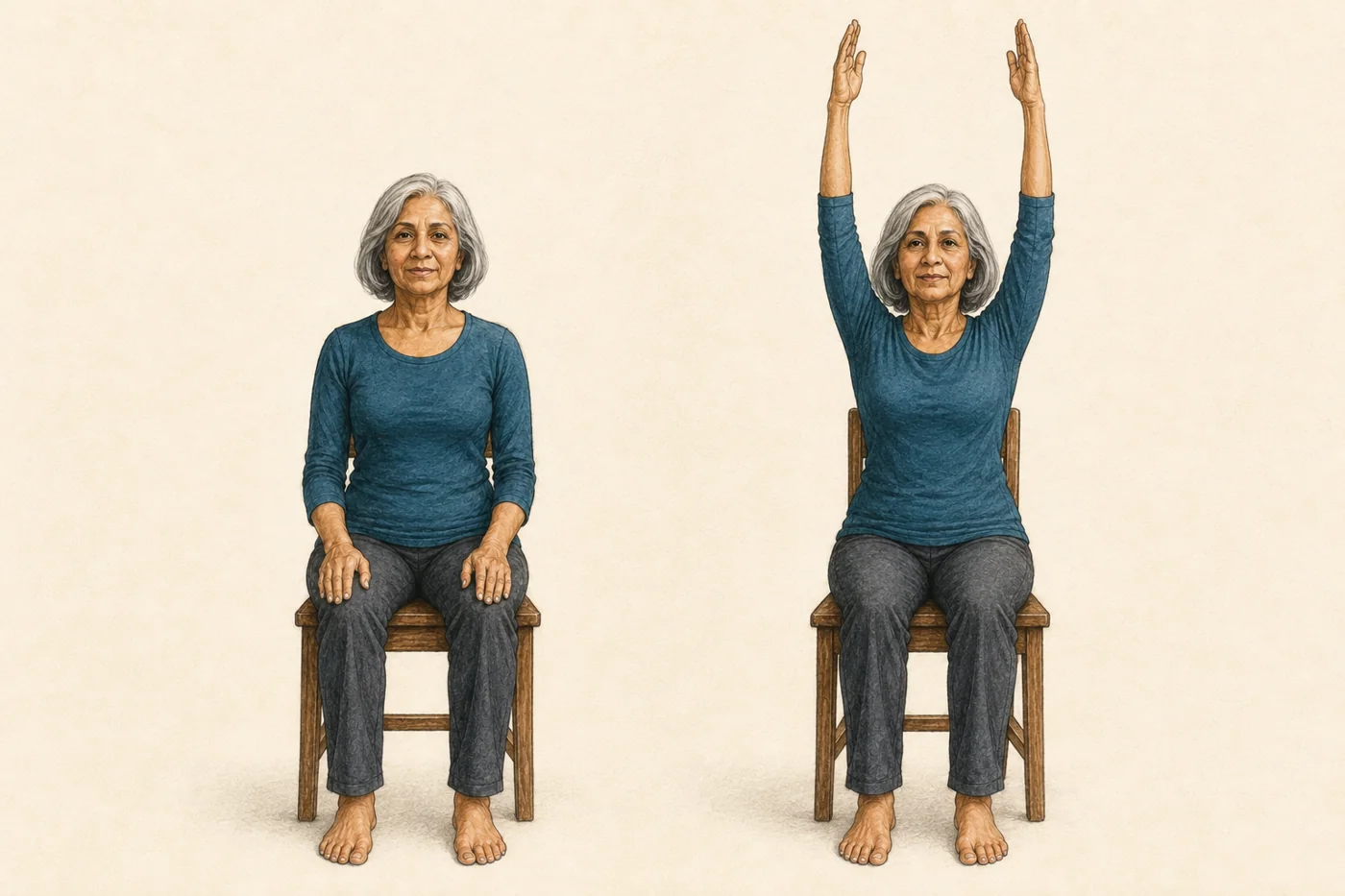
Set up
Sit near the front half of the chair. Place feet hip-width apart, knees over ankles, and hands on the thighs.
The movement
- Inhale and lengthen from the sitting bones through the crown.
- Exhale and soften the ribs over the pelvis while the feet press evenly into the floor.
- Inhale and reach the arms forward and overhead within a comfortable shoulder range.
- Exhale and return the hands to the thighs without collapsing the chest.
Breath & pace
Hold the upright seat for 3 to 5 breaths.
Understanding the practice
Tadasana is a standing shape; here it is adapted to the support of a chair. Attention stays on keeping a settled base and an easy length together, without straining the body.
Chair adaptations from Rajiv Lulla’s practice guide. See the general exercise and safety references.
Background and sources
Sources & teaching context
Exercise guidance and traditional references serve different purposes. Traditional descriptions are not clinical evidence.
- Yoga: Effectiveness and Safety
NCCIH. General guidance on yoga, beginners, modifications, and safety.
- Sitting exercises
NHS. Chair selection and introductory seated exercise.
- Strength exercises
NHS. Introductory strength movements, including the wall press-up.
- Older Adult Activity Guidelines
CDC. Strength and balance as part of a broader physical-activity pattern.
- Too Fit To Fracture
Giangregorio and colleagues. Consensus recommendations, including individualized spine-sparing movement.
Rest your hands
Let the meeting of the hands mark a small pause in your day. Feel their contact and give your attention to the moment you are in.
 Enlarge image
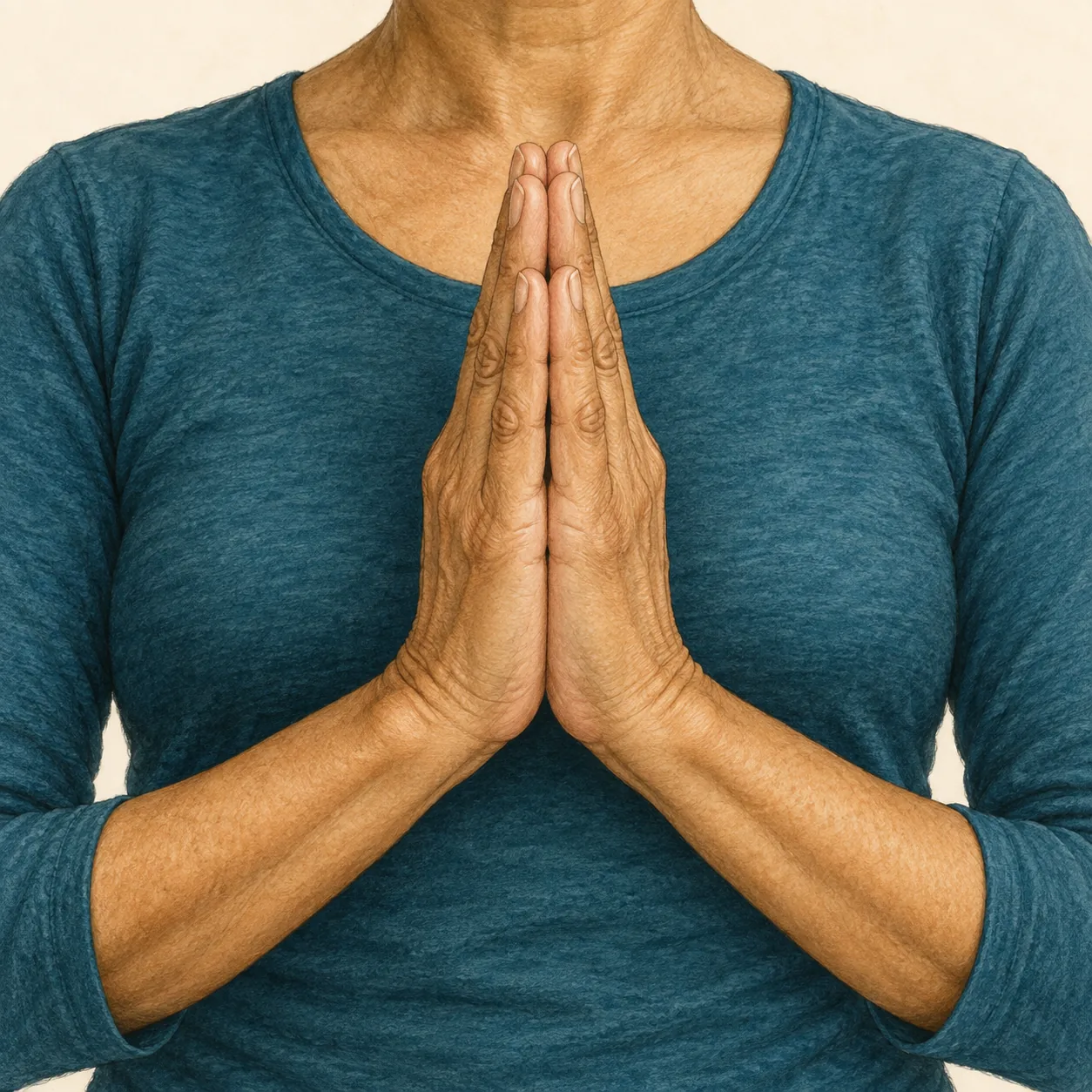
Anjali: palms meet lightly, fingers upward.
Settle in
Sit comfortably on a chair or in a seated position you already use. Let the shoulders settle.
Start with your hands resting on your thighs and your face relaxed.
Place your hands
- Bring both hands in front of your chest, palms facing each other.
- Let the palms and fingers meet lightly, with the fingers pointing upward.
- Keep the hands near the center of your chest and allow the elbows to relax downward.
- Soften the pressure between the palms until the gesture feels easy to maintain.
Breath and attention
Let the breath come and go naturally. If you wish, notice an incoming breath and the outgoing breath that follows, without trying to meet a count.
What to notice
- Where do you feel the contact between the two hands?
- Can the shoulders and jaw stay relaxed while the hands meet?
Finish gently
Separate the palms, lower both hands to your thighs, and let the fingers rest.
Make it easier
Hold the hands a little lower or leave some space between the palms. Comfortable contact is enough.
Take care
Avoid forcing sore fingers straight or pressing the palms flat. Release the gesture if pain, numbness, or increasing strain appears.
Sources and meaning
The teaching sources use joined hands in the prayer position. Joseph LePage identifies this as Anjali and relates it to reverence and devotion. This seated introduction adapts that hand position for a quiet pause. You may bring a sense of greeting, gratitude, or attentive presence to it.
- Art of Living: Sun Salutation · Step 1: Pranamasana (Prayer pose)
- Sivananda International: The Sun Salutation · Step 1: prayer position in front of the chest
- Joseph LePage: The Universe of Mudras, Part I · Opening discussion: Anjali, hands together in front of the heart
- British Museum: figure with joined hands in Anjali · Object 1919,0717.80
Notice the breath
Begin here
Natural Breath Awareness
Settle into your seat and notice the breath you already have.
Set up
Sit comfortably with your feet supported. Rest your hands on the thighs. Keep your eyes open or softly lowered.
How to practice
- Notice the next inhale and exhale without changing their depth or speed.
- Let the shoulders and jaw soften. You do not need to take a bigger breath.
- When attention wanders, gently return to the feeling of breathing.
- Finish by noticing your feet and the support of the chair.
Breath & pace
Stay for a few comfortable breaths. There is no target count and no breath hold.
Understanding the practice
Sooner or later the mind wanders off, and you will see it go. Noticing that and coming back belongs to this beginning practice. Nothing here asks you to produce a special experience, a sense of emptiness, or a state free of thought.
An original introductory attention practice, written for beginners.
Sources and scope
Main edition
Passage for this reading
- YOGA, October 2020
“Importance of Breath Awareness,” printed pp. 36 to 38.
Bihar School of Yoga. “Importance of Breath Awareness,” pp. 36 to 38; “Bhramari,” pp. 49 to 50. Teaching statements are not adopted as medical claims.
- Basic Practice of Some Pranayamas
“Pranayamas for contemplation and meditation,” PDF p. 5.
Ananda Balayogi Bhavanani, International Centre for Yoga Education and Research. Source page numbering refers to the PDF; hand descriptions compared independently.
What this edition covers
A modern introductory adaptation with complete guidance and source comparisons.
Limits and differences
The prose above identifies material differences. Traditional explanations and promised attainments are attributed to their sources; they are not clinical evidence. Review date: September 11, 2026.
These complete instructions are also available in their individual guides. Their teaching sources and adaptations remain beside the practice.