On this page
What midnight looked like: a copper face, an eight-wheeled chariot, and Ghatotkacha in front of Karna
It was the dead of night on the fourteenth day of the war, and the two armies were still fighting by the light of lamps and torches. Far from the field the blind king Dhritarashtra sat listening to Sanjaya, his charioteer, to whom the sage Vyasa had given sight of everything that happened at Kurukshetra. Sanjaya had just told him that Ghatotkacha, the son Bhima had fathered on the Rakshasa woman Hidimba, was driving at Karna. The old king’s sons were on that field and Karna was the fighter they leaned on, and he wanted to hear all of it. “How did that battle go,” he asked, “when Karna, Vikartana’s son, and the Rakshasa Ghatotkacha met each other at dead of night? What did that fierce Rakshasa look like? What kind of chariot did he ride? What were his horses like, and his weapons? How large were his horses, and the standard on his chariot, and his bow? What armor did he wear, and what did he have on his head? I am asking you, Sanjaya, and you are skilled at telling. Describe it all.” Sanjaya gave it to him as he had seen it. Ghatotkacha was a giant with blood-red eyes and a face the color of copper. His belly was low and sunken. The hair on his body bristled upward. His head was green, his ears were shaped like arrows, and his cheekbones stood high. His mouth was huge and ran from ear to ear, full of sharp teeth, four of them long and pointed. His tongue and his lips were very long and coppery, his brows stretched far across his face, and his nose was thick. His body was blue and his neck was red. He stood as tall as a hill and was terrible to look at: a vast frame, vast arms, a vast head, and the strength to go with them. He was ugly and hard-limbed, with the hair of his head tied upward in a frightful shape, wide hips and a deep navel, and yet for all his size his body was lean around the middle. The ornaments on his arms were made to his scale, and he wore armlets, this master of illusion. On his chest sat a breastplate like a ring of fire on the side of a mountain. On his head was a bright diadem of gold, well proportioned in every part and curved like an arch. His earrings shone like the morning sun, his garlands were of bright gold, and over his body he wore an enormous coat of brass armor that gave off a strong light.
His chariot was hung with a hundred tinkling bells, and from its standard flew many blood-red banners. It was a huge thing, a full nalwa in measure, covered in bearskins and loaded with every kind of heavy weapon. It carried a tall standard, it was wreathed in garlands, it ran on eight wheels, and its clatter was like the roar of clouds. The horses that drew it were like maddened elephants, red-eyed and dreadful, of many colors, very fast and very strong. They never tired. Long-maned, neighing again and again, they carried him into the fight. His driver was a Rakshasa too, with terrible eyes, a fiery mouth and blazing earrings, and in his hands the reins shone like rays of the sun. With that driver beside him Ghatotkacha came on like Surya, the sun god, with his charioteer Aruna. The standard on the chariot rose so high that it touched the sky, and it looked like a tall mountain with a great cloud wrapped around it. A dreadful flesh-eating vulture with a blood-red body perched on top of it. He came drawing his bow hard, a bow whose twang was like Indra’s thunder, whose string was very tough, and which measured twelve cubits long and a cubit across. He filled every quarter of the sky with arrows as long as a chariot’s axle, and so he rushed at Karna on that night that killed so many heroes. He stood proudly on his chariot and stretched the bow, and the twang that came from it sounded like rolling thunder. The Kaurava troops, Sanjaya told the king, were frightened by him, and all of them shook like the heaving waves of the sea.
Karna watched that frightful, wild-eyed Rakshasa come at him, and he seemed to smile. Radha’s son, as men called him after the foster mother who raised him, moved at once to stop him. The Rakshasa was smiling too. Karna drove in and struck back at him from close range, the way one elephant meets another, or the bull that leads one herd meets the bull of another herd. The clash between Karna and the Rakshasa was terrible, Sanjaya said, like the clash of Indra and the Asura Shambara. Each took up a formidable bow with a loud twang and struck the other and covered him with powerful arrows. They drew their bows to the full and shot straight shafts that tore them both and went through their coats of brass mail. They kept tearing at each other with arrows and with darts as long as axles, like two tigers with their teeth or two great elephants with their tusks. They pierced each other’s bodies, took aim at each other, and burned each other with clouds of arrows, until no one could bear to look at them. Their limbs were pierced and torn and running with streams of blood, and they looked like two hills of chalk with rivulets running down their sides. Both were great chariot fighters. Both struggled with all their strength, both were full of sharp-pointed arrows, each was tearing the other, and neither could make the other flinch. For a long time that fight in the night between Karna and the Rakshasa went on evenly. They seemed to be playing a game with life itself as the stake. Ghatotkacha aimed his sharp arrows and shot them with the whole of his strength, and the twang of his bow frightened friend and enemy alike. In that hour, Sanjaya told the king, Karna could not get the better of Ghatotkacha.
Seeing how it stood, Karna, who knew weapons better than any man alive, called celestial weapons into being. Ghatotkacha saw a celestial weapon aimed at him and called up his Rakshasa illusion in answer. All at once he was seen in the middle of a large force of dreadful-looking Rakshasas armed with lances, great rocks, hills and clubs. He came on with a mighty weapon raised in his hands, like the Destroyer of all creatures carrying his fierce and fatal club, and every king there was struck with fear. He roared like a lion, and at the sound the elephants passed urine and every fighting man shook. Then a thick rain of rocks and stones began to fall on every side. The Rakshasas poured it down without a pause, for it was midnight, the hour at which their kind grow stronger. Iron wheels fell without end, and bhushundis, and darts, lances, spears, shataghnis and axes. Faced with that fierce and terrible battle, all the kings fled in fear, and Dhritarashtra’s own sons with them, and the fighting men. One man among them did not shake. Karna was proud of the power of his weapons, and it was a noble pride. With his arrows he destroyed the illusion that Ghatotkacha had called up. Ghatotkacha saw his illusion scattered and was filled with rage, and he began to shoot deadly arrows, meaning to kill the Suta’s son, the charioteer’s son, as Karna was also called. Those arrows went through Karna’s body in that dreadful fight and came out bathed in blood and buried themselves in the earth like angry snakes. Karna, enraged in his turn and very quick with his hands, got the upper hand and put ten arrows into Ghatotkacha. They struck him in his vital parts and the pain was great. He took up a celestial wheel with a thousand spokes. Its rim was as sharp as a razor, it shone like the morning sun, and it was set with jewels and gems. Bhima’s son hurled it at the son of Adhiratha, meaning to finish him. It was a wheel of great power and it had been thrown with great force, yet Karna cut it to pieces with his arrows, and it fell with its purpose defeated, like the hopes and plans of an unlucky man. Ghatotkacha, furious at seeing his wheel fail, covered Karna with showers of arrows as Rahu covers the sun. Karna showed no fear. He had the prowess of Rudra, or of Indra’s younger brother, or of Indra himself, and in a moment he had buried Ghatotkacha’s chariot under winged arrows.
A key to reading this (measures and names): A nalwa is an old measure of length, four hundred cubits. The axle is the beam on which a chariot’s wheels turn, so an arrow as long as an axle is a very long arrow. The cubit that measures Ghatotkacha’s bow runs from the elbow to the tip of the little finger. Karna goes by many names in this chapter. He is Vikartana’s son and Vaikartana. He is Radha’s son and Adhiratha’s son after the foster parents who raised him, and the Suta’s son because they belonged to the Suta order, the charioteers. Indra’s younger brother is Vishnu. Bhushundis and shataghnis are heavy weapons of war, and the name shataghni means a killer of a hundred.
The gist: Dhritarashtra asks what the Rakshasa looked like, and Sanjaya describes him whole, from the copper face and green head to the eight-wheeled chariot, the vulture on the standard and the bow twelve cubits long. The duel that follows stays even for a long time. Karna calls up celestial weapons and Ghatotkacha answers with Rakshasa illusion, a rain of rocks and iron that sends the Kaurava kings running and leaves Karna standing alone. Karna breaks the illusion, cuts a thousand-spoked wheel to pieces in the air, and buries Ghatotkacha’s chariot under arrows.
A hundred heads, a body the size of a thumb, and a mountain that rained weapons: Ghatotkacha’s illusions and Karna’s unshaken smile
Ghatotkacha whirled a mace worked with gold and hurled it at Karna, and Karna cut it apart with his arrows and brought it down. Then the giant Rakshasa rose into the sky, roaring as deep as a bank of clouds, and from up there he poured down a shower of whole trees. Karna shot upward and pierced Bhima’s son, that master of illusions, where he hung in the sky, the way the sun pierces a mass of cloud with its rays. He killed every one of Ghatotkacha’s horses and cut his chariot into a hundred pieces, and then he poured arrows on him like a cloud pouring rain. Soon there was no space two fingers wide on Ghatotkacha’s body that an arrow had not entered, and the Rakshasa looked like a porcupine with its quills raised. He was so completely buried in arrows that Sanjaya and the men around him could no longer see the horses, the chariot, the standard or Ghatotkacha himself. Then, with a weapon of his own, Ghatotkacha destroyed Karna’s celestial weapon, and from that moment he fought the Suta’s son with illusion, moving with tremendous speed. Showers of arrows fell out of the sky from no source that anyone could see. Bhima’s son, whose power of illusion was very great, took on a fierce shape and began to daze the Kauravas. He grew many fierce, grim heads and with them began to eat Karna’s celestial weapons. A little later the huge Rakshasa was seen lying on the field with a hundred wounds in his body, limp, to all appearance dead, and the leading Kauravas took him for dead and shouted aloud for joy. Soon afterward he was seen on every side of them, darting about in new shapes. He took a monstrous form with a hundred heads and a hundred bellies, like Mount Mainaka. He shrank to the size of a thumb and moved sideways, or shot upward like the swelling surge of the sea. He tore down through the earth, came up again on its surface, and dived into the waters. He was seen in one place, and the next moment he was seen in another. When he had wandered by his illusion through the earth and the sky and every quarter of the compass, he came down out of the air and was seen standing in armor on a chariot decked with gold. He drove up close to Karna’s chariot with his earrings swinging and spoke to him without fear. “Wait a little, Suta’s son. Where will you go to save your life from me? Today, on this field, I will cure you of your wish to fight.” With that the Rakshasa, cruel in his strength, his eyes red as copper with anger, rose into the sky and laughed aloud.
He began to strike at Karna like a lion striking a prince of elephants. He poured arrows on him, each as long as a chariot’s axle, as a cloud pours rain on a mountain, and Karna destroyed that shower while it was still far off. Ghatotkacha saw this illusion broken as well. He made another and vanished. In his place stood a high mountain with many peaks, thick with tall trees, and from that mountain poured unbroken streams of lances, spears, swords and clubs. Karna looked up at it hanging in the sky, a mountain like a great heap of black antimony with fierce weapons running down it in streams, and he was not disturbed in the least. Smiling, he called up a celestial weapon, and that weapon cut the huge mountain apart and destroyed it. Then the fierce Ghatotkacha turned himself into a blue cloud with a rainbow in it, high in the sky, and rained stones on the Suta’s son. Karna, who was also called Vrisha, aimed the Vayavya weapon, the weapon of the wind, and destroyed that cloud of missiles. Then he covered every quarter with countless arrows and destroyed a weapon that Ghatotkacha had aimed at him. Bhima’s mighty son laughed loudly and called up one more illusion against Karna, an all-powerful one. This time Karna saw him coming without fear in the middle of a great company of Rakshasas who had the prowess of lions, tigers and maddened elephants. Some rode elephants, some rode chariots and some were on horseback, and they carried weapons of every kind and wore armor and ornaments of every kind. Ghatotkacha came among those fierce Rakshasas like Indra among the Maruts, and Karna, great bowman that he was, set about fighting him fiercely.
Ghatotkacha put five arrows into Karna and gave a terrible roar that frightened all the kings. Then he shot an Anjalika arrow and cut the bow in Karna’s hand, and with it the flight of arrows Karna had just loosed. Karna took out another bow, a strong one that could bear great strain and was as large as Indra’s own, and drew it with all his force. He shot gold-winged, deadly arrows at the Rakshasas who ranged the sky, and those broad-chested giants, hurt by his arrows, milled about like a herd of wild elephants set upon by a lion. Karna destroyed them with his arrows, and their horses and their elephants with them. He looked then like the god Agni consuming all creatures when the universe is dissolved. When that Rakshasa host was gone, the Suta’s son shone like Maheshvara in heaven after he had burned the triple city of the Asuras. On the Pandava side stood kings in their thousands, Sanjaya said, and there was only one among them who could so much as look at Karna in that hour. That one was Ghatotkacha. The prince of the Rakshasas had terrible energy and strength, and in his rage he looked like Yama himself, the god of death. Flames seemed to start from his eyes, like burning drops of oil falling from a pair of lit torches. He struck palm against palm and bit his lower lip, and he was seen once more on a chariot that his illusion had made. A team of asses drew it, creatures as large as elephants with the faces of Pishachas. “Take me to the Suta’s son,” he told his driver in his anger. And on that dreadful chariot he drove out once again to meet Karna in single combat.
In his rage the Rakshasa hurled at him an Ashani, a thunderbolt that Rudra himself had made, a terrible thing fitted with eight wheels. Karna set his bow down on his chariot, jumped to the ground, caught the Ashani and hurled it back at Ghatotkacha. Ghatotkacha had already leaped down from his chariot. The blazing Ashani burned that chariot to ashes with its horses, its driver and its standard, then drove into the earth and vanished in its depths, and the gods were filled with wonder. Every creature applauded Karna, who had leaped from his chariot and caught that weapon in his hands. With the feat done he climbed back up and began to shoot again. No other living being, Sanjaya told the king, could do what Karna did in that frightful battle. Karna’s arrows struck Ghatotkacha as torrents of rain strike a mountain, and once more the Rakshasa disappeared from the field, melting away like a shape of mist in the sky. So the fight went on. The giant Rakshasa, by his speed and by his power of illusion, destroyed Karna’s celestial weapons, and Karna, seeing them destroyed, felt no fear and kept fighting the man-eater. Then Bhima’s mighty son, in his anger, divided himself into many, and every great chariot fighter of the Kuru army was terrified. Lions came onto the field, and tigers and hyenas, and snakes with tongues of fire, and birds with iron beaks. Ghatotkacha himself, huge as Himavat, the king of mountains, was struck by the sharp arrows from Karna’s bow and vanished on the spot. Then a crowd of Rakshasas, Pishachas and Yatudhanas, and with them wolves and leopards in great numbers, all with frightful faces, rushed at Karna to eat him. They came on howling fiercely to frighten him. Karna shot every one of those monsters through with swift-winged, terrible arrows that drank their blood, and at last, with a celestial weapon, he destroyed the Rakshasa’s illusion. Then with straight, fierce arrows he struck Ghatotkacha’s horses. They fell to the ground before their master’s eyes with their limbs broken and maimed and their backs cut open. Hidimba’s son saw his illusion gone, and once more he made himself invisible. “I will bring about your death, and soon,” he said to Karna as he went.
A key to reading this (weapons and comparisons): The Anjalika is a kind of arrow. The Vayavya is the weapon of the wind, and so it blows a cloud apart. The Ashani is a thunderbolt hurled as a weapon, and this one is of Rudra’s making and runs on eight wheels. Vrisha is another name of Karna. Mainaka is a mountain, the son of Himavat, and it has a hundred heads. The triple city is the city of the Asuras that Maheshvara, who is Shiva, burned with a single arrow. The Maruts are the gods who attend Indra. Pishachas and Yatudhanas are kinds of demons that come with the Rakshasas.
The gist: The duel becomes a contest of illusions. Karna kills Ghatotkacha’s horses and cuts his chariot to pieces, and the Rakshasa answers by eating Karna’s weapons with many heads, lying as if dead, and rising again in a hundred shapes. He becomes a mountain and then a cloud, brings a Rakshasa army, cuts Karna’s bow, and hurls Rudra’s eight-wheeled thunderbolt. Karna breaks each illusion with a celestial weapon, destroys the Rakshasa host, and catches the thunderbolt in his hands and throws it back. Ghatotkacha vanishes with a promise to kill him soon.
Alayudha comes for the blood of Baka, Kirmira and Hidimba: Duryodhana’s welcome, a clash with Ghatotkacha, and a mace fight with Bhima
While Karna and the Rakshasa were fighting, another Rakshasa prince came onto the field. This was the valiant Alayudha, and he went to Duryodhana with a large force behind him, many thousands of frightful Rakshasas of every shape, all of them brave. An old quarrel with the Pandavas had brought him. Bhima had killed his kinsmen, the valiant Baka who used to eat Brahmins and the powerful Kirmira, and had killed his friend Hidimba too. Alayudha had waited a long time, brooding on that quarrel. Now he had heard that a battle was raging in the night, and he came wanting to kill Bhima in the fight, like a maddened elephant or an angry snake. Eager for battle, he spoke to Duryodhana. “You know how Bhima killed my kinsmen, the Rakshasas Baka, Kirmira and Hidimba. What more need I say? Long ago he took the maidenhood of the Rakshasa girl Hidimba, with no regard for us or for the other Rakshasas. I have come here, king, to kill that Bhima with all his followers, his horses, his chariots and his elephants, and to kill Hidimba’s son along with his friends. Today I will kill all the sons of Kunti, and Krishna, and the others who go before them, and I will eat them and all their followers. Order all your troops to stop fighting. We will fight the Pandavas.” Duryodhana was very glad to hear it. He stood among his brothers and accepted the Rakshasa’s offer. “We will put you and yours in the front and fight the enemy with you,” the king said. “My troops will not stand by and watch. Their hatred has not cooled.” “So be it,” said the Rakshasa chief, and he set off quickly toward Bhima with his army of man-eaters.
Alayudha’s body blazed, and he rode a chariot as bright as the sun. It was the match of Ghatotkacha’s chariot in every way. Its rattle was as deep, many arches adorned it, bearskins covered its great bulk, and it measured a nalwa. His horses, like Ghatotkacha’s, were very fast; they were shaped like elephants and brayed like asses. They fed on flesh and blood, they were enormous, and a hundred of them were yoked to his chariot. The rattle of his chariot was as loud and strong as his rival’s, and his bowstring was as tough. His arrows were as big as Ghatotkacha’s too, winged with gold, whetted on stone and as long as axles. He had arms as mighty as Ghatotkacha’s. The standard on his chariot shone like the sun or like fire, and vultures and ravens perched on it as they did on Ghatotkacha’s. He was the handsomer of the two, and his face, worked upon by anger, seemed to burn. His armlets blazed, and so did his diadem and his garlands. He wore wreaths of flowers and a headdress and a sword, and he was armed with a mace, with bhushundis, short clubs and plows, and with bows and arrows. His skin was as black and hard as an elephant’s. Riding that chariot bright as fire, wounding the Pandava host and driving it back, he looked like a cloud drifting across the sky, shot through with lightning. As he came on, the chief kings of the Pandava army, strong men with swords and shields and coats of mail, went into the fight with glad hearts.
The Kauravas were filled with delight when they saw Alayudha, a Rakshasa of terrible deeds, come to fight for them. Dhritarashtra’s sons, with Duryodhana at their head, were as glad as men with no raft who want to cross the ocean and are given one. The kings of the Kuru army felt like men reborn after death, and they all gave Alayudha a respectful welcome. They had reason to. The battle in the night between Karna and the Rakshasa was terrible, beyond the power of men, fierce and yet a delight to watch, and the Panchalas and all the other Kshatriyas on the Pandava side had been looking on with smiles, like spectators. The Kaurava soldiers, Sanjaya told the king, had been wailing aloud that all was lost, though Drona and Drona’s son and Kripa and the other leaders were guarding them all across the field. Every one of those warriors, seeing what Hidimba’s son could do, was shaken with fear, crying out in distress and nearly out of his senses. The troops had given up hope of Karna’s life. Duryodhana saw that Karna was in great distress, and he called Alayudha to him. “There is Karna, Vikartana’s son, fighting Hidimba’s son and doing things in battle that are worthy of his strength and courage. Look at those brave kings lying there, killed by Bhima’s son with every kind of weapon, like trees an elephant has broken. Among all my royal warriors, let this be your share of the battle. I give it to you, with your leave. Show your prowess, hero, and kill this Rakshasa. See to it that this wretch Ghatotkacha, trusting to his powers of illusion, does not kill Karna before you finish him.” “So be it,” said the fierce and strong-armed Rakshasa, and he rushed at Ghatotkacha. Bhima’s son let Karna go and began to grind down the enemy coming at him with arrows. The two Rakshasa princes fought in their anger like two maddened elephants in the forest fighting over the same she-elephant in her season. Karna, freed from the Rakshasa, drove at Bhima on his chariot bright as the sun.
Bhima saw Ghatotkacha locked in battle with Alayudha and suffering in it, like the bull of a herd fighting a lion. He paid no attention to Karna, who was coming at him, and rushed toward Alayudha on his own sun-bright chariot, scattering clouds of arrows. Alayudha saw him coming, let Ghatotkacha go, and turned on Bhima himself. Bhima, who had killed so many Rakshasas, charged hard and covered the Rakshasa prince with arrows, and Alayudha covered Kunti’s son again and again with straight arrows whetted on stone. All the other Rakshasas rushed at Bhima as well. They were terrible to look at and armed with every kind of weapon, and they wanted victory for Dhritarashtra’s sons. Strong as he was, Bhima met that attack by putting five sharpened arrows into each of them. Those evil-minded Rakshasas, received in that way, wailed aloud and fled in every direction. The mighty Alayudha saw his followers frightened off by Bhima. He charged and covered Bhima with arrows, and Bhima weakened him with many sharp-pointed shafts. Of the arrows Bhima shot at him, Alayudha quickly cut down some and caught the others in his hands. Then Bhima, whose prowess was a terror, looked steadily at the prince of the Rakshasas and hurled a mace at him with the force of thunder. It flew at him like a flame of fire. The man-eater struck it with a mace of his own, which knocked Bhima’s mace aside and flew on toward Bhima. Kunti’s son covered the Rakshasa prince with showers of arrows, and the Rakshasa stopped every one of them with sharp arrows of his own. Then all those dreadful Rakshasa warriors rallied at their leader’s command and came back to the fight, and they began to kill the elephants of Bhima’s force. The Panchalas and the Srinjayas, the horses and the great elephants of that force were sorely hurt by the Rakshasas and fell into confusion.
Krishna, who drove Arjuna’s chariot in this war, was watching that terrible battle between Bhima and the Rakshasa, and he spoke to Arjuna. “Look, Bhima is going under to that prince of the Rakshasas. Go quickly after Bhima, son of Pandu, and think of nothing else. Meanwhile let Dhrishtadyumna and Shikhandi, Yudhamanyu and Uttamaujas, great chariot fighters all, join with the sons of Draupadi and go against Karna. Let Nakula and Sahadeva and the valiant Yuyudhana kill the other Rakshasas at your order. As for you, hold this division that has Drona at its head. The danger that threatens us now is great.” When Krishna had spoken, those leading chariot fighters went as they were ordered, some against Karna and some against the other Rakshasas who were fighting for the Kurus. Then the valiant prince of the Rakshasas drew his bow to its full stretch and, with arrows like snakes of deadly poison, cut Bhima’s bow in two. Before Bhima’s eyes the mighty man-eater then killed his horses and his driver with sharpened arrows. Bhima, with no horses and no driver, came down from the platform of his chariot. He gave a loud roar and hurled a heavy mace at his enemy. It flew at Alayudha with a terrible sound, and the mighty man-eater stopped it with a mace of his own and roared back. Bhima watched that powerful and terrible feat and was filled with joy, and he took up another fierce mace. The battle between the man and the Rakshasa grew dreadful. The earth shook violently as their maces came down and clashed. They threw their maces aside and closed again, and they struck each other with clenched fists that fell with the sound of thunder. In their rage they went at each other with chariot wheels and yokes, with axles, chariot floors and chariot fittings, with anything that came to hand. Both were covered in blood as they fought, and they looked like a pair of huge maddened elephants. Krishna, who always worked for the good of the Pandavas, saw how that fight stood and sent Hidimba’s son to protect Bhima.
A key to reading this (Alayudha’s grievance): Bhima killed all three of the Rakshasas Alayudha names. He killed Hidimba, whose sister, also called Hidimba, bore Bhima his son Ghatotkacha. He killed Baka, the eater of Brahmins, at the town of Ekachakra, and he killed Kirmira, Baka’s brother, during the forest exile told in the Vana Parva. Yudhamanyu and Uttamaujas are the two warriors who guard the wheels of Arjuna’s chariot, and Yuyudhana is another name of Satyaki. The text names the pieces of wrecked chariot that Bhima and Alayudha swing at each other: wheels, yokes, axles, adhishthanas and upaskaras. Krishna’s orders in this scene send Dhrishtadyumna and Shikhandi against Karna, and they are still fighting him when Ghatotkacha comes back to Karna later in the night.
The gist: While Karna is hard pressed by Ghatotkacha, a second Rakshasa comes to Duryodhana. Alayudha wants Bhima’s blood for Baka, Kirmira and Hidimba, and his chariot, horses, arrows and standard match Ghatotkacha’s own. Duryodhana gives him Ghatotkacha as his share of the battle. Karna, set free, drives at Bhima. Bhima ignores Karna and attacks Alayudha to help his son. Krishna gives new orders: Dhrishtadyumna and Shikhandi go against Karna, the twins and Satyaki against the Rakshasas, and Arjuna is to follow Bhima and hold Drona’s division. Bhima loses his bow, horses and driver and fights Alayudha with maces, with fists and with pieces of chariots, until Krishna sends Ghatotkacha to his father’s side.
Krishna’s order: leave Karna, kill Alayudha first; two Rakshasas fight with trees and hills, and Baka’s brother’s head lands at Duryodhana’s feet
The man-eater was bearing down on Bhima in that fight, and Krishna went to Ghatotkacha. “Look, strong-armed one,” he said. “The Rakshasa is pressing Bhima hard in battle, before the eyes of all the troops and before your own. Leave Karna for now and kill Alayudha quickly. You can kill Karna afterward.” Ghatotkacha heard those words from Krishna of the Vrishni race and left Karna. He went against Alayudha, the prince of man-eaters, the brother of Baka, and the battle in the night between those two Rakshasas, Sanjaya told the king, grew fierce and dreadful. Around them the rest of the fighting went on. Satyaki, great chariot fighter that he was, and Nakula and Sahadeva shot down Alayudha’s warriors with sharp arrows; these were brave Rakshasas, terrible to look at and armed with bows. Arjuna, with the diadem on his head, shot his arrows in every direction and overthrew many of the leading Kshatriyas. Karna meanwhile threw into confusion many kings and many great chariot fighters among the Panchalas, Dhrishtadyumna and Shikhandi and the others who led them. Bhima saw them being cut down by Karna and rushed toward him at once, shooting as he came. Nakula and Sahadeva and Satyaki finished killing the Rakshasas and went to the place where the Suta’s son was. All of them began to fight Karna, while the Panchalas took on Drona.
Alayudha, in a rage, struck Ghatotkacha on the head with a huge parigha, a club of iron. Under that blow Bhima’s son, for all his strength, seemed to fall half into a swoon, and he sat down and did not move. Then he came to himself and hurled at his enemy a mace worked with gold and hung with a hundred bells, bright as a blazing fire. He threw it with great force, and it crushed Alayudha’s horses, his driver and his loud-rattling chariot to pieces. Alayudha turned to illusion and leaped down from that chariot, whose horses, wheels, axles, standard and pole had all been crushed. Trusting to his illusion, he poured down a heavy shower of blood. The sky seemed to be covered over with a mass of black clouds lit by flashes of lightning. A thunderstorm was heard, with loud cracks and the loud roaring of clouds, and a sharp clattering noise ran through that dreadful battle. Ghatotkacha saw the illusion the Rakshasa had made, rose into the air, and destroyed it with an illusion of his own. Alayudha, seeing his illusion destroyed by his enemy’s, began to pour a heavy shower of stones on Ghatotkacha, and Ghatotkacha scattered that terrible shower with a shower of arrows. Then they rained every kind of weapon on each other: iron parighas and spears, maces, short clubs and mallets, pinakas and swords, lances, long spears and kampanas, sharp arrows both long and broad-headed, discs and battle-axes, iron balls and short arrows, weapons with heads like the heads of cattle, and heavy mortars. They tore up great spreading trees of many kinds and struck each other with them, shami and pilu and karira and champaka, ingudi and badari and flowering kovidara, arimeda and plaksha, banyan and peepul. They fought with the peaks of mountains too, and with metals of many kinds. The crash of those trees and mountain peaks was as loud as the roar of driving thunder.
The battle between Bhima’s son and Alayudha, Sanjaya told the king, was dreadful in the extreme, like the battle fought long ago between Vali and Sugriva, the two princes of the monkeys. They struck each other with arrows and with fierce weapons of many other kinds, and with sharp scimitars. Then the two mighty Rakshasas ran at each other and each seized the other by the hair. Those two giants, with many wounds on their bodies and blood and sweat running down them, looked like two great masses of cloud pouring rain. Then Hidimba’s son rushed in at speed. He whirled the Rakshasa high in the air, dashed him to the ground, and cut off his great head. He took up that head with its pair of earrings and gave a loud roar. The Panchalas and the Pandavas saw Baka’s giant brother lying dead and began to shout like lions. With the Rakshasa fallen, the Pandavas beat drums by the thousand and blew conchs by the ten thousand. The night was lit by torches on every side and rang with the sound of instruments. It was very bright to look at, and in that hour it seemed plainly to promise the Pandavas victory. Then Bhima’s mighty son threw the head of the dead Alayudha down in front of Duryodhana.
Duryodhana looked at the brave Alayudha’s head, and he was filled with dread for his whole army. Alayudha had come to him of his own accord, remembering his old quarrel, and had told him that he would kill Bhima in battle. The Kuru king had taken Bhima’s death for a certainty, and he had believed that his brothers would all live long because of it. Bhima had sworn an oath to kill Duryodhana and every one of his brothers. Now Alayudha lay dead, killed by Bhima’s own son, and to the king that oath looked as good as fulfilled already.
A key to reading this (the feud): Sanjaya calls Alayudha the brother of Baka, the Rakshasa Bhima killed at Ekachakra. Kirmira, another brother of Baka, and Hidimba, Alayudha’s friend, also died at Bhima’s hands, and that old quarrel is what brought Alayudha to Duryodhana unasked. A parigha is a heavy club of iron. Pinaka and kampana are names of weapons that the text gives without describing them. Vali and Sugriva are the monkey brothers whose story is told in the Vana Parva, where Rama kills Vali and makes Sugriva king.
The gist: Krishna takes Ghatotkacha off Karna and sends him against Alayudha to save Bhima. The two Rakshasas match illusion with illusion and stones with arrows, hurl weapons, uprooted trees and mountain peaks, and end by seizing each other by the hair. Ghatotkacha whirls Alayudha up, dashes him down, cuts off his head and throws it in front of Duryodhana. The king had counted on Alayudha’s promise to kill Bhima, and now he sees Bhima’s oath against himself and his brothers as good as kept.
A red cloud in the sky and a Kuru army running; the Vasavi dart in Karna’s hand, and the fall of Ghatotkacha, which crushes an akshauhini
Ghatotkacha was filled with delight at having killed Alayudha. He stood at the head of the army and sent up shout after shout, roars loud enough to make elephants tremble, and a great fear entered the hearts of the Kaurava warriors. Karna had not been idle. While Bhima’s son was busy with Alayudha he had rushed at the Panchalas. He drew his bow to the full and put ten strong, straight arrows each into Dhrishtadyumna and Shikhandi, and with many other powerful arrows he made Yudhamanyu, Uttamaujas and the great chariot fighter Satyaki reel. They struck at Karna from every side, and their bows were seen bent into circles. The twang of their bowstrings and the rattle of their chariot wheels ran together that night into a sound as loud and deep as the roar of clouds at the end of summer. The battle in the night, Sanjaya said, was like a gathering bank of storm cloud. The bowstrings and the wheels were its thunder, the bows were its flashes of lightning, and the showers of arrows were its rain. Karna stood unmoved as a hill, with the strength of a king of mountains, and destroyed that wonderful shower of arrows as it came at him. He was devoted to the good of Dhritarashtra’s sons, and he struck at his enemies with lances that had the force of thunder and with whetted arrows on fine wings of gold. Soon he had broken and cut down the standards of some and pierced and torn the bodies of others with sharp arrows. Some lost their drivers and some their horses. Many of them, badly hurt by the Suta’s son, fell back into Yudhishthira’s division.
The sight of them broken and forced to retreat drove Ghatotkacha mad with rage. He mounted his splendid chariot, decked with gold and jewels, roared like a lion, drove up to Karna, and pierced him with arrows that struck like thunder. The two of them began to fill the sky with barbed arrows and cloth-yard shafts, with frog-faced arrows, nalikas, dandas and ashanis, with arrows headed like a calf’s tooth or a boar’s ear, with broad-headed shafts, shafts pointed like horns and shafts with heads like razors. The gold-winged arrows blazed as they flew level across the sky in that storm, and the sky looked as if it had been hung with garlands of beautiful flowers. Each was the other’s equal in prowess, and they struck each other equally with powerful weapons. No one could find any sign in that fight that either of those two fine fighters was the better. Karna was the son of Surya, the sun god, and his battle with Bhima’s son under that thick, heavy shower of weapons was beautiful to see, a sight with hardly an equal, like the fierce meeting of Rahu and the sun in the sky. When Ghatotkacha, a master of every weapon, found that he could not get the better of Karna, he called up a fierce and mighty weapon. With it the Rakshasa killed Karna’s horses first and then his driver. As soon as he had done that, Hidimba’s son made himself invisible.
Dhritarashtra broke in. “When that Rakshasa, who fought by trickery, disappeared in that way, tell me, Sanjaya, what did the warriors of my army think?” Sanjaya told him. When they saw the Rakshasa disappear, all the Kauravas said aloud, “That Rakshasa fights by deceit. He will show himself again, and then he will surely kill Karna.” Karna, whose hands were wonderfully quick with his weapons, covered every side with showers of arrows. That thick shower made a darkness in the sky, and nothing living could be seen through it. So quick were the hands of the Suta’s son that no one could tell when his fingers touched his quivers, when he set his arrows to the bowstring, or when he aimed and let them fly. The whole sky seemed to be shrouded in his arrows. Then the Rakshasa called up a fierce and terrible illusion in the sky. Sanjaya and those with him saw overhead what seemed to be a mass of red cloud, like the fierce flame of a blazing fire. Flashes of lightning came out of that cloud, and many burning brands, and tremendous roars like the noise of thousands of drums beaten at once. Things began to fall from it: many arrows winged with gold, and darts, lances, heavy clubs and other weapons of that kind, battle-axes, scimitars washed in oil, axes with blazing edges, spears, spiked maces that gave off bright rays, handsome maces of iron, long darts with sharp points, heavy maces decked with gold and wound about with cord, and shataghnis on every side. Great rocks fell from it, and thousands of thunderbolts with loud cracks, and many hundreds of wheels and razors as bright as fire. Karna shot shower after shower of arrows and could not destroy that thick, blazing downpour of darts, lances and clubs. A loud uproar rose from falling horses killed by those arrows, from great elephants struck by the thunderbolts, and from great chariot fighters whose lives the other weapons took. Duryodhana’s army, wounded on every side by Ghatotkacha’s terrible shower, was seen wandering over the field in great pain. Crying out in misery, their spirits gone, the wandering troops seemed about to be wiped out. Their leaders had noble hearts and did not turn their faces from the field and run. Yet when Dhritarashtra’s sons saw that frightful shower of great weapons, made by the Rakshasa’s illusion, falling on the field, and saw their vast army being cut down without a pause, a great fear came over them.
Hundreds of jackals began to cry, with tongues that blazed like fire and terrible yells. The Kaurava warriors saw Rakshasas yelling overhead and were filled with distress. Those dreadful Rakshasas had tongues of fire, blazing mouths and sharp teeth, and bodies as huge as hills. They stood in the sky with darts in their fists, like clouds pouring down rain. The troops began to fall, struck and crushed by fierce arrows, darts and lances, by maces and spiked clubs that blazed, by thunderbolts, pinakas, ashanis, discs and shataghnis. The Rakshasas poured down on Duryodhana’s warriors long darts, and treacle, and shataghnis, and pillars of black iron wound with cords of jute. Every fighting man was stunned. Brave warriors began to drop on the field with their weapons broken or slipping from their grip, with their heads gone or their limbs shattered. Horses, elephants and chariots were crushed under the falling rocks. The Yatudhanas, dreadful shapes that Ghatotkacha had made by his power of illusion, went on pouring down that thick shower of great weapons, and they spared neither the men who were terrified nor the men who begged for mercy. Death himself had brought on that cruel slaughter of Kuru heroes, that destruction of Kshatriyas, and in the middle of it the Kaurava warriors suddenly broke and ran, shouting as they went, “Run, Kauravas! All is lost! The gods, with Indra at their head, are killing us for the sake of the Pandavas!” There was no one then who could rescue the sinking Bharata troops. In that fierce uproar, that rout and destruction of the Kauravas, the camps lost the marks that told them apart and one side could not be told from the other. The soldiers had no thought for one another in their flight, and wherever a man looked the field seemed empty. Only Karna could be seen there, drowned in that shower of weapons. He covered the sky with his arrows and fought on against the Rakshasa’s celestial illusion. The Suta’s son was a modest man, and he was doing the hardest and noblest of deeds, and he kept his head in that battle. All the Saindhavas and Bahlikas looked at him in their terror, the one man who still had his wits about him. They watched the Rakshasa triumph, and all of them paid honor to Karna.
Then Ghatotkacha hurled a shataghni fitted with wheels, and it killed Karna’s four horses at a single stroke. They sank to the ground on their knees, with their lives gone and their teeth, eyes and tongues gone with them. Karna jumped down from his horseless chariot. He saw the Kauravas running away, and he saw that the Rakshasa’s illusion had defeated his own celestial weapon. Even then he kept his senses. He turned his mind inward and began to consider what he should do next. All the Kauravas were looking at Karna and at that terrible illusion, and they cried out to him. “Karna, kill the Rakshasa with your dart, and do it quickly. The Kauravas and the sons of Dhritarashtra are about to be wiped out. What will Bhima and Arjuna do to us? Kill this wretched Rakshasa who is devouring us all at dead of night. Those of us who come through this dreadful fight today will live to fight the sons of Pritha. So kill this terrible Rakshasa now, with the dart that Indra gave you. Karna, do not let these great warriors, the Kauravas, these princes who are like Indra himself, all be destroyed in this battle in the night.” Karna saw the Rakshasa alive in the dead of night and the Kuru army struck with fear, and he heard its loud wailing, and he set his heart on throwing the dart. He was burning with rage like an angry lion and could not bear the Rakshasa’s attacks any longer. Wanting Ghatotkacha dead, he took up that dart which gave victory and could not be resisted. For years he had kept it and paid it worship, saving it to kill Arjuna in battle. Shakra himself, Indra, the king of the gods, had given it to the Suta’s son in exchange for his earrings, and in Karna’s hand it would kill one powerful enemy and then go back to the god who gave it. It was a blazing, terrible missile wound about with cords. It seemed to thirst for blood, and it looked like the very tongue of the Destroyer, or like the sister of Death himself. That terrible, shining dart, called Naikartana, Karna now hurled at the Rakshasa.
The Rakshasa saw that splendid, blazing weapon in the hands of the Suta’s son, a weapon that could pierce the body of any enemy. He was afraid, and he fled, swelling his body until it was as huge as the foot of the Vindhya mountains. Every creature in the sky cried aloud at the sight of that dart in Karna’s hand. Fierce winds began to blow, and thunderbolts fell on the earth with loud cracks. The shining dart destroyed Ghatotkacha’s blazing illusion and went straight through his chest. Then it flew up into the night and entered a constellation of stars. Ghatotkacha had fought many brave warriors, Rakshasas and men, with many beautiful weapons. Now he gave one terrible roar after another and fell, his life taken by Shakra’s dart. One more wonderful thing he did for the destruction of his enemies. At the moment the dart pierced his heart he shone like a great mountain or a mass of cloud. Bhima’s son, whose deeds had been so frightful, took on that terrible and awful shape and came down. Dying, he fell on a part of Dhritarashtra’s army and crushed those troops under the weight of his body. He wanted to help the Pandavas even then. He dropped fast, his giant body still growing as it fell, and with his last breath he killed a full akshauhini, a whole army division, of the Kaurava troops. A loud uproar went up, made of lion roars, the blare of conchs and the beating of drums and cymbals. The Kauravas had seen the Rakshasa’s illusion destroyed and the Rakshasa himself killed, and they shouted aloud for joy. The Kurus honored Karna as the Maruts honored Shakra after the killing of Vritra. He mounted Duryodhana’s chariot behind the king and rode into the Kuru host with every eye upon him.
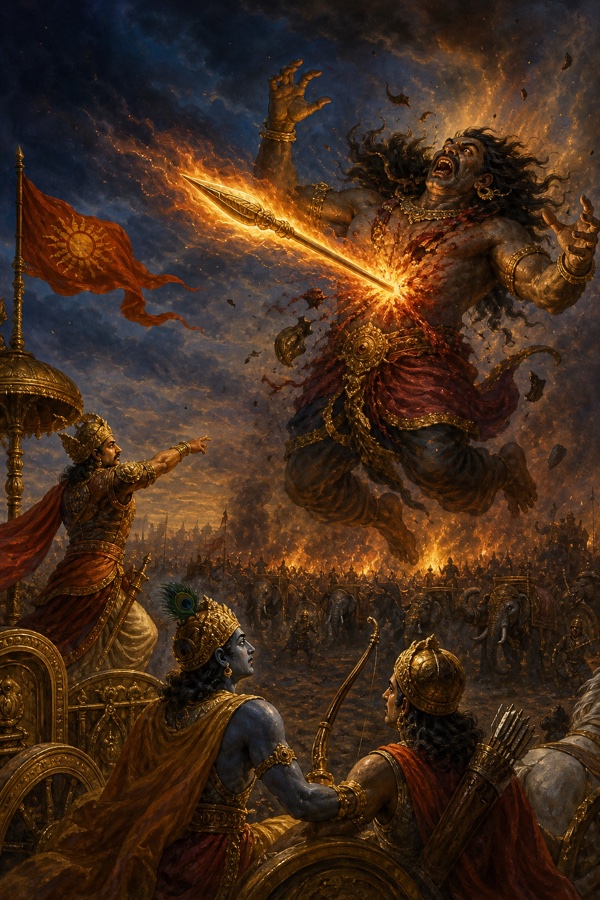
A key to reading this (the dart): This is the dart Indra gave Karna in the Vana Parva. Indra came to him in the guise of a Brahmin and asked for the armor and the earrings he had been born with, and Karna asked for an unfailing dart in exchange. Indra gave it on terms: in Karna’s hand it would kill one powerful enemy and then return to Indra. Karna kept it for Arjuna. The text calls the dart Naikartana here. Shakra and Vasava are names of Indra. A shataghni is a weapon whose name means a killer of a hundred, and Yatudhanas are demons of the Rakshasa kind. Rahu is the demon who covers the sun.
The gist: Karna and Ghatotkacha fight as equals until the Rakshasa kills Karna’s horses and driver and vanishes. He raises a red cloud over the field that rains weapons, rocks and thunderbolts, and Rakshasas in the sky pour down iron until the Kuru army runs, crying that the gods are killing them. Karna alone keeps fighting. With his horses dead and the army begging him, he throws the dart he had kept for Arjuna. It kills Ghatotkacha, whose falling body crushes a whole akshauhini. The Kauravas cheer, and the dart is gone.
The Pandavas weep and Krishna dances: “Understand, Dhananjaya, that Karna died tonight”
Hidimba’s son lay dead on the field like a mountain split apart, and all the Pandavas were filled with grief and wept freely. Krishna alone was overcome with delight. He began to roar like a lion, and the sound of it hurt the grieving Pandavas. Shouting aloud, he embraced Arjuna. He tied up the reins of the horses and, roaring, began to dance for joy, swaying like a tree shaken by a storm. Then he embraced Arjuna again. He slapped his own armpits over and over, and standing on the platform of the chariot, Krishna, a man of great intelligence, began to shout once more. Arjuna watched those signs of delight with grief in his own heart, and he spoke. “Slayer of Madhu, you are showing great joy at a time that hardly calls for it. This is an hour for sorrow, when Hidimba’s son lies dead. Our troops saw Ghatotkacha killed and they are running away. We ourselves are filled with dread because he has fallen. The cause must be a very grave one, Janardana, for you to feel such joy at such a time. You are the most truthful of men. I am asking you, so tell me truly what it is. If it is no secret, you ought to tell me. Tell me what has shaken your gravity today. This act of yours, this lightness of heart, seems to me like the drying up of the ocean or the walking of Mount Meru.”
“The joy I feel is great,” Krishna said. “Listen to me, Arjuna. What I am going to tell you will drive out your sorrow at once and fill your heart with delight. Karna’s dart has been spent on Ghatotkacha, and you may take it that Karna is already killed in battle. The man does not exist in this world who could have stood before Karna while he held that dart, looking like Kartikeya, the god of war, in battle. It is our good fortune that the armor he was born with was taken from him. It is our good fortune that his earrings were taken too. It is our good fortune that his unfailing dart is now spent, thanks to Ghatotkacha. Wearing the coat of mail and the earrings he was born with, Karna, a man who has mastered his senses, could have conquered the three worlds alone, and the gods along with them. Indra would not have dared to come near him, nor Varuna, the lord of the waters, nor Yama. If he still had his armor and his earrings, you could not have beaten him in battle by bending your bow Gandiva, and I could not have beaten him by raising my discus, the one called Sudarshana. It was for your good that Shakra used an illusion to strip Karna of his earrings, and for your good that the conqueror of enemy cities lost his armor in the same way. Karna cut that armor and those bright earrings from his own body and gave them to Shakra, and for that he came to be called Vaikartana. He seems to me now like an angry and deadly snake that a spell has stupefied, or like a fire whose flames have sunk low.”
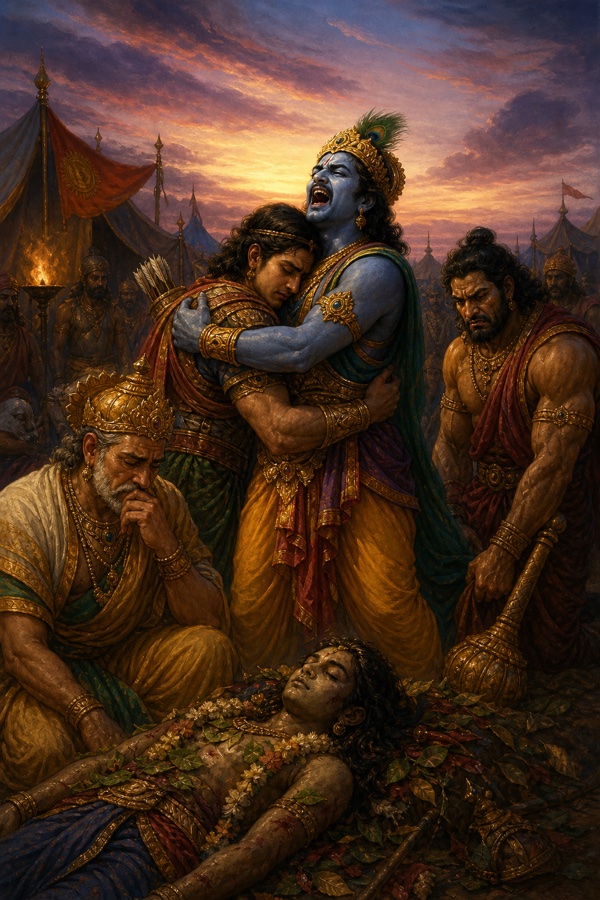
Krishna went on. “Shakra gave Karna that dart in exchange for his earrings and his celestial armor, the same dart that has now killed Ghatotkacha. From the day he got it, Karna counted you as a man already killed in battle. And I swear to you that even now, with the dart gone, no one can kill that hero except you. He is devoted to Brahmins. He is truthful in speech, he practices austerities, he keeps his vows, and he is kind even to his enemies. For these reasons Karna is called Vrisha. He is brave in battle and strong in the arm, and his bow is always raised. As a lion in the forest takes the pride out of the leaders of elephant herds, Karna takes the pride out of the greatest chariot fighters on the field, and he is like the sun at midday, which no one can look at. When he fought all the best and most famous warriors of your army and loosed his showers of arrows, he looked like the autumn sun with its thousand rays. He shoots without a pause, like the clouds that pour down rain at the end of summer; he is a raincloud loaded with celestial weapons. The gods could not defeat him in battle. He would tear them until their flesh and blood fell thick on the field. Yet he has lost his armor and his earrings, son of Pandu, and now he has lost the dart that Indra gave him. Karna is now as other men are.”
“One opening for killing him will come,” Krishna said. “The wheels of his chariot will sink into the earth. Seize that moment and kill him while he is in that distress. I will give you a sign beforehand, and when you have it you must act. While Karna stands with a weapon in his hand he cannot be beaten, and Indra himself, the conqueror of Vala, the first of heroes with the thunderbolt in his fist, could not kill him. For your good, Arjuna, I have killed, one after another, by one device or another, Jarasandha, and the famous ruler of the Chedis, and the strong-armed Nishada named Ekalavya. The other great Rakshasas have all been killed as well, Hidimba, Kirmira and Baka first among them, and Alayudha, who ground down the troops that faced him, and Ghatotkacha, a crusher of enemies and a warrior of fierce deeds.”
A key to reading this (Krishna’s list): Every name Krishna counts is a death told elsewhere in the epic or in this night’s fighting. Jarasandha was killed by Bhima, and Krishna explains in the next scene how he was first disarmed. The ruler of the Chedis is Shishupala, whose head Krishna cut off with his discus in the Sabha Parva. Ekalavya the Nishada gave his thumb to Drona in the Adi Parva, and the Udyoga Parva also says that Krishna killed him. Hidimba, Baka and Kirmira were killed by Bhima, and Alayudha and Ghatotkacha died tonight. Vrisha is a name of Karna, and Krishna gives the reasons for it himself. The conqueror of Vala is Indra. The sinking of Karna’s wheel comes in the Karna Parva.
The gist: Ghatotkacha is dead, the Pandavas weep, and Krishna dances on the chariot. Arjuna asks why. Krishna answers that Karna is as good as killed: the armor is gone, the earrings are gone, and now the dart he was keeping for Arjuna is gone too. Karna is as other men are now, and only Arjuna can kill him, at the moment his chariot wheels sink into the earth, on a sign Krishna will give. Krishna adds that Jarasandha, the ruler of the Chedis, Ekalavya and the great Rakshasas were all removed, one after another, for Arjuna’s good.
From Jarasandha to Ghatotkacha: Krishna’s ledger of who was removed and how, and the dart that was never thrown at Arjuna
Arjuna asked him, “Janardana, how were those kings killed for our good, Jarasandha and the others, and by what means?” Krishna answered him. “If Jarasandha, the ruler of the Chedis and the mighty son of the Nishada king had not been killed, they would have become terrible. Duryodhana would certainly have chosen those great chariot fighters for his side. They had always been our enemies, and so they would all have gone over to the Kauravas. Every one of them was a hero and a great bowman, skilled in weapons and steady in battle. With the prowess of gods, they would have protected Dhritarashtra’s sons. The Suta’s son, Jarasandha, the ruler of the Chedis and the Nishada’s son, once they had taken up Duryodhana’s cause, would have conquered the whole earth. Hear, then, the means by which they were killed. Without such means the gods themselves could not have beaten them in battle. Each one of them, Partha, could have fought the whole host of heaven with the guardians of the world protecting it.”
Krishna began with Jarasandha. “Baladeva once attacked him, and Jarasandha in his rage hurled a mace to destroy us, a mace that could kill any creature alive. It came at us bright as fire, dividing the sky as the parting divides a woman’s hair, with the force of the thunderbolt that Shakra throws. Baladeva, Rohini’s son, saw it coming and loosed the weapon called Sthunakarna to stop it. The power of Baladeva’s weapon broke the force of the mace, and it fell to the earth, splitting the ground and making the mountains shake. There was a terrible Rakshasa woman of great power named Jara. She was the one who had joined that killer of enemies together, prince, and Jarasandha takes his name from that. He had been made of the two halves of one child, and because Jara united those halves he came to be called Jarasandha. That Rakshasa woman was there inside the earth, Partha, and the mace and the Sthunakarna weapon killed her, together with her son and her kin. Jarasandha lost his mace in that great battle, and afterward Bhima killed him before your eyes. If the valiant Jarasandha had stood with his mace in his hand, the gods themselves, with Indra at their head, could not have killed him. The Nishada’s son was another, a man whose prowess nothing could defeat. For your good Drona took the place of his teacher and, by a trick, deprived him of his thumb. He was proud and steady in his strength, and with his fingers cased in leather guards he shone like a second Rama. With his thumb, Partha, Ekalavya could not have been beaten in battle by the gods, the Danavas, the Rakshasas and the great serpents all together. He had a firm grip, he was skilled in weapons, he could shoot day and night without a pause, and mere men could not bear to look at him. For your good I killed him on the field of battle. The mighty ruler of the Chedis I killed before your eyes. He too could not have been beaten in battle by the gods and the Asuras together. I was born to kill him and the other enemies of the gods, with you to help me, out of a wish to do the world good.”
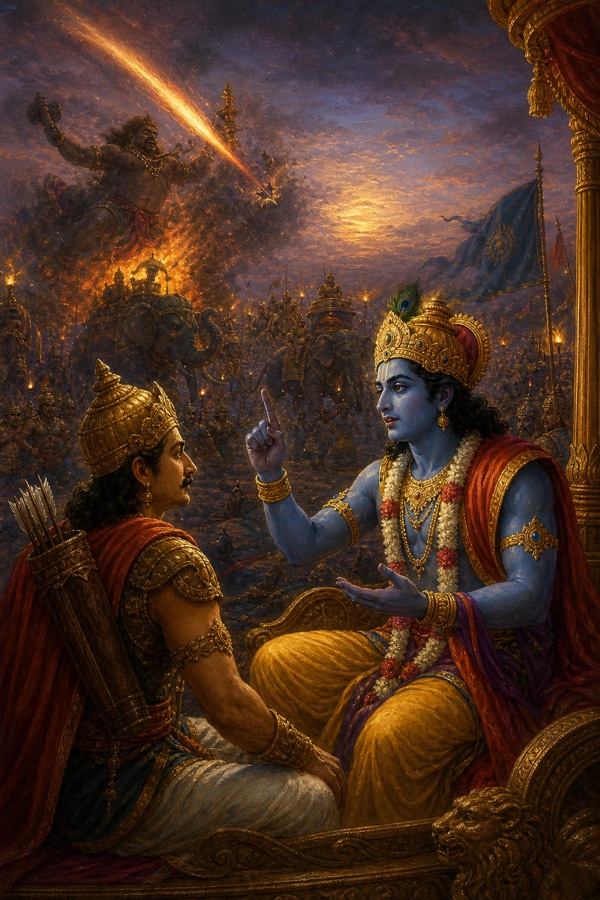
Then he came to the Rakshasas. “Hidimba, Baka and Kirmira were all killed by Bhima. Those Rakshasas were as strong as Ravana, and every one of them destroyed Brahmins and sacrifices. Alayudha, with his great powers of illusion, was killed in the same way by Hidimba’s son. And Hidimba’s son I have killed by a device of my own, through Karna and his dart. If Karna had not killed him with that dart in this great battle, I would have had to kill Bhima’s son Ghatotkacha myself. I did not kill him before this because I wished to do you all a service. That Rakshasa was an enemy of Brahmins and of sacrifices. He destroyed sacrifices and his soul was sinful, and so he has been killed in this way. By the same stroke the dart that Shakra gave has been made useless. All who destroy righteousness, son of Pandu, are mine to kill. That is the vow I have taken, so that righteousness may be established. Where the Vedas are, and truth, self-restraint, purity, righteousness, modesty, prosperity, wisdom and forgiveness, there I am always to be found. You need have no fear at all about the killing of Karna. I will tell you the means by which you will kill him. Bhima, too, will succeed in killing Duryodhana, and I will tell you how that is to be brought about. Meanwhile the uproar from the enemy’s army is growing. Your troops are running away on every side. The Kauravas have got what they wanted and are destroying your army, and Drona, who strikes harder than any man, is scorching us in battle.”
When Sanjaya had told him this, Dhritarashtra had a question of his own. “The Suta’s son had a dart that was sure to kill one man. Why did he not throw it at Arjuna and at no one else? With Arjuna killed by that dart, all the Srinjayas and the Pandavas would have been killed. With Arjuna dead, why should the victory not have been ours? Arjuna has taken a vow that he will never refuse a challenge when he is called out to battle. The Suta’s son should have called him out. Tell me, Sanjaya, why did Karna not meet Arjuna in single combat and kill him with the dart Shakra gave him? My son has no sense and no counselors, that is certain. The enemy gets the better of that sinful wretch every time, so how is he ever to beat his enemies? That dart was a mighty weapon and his victory rested on it, and Krishna has made it useless by way of Ghatotkacha. It has been snatched from Karna as a strong man snatches a fruit from the hand of a cripple with a withered arm. When a boar and a dog fight and one of them dies, the hunter is the one who gains. I think, learned one, that Krishna gained in just that way from the battle between Karna and Hidimba’s son. If Ghatotkacha had killed Karna, that would have been a great gain for the Pandavas. If Karna killed Ghatotkacha, that was a great gain for them too, because Karna’s dart was lost. Krishna is very wise, a lion among men. He reasoned in this way, and to do what was pleasing and good for the Pandavas he had Ghatotkacha killed by Karna in battle.” Sanjaya did not dispute it. The slayer of Madhu had known what Karna meant to do, he said, and so Krishna ordered Ghatotkacha, the mighty prince of the Rakshasas, to meet Karna in single combat, in order to make that fatal dart useless. “All this, king, is the fruit of your own bad policy,” Sanjaya told him. “We would surely have won if Krishna had not saved the great chariot fighter Arjuna from Karna’s hands in this way. Arjuna would have been destroyed in battle with his horses, his standard and his chariot, if that master, that lord of yogins, had not saved him. He was protected by many devices, king, and Krishna helped him well, and so when Arjuna met his enemies he overcame that fatal dart. Otherwise it would have destroyed Kunti’s son as quickly as lightning destroys a tree.”
The king pressed him. “My son loves a quarrel. His advisers are fools, and he is vain of his own wisdom. That is why this sure means of Arjuna’s death has come to nothing. Why, Suta, did Duryodhana not have that fatal dart thrown at Arjuna? Why did Karna not throw it, a man of great intelligence whom no one who bears arms can match? And you, son of Gavalgana, wise as you are, why did you too forget this great object? Why did you not remind Karna of it?” Sanjaya answered that they had talked of it every night, Duryodhana and Shakuni and Duhshasana and Sanjaya himself. “We used to say to Karna, ‘Leave every other warrior alone, Karna, and kill Arjuna. Then we shall lord it over the Pandavas and the Panchalas as if they were our slaves. Or if, when Arjuna falls, Krishna sets another of Pandu’s sons in his place to carry on the fight, then let Krishna himself be killed. Krishna is the root of the Pandavas, and Arjuna is the trunk that has risen from it. The other sons of Pritha are the branches, and the Panchalas may be called the leaves. The Pandavas have Krishna for their refuge, Krishna for their strength, Krishna for their leader. He is the center that holds them, as the moon is among the constellations. So leave the leaves and the branches and the trunk, Suta’s son, and kill that Krishna, who is everywhere and always the root of the Pandavas.’ And it is true, king. If Karna had killed Krishna of the Dasharha race, the joy of the Yadavas, the whole earth would have come under your rule beyond any doubt. If that glorious man, the joy of the Yadavas and the Pandavas alike, could have been laid lifeless on the ground, then the whole earth with its mountains and forests would have owned you as its master. Every morning we rose with that resolve formed against Krishna, the lord of the gods themselves, whose energy has no measure. And when the hour of battle came we forgot our resolve. Krishna always protected Arjuna, Kunti’s son. He never set Arjuna in front of the Suta’s son in battle. He always set other leading chariot fighters in front of Karna, thinking how that fatal dart of ours might be wasted by our own hands. And when Krishna guarded Arjuna from Karna in this way, king, why would he, the first of beings, fail to guard himself? When I think it over well, I see no one in the three worlds who is able to defeat Krishna, the hero who carries the discus in his hand.”
Sanjaya went on. Satyaki, a chariot fighter whose prowess nothing could defeat, asked Krishna about Karna. “Janardana, Karna had firmly resolved to throw that dart, with its measureless power, at Arjuna. Why then did the Suta’s son not throw it at him?” Krishna told him. “Duhshasana, Karna, Shakuni and the ruler of the Sindhus, with Duryodhana at their head, often debated this. They used to say to Karna, ‘Karna, great bowman, you whose prowess in battle has no measure, first of all victors, this dart must be thrown at no one except that great chariot fighter, Kunti’s son Arjuna. He is the most famous of them all, as Indra is among the gods. Once he is killed, all the other Pandavas and the Srinjayas will lose heart, like gods who have lost their fire.’ Karna agreed and said, ‘So be it,’ and the wish to kill the wielder of Gandiva was always in his heart. For my part, I always kept Radha’s son confused. That is why he did not throw the dart at Pandu’s son, the one with the white horses. As long as I could not defeat that means of Arjuna’s death, I had no sleep and no joy in my heart. So today, chief of the Shinis, when I saw that dart made useless through Ghatotkacha, I looked on Arjuna as a man rescued from the jaws of Death. I do not hold my father, my mother, any of you, my own brothers, or my very life as worth protecting in battle as Arjuna is. If there is anything more precious than the sovereignty of the three worlds, Satvata, I do not want it unless Pritha’s son is there to share it with me. So when I saw Arjuna like a man come back from the dead, Yuyudhana, these transports of joy came over me. That is why I sent the Rakshasa to fight Karna. No one else could have stood against Karna in battle by night.” So Krishna, Devaki’s son, who is always devoted to Arjuna’s good and to what pleases him, spoke to Satyaki that night, Sanjaya said.
A key to reading this (names and the older threads): The ruler of the Chedis is Shishupala, whom Krishna killed with his discus in the Sabha Parva. The Nishada king’s son is Ekalavya, whose thumb Drona asked for as his teacher’s fee in the Adi Parva. Rohini’s son is Baladeva. The Sabha Parva tells in full how Jarasandha was born in two halves and joined by the Rakshasa woman Jara. Vrisha and Radha’s son are names of Karna, Gavalgana’s son is Sanjaya, and Satvata and Yuyudhana are names of Satyaki, who belongs to the Shini line. Partha means the son of Pritha, which is another name of Kunti, and in these speeches it is Arjuna. Devaki’s son, Janardana and the slayer of Madhu are Krishna. The ruler of the Sindhus is Jayadratha, whom Arjuna killed earlier on this same day.
The gist: Krishna tells Arjuna how each enemy was removed. Jarasandha lost his mace to Baladeva’s weapon before Bhima killed him, Ekalavya lost his thumb to Drona before Krishna killed him, and Krishna himself killed the ruler of the Chedis. Bhima killed Hidimba, Baka and Kirmira, Ghatotkacha killed Alayudha, and Ghatotkacha was killed through Karna’s dart, which Krishna counts as his own doing. Dhritarashtra asks why the dart was never thrown at Arjuna. Sanjaya answers that the resolve was made every night and forgotten at the hour of battle, while Krishna kept Arjuna away from Karna. To Satyaki, Krishna says that he had kept Karna confused and that he had neither sleep nor joy while that dart remained.
“Destiny has destroyed you”: the blind king’s last question, Yudhishthira’s grief for Ghatotkacha and his charge at Karna, and Vyasa’s word that on the fifth day the earth will be his
Dhritarashtra was not satisfied. “I see, Sanjaya, that Karna and Duryodhana and Shakuni, Subala’s son, acted very much against sound policy in this, and you most of all. You all knew that the dart could always kill one man in battle, and that the gods themselves, with Indra at their head, could neither bear it nor stop it. Why then did Karna not throw it at Devaki’s son or at Arjuna when he fought them before?” Sanjaya gave him the same answer. “Every day, when we came back from the battle, all of us used to debate in the night, and we would say to Karna, ‘Tomorrow morning, Karna, this dart must be thrown at Krishna or at Arjuna.’ And when the morning came, king, by the working of destiny, Karna and the other warriors forgot that resolve. I hold that destiny is supreme, since Karna had that dart in his hands and killed neither Arjuna nor Krishna, Devaki’s son, in battle. Destiny itself had clouded his understanding. The illusion of the gods confused him, and so, though he had Indra’s fatal dart in his hand, he did not throw it at Krishna to destroy him, or at Arjuna, whose prowess is like Indra’s own.”
“You are destroyed by destiny, by your own understanding, and by Krishna,” Dhritarashtra said. “Indra’s dart is lost. It has gone to kill Ghatotkacha, who counted for as little as a straw. Through that most unwise act Karna and my sons and all the other kings have already entered the house of Yama. Tell me now how the battle between the Kurus and the Pandavas raged again after Hidimba’s son fell. The Srinjayas and the Panchalas were drawn up in battle order and are skilled at striking, and they rushed against Drona. How did they fight? Drona was enraged at the killing of Bhurishravas and Jayadratha. He cared nothing for his own life, and he went against the Pandavas and Srinjayas and broke into their army like a yawning tiger, or like the Destroyer himself with his mouth wide open. How did they withstand him as he struck? And what did Drona’s son do in that battle, and Karna and Kripa and the others, with Duryodhana at their head, who were protecting the teacher? Arjuna and Bhima were eager to kill Bharadvaja’s son, Sanjaya. Tell me how my warriors covered them with arrows. One side was furious at the death of the ruler of the Sindhus and the other at the death of Ghatotkacha, and neither could bear its loss. How did they fight that battle in the night?”
Sanjaya took up the story. When Karna killed the Rakshasa Ghatotkacha that night, the Kaurava troops were filled with joy and shouted aloud. In that dark hour they fell hard on the Pandava troops and began to cut them down. King Yudhishthira saw it all, and his spirit sank. He spoke to Bhima. “Hold back Dhritarashtra’s army, strong-armed one. A great numbness has come over me because Hidimba’s son is killed.” With that order given, he sat down on his chariot. His face was wet with tears and he sighed again and again, and the sight of Karna’s prowess left him with no heart for the fight. Krishna saw how he suffered and spoke to him. “Son of Kunti, do not give way to such grief. Such despair does not become you, chief of the Bharatas, as it might an ordinary man. Rise, king, and fight. Carry the heavy burden. If you lose heart, our victory becomes uncertain.” Yudhishthira, Dharma’s son, wiped his eyes with his hands and answered him. “The high path of duty is not unknown to me, Krishna. A man who forgets the services others have done him earns the dreadful fruit of killing a Brahmin. While we were living in the forest, Hidimba’s son did us many services, though he was only a child then. When he learned that Arjuna had gone away to win weapons, that great bowman came to me at Kamyaka, and he stayed with us until Arjuna came back. On our way through many places that were hard to cross, he carried the tired princess of Panchala on his own back. The things he did show that he was skilled in every kind of warfare, and many of those hard things he did for my sake. My love for Ghatotkacha, that prince of the Rakshasas, is twice the love I naturally bear toward Sahadeva. He was devoted to me. I was dear to him and he was dear to me. That is why grief is burning me, Krishna of the Vrishnis, and why I have lost heart.”
He was not finished. “Look at our troops, Krishna, beaten and routed by the Kauravas. Look at those great chariot fighters, Drona and Karna, fighting in earnest. Look at the Pandava army, crushed at dead of night like a wide thicket of heath under a pair of maddened elephants. The Kauravas think nothing of the strength of Bhima’s son or of all the weapons Arjuna carries, and they are putting out their full strength. There are Drona and Karna and King Duryodhana, roaring aloud because they have killed the Rakshasa in battle. How could Hidimba’s son be killed fighting the Suta’s son, Janardana, while we are alive, and you too? Karna made a great slaughter among us, and then, before Arjuna’s very eyes, he killed Bhima’s mighty son, the Rakshasa Ghatotkacha. When the wicked sons of Dhritarashtra killed Abhimanyu, the great chariot fighter Arjuna was not there in that battle, and all of us were held back by the ruler of the Sindhus. Drona and his son were the cause of that deed. The teacher himself told Karna how Abhimanyu could be killed. While Abhimanyu fought with his sword, it was the teacher himself who cut that sword in two. And when the boy was in that plight, Kritavarma most cruelly killed his horses and his two Parshni drivers, and then other great bowmen finished Subhadra’s son. Arjuna killed the ruler of the Sindhus for a small offense, Krishna, and that act gave me no great joy. If it is right for the Pandavas to kill their enemies, and if it must be done, then Drona and Karna should have been killed before now. That is what I think. Those two are the root of our troubles. With those two beside him in battle, Duryodhana has grown confident. It was Drona who should have been killed, or the Suta’s son with his followers, and Arjuna killed the Sindhu king, who had very little to do with the matter. Punishing the Suta’s son is surely my task. So I will fight now, hero, to kill the Suta’s son. Bhima is busy with Drona’s division.” Having said this, Yudhishthira set off quickly against Karna, holding his formidable bow and blowing his conch fiercely. Shikhandi followed close behind the king with a force of Panchalas and Prabhadrakas around him: a thousand chariots, three hundred elephants and five thousand horses. The Panchalas in their mail, and the Pandavas with Yudhishthira at their head, beat their drums and blew their conchs. Krishna spoke to Arjuna. “There goes Yudhishthira in a rage, driving fast, wanting to kill the Suta’s son. It would be wrong for you to leave this to him.” Then he urged the horses on and followed the king, who was already some way off.
Yudhishthira’s mind was heavy with grief, and he looked like a man scorched by fire as he drove hard to kill the Suta’s son. The sage Vyasa saw him and came to him. “It is good fortune that Arjuna still lives, though he met Karna in battle,” Vyasa said. “Karna had been keeping his dart to kill Arjuna. It is good fortune that Arjuna did not fight him in single combat. Had they fought, each would have challenged the other and loosed his celestial weapons on every side. Arjuna would have destroyed the weapons of the Suta’s son, and Karna, hard pressed, would surely have thrown Indra’s dart in that battle. Then, Yudhishthira, your grief would have been great indeed. It is good fortune that the Suta’s son has killed the Rakshasa in battle. Ghatotkacha was killed by Death himself, and Indra’s dart was only the instrument. It was for your good that the Rakshasa was killed. Do not give way to anger, and do not set your heart on grief. This is the end of every creature in this world, Yudhishthira. Join with your brothers and with all the great kings of your army, and fight the Kauravas. On the fifth day from today the earth will be yours. Keep your mind always on virtue. With a glad heart, son of Pandu, practice kindness to all creatures, austerity, charity, forgiveness and truth. Where righteousness is, there is victory.” When he had said this to Pandu’s son, Vyasa vanished where he stood.
A key to reading this (Yudhishthira’s memories): The Vana Parva tells how Ghatotkacha carried Draupadi on the Pandavas’ journey to Mount Gandhamadana, in the years when Arjuna was away winning weapons. Abhimanyu, the son of Arjuna and Subhadra, was killed the day before this one. Yudhishthira names Drona, who cut his sword, and Kritavarma, who killed his horses and his two Parshni drivers, the drivers at the wings of his chariot. The ruler of the Sindhus is Jayadratha, who held the other Pandavas back that day and whom Arjuna killed before this night began. The Prabhadrakas fight beside the Panchalas throughout the war. Vyasa counts five days from this one to the day the earth will be Yudhishthira’s. The next chapter opens with Yudhishthira giving up his attack on Karna at Vyasa’s word.
The gist: Dhritarashtra gives his verdict: destiny, their own understanding and Krishna have destroyed the Kauravas, and Indra’s dart is lost on a Rakshasa who counted for a straw. Sanjaya returns to the field, where the Kauravas are shouting and cutting down the Pandava troops, and Yudhishthira sits on his chariot weeping for Ghatotkacha, who once carried Draupadi on his back and whom he loved twice as much as Sahadeva. Krishna tells him to rise and fight. Yudhishthira answers that Drona and Karna are the root of the Pandavas’ troubles, and he drives at Karna himself, with Shikhandi behind him and Krishna and Arjuna following. Vyasa stops him: Ghatotkacha’s death has saved Arjuna from the dart, grief and anger must be put aside, and on the fifth day the earth will be his.
Source: the Mahabharata of Krishna-Dwaipayana Vyasa, Drona Parva. This chapter follows K. M. Ganguli, Sections 159 to 183; this second part tells Sections 175 to 183. The Gita Press Hindi edition numbers these chapters differently. Names, order, and events were checked against Ganguli’s complete translation. About the sources.
Based on: The Mahabharata, Vyasa (Gita Press, Gorakhpur)
The same story elsewhere
- Karna’s gift of his armor
How Karna came by the Vasavi dart that he throws at Ghatotkacha tonight - Jatasura and Ghatotkacha
Vana Parva: the first feats of Bhima’s son, and the Jatasura whose son Alambusha dies tonight - The fall of Drona
The next chapter: after midnight, and the fifteenth day