On this page
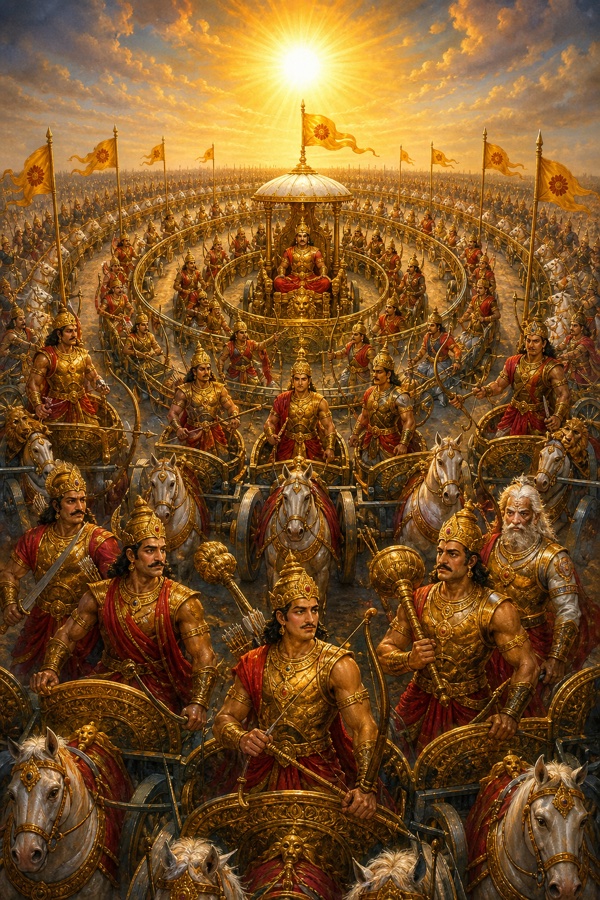
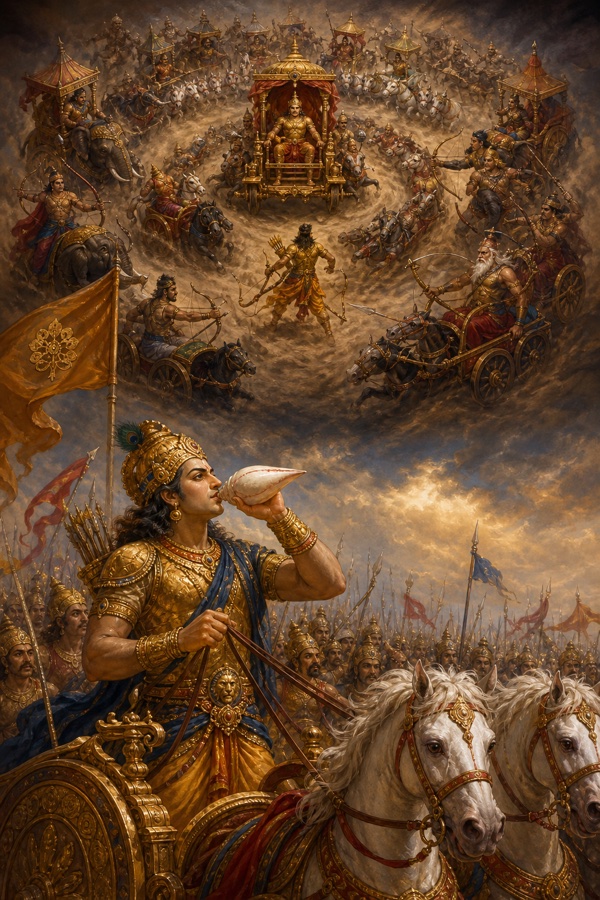
The Kuru army spent the night after the twelfth day like men under a curse. Arjuna had broken their lines, Yudhishthira had been guarded too well to be taken, and the vow Drona had made to seize him had failed in front of everyone. With their commander’s leave they had come off the field in torn mail, dust on their faces, glancing about them, and the whole way back they had listened to every creature praising Arjuna and talking of the friendship Krishna bore him. Nobody in the camp spoke that night. On the thirteenth morning of the war Duryodhana did, in a temper, sick at the enemy’s success, and he said it where all the troops could hear. “There is no doubt of it: you have marked us down as men you mean to see destroyed,” he told Drona. “You had Yudhishthira within your reach and you did not take him. An enemy you set out to seize cannot escape once you have him in sight, though the Pandavas guard him with the gods to help them. You were pleased with me and gave me a boon, and now you do not act on it. A noble man never cheats the hope of one who is devoted to him.” Drona was ashamed. He answered that the king should not think this of him, that he worked always for what Duryodhana wanted, and that the three worlds together, gods, Asuras, Gandharvas, Yakshas, Nagas and Rakshasas, could not defeat a force Arjuna protected; where Krishna stood and Arjuna commanded, whose strength counted for anything, unless it were three-eyed Shiva’s? Then he gave his word again. “What I tell you today is the truth, and it will not turn out otherwise. Today I will kill a great chariot warrior, one of the first heroes the Pandavas have. Today I will also form an array the gods themselves could not pierce. Only find some way to take Arjuna off the field. There is nothing in war he does not know or cannot do; he has gathered from many places everything there is to learn about it.” The array he formed was the great circle, the wheel, and Sanjaya described it rank by rank to the blind king whose sons stood inside it. Drona set within it every king of the Kuru side, each a match for Indra. At the entrance he posted the princes, bright as the sun, ten thousand steady bowmen who had taken an oath to stand by one another: gold on every standard, red robes, red ornaments, red banners, garlands of gold, sandal paste and scented oils on their skin and wreaths of flowers over all of it, men who shared one another’s joys and griefs and each of whom meant to outdo the rest. At their head rode the king’s own handsome grandson Lakshmana, the son of Duryodhana. Duryodhana held the middle of the host under a white umbrella, yak-tail fans moving on either side of him, splendid as the king of the gods, with Karna, Duhshasana and Kripa around him. At the head of the army stood Drona, like the sun coming up. There too stood Jayadratha, the handsome ruler of the Sindhus, as hard to move as the cliff of Meru, and beside him thirty of Dhritarashtra’s sons with Ashvatthama in front of them, and on his flank the gambler Shakuni, king of Gandhara, and Shalya, and Bhurishravas. Then the two armies went at each other with death as the only place either meant to stop.
The Day Arjuna Was Far Away
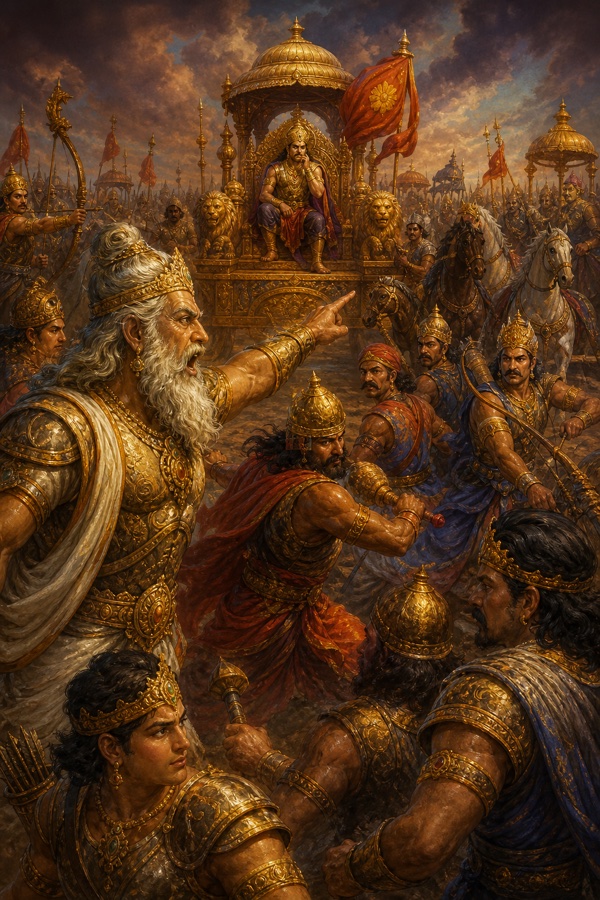
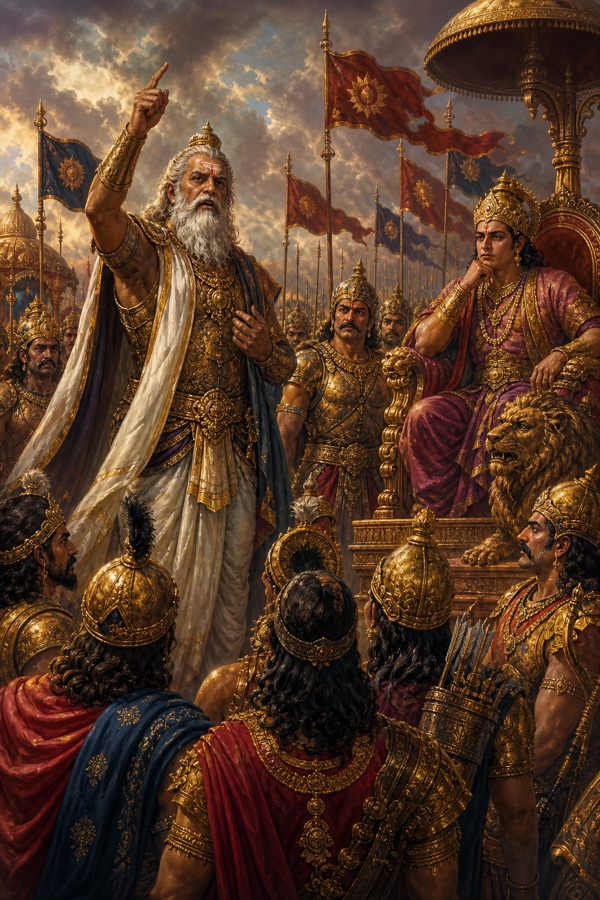
Arjuna was not there to see it. Drona had hardly finished speaking to Duryodhana that morning when the Samshaptakas, the sworn bands whose oath was that the earth should be left without Arjuna or without them, sent Arjuna their challenge once more. They drew him away to the southern side of the field, and the fight he had with them there was like nothing that had been seen or heard of before. So the one man Drona had asked to have removed was gone from the Pandava line when the circle stood ready, shining so that it could no more be looked at than the sun at noon, when it stands overhead and scorches whatever is beneath it. Sanjaya gave the king the end of that day before he gave him the beginning. Abhimanyu, at the command of his father’s eldest brother, had pierced the circle in many places, had done the hardest things a fighter can do and killed heroes by the thousand; then six had met him together, and at the last he had gone down before Duhshasana’s son and given up his life; the Kurus had been filled with joy and the Pandavas with grief, and the troops had been withdrawn for the night. The old king said his heart seemed to be breaking into pieces. “The duties the lawgivers laid down for Kshatriyas are cruel indeed,” he said, “when brave men who wanted a kingdom did not scruple to shoot their weapons at a child. Tell me, Sanjaya, how so many warriors trained in arms killed that boy, who had been brought up in luxury and still ranged the field without fear. Tell me how our men behaved when Subhadra’s son had broken into our line of chariots.” Sanjaya asked him to be still and to bear a grief that could hardly be borne, and began with the morning.
The Pandavas came at the circle with Bhima in front. With him drove Satyaki and Chekitana, Dhrishtadyumna the son of Prishata, Kuntibhoja, the great chariot warrior Drupada, Arjuna’s son Abhimanyu, Kshatradharma, Brihatkshatra, Dhrishtaketu who ruled the Chedis, the twins Nakula and Sahadeva whom Madri bore, Ghatotkacha, Yudhamanyu, Shikhandi, Uttamaujas, Virata, the five sons of Draupadi, the son of Shishupala, the Kekayas, and the Srinjayas in their thousands, all of them angry, each at the head of his own men, and they rushed together at the son of Bharadvaja. Drona checked them as soon as they came near with a thick shower of arrows. They were a great wave running at a hill that cannot be pierced, the sea itself rising against its own shore, and he pushed them back, and none of them could stay in front of his bow. Sanjaya said that the strength of Drona’s arms as he and the others saw it that morning was a wonder past telling: the Panchalas and the Srinjayas could not so much as get near him. Yudhishthira watched him come forward in his rage and turned over one plan after another for stopping him. In the end, judging that no one else could stand against Drona, he laid that heavy, unbearable burden on the son of Subhadra. Sanjaya had told the king what kind of boy that was. Every good quality that was in Krishna and every one that was in the five Pandavas had come together in Abhimanyu alone: he had Yudhishthira’s firmness and Krishna’s conduct, he matched Bhima in his feats, Arjuna in beauty, in prowess and in knowledge of the scriptures, and the twins in humility. In battle he did not fall short of Krishna himself, and there was more fire in him than in his own father. To him the king said, “Child, act so that Arjuna, when he comes back from the Samshaptakas, has no cause to reproach us. We do not know how to break the circular array. You can pierce it, or Arjuna, or Krishna, or Pradyumna. A fifth who could do it is not to be found. Your fathers, your mother’s brothers and all these troops are asking a boon of you, Abhimanyu, and you should grant it. Take up your weapons quickly and destroy this array of Drona’s, or Arjuna will come back from his fight and reproach every one of us.”
Abhimanyu answered, “I want victory for my fathers, and I will soon force my way in battle into that array of Drona’s, firm and fierce as it is and the first among arrays. My father taught me how to break into an array of this kind and strike it from inside. But I will not be able to come out again if any danger overtakes me there.”
It was said in front of all of them, his fathers, his uncles and the waiting line of chariots. He could go in. Once inside, if the fight turned against him, he had no means of getting back out, and he told them so before a single horse had moved.
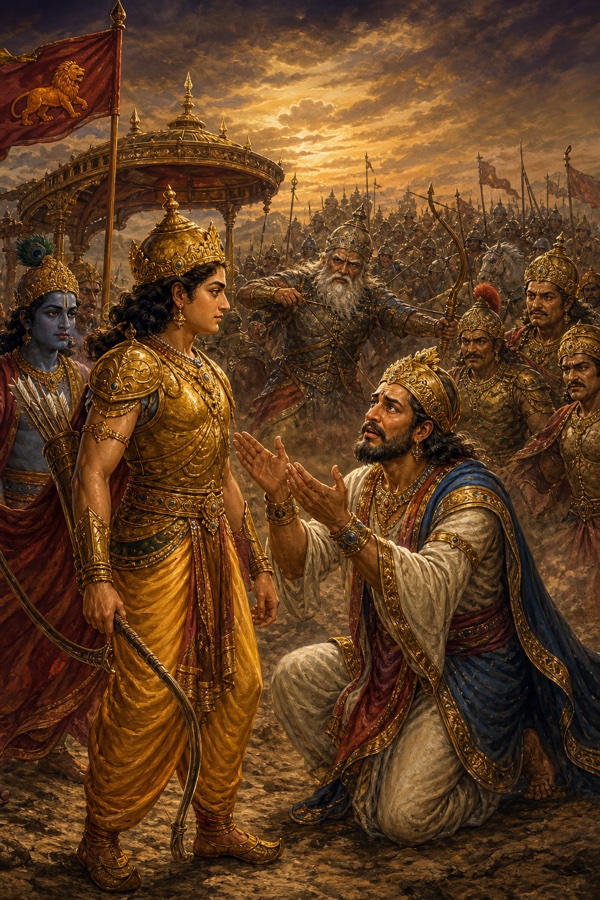
Yudhishthira said, “Break this array once and make a passage for us. All of us will follow you along the track you take. In battle you are the equal of Arjuna himself. When we see you go in we will come in after you, and we will guard you on every side.”
Bhima added his own promise. “I will be behind you myself, and Dhrishtadyumna, and Satyaki, and the Panchalas, and the Prabhadrakas. Break it once, and we will enter it again and again and kill the leading warriors inside.”
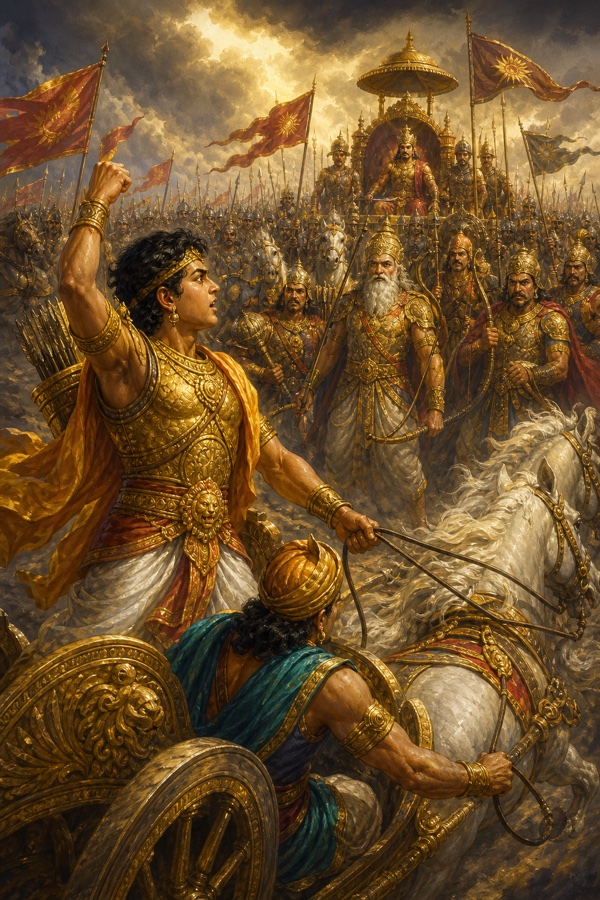
Abhimanyu gave them his answer. “I will go into this invincible array of Drona’s the way an insect in a rage flies into a blazing fire. Today I will do what is good for both my houses, my father’s and my mother’s. I will do what pleases my mother’s brother, and my mother too. Today every creature will watch great bodies of enemy soldiers cut down without a pause by me, a child with no one to help him. If any man who meets me today gets away with his life, I will not count myself begotten by Partha and born of Subhadra. If I cannot, in battle, from a single chariot, cut the whole Kshatriya race into eight pieces, I will not call myself the son of Arjuna.”
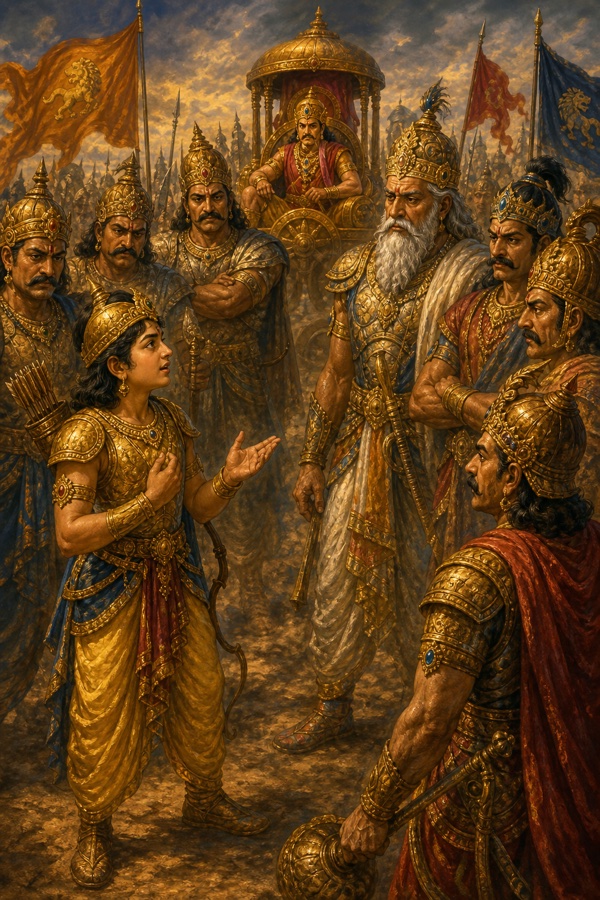
Yudhishthira blessed him. “You dare to pierce Drona’s invincible array with these men to guard you, great archers of fierce strength, the equals of the Sadhyas, the Rudras and the Maruts, like the Vasus, like Agni, like Aditya himself in prowess, and you speak as you have just spoken. So may your strength increase, Abhimanyu.”
A key to reading this (the concept): Abhimanyu says two things about the circular array, both of them to Yudhishthira before the battle: his father taught him how to break into an array of this kind and strike it from within, and if danger overtakes him inside he will not be able to come out. Yudhishthira names four men who can pierce it, Abhimanyu, Arjuna, Krishna and Pradyumna, and says there is no fifth. The only teaching the text mentions here is the father’s; it has no scene of a lesson overheard before birth.
The gist: Drona promises Duryodhana a dead Pandava champion and an array the gods could not pierce, and asks that Arjuna be drawn away; the Samshaptakas take Arjuna to the south of the field. Bhima and the whole Pandava line are thrown back from the circle, and Yudhishthira lays the task on Abhimanyu, one of the four men he can name who are able to break it. The boy says before he starts that he can get in and may have no way out. Yudhishthira and Bhima give their word to follow in his track and guard him on every side.
The Charioteer’s Warning, and the Breaking of the Array
Abhimanyu turned to his charioteer, Sumitra. “Drive the horses quickly toward Drona’s army,” he said. “Go on. Go on.” The man answered him first. “May you live long. It is a heavy load the Pandavas have put on you. Weigh it in your own mind, decide whether you are able to carry it or are not, and fight after that. The preceptor Drona is a master of the highest weapons and a finished fighter. You have been brought up in great comfort, and you are not used to battle.”
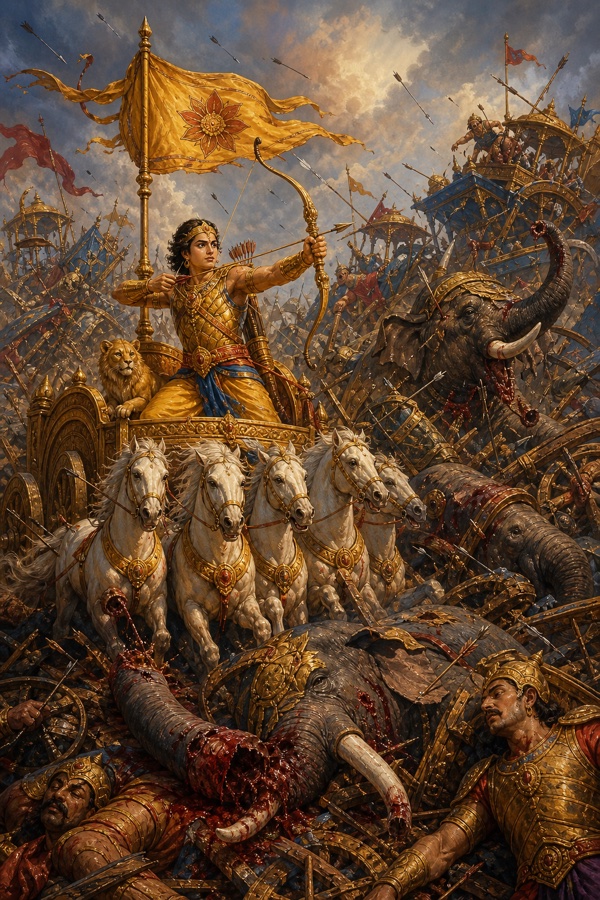
Abhimanyu laughed. “Charioteer, who is this Drona? And what is this great gathering of Kshatriyas? I would meet Indra himself in battle, mounted on his elephant Airavata with all the gods to help him. These Kshatriyas do not give me the smallest anxiety today. This whole enemy army does not come to a sixteenth part of me. Put my mother’s brother Vishnu, who conquered the universe, in front of me as an enemy, or put my father Arjuna there, and fear would still find no way into my heart.” So he set the warning aside and gave the order again: “Go with all speed toward the army of Drona.”
The charioteer obeyed, with a heart that had little cheer in it. The horses were three-year-olds in golden trappings, and under Sumitra’s hand they ran at Drona’s army, and at Drona himself, with great speed and force. The Kauravas saw the boy coming and moved against him with Drona at their head, and the Pandavas came on behind him. He wore golden mail. His standard carried the device of a karnikara tree. And this son of Arjuna, who was greater than Arjuna himself, went at the warriors around Drona wanting battle and without fear, as a lion’s cub goes at a herd of elephants.
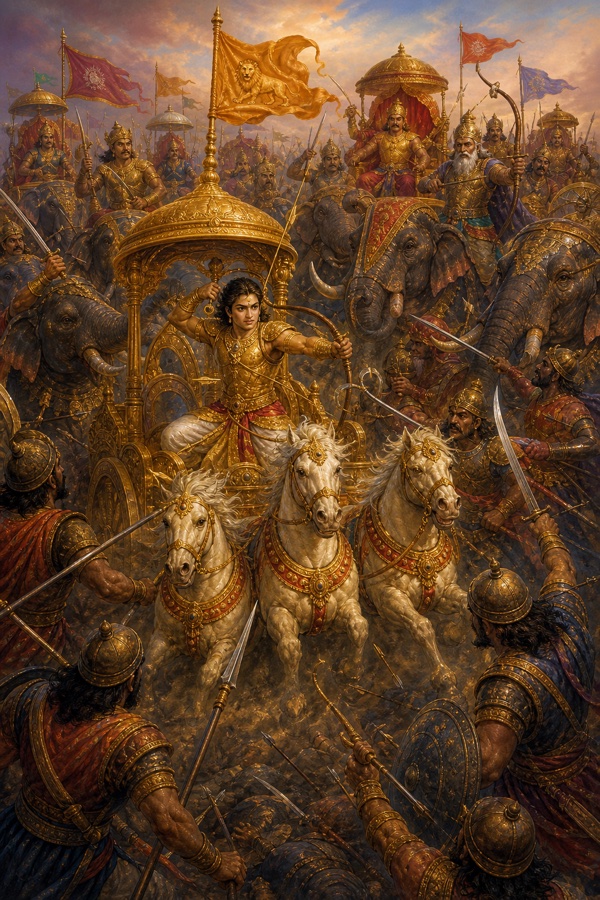
They were glad to see him, and they struck at him while he worked to pierce their array. For a moment the two forces churned in one place, like the eddy in the ocean where the current of the Ganga runs into it. The fight that began between those straining men grew fierce and terrible, and in the course of it, with Drona looking on, Arjuna’s son broke the array and went in.
Once he was inside, great bodies of elephants and horses and chariots and foot soldiers closed around him, glad of the chance, and began to strike. The ground rang with it: instruments of every kind, shouts, the slapping of armpits, roars and yells and cries like a lion’s, “Wait! Wait!”, a confusion of fierce voices calling “Do not go! Stay! Come to me!”, and over and over “This one! Here I am! The enemy!”, the grunting of elephants, the tinkle of bells and ornaments, bursts of laughter, the clatter of hooves and chariot wheels. With all that noise they rushed him. He had great lightness of hand, and he knew the places in a body where the life is kept; his arrows went fast into those places, and the men coming at him died. Cut down by sharp shafts of many kinds, helpless against them, they went on falling upon him the way insects fall into a blazing fire. He strewed the ground with their bodies and with the limbs of their bodies as priests at a sacrifice strew the altar with blades of kusha grass. He cut off arms by the thousand. Some were cased in guards of iguana skin. Some still held a bow and arrows, or a sword, a shield, an iron hook, reins, a lance, a battle-axe, a mace, an iron ball, a spear, a rapier, a crowbar, a short arrow, a spiked club, a dart, a goad, a great conch, a mallet, a noose, a heavy club, a stone. All of them wore armlets and had been washed in perfumes and oils, and lying there bright with blood they made the field beautiful, as though it were strewn with five-headed snakes that Garuda had killed. He scattered heads over the field past counting: heads with fine noses and faces and hair, clear skin, rings in the ears, blood running from them freely and the lower lip still bitten in anger; heads in garlands and crowns and turbans, with pearls and gems on them, as bright as the sun or the moon, lying like lotuses cut from their stalks. While life was in them they had been fragrant with many perfumes, Sanjaya said, and had spoken words that were both pleasant and good to hear. Chariots that had been well fitted out, that had looked like the cities of cloud people see in the sky, with their shafts in front and their fine bamboo poles and their standards flying, lost their wheels and rims and yokes and platforms. The gear of war inside them was smashed, the rich cloths laid over them blew away, and the men who had ridden them lay dead in thousands. He was seen on every side at once, breaking whatever stood in front of him. With his keen arrows he cut apart elephants and the men who rode them, with their standards and hooks and banners, their quivers and mail, girths and neck ropes and blankets, bells and trunks and tusks, and the foot soldiers who guarded each elephant from behind. Horses of the Vanayu breed, hill horses, Kamboja and Bahlika horses, fast and well trained, ridden by good men with swords and lances, lost the fine ornaments on their tails and lay with their tongues out and their eyes started from the sockets and their entrails and livers drawn from them, the riders dead at their sides and the rows of bells torn from their necks, to the delight of the Rakshasas and the beasts that eat flesh. One boy was crushing an army of three arms, chariots and elephants and horse, as three-eyed Shiva once crushed the host of the Asuras, and when he had done things in battle his enemies could not endure, he tore up the great divisions of foot soldiers as well.
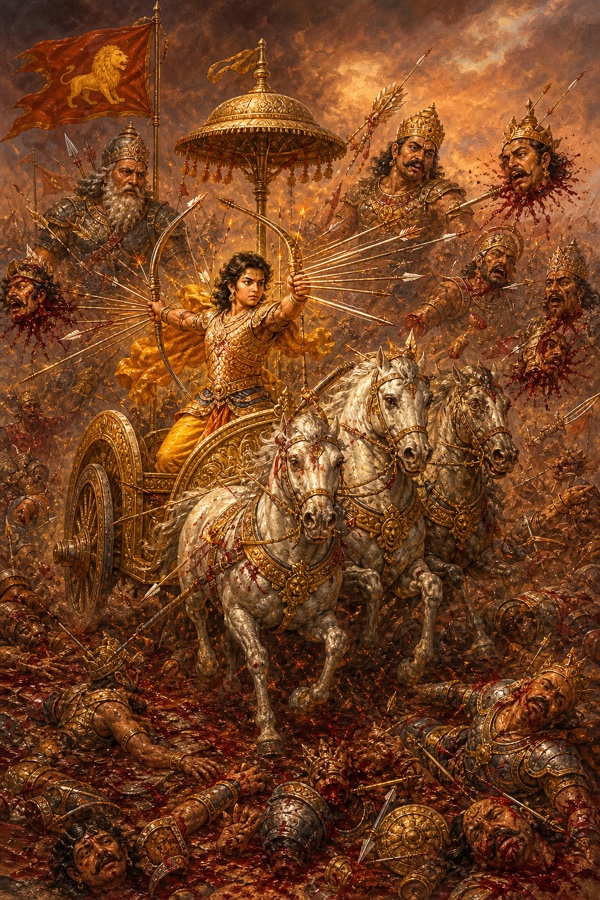
The warriors of the Kuru host and the sons of Dhritarashtra, seeing their army cut up by one boy with his whetted arrows as Skanda once cut up the Asuras, looked about them on every side with empty eyes. Their mouths went dry. Their eyes would not keep still, sweat covered their bodies and their hair stood up. They gave up hope of beating him and set their hearts on getting off the field. Calling to one another by name and by family, leaving wounded sons and fathers and brothers and kinsmen and relations by marriage lying where they had fallen, they whipped their horses and elephants and tried to run. Duryodhana saw it, and in his rage he went at Subhadra’s son himself. Drona saw the king turn that way and called out to all the warriors, “Rescue the king. Here in front of us, before our eyes, Abhimanyu is killing everyone he aims at. Go at him quickly, without fear, and protect the Kuru king.” Men who owed Duryodhana much and wished him well closed around him, afraid for him, and Drona and Ashvatthama, Kripa, Karna, Kritavarma, Shakuni the son of Subala, Brihadbala, Shalya who ruled the Madras, Bhuri, Bhurishravas, Shala, Paurava and Vrishasena shot so many arrows at the boy that under the cloud of them they got the king away. To Abhimanyu it was a morsel snatched out of his mouth. He covered those chariot warriors, their drivers and their horses with thick showers of arrows, turned them back, and roared like a lion hungry for its prey. They could not bear the sound. With Drona at their head they came around him on every side with a great body of chariots and loosed arrows of many kinds, and he cut those arrows down in the air before one of them reached him and then put his own shafts into every man who had shot. Stung by arrows that were like poisonous snakes, they ringed that boy who would not retreat, meaning to kill him, and he held the whole sea of them alone, as the shore holds the ocean when it rises, and no one on either side turned his back. Duhsaha pierced him with nine shafts, Duhshasana with twelve, Kripa the son of Sharadvat with three. Drona pierced him with seventeen, each like a venomous snake. Vivinshati pierced him with seventy, Kritavarma with seven, Brihadbala with eight, Ashvatthama with seven, Bhurishravas with three, Shalya with six, Shakuni with two, and King Duryodhana with three. Abhimanyu seemed to be dancing on his chariot, and he gave each of them three in return. Then, angry that the sons of Dhritarashtra should try to frighten him so, he showed the strength that training and practice had put into him. His horses were well broken, as fast as Garuda or the wind and obedient to every touch of the reins, and they carried him across the path of the heir of Ashmaka and stopped that prince where he was. The son of Ashmaka, a handsome and powerful man, stood his ground, pierced him with ten shafts and called out, “Wait! Wait!” Abhimanyu, smiling, answered with ten of his own that cut away the prince’s horses, his driver, his standard, his two arms, his bow and his head and dropped them on the ground, and at the death of their ruler the whole Ashmaka force wavered and began to run. Then Karna and Kripa, Drona and Ashvatthama, the ruler of the Gandharas, Shala and Shalya, Bhurishravas and Kratha, Somadatta, Vivinshati, Vrishasena, Sushena, Kundavedhi, Pratardana, Vrindaraka, Lalithya, Prabahu, Dirghalochana and the angry Duryodhana poured their arrows on him. Hurt by so many great archers, he loosed at Karna a shaft that could go through any armor and any body. It passed through Karna’s mail and through Karna and went into the earth like a snake going into an anthill, and Karna, in great pain and helpless with it, shook where he stood like a hill in an earthquake. With three more sharp shafts the boy in his anger killed Sushena, Dirghalochana and Kundavedhi. Karna recovered and pierced him with twenty-five arrows, Ashvatthama with twenty and Kritavarma with seven. Covered with arrows from head to foot, the son of Indra’s son ranged the field in a rage, and to every soldier who saw him he looked like Yama carrying the noose. Shalya happened to be near, and he poured arrows over Shalya and shouted so that the Kuru troops were afraid. Those straight shafts went into the ruler of the Madras where he was most easily hurt, and he sat down on the floor of his chariot and fainted. At the sight of Shalya covered in gold-winged arrows the troops ran, with Drona watching them go, like a herd of deer with a lion among them, while the ancestors, the gods, the Charanas and the Siddhas and creatures of every kind on the earth praised the boy’s skill and courage, and he shone like a sacrificial fire fed with clarified butter.
A key to reading this (lineage): Abhimanyu is the son of Arjuna and of Subhadra, a daughter of the Satvata line and the sister of Krishna. That is why he promises to serve both his houses, his father’s and his mother’s, and why he calls Vishnu, who is Krishna, his mother’s brother. Sanjaya gives him two more names from the same descent: the son of Indra’s son, since Arjuna is the son of Indra, and the joy of Vishnu’s sister. He also calls him the grandson of Dhritarashtra, the old king to whom the whole battle is being told.
The gist: The charioteer Sumitra warns that the load is too heavy for a boy raised in comfort, and Abhimanyu laughs and says that Indra with all the gods would not frighten him. With Drona watching he breaks the array and goes in, and the men who close around him die until the ground is covered with arms, heads, chariots, elephants and horses. The Kuru army starts to run. Duryodhana attacks and has to be rescued, twelve warriors pierce the boy together and take three arrows each in return, the heir of Ashmaka and three others are killed, Karna is shot through, and Shalya faints on his chariot.
Jayadratha Seals the Gate
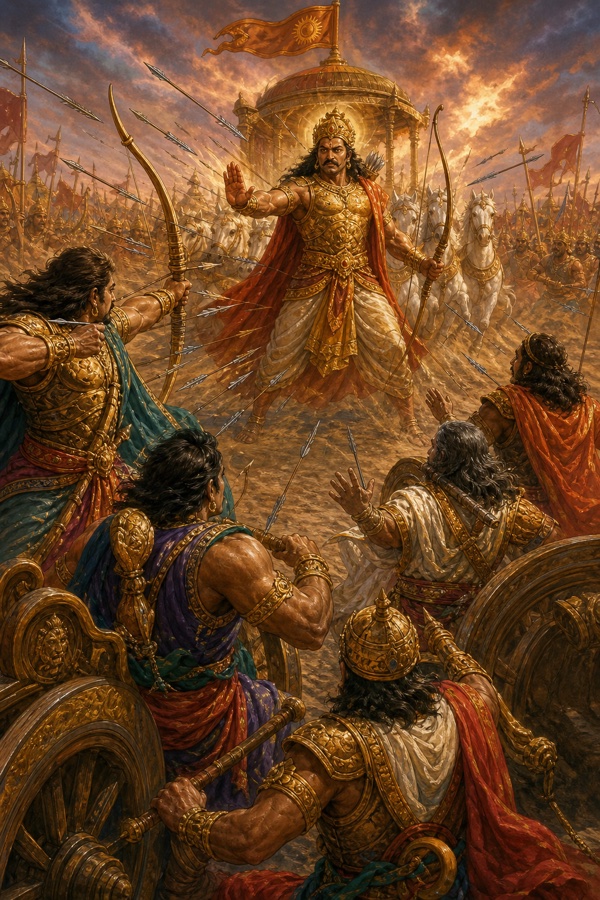
Behind him, his elders tried to keep their word. Yudhishthira and Bhima, Shikhandi and Satyaki, the twins Nakula and Sahadeva, Dhrishtadyumna, Virata, Drupada, the Kekaya prince, Dhrishtaketu and the Matsya warrior, all of them angry, formed in order of battle and drove down the very path the boy had made, his fathers and his mother’s kin together, meaning to bring him out. The Kuru troops in front of them turned away from the fight. Then one man came forward to rally that broken front, and Sanjaya named him to the king as the king’s own son-in-law: Jayadratha, son of Vriddhakshatra, a fierce and great archer who ruled the Sindhus. He called celestial weapons into being and stopped the sons of Pritha, with all their followers, when they wanted nothing in the world except to rescue their boy, and he did it like an elephant at play in low, wet ground.
The king stopped him there. “It seems to me, Sanjaya, that a heavy load was thrown on the ruler of the Sindhus, if he had to hold back, alone, the angry Pandavas when they were trying to save their son. His strength and his courage must have been wonderful indeed. Tell me what that warrior’s prowess was and how he managed the greatest of feats. What gifts had he given, what offerings had he poured, what sacrifices had he performed, what austerities had he carried through, that he could check the sons of Pritha single-handed when they were roused to anger?”
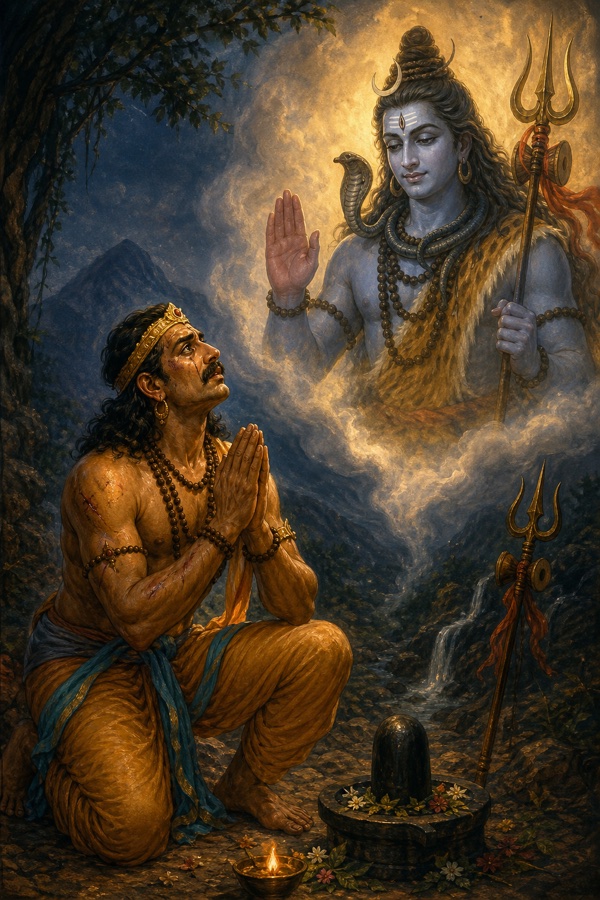
Sanjaya told him. Jayadratha had once insulted Draupadi, and Bhima had beaten him for it, and the humiliation had bitten deep. Wanting a boon, the king of the Sindhus took up the hardest austerities. He held his senses back from everything they loved, bore hunger and thirst and heat, and wore his body down until the swollen veins stood out on it, and all the while, reciting the eternal words of the Veda, he worshiped the great god Shiva, Mahadeva. That god is always moved to compassion for those who are devoted to him, and in the end he was kind. He came to Jayadratha in a dream and said, “Ask for the boon you want. I am pleased with you, Jayadratha. What do you desire?” Jayadratha bowed, joined his palms and, with his mind held still, said, “Let me, alone, on a single chariot, check in battle all the sons of Pandu, terrible as their energy and their prowess are.” That was the boon he asked for. The god answered, “I grant it. Arjuna, the son of Pritha, is excepted. The other four sons of Pandu you shall check in battle.” “So be it,” said Jayadratha to the lord of the gods, and woke from his sleep.
By that boon, and by the strength of his celestial weapons, he held the entire Pandava army single-handed. The twang of his bowstring and the slap of his palms put fear into the Kshatriyas who faced him and delight into the Kuru troops, and the Kshatriyas of the Kuru side, seeing that he had taken the load on himself, ran shouting to the part of the field where Yudhishthira’s army was. Big horses of the Sindhu breed, well trained, fast as the wind and obedient to the driver, drew his chariot, and the chariot was fitted out so that it looked like a city of cloud in the sky. His standard carried a great boar in silver. Under his white umbrella, among his banners and the yak-tail fans that mark a king, he shone like the moon in the heavens, and the iron fence of his chariot, set with pearls and diamonds, gems and gold, glittered like a night sky full of lights. He drew his great bow, and with arrows past counting he filled the array again in every place where Arjuna’s son had opened it. He pierced Satyaki with three arrows and Bhima with eight, Dhrishtadyumna with sixty, Drupada with five sharp ones, Shikhandi with ten, the Kekayas with twenty-five, each of Draupadi’s five sons with three and Yudhishthira with seventy, and he drove thick showers into the rest of the Pandava heroes. Yudhishthira smiled, took aim at Jayadratha’s bow and cut it with a single polished, well-tempered shaft. Jayadratha had another bow in his hand in an instant, pierced Yudhishthira with ten arrows and struck each of the others with three. Bhima marked how quick those hands were, and with three broad-headed shafts he brought down the man’s bow, his standard and his umbrella. Jayadratha took up yet another bow, strung it, and brought down Bhima’s standard, Bhima’s bow and Bhima’s horses, and Bhima, with his bow cut and his team dead, jumped from that fine chariot onto Satyaki’s as a lion springs to the top of a mountain. The Kuru troops shouted “Excellent! Excellent!” and applauded again and again, and every creature praised the feat of one man resisting all the angry Pandavas together. The Matsyas, the Panchalas, the Kekayas and the Pandavas strained with all their strength and did get as far as Jayadratha, and none of them could stand against him. Each man who tried to pierce the array Drona had formed was checked by the ruler of the Sindhus through the boon he had from Mahadeva, and the path that Subhadra’s son had made for his fathers by killing so many warriors and elephants was filled up.
A key to reading this (numbers and the boon): Jayadratha asked to check all the sons of Pandu, alone, on one chariot. Mahadeva granted it with one exception, Arjuna. The four he may check are Yudhishthira, Bhima, Nakula and Sahadeva, and on this day Arjuna is on the southern side of the field with the Samshaptakas. The boon holds their allies along with them: Satyaki, Dhrishtadyumna, Drupada, Shikhandi, the Kekayas and Draupadi’s five sons are all turned back at the same place, and Sanjaya says twice that Jayadratha filled up again the openings Abhimanyu had made.
The gist: Yudhishthira, Bhima and the Pandava chiefs drive down the path Abhimanyu has opened, and Jayadratha stops them alone. Sanjaya explains how: beaten by Bhima after he insulted Draupadi, Jayadratha won from Mahadeva the power to check every son of Pandu except Arjuna. He fills the breaches in the array with his arrows, loses a bow to Yudhishthira and another to Bhima, kills Bhima’s horses, and lets no one pass. Abhimanyu is inside the circle without the men who gave their word to guard him.
The Clash with Duhshasana, and Karna Driven Back
Inside the circle, Shalya had fainted on the floor of his chariot, and his younger brother had seen it. He came at Abhimanyu in a fury, scattering arrows. The boy’s hands were too quick for him: his shafts took off the man’s head and his driver, the triple bamboo pole of his chariot, its seat, its wheels, its yoke, the shafts and the quiver, the floor, the banner and every piece of fighting gear the chariot carried, so fast that nobody could catch sight of the archer who was doing it. Shalya’s brother, the chief ornament of any battle he fought in, fell to the earth dead like a great hill torn up by a storm, and his followers scattered in fear in every direction, while all who watched cheered the son of Arjuna with shouts of “Excellent! Excellent!” Then many of the dead man’s followers came on, calling out their families, their homes and their names, some on chariots, some on horses, some on elephants and others on foot, all of them fierce and carrying every kind of weapon. They meant to frighten him with the whistle of their arrows and the deep roar of their wheels, with whoops and lion-shouts, the twang of bowstrings and the slap of palms, and they said, “You will not get away from us alive today.” He smiled, and pierced first the ones who had pierced him first. He showed them the weapons he had from Krishna and the weapons he had from Arjuna, handsome to see and very fast, and he used each as its giver used it. He had put the weight of his task out of his mind and all fear with it, and he shot again and again, with no gap that anyone could see between the aiming of an arrow and its release; only the bow showed, trembling, drawn to a circle on every side of him like the blazing disc of the autumn sun, and the sound of its string and of his palms was the sound of clouds full of thunder. He was modest, and quick to anger, and respectful to his elders, and very handsome, and out of regard for the brave men in front of him he began gently. Then, like the sun when the rains are over and autumn comes, he grew fierce by degrees and sent out whetted, gold-winged arrows in hundreds and thousands, razor-edged shafts, calf-tooth heads, long stout arrows, crescent heads and broad heads, until under the eyes of Drona he had covered the chariot division of the Kaurava army and that army turned its back. He seemed to be everywhere. Wheeling like a circle of fire, he pierced Drona and Karna, Kripa and Shalya, Ashvatthama, Kritavarma of the Bhoja line, Brihadbala, Duryodhana, Somadatta and Shakuni, and kings and princes and bodies of troops besides, and the Kuru soldiers who watched him trembled again and again. Drona watched too, the teacher who had trained the boy’s father, and his eyes were wide with joy. He came quickly over to Kripa and spoke, and what he said struck Duryodhana in his very vitals. “There goes the young son of Subhadra at the head of the sons of Pritha, delighting all his friends, and King Yudhishthira, and Nakula and Sahadeva, and Bhima the son of Pandu, and all his kinsmen and his relations by marriage, and everyone who is watching this battle without taking part in it. I do not count any bowman his equal in battle. If he only chose to, he could destroy this vast host. For some reason of his own, it seems, he does not choose.” Duryodhana, furious with Abhimanyu, looked at Drona with a faint smile. Then he turned to Karna, to King Bahlika, to Duhshasana, to the ruler of the Madras and the many other great chariot warriors of his army. “The preceptor of the whole Kshatriya order, the first of those who know Brahman, has lost his judgment and does not wish to kill this son of Arjuna. No one who comes against the preceptor in battle as an enemy escapes with his life. Death himself would not. What then is a mortal to him? I tell you the truth, friends. This boy is Arjuna’s son, and Arjuna is the preceptor’s pupil, and that is why the preceptor protects him. Pupils, and sons, and the sons of both are always dear to good men. Sheltered by Drona, the boy thinks himself brave. He is a fool with a high opinion of himself. Crush him, and do it without delay.”
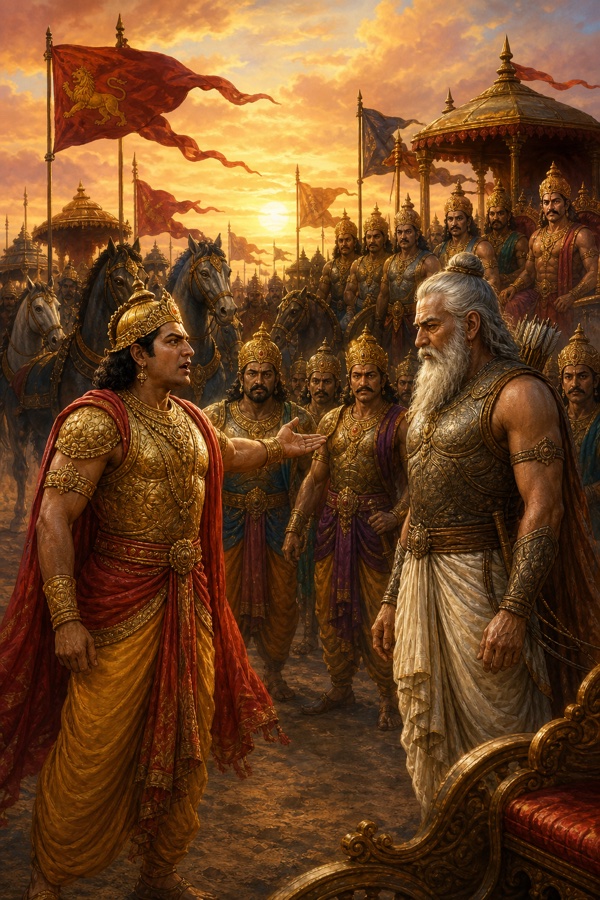
They went at Subhadra’s son in a rage, wanting him dead, in plain sight of Drona. Duhshasana had answered the king before any of them moved. “I tell you I will kill him myself, with the Pandavas looking on and before the eyes of the Panchalas. I will swallow the son of Subhadra today as Rahu swallows the sun.” And he called to the Kuru king a second time, loudly: “The two Krishnas, Arjuna and his friend, are vain beyond measure, and when they hear I have killed Subhadra’s son they will leave this world of men for the country of the dead. There is no doubt of it. And when the other sons born of Pandu’s wives hear that those two are dead, they and all their friends will throw away their lives in despair before a single day is out. So with this one enemy killed, every enemy you have is killed. Wish me well. I will kill this foe of yours.” He roared, and in his fury rushed at Abhimanyu and covered him with showers of arrows.
Abhimanyu received him with twenty-six sharp-pointed arrows. Duhshasana fought him desperately, raging like an elephant in rut. Both were masters of fighting from a chariot, and they circled each other as they fought, handsomely, one wheeling to the left and the other to the right, while around them the troops beat panavas and mridangas, dundubhis and krakachas, great anakas, bheris and jharjharas, drums of every size, and roared like lions, until the din was the din of the salt sea. Abhimanyu was torn with arrows, and he smiled at the enemy standing in front of him. “It is my good luck that I see here in battle, come to face me, that vain hero who is cruel, who has thrown away all righteousness, and who bawls out his own praises. In the assembly of the Kurus, with King Dhritarashtra listening, you angered King Yudhishthira with your harsh speeches. You trusted in the cheating of the dice and in the skill of Subala’s son, and in the madness of winning you said many wild things to Bhima. Those great men are angry, and through their anger the fruit of that conduct has come to you at last. Your understanding is wicked. Take now, without delay, the fruit of robbing other people of what was theirs, of your wrath, of your hatred of peace, of greed, of ignorance, of making war on your kin, of injustice and persecution, of taking their kingdom from my fathers, those fierce archers, and of your own savage temper. Today I will punish you with my arrows in the sight of the whole army. Today, in battle, I will lay down the anger I carry against you. I will pay what I owe to Draupadi in her anger, and to my father, who is always longing for the chance to punish you. Today I will be free of my debt to Bhima. You will not escape me with your life, unless you leave the battle.”
With that he aimed a shaft bright as Yama, as Agni, as the god of wind, an arrow fit to send Duhshasana to the other world. It flew at his chest, struck at the joint of the shoulder and went into his body up to the feathers, as a snake goes into an anthill. Abhimanyu drew his bow to its full stretch and struck him again with twenty-five arrows whose touch was like fire. Pierced deep and in great pain, Duhshasana sat down on the floor of his chariot and lost consciousness, and his driver carried him senseless and at speed out of the middle of the fight. The Pandavas saw it, and Draupadi’s five sons, and Virata, the Panchalas and the Kekayas, and they roared like lions. Their troops in their joy beat and blew every instrument they had, and laughed with delight at what the boy had done. A proud enemy who had never relented was beaten, and the sons of Draupadi, whose banners carried the images of Yama, of Maruta, of Indra and of the twin Ashvins, with Satyaki, Chekitana, Dhrishtadyumna, Shikhandi, the Kekayas, Dhrishtaketu, the Matsyas, the Panchalas, the Srinjayas and the Pandavas led by Yudhishthira, rushed forward in their gladness to pierce Drona’s array. A dreadful battle began between them and the Kuru warriors, and no man on either side would give ground.
In the middle of it Duryodhana spoke to Karna, the son of Radha. “Look at this. Duhshasana, who burns like the sun, who until this moment was killing the enemy, has gone down before Abhimanyu. And the Pandavas are rushing at us in a rage, fierce as great lions, wanting to rescue Subhadra’s son.” Karna, angry and eager to serve the king, rained sharp arrows on Abhimanyu, and as if in contempt of him shot at his followers too with many fine, keen shafts. Abhimanyu wanted to reach Drona. He put seventy-three arrows into Karna quickly and went on, and Sanjaya told the king that not one chariot warrior in the Kuru army could bar the way toward Drona to that son of Indra’s son while he was wounding their leading men.
Karna, whom archers honored above all others, wanted the victory. He pierced the son of Subhadra with hundreds of arrows and brought his best weapons into play. He was a pupil of Rama, the son of Jamadagni, and few men knew weapons as he did, and with them he hurt a boy whom no enemy could defeat. Subhadra’s son fought like one of the gods, and under all that rain he felt no pain. With arrows whetted on stone and sharp at the point he cut the bows of many brave warriors, and then he began to hurt Karna in return. His bow drawn to a circle, he sent shafts like venomous snakes that cut away, in quick succession and with a smile, Karna’s umbrella, his standard, his charioteer and his horses. Karna shot five straight arrows at him, and he took them without fear. A moment later, with a single arrow, he cut Karna’s bow and his standard and dropped them on the ground.
Karna’s younger brother saw the trouble he was in. Pulling his bow with great force, he drove at Subhadra’s son, while the Pandavas and their followers shouted and beat their instruments and cheered the boy. Roaring, bow in hand, plucking again and again at the string, he put himself between the two of them and, smiling, pierced Abhimanyu with ten arrows, him and his umbrella and his standard, his charioteer and his horses. The Kuru warriors were delighted to see the boy hurt at last, after feats beyond a man’s that he had done in the manner of his father and his grandfather. Abhimanyu bent his bow hard, smiled, and with one winged arrow cut off the man’s head, and the head dropped from the trunk to the ground. Karna saw his brother killed and thrown down like a karnikara tree shaken from a mountain top by the wind, and it filled him with pain. Abhimanyu’s arrows, more than could be counted, made him turn away, and Karna fled the field, carried off by fast horses, while the boy rushed at the other great archers.
A key to reading this (lineage): Karna is called here the son of Radha and the son of Vikartana. Radha was the wife of Adhiratha, a man of the charioteer caste; the two of them found the infant Karna in a box drifting on the Ganga and reared him as their son. The Rama whose pupil he is called is the son of Jamadagni, the same Rama whom Sanjaya names, together with Bhima and with the Destroyer at the end of an age, as three who are spoken of as equals.
The gist: Abhimanyu kills Shalya’s younger brother and, beginning gently, turns the Kuru chariot division. Drona praises him aloud to Kripa, and Duryodhana tells his chiefs that the preceptor is sparing his pupil’s son and orders them to crush the boy. Duhshasana promises to swallow him as Rahu swallows the sun and is carried from the field unconscious, an arrow sunk in his shoulder joint. Karna loses his umbrella, standard, driver, horses and bow; his younger brother steps between them and is beheaded; and Karna himself is driven off. Outside, the Pandavas cheer and throw themselves at the array again.
The Slaughter of a Hundred Princes, and the Gandharva Illusion
With Karna gone, the boy in his anger broke that host of many arms, elephants and horses, chariots and foot, and the Kaurava array gave way. His arrows covered the sky like flights of locusts or a thick fall of rain, and under them nothing could be made out. Of all the warriors he was cutting down, Sanjaya said, none stayed on the field any longer except the ruler of the Sindhus. Then the son of Subhadra blew his conch and fell on the Bharata host once more. He went through the Kaurava army like a burning brand thrown into dry grass. Having pierced their array, he tore chariots and elephants and horses and men with his sharp shafts and crowded the field with headless trunks, and the Kaurava warriors, cut by the arrows from that bow, ran, and as they ran they killed their own comrades in front of them. The arrows went on falling, fierce, whetted on stone, past counting. Arms lay in thousands with gold armlets on them, and hands still cased in leather, and arrows and bows and bodies, and heads with earrings and wreaths of flowers. Chariot fittings and seats and long poles, crushed axles, broken wheels and yokes in thousands, darts and swords and fallen standards and shields, and the bodies of dead Kshatriyas and horses and elephants choked the ground until it was terrible to see and could no longer be crossed. The princes called to one another as they were killed, and the noise of it, enough to deepen the fear of any man who was afraid already, filled every quarter of the sky. He was ringed by Kuru troops and covered in dust, and while he ranged the field toward each of the points and between them, none of them could get a sight of him, and all that time horses and elephants and men went on dying almost without a pause. Soon afterward they saw him come out of the press. He stood in the middle of the enemy army scorching it like the sun at noon, the son of Indra’s son, Indra’s equal in battle.
When Jayadratha had checked the Pandavas, the fighting between the two armies turned dreadful. Inside the array Abhimanyu, whose aim was sure, churned it as a sea monster churns the ocean, and the chief warriors of the Kaurava army came at him in the order of their rank and standing. They closed him in with crowds of chariots. He killed the charioteer of Vrishasena and cut Vrishasena’s bow, then put straight shafts into the horses, which bolted with the speed of the wind and carried Vrishasena out of the battle; and Abhimanyu’s own driver used that opening to take the chariot clear of the press to another part of the field, while the chariot warriors who saw it done cried, “Excellent! Excellent!” Vasatiya watched the boy coming on from a distance, killing in his anger like a lion, and went at him fast and hard. He pierced Abhimanyu with sixty gold-winged shafts and said, “As long as I am alive, you will not escape with your life.” Vasatiya wore a coat of iron mail. Subhadra’s son shot him in the chest with a long-ranging arrow, and he fell to the earth dead. Many great Kshatriyas, furious at that, surrounded the king’s grandson to kill him, stretching bows of every kind, and the fight was savage. He cut their arrows and their bows, limbs from their bodies, heads with their earrings and garlands. Arms lay lopped off with the gold still on them, still gripping scimitars and spiked maces and battle-axes, the fingers still in their leather gloves, among wreaths and ornaments and cloth, fallen standards, mail, shields, gold chains, diadems, umbrellas and yak-tail fans, the wrecked fittings of chariots, banners, charioteers and horses. The dead were rulers of many countries who had come wanting victory, and the field where they lay was a fearful sight. He crossed it in every direction in his anger, and his body could not be seen. Only the gold-worked mail showed, and the ornaments, and the bow and the arrows; he stood in their midst killing, bright as the sun, and no one could keep his eyes on him. He was taking lives as the Destroyer takes them when the dissolution of the universe arrives. He seized Satyashravas as a tiger in a fury seizes a deer. Great chariot warriors saw Satyashravas taken and rushed in with weapons of every kind, rivals even then, each one shouting, “I will go first! I will go first!”, and he received that whole charging division of Kshatriyas as a whale in the sea receives a shoal of small fish, with the greatest ease. Like rivers that never turn back once they have come to the sea, none of them turned back once they had come to him, and the army reeled like a boat caught by a great storm on the ocean, its crew sick with terror at the force of the wind. Then Rukmaratha, the son of the ruler of the Madras, spoke up without fear to steady the frightened troops. “You are brave men, and you need not be afraid. While I am here, what is Abhimanyu? I will take him a living captive. There is no doubt of it.” He drove at Abhimanyu on a handsome, well-furnished chariot, put three shafts into his chest, three into his right arm and three more sharp ones into his left, and gave a loud roar. Abhimanyu cut his bow, cut off his right arm and his left, cut off his head with its fine eyes and brows, and dropped them quickly on the ground.
Rukmaratha had been honored among them, and he had vowed to burn his enemy up or take him alive. Many princes who were his friends saw him killed. They were skilled at striking and hard to beat, with gold on their standards, and they stretched bows a full six cubits long and surrounded Arjuna’s son, all of them pouring arrows on him at once. Duryodhana saw the boy, brave and still unbeaten, facing alone all those angry princes with their courage, their trained skill, their strength and their youth, saw him covered with arrows, and was very glad. He counted Abhimanyu already a guest in the house of Yama. In an instant the princes’ gold-winged shafts, of many shapes and great force, had hidden Arjuna’s son; Sanjaya and the others saw the boy, his standard and his chariot covered as trees are covered when the locusts come down on them. Pierced deep, he filled with rage like an elephant struck with the hook.
Then he used the Gandharva weapon and the illusion that follows from it. Arjuna had won that weapon by ascetic penances from the Gandharva Tumburu and others, and with it his son now confounded his enemies. Showing his weapons quickly, he wheeled through the battle like a circle of fire, and they saw him sometimes as one man, sometimes as a hundred, sometimes as a thousand. Between the skill with which his chariot was driven and the illusion his weapons made, they could not tell where he was, and he cut the bodies of those kings into a hundred pieces. His sharp shafts sent their lives to the other world while their bodies dropped to the earth. He cut away their bows, their horses and their charioteers, their standards, their arms with the armlets on them, and their heads. A hundred princes were killed and laid low by Subhadra’s son like a grove of five-year-old mango trees, just at the point of bearing fruit, flattened by a storm. They were young, they had been brought up in every luxury, and they were as dangerous as angry snakes, and one boy alone had killed them all. Duryodhana saw it, and he was afraid.
With his chariot warriors and elephants and horses and foot soldiers crushed in front of him, the Kuru king went quickly, in wrath, at Abhimanyu. Their fight lasted only a short while and was never finished, though it was fierce while it lasted. Sanjaya told Dhritarashtra that his son, hurt by Abhimanyu’s arrows, was obliged to turn back from it.
A key to reading this (a modern equivalent for the numbers): The epic’s figures here are few and round: ten thousand bowmen posted at the entrance of the array, a hundred princes killed after Rukmaratha’s death, ten thousand kings who break and run when the king of the Kosalas falls, and the ten thousand warriors Yudhishthira credits to the boy that evening. Taken as counts of men, they show one chariot fighter breaking a formation the size of a modern division. Sanjaya’s own words for the day are a battle between one and the many.
The gist: With Karna driven off, Abhimanyu burns through the Kuru army until only Jayadratha keeps his place. He drives Vrishasena from the field, kills Vasatiya, seizes Satyashravas, and cuts down Rukmaratha, the son of Shalya, who had promised to take him alive. A hundred princes who surround him after Rukmaratha’s death die under the Gandharva weapon, which shows him as one man, then as a hundred, then as a thousand. Duryodhana attacks him in person and has to turn back, wounded.
The Death of Lakshmana, and the Ring of Six Great Warriors
The old king broke in again. “What you tell me, Sanjaya, of one fighting many and winning, is wonderful and close to past belief. Yet I do not count it a marvel wholly beyond belief in those who make righteousness their refuge. When Duryodhana had been beaten back and a hundred princes killed, what did the warriors of my army do against the son of Subhadra?” Their mouths went dry, Sanjaya said, and their eyes would not keep still. Sweat covered their bodies and their hair stood on end. They despaired of beating their enemy and made ready to leave the field, and then they fled, abandoning their wounded brothers and fathers and sons, their friends and kinsmen and relations by marriage, and driving their horses and elephants as fast as they could go.
Drona saw them broken and running. So did Ashvatthama, Brihadbala, Kripa, Duryodhana, Karna, Kritavarma and Shakuni the son of Subala, and all of them rushed in great anger at Subhadra’s son, who had still not been beaten. Nearly every one of them was driven back by the king’s grandson. A single warrior kept coming, and he was Lakshmana, the son of Duryodhana, brought up in luxury, skilled with arrows, full of energy, and without fear because he was inexperienced and proud. His father, anxious for him, turned back to follow him, and the other great chariot warriors turned back to follow Duryodhana, and together they drenched Abhimanyu with arrows as clouds pour rain on the side of a mountain. Alone, he began to break them up as a dry wind blowing from every quarter breaks up the gathering clouds.
Like one maddened elephant meeting another, Arjuna’s son met Lakshmana, who was also a grandson of the king Sanjaya was speaking to. Lakshmana was very handsome and very brave, he stood near his father with his bow stretched, he had been raised in every luxury, and he looked like another son of the Lord of Treasure. His sharp shafts struck Abhimanyu in both arms and in the chest. Abhimanyu filled with rage like a snake struck with a rod, and he said to him, “Look well at this world, for soon you will have to go to the other. I am going to send you to the house of Yama while all your kinsmen watch.”
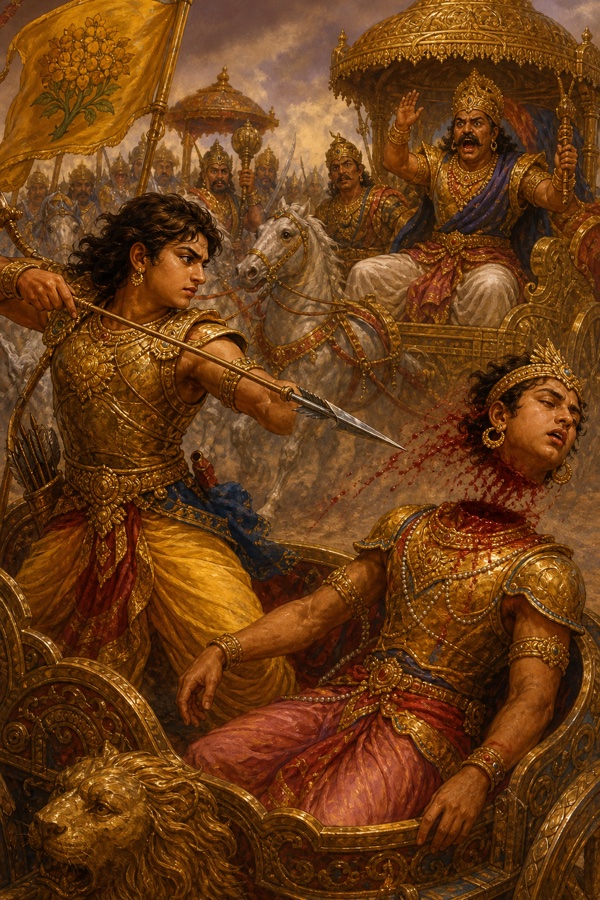
He took out a broad-headed arrow that looked like a snake just come out of its old skin. Sped by his arms, it cut off Lakshmana’s head, a beautiful head with rings in its ears, a fine nose, fine brows and handsome curling hair. The Kuru troops cried out “Oh!” and “Alas!” when they saw Lakshmana killed. He was a son Duryodhana loved, and rage took the king. He shouted to the Kshatriyas under him, “Kill this one!”
Six chariot warriors closed around Abhimanyu then: Drona, Kripa, Karna, Drona’s son Ashvatthama, Brihadbala, and Kritavarma the son of Hridika. He pierced them with sharp arrows, beat them off, and fell with great speed and fury on the huge force of Jayadratha. There the Kalingas, the Nishadas and the brave son of Kratha, all of them in mail, cut off his road and ringed him with their elephant division, and the fight between them was stubborn and fierce. He set about destroying that elephant division as a wind coursing through every quarter destroys the great banks of cloud gathering in the sky. Kratha’s son covered him with showers of arrows, and many other chariot warriors, Drona at their head, came back to the field and rushed at him, scattering sharp and powerful weapons. He stopped all those weapons with his own arrows and turned on the son of Kratha with shower after shower, quickly, wanting him dead. He cut away the man’s bow and arrows, his bracelets, his arms, his head with the diadem on it, his umbrella, his standard, his charioteer and his horses. Kratha’s son was a man of noble family and good conduct, learned in the scriptures, strong, famous and powerful in arms, and when he was killed nearly all the other fighting men turned away from the battle.
Dhritarashtra asked, “This young son of Subhadra, who has never been beaten and never turns from a battle, had broken into our array and was doing deeds worthy of his family, drawn by three-year-old horses of the best breed, strong ones that seemed to trot through the sky. Which heroes of my army surrounded him?” Sanjaya gave him the names again. Abhimanyu, of Pandu’s line, had gone into the array and with his sharp arrows turned every king away from the fight, and then Drona, Kripa, Karna, Ashvatthama, Brihadbala and Kritavarma the son of Hridika, those six chariot warriors, surrounded him. The rest of the Kuru fighting men, seeing that Jayadratha had taken on himself the heavy duty of keeping the Pandavas off, supported him by rushing at Yudhishthira.
A sub-tale: The Lakshmana of this chapter is the son of Duryodhana; he shares a name, and nothing more, with the brother of Rama in the Ramayana. In the morning he rode at the head of the ten thousand princes posted at the entrance of the array. Sanjaya calls him Dhritarashtra’s grandson and gives Abhimanyu the same title in the next breath, so the boy who dies and the boy who kills him belong to one house.
The gist: The Kuru army runs. Eight of its chiefs rush at Abhimanyu, and nearly all of them are driven back. Duryodhana’s son Lakshmana comes on alone, wounds him in the arms and chest, and loses his head to a single broad-headed arrow. Duryodhana cries, “Kill this one!”, and six chariot warriors surround the boy: Drona, Kripa, Karna, Ashvatthama, Brihadbala and Kritavarma. He beats them off, breaks the elephant division of the Kalingas and Nishadas, and kills the son of Kratha.
The Blow Against Brihadbala of Kosala and Against Shalya
Strong men among them drew bows a full six cubits long and poured arrows on Subhadra’s son like torrents of rain. He stopped those great archers, learned in every branch of knowledge, with shafts of his own. He pierced Drona with fifty arrows and Brihadbala with twenty, Kritavarma with eighty and Kripa with sixty. He drew his bow to its full stretch and pierced Ashvatthama with ten gold-winged arrows of great speed. In the middle of his enemies he shot Karna in the ear with a bright, well-tempered, bearded arrow of great force. He brought down the horses yoked to Kripa’s chariot and both of his Parshni charioteers, the drivers who guard a warrior’s flanks, and put ten arrows into the center of Kripa’s own chest. Then, with the sons of Dhritarashtra looking on, he killed the brave Vrindaraka, a man who had added to the fame of the Kurus.
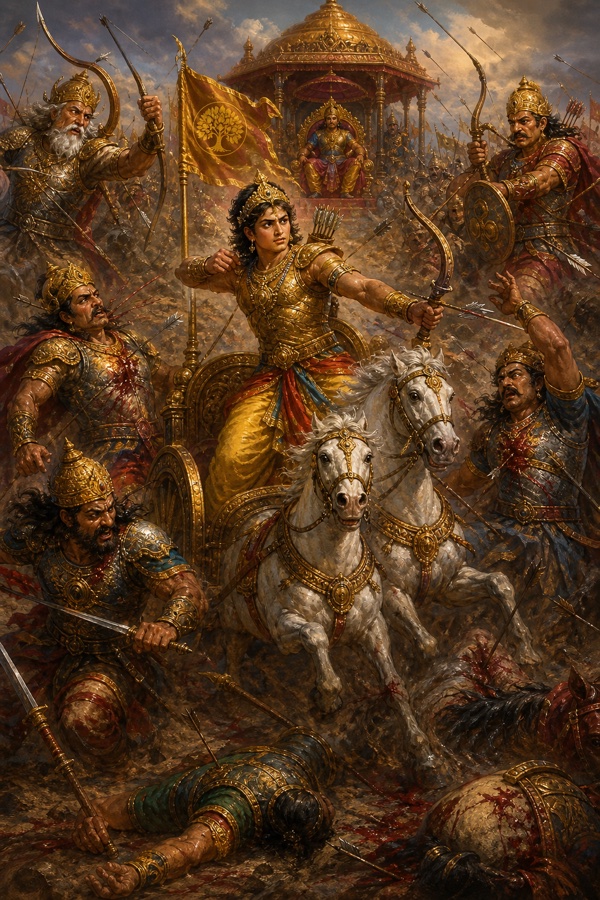
While he was killing the leading warriors among his enemies one after another without fear, Ashvatthama pierced him with twenty-five small arrows. In the sight of all the sons of Dhritarashtra he quickly answered with many whetted shafts. Drona’s son came back with sixty, fierce, fast and very sharp, and failed to make him tremble: pierced by them, he stood as immovable as Mount Mainaka. Then he put seventy-three straight, gold-winged arrows into Ashvatthama. Drona, wanting to rescue his son, pierced Abhimanyu with a hundred arrows, and Ashvatthama, wanting to rescue his father, with sixty more. Karna struck him with twenty-two broad-headed arrows, Kritavarma with fourteen, Brihadbala with fifty of the same kind, and Kripa the son of Sharadvat with ten. He gave ten back to every one of them.
The ruler of the Kosalas struck him in the chest with a barbed arrow. Abhimanyu at once brought down the man’s horses, his standard, his bow and his charioteer. Left without a chariot, the king of the Kosalas took up a sword, meaning to cut from its trunk that handsome head with the rings in its ears. Abhimanyu shot King Brihadbala in the chest with one strong arrow, and he fell with his heart split. Ten thousand kings saw it and broke. They fled with their swords and bows in their hands, saying as they went things that boded no good for Duryodhana, and Subhadra’s son, with Brihadbala dead behind him, ranged the battle stopping the great archers of the Kuru army where they stood with showers of arrows as thick as rain.
He shot Karna in the ear again with a barbed arrow, and to anger him further put fifty more shafts into him. Radha’s son gave him back as many. Covered with arrows, Abhimanyu looked beautiful, and in his fury he bathed Karna in blood as well, so that the two of them, pierced all over and red from head to foot, were like a pair of kinshuka trees in flower. Then he killed six of Karna’s brave counselors, men who knew every mode of fighting, with their horses, their charioteers and their chariots, and without fear gave each of the other great archers ten arrows for those they had sent him. He killed Ashvaketu next, the young son of the ruler of the Magadhas, with six straight shafts, and Ashvaketu’s four horses and his driver with him. With a sharp, razor-headed arrow he killed the Bhoja prince of Martikavata, whose banner carried an elephant, and he gave a great shout and began to scatter his arrows on every side.
The son of Duhshasana came at him then. He pierced Abhimanyu’s four horses with four shafts, the charioteer with one, and Abhimanyu himself with ten. Abhimanyu put ten swift arrows into him and, his eyes red with anger, called out in a loud voice, “Your father left the battle and ran like a coward. It is well that you know how to fight. All the same, you will not escape with your life today.” He sent a long arrow at him, one that a smith’s hand had polished well, and Drona’s son cut it down with three shafts of his own. Abhimanyu let Ashvatthama be and struck at Shalya, and without fear planted nine vulture-feathered shafts in Shalya’s chest. He cut Shalya’s bow and killed both of his Parshni charioteers, then pierced Shalya himself with six shafts made wholly of iron, and Shalya left that chariot, which had no horses to draw it now, and climbed onto another. After that Abhimanyu killed five warriors, Shatrunjaya, Chandraketu, Mahamegha, Suvarchas and Suryabhasa, and then he pierced Shakuni, the son of Subala.
A key to reading this (places and lineage): Brihadbala is the ruler of the Kosalas, and Ashvaketu is the young son of the ruler of the Magadhas. The Bhoja prince killed here comes from Martikavata and carries an elephant on his banner; Kritavarma, one of the six, is of the Bhoja line too, and is called the son of Hridika. Shalya rules the Madras. By this hour his son Rukmaratha and his younger brother have both died at Abhimanyu’s hands, and he is himself the brother of Madri, the mother of Nakula and Sahadeva, so that two of the men held outside the array by Jayadratha are his sister’s sons.
The gist: Ringed by the six, Abhimanyu pierces every one of them, shoots Karna in the ear, kills Kripa’s horses and both his flank drivers, and stands under sixty of Ashvatthama’s arrows like Mount Mainaka. Brihadbala, king of the Kosalas, comes at him on foot with a sword and is shot through the heart, and ten thousand kings run. Six of Karna’s counselors die, and Ashvaketu of Magadha, the Bhoja prince of Martikavata and five more named warriors; Shalya is driven onto a second chariot; and Duhshasana’s son is told that he will not leave the field alive.
Drona’s Counsel, and the Start of the Trick
Shakuni pierced him with three arrows in return, and then spoke to Duryodhana. “Let all of us grind this one down together, or he will fight us one at a time and kill us all. Think of a way to kill him, and take counsel on it with Drona and Kripa and the others.” Karna, the son of Vikartana, said to Drona, “Abhimanyu is grinding all of us down. Tell us the means by which we can kill him.”
Drona, the great bowman, answered all of them. “You have been watching him closely. Has any one of you been able to find a flaw in this boy? He is moving in every direction at once, and still, has any of you today found the smallest opening in him? Look at the lightness of his hand and the quickness of his movement, this son of Arjuna, this lion among men. In the track of his chariot you can see nothing except his bow drawn to a circle, so fast does he aim his arrows and so fast does he let them go. He delights me, this son of Subhadra, though he is wearing down the breath in my body and stunning me with his shafts. The greatest chariot warriors, with all their anger, cannot find a gap in him, and so he delights me greatly as he ranges the field. I see no difference in battle between the bearer of Gandiva himself and this boy with his quick hand, who is filling every point of the horizon with his arrows.”
Karna was suffering from the arrows of Arjuna’s son, and he spoke to Drona again. “Abhimanyu’s arrows have hurt me badly, and I stay in this battle only because a warrior ought to stay. The arrows of this boy are terrible. They are fierce, they have the energy of fire, and they are weakening my heart.”
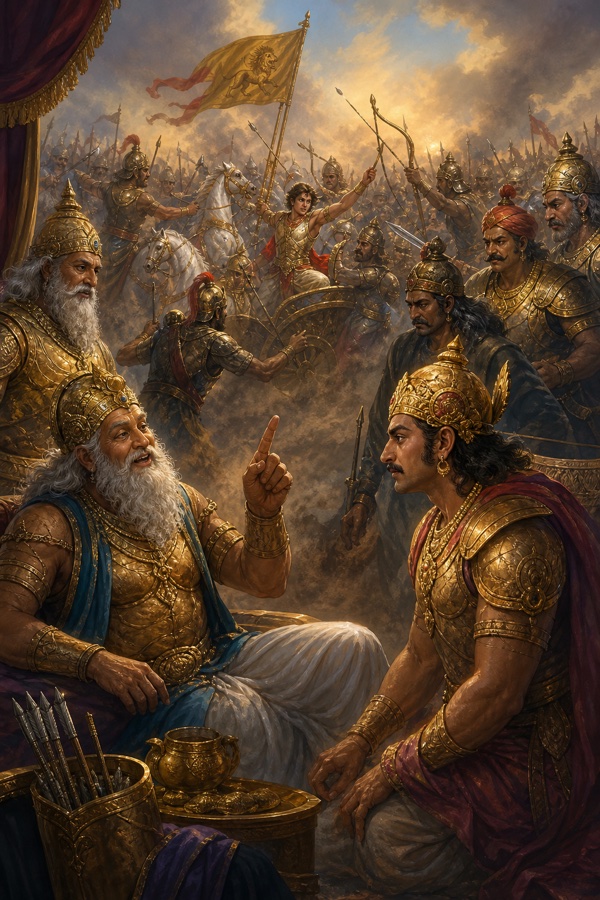
The preceptor answered Karna slowly, and with a smile. “Abhimanyu is young, and his prowess is great. His coat of mail cannot be pierced. I taught his father how defensive armor is to be worn, and this boy certainly knows the whole of that science. But with well-shot arrows you can cut his bow, and his bowstring, and the reins of his horses, and the horses themselves, and his two Parshni charioteers. Do that, Karna, if you are able. Make him turn from the fight by those means, and strike him then. With his bow in his hand he cannot be beaten by the gods and the Asuras together. If you wish it, take his chariot from him, and take away his bow.”
Karna, the son of Vikartana, heard the preceptor out, and with his arrows he quickly cut the bow of Abhimanyu while the boy was shooting at great speed. Kritavarma of the Bhoja line killed his horses. Kripa killed his two Parshni charioteers. The rest covered him with showers of arrows now that the bow was gone from his hand. Those six great chariot warriors, moving fast at a moment when speed was needed, and without pity, buried in arrows a boy who had no chariot and was fighting all of them alone.
A key to reading this (the concept): Drona’s counsel and what follows it are told in a few lines. The preceptor, who has just said he sees no difference in battle between this boy and Arjuna, tells Karna that the armor cannot be pierced and that the bow, the string, the reins, the horses and the two flank drivers can be cut away. Karna cuts the bow with his arrows while Abhimanyu is shooting, Kritavarma kills the horses, Kripa kills the two drivers, and six chariot warriors cover a boy who has neither chariot nor bow. The text does not say from which side Karna’s arrows came. Three voices in these sections judge what was done: the beings in the sky, who call the act unrighteous; Yudhishthira, who tells Vyasa that men who make war their calling fight opponents placed as they themselves are placed, and that this fight was extremely unequal; and Dhritarashtra, who calls cruel the Kshatriya duty under which brave men shot their weapons at a child.
The gist: Shakuni urges Duryodhana to have them all strike together, and Karna, in pain from the boy’s arrows, asks Drona how he can be killed. Drona praises Abhimanyu as Arjuna’s equal, says that no one has found a gap in him, and then names what can be cut: bow, bowstring, reins, horses and the two Parshni charioteers. Karna cuts the bow, Kritavarma kills the horses, Kripa kills the two drivers, and the six cover with arrows a boy who now has no chariot under him.
Sword, Chariot Wheel, and Mace: the Final Blow
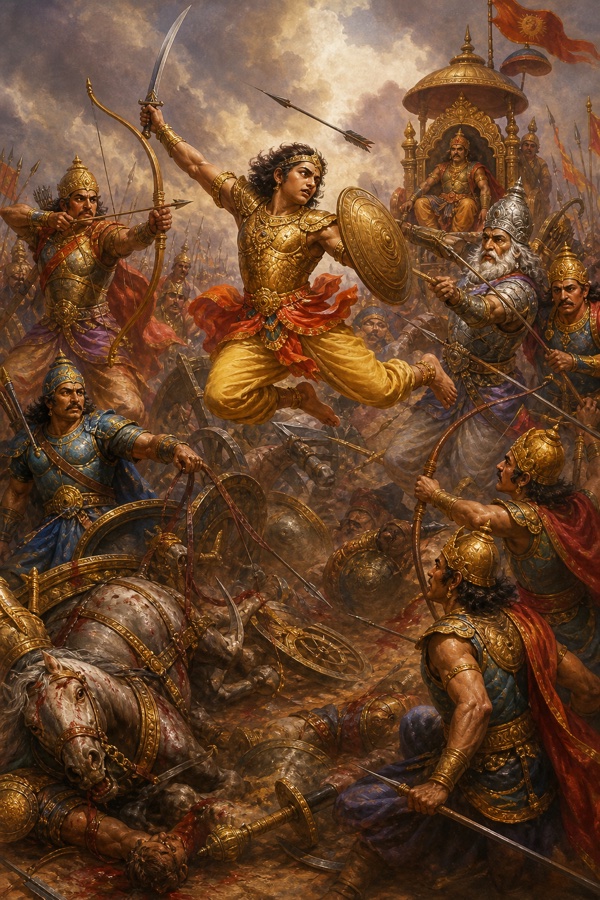
He had no bow now and no chariot. Keeping his eye on what a warrior owes, he took up a sword and a shield and leaped into the sky. With great strength and great speed he traced the course called Kaushika and others, and swept fiercely through the air like Garuda, the king of birds. Each of the great archers thought, “He may come down on me, sword in hand,” and with their faces turned upward they watched for a lapse in him and went on shooting. Drona, with a sharp arrow, quickly cut off the hilt of Abhimanyu’s sword, a hilt set with gems. Karna, the son of Radha, with sharp shafts, cut away his fine shield.
With sword and shield gone he came down out of the sky to the earth, his limbs whole. He picked up a chariot wheel and rushed in anger at Drona. The dust the chariot wheels had raised lay bright on his body, he held the wheel above him in his lifted arms, and he looked very beautiful; for a while in that battle he was a fearful likeness of Krishna, Vasudeva himself, with the discus. His clothes were dyed with the blood that ran from his wounds. His brow was drawn into furrows and terrible to see. He roared like a lion, again and again, standing among those kings, and he shone on that field. Sanjaya called him the joy of Vishnu’s sister, and an Atiratha, the name for a chariot warrior who can fight a multitude alone, and said that with Vishnu’s own weapon in his hands he looked like a second Krishna. The ends of his hair streamed in the wind. With that supreme weapon lifted over him, his body became a thing the gods themselves could not look at.
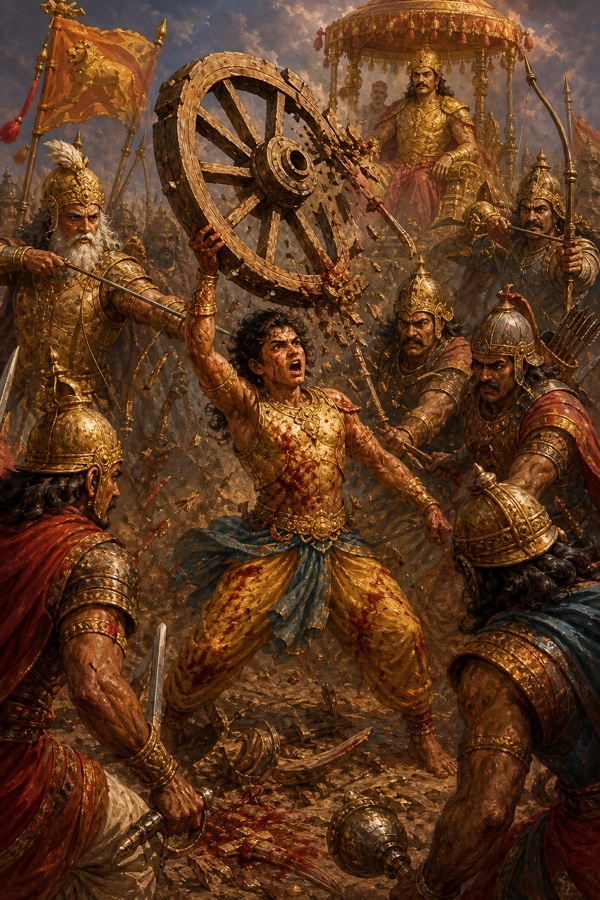
The kings saw it, and saw the wheel in his hands, and were filled with anxiety, and they cut the wheel into a hundred pieces. Then Arjuna’s son took up a great mace. They had stripped him of his bow, his chariot and his sword, and now of his wheel; mace in hand, he ran at Ashvatthama. Ashvatthama saw that mace come up like a blazing thunderbolt, got down from his chariot in haste and took three long leaps to be out of its way. The mace killed Ashvatthama’s horses and both of his Parshni charioteers. Stuck all over with arrows, Subhadra’s son looked like a porcupine. He crushed Kalikeya, a son of Subala, down into the earth, and killed seventy-seven Gandhara men who followed Kalikeya. He killed ten chariot warriors of the Brahma-Vasatiya people next, and after them ten huge elephants.
He went on toward the chariot of Duhshasana’s son and smashed it, chariot and horses together, pressing them down into the earth. Duhshasana’s son, whom no one had yet beaten, took up his own mace and rushed at Abhimanyu, shouting, “Wait! Wait!” The two were cousins, and each wanted the other dead. With their maces lifted they began to strike, like three-eyed Shiva and the Asura Andhaka in the old days. Each was hit by the head of the other’s mace, and both fell to the ground like two standards raised in honor of Indra and then pulled up.
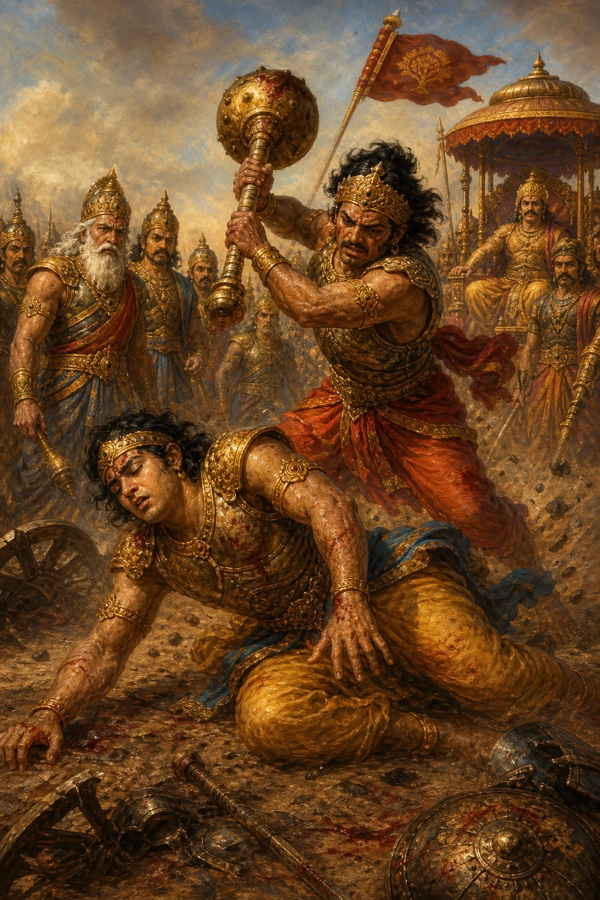
Duhshasana’s son, who added to the fame of the Kurus, got up first, and as Abhimanyu was on the point of rising he struck him with the mace on the crown of the head. The force of that blow, and all the exertion that had gone before it, stunned him, and the son of Subhadra fell to the earth senseless. So, Sanjaya told the king, one was killed by many in battle, one who had ground a whole army as an elephant grinds the lotus stalks in a lake.
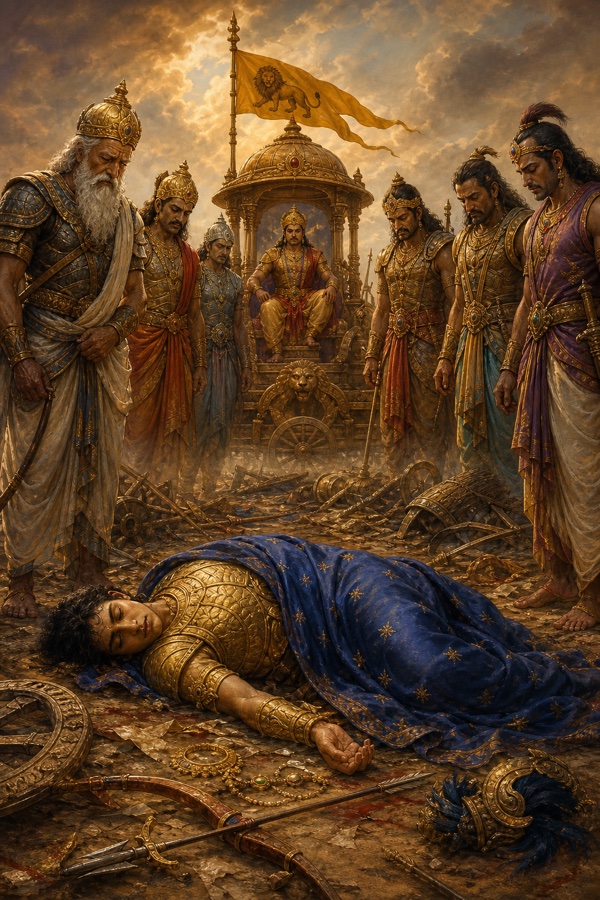
He lay dead on the field like a wild elephant killed by hunters, and the Kuru troops gathered around the fallen boy. He looked like a fire in the hot season that has burned a whole forest and gone out, like a storm that has broken the crests of mountains and spent its fury, like the sun come to the western hills after scorching the Bharata host, like the moon swallowed by Rahu, like the ocean with its water gone. His face had the splendor of the full moon, and lashes as black as a raven’s feathers made his eyes beautiful, and he was stretched out on the bare ground. The great chariot warriors of the Kuru army looked at him and were filled with joy. They shouted like lions, over and over. Their troops were beside themselves with gladness, Sanjaya said, while tears ran fast from the eyes of the Pandava heroes. And creatures of many kinds in the sky, seeing him lie there like the moon dropped out of heaven, said aloud, “Alas, this one lies on the field, killed while he fought alone by six great chariot warriors of Dhritarashtra’s army, with Drona and Karna at their head. We hold that this was an unrighteous act.”
A key to reading this (the count): Sanjaya names six chariot warriors who surround Abhimanyu after Lakshmana’s death: Drona, Kripa, Karna, Ashvatthama, Brihadbala and Kritavarma. Brihadbala is then killed by Abhimanyu. When the text speaks again of six who bury the boy in arrows once his bow is cut, it gives no new list, and the voices in the sky say only that he was killed by six great chariot warriors with Drona and Karna at their head. The acts it assigns by name are these: Karna cuts the bow and afterward the shield, Kritavarma kills the horses, Kripa kills the two Parshni charioteers, Drona cuts the hilt from the sword, the kings together break the wheel, and the mace blow on the crown of the head comes from the son of Duhshasana, who is Abhimanyu’s cousin. Sanjaya’s summary before the story begins says the same: six heroes met him together, and he went down before Duhshasana’s son. Nowhere do these sections count seven attackers. Abhimanyu speaks to no one after his words to Duhshasana’s son, and he asks no one for anything. His age is given only as that of a child, a boy still in his minority.
The gist: Without bow or chariot, Abhimanyu fights with sword and shield in the air until Drona cuts the hilt and Karna the shield, then with a chariot wheel until the kings break it, then with a mace. The mace kills Ashvatthama’s horses and flank drivers, Kalikeya the son of Subala, seventy-seven Gandharas, ten Brahma-Vasatiya chariot warriors and ten elephants, and it wrecks the chariot of Duhshasana’s son. The two cousins knock each other down. Duhshasana’s son is up first, and his mace comes down on the crown of Abhimanyu’s head as the boy is rising. The beings of the sky call the killing unrighteous.
Twilight, and Yudhishthira’s Lament
With that hero dead, the earth looked splendid, like the sky set with stars and the moon. She was strewn with gold-winged arrows and covered with waves of blood. The handsome heads of brave men lay on her, with their earrings and their costly turbans of many colors, and banners and yak-tail fans, fine blankets, jeweled weapons, the bright ornaments of chariots and horses, of men and elephants, sharp, well-tempered swords like snakes freed of their old skins, bows, broken arrows, darts, lances and weapons of other kinds. Horses lay dead or dying in their blood, with the riders Subhadra’s son had brought down lying about them, and in many places no one could pass. There were iron hooks, and elephants as big as hills crushed by arrows with their shields and weapons and standards on them, and fine chariots without horses or drivers or warriors, scattered and broken by elephants, like lakes whose waters have been churned up, and great bodies of foot soldiers lying dead with their weapons on them. The field had taken on a look to put terror into every timid heart.
The Kuru troops, seeing Abhimanyu on the ground, bright as the sun or the moon, were carried away with joy, and the Pandavas were filled with grief. When that boy fell, still short of manhood, the Pandava divisions ran, with King Yudhishthira looking on. He saw his army breaking at the fall of Subhadra’s son and called to his brave warriors, “Abhimanyu never turned from the battle, and he has been killed, and he has certainly gone up to heaven. Stand, then, and do not be afraid. We will defeat our enemies yet.” So the king, a great warrior himself, tried to lift the daze of grief from his soldiers, and he went on speaking to them. “First he killed princes of the enemy in battle, men like venomous snakes, and only after that did the son of Arjuna give up his life. He killed ten thousand warriors, and with them the king of the Kosalas. He was like Krishna, like Arjuna himself, and he has surely gone to the dwelling of Indra. He destroyed chariots and horses and men and elephants by the thousand and was still not content with what he had done. We should not grieve for one who did deeds of such merit. He has gone to the bright regions of the righteous, which men win by what they do.”
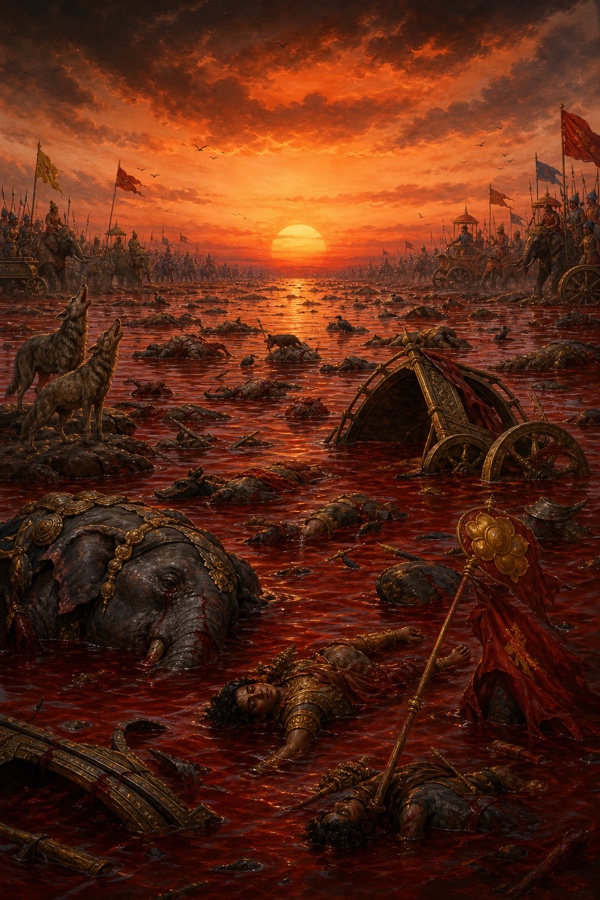
That evening the Kuru army went back to its camp. Sanjaya was with it, and he told the king how they left: they had killed one of the first warriors of the other side, they had been badly hurt by his arrows and were covered in blood, and they came off the field slowly, with the enemy’s eyes fixed on them, having taken a heavy loss and almost out of their senses. Then came that strange hour which lies between day and night. Jackals howled, an evil sound. The sun, the pale red of lotus filaments, sank low toward the western hills and took with it the brightness of swords and darts, rapiers, chariot fences, shields and ornaments; it made the sky and the earth one color and put on its favorite form, which is fire. The field was strewn with the still bodies of elephants beyond number, like the cloud-capped crests of hills split by thunder, lying with their standards and hooks and with the riders fallen from their backs. Great chariots lay crushed, their warriors and charioteers, their ornaments and horses, their standards and banners broken and torn, and they looked like living creatures the enemy’s arrows had killed. Horses and riders lay dead in great numbers, their costly trappings and blankets scattered about, tongues and teeth and entrails and eyes forced from their places, a fierce and dreadful sight. Men in costly mail and ornaments and robes, their weapons with them, lay lifeless among dead horses and elephants and broken chariots on the bare ground, helpless, who had been used to costly beds and coverings.
Dogs and jackals came, and crows and cranes and other birds that eat flesh, wolves and hyenas and ravens, and with them Rakshasas of every tribe and Pishachas in great numbers. They tore the skin of the dead and drank the fat, the blood and the marrow, and began to eat the flesh, and the Rakshasas laughed horribly and sang aloud as they dragged dead bodies away by the thousand. Great warriors had made a river there, dreadful and hard to cross as the Vaitarani itself. Blood was its water. Chariots were the rafts on it, elephants its rocks, the heads of men its smaller stones, and flesh its mire; costly weapons of many kinds were the garlands that floated on it; and it ran fiercely through the middle of the battlefield, carrying living creatures to the country of the dead. Pishachas of horrible and repulsive form drank and ate in that stream and were glad, and the dogs and jackals and flesh-eating birds fed beside them and held their feast, to the terror of everything that lived. The field was swelling the population of Yama’s kingdom. Corpses of men rose up on it and began to dance. And the warriors, gazing at all this, left it slowly, and as they went they saw Abhimanyu, a great chariot warrior who had been like Indra, lying on the ground with his costly ornaments knocked from their places and fallen away, like a sacrificial fire on the altar that no one feeds with clarified butter any longer.
In the Pandava camp, after the death of that hero, a leader of chariot divisions, the warriors left their chariots, took off their armor, threw aside their bows and sat down around King Yudhishthira. Their hearts were fixed on the dead Abhimanyu, and they sat brooding on their grief. He was the king’s nephew, a brave boy and a great chariot warrior, and Yudhishthira, overwhelmed, began to lament. “Alas, Abhimanyu wanted to do what was good for me, and he pierced the array Drona had formed, crowded with soldiers as it was. Great bowmen met him in battle, men of high courage, skilled in arms and hard to defeat, and they were routed and made to retreat. He met our relentless enemy Duhshasana, and with his arrows he drove that warrior senseless from the field. Alas, Arjuna’s brave son crossed the whole vast ocean of Drona’s army, and then he met the son of Duhshasana and had to become a guest in the house of Yama.”
A key to reading this (lineage and place): Abhimanyu is the son of Arjuna, and Sanjaya calls Yudhishthira the eldest brother of the boy’s father and the boy his nephew; when Yudhishthira asked for the array to be broken that morning, he spoke of “your fathers,” in the plural. The Vaitarani, to which Sanjaya compares the stream of blood on the field, is named as a river that is hard to cross, and he says that the stream carried living creatures to the country of the dead. Yama’s house is where Yudhishthira now says the boy has gone as a guest, and where Abhimanyu had promised to send Lakshmana.
The gist: The field after Abhimanyu’s death is splendid and terrible together, and the Pandava divisions break when he falls. Yudhishthira rallies them: the boy never retreated, he killed ten thousand, he has gone to Indra’s dwelling, and no one should grieve. The Kuru army withdraws at dusk, bloodied, past jackals and flesh-eaters and a river of blood, and sees him lying like an altar fire that is no longer fed. In camp the Pandava warriors put off their armor and sit around the king, and the man who forbade grief on the field begins to lament.
Yudhishthira’s Lament, and the Coming of Vyasa
He went on, and now it was himself he accused. “With Abhimanyu killed, how am I to look at Arjuna, or at the blessed Subhadra, who has lost the son she loved best? What words will we have today for Krishna and for Arjuna, for Hrishikesha and Dhananjaya? Senseless words, broken ones, words that ought not to be spoken. I wanted to do what was good, and I was looking for victory, and it is I who have done this great evil to Subhadra, and to Krishna, and to Arjuna.
“A covetous man never sees his own faults. Covetousness comes of folly. Men who gather honey do not see the fall that is in front of them, and I am like those men.
“He was only a child. He should have been given good food, and carriages, and beds, and ornaments, and we set him in the very front of the battle. How could good come to a child of tender years, unseasoned in war, in a place of such danger? Like a horse of proud mettle that will do whatever its master asks, he gave himself up.
“Alas, today we too will lie down on the bare earth, blasted by the looks of grief that Arjuna will turn on us in his wrath. Arjuna is generous and intelligent, modest, forgiving, handsome and strong. His limbs are well grown and beautiful. He is respectful to his elders, brave, beloved, devoted to truth, a man of glorious deeds, and the gods themselves applaud what he has done. He killed the Nivatakavachas and the Kalakeyas, the enemies of Indra who lived in Hiranyapura. In an instant he killed the Paulomas with all their followers. He is so strong that he grants quarter to a relentless enemy who asks it of him.
“And we could not protect the son of such a man from danger today. A great fear has come upon the sons of Dhritarashtra, strong as they are. Arjuna, enraged at the killing of his son, will wipe out the Kauravas. And it is plain that Duryodhana, a man of mean mind with mean counselors, the destroyer of his own family and his own party, will see the Kaurava army wiped out and give up his life in grief.
“I have seen this son of Indra’s son lying on the field of battle, he whose energy and prowess no one could match, and there is no delight left for me in victory, or in sovereignty, or in immortality, or in living among the gods themselves.”
A key to reading this (Yudhishthira’s self-blame): On the field Yudhishthira told his soldiers that no one should grieve for a boy who had gone to Indra’s dwelling. In camp he blames one person, himself: “it is I who have done this great evil,” to Subhadra, to Krishna and to Arjuna. He names its root as covetousness, which comes of folly, and he compares himself to the honey gatherers who do not see the fall in front of them. Only when Vyasa arrives does he speak of what the enemy did, of the unrighteous warriors who surrounded the boy and the ruler of the Sindhus who kept the rest outside.
While Kunti’s son was lamenting in this way, the great seer Krishna Dvaipayana came to him: Vyasa, the island-born sage whom Yudhishthira called grandsire. Yudhishthira honored him as custom required and had him seated, and then, sick with grief for the death of his brother’s son, he spoke.
“Alas, Subhadra’s son was fighting many great bowmen, and several great chariot warriors of unrighteous ways surrounded him, and he was killed on the field. He was a killer of enemy heroes, and he was a child in years, with a child’s understanding. He fought in battle against desperate odds. I asked him to open a passage for us in the battle. He went in among the enemy army, and we could not follow him, because the ruler of the Sindhus stood in our way.
“Those who take up battle as their calling always fight with opponents who are placed as they are placed. This battle that the enemy fought with Abhimanyu was a wholly unequal one. That is what grieves me so deeply and draws these tears from me. When I think of it, I cannot get my peace of mind back.”
The gist: Yudhishthira asks how he is to face Arjuna and Subhadra, calls himself a covetous man who did not see the fall ahead, and says they set a child, who should have had good food and beds and ornaments, at the front of the battle. He expects Arjuna’s grief and anger to strike his own brothers down and then to destroy the Kauravas, and he says that neither victory nor a kingdom nor heaven can please him now. Vyasa comes, is honored and seated, and hears the king’s complaint: unrighteous warriors surrounded a child, Jayadratha kept his fathers out, and the fight was unequal.
Source: the Mahabharata of Krishna-Dwaipayana Vyasa, Drona Parva, Abhimanyu-vadha sub-parva, Sections 31 to 50. The Sanskrit e-text, the Gita Press Hindi edition, and Kisari Mohan Ganguli’s complete English translation were used to verify names, sequence, and principal events. Where the recensions differ, this English retelling follows Ganguli, and the Hindi edition follows Gita Press.
Based on: the Mahabharata, Vedavyasa (K. M. Ganguli’s English translation; Gita Press, Gorakhpur)