On this page
Shakuni and Karna Talk, and the Grudge in Duryodhana’s Heart
Janamejaya, once Dhritarashtra had finished speaking, Shakuni the son of Suvala saw his opening. With Karna backing him, he said to Duryodhana, “Bharata, you have driven the brave Pandavas into exile by your own might. Now rule this earth without a thorn in your side, the way Indra rules heaven. Every king of the east, south, west, and north has become your tributary. That blazing fortune, the royal splendor we saw only days ago with heavy hearts beside Yudhishthira at Indraprastha, we now see with you. By the power of your mind alone you stripped it from King Yudhishthira.”
“This whole earth, ringed by its seas, with its mountains and forests, its cities and its mines, is yours now. Worshipped by the Brahmins and honored by kings, you shine through your own prowess like the sun among the gods of heaven. Come, let us go and look at the Pandavas, stripped now of all their grandeur, men who once bowed to no one’s command and stood under no one’s authority. They are living, we hear, on the bank of a lake called Dwaitavana, among a crowd of Brahmins, with the forest itself for a home. Go there in the fullness of your splendor, and scorch the sons of Pandu with the sight of your glory, the way the sun scorches everything with its burning rays.”
“Is there a sweeter pleasure than to stand in your own abundance and watch them stripped of theirs? A man on a mountain peak looks down on another crawling along the ground below, and that is how it feels to see yourself rich and your enemy in ruin. To stand in your grandeur and watch Dhananjaya (Arjuna) in bark and deerskin will give you a joy greater than the birth of a son, or wealth, or a kingdom won. Let your queens be dressed in priceless robes while the grieving Krishna (Draupadi) goes in bark and hides, and her sorrow will only deepen. Drupada’s daughter, seeing your queens decked in ornaments, will curse her own life, and the grief that takes her will run deeper than the grief of the day Duhshasana dragged her into the assembly hall.”
When they had said this, Janamejaya, both Karna and Shakuni fell silent.
Duryodhana was delighted by Karna’s words, but his face fell at once, and he answered, “Karna, what you say is always in my mind. But I will never be given leave to go where the Pandavas are living. King Dhritarashtra grieves for those heroes without pause. He believes their tapas (austerity) has made them stronger than before. And if the king reads our real purpose, he will look to the future and never grant it. In the forests of Dwaitavana we can have no business with the exiled Pandavas except their destruction.”
“You remember what the Kshatta, Vidura, said to me, to you, and to Suvala’s son at the time of the dice game. Remembering all those words and laments, I cannot decide whether to go or stay. If I could watch Bhima and Phalguna (Arjuna) suffering in the forest with Krishna, I would be overjoyed. Winning the kingdom of the whole earth would not bring the joy that seeing the Pandavas in bark and deerskin will bring. Karna, sit with Suvala’s son and Duhshasana and work out some clever plan that lets us reach those forests. Tomorrow I will go to the king. And while I sit with Bhishma you and Shakuni put forward some pretext.”
A key to reading this (place): Dwaitavana is the forest where the exiled Pandavas are living; the Kuru cattle-stations, where the royal herds are raised, stand close by. The whole “Ghosha-yatra,” the inspection of the cattle herds, will be staged as a pretext built on that nearness.
“Let it be so,” they said, and each went his own way. When the night had passed, Karna came to the king and said with a smile, “I have a plan. Our cattle are waiting for you right now in the forests of Dwaitavana. We can all go there on the pretext of inspecting our cattle-stations, since it is only right for kings to visit their herds from time to time. Give your father that reason, and he is certain to grant it.” As Duryodhana and Karna laughed and talked, Shakuni too spoke up: “The same flawless plan had come to me. The king will surely give leave, or send us there himself.” The three laughed together, clasped one another’s hands, settled it, and went to see Dhritarashtra.
A sub-tale: A cowherd named Samanga had been coached beforehand. He went to King Dhritarashtra and raised the matter of the cattle, that the time had come to count and brand the calves. At that Karna and Shakuni added that it was also the perfect season for Duryodhana to hunt. In this way the pretext was dressed up as royal business.
Hearing this, Janamejaya, Dhritarashtra gave a warning. “Hunting and the inspection of the herds are proper enough, my son. But the Pandavas live close to those cattle-stations. Do not go there yourself. Beaten by fraud, they are living in deep hardship in the thick of the forest. They are men of great strength, and now they are given to austerity. Yudhishthira keeps his temper, though Bhima is fierce by nature. Yajnaseni (Draupadi) is fury given form. Full of pride and folly as you all are, you will surely commit some offense. With the power of her austerities she could burn you to ash, or those armed heroes could. And if you should try to harm them by weight of numbers, that would be deeply wrong, though to my mind you would not succeed. Dhananjaya has come back from the forest more skilled in arms than ever. Could he not kill you all? So I think it wrong for you to go there in person.”
Then Shakuni spoke. “The eldest of the Pandavas knows dharma. He swore in the assembly to live twelve years in the forest. The other Pandavas all obey Yudhishthira, and Kunti’s son Yudhishthira will never turn his anger on us. We only want to hunt, and while we are there we will look over the count of the herds. We are not going to see the Pandavas, so no misconduct on our part is possible.” At these words Dhritarashtra, reluctantly, gave Duryodhana his leave.
A key to reading this (the numbers, in modern terms): Duryodhana’s traveling party was almost a city on the move: 8,000 chariots, 30,000 elephants, 9,000 horses, and thousands of foot-soldiers, along with shops, pavilions, traders, bards, and hunters. In modern terms it was like a vast royal tour convoy, its din as deep as the roar of monsoon storms. Duryodhana pitched camp about four miles from the Dwaitavana lake.
The gist: Shakuni and Karna goad Duryodhana into going to crush the forest-dwelling Pandavas in spirit with a display of his wealth. He agrees, but worries about his father’s permission. Together the three invent the pretext of a “Cattle-station inspection.” Dhritarashtra warns against the Pandavas’ nearness and the power of their austerities and refuses, but on Shakuni’s assurance he reluctantly grants leave.
The Clash with the Gandharvas at Dwaitavana, and Duryodhana’s Capture
King Duryodhana wandered from forest to forest until he reached the cattle-stations and pitched his camp. His servants chose a fine spot rich in water and trees and built separate quarters for him and for Karna, Shakuni, and his brothers. The king inspected the marks and features of thousands of cattle and counted them, had the calves branded, and picked out those to be tamed. When the tally of every three-year-old calf was complete, the Kuru prince moved happily among his herdsmen. The townsfolk and thousands of soldiers played in those forests like gods. Herdsmen skilled in song, dance, and music, and girls decked in ornaments, kept the king entertained. Surrounded by the women of his household, he handed out wealth, food, and drink as he pleased.
With his attendants the king hunted hyenas, buffaloes, deer, gavayas, bears, and boars. Piercing thousands of animals with his arrows, drinking milk and enjoying many rich dishes, watching forests loud with wine-drunk bees and full of the cries of peacocks, he came at last near the holy lake of Dwaitavana. The place lay in the shade of saptaparna, punnaga, and bakula trees. The king reached it like Indra, wielder of the thunderbolt.
At that very time, Yudhishthira the Dharma-king was near that lake with his wife, Drupada’s daughter, performing the daily rite called Rajarshi, by the ordinance laid down for the gods and for those who live in the wild. Arriving there, Duryodhana ordered thousands of servants, “Build me a pleasure-house at once.” They answered “Let it be so” and went toward the shore of the lake. But as they were about to enter the gate of the woods, a host of Gandharvas held them back. For the Gandharva king had already come there from Kubera’s abode with his followers. He had come to play with many troops of apsaras and sons of the gods, and he had ringed the place off and closed it to everyone.
A key to reading this (a note): The Gandharvas are the half-divine beings of the god-world, masters of song and instrument and of maya (illusion, the divine power to conjure appearances). Their king is Chitrasena, who turns out later to be Arjuna’s friend and teacher. Their barring of the way is the opening move of a divine intervention, and more than a simple border dispute.
Duryodhana’s soldiers came back and reported that the lake was closed off by the Gandharva king. Duryodhana sent his warriors to drive the Gandharvas away. Returning to the lake, the warriors said, “Great King Duryodhana is coming here to enjoy himself. Stand aside.” The Gandharvas laughed and answered harshly, “Your wicked king Duryodhana has lost his wits. How does he give orders to us, dwellers of heaven, as though we were his servants? You are fools too, walking into the jaws of death by carrying his message. Turn back at once, or go to the realm of Yama this very day.”
Hearing this, Duryodhana filled with rage and said, “Punish these wretches, even if they have come with Indra of the hundred sacrifices himself.” Dhritarashtra’s sons and thousands of warriors charged into the forest with a lion’s roar. The Gandharvas kept holding them back gently, but they would not stop. So the Gandharvas went to their king Chitrasena and told him everything. Chitrasena, enraged, gave the order, “Punish these lawless wretches.” The Gandharvas took up their weapons and fell upon Dhritarashtra’s army. Seeing the Gandharvas coming with weapons raised, the Kuru soldiers fled in all directions, right before Duryodhana’s eyes.
But even seeing everyone turn and run, Radheya (Karna) did not flee. He held the Gandharvas off with a downpour of arrows. With the great quickness of his hands the charioteer’s son pierced hundreds of Gandharvas with razor-edged shafts, broad-heads, and many weapons of bone and steel, and in a short while had Chitrasena’s army screaming in pain. But the Gandharvas came back in their hundreds and thousands. Then Duryodhana, Shakuni, Duhshasana, Vikarna, and Dhritarashtra’s other sons, their chariots thundering like the cry of Garuda, returned under Karna’s lead and began to cut that army down.
Then the whole Gandharva army closed with the Kauravas. The fighting was savage. The Gandharvas, harried by the Kurus’ arrows, seemed to tire, and the Kauravas raised a great shout. But seeing his army frightened, the enraged Chitrasena sprang from his seat, set on destroying the Kuru host. Skilled in every art of war, he fought with weapons of maya (illusion). Under his illusions the Kaurava warriors began to lose their senses. It seemed that every Kuru fighter was hemmed in by ten Gandharvas at once. Battered and terrified by the assault, all who wished to live fled.
But though all of Dhritarashtra’s army broke and ran, Karna the son of Surya stood unmoved as a mountain. Duryodhana, Karna, and Shakuni, wounded and torn, kept fighting the Gandharvas. Then all the Gandharvas rushed at Karna from every side, in their hundreds and thousands, with swords, axes, and spears, to kill him. One cut the yoke of his chariot, another the flag-staff, another the axle, others the horses, the driver, the parasol. Thousands of Gandharvas together broke his chariot to pieces. Then Karna took up sword and shield, leaped down from the chariot, climbed onto Vikarna’s chariot, and saved himself by driving the horses hard away.
With Karna beaten, the whole Kuru army fled right before Duryodhana. But Duryodhana refused to run. He poured out a thick rain of arrows, yet the Gandharvas smashed his chariot to fragments and killed his driver and horses. When the chariotless Duryodhana fell to the ground, Chitrasena pounced on him and seized him as though taking his very life. With the king a prisoner, the Gandharvas also seized Duhshasana in his chariot, along with Vivinsati, Chitrasena (Duryodhana’s brother), Vinda and Anuvinda, and every woman of the royal household.
A key to reading this (names): Two men named Chitrasena appear in this episode: Chitrasena the Gandharva king (Arjuna’s friend) and Chitrasena the son of Dhritarashtra (Duryodhana’s brother). They are two different characters; do not let the shared name confuse you.
The gist: Duryodhana busies himself counting the herds and indulging in pleasure, but the Gandharva king Chitrasena has already ringed off the Dwaitavana lake. Duryodhana’s arrogance sparks a fight; Karna alone holds his ground but is beaten in the war of illusions and flees. Duryodhana, his brothers, and the household women are taken prisoner. Here, for the first time, the Kauravas’ pride is broken in public.
The Plea for Refuge with the Pandavas, and Yudhishthira’s Reasoning on Dharma
Duryodhana’s soldiers, beaten by the Gandharvas, joined those who had fled earlier and came to the Pandavas, who were living nearby. With Duryodhana taken captive, all the vehicles, shops, pavilions, carts, and animals were handed into the Pandavas’ keeping. The soldiers said, “The Gandharvas are carrying off the son of Dhritarashtra as their prisoner. Sons of Pritha, go after them! Duhshasana, Durvishaha, Durmukha, and Durjaya are all being led away in chains, and with them all the women of the royal household.”
Stricken with grief, Duryodhana’s men came to Yudhishthira longing for their king’s release. Then Bhima said to those old attendants in a mocking voice, “The work we would have done with great effort, mounted on our horses and elephants, the Gandharvas have done for us. Men who came here for another purpose have fallen into an end they never imagined. This is the fruit of that king’s wicked ways, that lover of crooked dice. There is a saying that a weak man’s enemy is brought down by another’s hand, and the Gandharvas have proved it true before our eyes. This wretch came here to gloat over us, himself in prosperity and us in ruin, worn thin by austerity, bearing cold and heat. Now the men who follow this sinful Kaurava are watching his disgrace.” Bhima was still speaking his bitter words when Yudhishthira said, “This is no time for harsh speech.”
Yudhishthira said, “My son, why such language toward the Kurus, who are frightened and in distress and have come to us for shelter? Vrikodara, quarrels and disputes break out among kinsmen, and enmity runs its course. But the honor of the family is never put to the fire. If some outsider tries to disgrace the honor of the house, good men do not endure it. The wicked Gandharva king knows we live here, and still he has slighted us and done this hateful thing. An outsider has carried Duryodhana off by force and dishonored the women of our house, and by this the honor of our family is being destroyed.”
“So rise and take up your weapons to protect those who have sought our shelter and to guard the honor of our house. Arjuna, you and the twins (Nakula and Sahadeva), set Duryodhana free. Here stand ready the chariots of Dhritarashtra’s sons, with their golden banners and every kind of weapon. Mount them with Indrasena and the other skilled drivers and go. Even an ordinary Kshatriya protects a suppliant with all his strength, so what shall I say of you, Vrikodara? The man who helps even an enemy who comes with joined palms begging shelter, that man is truly high of soul.”
“The granting of a boon, the winning of a kingdom, and the birth of a son, these three are great sources of joy. But rescuing an enemy from ruin, Pandavas, is worth all three together. Duryodhana in distress is begging, resting his very life on the strength of your arms; what greater joy is there than that? If my vow were finished, I would run to his aid myself. First, Bharata, try to free Duryodhana by a settlement. If the Gandharva king will not agree to terms, free him with a light skirmish. And if he still will not let go, then crush them with full force and set Duryodhana free. My vow is under way and not yet complete, and so I cannot go myself.”
Hearing these words of Ajatashatru (Yudhishthira), Dhananjaya, out of respect for his elder brother’s command, vowed to set the Kauravas free. Arjuna said, “If the Gandharvas will not release Dhritarashtra’s sons peacefully, then today the earth will drink the blood of the Gandharva king.” Hearing this vow from the truthful Arjuna, the Kauravas recovered the courage they had lost.
The gist: Here the moral depth of the Mahabharata surfaces. Bhima’s sarcasm is natural: the enemy has fallen by his own pride. But Yudhishthira turns it into a question of the family’s honor, since an outsider’s insult to a blood relative cannot be borne. This goes beyond a simple contest of good and evil; it is a crisis of dharma, in which protecting the very man who wronged you becomes a duty. Yudhishthira lays out a three-tier strategy: first a settlement, then a light skirmish, then full force.
The Battle with the Gandharvas, and Arjuna’s Celestial Weapons
At Yudhishthira’s words, those men rose up with glad faces, led by Bhimasena. They put on impenetrable mail worked with pure gold and took up their many celestial weapons. Armored and mounted on chariots flying their banners, the Pandavas looked like blazing fire. Seeing them come on together, the Kuru army sent up a loud shout.
Following Yudhishthira’s wise instruction, there was a light skirmish first. But when Arjuna saw that the Gandharva king’s foolish soldiers would not see their own good in a light skirmish, he said in a gentle voice, “Release my brother, King Suyodhana (Duryodhana).” The Gandharvas laughed and answered, “Boy, there is only one in the world whose command we obey and under whom we live at ease. No one but that divine lord can give us orders.” Then Dhananjaya said, “Both these things, laying hands on other men’s women and this hostile conduct toward men, are shameful and improper for a Gandharva king. So, by the order of Yudhishthira the Dharma-king, release the sons of Dhritarashtra and these women. If you will not release them peacefully, I will free Suyodhana by my own might.” Saying this, Pritha’s son Dhananjaya loosed a downpour of sharp, sky-ranging arrows.
A key to reading this (a note): The divine weapons (divyastras) are missiles empowered by mantra and summoned by a set rite. Arjuna here uses the Agneya (Agni’s, the fire weapon), the Sthunakarna, the Indrajala (a maya-breaking weapon against illusion), the Saura, the Saumya, and the Shabdavedha (which strikes a target by sound alone). This last weapon matters because Chitrasena fights while hidden by illusion.
The battle between the four Pandavas and thousands of Gandharvas was extraordinary. Just as Karna’s and Duryodhana’s chariots had been broken earlier, the Gandharvas tried to break these heroes’ chariots too. But the brothers held thousands of Gandharvas off with their storms of arrows, and the Gandharvas could not get near them. Then the enraged Arjuna sent hundreds of thousands of Gandharvas to Yama’s realm with the fire weapon. Bhima, that mighty archer, also killed hundreds of Gandharvas. Madri’s sons (Nakula and Sahadeva) killed hundreds more.
The Gandharvas, cut down by the celestial weapons, rose into the sky carrying Dhritarashtra’s sons with them. But Dhananjaya hemmed them in on every side with a wide net of arrows, as though they were birds trapped in a cage. In their fury they hurled maces, lances, and swords at Arjuna, but he sheared off their limbs with crescent-headed arrows. Heads, legs, and arms rained down from above like a fall of stones. Arjuna loosed the Sthunakarna, the Indrajala, the Saura, the Agneya, and the Saumya. Under Kunti’s son’s fire weapons the Gandharvas burned as the Daityas burned under Indra’s thunderbolt.
Seeing the Gandharvas terrified of Kunti’s son, Chitrasena swept down on Dhananjaya from above with a mace. But Arjuna cut that iron mace into seven pieces with his arrows. Then Chitrasena used his art, his maya, to vanish from Arjuna’s sight and fought on unseen. Arjuna blocked all his weapons with his celestial ones. When the Gandharva king had disappeared completely, Arjuna used the sound-tracking Shabdavedha to end his hiding. Harried by those weapons, the Gandharva king appeared before his dear friend and said, “Look at me, I am your friend, and I have been fighting you!” Seeing his weary friend Chitrasena, Arjuna drew back his weapons. The other Pandavas held back their weapons and chariots as well. Chitrasena, Bhima, Arjuna, and the twins all asked after one another’s welfare and took their seats on their chariots.
The gist: When the Gandharvas will not yield to a light skirmish, Arjuna turns to his celestial weapons and crushes their army. The turning point comes when the Gandharva king fights invisibly and Arjuna forces him into the open with the sound-tracking weapon. Only then does it emerge that he is Chitrasena, Arjuna’s friend and teacher. The battle turns into friendship.
Chitrasena’s Secret, and Duryodhana’s Release
Then Arjuna smiled and asked Chitrasena, in the midst of the Gandharva host, “Hero, why are you punishing the Kauravas? Why has Suyodhana been punished like this, along with his women?” Chitrasena answered, “Dhananjaya, from my own abode I already knew why Duryodhana and Karna had come here. Their purpose was this: knowing you were suffering in exile in the forest while they lived in luxury, this man wanted to mock you and Drupada’s daughter in your distress. Indra the king of the gods, knowing their purpose too, said to me, ‘Go, bring Duryodhana here bound in chains with his counselors. And always protect Dhananjaya and his brother in battle, for he is your dear friend and pupil.’ At Indra’s words I came here. Now I will carry this wretch to the world of the gods on Indra’s order.”
Arjuna said, “Chitrasena, if you wish to do me a kindness, release Suyodhana by the order of Yudhishthira the Dharma-king, for he is our brother.” Chitrasena said, “This sinner is forever swollen with pride and does not deserve release. He has cheated and tormented both Yudhishthira and Krishna (Draupadi). But Yudhishthira does not yet know why this man came here. So let the king hear it all and do as he wishes.”
Then they all went to Yudhishthira and told him the whole account of Duryodhana’s conduct. Ajatashatru heard it, set the Kauravas free, and praised the Gandharvas. The king said, “It is good fortune that, mighty as you are, you did not kill Dhritarashtra’s son along with his counselors and kinsmen. You have shown us great kindness. By releasing this wretch you have also preserved the honor of our house. I am glad to see you all. Tell me what I may do for you. Take what you wish and return quickly.”
The Gandharvas, well pleased, departed with the apsaras. Then Indra the king of the gods came there and sprinkled celestial nectar on the Gandharvas killed in the battle, bringing them back to life. The Pandavas freed their kinsmen and the women of the household and so accomplished that hard task. Then Yudhishthira spoke tenderly to the freed Duryodhana, in the midst of his brothers: “My son, never do such a reckless thing again. The reckless man finds no happiness, Bharata. Be content with all your brothers. Return to your capital without grief or despair.”
Taking his leave of the son of Pandu, Duryodhana bowed to Yudhishthira and set out for his capital, overcome with shame, his heart torn, moving like something drained of life. When the Kaurava prince had gone, the Brahmins honored Yudhishthira, and, ringed by those Brahmins rich in austerity as Indra is ringed by the gods, he lived on in Dwaitavana in contentment.
A sub-tale: Chitrasena’s secret is a fine example of the Mahabharata’s moral complexity. Duryodhana’s abduction was no accident; it was Indra’s careful design, meant to break his pride. Yet that same Indra had also told Chitrasena to protect Arjuna. So the very Gandharva who bound Duryodhana turned out to be Arjuna’s guardian and friend. The lines between enemy and protector do not stay straight here.
The gist: Chitrasena reveals that all of this was Indra’s plan, meant to punish Duryodhana’s wicked purpose and at the same time protect Arjuna. Yudhishthira, with an eye to dharma, has Duryodhana released with forgiveness and sends him off without a trace of triumph. For Duryodhana this very rescue becomes a deep blow to his pride, since his enemy is the one who saved him.
The Shamed Duryodhana, and the Vow to Fast to Death
Janamejaya asked, “Beaten and captured by the enemy, then freed by the force of Pandava arms, that proud, wicked, boastful Duryodhana must have found it very hard to enter Hastinapura. Vaishampayana, describe in full the city-entry of that prince, sick with shame and grief.”
Vaishampayana said: taking his leave of Yudhishthira, Duryodhana went slowly, head bowed, sick with grief. On the way he made camp with his fourfold army in a lovely spot rich in grass and water. Bright with a fire’s heat, he sat on a high couch like the moon in eclipse. In the morning Karna came to him and said, “It is good fortune that you are alive! Good fortune that we meet again! By luck you conquered the Gandharvas, who take any shape they please, and your brothers came back victorious. As for me, hemmed in by all the Gandharvas, my body torn with arrows, I could save myself only by fleeing before your eyes. It is a great wonder that you all came back safe from that inhuman battle with your women, your army, and your vehicles.”
Hearing Karna’s words, Duryodhana said to the king of Anga (Karna) in a voice choked with tears, “Radheya, you do not know what happened, and so I take no offense at your words. You think the Gandharvas were beaten by my strength. My brothers and I fought the Gandharvas a long time. Many fell on both sides. But when those brave Gandharvas rose into the sky by their many illusions and fought from there, the battle stopped being equal. We were defeated, and taken prisoner. Then some of our soldiers and officers, sick with grief, went to the Pandavas, those heroes who never deny a suppliant their help.”
“The Pandavas asked for our release with gentle words, though they could have done it by force. When the Gandharvas would not agree, Arjuna, Bhima, and the twins loosed their storms of arrows. Then the Gandharvas fled into the sky, dragging us along. Arjuna spread a net of arrows and, loosing his celestial weapons, held them back. Then his friend the Gandharva king appeared, and the two embraced and asked after each other’s welfare. Karna, Arjuna went to Chitrasena and said in proud words, ‘Gandharva chief, release my brothers. While the Pandavas live, no one can disgrace them.’ Then the Gandharva king revealed to the Pandavas our whole purpose, that we had come to mock them and Drupada’s daughter in their distress.”
“And while that Gandharva was laying out our schemes, I was so overcome with shame that I wished the earth would split open and swallow me. The Gandharvas bound us and led us to Yudhishthira and revealed everything. What greater misery is there than this, that before my own women, bound in chains, wholly in the power of my enemies, I was handed over to Yudhishthira as a gift? The men I always tormented, who were always my enemies, are the ones who freed me from my bonds, and I, base as I am, owe them my very life. If I had died in that great battle, it would have been far better. Killed by the Gandharvas, my fame would have spread over the whole earth, and I would have won the blessed worlds of Indra’s heaven.”
“Now hear what I will do. I will sit here and give up food, and the rest of you go home. Let all my brothers return to Hastinapura. Let all my friends, Karna among them, and all my kinsmen, Duhshasana among them, return to the capital. Disgraced by my enemies, I will not go there. The man who once stripped his enemies of honor and raised the honor of his friends has become a source of grief to his friends and joy to his enemies. What would I say to the king if I went to Hastinapura? What would Bhishma, Drona, Kripa, Ashvatthama, Vidura, Sanjaya, Bahlika, Somadatta, and the other venerable elders say to me, and what would I answer them? I who once trod on my enemies’ heads and walked over their chests have fallen from my place. In my folly I did a deeply wrong and sinful thing, and it has brought me to this ruin. So I will give up my life by fasting. What man of self-respect can go on carrying his life after being rescued by his enemies?”
Then Duryodhana said to Duhshasana, “Hear my words, Duhshasana. Become king in my place. Rule this earth under the protection of Karna and Suvala’s son. Guard your brothers as Indra guards the Maruts, so that they all put their trust in you. Always provide for the Brahmins, and be a shelter to your friends and kinsmen. Always honor your elders. Go, rule the earth, giving joy to your friends and punishment to your enemies.” And clasping him by the neck, Duryodhana said, “Go!”
Hearing this, Duhshasana, sick with grief, his throat choked, his palms joined, his head bowed, said, “Do not do this!” and sank to the ground with a heavy heart. Weeping, at his elder brother’s feet, he said again and again, “This will never be! Let the earth split, let the sky of heaven break, let the sun cast off its light, the moon give up its coolness, the wind give up its motion, Himavat move from its place, the sea’s water dry up, and fire give up its heat, but even then, king, I will not rule the earth without you. Be calm, king! You alone will be king in our house for a hundred years.” So saying, Duhshasana clung to his elder brother’s feet and wept.
The gist: The shamed Duryodhana admits the truth to Karna: the Gandharvas were never beaten by his strength, and it was the Pandavas who freed him. That debt of gratitude is harder for him to bear than death. He resolves on a fast to death (prayopavesha) and wants to hand the kingdom to Duhshasana. Duhshasana’s loving lament shows the humanity of the Kaurava side.
Karna and Shakuni’s Counsel, and Duryodhana’s Unshaken Vow
Seeing them both weeping, Karna came to them in grief and said, “Kuru princes, why do you grieve like fools, like ordinary men? Weeping never lessens grief. Take heart, and do not gladden your enemies with conduct like this. King, the Pandavas only did their duty in freeing you. Those who live in a king’s realm always serve the king’s interest. The Pandavas, living under your protection, are happy in your kingdom. Do not grieve like a common man. Look how your own brothers suffer at the sight of you resolved to fast. Rise, return to your city, and comfort them.”
Karna went on, “King, this conduct of yours today looks childish. What is so strange in the Pandavas freeing you after you were beaten by a foe? Those who live in a king’s realm, above all those who bear arms, always serve the king’s interest, whether the king knows them or not. Often even great men who cut through enemy ranks are beaten by the enemy and freed by their own soldiers. The Pandavas live in your kingdom; they freed you, so where is the cause for grief? True, it was wrong of them not to come with you at the time of the battle. They had already become your subjects in the dice game, your slaves, and so they are bound to help you. You are enjoying all the Pandavas’ wealth, they are still alive, and they have not vowed to die by fasting. Rise, king! If you throw away your life by fasting, you will become nothing but an object of ridicule among the other kings.”
Even at these words of Karna, Duryodhana held firm in his resolve to leave the world and would not rise from where he sat. Then Suvala’s son Shakuni, comforting the shame-broken Duryodhana who sat resolved on death, said, “You have heard Karna’s words. They are wise words indeed. Why throw away in folly the life, and the high fortune I won for you? I think you have never served your elders. The man who cannot master a sudden joy or grief is destroyed even in the midst of fortune, like an unbaked pot sunk in water.”
“A king who is without patience, without prowess, given to sloth, without judgment, and sunk in the pleasures of the senses wins no respect from his people. Why this needless grief when you have gained so much? Do not waste this fine deed of the sons of Pritha by giving way to grief. When you should be glad and rewarding the Pandavas, you are grieving, and this conduct makes no sense. Be glad, do not give up your life, and remember the good they did you with a grateful heart. Give the sons of Pritha back their kingdom, and by that act earn both dharma and fame. Make peace with the Pandavas, give them their ancestral kingdom, and then you will be happy.”
Hearing Shakuni’s words, and seeing Duhshasana fallen before him, overcome with a brother’s love, the king lifted Duhshasana up, gathered him in his round arms, and tenderly smelled his head. But the words of Karna and Shakuni left Duryodhana more crushed than before, and shame and despair closed over his soul. He answered in grief, “I have no use now for dharma, wealth, friendship, splendor, kingdom, or pleasures. Do not stand in the way of my resolve; leave me alone. I am firm in giving up my life by fasting. Go back to the city and honor my elders for me.” They said, “King, your road is our road too. How can we enter the city without you?”
For all the pleading of his friends, counselors, brothers, and kinsmen, the king did not waver from his resolve. He spread kusha grass on the ground, purified himself by touching water, and sat down there. Clad in bark and kusha, he took up the supreme vow. Silencing all speech, longing to reach heaven, he let go of all outward dealings and turned inward to prayer and meditation.
A key to reading this (a note): Prayopavesha, the fast to death, is the resolve to give up food and water and wait for death. In the old Kshatriya tradition it could become a means of revenge or of wiping out shame. Duryodhana treats it as a way to escape disgrace and reach heaven, a path he does not see as self-slaughter.
The gist: Karna and Shakuni offer practical arguments: the Pandavas only did a subject’s duty, so where is the shame? Shakuni goes so far as to say Duryodhana should give the Pandavas back their kingdom and make peace. But Duryodhana’s pride will not let him bend; he spreads kusha grass and sits down to fast to death.
The Summoning of the Danavas of Patala, and the Rousing of Duryodhana
Meanwhile, the Daityas and Danavas who in ancient times had been beaten by the gods and driven to live in Patala (the nether world) learned of Duryodhana’s resolve. Understanding that if the king died their side would grow weak, they began a fire rite to summon Duryodhana to them. Masters of mantra performed the rites laid down in the Atharva Veda and the Upanishads, following the formulas spoken by Brihaspati and Ushanas (Shukracharya). Brahmins under stern vows chanted the mantras and poured offerings of clarified butter and milk into the fire.
When the rite was complete, a strange goddess rose from the fire, her mouth gaping wide, asking, “What shall I do?” The pleased Danavas commanded her, “Bring us the son of Dhritarashtra, who has vowed to give up his life.” Saying “Let it be so,” she reached in the blink of an eye the place where Suyodhana was. She carried him down to Patala and told the Danavas. Finding the king among them in the night, the Danavas looked on him with delighted eyes and spoke to him in flattering words.
The Danavas said, “Suyodhana you who carry forward the line of Bharata! You are always surrounded by heroes and men of fire. Why then this reckless act of fasting? The suicide sinks into hell and becomes a target of blame. Men of intelligence like you never set their hands to acts that are sinful and against their own interest. So stop this resolve, which destroys dharma, wealth, happiness, fame, and energy. Learn the truth of the divine origin of your soul and of the maker of your body, and then take courage.”
“In ancient times we obtained you from Maheshvara (Shiva) by our austerities. The upper part of your body is made of a mass of Vajras and is therefore invulnerable to weapons of every kind. The lower part, which can captivate a woman’s heart by its beauty, was made of flowers by the goddess herself, the wife of Mahadeva. Your body is thus the creation of Maheshvara and his goddess. So you are of divine origin and not human. Many brave Kshatriyas, Bhagadatta and the rest, will kill your enemies, so let this grief go. There is nothing for you to fear. Many heroic Danavas have already been born on earth to aid you.”
“Other Asuras will enter heroes such as Bhishma, Drona, and Karna. Possessed by them, these heroes will cast off their compassion and fight your enemies. When the Danavas enter their hearts and take them wholly, they will fling every affection far away and, hard-hearted, spare no one in battle, not son, brother, father, friend, pupil, kinsman, child, or old man. Blinded by ignorance and wrath, driven by the destiny the Creator has ordained, these men, their hearts steeped in sin, will hurl every kind of weapon and empty the earth of people, boasting to one another, ‘You will not escape from me today with your life.’”
A key to reading this (a note, to be read with restraint): Here the Danavas reassure Duryodhana that heroes like Bhishma, Drona, and Karna will fight without mercy once possessed by Asuras. The Mahabharata does not dodge the moral crisis here; it hints that the coming great war will be a stage for the struggle of divine and demonic powers, running deeper than mere human spite. But these are the Danavas’ words, a single side’s claim with no all-knowing truth behind it, and they are best read as one party’s interpretation.
The Danavas said, “And these five Pandavas too, king, will fight them, and with fate favoring them will destroy them. Many Daityas and Rakshasas born into the Kshatriya line will fight your enemies with maces, clubs, lances, and the finest weapons. Hero, as for the fear of Arjuna in your heart, we have already arranged the means of his death. The soul of the slain Narakasura has taken the form of Karna. Remembering his old hostility, he will clash with both Keshava (Krishna) and Arjuna. That great hero will conquer Arjuna in battle, and all your enemies with him.”
“Knowing all this, Indra, wielder of the thunderbolt, wishing to save Arjuna, will take from Karna his earrings and armor by a disguise. For that reason we have appointed hundreds of thousands of Daityas and Rakshasas, famous under the name of Samsaptakas. These renowned warriors will kill the hero Arjuna. So do not grieve. You will rule the whole earth without a rival. Do not give way to despair. If you die our side grows weak. As the Pandavas are the refuge of the gods, so you are always our refuge.”
A key to reading this (names): The Samsaptakas are warriors who swear either to kill or to die: they will return only after killing, or perish in the attempt. In the war at Kurukshetra they will try to draw Arjuna away from the main battle and keep him engaged. Their mention here is the seed of a later part of the story.
With these words the Danavas embraced that king and encouraged him like a son. Calming his mind with soft words, they gave him leave: “Go, and win victory!” Then that same goddess carried him back to the very place where he had sat resolved to die. She set the hero down, paid him homage, and, with the king’s leave, vanished.
When the goddess had gone, Duryodhana took all of this for a dream. He thought to himself, “I will defeat the Pandavas in battle.” He believed that Karna and the army of the Samsaptakas were both able and eager to destroy Partha (Arjuna). So the wicked-minded man’s hope of conquering the Pandavas hardened. Karna too, into whose soul a portion of Narakasura had entered, was now set on killing Arjuna. The Samsaptakas as well, possessed by Rakshasas and swayed by the qualities of passion and darkness, wanted Phalguna’s death. Even Bhishma, Drona, Kripa, and the rest, worked upon by the Danavas, no longer held their old affection for the Pandavas. But King Suyodhana told no one of this.
When the night had passed, Karna the son of Surya joined his palms and, smiling, said to Duryodhana, “A dead man does not conquer his enemies; only by living does he see his own good. Where is victory for the dead? So this is no time for grief, or fear, or death.” Embracing the king, he said, “Rise, king! Why do you lie here? Why do you grieve? Or do you fear Arjuna’s prowess? I swear a true vow that I will kill Arjuna in battle. I swear by my weapons that when thirteen years have passed I will bring the sons of Pritha under your power.”
Remembering these words of Karna, the words of the Danavas, and the pleas of his brothers, Suyodhana rose. With firm resolve he arrayed his army of horses, elephants, chariots, and foot. Bright with white parasols, banners, white yak-tail fans, chariots, elephants, and foot-soldiers, that vast host flowed on like the waters of the Ganga. Blessed by the Brahmins with wishes for victory, honored by countless joined palms, blazing with great splendor, he went ahead with Karna and Shakuni. Duhshasana and all the brothers, with Bhurishravas, Somadatta, and the great king Bahlika, followed Duryodhana with chariots, horses, and the finest elephants, and in a short while the sons of the Kurus entered their city.
The gist: The Danavas summon Duryodhana to Patala and tell him his body is Maheshvara’s creation, and that Bhishma, Drona, and Karna will fight without mercy once possessed by demonic powers; Karna carries a portion of Narakasura and will clash with Arjuna, and the Samsaptakas will kill him. This dreamlike encounter fills Duryodhana with fresh confidence. He gives up the vow and, with Karna’s oath to kill Arjuna, arrays his army and returns to Hastinapura.
Bhishma’s Counsel for Peace and Karna’s Conquest of the Directions
Janamejaya asked, “While the sons of Pritha were living in the forest, what did the sons of Dhritarashtra, and Karna, Shakuni, Bhishma, Drona, and Kripa do? Tell me this.”
Vaishampayana said: When Duryodhana, freed by the Pandavas, had returned to Hastinapura, Bhishma said to him, “My child, I told you before that going there did not please me, and yet you went. As a consequence you were taken captive by the enemy, and the Pandavas, who know what is right, set you free. Even so you feel no shame. In your own presence and before your whole army, the Suta’s son [Karna] took fright and fled from the battle with the Gandharvas. You saw both things, O king: the prowess of Pandavas and the weakness of the Suta’s son. In the science of arms, in valor, in dharma, Karna is not equal to even a fourth part of the Pandavas. Therefore, for the welfare of this house, my judgment is that peace with Pandavas is the better course.”
Hearing these words of Bhishma, the king laughed loudly and abruptly walked out with the son of Suvala. When he had gone, Karna, Duhshasana, and the other great bowmen followed at his heels. Watching them leave, Bhishma, grandsire of the Kurus, bowed his head in shame and withdrew to his own quarters. Once Bhishma was gone, Duryodhana came back and began to take counsel with his ministers: “What is best for me? What still remains to be done? And how can I bring about whatever good is possible?”
Karna said, “Duryodhana take my words to heart. Bhishma is forever running us down and praising the Pandavas. Out of ill will toward you he despises me as well, and in your presence he never fails to belittle me. I will not endure such talk from him. Give me leave, with servants, troops, and chariots, and I alone will conquer this whole earth with its mountains and forests. The land that four mighty Pandavas once conquered, I will conquer single-handed for you. Let that wretched Bhishma see it and reproach himself. Give the command, and victory will surely be yours. By my own weapon I swear it.”
Overjoyed at these words, Duryodhana said, “I am blessed. You have shown me your favor, and today my life has borne fruit. Go and may all good attend you.” On an auspicious lunar day, at an auspicious hour, and under a lucky star, honored by the twice-born and bathed with sacred and auspicious substances, that great bowman set out, filling the three worlds with the rattle of his chariot.
With a vast army Karna laid siege to the beautiful city of Drupada, and after a fierce fight brought him to heel, exacting silver, gold, gems, and tribute. Then he marched north, defeated Bhagadatta, and, fighting his foes all the way, climbed the great mountain Himavat and took tribute from all its kings. Descending, he swept east and subdued the Angas, the Bangas, the Kalingas, the Mandikas, the Magadhas, the Karkakhandas, the Avasiras, the Yodhyas, and the Ahikshatras. Then, taking Vatsa-bhumi, he forced Kevali, Mrittikavati, Mohana, Patrana, Tripura, and Kosala to pay tribute.
Going south, Karna vanquished the great charioteers of that quarter and, in the Deccan, closed with Rukmi. After a terrible fight Rukmi said, “I am pleased with your strength and prowess. I will do you no harm; I have only kept a Kshatriya’s vow. Take as much gold as you wish.” Leaving Rukmi, Karna went on to Pandya and to Mount Sri, and took tribute from Karala, king Nila, the son of Venudari, and other kings of the south. He then defeated the son of Shishupala and brought all the neighboring rulers under his sway. Having conquered the Avantis and made peace with them, and having met with the Vrishnis, he took the west. Turning to the quarter of Varuna, he exacted tribute from all the Yavana and Barbara kings.
So, having conquered east, west, north, and south, the whole earth, that hero, unaided and alone, subdued all the Mlechchhas, the mountaineers, the Bhadras, the Rohitakas, the Agneyas, and the Malavas. Defeating the great charioteers led by the Nagnajitas, he brought the Sasakas and the Yavanas under his sway. Having thus conquered the entire world, the mighty charioteer returned to Hastinapura. Duryodhana, with his father, his brothers, and his friends, came out to meet Karna and honored him with full ceremony, declaring, “What I never had from Bhishma, Drona, Kripa, or Bahlika, I have had from you. In you, Karna, lies my refuge. The Pandavas and all the other prosperous kings together do not come to a sixteenth part of you.”
An uproar broke out in Hastinapura: some kings praised Karna, some blamed him, some kept silent. Having brought the whole earth to heel and gained inexhaustible wealth, Karna presented himself before the king. Entering the palace, that knower of dharma touched the feet of Dhritarashtra and Gandhari as a son would. Dhritarashtra embraced him with affection and sent him on his way. From that day, Duryodhana and Shakuni were convinced that the sons of Pritha had already been beaten in battle by Karna.
The gist: Bhishma warns Duryodhana plainly: Karna fled from the battle with the Gandharvas and is not equal to even a fourth part of the Pandavas, so peace is the wiser course. Duryodhana only laughs and walks out. Stung by the insult, Karna sets out on a dig-vijaya, a conquest of all the directions, and returns having beaten the kings of every quarter. The pride of the Kaurava camp swells again.
The Vaishnava Yajna and the Invitation to the Pandavas
Karna said to Duryodhana, “O Kaurava, the earth is now cleared of enemies. Rule it like Indra with his foes destroyed.” The king replied, “Nothing is beyond the reach of one who has you for his refuge. Watching the splendid Rajasuya the Pandavas performed, a longing has risen in me to perform such a yajna (fire-rite) myself. Fulfill this wish of mine.” Karna answered that, with all the kings subdued, the leading Brahmins should be summoned, the materials for the rite duly gathered, and Ritwijas learned in the Vedas should conduct the yajna by the ordinance.
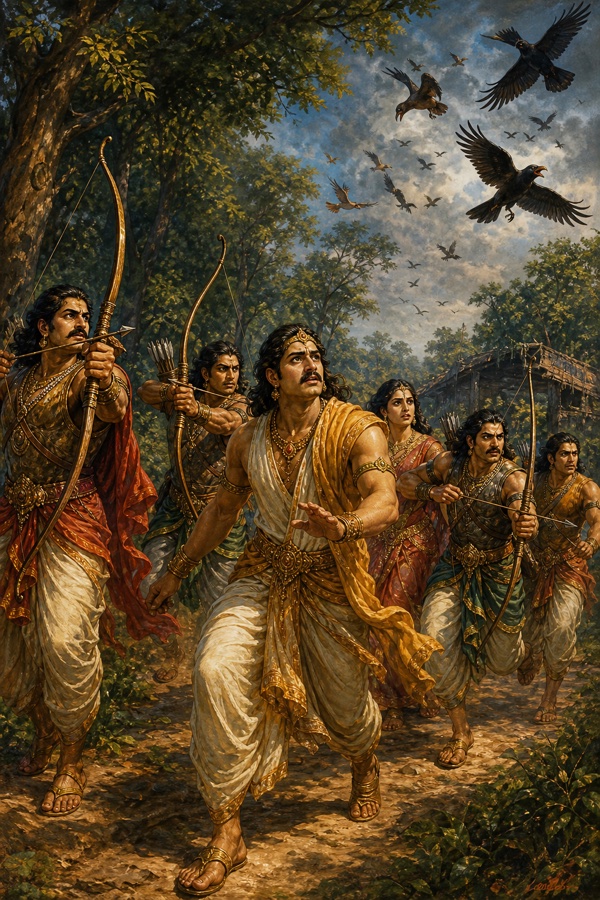
The king summoned his priest and asked him to perform the Rajasuya. But the foremost Brahmins said, “So long as Yudhishthira lives, this rite cannot be performed in your family. And your father Dhritarashtra, blessed with long life, still lives, so for this reason too you cannot undertake it. There is, however, another great yajna equal to the Rajasuya; perform that. All the kings who owe you tribute will pay in gold, pure and impure. Have a sacrificial plow made from that gold and plow the sacrificial ground with it. On that spot let the rite begin, undisturbed, sanctified with mantras and rich in food. This yajna is called the Vaishnava, and none but the ancient Vishnu has ever performed it. It rivals the Rajasuya and can be completed without any hindrance.”
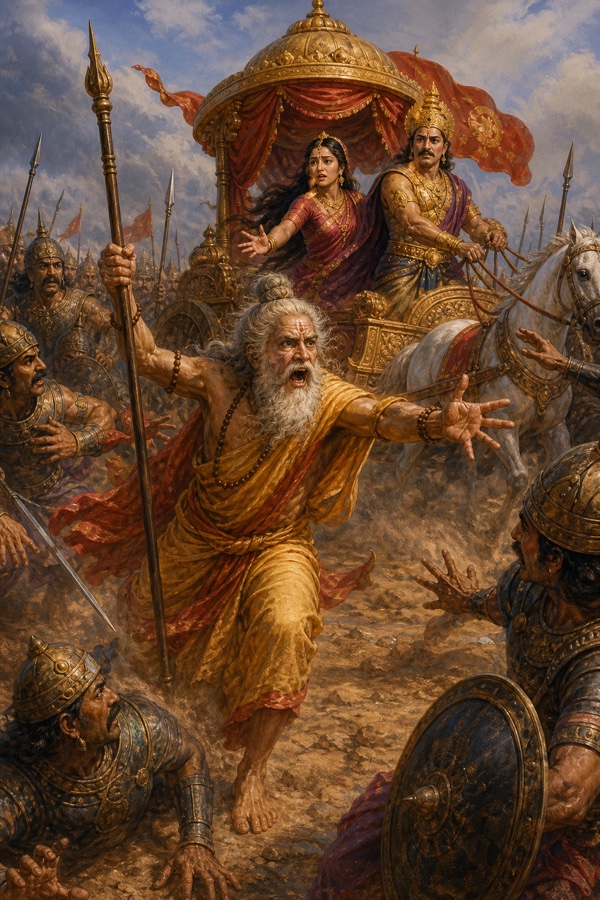
Hearing the Brahmins’ words, the king consulted Karna, his brothers, and Shakuni. All said, “So be it.” Then the king assigned every man his task and ordered the artisans to make the golden plow. One by one the commands were carried out. So the Vaishnava yajna began, and the son of Gandhari was duly initiated. Dhritarashtra, Vidura, Bhishma, Drona, Kripa, Karna, and Gandhari were all delighted. Duryodhana sent out messengers to invite the kings and Brahmins.
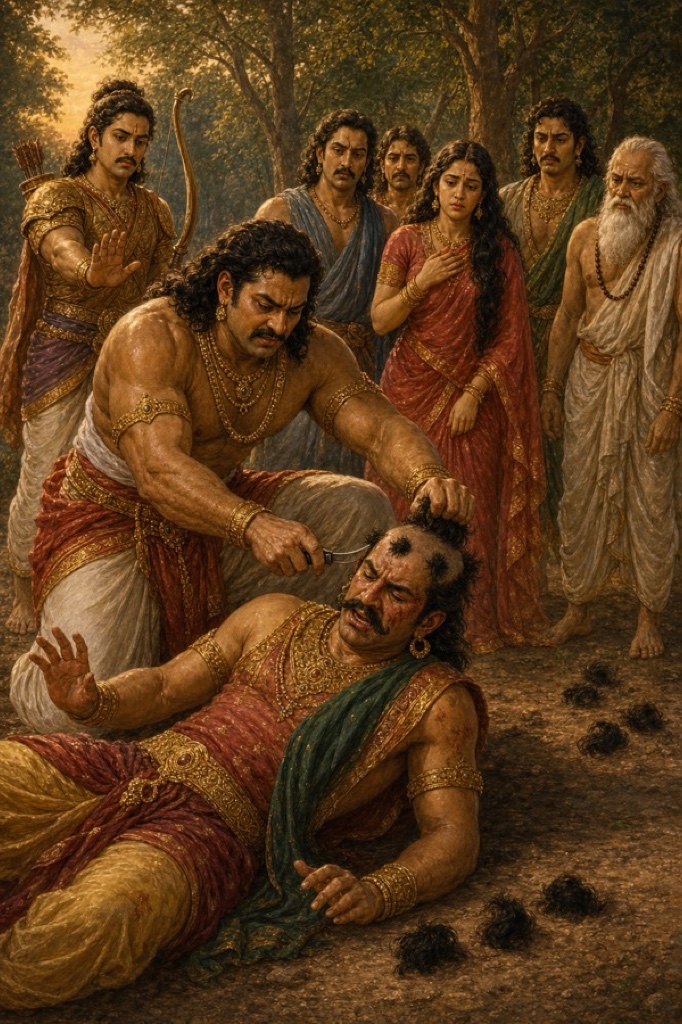
To one messenger Duhshasana said, “Go to the Dwaita forest and invite its Brahmins, and those wretched Pandavas too.” The messenger went, bowed to the Pandavas, and said, “Having won boundless wealth by his own prowess, Duryodhana is holding a great yajna. Kings and Brahmins are coming from every direction. The king invites you: come and witness the rite.”
Hearing the messenger’s words, Yudhishthira said, “It is good fortune that King Suyodhana, who adds to the fame of his forefathers, is performing this splendid yajna. We would surely come, but we cannot now, for until the thirteenth year ends we must keep our vow.” At this Bhima said, “King Yudhishthira will go there when, at the close of the thirteenth year, he offers Duryodhana as an oblation into the fire of weapons in the yajna of battle. Tell Suyodhana: when the Pandavas pour the clarified butter of their wrath upon the sons of Dhritarashtra in that yajna of war, then I will come.” The other Pandavas said nothing unkind. The messenger returned and reported everything.
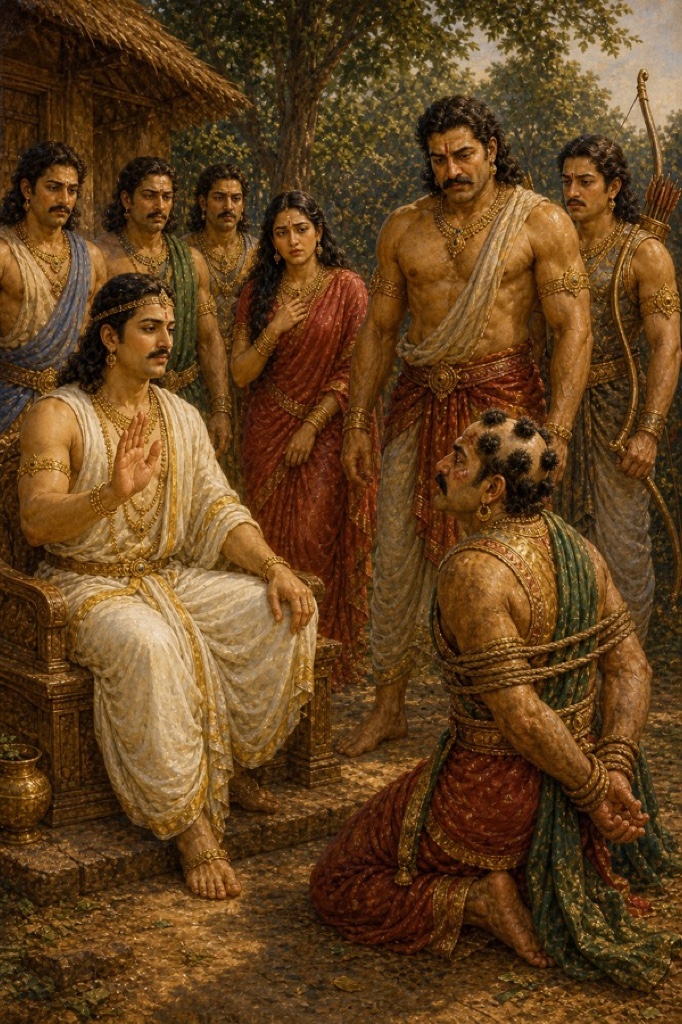
Duryodhana’s yajna was completed without a hitch. Vidura saw to it that all the orders were satisfied with food and drink, garlands, and garments. The king dismissed thousands of kings and Brahmins with gifts of every kind.
A sub-tale: Bhima’s reply shows the edge of the Mahabharata’s dialogue. Duryodhana’s invitation is really a display of his own splendor. Bhima turns it into the figure of a “Yajna of war,” in which the oblation will be Duryodhana and the Kauravas, and the clarified butter the Pandavas’ stored-up wrath. The line is a taunt and, beyond that, a prophecy of the Kurukshetra war to come.
The gist: Duryodhana wants to perform the Rajasuya, but the Brahmins explain that it is impossible while Yudhishthira and Dhritarashtra still live; so the “Vaishnava yajna,” its equal, is held instead. The Pandavas are invited, but Yudhishthira declines, citing his vow, and Bhima sends back a warning about the yajna of battle.
Karna’s Vow to Kill Arjuna and the Pandavas’ Distress
As Duryodhana entered the city, the bards sang his praises. The citizens sprinkled him with parched grain and sandal paste and said, “It is good fortune, O king, that your yajna was completed without obstruction.” But some, bolder of speech, said, “This yajna does not match Yudhishthira’s; it does not come to a sixteenth part of it.” His friends, however, said, “This yajna was supreme, greater than all others. Yayati, Nahusha, Mandhata, and Bharata went to heaven by performing such rites.” Pleased by his friends’ warm words, the king entered the city and his own palace. Having worshiped the feet of his father and mother, of Bhishma, Drona, Kripa, and Vidura, and honored in turn by his younger brothers, he took his seat on an excellent throne.
Then Karna rose and said, “It is good fortune that this great yajna is complete. But when the sons of Pritha have been killed in battle and you perform the Rajasuya, I will honor you again in just this way.” The king replied, “Well said. When the wicked Pandavas are dead and I perform the Rajasuya, then you shall honor me again like this.” So saying, he embraced Karna and fell to thinking about the Rajasuya. He said to the Kurus, “When will I kill the Pandavas and perform that splendid Rajasuya yajna?”
Then Karna said, “Hear me. Until I have killed Arjuna, I will let no one wash my feet, nor will I taste meat. And I will keep the Asura vow: to no one who asks me for anything will I ever say, ‘I have it not.’” At this vow the sons of Dhritarashtra raised a great shout and were sure the Pandavas were already beaten. Then Duryodhana withdrew to his palace like Kubera entering the garden of Chitraratha, and all the great bowmen went to their own quarters.
A key to reading this (a note): Karna’s “Asura vow” meant never turning away a suppliant and giving up all comfort until his oath was fulfilled. That same vow would later become the seed of his tragedy, for it was this very generosity that let Indra, in disguise, beg away his armor and earrings.
Meanwhile the Pandavas, troubled by the messenger’s words, found no ease at all. When spies brought news of Karna’s vow to kill Arjuna, Yudhishthira, the son of Dharma, grew deeply anxious. Reckoning Karna of the impenetrable mail a warrior of wonderful prowess, and calling to mind all his own sorrows, he could find no peace. Filled with worry, he resolved to leave the Dwaita forest with its many beasts of prey.
The son of Dhritarashtra, meanwhile, ruled the earth with his brave brothers and with Bhishma, Drona, and Kripa. With the help of Karna, crowned with the glory of war, Duryodhana stayed ever intent on the welfare of the kings, performed sacrifices with lavish gifts, and honored the Brahmins. Holding that giving and enjoying are the only uses of wealth, he went on doing good to his brothers.
The gist: After the yajna, Karna swears a fierce oath: no comfort and the Asura vow until Arjuna is dead. Hearing of it, Yudhishthira is thrown into distress and thinks of leaving the Dwaita forest. The Kaurava camp is sunk in pride, as though the Pandavas had already lost.
The Deer in the Dream and the Move Toward the Kamyaka Forest
Janamejaya asked, “After freeing Duryodhana, what did the Pandavas do in the forest?” Vaishampayana said: Once, as Yudhishthira slept at night in the Dwaita woods, some deer came to him in a dream, their voices choked with tears. Their bodies trembling, they stood with joined hands, and Yudhishthira asked them, “Who are you? What do you want?” Those survivors of the slaughtered deer replied, “O Bharata, we are what remains of the deer that have been killed. We will be wiped out entirely, so change your dwelling. All your brothers are heroes skilled with weapons; they have thinned the ranks of the forest-dwellers. We are only a few, like seed grain that is left. By your grace let us grow again.”
Seeing those few surviving deer, like leftover seed, trembling with fear, Yudhishthira was filled with grief. Bent on the welfare of all creatures, the king said, “So be it. I will do as you ask.” Waking, moved to pity for the deer, he told his brothers, “The deer that survive the slaughter spoke to me in the night: ‘We are the seed that remains of our lines; have mercy on us.’ They spoke the truth. For a year and eight months now we have been living off them. Let us go on, then, to the lovely Kamyaka forest, at the edge of the desert near Lake Trinabindu, and pass the rest of our time there in peace.”
So the Pandavas set out at once with the Brahmins, all their companions, and their retainers led by Indrasena. Traveling roads well supplied with good grain and clear water, they reached the holy Kamyaka hermitage, rich in ascetic power. As the virtuous enter heaven, so they entered that forest, surrounded by the brahmana.
The gist: In a dream the surviving deer beg Yudhishthira to move on, or their whole kind will be destroyed. Devoted to the welfare of every creature, Yudhishthira agrees at once and leads the Pandavas from the Dwaita forest to the Kamyaka. The episode shows the vision of ahimsa (non-harm) that extends mercy even to the creatures he might hunt.
Vyasa’s Arrival and His Teaching on Charity and Tapas
Eleven years of the Pandavas’ forest life passed in sorrow. Living on fruit and root, men worthy of ease spent their days in hardship. Remembering his own fault at the dice, Yudhishthira could not sleep in peace, as though a spear were lodged in his heart. Recalling Karna’s cutting words, he swallowed the venom of his anger and, in humble dress, sighed on. Arjuna, the twins, Draupadi, and Bhima all felt sharp pain at the sight of Yudhishthira. Knowing that only a little of their exile remained, they filled with anger and hope and threw themselves into every kind of effort.
After a time the great ascetic Vyasa came to see the Pandavas. Yudhishthira went forward to welcome him, bowed, and, when the rishi was seated, sat before him, eager to listen. Seeing his grandsons gaunt and living on the produce of the wild, Vyasa was moved to compassion and said, in a voice thick with feeling, “Yudhishthira, those who do not practice tapas (austerity) win no great happiness in this world. A man tastes joy and sorrow by turns; no one enjoys unbroken happiness. The wise man knows that life has its ups and downs, and so he neither exults nor grieves. When happiness comes, take it; when sorrow comes, bear it, as a farmer waits for his season.”
“Nothing is higher than tapas; from tapas comes great reward. There is nothing, O Bharata, that tapas cannot achieve. Truth, sincerity, freedom from anger, justice, self-control, mastery of the senses, freedom from malice, simplicity, purity, and restraint of the faculties: these purify a person of merit. The fruit of what is done in this world is reaped in the next. So a man should discipline his body with tapas and vows. With a guileless and cheerful heart, according to his means, he should go to a worthy recipient, bow to him, and give.”
Yudhishthira asked, “Of charity and austerity, which bears greater fruit in the next world, and which is harder?” Vyasa said, “My son, nothing in this world is harder than charity. Men thirst greatly after wealth, and wealth is hard to come by. For its sake, brave men give up even their dear lives and plunge into the depths of the sea and the forest; some take to farming, some to herding cattle, some to servitude. To part with wealth won by such toil is very hard. So in my view charity stands supreme, above every other merit. Given in a pure spirit, at the right time and place, to worthy souls, charity yields inexhaustible fruit. But the giving of ill-gotten wealth does not save the giver from the sin of rebirth.” In this connection Vyasa told the old story of Mudgala, who won inexhaustible fruit by giving away only a single drona of grain.
A key to reading this (a measure): A drona was an old unit for measuring grain. One drona came to a few sers of grain, a few kilograms in modern terms. The point of the story is that inexhaustible fruit comes from the purity of the spirit behind the gift, whatever its size.
The Story of Mudgala and Durvasa’s Test
Vyasa said, “In Kurukshetra there lived a righteous sage named Mudgala, truthful, free of malice, master of his senses. He lived by the Shila and Unchha ways, gleaning the grain left and fallen in the fields for his livelihood. Though he lived like a pigeon, he still honored his guests and performed the Ishtikrita sacrifice and other rites. With his son and wife he ate for a fortnight, and for the other fortnight gathered a single drona of grain in the pigeon’s manner. He ate only what remained after the gods and guests had been fed.”
“On auspicious days Indra himself, with the gods, would partake of the food of his sacrifice. Mudgala gladly fed his guests as well. By the purity of his spirit, the moment a guest arrived that single drona of grain swelled so greatly that hundreds of learned Brahmins were satisfied from it.”
“Once, hearing of the vow-keeping Mudgala’s fame, the sage Durvasa came there, naked, with only the sky for his garment, dressed like a madman, his head shaved, hurling insults. He said, ‘know that I have come seeking food.’ Mudgala said, ‘You are welcome.’ He gave the hungry, half-crazed sage water to wash his feet and mouth and set fine food before him. Durvasa ate it all. Mudgala served him again. He ate that too, smeared the leavings over his body, and went off as he had come.”
“In this way, over the six seasons, Durvasa came six times and each time ate everything. Yet Mudgala, without eating himself, went back to gleaning grain in the Unchha way. Hunger could not spoil his composure; neither anger, nor deceit, nor any sense of insult, nor agitation could enter his heart. With his son and wife he stayed pure of heart throughout. Then, well pleased, Durvasa said, ‘There is no one on earth as guileless and generous as you. Hunger drives off the sense of dharma and strips away patience, yet you have done everything in a pure spirit. Self-control, patience, justice, mastery of the senses, mercy, and dharma all stand firm in you. You will go to heaven in your very body.’”
A sub-tale: This test by Durvasa falls across the Mahabharata twice: here upon Mudgala, and later (through Duryodhana’s scheme) upon the Pandavas. In both places Durvasa’s anger is a touchstone: whoever is pure of heart and steady in dharma comes through that fire unscathed. Mudgala’s gleaning life teaches that even with the barest means the purest giving is possible.
The Faults of Heaven and Mudgala’s Choice of the Supreme State
The moment Durvasa said this, a messenger of the gods came before Mudgala on a chariot yoked with swans and cranes, ringing with bells, filled with divine fragrance, richly painted, and able to go anywhere at will. He said, “Rishi, mount this chariot earned by your deeds. You have won the fruit of your austerity.” Mudgala said, “Messenger of the gods, tell me the character and nature of those who dwell there. What is the happiness of heaven, and what are its faults? Friendship with the good is formed by walking only seven steps together; in the name of that friendship, tell me the truth, so that I may settle my course.”
The messenger said, “You are of simple mind, that even after gaining this divine bliss you reason like one without discernment. The realm called heaven lies above, reached by lofty roads, forever ranged by celestial chariots. Atheists, liars, those without austerity, and those who have performed no great sacrifices cannot go there. Only the virtuous, the disciplined, the masters of their senses, the free of malice, and the charitable and brave go there. There are thousands of shining realms of the gods, the Sadhyas, the Vishvedevas, the great rishis, the Yamas, the Dharmas, the Gandharvas, and the Apsaras. There stands the golden Meru, spread over thirty-three thousand yojanas, and the divine gardens with Nandana at their head. There is no hunger, no thirst, no weariness, no fear, and nothing loathsome.”
“Every fragrance there delights, every breeze is soft, every sound is sweet to the ear. There is no grief, no old age, no toil, no regret. That world is gained by the fruit of one’s own deeds. Above it are the shining realms of Brahma, and higher still dwell beings called the Ribhus, who are gods even to the gods. Lit by their own light, free of malice, sorrow, weariness, and ignorance, they do not change even at the end of a kalpa. For them there is no frenzy, no elation, no sorrow. Even the gods long for their supreme state.”
“Now hear the faults of heaven. There a man only reaps the fruit of deeds already done; he can do no new deed. And when his merit is fully spent, he falls. That fall is heaven’s flaw: to be cast down while sunk in pleasure, to drop to a lower place after enjoying the higher realms, is very hard to bear. The mind of the falling one grows dull, his garland begins to wither, and fear takes hold of his heart. These faults reach even to the realm of Brahma. The fallen, by their remaining merit, are born again among men and win high fortune. This world is called the world of action; the others are called the worlds of fruit.”
Hearing this, Mudgala reflected and said, “Messenger, I salute you; go back in peace. I have no use for a heaven or a happiness with such great faults. I will search for that imperishable region where those who reach it know no grief, no pain, no agitation. Tell me the region without fault.” The messenger said, “Above the realm of Brahma is the supreme seat of Vishnu, pure, eternal, radiant, known as the Para Brahma. There the sense-bound, the proud, the greedy, the ignorant, the angry, and the envious cannot go. Only those free of passion, free of pride, free of conflicting emotions, masters of their senses, and given to contemplation and yoga go there.”
Hearing this, the sage sent the messenger away and, still gleaning grain, came to perfect contentment. Praise and blame became one to him; a clod, a stone, and gold looked alike to his eyes. By the means of attaining Brahman he stayed always in meditation, and, gaining the highest understanding through knowledge, he reached that supreme and eternal state of liberation. Vyasa said, “So you too must not grieve. You have been robbed of a flourishing kingdom, but by tapas you will regain it. Sorrow after happiness, happiness after sorrow, come by turns, like the rim-point circling the axle of a wheel. When the thirteenth year has passed, you will win back the kingdom of your father and grandfather. So let the fever of your heart go.” With that, Vyasa returned to his hermitage to practice austerity.
The gist: The messenger describes for Mudgala the joys of heaven and even of Brahma’s realm, but tells him their root flaw as well: once merit is spent, the fall comes. The discerning Mudgala chooses Vishnu’s supreme seat, liberation, over perishable heaven, and attains it. With this story Vyasa steadies Yudhishthira: joy and sorrow are a turning wheel, and in the thirteenth year the kingdom will return.
Duryodhana’s Durvasa Trick and Draupadi’s Prayer to Krishna
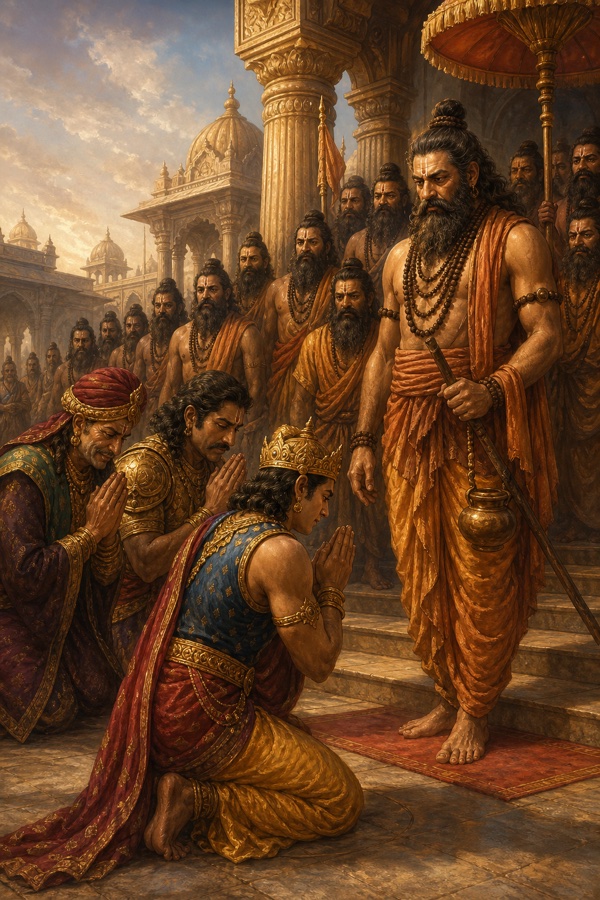
Janamejaya asked what Duryodhana, on the wicked counsel of Karna, Duhshasana, and Shakuni, did against the Pandavas, who were living happily in the forest. Vaishampayana said: Learning that the Pandavas lived in the forest as contentedly as in a city, Duryodhana burned to do them harm. Just then the famous ascetic Durvasa arrived at the city of the Kurus with ten thousand disciples. Duryodhana and his brothers welcomed him with deep humility and courtesy, and the prince himself served the rishi like a menial.
Durvasa stayed some days, and, in fear of a curse, Duryodhana waited on him day and night. Sometimes the rishi would say, “I am hungry, bring food at once”; sometimes he would go to bathe and return late to say, “I have no appetite today, I will eat nothing,” and vanish. Sometimes he would appear suddenly and demand, “Feed me quickly.” Sometimes he would wake at midnight, have a meal cooked, then find fault with it and not eat. So he tried the prince; but seeing Duryodhana neither angered nor annoyed, he was pleased and said, “I can grant you a boon. Ask for whatever is nearest your heart, so long as it is not against dharma.”
Duryodhana had already settled with Karna and Duhshasana what to ask. Delighted, he said, “King Yudhishthira is the eldest and most respected member of our house, and he now lives in the forest with his brothers. As you have been my guest, be once his guest too. And go at the hour when that delicate and excellent princess of Panchala [Draupadi], having fed the Brahmins, her husbands, and herself, has lain down to rest.” Durvasa said, “I will do just so,” and took his leave. Duryodhana counted himself successful and, gripping Karna’s hand, showed his joy. Karna too said, “By good luck your enemies have fallen into a sea of danger hard to cross. The Pandavas have now dropped into the fire of Durvasa’s wrath.” So Duryodhana and the rest went home well pleased.
One day, having learned that the Pandavas were at their ease and that Draupadi was resting after her meal, Durvasa reached that forest with his ten thousand disciples. Yudhishthira came forward with his mothers, joined his hands, showed the sages to fine seats, and received them with honor, saying, “Revered one, perform your daily bath and observances and return soon.” Not knowing how the king would feed so many, the sage went with his disciples to the river to bathe.
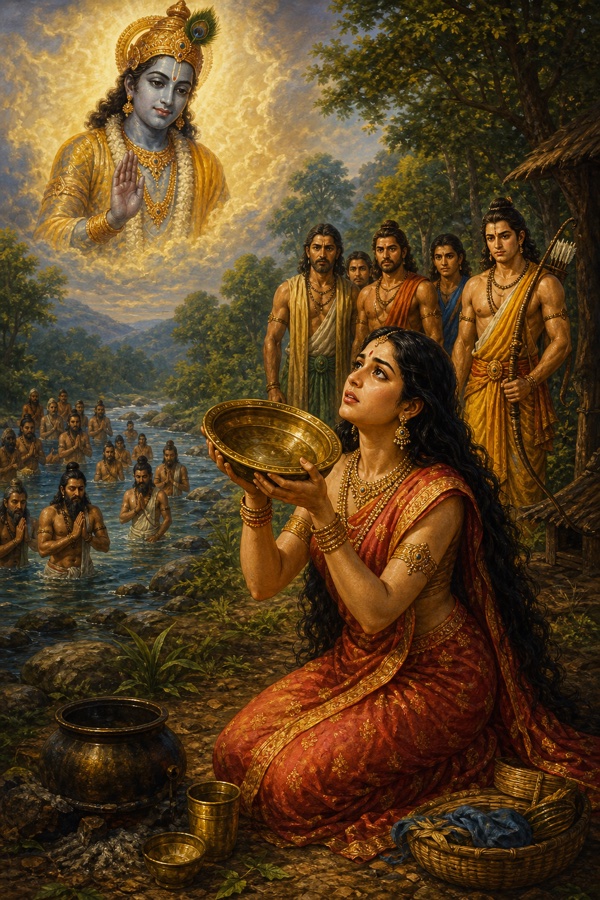
Draupadi, devoted to her husbands, was thrown into anxiety over the food. When no way of providing it appeared, however hard she thought, she prayed within her heart to Krishna. She said, “Krishna Vasudeva of inexhaustible power, lord of the universe! You lift the troubles of those who take refuge in you. You are the soul, the creator, and the destroyer. You are inexhaustible and the protector of the afflicted. You are the highest of the high, and the source of mental awareness. O supreme and infinite one, giver of every good, be the refuge of the helpless. O primordial being I take shelter in you. O dark one, blue as the petal of the lily, red-eyed, robed in yellow, wearing the Kaustubha gem on your breast: as you once saved me from Duhshasana, save me now from this danger.”
Adored by Draupadi, the ever-gracious lord Keshava knew her plight, left Rukmini’s bed, and came at once. Seeing Vasudeva, Draupadi bowed in joy and told him all about the sages’ arrival. When he had heard it, Krishna said, “I am very hungry. Give me food first, then see to your task.” At this Draupadi said in distress, “The vessel the sun gave stays full until I have eaten, but I have already eaten today, so there is no food left in it.” Krishna said, “This is no time for jest, Draupadi. I am very hungry. Bring the vessel quickly and show it to me.”
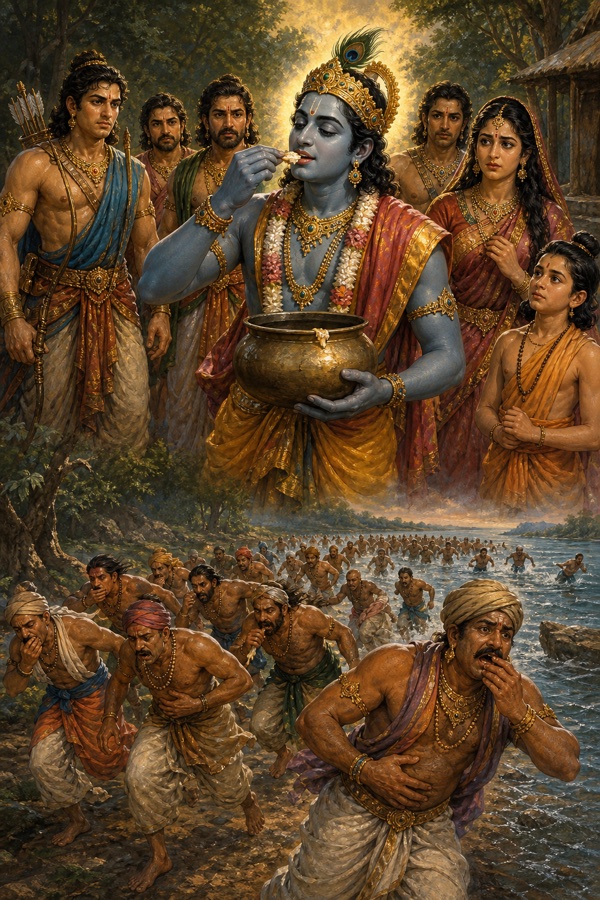
At Draupadi’s urging the vessel was brought, and Krishna looked into it and saw a single grain of rice and vegetable clinging to the rim. Taking it, he said, “May Hari, the soul of the universe, who receives the oblations of sacrifices, be satisfied with this.” Then he told Bhimasena, “Go, and quickly call all those sages to the meal.” Bhima went to the river, where Durvasa and the others were bathing. But they were all feeling their stomachs filled to the throat. Coming out of the water, they stared at one another in wonder and said to Durvasa, “We had the king cook a meal, but now our bellies are full. The food has been made for nothing. What shall we do?”
Durvasa said, “By wasting the meal we have done a great wrong to the royal sage Yudhishthira. Will the Pandavas not burn us with an angry look? I know them to be great ascetics, firm in dharma, and devoted to Vasudeva. I fear the devotees of Hari. If they are angered they will burn us like a heap of cotton. So, disciples, let us flee at once, without seeing them again.” At that all the Brahmins, afraid of the Pandavas, scattered in every direction.
Bhima, not finding the sages, returned and told Yudhishthira everything. The Pandavas waited a while for them. Yudhishthira said, “The rishis will come at midnight to trap us. How are we to escape this danger?” Just then Krishna appeared and said, “Sons of Pritha, knowing your danger from that wrathful rishi, I came at once at Draupadi’s prayer. Now fear Durvasa not at all; afraid of your ascetic power, he has already fled. The righteous never come to grief. Now I will take my leave; may you always prosper.” The Pandavas and Draupadi, at ease again, said, “As drowning men reach the shore by a boat, so by your grace we have escaped this danger. Go now in peace, Govinda.” Krishna returned to his capital, and the Pandavas, with Draupadi, lived happily on in the forests.
A sub-tale (the sun-given vessel): At the start of the exile the sun had given Yudhishthira an inexhaustible vessel that kept yielding food each day until Draupadi had eaten. Duryodhana’s scheme turned on this: after Draupadi’s meal the vessel stood empty, and that was the moment to send Durvasa with his thousands of disciples, so that a poor reception would draw a curse. But Krishna, taking the single grain stuck in the vessel, satisfied the hunger of the whole universe, and the scheme rebounded.
The gist: Duryodhana plays his trick of sending Durvasa with thousands of disciples to the Pandavas at the moment the inexhaustible vessel is empty, so that a failed welcome will draw a curse. At Draupadi’s cry Krishna comes and, taking the one grain left in the vessel, satisfies the hunger of all the sages. Durvasa flees in fear, and the Kauravas’ scheme comes to nothing.
Jayadratha comes to the Kamyaka forest and casts an evil eye on Draupadi
Those great heroes of the Bharata line moved through the Kamyaka forest like immortals, hunting and taking their pleasure in woodland tracts bright with the flowers of the season. One day the brothers rode out in every direction to hunt game for the Brahmins in their company, and with the leave of the great ascetic Trinavindu and their guru Dhaumya, they left Draupadi alone at the hermitage. Just then the king of Sindhu, Jayadratha on his way to the country of Salwa to seek a bride, halted in the Kamyaka woods in his finest royal dress, a train of princes riding with him.
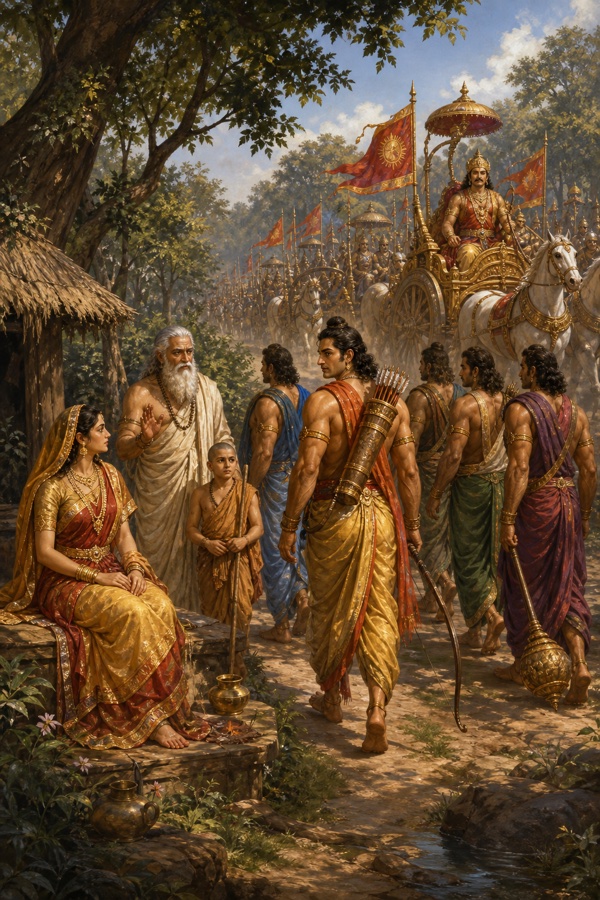
In that secluded spot he saw Draupadi standing at the door of the hermitage, lighting up the forest the way lightning kindles a mass of dark clouds. The sight of her flawless form struck them all still; they stood with hands joined, wondering, “Is she an Apsara, a daughter of the gods, some divine illusion?” Overcome with desire, Jayadratha said to the prince named Kotika, “Who is this woman of faultless beauty? Is she even human? If I could win one so lovely, I would need no other marriage. I would take her home with me. Go, Kotika, and find out who her husband is.”
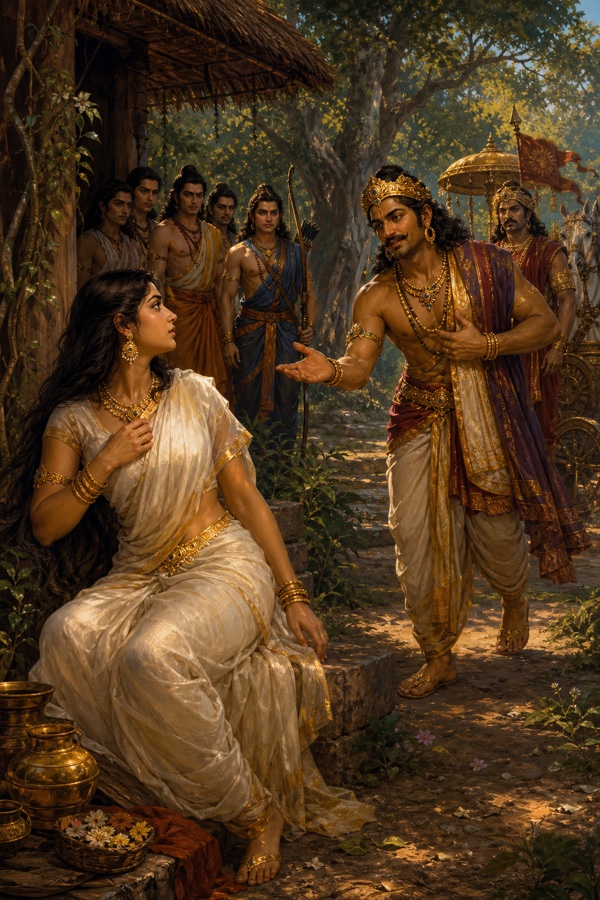
Kotika, wearing his earrings, stepped down from his chariot and came up to her the way a jackal sidles up to a tigress, and said, “Fair lady, who are you, standing alone in this hermitage with your hand on a branch of the Kadamba tree, like a flame of fire fanned bright by the night wind? Beautiful as you are, do these forests hold no fear for you? I take you for a goddess, or a Yakshi, or a Danavi, or some high Apsara, or the wife of a Daitya, or a daughter of the Naga king, or the consort of Varuna, Yama, Soma, or Kubera, wandering here in human shape.”
“You do not ask us who we are. Fair lady, we ask you with respect: tell us the names of your husband, your kin, and your house. As for me, I am Kotika, son of king Suratha. The man on the golden chariot is Kshemankara. Behind him stands the son of the king of the Pulindas. And there stands the son of Subala, of the line of Ikshvaku. And if you have ever heard the name of Jayadratha, that is the king of the Sauviras there, who rides at the head of six thousand chariots, with horses, elephants, and foot, and with twelve Sauvira princes for his standard-bearers: Angaraka, Kunjara, Guptaka, Satrunjaya, Srinjaya, Suprabiddha, Prabhankara, Bhramara, Ravi, Sura, Pratapa, and Kuhana.”
A key to reading this (lineage and place): Jayadratha is king of the Sindhu and Sauvira countries (roughly modern Sindh and the lands around it). This same Jayadratha is the husband of Duhshala, the one sister of the Kauravas, which makes him brother-in-law to Pandavas and Kauravas alike. That family tie is what will save his life later.
At these questions Draupadi lowered her eyes, let go of the Kadamba branch, drew her silken garment about her, and said, “It is not proper for a woman like me to speak with you this way, but there is no other man or woman here and I am alone, so I will speak. I have gathered, Saivya, that you are Kotika. I am the daughter of king Drupada, and people call me Krishna. I have taken five men as my husbands, of whom you must have heard while they lived at Khandavaprastha. Those five, Yudhishthira, Bhimasena, Arjuna, and the two sons of Madri, have left me here and gone out to hunt, dividing the four quarters among them. The king went east, Bhimasena south, Arjuna west, and the twins north. So step down now and dismiss your carriages, and go only after they have welcomed you. The son of Dharma loves his guests; he will be glad to see you.” And having said this, remembering her husbands’ hospitable ways, Draupadi withdrew into her cottage.
Jayadratha’s vile proposal and Draupadi’s rebuke
Kotika told Jayadratha everything that had passed between him and Draupadi. When he heard it, Jayadratha said, “Just hearing her voice has left my heart besotted with her. Why then did you come back with nothing? I tell you the truth: once a man has seen her, every other woman looks like a monkey to him. Tell me, is that peerless lady of human birth?” Kotika answered, “She is Krishna, Drupada’s daughter, wife of the five Pandavas, the honored, beloved, and faithful wife of Pritha’s sons. Take her, and make for Sauvira.”
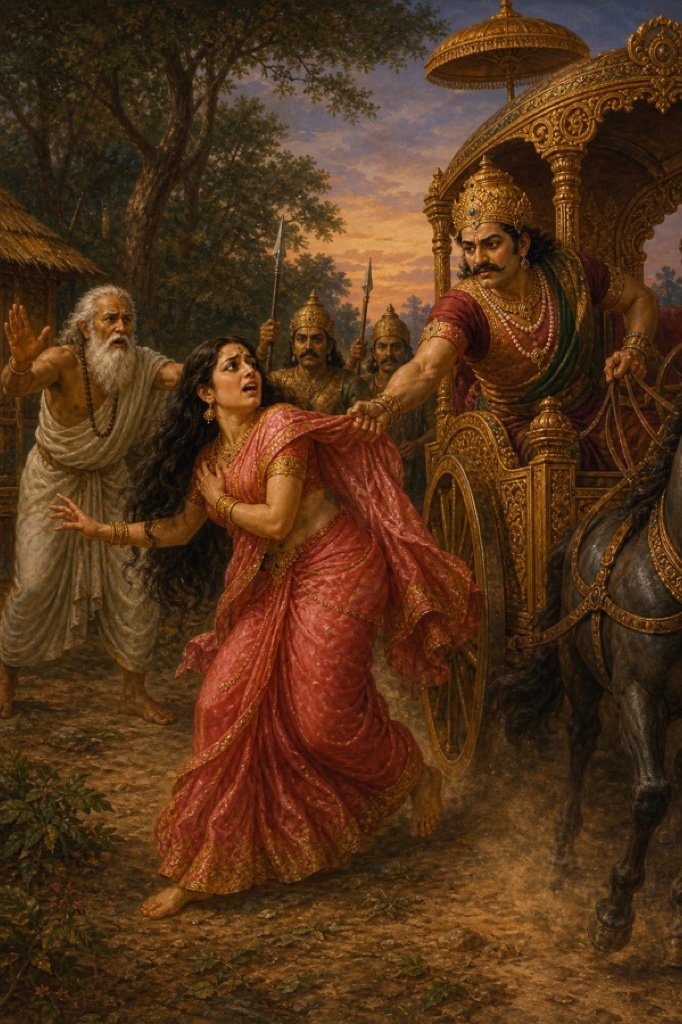
At this the malignant Jayadratha, with six men, walked into that lonely hermitage the way a wolf walks into a lion’s den. He said to Krishna, “All good to you, fair lady. Are your husbands well, and those others whose welfare you always wish?” Draupadi answered, “Kunti’s son Yudhishthira of the Kuru line, his brothers, myself, and all those you have asked after are well. Is all right with your kingdom, your treasury, and your army? Take this water for your feet, prince, and this seat. I offer fifty animals for your company’s meal; and Yudhishthira himself will give you deer, antelope, boar, buffalo, and much other game.”
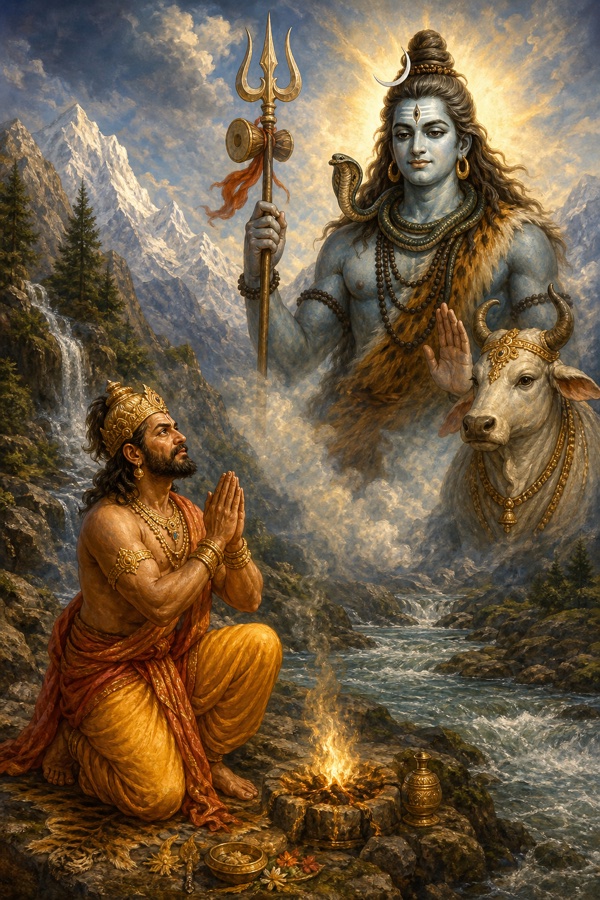
Jayadratha replied, “All is well with me. By arranging our meal you have as good as given it. Now come, mount my chariot and be perfectly happy. It does not become you to honor those wretched sons of Pritha, who live in the woods, stripped of power and kingdom, sunk to the very bottom of misfortune. A woman of sense does not cling to a beggared husband. The Pandavas have fallen from their high place for good; their kingdom is lost to them for all time. You have no need to share their sorrow. Leave the Pandavas, become my wife, and enjoy the kingdoms of Sindhu and Sauvira.”
Hearing these dreadful words from the king of Sindhu, Krishna knit her brows, and with utter contempt for what he said she stepped back and told him, “Say no such thing again. Have you no shame? Be on your guard.” And anxiously awaiting the return of her husbands, she kept him tangled up in long speeches.
Flushed crimson with anger, her eyes ablaze and her brows drawn tight, Draupadi lashed out at the Sauvira king. “Have you no shame, fool? Does it not give you pause, Sauvira, to speak such insults of those famous heroes, each the equal of Indra, each true to his duty, men who do not flinch before whole armies of Yakshas and Rakshasas? Good men never slander the learned or those given to austerity, whether they live in the wild or at home. Only a wretch as low as you does such a thing. You are digging a pit under your own feet, and there is no Kshatriya in this gathering to catch your hand and save you from the fall.”
“To hope to defeat king Yudhishthira is to try to wrest the leader from a herd of wild elephants roaming the Himalayan valleys, its chief huge as a mountain peak, temples streaming with rut. In your childish folly you would wake a sleeping lion to pluck the hair from its face. You will have to run the moment you see Bhimasena in his fury. To fight the two younger Pandavas is to set your foot on the tails of two venomous black cobras with forked tongues. Bamboo, reed, and plantain bear fruit only to die, never to grow; and just as the she-crab conceives for her own destruction, so you, by laying hands on me, who am guarded by these great heroes, are calling down your own ruin.”
Jayadratha said, “I know all this, Krishna, and I know the prowess of those princes too. But you cannot frighten us with these threats. We are born of seventeen high clans and endowed with the six kingly qualities, and so we count the Pandavas beneath us. Climb onto this elephant or this chariot at once for words alone will not hold us back; or humble yourself and beg the mercy of the Sauvira king.”
A key to reading this (a note): The “Six kingly qualities” (shadgunya) are the six policies of a ruler in old statecraft: sandhi (making peace), vigraha (war), yana (marching to attack), asana (waiting and holding), dvaidhibhava (playing a double game), and samshraya (seeking shelter with a stronger power). Jayadratha’s swagger here shows the pride of his line, a pride that will break soon enough.
Draupadi said, “Powerful as I am, why does the Sauvira king think me so helpless? Well-known as I am, I will not cringe in fear before this prince. She for whose protection Krishna and Arjuna would ride together in a single chariot could not be carried off by Indra himself, let alone by a feeble mortal like you. When Kiriti, Arjuna, drives his chariot into your ranks for my sake, he will burn through everything like a fire eating a heap of dry grass in summer. When Arjuna sends his arrows swarming from the Gandiva like a flight of locusts, you will rue your folly.”
“When Bhima comes at you with his mace, and the two sons of Madri range in every direction spitting the venom of their anger, your remorse will be the kind that never leaves you. As surely as I have never been false to my worthy husbands even in thought, by that merit I will have the joy of seeing you beaten and dragged along by the sons of Pritha. You cannot frighten me by seizing me, cruel man, for the instant those Kuru heroes catch sight of me they will bring me back to the Kamyaka woods.”
Then, seeing them ready to lay hands on her, Draupadi rebuked them: “Do not defile me with your touch!” and in great fear she cried out to her guru Dhaumya. Jayadratha caught hold of her upper garment, but she shoved him off hard, and he fell to the ground like a tree torn up by the roots. He seized her again by force, and Draupadi began to gasp for breath. Dragged along by that wretch, Krishna bowed at Dhaumya’s feet and was at last hauled onto the chariot. Then Dhaumya said to Jayadratha, “Observe the ancient custom of the Kshatriyas, Jayadratha. You cannot carry her off without first defeating those great warriors. Beyond doubt you will taste the bitter fruit of this base deed when you meet the Pandavas with Yudhishthira at their head.” And so saying, Dhaumya pressed in among Jayadratha’s foot-soldiers and followed the princess as she was carried away.
The gist: In the Kamyaka forest Jayadratha casts an evil eye on Draupadi, alone at the hermitage, and makes her the vile offer of becoming his queen. Courteous but unafraid, Draupadi warns him of the Pandavas’ might, yet Jayadratha, in the pride of his line, forces her onto his chariot. Her guru Dhaumya follows the army, warning him as he goes.
The Pandavas return, and the news of the seizure
Meanwhile those warriors, who had ranged apart killing deer and buffalo, at last came together again. Hearing the shrieks of birds and beasts and the wild uproar of the forest, Yudhishthira said to his brothers, “These birds and animals fleeing toward the sun are crying out harshly, in great alarm. It tells me some enemy has broken into this great wood. Leave the hunt at once. My heart burns; my very soul, crushing down my reason, seems ready to fly out of me. The Kamyaka forest feels to me like a lake stripped of its snake by Garuda, like a pot drained by thirsty men, like a kingdom robbed of its king and its fortune.”
They turned quickly toward their hermitage. On the way a jackal appeared on their left, shrieking horribly. Yudhishthira said, “This jackal crying on our left is a plain sign that the sinful Kurus have brushed us aside and begun to work their violence on us.” Reaching the hermitage, they found Draupadi’s maid Dhatreyika weeping and sobbing on the ground. Indrasena sprang from the chariot and asked in dismay, “Why do you writhe on the ground and weep? Why is your face pale and stricken with grief? Has some brute done harm to Draupadi, that peerless beauty, dear as life to these Kuru heroes?”
Dhatreyika wiped her face and said, “Brushing aside the five Pandavas, each the equal of Indra, Jayadratha has carried Krishna off by force. His track has not yet faded; the branches he broke have not yet wilted. Turn your chariots and give chase at once, for the princess cannot have gone far. You heroes with the might of Indra, take up your finest bows and quivers and go swiftly, before threat or force robs her of her senses and the bloom of her face. See that no ruin comes of this, like an oblation poured onto a heap of ashes, a garland flung on a grave, or the Soma of a yajna, a fire-rite, lapped up by a dog. Go, and let no time slip through your hands.”
Yudhishthira said, “Be calm, good woman, and hold your tongue. Do not speak like this before us. Any king or prince blinded by the intoxication of power is certain to fall.” And with that they set off along the track she had pointed out, drawing deep breaths that hissed like snakes and twanging the strings of their great bows. Soon they saw the dust thrown up by the hooves of Jayadratha’s cavalry, and in the midst of the army they saw Dhaumya, urging Bhima to hurry. The Pandavas steadied him and said, “Take heart and go back.” Then, like hawks stooping on their prey, they fell on that army in fury. But when they saw their beloved seated on Jayadratha’s chariot, their anger passed all bounds. They roared at Jayadratha to halt, and the enemy lost all sense of which way to turn.
Draupadi names the Pandavas, and the battle begins
At the sight of Bhima and Arjuna the enemy Kshatriyas raised a great shout in the forest. But when he saw the standards of the Kuru heroes, Jayadratha lost his nerve. He said to Yajnaseni, seated on his chariot, “Those five great warriors coming toward us are, I think, your husbands. You know the Pandavas well, so tell me which of them rides which chariot.” Draupadi answered, “You have done this brutal thing that will cut your own life short; what good will it do you now to learn the names of those great warriors? Now that my heroic husbands have come, not one of you will be left alive in the fighting. Still, since you stand in the jaws of death and have asked, I will tell you, as custom allows.”
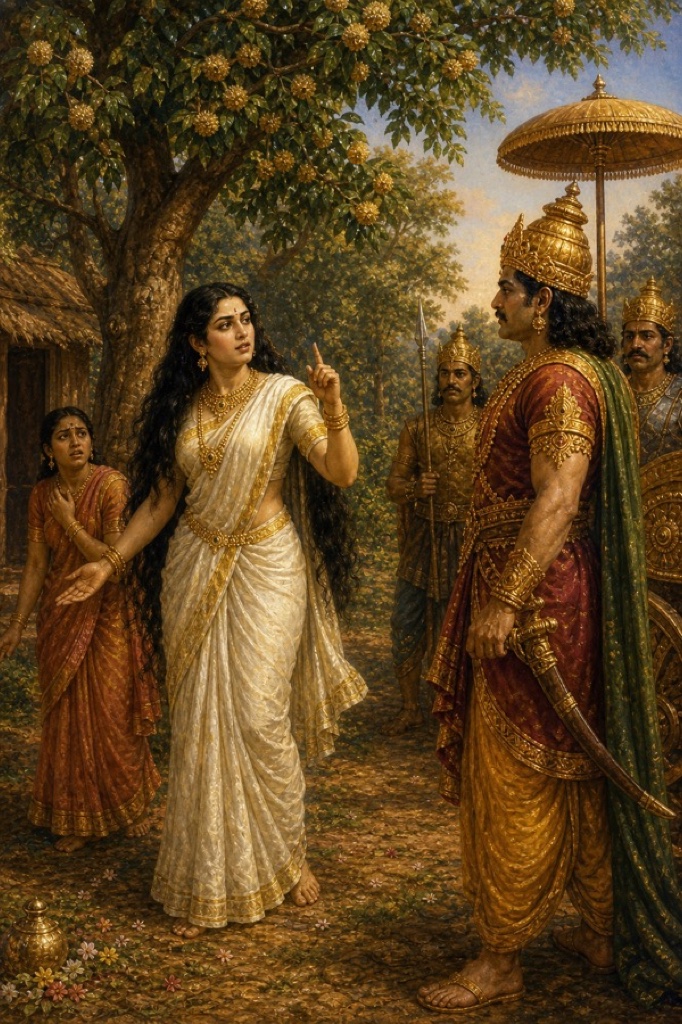
“With Yudhishthira and his younger brothers in view, I feel not the slightest fear of you. The man on the crest of whose flagstaff two sweet-toned drums called Nanda and Upananda are always sounding, Sauvira king, is the one who truly knows the dharma of his own acts. With a complexion like pure gold, a high nose, large eyes, and a spare frame, that husband of mine is known through the world as Yudhishthira prince. He grants life even to an enemy who surrenders. So throw down your weapons, fool, join your hands, and for your own good take refuge with him.”
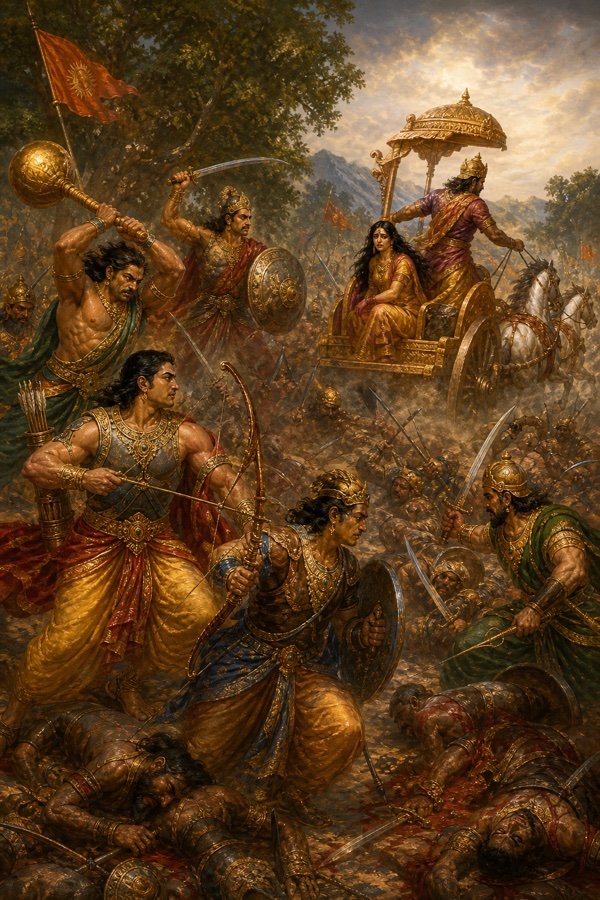
“And the one you see with long arms, tall as a full-grown Sala tree, seated on his chariot, biting his lip, his brows drawn together, is my husband Vrikodara, Bhima. Strong, well-trained horses of the finest breed draw his chariot. His deeds are beyond what men can do, and so he is known on earth as Bhima. Those who wrong him do not live; he never forgets an enemy, takes his revenge on one pretext or another, and is not even calmed once he has taken it.”
“And that fine archer, wise and renowned, master of his senses, reverent toward his elders, brother and disciple of Yudhishthira, is my husband Dhananjaya, Arjuna. He never abandons dharma out of lust, fear, or anger, and never does a cruel deed. Charged with the energy of fire, a match for any enemy, he is the son of Kunti. And that other young man, skilled in every question of dharma and profit, who takes away the fear of the frightened, held the handsomest man in all the world, dear to all the Pandavas, is my husband Nakula. And that hero, skilled in arms, wise, devoted to pleasing the son of Dharma, youngest of the Pandavas, is my husband Sahadeva. No one equals him in wisdom or in ready speech; he keeps the dharma of the Kshatriya always in mind, and would sooner leap into fire or give up his life than say anything against dharma.”
“When the Pandavas cut down your warriors in battle, you will see your army in the plight of a ship going down with its cargo of jewels on the back of a whale. I have told you the prowess of the men you slighted in your folly. If you get away from them unhurt, count it a new lease on life.”
Then the five sons of Pritha, each like Indra and brimming with wrath, left the terrified foot-soldiers who were begging for mercy and crashed into the charioteers, darkening the very sky with the storm of arrows they loosed.
The slaughter of the Sauvira army and Jayadratha’s flight
Meanwhile the king of Sindhu was barking orders: “Halt, strike, forward, quick.” At the sight of Bhima, Arjuna, the twins, and Yudhishthira, his army sent up a great shout, but when they saw those heroes like tigers, the courage of the Sivi, Sauvira, and Sindhu troops broke. Bhimasena, gripping a mace of Saikya iron sheathed in gold, sprang toward the death-doomed king of Sindhu. But Kotikakhya threw a ring of chariots between them and cut the two apart. Pierced by many spears, maces, and arrows, Bhima did not waver, and with his mace he killed an elephant, its driver, and fourteen foot-soldiers stationed before Jayadratha’s chariot.
Arjuna, meaning to capture the Sauvira king, killed five hundred brave mountaineers fighting in the front of the Sindhu army. Yudhishthira, in the blink of an eye, cut down a hundred of the best Sauvira warriors. Nakula leaped from his chariot, sword in hand, and like a farmer scattering seed he sent the heads of the soldiers fighting in the rear flying every way. From his chariot Sahadeva, with iron shafts, dropped the many warriors fighting on elephants like birds knocked from the boughs of a tree.
Then the king of Trigarta, Suratha, got down from his chariot and killed Yudhishthira’s four horses with his mace. But Yudhishthira pierced his chest with a crescent-headed arrow, and he fell, vomiting blood, like an uprooted tree. Now horseless, Yudhishthira climbed with Indrasena onto Sahadeva’s chariot. Then two warriors, Kshemankara and Mahamuksha, poured arrows on Nakula from both sides, but the son of Madri killed them both with two long shafts. Suratha, the Trigarta king, a master of elephant warfare, drove up in front of Nakula’s chariot and had it dragged away by his elephant; but Nakula leaped clear and stood with shield and sword, unmoving as a mountain. Suratha urged his monstrous elephant at him, trunk raised, but as it closed in Nakula sheared off its trunk and tusks with his sword. The armored beast crashed down with a terrible scream, crushing its own riders. This feat done, Nakula climbed onto Bhima’s chariot and rested a while.
Seeing Kotikakhya coming, Bhima struck off his charioteer’s head with a horseshoe-shaped arrow. With no driver, the horses bolted every which way, and when Bhima saw the driverless prince turn his back, he closed in and killed him with a bearded dart, a naracha. With his sharp crescent-headed arrows Arjuna cut off the heads and bows of the twelve Sauvira heroes and brought down the leaders of the Ikshvaku, Sivi, Trigarta, and Sindhu forces. Many an elephant fell by Arjuna’s hand with its banners, and chariots with their standards. Headless trunks and trunkless heads began to cover the whole field, and dogs, herons, crows, hawks, jackals, and vultures fell upon the flesh and blood of the slain.
When Jayadratha saw his warriors falling, he took fright, abandoned Krishna where she stood, and fled to save his life down the same forest path he had come by. Yudhishthira had Sahadeva lift Draupadi, walking ahead with Dhaumya, onto a chariot. With Jayadratha gone, Bhima began mowing down the fleeing troops with iron shafts, naming each man as he cut him down, but Arjuna checked him: “I do not see Jayadratha on the field, the one man who brought this bitter trouble on us. Find him first, and may you succeed. What is gained by killing these soldiers? Why are you set on this useless work?”
Bhimasena turned to Yudhishthira and said, “Many of the enemy’s warriors are dead and the rest are scattering in all directions. Take Draupadi, the twins, and Dhaumya back to the hermitage now, king, and comfort the princess. That fool of a Sindhu king I will not leave alive, though he take shelter in the underworld or have Indra himself at his back.” Yudhishthira said, “Think of our sister Duhshala and of Gandhari, and do not kill this king of Sindhu, wicked as he is.”
A key to reading this (lineage): Duhshala is the only daughter of Dhritarashtra and Gandhari, sister to the hundred Kauravas, and Jayadratha’s wife. It is this tie that makes Yudhishthira order Bhima to spare Jayadratha, so that Gandhari need not grieve a widowed daughter. Here you see one of the Mahabharata’s moral knots, where a wrongdoer is saved by a family bond.
The gist: Returning, the Pandavas read disaster in the omens; the maid brings them word of Draupadi’s seizure. They run down Jayadratha’s army and tear it apart, Bhima, Arjuna, Nakula, and Sahadeva showing astonishing prowess. Jayadratha abandons Draupadi and flees. Bhima wants him dead, but Yudhishthira stops him by invoking their sister Duhshala and Gandhari, and it is this family mercy that will grant him his life.
Shiva Tells of Narayana’s Glory: The Deluge and the Avatars
Mahadeva went on to tell Jayadratha of the wondrous glory of Vishnu. “At the end of the cycle of ages that same Lord takes the form of the all-consuming fire and burns up the whole world, mountains, seas, islands, and forests alike. When the Naga realm of the underworld has been destroyed in the same way, huge many-colored clouds, roaring terribly and shot through with lightning, spread across the entire sky and pour down water in streams as thick as the axles of chariots, until they quench that all-consuming fire.
“At the close of four thousand yugas, when the earth is flooded with water like one vast sea, when all moving creatures are gathered into death, when sun, moon, and wind are undone and the universe is stripped of planets and stars, then Narayana, the supreme Being beyond the senses, with a thousand heads, a thousand eyes, and a thousand feet, desires his rest. The serpent Shesha, with a thousand hoods, blazing like ten thousand suns, white as the kunda flower, the moon, a string of pearls, or the white lotus, becomes his couch. In the lap of that deep water the almighty one sleeps, wrapping all space in the darkness of night.
“When his creative power stirs, he wakes and finds the world empty. Here the name Narayana is explained: water was born from the Rishi Nara and became his body, so it is called nara; and that water became his ayana, his resting-place, so he is called Narayana. Then, as that eternal Being turns his thought to creating anew, a lotus springs from his navel, and from the navel-lotus comes the four-faced Brahma. Seated on that lotus and seeing the world a blank, Brahma, grandsire of all, by his own will creates the great Rishis in his own likeness, Marichi and the rest, and those Rishis complete the work, bringing forth Yakshas, Rakshasas, Pishachas, reptiles, men, and all creatures moving and still.
“The Supreme Spirit has three states: as Brahma he creates, as Vishnu he preserves, and as Rudra he destroys. When the world had been turned to water in this way, the Lord, searching for solid ground, moved here and there like a firefly on a rainy night. ‘How shall I lift this earth sunk in the water?’ Thinking so, he took in the water the form of a boar fond of sport, ten yojanas long, with pointed tusks, dark as a cloud and huge as a mountain; and plunging in, he raised the earth on one of his tusks and set it back in its place.
“At another time he took the strange form of half lion, half man, the Nrisimha. The Daitya king Hiranyakashipu, seeing that uncanny shape, blazed with rage and rushed at him with a trident. But the man-lion leaped into the air and tore the Daitya apart with his sharp claws. Then that same Lord was born of Aditi from the seed of Kashyapa; a thousand years later he appeared as Vamana, in the guise of a dwarf Brahmin boy, staff and water-pot in hand, the mark of Srivatsa on his breast. With the help of Brihaspati he came to the sacrifice of Bali, king of the Danavas. Pleased, Bali said, ‘Ask, Brahmin, what do you want?’ Vamana smiled and said, ‘Only three paces of ground.’ Bali agreed, and then Hari measured this whole boundless world in just three steps and gave it to Indra. This is the tale famous as the Vamana avatar.
“And to destroy the wicked and guard dharma, that same Vishnu has been born among men in the line of the Yadus, and is called Krishna. It is that Krishna, bearer of conch, discus, and mace, clad in yellow, marked with Srivatsa, who protects Arjuna. Seated on one chariot with Krishna, whose power has no end, the son of Pritha cannot be beaten. Even the gods cannot stand against him, much less a man. So, king, leave him be. The other four Pandavas you will be able to hold back for a single day.”
With that Hara, Uma’s lord, ringed by his dwarfish, hunchbacked attendants with their fearsome eyes and ears, vanished from that place along with Uma. And Jayadratha went home, while the Pandavas went on living in the Kamyaka forest.
A key to reading this (the yuga-count in modern terms): “Four thousand yugas” points to the great deluge at the end of a kalpa. In the traditional reckoning, a thousand chaturyugas (one cycle of Satya, Treta, Dvapara, and Kali) together make a single day of Brahma, at the end of which this flood comes. The figure marks a vast span of many hundreds of millions of years, in which creation and destruction repeat in an endless rhythm.
The gist: Shiva told Jayadratha of Narayana’s glory: the all-consuming fire and the great flood at the deluge, Narayana asleep on the couch of Shesha, Brahma born from the navel-lotus, and the avatars of the boar, the man-lion, the dwarf, and Krishna; then Shiva and Jayadratha each went their way.
Source: the Mahabharata of Krishna-Dwaipayana Vyasa, Vana Parva, Markandeya-samasya and Draupadi-harana sub-parvas, Sections 186-232 and 264-271. The Gita Press Hindi edition is the controlling witness. The Sanskrit e-text and an independent complete translation were used to verify names, sequence, and principal events. Where recensions differ, this retelling follows Gita Press.
Source: the Mahabharata of Vyasa (Gita Press, Gorakhpur)
The same story, told elsewhere
- Markandeya’s vision of the deluge
The Shrimad Bhagavatam (Canto 12): Markandeya’s vision of the deluge - The Devi Mahatmya
The Devi Mahatmya, which is a part of the Markandeya Purana