Guru Nanak’s prayer for the hour before dawn, and the first page of the Guru Granth Sahib.
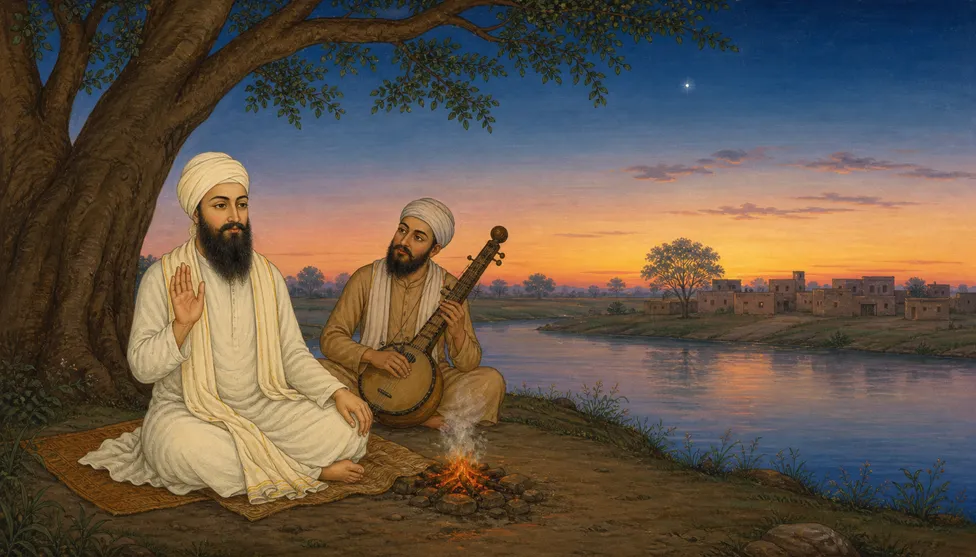
The stars were still out over the river Ravi when the village of Kartarpur began its day. People who would be in the fields by sunrise sat down together in the last of the dark. Among them sat the teacher who had founded the village and who farmed its land beside them. Together they said one prayer through, from its first word to its last. The teacher was Guru Nanak, and the prayer was his own.
He had been born in 1469 at Talwandi in the Punjab, and he had spent more than twenty years of his life on the road. The old accounts of his journeys take him east to Assam, south to Lanka, north into the Himalaya, and west as far as Mecca and Baghdad. Beside him walked Mardana, a Muslim musician from his own village, who played the rabab, a lute, whenever the Guru began to sing. The hymns of those years were made for singing. This prayer he left without a melody. It was to be spoken, in the hour he prized above every other, the still hour before the sun.
It is called the Japji. In 1604 the fifth Guru, Arjan, gathered the hymns of the Gurus and the saints into one book, and he set the Japji on its first page. The Sikhs honor that book today as the Guru Granth Sahib, their living Guru, and they still begin the day as Kartarpur did. The prayer opens with a single line on who God is. Thirty-eight stanzas follow, called pauris, a word for the steps of a stair, and one short verse brings it to a close. On the first step Guru Nanak asked how a person becomes true. Every step after it climbs toward the answer.
Mool Mantar · The Root
The line that opens the Japji opens the whole of the Guru Granth Sahib, and the Sikhs call it the Mool Mantar, the root mantra. It begins with a number. Before any word Guru Nanak set the figure 1. After the figure comes Onkar, the Being whose presence runs through everything that exists. The two are read together as Ik Onkar, the One.
A handful of words follow, and each of them holds a teaching about that One. Truth is his Name, Sat Naam. He is the maker of all that is, and he lives in all that he has made. He is without fear, and he is without enmity toward anyone. Time has no hold on his form. He is never born. He exists of himself and owes his being to no one else. The last two words turn from God to the person saying the prayer. This One is known through the grace of the Guru, and no one comes to that knowing alone.
Under that line stands one word, Jap. It names the prayer and gives its instruction together. Say this over, it means, with the tongue and with the mind, until it stays. A short verse then sets a seal on what has been said. The One was true before anything began. He was true when the ages began to turn. He is true now. And Nanak says he will be true in all the time to come.
Pauris 1 to 3 · How Does a Person Become True?
The first step began with four roads, and Guru Nanak closed each of them as soon as he had named it. Thinking will not do it, he said. A person can think a hundred thousand times, and the thinking never arrives. Silence will not do it. A person can sit without a word, the attention drawn out in one unbroken thread, and the stillness inside does not come. Gathering will not do it. The hungry stay hungry though they heap up the goods of every world. And cleverness will not do it. Of a thousand clever plans, of a hundred thousand, not one leaves this world with the person who made them.
Then he asked the question outright. “How does a person become true? What brings down the wall of the false?” He answered with one word, hukam. It is the word for a ruler’s order, the kind that is carried out. The Guru used it for the order of God, by which everything that exists is moving at this moment. “Walk in the hukam, in the will of the One who commands,” he said. That road, said Nanak, was written into every person from the beginning. The thirty-seven steps that follow open that one word.
The telling of him has never run short. Tens of millions have told and told again, and there is always more to tell. The Giver goes on giving, and those who receive grow tired of taking. Age after age the world eats from his hand. By his command the Commander keeps every creature moving on its road. And he himself, said Nanak, is in bloom, and nothing troubles him.
Pauris 4 to 7 · What Can Be Offered
The fourth step turned on a difficulty. The Master is true, the Guru said, and true is his law. His speech is love, and he himself is without limit. People pray to him, and what they say is “give, give,” and the Giver gives. If everything a person holds has come from him, what is left to set before him so that his court may be seen? What words can a mouth speak that would win his love when he heard them?
The Guru’s answer was a time of day. It is the amrit vela, the hour of nectar that comes at the end of the night. A person should rise in it, give himself to the true Name and think on the greatness of the One. The Japji itself is said in that hour. By his grace the robe of honor is given, the Guru said, and by his nadar, his glance of favor, the door of freedom opens. So a person comes to know, said Nanak, that the True One himself is everything.
Then he spoke of the Guru, the one through whom God is known. Through the Guru comes the sound of the Name. Through the Guru comes true knowledge. Through the Guru comes the understanding that God is present in all things. The Guru is Shiva. The Guru is Gorakh and Brahma. The Guru is Mother Parvati. Whatever a seeker hopes to find in the gods and the great yogis is found in the Guru. “Even if I knew him, I could not tell of him,” Guru Nanak said. “He cannot be put into words.” So he asked for a single thing. “Guru, give me this one understanding. There is one Giver of all that lives. May I never forget him.”

Long life, a great name and the applause of the world lie in one pan of the scale, and a single glance lies in the other. God gives virtue to the one who has none, said Nanak, and it is he who gives virtue to the virtuous as well. No one else can be found who could hand such a man a single virtue.
Pauris 8 to 11 · Listening
Four steps in a row began on one word, suniai, by listening. Suniai is to listen to the Name of God with the whole heart given to it, the way a person listens to something very dear.
By such listening, the Guru said, an ordinary person comes to stand with the siddhas, the adepts of yoga, and with the pirs, the holy men of Islam. He stands with the gods, and with the naths, the masters of the yogis. By listening, the earth is understood, and the sky over it, and the bull that the old stories set beneath the earth to carry it. By listening, the continents are known, and the worlds, and the regions under the ground. By listening, death can no longer lay a hand on a person. The step closed on two lines that close the next three as well. The lovers of God, said Nanak, are always in bloom, and listening puts an end to sorrow and to sin.
Pauris 12 to 15 · Taking It to Heart
After listening came mannai, and that word carried the next four steps. To listen is to let the Name in. Mannai is what follows when the Name has been believed and has settled, so that a person trusts it from within. The Guru began by owning that he could not describe such a person. No one can tell the state of a person who has taken the Name to heart, he said, and whoever tries is sorry for it afterward. No paper would hold it. No pen could write it, and no scribe could set it down, though people sit together and try to think it through. Deep peace, love and a moment of real stillness are known only by living them.
Each of these four steps closed on the same pair of lines. Such is the Name, which no stain touches, and only the one who takes it to heart knows what it is.
Pauris 16 to 19 · Countless
Next Guru Nanak spoke of those who had listened and had taken the Name to heart. He called them the panch, the chosen, the word a village uses for the elders it trusts to lead it. The chosen are accepted, he said, and the chosen lead. They are honored in the court of God, and they lend grace to the courts of kings. Their minds rest on the Guru alone.
From them he looked out at the creation, and no reckoning could hold it. Let a person say what he likes and think as hard as he can, the works of the Maker cannot be counted. The old stories said that the earth rests on a bull. The Guru gave that bull a name. It is dharma, he said, and dharma is the child of compassion, and contentment is the cord that holds the whole in its place. Whoever understands this becomes true. Then he pressed the old story with a question. How heavy a load can one bull carry? Beyond this earth there are more earths, and more beyond those. What power stands beneath them all and bears their weight?
The kinds of living things, their colors and their names, were all written down by a pen that never stopped moving. Who would know how to write out that account? If it were written, how long would it run? What power is his, and what beauty of form. What gifts are his, and who could measure them? He spread out the whole expanse of creation with a single word, and at that word a hundred thousand rivers began to flow.
The step ended on four lines that close the next three steps as well, and in them the Guru spoke straight to God. “What power have I to speak of your creation? I am not fit to be offered up to you even once. Whatever pleases you is the one good work. You are safe forever, Formless One.”
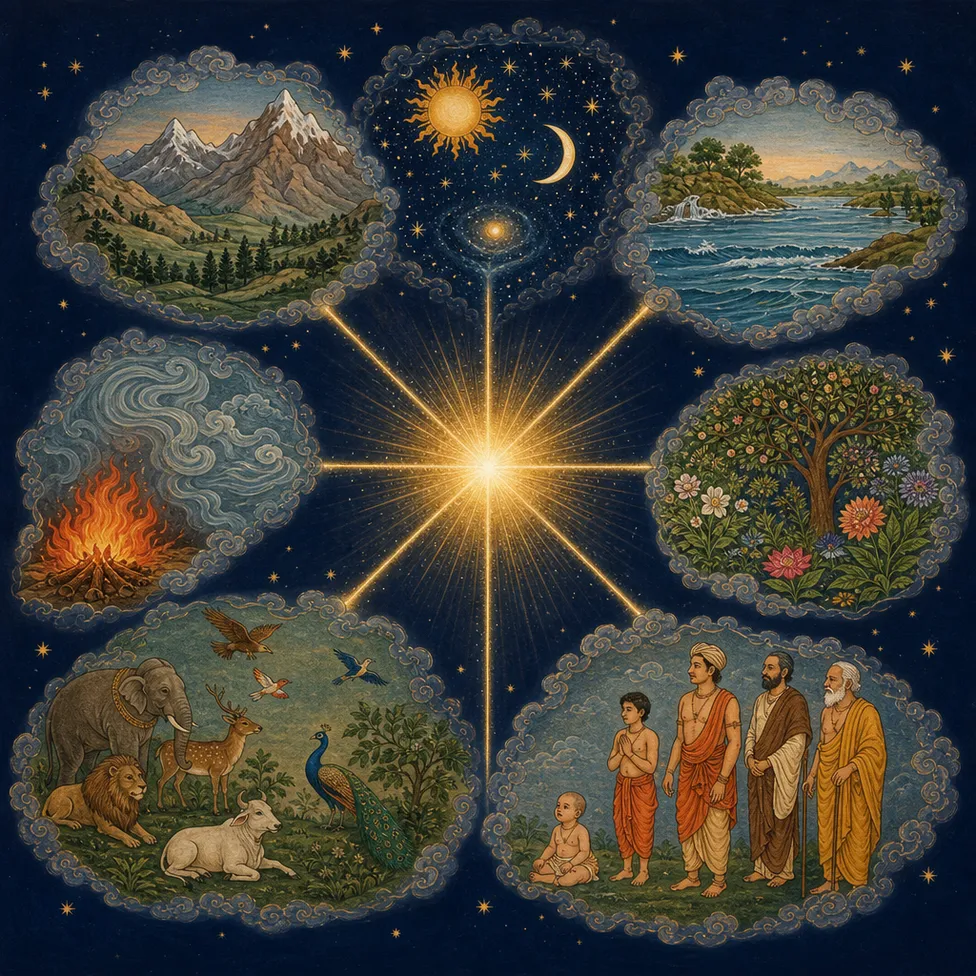
The four lines closed the step for the last time. “What power have I to speak of your creation? I am not fit to be offered up to you even once. Whatever pleases you is the one good work. You are safe forever, Formless One.”
Pauris 20 to 23 · The Color of the Name
The twentieth step began at the washing place. When hands, feet and body are covered in dust, water takes the dust away. When a cloth has been fouled, soap washes it clean. When the mind itself is stained with wrongdoing, the Guru said, one thing alone will clean it, and that is to be steeped in the color of the Name. “Saint” and “sinner” are more than names that people call one another. Whatever a person does, and does again, is written into him, and he carries the writing with him when he goes. “You yourself sow,” the Guru said, “and you yourself eat what comes up.” By the hukam, said Nanak, each one comes into the world and leaves it.
Then he turned and spoke to God. “Every virtue is yours, and I have none. Unless you plant virtue in me, I cannot even worship you. Glory to you. You are maya, the power that spreads the world before our eyes. You are the Word. You are Brahma the maker. You are true, you are beautiful, and your heart is always glad.”
From praise he passed to a question. At what time was the world made? At what hour, on what date of the moon, on which day of the week? In what season and in what month did the forms first appear? The pandits never found the hour, or it would stand written in a Purana. The qazis, the judges of Islam, never found it, or they would have set it down when they wrote out the Quran. No yogi knows the date or the day. No one at all knows the season or the month. The Maker who made the world knows it, and he alone.
“How can I speak of him?” the Guru asked. “How can I praise him, or describe him, or know him?” Everyone speaks of him, said Nanak, and each speaker thinks himself wiser than the one before. Great is the Master, and great is his name, and whatever happens is his doing. Whoever trusts his own wit to take the measure of God will find no honor waiting when he arrives in the world to come.
Pauris 24 to 26 · No End and No Price
One word came back in line after line of the next step. It was ant, the end, and each time it came the Guru said that there was none. There is no end to his praises, and no end to the telling of them. There is no end to his works, and no end to his gifts. There is no end to what can be seen of him, and no end to what can be heard. No one knows what purpose lies in his mind. No one has found the edge of the world he made, its near shore or its far one. Many cry out in their longing to find where he ends, and his limits are never found. No one knows them. The more that is said of him, the more is left to say.
Great is the Master, and high is his seat, and his Name is higher than the highest. Only one as high as he is could know how high he stands. He alone knows his own greatness. Every gift, said Nanak, comes by his glance and his grace.
“These too are your gifts, Giver,” the Guru said. If everything lies inside the one order, the hard hours lie inside it as well. Release from bondage comes by his will, and no one has anything else to say about it. If some fool presumes to, he will learn how many blows his own face can take. God himself knows what each one needs, and he himself gives it, and there are some who say so. The one whom he blesses with the gift of his praise, said Nanak, is a king over kings.
And still everyone tries. The Vedas speak of him, and the Puranas. The learned speak, and give their lectures. Brahmas speak of him, and Indras. The gopis speak, the cowherd girls who loved Krishna, and Krishna speaks with them. Shivas speak, and the siddhas. All the Buddhas he has made speak of him. The demons speak, and the gods. Holy men speak, and silent sages, and those who serve. Many are speaking now, and many are only beginning. Many have spoken, and risen, and gone. If he made as many again as he has made already, not one of them could say how great he is. He is as great as he chooses to be, and the True One himself knows it, said Nanak. If some loud talker claims to describe him, that man should be written down as the greatest fool among fools.
Pauri 27 · That Door
The Sikhs know the twenty-seventh step by its first words, So Dar, that door. It returns in the evening prayer, so those who keep the daily order hear it at dawn and again at dusk. “What is that door like,” the Guru asked, “and what is the house in which you sit and look after all that exists?” He answered by listening at it. Music without number is playing there, and no one could count the players. Raga after raga is sung, each great melody with the raginis that belong to it, and no one could count the singers.
Wind sings to him there, and water, and fire. Dharmaraj, the judge of the dead, sings at his door. Chitra and Gupta sing, the two scribes who write down every deed for that judge to weigh. Shiva sings, and Brahma, and the Goddess, all of them beautiful because he made them so. Indra sings from his throne, with the gods beside him at the door. The siddhas sing from the depth of their trance, and the holy sing in their contemplation. The celibate sing, and the givers, and the contented, and the heroes who never give ground.
The pandits sing, and the great seers who have read the Vedas through every age. The beautiful women sing who steal the heart, in heaven, on earth and in the worlds below. The jewels he made are singing, and the sixty-eight holy places with them. The mighty warriors sing. The four kinds of living things sing, those born from the egg, from the womb, from sweat and from the soil. The continents sing, and the spheres, and the whole universes that he made and holds in their places. All of creation is one court, and all of it is singing.
“Those sing to you who please you,” the Guru said, “your lovers, steeped in your sweetness. How many more are singing whom I cannot call to mind? How can Nanak think of them all?”
He is the one who is always true, the true Master, and true is his greatness. He is, and he will be. He made the world, and he will never pass away from it. He brought forth maya in every color and kind and species. Having made it, he watches over his work as befits his greatness. He does whatever pleases him, and no one can give him an order. He is the king, the king over kings. All that is left for a creature, said Nanak, is to live inside his will.
Pauris 28 to 31 · To the Yogis
In the Guru’s day the Naths, the yogis of Gorakh’s order, walked the roads of the Punjab. They wore great rings through their ears and ash on their skin. They carried a begging bowl, a bag and a staff, and they wrapped themselves in a patched coat. Guru Nanak spoke to them now, and he used the names of their own gear.
“Let contentment be your earrings,” he said. “Let honest work be your bowl and your bag, and let meditation be the ash you wear. Let the thought of death be your patched coat. Let a body kept clean of every vice be your discipline, and let faith be your staff.” The yogis had twelve orders, and the one they held highest was called the Aai Panth. “To count all people as your own company,” the Guru said, “that is the Aai Panth. Master the mind, and the world is mastered.”
Each of these four steps ended in a bow. Adesh was the yogis’ own word of greeting, and the Guru turned it toward God. “I bow to him, I bow. He is the first, the pure, without beginning and beyond destruction, and through every age he is the same.”
Pauris 32 and 33 · The Stair and the Hand
Suppose one tongue became a hundred thousand tongues, the Guru said, and the hundred thousand became twenty times as many. Suppose each of those tongues repeated the single Name of the world’s Lord a hundred thousand times. On that road stands the stair that leads up to him, and whoever climbs it becomes one with him. Talk of the sky reaches the ground as well, and worms that hear it begin to fancy that they too will get there. He is reached by his own glance of grace, said Nanak. The boast of a false man is as false as the man.
Pauris 34 to 37 · The Five Realms
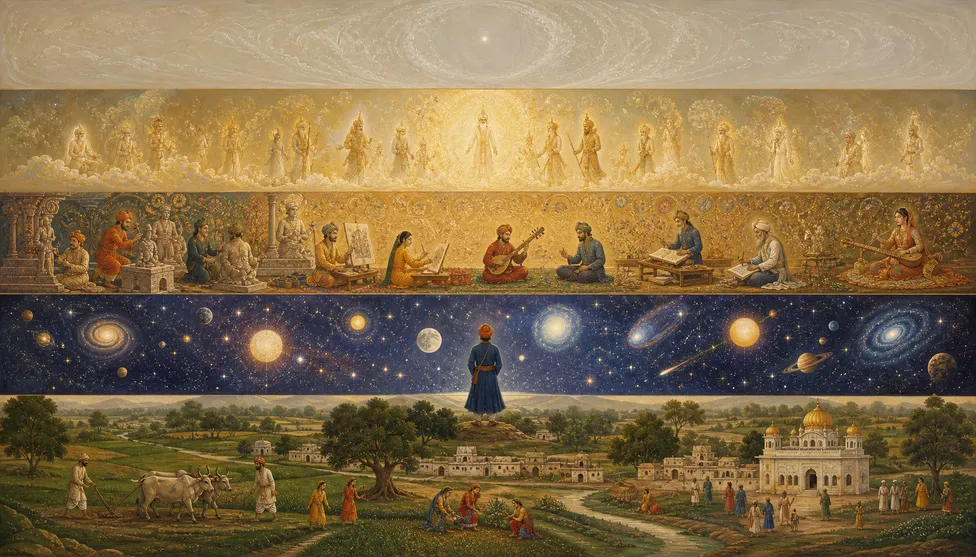
The last climb of the prayer passes through five realms, called khands, the stages of a soul on its way to God. The first is Dharam Khand, the realm of duty, and it is the ground under everyone’s feet. God made nights and seasons, the Guru said, the dates of the moon and the days of the week. He made wind and water, fire and the worlds below. In the middle of them all he set the earth, and he set it there as a dharamsal, a house for the practice of dharma.
On the earth he placed living things of every habit and color, and their names are many and have no end. Each of them is judged by what it does. He is true, and his court is true. In that court the chosen stand in their beauty, and by his glance of grace they wear his mark. There the unripe are told from the ripe. A person finds out which he is, said Nanak, on the day he arrives. So the earth is a place made on purpose, where what a person does counts.
How many Indras there are, how many moons and suns, how many spheres and lands. How many siddhas, Buddhas and naths, and how many goddesses in their many forms. How many gods and demons and silent sages, and how many seas full of jewels. How many sources of life, how many languages, how many lines of kings. How many kinds of contemplation, and how many who serve. There is no end to it, said Nanak, no end. In the realm of knowledge a person learns how vast the creation is and how small the “I” that once stood at its center, and the knowledge comes as relief.
The fifth realm is Sach Khand, the realm of truth, and there the Formless One himself lives. He makes, and he watches over what he has made, and his glance fills it with joy. There are continents in that realm, and spheres, and universes, and whoever set out to describe them would never reach the end. World stands upon world there, and form upon form, and each does its work exactly as his hukam runs. He watches, and he considers, and he is glad. To tell of it, said Nanak, is as hard as iron.
Pauri 38 · The Mint
The last step of all was set in a goldsmith’s shop, and every tool in it was a virtue. Let self-restraint be the smithy, the Guru said, and let patience be the goldsmith. Let understanding be the anvil, and knowledge the hammer. Let the fear of God be the bellows, and hard discipline the fire. Let love be the crucible, and into it pour the nectar of the Name. In that true mint the shabad is struck, the Word. This is the work of those on whom his glance of grace has fallen. And by that glance, said Nanak, the gracious One fills them with joy.
The first step had asked how a person becomes true. Here on the last stood the answer in full. A true person is made, as a coin is made, with discipline and patience, with heat and with love, under the glance of God.
The Closing Salok · In the Lap of Day and Night
The Japji ends on a salok, a short verse, and after all the worlds and ages it comes home to the plainest things there are. Air is the guru. Water is the father, and the great earth is the mother. Day and night are a pair of nurses, and the whole world is a child at play in their lap.
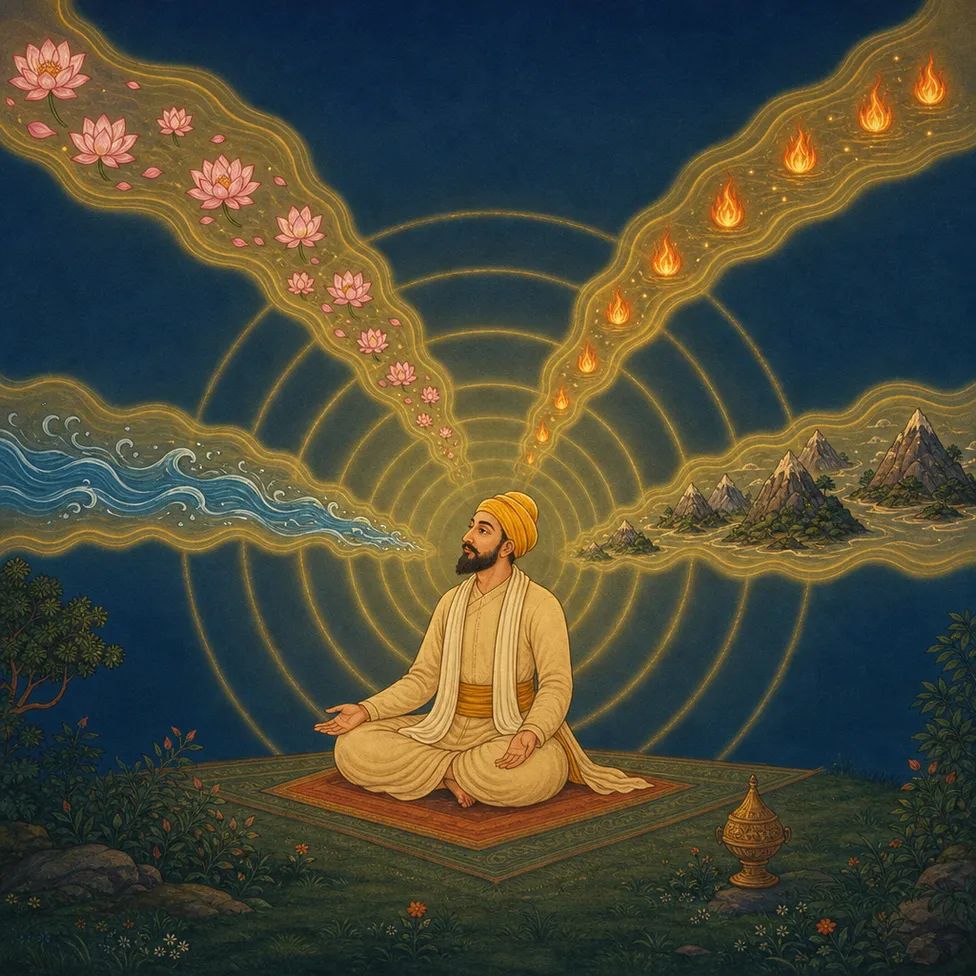
The One whom thirty-eight steps could not measure is as near as a breath and a drink of water. Good deeds and bad are read out in his presence by Dharma, the judge. By their own deeds some are drawn close to him, and some are left far off. Those who kept the Name in mind, and who went away with their hard labor done, have faces that shine, says Nanak. And how many more go free along with them. A person who has become true takes others across with him.