On this page
Dawn has not broken yet. On the Kuru-Panchala plain, in a forest school, three singers sit on kusha mats outside the hall of sacrifice. The one in the middle draws breath and lets out a single long tone: Om. The tone rises, holds, and before it thins away a seam of gold lies along the treetops in the east. The students listen with their eyes closed. They have been told that the essence of every essence sits inside this one syllable, the essence pressed from earth into water, water into plants, plants into a human being, the human being into speech, speech into the rik, the rik into the saman, and the saman into this udgitha. The eighth, and the highest.
The Chandogya Upanishad belongs to the Sama Veda, to the chandogas, the singers who carried the Veda in the singing voice. Of its eight chapters the first two teach the inner method of that singing, and this first chapter turns one question over through thirteen khandas: when the udgatar (the chief priest who sings the saman) says Om and lifts the song, whom is he singing? The chapter answers by walking through a war between gods and asuras, a flight of gods from death, an argument among three learned men, the sacrifice of a starving brahmana, and at the end the singing of dogs. Every story yields the same answer, prana, the breath, and behind that breath the thing this chapter names akasha, space.
Before any of that can mean anything, it helps to know what those three men outside the hall are actually doing, because a saman is a made thing with parts, and every part has a name. It starts as a rik, a verse of the Rig Veda, a line of words that can be spoken flat in an ordinary voice. The singer takes that line and stretches it. He lengthens its vowels past the count they have in speech, bends the pitch up and lets it come down, and threads through it syllables that carry no meaning at all, hau, hai, i, u, auhoyi, the way a potter throws extra clay onto the wheel to hold a shape. By the time he is finished the verse has become music with a fixed architecture. It opens with the hinkara, a hummed hin that finds the pitch before a single word arrives. Then the prastava, the approach. Then the udgitha, the loud central stretch, the part that gives this whole discipline its name and the part this chapter will spend thirteen khandas pulling apart. Then the pratihara, the answering turn. Then the nidhana, the laying down, where the voices come together and settle on one long syllable and stop.
Nobody performs it alone. A working session runs three streams of the Veda at once with a fourth man watching all three. The hotar recites from the Rig Veda and calls the gods into the enclosure by name. The adhvaryu carries the Yajur Veda and does the physical labor, measuring the ground, laying the fires, pouring the offerings, muttering his formulas under his breath while his hands keep moving. The udgatar sings the Sama Veda from a seat of his own, and two assistants sing with him: the prastotar, who takes the prastava, and the pratihartar, who takes the pratihara. Above all of them sits the brahman, who may not speak for a whole day, whose entire office is to hear the one syllable that went wrong and mend it before the damage sets.
The session belongs to the man paying for it. A yajamana, a householder or a king, fixes the days, feeds and houses the priests for as long as it takes, and at the close hands over the dakshina, the fee, in cattle and cloth and gold and grain, enough on a large session to move a visible share of a man’s wealth out of his storehouse in an afternoon. What he is buying is a performance without a flaw in it. One tone taken at the wrong height, one pause dropped in the wrong place, one priest opening his mouth over a portion of the song whose owner he could not name, and the whole commission leaks out through that crack, and the patron has spent a season’s grain on nothing. This is why the sentence that keeps recurring in this chapter, “मूर्धा ते विपतिष्यति”, your head will fall off, hits the way it does. It is what one professional says to another about a professional failure, and everyone in the enclosure understands the accounting behind it.
The man in that seat has been working toward it since he was small. He was handed to a teacher young enough that he learned the tones before he had any idea what the words under them meant, and he lived in the teacher’s house afterward for years, carrying firewood to the fires morning and evening, taking the chant apart one join at a time, the words first, then the pitches, then the stobhas, then the places where a breath may be taken and the places where it may not. His family’s standing travels with his throat. Villages know which house turns out singers who never slip, and which house produced the man whose voice cracked at somebody’s twelve day session, and the memory of it outlives the man. So when this Upanishad says that Om is the udgitha, it is speaking to people who have paid for the training, who will be judged on the result, and who want to know what the sound they have been shaping since childhood is actually made of.
The main figures of this chapter
Angiras, Brihaspati and Ayasya: three ancient seers who worshiped the chief breath itself as the udgitha; in this chapter all three of their names come to rest on that one breath.
Baka Dalbhya: udgatar to the seers of Naimisha, who sang their desires into fulfillment; the vision of the dogs and their udgitha came to him (the text also calls him Glava Maitreya).
Kaushitaki: the father who told his only son that he had sung the sun knowing it as one, and so the son also came out one.
Shilaka Shalavatya, Chaikitayana Dalbhya and Pravahana Jaivali: three men skilled in the udgitha, whose argument carries the motion of the saman all the way up to space.
Ushasti Chakrayana: a starving scholar from a Kuru country flattened by hail, who ate the beans his wife had saved, walked into a king’s sacrifice, and silenced all three officiating priests.
The gods and the asuras: two broods of Prajapati, whose rivalry made the gods take up the udgitha as a weapon.
Om, the essence of essences (khanda 1)
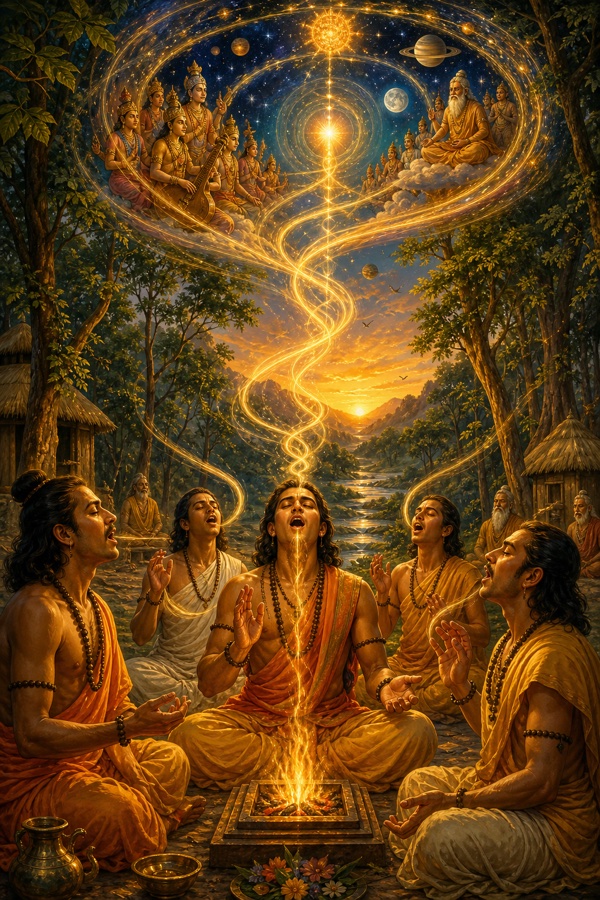
“ओमित्येतदक्षरमुपासीत”, one should worship this syllable Om: that is the first sentence of this Upanishad. The word upasana is built from upa and asana, sitting near; holding a thing in the mind so long and so often that it grows larger than the shape it shows you. This is a practice with a posture and an hour attached to it. A man sits down before light, faces a direction he has chosen and keeps to, and works one object over in the mind the way a smith works one piece of metal, coming back to it every day for years until the object stops being a thing he thinks about and becomes the place he thinks from. When the udgatar sits down to sing, he lifts the song out of Om, and so the text says that Om is the udgitha, and then goes down into the explanation of it. The first khanda weighs this single syllable against the whole universe, and it weighs by the measure of rasa, essence.
The essence of all beings is the earth, of the earth water, of water the plants, of the plants the human being, of the human being speech, of speech the rik, of the rik the saman, and “साम्न उद्गीथो रसः”, the essence of the saman is the udgitha. Count them and the udgitha falls eighth, and the Upanishad calls it pararhya, that beyond which nothing further can be set down. Put cane through the press and juice runs out; boil the juice into jaggery, boil the jaggery into sugar. Each time the thing grew smaller and the essence grew denser. The udgitha is the whole world thickened in that way. “स एष रसानाꣳ रसतमः परमः”, this is the most essential of essences, the highest.
Then the question comes: which is the rik, which the saman, which the udgitha? The answer turns inward. Speech is the rik, breath is the saman, and this syllable Om is the udgitha. Speech and breath make a mithuna, a couple, and that couple comes together inside Om. As a couple on meeting fulfills the desire of each in the other, so the speech and breath joined in Om fulfill desires; and the man who worships this syllable knowing it in this way becomes apayita, a fulfiller of desires. Speak, and breath is spent; breathe, and speech becomes possible. Om sits at the point where the two touch.
The same khanda holds another clue. In Sanskrit a man who agrees to something says om, the way we say yes. Om is therefore the syllable of anujna, assent, and the Upanishad says that assent itself is prosperity; the man who says yes to a thing makes it grow. All three Vedas run on this syllable: the adhvaryu gives his orders with Om, the hotar recites his riks with Om, the udgatar sings with Om. All of it happens through the greatness of this syllable, through its essence, in its honor.
The last mantra of the khanda puts down a hard truth. At the sacrifice the man who knows all this sings, and so does the man who knows none of it, and from outside the two voices sound alike. Still, “नाना तु विद्या चाविद्या च”, knowledge and ignorance are two different things. Work done with knowledge, with faith, and with the upanishad (the secret understanding) is viryavattara, the stronger work. Let two singers sing the same saman, one of them aware that he is singing the breath and the other only holding his pitch, and no listener will catch the difference. Inside the singers, the two are standing in different places.
In short: the first khanda makes Om the essence of the saman, the eighth and final distillate; speech and breath meet as a couple in this syllable. The man who sings with knowledge sings with more force, because knowledge and ignorance ripen into different fruit.
The gods, the asuras, and the breath that evil could not pierce (khanda 2)
Now the story. The gods and the asuras, both of them children of Prajapati, fell to fighting, and the gods decided to overpower the asuras with the udgitha, and took the udgitha up. The weapon was in hand. Where was it to be kept? First they worshiped the breath in the nose as the udgitha. The asuras shot it through with evil. “पाप्मना ह्येष विद्धः”, this one stands pierced with evil, and that is why the nose to this day smells fragrance and stench alike. The nose picks; the nose makes a face; and wherever there is picking, an asura’s arrow finds a way in.
Then the gods worshiped speech as the udgitha, and the asuras pierced that too, which is why speech says true things and false things. Then the eye: it looks at what deserves looking at and at what does not. Then the ear: it hears the hearable and the unhearable. Then the mind: it resolves well and it resolves badly. Every sense opened a crack, and through every crack the evil came in. The crack is the taking of sides. Anything that takes a side can be tempted and can be frightened.
At last the gods worshiped the breath in the mouth, the mukhya prana, as the udgitha. The asuras rushed at it and broke to pieces the way a lump of clay shatters against hard stone. The Upanishad says that a man who wishes evil on one who knows this, or torments him, shatters the same way, since “स एषोऽश्माखणः”, the knower is himself that hard stone. With this breath you recognize neither fragrance nor stench; it is apahatapapma, a breath from which evil has been shaken clean. Whatever you eat and drink, you eat with this breath, and by it the other breaths are fed. At the end, when this one gets no food, it walks out, and the dying man’s mouth is left hanging open.
Then the Upanishad takes three old names and opens each onto this same breath. Angiras worshiped it, and so people hold this breath to be Angirasa, since it is the rasa of the angas, the sap of the limbs. Brihaspati worshiped it, and so this breath is Brihaspati, since speech is brihati, the large one, and the breath is her lord. Ayasya worshiped it, and so this breath is Ayasya, since it moves, ayate, from the mouth, asya. Then Baka Dalbhya came to know it; he became udgatar to the seers of Naimisha and sang their desires into their hands. Whoever worships knowing this becomes an agatar himself, one who brings by singing. This is the adhyatma view, the udgitha worshiped by looking inside your own body.
In short: the gods lodged the udgitha in nose, speech, eye, ear and mind, and every one of them was pierced with evil, because every one of them chooses. On the chief breath the asuras broke like clods of clay; Angiras, Brihaspati, Ayasya and Baka Dalbhya all sang this same breath.
The sun, vyana, and the three syllables of ud-gi-tha (khanda 3)
Having looked inward, the third khanda lifts its eyes outward, and this is the adhidaivata view. That sun which burns up there, worship it as the udgitha; rising, it sings a high song for all creatures, and by rising it kills the darkness and the fear. “भयमपहन्त्यपहन्ता ह वै भयस्य तमसो भवति य एवं वेद”, it strikes fear away, and the man who knows this becomes himself a killer of fear and darkness. Then the text sets breath and sun side by side: this one is warm, that one is warm; this one they call svara, tone, and that one svara and pratyasvara, the one that goes out and comes back. Breath rises and returns; the sun rises and returns. Take the one inside and the one outside, and worship both as the udgitha.
Now a finer point. The breath going out is prana, the breath coming in is apana; the joint between them, the pause held in the middle, is vyana, and vyana is speech. We speak only when breath is neither leaving nor entering. Test it: try to say a sentence while drawing a deep breath, and the words break apart. Speech is the rik, so the rik too is spoken in that held pause; the rik is the saman, so the saman too is sung there; the saman is the udgitha, and so is the udgitha. Every act that takes strength, churning fire out of wood, running a race, drawing a stiff bow, a man does with his breath held. For this reason, worship vyana as the udgitha.
Then the Upanishad breaks the word udgitha into three pieces and seats a world on each piece. Ut is prana, since a man stands up by his breath; gi is speech, since words are called gira; tha is food, since all this is established in food. Ut is the sky, gi the middle air, tha the earth. Ut is the sun, gi the wind, tha the fire. Ut is the Sama Veda, gi the Yajur Veda, tha the Rig Veda. For the man who worships these syllables knowing them so, speech yields its milk, and he becomes rich in food and an eater of food. Three syllables, and inside each of them the whole upper, middle and lower world.
The khanda closes with a method for the udgatar, one that could serve anybody about to begin a piece of work. Go first to the saman with which you will sing the praise; then to the rik in which that saman is set; then to the seer who saw it; then to the deity you mean to praise; then to the meter, the stoma (the count of the singing), the direction you will face while you sing. Approach them all. At the end come to your own self, meditate on your desire, and sing with care, without a lapse of attention. The mula gives the instruction in its own compressed way: “आत्मानमन्तत उपसृत्य स्तुवीत कामं ध्यायन्नप्रमत्तः”, having approached the self at the last, let him sing the praise, meditating on his desire, giving it his whole attention. Then the desire that brought him to sing is quickly fulfilled. Before he sings, the singer touches the whole lineage and then comes back and sits down inside himself.
In short: the sun outside and the breath inside are both warm, both go out and return, and both are the udgitha. Speech rests on vyana, the pause between the breaths; the three syllables ud-gi-tha carry the three worlds; and before singing, a singer touches the whole lineage and comes home to himself.
Gods in flight from death, and the deathless tone (khandas 4 and 5)
The fourth khanda opens with the same sentence, worship this syllable Om as the udgitha, and then tells a short story. The gods were afraid of death. To escape it they entered the threefold knowledge, the three Vedas, and covered themselves over with the meters. The word chandas comes from exactly there, from chad, to cover. Death saw them even inside that cover, the way a man sees a fish in clear water; in the rik, in the saman, in the yajus, they were plainly visible. Every word of the ritual, every mantra, every meter, lies finally within death’s reach, because the fruit of ritual runs out sooner or later.
Knowing this, the gods rose above the rik, the saman and the yajus, and entered the tone. Which tone? When a rik is finished the udgatar gives it Om and carries it up; when the saman is finished, Om; when the yajus is finished, Om. “यदेतदक्षरमेतदमृतमभयं”, this syllable is the deathless, this is the fearless. Entering it, the gods became deathless and free of fear. The man who praises this syllable knowing it in this way enters the same deathless and fearless tone, and becomes as deathless as the gods. The Om at the tail of every mantra is a door above the mantra, and a stair by which speech steps down into silence.
The fifth khanda picks up from there: “य उद्गीथः स प्रणवो यः प्रणवः स उद्गीथ”, the udgitha is the pranava, the pranava is the udgitha. Pranava is the Rig Veda’s name for Om, udgitha the Sama Veda’s, and the thing is one. That sun is the udgitha and the pranava, since it goes on its way sounding om. Here a father and a son appear. The seer Kaushitaki said to his son, “I sang that sun knowing it as one, and that is why you are my one son. Turn toward his rays and sing them knowing them as many, and your sons will be many.” That was the adhidaivata word.
Then the same word turned inward. This chief breath, worship it as the udgitha, since it too moves along sounding om. Kaushitaki said to his son, “I sang this breath knowing it as one, and that is why you are one; sing the breaths knowing them as bhuman, as abundance, and yours will be many.” Whatever we see a thing to be, that is the shape in which its fruit comes down on us; see one as one and one arrives, see the many as many and many arrive. The last mantra of the khanda is a practical note: since the udgitha and the pranava are one, a fault in the udgatar’s singing is repaired by the hotar, who recites the pranava from his own seat. Om mends every song that tears.
In short: death spotted the gods hidden in the three Vedas the way a man spots a fish in clear water; they entered the tone of Om and became deathless and fearless. Udgitha and pranava are one thing, and Kaushitaki’s lesson is that we receive the fruit of a thing in the shape in which we sing it.
The saman seated on the rik: the person in the sun and the person in the eye (khandas 6 and 7)
The sixth khanda opens the word saman. The earth is the rik, fire the saman; this saman is seated upon that rik, which is why the saman is sung mounted on the rik. The earth is sa, fire is ama, and the two together are saman. In the same way the middle air is the rik and the wind the saman; the sky the rik and the sun the saman; the stars the rik and the moon the saman. Then inside the sun: its white brilliance is the rik, and the blue beyond the deepest black is the saman. This is the shape of sama singing, the words of the rik below, the tone afloat above them; and the Upanishad says the whole world is built to that shape, a ground below and breath afloat on it.
And then the Upanishad brings us to the brightest image in the chapter. Inside the sun a hiranmaya purusha is seen, a golden person, golden of beard and golden of hair, gold to the very tips of his nails. Both his eyes are like a kapyasa lotus. Readers stand divided on this word kapyasa: Shankara’s commentary takes it as the color of a red lotus in full bloom, like the seat of a monkey, while later Vaishnava teachers read it as a lotus opened by the rays of the sun.
His name is Ut, since he has risen above all evils, and the man who knows this rises above all evils too. The rik and the saman are his two geshnas, his joints, or his singers, and therefore he is the udgitha and the one who sings him is the udgatar. He rules over the worlds beyond the sun and over the desires of the gods. So much for the adhidaivata view.
The seventh khanda lowers that same frame into the body. Speech is the rik, breath the saman; the eye the rik, the self (the shadow flickering in the eye) the saman; the ear the rik, the mind the saman. The white brilliance of the eye is the rik, its blue beyond the deepest black the saman. And the person seen inside this eye, he is the rik, the saman, the uktha, the yajus, brahman. His form is the form of that person in the sun, his joints those joints, his name that name. He rules over the worlds on this side and over the desires of men. Those who sing over the vina sing him, and so they win wealth.
What was seen in the sun was seen in one’s own pupil. In this Upanishad the distance between outside and inside keeps dissolving in exactly this way. Then the fruit. The man who sings the saman knowing this sings both: through the one in the sun he wins the worlds beyond and the desires of the gods; through the one in the eye he wins the worlds on this side and the desires of men. So an udgatar with this knowledge may ask his patron, “Which desire of yours shall I sing into your hands?” Such a singer has the power to sing desires into fulfillment. That question is a claim of authority, and it rests on seeing whom the song is about, far past any sweetness of voice.
In short: the saman is sung mounted on the rik, as fire is mounted on the earth and wind on the middle air, and the whole world is built to that pattern. The golden person inside the sun and the person inside the eye are one, one name and one form; the man who sings knowing both becomes lord of the desires of gods and of men.
Three masters of the udgitha and the motion of space (khandas 8 and 9)
Now the Upanishad takes us into a sitting. Three men became skilled in the udgitha: Shilaka Shalavatya, Chaikitayana Dalbhya and Pravahana Jaivali. The three of them said, “We are skilled in the udgitha. Come, let us talk about the udgitha.” They sat down together. Pravahana Jaivali, who was a kshatriya, said, “भगवन्तावग्रे वदतां ब्राह्मणयोर्वदतोर्वाचꣳ श्रोष्यामि”, let the two of you speak first, I will listen to the speech of two brahmanas. Hear that sentence with the seating arrangement in mind. A kshatriya rules, protects, taxes and pays; a brahmana keeps the Veda and teaches it, and at a sitting on sacred learning the brahmanas talk and the kshatriya listens, which is exactly the courtesy Pravahana offers. He offers it knowing what he is holding. Within a few exchanges the two men who were invited to speak first will both be sitting at his feet, and the Upanishad lets that reversal happen without underlining it once. Then Shilaka said to Dalbhya, “May I put a question to you?” Dalbhya said, “Ask.” What follows is a ladder, and every rung of it asks what this thing moves upon, what holds it.
Shilaka asked, “का साम्नो गतिः”, what is the motion of the saman? Dalbhya: “Tone.” “The motion of tone?” “Breath.” “Of breath?” “Food.” “Of food?” “Water.” “Of water?” “That world up there, heaven.” “Of that world?” Dalbhya said, “One should carry the saman no further than the world of heaven. We establish the saman in the world of heaven, for the saman is praised as heaven.” Shilaka Shalavatya said, “Dalbhya, your saman has no ground under it; and if anyone were to say now that your head will fall off, your head would fall off.” That is the formula again, and among men who sing for a living it is said in a level voice. It carries the whole weight of the trade: you have taught a saman that stops at a floor with nothing under it, and a man who sings on a foundation like that is a man whose patron has been cheated. Dalbhya bowed. “Then let me learn this from you.” “Learn it.” He asked to be taught by the man who had just humiliated him, in front of a third man, without a word of argument, because a wrong answer held onto is worse than a wrong answer put down.
Shilaka carried the same ladder a rung higher. “What is the motion of that world?” “This world.” “Of this world?” And Shilaka said, “One should carry it no further than the world of foundation; we establish the saman in the foundation, in this earth, for the saman is praised as foundation.” Then Pravahana Jaivali spoke. “Shalavatya, your saman has an end to it; and if anyone were to say now that your head will fall off, your head would fall off.” Shilaka said, “Then let me learn this from you.” “Learn it.” The man who had sat down to listen to two brahmanas turned out to be the teacher.
In the ninth khanda Pravahana gives his answer. “What is the motion of this world?” “Space. All these beings arise out of space alone and set again into space. Space is greater than all of them; space is parayana, the final resort.” This akasha names the open air, and far beyond that the openness in which all the worlds settle and dissolve; Shankara’s commentary takes akasha here as a name for the supreme brahman. “स एष परोवरीयानुद्गीथः स एषोऽनन्तः”, this is the udgitha that is parovariyas, better and better, and this is the endless one. For the man who worships it knowing this, life grows better and better, and he wins better and better worlds.
The khanda adds one more name to the line. Atidhanva Shaunaka taught this same udgitha to Udarashandilya and told him, “As long as people in your family know this udgitha, their life in this world will stand higher than the lives of others, and so will their standing in that world.” The man who worships knowing this has a life of the better kind here and a world of the better kind there. The motion of the saman, which had been halting at heaven, and then at the earth, came at last to rest in space, which has no far edge to stop at.
In short: the motion of the saman runs from tone to breath, from breath to food, from food to water, from water to heaven and then to this world, and both Dalbhya and Shilaka stopped short on the way. Pravahana Jaivali named space as the final resort; that is the udgitha, better and better, and endless.
Ushasti Chakrayana: the sacrifice of a starving scholar (khandas 10 and 11)
The Kuru country was rich land, the plain where the great families kept their cattle and their singers, the country whose sacrifices other regions measured themselves against. Then the weather ruined it. Hail had come down on the Kuru country (some readers take the word matachi to mean a plague of locusts; Shankara’s commentary holds to the beating of hail) and the fields were wrecked. In those days Ushasti Chakrayana was living wretchedly with his wife Atiki in a village of elephant keepers. An ibhya village is a wealthy one; elephants eat their keepers into poverty unless the keepers are already rich, and a man with elephants in his yard had grain in his storehouse when the rest of the district had none. Hunger was such that this learned brahmana came and stood at the door of an ibhya, a rich man who kept elephants, or his driver, who was eating coarse beans, kulmasha. Consider what that walk cost him. A brahmana of his standing lives by being fed with honor; a patron sends for him, seats him, washes his feet and serves him first, and the food comes toward him as a mark of what he carries in his memory. Standing at a stranger’s door during a famine while the man of the house goes on chewing is the other end of that arrangement entirely. Ushasti asked for alms. The man said, “There is nothing else. These are all there is, the ones set out before me.” Ushasti said, “Then give me some of these.” The man gave.
Then he offered, “Here, take the water to drink as well.” Ushasti said, “उच्छिष्टं वै मे पीतꣳ स्यात्”, that would be drinking what is left over. Ucchishta is food or water that another mouth has already been at, and a man of Ushasti’s training does not take it; the rule stands near the center of how he has lived every day of his life, and it is not a rule he keeps in order to be admired for keeping it. The ibhya was startled, since the man had just eaten from a bowl already half emptied. “And are these beans of mine not leavings too?” Ushasti answered, “If I did not eat them I would not live at all”, and then the other half of it, “कामो म उदपानम्”, water I can have wherever I please. That sentence is the pivot of the story. The line of dharma moves aside where life itself is at stake; where life is safe, the same line comes back. Ushasti ate his fill and carried the rest home to his wife. She had already had good alms that day; she took the beans and put them away with care. Two starving people, and neither of them ate the last of it. She set it aside the way people who have been hungry a long time set things aside, knowing that tomorrow is also going to arrive.
In the morning as he rose he said, “If only we could get a little food, we could get a little wealth as well. That king over there is going to sacrifice; he could choose me for all the priestly offices.” His wife said, “My lord, here are yesterday’s beans.” He ate them, the beans a stranger had chewed beside a day earlier, and went to the sacrifice, which was already spread out, the ground measured, the fires alight, the posts standing, the patron’s household busy with the feeding of hundreds. There the udgatars were sitting down to sing at the astava, the enclosure kept for the singers, a place a man walks into only if he belongs there. Ushasti went and sat near them, in whatever he had left to wear, and said to the prastotar (the priest who sings the prastava, the opening section of the saman), “Prastotar, if you sing the prastava without knowing the deity that belongs to it, your head will fall off.”
He said the same to the udgatar, “If you sing the udgitha without knowing the deity that belongs to it, your head will fall off,” and the same to the pratihartar (the priest who sings the pratihara, the responding section). All three priests stopped and sat in silence. The whole apparatus halted with them, the fires burning, the offerings ready, the patron’s year of preparation standing still, because three professionals had been asked a question about their own craft in front of witnesses and had no answer for it. A stranger in torn clothes, a man who the day before had argued over somebody’s leftover beans, had brought a king’s sacrifice to a halt. The yajamana, the king for whom it was being performed, came over. “Sir, I should like to know who you are.” “I am Ushasti Chakrayana.” The king said, “I searched for you for all these priestly offices; when I could not find you I chose others. Now let all my offices be yours.”
Ushasti said, “Very well. Let these same men sing the praise, with my leave; and whatever wealth you give them, give as much to me.” The king said, “So be it.” Read what the starving man had just done. He declined to take the offices away from the three who held them, which would have ruined them, and he took the fee instead, the same fee, measured against theirs. A day earlier he had been arguing over somebody’s leftover beans. He asked for exactly what his knowledge was worth at the going rate and for nothing beyond it. Then the prastotar came near. “Sir, you said that my head would fall off if I sang without knowing. Which is that deity?” Ushasti said, “Breath. All these beings enter into breath and rise up out of breath. That is the deity that belongs to the prastava. Had you sung it without knowing her, your head would have fallen off, exactly as I told you.”
The udgatar came. “And the deity of the udgitha?” “The sun. All these beings sing the sun as he stands high above them.” The pratihartar came. “And the deity of the pratihara?” “Food. All these beings live by taking in food.” The man whom food had kept alive the day before called food a deity that morning, and the word came out of his mouth truer than it could have come from anyone else. Three answers, and one thread running through all of them from the first khanda onward: breath, its outer form the sun, and its food. The sacrifice went on, and now the singers knew whom they were singing.
In short: in a wrecked Kuru country the starving Ushasti ate another man’s leftover beans and refused his water, since no life hung on the water. At the king’s sacrifice he silenced all three priests and then taught them that breath stands behind the prastava, the sun behind the udgitha, and food behind the pratihara.
The udgitha of the dogs and the reading of the stobhas (khandas 12 and 13)
Now the shauva udgitha, the udgitha of the dogs. Baka Dalbhya, whom the text also calls Glava Maitreya, had gone out beyond the village for his private recitation. A white dog appeared in front of him. Other dogs came up to the white one and said, “अन्नं नो भगवानागायत्वशनायाम वा”, sir, sing food for us, we are hungry. The white dog told them, “Come to me here tomorrow morning.” Baka Dalbhya stayed where he was and waited, since this was a sight no man lets go of. He had gone out for svadhyaya, the private recitation a man does alone past the last houses of the village, going through what he holds in memory so that no part of it slackens, the daily obligation of every man who carries the Veda. He went out to keep his own text alive, and got an appointment with a dog instead.
In the morning the dogs came. The way priests about to sing the bahishpavamana hymn hold one another and slide forward in a line toward the astava, the dogs came sliding forward linked to one another, sat down, and first made the sound hin, the way an udgatar makes his hinkara before the song. Then they sang: “ओ३मदा३मों३पिबा३मों३”, om, let us eat; om, let us drink; om, may the god Varuna, Prajapati, Savitri bring food here; lord of food, bring food here, bring it, om. The same tone, the same hinkara, the same manner, and dogs for singers. The bahishpavamana is sung outdoors at the start of a pressing day, and the priests go to it in a physical chain, each man taking hold of the garment of the man ahead and the line creeping forward together. Picture that column of dignitaries, and then picture the dogs doing it correctly, nose to tail, settling into place, clearing their throats with the hin, and opening with a drawn out om. It is funny. It is meant to be funny. All the ritual in their prayer came down to one word, and the word was food.
The Upanishad leaves this scene standing without a comment, and that is where its force lies. One reader can find laughter in it at the singers of the sacrifice, who take the great names of the gods in their mouths while they sing for food and for their fee. And then it stops being funny, on the second reading, when it occurs to you that the dogs got the ritual right and meant every word of it. The udgitha reaches as far down as the dogs; the hungry creature sings the same breath the udgatar sings; and of everything sung in this chapter, om, let us eat, om, let us drink, is the sentence with the least pretense in it. Every praise anyone offers anywhere has that cry underneath it somewhere, and the dogs have simply left off the ornament. This story stands directly after the story of Ushasti, and one thread runs through both: breath needs food, and the man who knows this is the real singer.
The thirteenth khanda holds an inner lore of the sama singers, the lore of the stobhas. Stobhas are the extra sounds, hau, hai, atha, iha, i, u, e, auhoyi, hin, packed into the singing between the words of the rik; from outside they seem to mean nothing. The Upanishad sets a deity on each: hau is this world, hai the wind, atha the moon, iha the self, i the fire; u is the sun, e is nihava, the calling, auhoyi the Vishvedevas, hin Prajapati; the tone is breath, or it is food, and speech is Virat. The thirteenth stobha, “अनिरुक्तस्त्रयोदशः स्तोभः सञ्चरो हुङ्कारः”, hum, is anirukta, left without a definite name, sanchara, wandering here and there. Twelve of these sounds have been pinned to a world or a deity or a power; the thirteenth is left loose on purpose, and a tradition that names everything has kept one sound back with nothing assigned to it. For the man who knows this upanishad of the samans, this secret, speech yields its milk, and he becomes rich in food and an eater of food.
In short: Baka Dalbhya saw dogs form a line like officiating priests, make the hinkara, and sing Om for food; this cry of hunger is the plainest form the whole udgitha takes. The stobhas, those apparently meaningless sounds of sama singing, each carry the name of a world or a deity; and the thirteenth, hum, is anirukta, the one with no name at all.
And in the end, toward yourself
Stand up from this chapter and one plain thing stays in your hand: we are singing something all day long. The talk of the office, the talk of the house, the talk that runs on inside the mind, all of it carries a tone, and under the tone a breath. This Upanishad asks whom that song is about. The gods lodged their udgitha in the nose, in speech, in the eye, in the ear and in the mind, and each time they were shot through, because every sense keeps its preferences. Our own defeats come at the same place, where we mistake a preference for the truth. That breath, which takes in fragrance and stench on equal terms, is moving inside us today, and listening to it once a day is where worship begins.
The story of Ushasti brings back our own hard seasons. If you must eat somebody’s leftover beans, eat them, because no rule stands above life itself; and where life is in no danger, draw the line again, the way Ushasti drew it over the water. Do not let your learning go even on an empty stomach, since it is the thing that will one day seat you at a king’s sacrifice. Keep the singing of the dogs somewhere near you, so that when pride comes over your knowledge or your prayer, you remember that every living creature is singing that same food and that same breath.
And at the very end, the ladder on which Shilaka and Dalbhya came to a stop and Pravahana kept climbing. Tone to breath, breath to food, food to water, water to the world, the world to space. In our lives too every thing stands on something else, and that on something further; keep asking what a thing moves upon, and one day the answer arrives like open space, in which everything rises and everything sets, and which goes nowhere itself. Reach that, and say Om. In the chapters ahead this Upanishad of the singers will call that same space by new names, and in the sixth chapter Uddalaka will say it to his son: you are that.
Source: Chandogya Upanishad, chapter 1, khandas 1 to 13; read against the Sanskrit, with Shankara’s reading noted where readings differ.