On this page
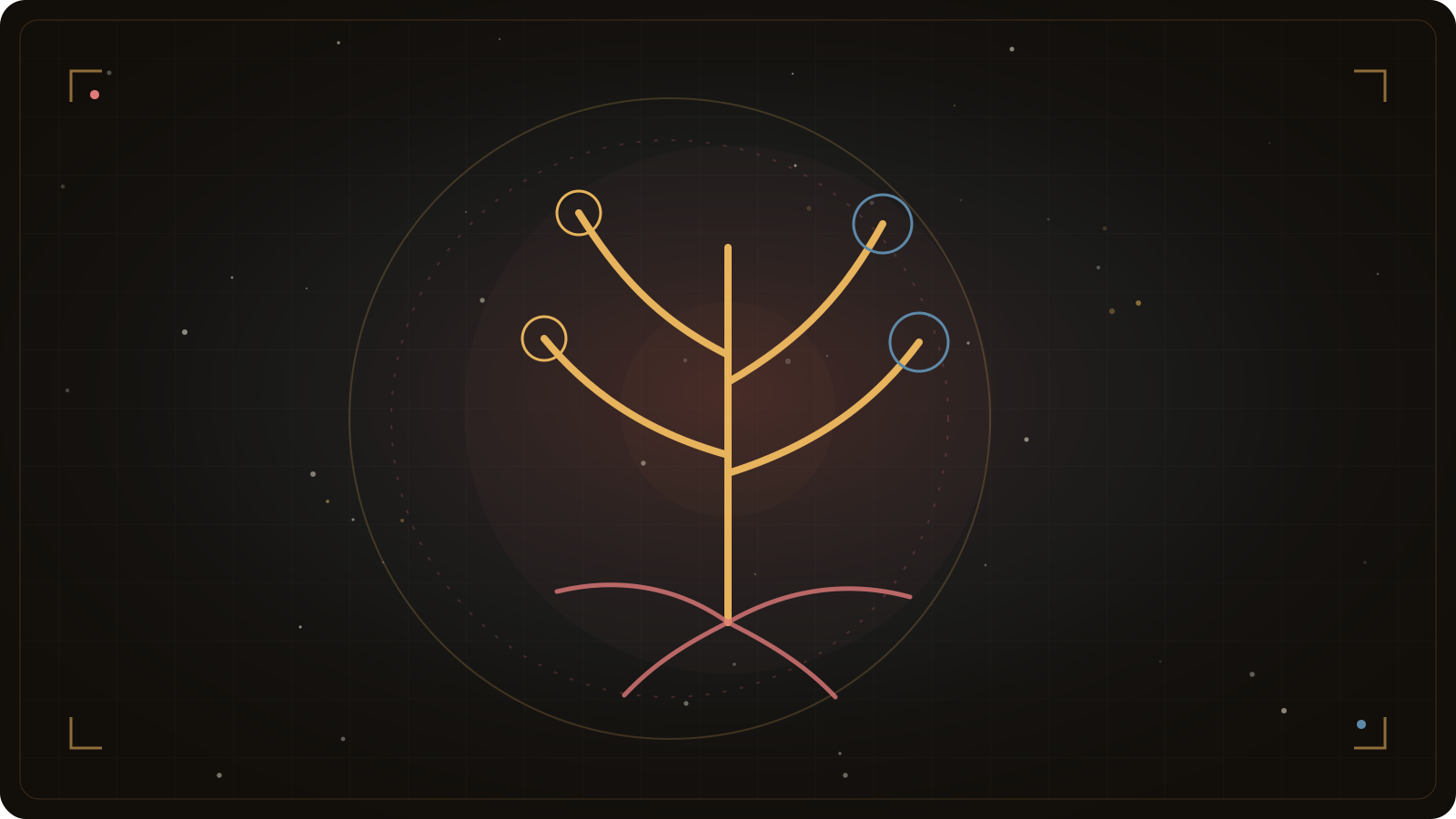
Krishna opens with a very old picture. Look at this world, he says, as an upside-down peepal tree, its roots reaching up and its branches spreading down. That strange tree is the whole of creation. And a single tool exists that can bring it down: the sharpened axe of detachment.
The upside-down tree, roots above
Every tree you have ever seen keeps its roots below, in the soil, and lifts its branches toward the sky. The tree Krishna describes stands inverted. Its root is above, fixed in the supreme being from whom everything flows. From that root the trunk descends: Brahma the creator, who is first to appear when a world begins. From Brahma the branches spread downward into the visible world, and the leaves of the whole tree are the Vedas.
This ashvattha, its root above and its branches below, is called imperishable. Its leaves are the Vedas, and whoever knows this tree for what it is knows the Vedas as well. (Gita 15.1)
Look closer and the branches run in two directions at once, upward toward the worlds of the gods and downward toward humans and every creature below them. The three gunas are the water that feeds it. Its tender shoots are the objects of the senses. And its roots do not stay in one place; they reach into every region, high and low, and one set of them creeps down into human life, where they bind a person to his own actions. Those binding roots have names of their own: the feeling of “I,” the feeling of “mine,” and the buried wants a person carries from one life to the next. They take hold in the human body alone, because only a human being acts with a free hand and reaps exactly what those acts deserve.
Stand beneath this tree and you can make out neither its top nor its end, nor the ground that holds it. It looks solid and permanent, and yet think it through and it will not hold the shape it seems to have. Krishna’s counsel is direct: take the strong axe of detachment and cut the tree at its deep-set root. It is not enough to lop the visible branches, not enough even to sever one’s outward ties to the world. The tree comes down only when a person lets go of “I” and “mine” and the old buried wants, and that is the work the axe is for. Once the root is severed, every branch falls away on its own. Then seek shelter in the primeval person, Narayana, from whom this whole ancient spread has flowed, and having given yourself over to him, dwell on him. Reach that place once and there is no return.
The abode from which there is no return
Krishna gives that abode a description all its own. No light of the sun reaches there, he says, none of the moon, none of fire. It shines by itself, and it is from its light that every other light borrows the power to shine. Whoever arrives there once never falls back into this whirl. That is my supreme abode.
And who arrives? The one who is free of pride and delusion, who has beaten the pull of attachment, who stays settled in the truth within and lets no craving of any kind live on in the mind. Heat and cold, honor and insult, the swing between pleasure and pain, none of these pairs can move such a person. He walks past every one of them untouched and reaches that unshakable home.
Every being a portion of that same one
Now Krishna says something startlingly intimate. The being wandering through this world of the living, he says, is none other than my own eternal portion.
In this world of the living, my own eternal portion lives as the living being. It draws toward itself the five senses that rest in nature, and the mind as the sixth. (Gita 15.7)
Take that in: every creature is a piece of him. A piece only, a small part of the whole, and yet a piece of the same eternal, conscious being, kin to him the way a spark is kin to fire. When this portion takes hold of a body, and again when it lets that body go, it carries the senses and the mind along with it, the way a breeze lifts fragrance from a bed of flowers and sets it down somewhere else. It is the lord of whatever body it wears, master of all its instruments. Through the ears, the eyes, the skin, the tongue, and the nose, this same portion keeps tasting the whole rasa of the world.
Those with delusion’s veil across their eyes never see it arriving, departing, or enjoying, even while it does all three in plain sight of them. Those who open the eye of knowledge recognize it at once. The yogi who works at it, once his mind has been made clean, comes to see this self seated in his own heart. Where the mind stays clouded, effort and years of scripture-reading both fall short, because the self gives itself only to a cleared mind.
Seated in every heart
Then Krishna throws his pervasiveness wide open. The blaze in the sun that lights the entire world, he says, the glow in the moon and in fire, all of it is mine alone. It is I who enter the soil and hold every creature up by my own vital force. I become the moon, full of nectar, and feed every plant and herb that grows. I burn as the digestive fire in every body, joined with the prana and the apana, and I cook the food of all four kinds, whatever a body chews, swallows, licks, or sucks. And the innermost truth he saves for these words.
I am seated in the heart of all. From me alone come memory, knowledge, and the reasoning that clears away doubt. All the Vedas, in the end, are meant for knowing me. I am the source of Vedanta, and the knower of the Vedas too. (Gita 15.15)
The perishable, the imperishable, and the highest person
At the close Krishna opens the distinction that gives this chapter its name. In this world, he says, there are two kinds of person. The first is the kshara, the perishable: the body of every living being, all of matter, everything that keeps changing and dissolving, every name and form. The second is the akshara, the imperishable: the self that dwells inside every body and never alters, that same eternal portion he spoke of before. Beyond both of these stands a third, higher than either, the supreme person, whom people call the supreme self. He has entered all three worlds and holds them up, and he does not perish even when the worlds themselves dissolve.
Because I stand beyond the perishing kshara, Krishna says, and higher even than the undying akshara, the world and the Vedas both know me by the name Purushottama, the highest person. Whoever recognizes me in this form, with a mind cleared of every confusion, has as good as known everything worth knowing, and turns to me with his whole being: his love, his thought, his senses, his work, all of it given over to me.
Then Krishna seals it. This is the most secret teaching I have given you, he tells Arjuna. Take it in to the core, and a person becomes truly wise, and everything a life was meant to accomplish stands accomplished.
Say this chapter in a single breath and it comes to this: the world is an upside-down tree whose true root is above, in that supreme truth, and we are all small portions of that same supreme. Recognize the root, and the tree grows light on its own.
Source: Srimad Bhagavad Gita
Verse by verse
All 20 verses of this chapter, each in a plain English rendering. Every verse has its own link, such as lulla.net/en/bhagwad-gita/15/1/. Read the chapter above first, then come down to the source.
15.1They speak of an imperishable ashvattha tree with its roots above and…
The Blessed Lord said:
They speak of an imperishable ashvattha tree with its roots above and its branches below, whose leaves are the Vedic hymns. One who knows that tree is a knower of the Veda.
15.2Its branches, nourished by the gunas and budding with sense objects, spread…
Its branches, nourished by the gunas and budding with sense objects, spread below and above. Below too its roots stretch on, binding through action in the world of men.
15.3Its form is not perceived here as such, nor its end, nor…
Its form is not perceived here as such, nor its end, nor its beginning, nor its foundation. Having cut down this firmly rooted ashvattha with the strong weapon of nonattachment.
15.4Then that goal must be sought, going to which they do not return again.
Then that goal must be sought, going to which they do not return again. I take refuge in that very primal Purusha, from whom this ancient activity has streamed forth.
15.5Free from pride and delusion, having conquered the fault of attachment, ever…
Free from pride and delusion, having conquered the fault of attachment, ever dwelling in the Self, with desires wholly turned away, released from the pairs of opposites called pleasure and pain, the undeluded reach that imperishable goal.
15.6Neither the sun nor the moon nor fire illumines that place.
Neither the sun nor the moon nor fire illumines that place. Having gone there, they do not return; that is my supreme abode.
15.7The eternal one who has become the individual soul in the world…
The eternal one who has become the individual soul in the world of living beings is a portion of me alone. It draws to itself the mind and the five senses, which rest in prakriti.
15.8When the lord of the body takes on a body and when…
When the lord of the body takes on a body and when he departs from it, he goes taking these with him, as the wind carries fragrances from their source.
15.9Presiding over the ear, the eye, the skin, the tongue, the nose…
Presiding over the ear, the eye, the skin, the tongue, the nose, and the mind, this one enjoys the objects of the senses.
15.10Whether departing, staying, or enjoying, joined with the gunas, the deluded do…
Whether departing, staying, or enjoying, joined with the gunas, the deluded do not perceive him; those with the eye of knowledge see him.
15.11Striving yogis see this one dwelling in the self.
Striving yogis see this one dwelling in the self. Those whose minds are unrefined, lacking discernment, do not see him even though they strive.
15.12The light that dwells in the sun and illumines the whole world…
The light that dwells in the sun and illumines the whole world, the light that is in the moon and in fire, know that light to be mine.
15.13Entering the earth, I sustain all beings with my power.
Entering the earth, I sustain all beings with my power. Becoming the moon, the essence of sap, I nourish all plants.
15.14Becoming the fire of digestion, dwelling in the bodies of living beings…
Becoming the fire of digestion, dwelling in the bodies of living beings, joined with the outgoing and incoming breaths, I digest the four kinds of food.
15.15I am seated in the heart of all, and from me come…
I am seated in the heart of all, and from me come memory, knowledge, and their removal. I alone am to be known through all the Vedas; I am the author of the Vedanta and the knower of the Veda.
15.16There are these two Purushas in the world, the perishable and the imperishable.
There are these two Purushas in the world, the perishable and the imperishable. All beings are the perishable; the one who stands unchanging is called the imperishable.
15.17The supreme Purusha is yet another, called the Paramatma, the imperishable Lord…
The supreme Purusha is yet another, called the Paramatma, the imperishable Lord who enters the three worlds and sustains them.
15.18Because I transcend the perishable and am higher even than the imperishable…
Because I transcend the perishable and am higher even than the imperishable, I am celebrated in the world and in the Veda as Purushottama, the supreme person.
15.19One who, undeluded, knows me thus as the supreme person knows all…
One who, undeluded, knows me thus as the supreme person knows all, and he worships me with his whole being, Bharata.
15.20Thus has this most secret teaching been declared by me, sinless one.
Thus has this most secret teaching been declared by me, sinless one. Knowing this, one becomes wise and has fulfilled all that is to be done, Bharata.