On this page
Janaka’s messengers are still speaking before Vasishtha. In Janaka’s city, they say, everyone went mad with grief on hearing of Dasharatha’s end. Whoever saw Videha at that time did not feel his name to be true. The king, they say, sent four quick-witted spies to Ayodhya to learn Bharata’s feeling, good or ill. He set out, they say, after the spies told of Bharata’s deeds. When Janaka comes, Rama leads the army on toward the sea of the hermitage, as if it were a river of compassion.
In this episode of the Ramcharitmanas the messengers tell how the king set out at an auspicious hour and bathed at Prayaga this very morning. They say everyone began to cross the Yamuna, and he sent them for news. At the news of his coming the company of Ayodhya is glad, Rama is greatly embarrassed, and Indra is wholly in the power of worry. Crooked Kaikeyi melts in self-reproach. At dawn the men and women of Ayodhya worship and entreat Vishnu that Rama be king and Sita queen. They ask for death in Ayodhya while Rama is king. Each has the sight of Rama in his own way, and all praise their own fortune. Janaka sees the great hill, salutes, and leaves his chariot. The two companies meet with respect, and Rama leads the king on. The river of compassion drowns the banks of knowledge and dispassion. In both royal companies knowledge, patience, and shame do not stay, and all weep. Men and women ask in anger what the perverse Creator has done. At the sight of Videha’s state, none of the gods, siddhas, ascetics, yogis, and sages can cross the river of love. Vasishtha asks Janaka to hold patience. That day passes without water, and at dawn everyone sits under the banyan tree, their minds soiled and their bodies thin.
Mithila’s company comes to Chitrakuta
The main figures in this episode
- Janaka the king of Mithila, whose city, as his messengers tell it, goes mad with grief at the word of Dasharatha’s end. They say he sent four spies to Ayodhya, set guards over house, city, and land, and set out at an auspicious hour, taking no rest on the road. At the sight of the great hill he salutes and leaves his chariot. He bows at the sages’ feet, and Rama leads him and his company on. Gods, siddhas, ascetics, yogis, and sages who see his state cannot cross the river of love. Vasishtha tells him to hold patience and consoles him in many ways. His knowledge is a sun that destroys the night of becoming. At dawn he bathes and sits under the banyan tree.
- Rama who is greatly embarrassed at the news of Janaka’s coming. He honors the townspeople with care, each of whom has the sight of him in his own way, and they say he knows them as his own. When he hears that Janaka is coming, he rises in haste with the council and goes ahead with his brothers, the ministers, the guru, and the townspeople. He salutes the rishis, meets Janaka with his brothers, and leads the king and his company on. At dawn he bathes with Janaka and sits under the banyan tree.
- Vasishtha the guru, who sends Janaka’s messengers off at once with six or seven Kiratas for company. When both companies are plunged in grief, he says to Janaka, “Do hold patience, king.” He consoles Janaka in many ways.
- Shatananda who, in the commentary’s reading, is one of the rishis from Janakpur that Rama salutes when the two companies meet.
- The people of Ayodhya who are glad at the news of Janaka’s coming and bring it into their minds that they will stay four days more. At dawn they bathe, worship Ganesha, Parvati, Shiva, and the sun, and entreat Vishnu for Rama as king, Sita as queen, and Bharata as crown prince. Each asks that death may come in Ayodhya while Rama is king. Doing their daily rites, they salute Rama with thrilling bodies and praise their own fortune. They go ahead with Rama when Janaka is coming.
- The messengers from Mithila who finish their account before Vasishtha. They tell of the grief in Janaka’s city, of the spies sent to Ayodhya, and of the king’s preparations and his march. They say the king sent them for news. They bow their heads to the ground, and the chief sage sends them off at once.
The news reaches Janaka’s city
The messengers went on. “Hearing of the lord of Kosala’s end, all the people of Janaka’s city went mad in the power of grief. Whoever saw Videha at that time did not feel his name to be true.” The commentary takes the name Videha to mean one free of the body’s pride, and asks what grief such a man could feel.
The messengers went on. “Hearing of the queen’s ill deeds, the king could see nothing, like a snake without its jewel. Bharata’s rule, and Rama’s dwelling in the forest. Dismay came into Janaka’s heart.”
“The king asked the company of the learned and the ministers to say, considering it, what was right that day. Understanding Ayodhya’s twofold fix, no one said anything, whether to go or to stay. Holding patience and considering in his heart, the king sent four quick-witted spies to Ayodhya. Finding out Bharata’s feeling, good or ill, they were to come back quickly, and no one was to see them.”
“The spies went to Ayodhya, learning Bharata’s way and seeing his deeds. Bharata set out for Chitrakuta, and the spies set out for Mithila.”
The king is on the road
The messengers went on. “Arriving, the spies told Janaka’s court of Bharata’s deeds, as far as their wits allowed. Hearing it, the guru, the family, the ministers, and the king all became utterly distraught with worry and love.”
“Holding patience and praising Bharata, the king called good warriors and stable-masters. Setting guards over house, city, and land, he made ready horses, elephants, chariots, and many carriages.”
“Fixing an auspicious hour, he set out at once. The king took no rest on the road. Bathing at Prayaga this very morning, he moved on. Everyone began to cross the Yamuna, and he sent us to take news, master.” Saying so, they bowed their heads to the ground. The chief sage gave them six or seven Kiratas for company and sent the envoys off at once.
Hearing of Janaka’s coming, all the company of Ayodhya was glad. Rama was greatly embarrassed, and Indra was wholly in the power of worry.
Ayodhya at its morning worship
Crooked Kaikeyi melted in self-reproach. To whom could she speak, and whom could she blame? Bringing it into their minds that they would stay four days more, the men and women were glad.
In this way that day too passed. At dawn everyone began to bathe. After bathing, the men and women worshiped Ganesha, Parvati, Shiva, and the sun.
Afterwards, bowing at Vishnu’s feet and joining their cupped palms and the hems of their garments, they entreated. “Let Rama be king and Sita queen, and the capital Ayodhya the utmost of joy. Let it dwell in ease again with its company, and let Rama make Bharata crown prince. Watering everyone with the nectar of this happiness, lord, give the gain of living in the world.”
“Let Rama’s rule be in the city, with the guru, the company, and his brothers. While Rama is king, may one die in Ayodhya.” Everyone asked for this.
The townspeople praise Rama, and their own fortune
Hearing the townspeople’s speech full of love, the sages, men of knowledge, disparaged yoga and dispassion. In this way, doing their daily rites, the townspeople saluted Rama, their bodies thrilling.
High, low, and middling, men and women, each had the sight of him in his own way. With care he honored everyone, and everyone praised Rama.
“From boyhood it has been Rama’s habit to keep policy, knowing love. Rama is the sea of good conduct and reserve, beautiful of face and of eye, simple by nature.” The commentary gives the two words of face and eye a second sense as well: favorable to everyone, and looking on everyone with grace and love.
Speaking of his virtues, they were full of love, and they began to praise their own fortune. “In the world there are few such heaps of merit as we, whom Rama knows as his own.”
At that time everyone was absorbed in love. Hearing that Janaka was coming, Rama rose in haste with the council.
The chariot left at the sight of the great hill
With his brothers, the ministers, the guru, and the townspeople, Rama went ahead. The moment Janaka saw the great hill, saluting, he left his chariot.
There was longing and eagerness for the sight of Rama. No one had a trace of the road’s weariness or affliction. The mind was there where Rama and Sita were. Without the mind, who is aware of the body’s pain or pleasure?
In this way Janaka came on with his company, their wits drunk with love. Seeing them come near, they were full of love and began to meet one another with respect.
Janaka began to bow at the sages’ feet, and Rama saluted the rishis. The commentary takes the sages to be Vasishtha and the others from Ayodhya, and the rishis to be Shatananda and the others from Janakpur. Meeting the king, Rama with his brothers led him on, together with his company.
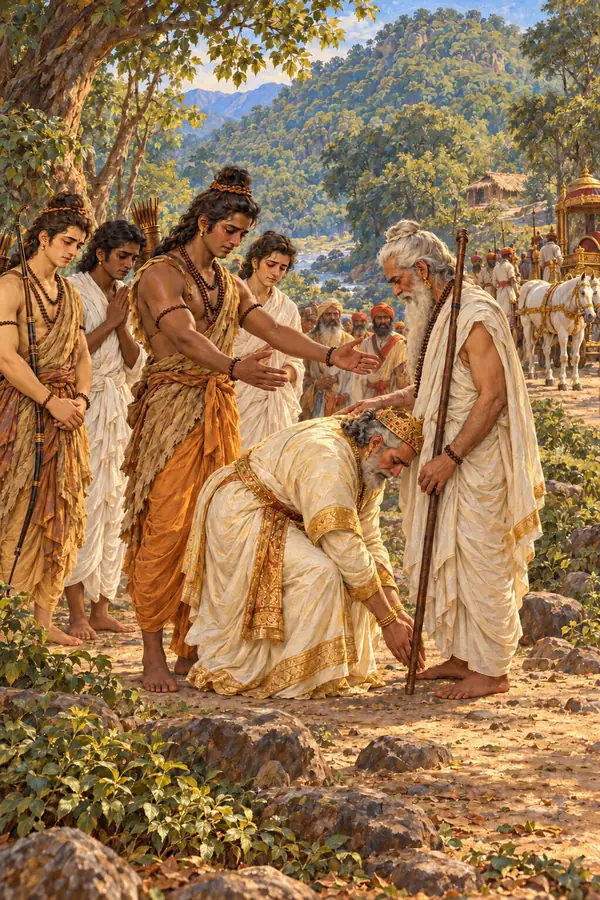
The hermitage was a sea, full of the holy water of the rasa of peace. Rama was leading the army on, as if it were a river of compassion. The commentary reads him as leading it to merge in that sea.
The river of compassion drowns its banks
The river drowned the banks of knowledge and dispassion. Words full of grief were the streams and brooks that met it. The sighs of worry were the wind and the waves, and they broke the fine trees on the bank of patience.
Cruel grief was its swift current. Fear and confusion were its boundless whirlpools and eddies. The learned were the boatmen, and learning was the big boat. They could not row it, and none of them had the knack.
The poor Kols and Kiratas who roam the forest were the travelers, weary and beaten in heart at looking on it. When the river went and met the sea of the hermitage, it was as if the sea rose in turmoil.
Both royal companies were distraught with grief. Knowledge, patience, and shame did not stay. Praising the king’s form, virtues, and good conduct, they wept, plunged in the sea of grief. The commentary takes the king to be Dasharatha.
Who could cross the river of love at the sight of Videha?
Plunged in the sea of grief, men and women, greatly distraught, worried. Laying blame, all of them said in anger, “What has the perverse Creator done?” At the sight of Videha’s state, none of the gods, siddhas, ascetics, yogis, and sages was able to cross the river of love. The commentary gives this line to Tulsi.
The chief sages gave teaching without measure to the people here and there. Vasishtha said to Videha, “Do hold patience, king.”
Janaka’s knowledge, and the greatness of love
Janaka’s knowledge is a sun that destroys the night of becoming. His words are rays, and the sages are the lotuses they open. Can delusion and attachment come near him? This is the greatness of Sita’s and Rama’s love. In the commentary’s reading Janaka’s state came of Sita’s and Rama’s unworldly love, which shows its power even on those who have crossed worldly delusion and attachment.
The worldly, the seekers, and the clever siddhas are the three kinds of beings the Veda tells of in the world. The one whose mind is steeped in Rama’s love has great honor in the assembly of sadhus.
Without love for Rama, knowledge does not shine, like a ship without a helmsman. The sage consoled Janaka in many ways.
The day that passed without water
All the people bathed at Rama’s ghat. The men and women were full of grief, every one of them. That day passed without water.
Beasts, birds, and deer took no food. Of the dear kinsfolk, what is there to think?
Both companies, with Janaka and Rama, bathed at dawn. All sat under the banyan tree, their minds soiled and their bodies thin.
Two companies under the banyan tree
The messengers finished their report to Vasishtha. They told of Janaka’s city gone mad at the news of Dasharatha’s end. They told of a king whose name no longer seemed true to those who saw him. They said he had heard of the queen’s ill deeds and could see nothing. No one in his council would say whether to go or to stay, they said. They told how he had sent four quick-witted spies to find out Bharata’s feeling, good or ill.
When the spies told of Bharata’s deeds, they said, the court was distraught with worry and love. The king had praised Bharata, called his warriors and stable-masters, and had guards set over house, city, and land. He had set out at an auspicious hour, taken no rest, bathed at Prayaga that morning, and sent them to take news. Vasishtha gave the envoys Kiratas for company and sent them off at once.
Ayodhya’s company was glad at the news, Rama was embarrassed, and Indra worried. Kaikeyi melted in self-reproach, and the men and women were glad at the thought of four days more. After bathing at dawn they worshiped, and they entreated Vishnu that Rama might be king, Sita queen, and Bharata crown prince. They asked that death might come in Ayodhya while Rama was king.
The sages, men of knowledge, heard the townspeople and disparaged yoga and dispassion. High, low, and middling, each had Rama’s sight in his own way, and he honored everyone with care. Speaking of Rama’s virtues, the people praised their own fortune and said that Rama knew them as his own.
Rama rose at the news that Janaka was coming, and he went ahead with his brothers and the townspeople. Janaka saw the great hill, saluted, and left his chariot. The two companies met with respect. Janaka bowed to the sages, and Rama saluted the rishis. Rama and his brothers met the king and led his company on.
The two royal companies were distraught with grief. They praised the form, virtues, and good conduct of the king, Dasharatha in the commentary’s reading, and wept. Men and women laid the blame and asked in anger what the perverse Creator had done. The chief sages taught the people here and there. Vasishtha told Janaka to hold patience and consoled him in many ways, and everyone bathed at Rama’s ghat. That day passed without water, and the beasts, birds, and deer went without food. At dawn both companies bathed and sat under the banyan with soiled minds and thin bodies.
Source: the Gita Press edition of Tulsidas’s Ramcharitmanas, Ayodhyakand, doha 271 to 277, read with Hanuman Prasad Poddar’s Hindi commentary.